Film Festivals & Short Film Evenings in Munich
Film Festivals & Short Film Evenings in Munich (Preview)
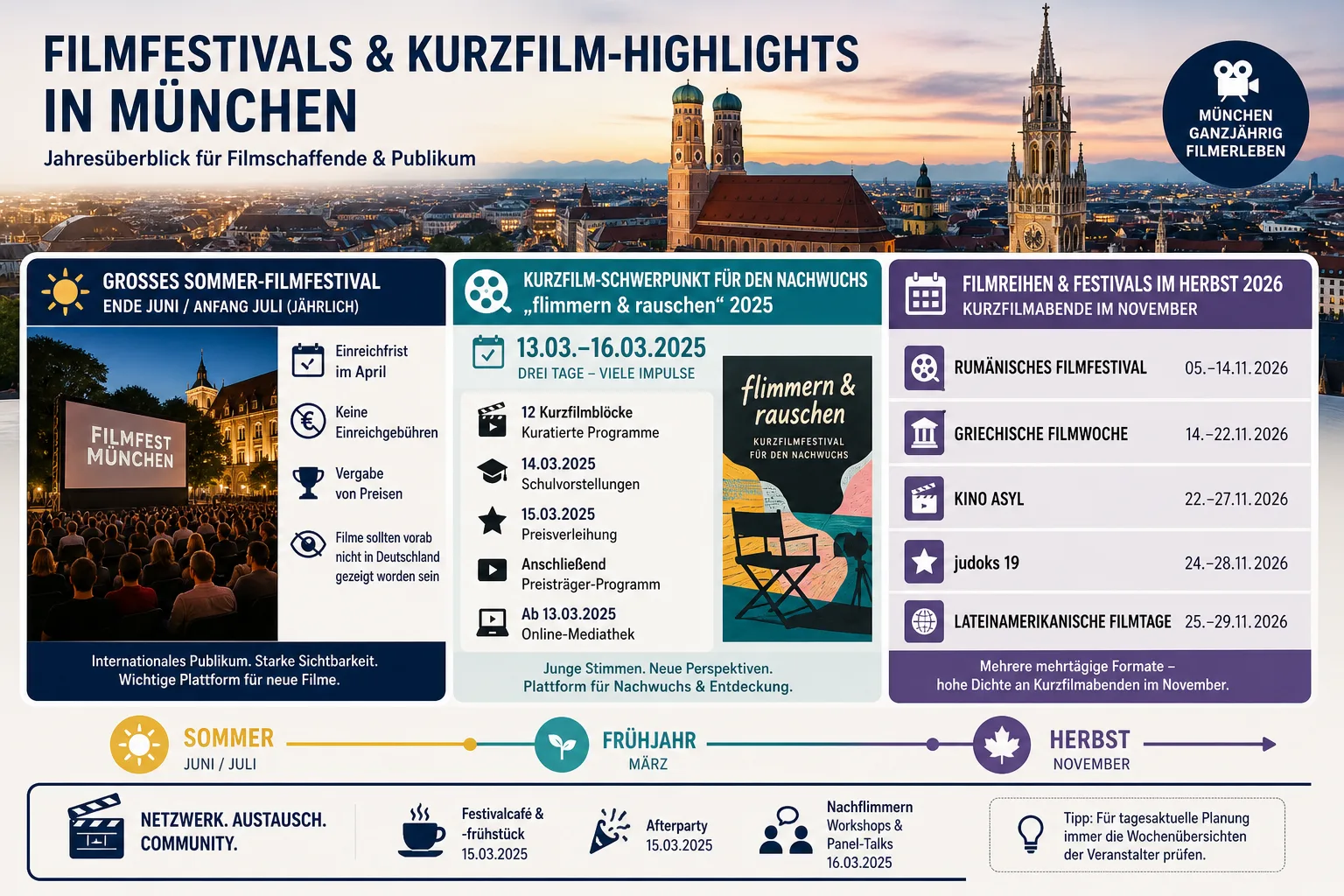
Munich will remain one of the most exciting film cities in the German-speaking world in the coming months and years: From a major international summer festival to an established up-and-coming short film festival and thematic film series in the fall, a calendar is created that brings together filmmakers, cinephiles, and curious visitors.
Important: Dates, submission deadlines, and program sections are published anew each year. This overview describes the typical timeframes and processes so you can plan ahead early.
Summer in Munich: The Major International Film Festival
The international summer festival is traditionally the most visible anchor point in Munich's film calendar. It combines premieres, curated series, conversations with filmmakers, and an urban audience that consciously embraces new perspectives. For many, it is the moment of the year when Munich is perceived especially strongly as a place for film and debate.
What you can typically expect
- International feature and documentary films with a thematic or curatorial focus.
- Talks, Q&As, and panels that contextualize individual programs.
- Industry meetings and networking, provided the annual program includes such formats.
For visitors
If you experience the festival as an audience member, it is worth taking an early look at the program: Popular screenings are often quickly sold out, and side series can be just as exciting as the big titles. Also, plan time for introductions or discussions, as the strongest impressions often arise there.
Focus on Newcomers: Short Film Festival "flimmern & rauschen"
In Munich's spring, the short film festival "flimmern & rauschen" traditionally focuses on newcomers, educational contexts, and regional film scenes. Typical for the format is a concentrated festival duration with curated short film blocks and accompanying community and learning formats.
Formats you are likely to find again
- Curated short film programs in several blocks (often organized by themes, genres, or target groups).
- Mediation offers such as school screenings or moderated programs that promote media literacy and film discussions.
- Festival meeting points (e.g., café/networking formats) for exchange between audience, filmmakers, and the scene.
- Workshops & talks on practical questions (screenwriting, production, technology, festival strategy), depending on the respective annual program.
Why this is so valuable for up-and-coming filmmakers
Especially for first-time festival participants, a short film festival is a realistic training ground: Submission documents, screening formats, Q&A situations, and networking can be experienced in a manageable setting. Those who want to aim for larger festivals in the future can build routine here—without the pressure of a purely industry-driven environment.
Autumn Density: Thematic Film Series & Short Film Evenings
In autumn, Munich's cinema culture often condenses into a series of thematic festivals, film weeks, and program tracks—often with individual evenings where short film blocks or short film specials take place within a larger series format.
Typical focuses in late autumn
Depending on the organizer and year, the Munich calendar may include:
- Country and community film weeks (e.g., Greek, Romanian, or Latin American film programs).
- Documentary and debate series with a socio-political focus.
- Initiative programs that understand cinema as a meeting space (e.g., with moderated screenings and discussions).
How to cleverly plan short film evenings
- Check program windows: Short film blocks often take place only on individual evenings within a longer festival period.
- Note ticket model: Some evenings are free of charge, others have regular cinema or festival prices; details are provided by the organizer.
- Decide early: Highly sought-after themed evenings are often sold out faster than regular screenings.
In terms of content, short films are particularly strong in these series: They bundle many perspectives in one evening, allow for formal experiments, and create space for voices that are less visible in regular cinema releases.
For Filmmakers: Deadlines, Requirements, Awards
If you are submitting yourself, three levers determine whether your festival year will be plannable: Deadlines, Requirements, and Awards. Even though details vary by festival, the mechanics are usually similar.
1) Deadlines: Plan production and post-production backwards
- Spring as a key phase: Many summer festivals have submission windows in spring.
- Build in buffers: Plan time for export, subtitles, viewing link, stills, press text, and if necessary, music rights/archive material.
- Calendar discipline: Create a fixed deadline checklist for each target festival (final cut, sound mix, DCP/file format, subtitle versions).
2) Requirements: Technology, rights, premiere rules
- Technical specifications: Runtimes, file formats, sound formats, and subtitle requirements differ—the respective call for entries is always binding.
- Rights & proofs: Many festivals expect that screening rights, music rights, and, if applicable, archive approvals are clarified.
- Premiere status: If a festival prefers or requires premieres, this will influence your order of screenings and online releases.
3) Awards: More than just trophies
Festival awards (jury or audience prizes, newcomer or special categories) are often a lever for visibility: They make press work easier, improve pitch documents, and increase the chance of further invitations. Which awards are given is stated in the annual program info.
How to Find Your Place in Munich's Film Scene
Whether you live in Munich or travel for a festival: You can connect with the scene in different ways—as an audience member, filmmaker, or culture enthusiast.
Recommendations by goal
- If you are curious: Deliberately choose a short film block (spring or autumn). The variety per evening makes it easy to get started.
- If you are studying or submitting for the first time: Use workshops, Q&As, and networking formats to gather feedback and initiate collaborations.
- If you work professionally: Plan the summer festival period long-term, watch for submission windows in spring, and have press assets ready early.
- If you are looking for debates & perspectives: Focus on thematic series in autumn that integrate discussions and context more strongly into the evening.
Common to all these paths: Munich continually reinvents itself through film—as a city where a short film evening is not just a program, but an encounter, exchange, and an entry into long-term creative networks.