Discover Improv Theater & Performance Scene in Munich
Improv Theater & Performance Art in Munich: Discover the Alternative Scene for the Coming Months
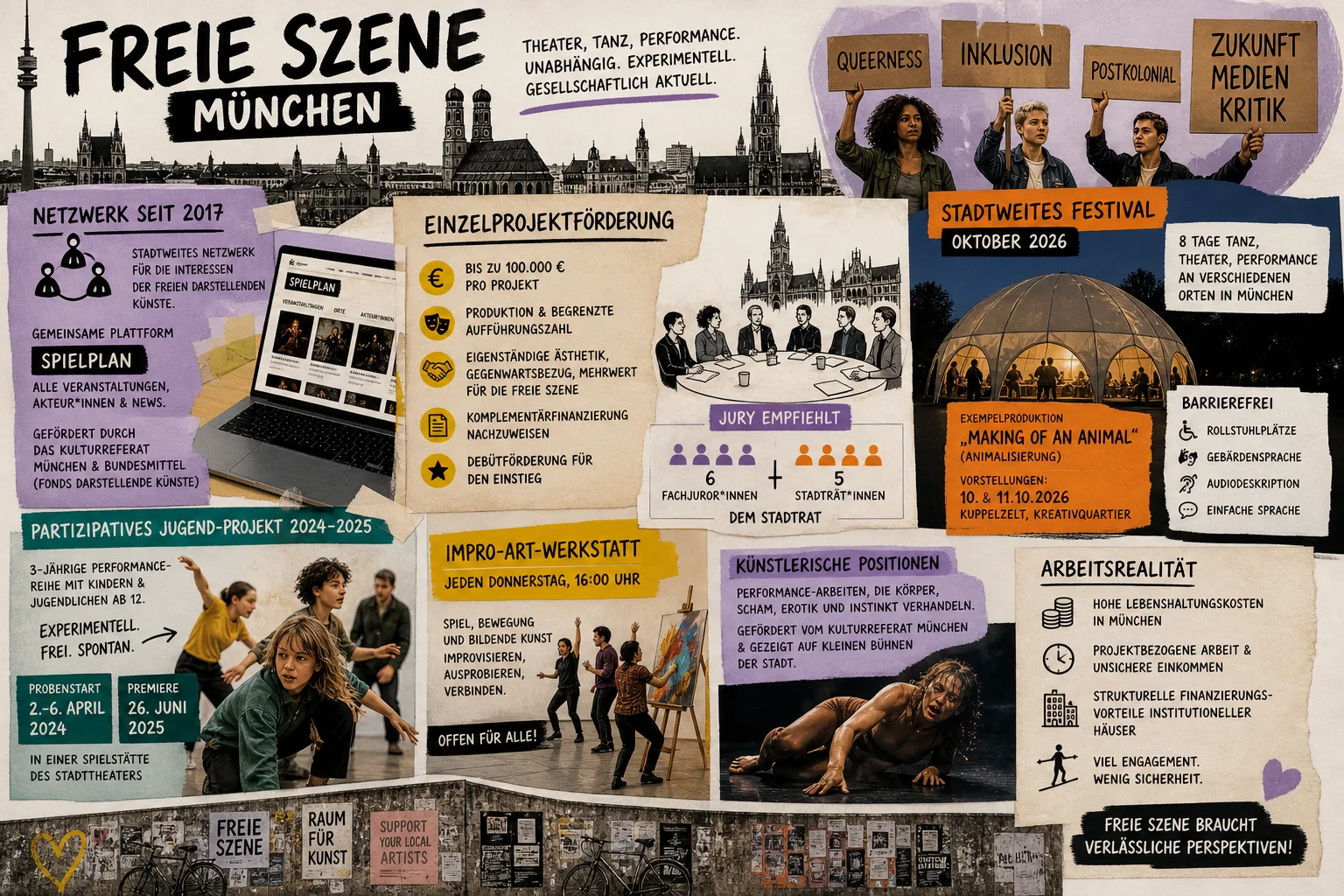
Munich is often associated with grand stages and prestigious venues. In the coming months, it is especially worthwhile to take a look at the independent performance and improv scene: new formats are emerging in project spaces, studios, temporary venues, and interdisciplinary settings—often close to current debates, easily accessible, and artistically bold.
Profile of the Independent Performance Scene: Themes, Aesthetics, Attitudes
In the upcoming season, independent performing arts in Munich will likely continue to be characterized by three things: a spirit of experimentation, interdisciplinary working methods, and a strong focus on the present. Instead of fixed genres, many productions bring together theater, dance, sound, video, installation, and audience situations.
In terms of content, the coming months will especially feature topics that lend themselves well to performative formats because they can be negotiated physically, dialogically, and situationally:
- Queer Perspectives & Gender Issues (identity, body politics, role models, language).
- Inclusion & Access (more accessible formats, diverse casts, new audience models).
- Postcolonial & Memory Politics Issues (power relations, archives, urban history).
- Digital Life Worlds (social media, AI/automation as a topic and as an aesthetic).
For visitors, this means: Those who attend improv or performance evenings in the future will not only see "plays," but often experimental setups, laboratories, and situations that are deliberately left open. This very openness is a strength of the scene—it enables quick responses to social developments without the long lead times of large institutions.
Orientation: How to Find Schedules, Venues, and Formats in the Future
To reliably find what you're looking for in the coming weeks and months, a pragmatic search strategy is worthwhile. In the independent scene, programs often emerge more spontaneously than at major venues; however, information is usually easy to find digitally.
1) Official and Curated Overviews First
- Municipal Culture Pages & Funding Portals provide information about which actors are currently visible and which focal points are being set.
- Professional Associations and Umbrella Organizations compile announcements, industry standards, and sometimes event information in the field of independent performing arts.
2) Then to Practice: Newsletters, Socials, Ticketing
- Newsletters from venues and collectives are usually the fastest way to find out about short-term dates.
- Ticketing platforms and municipal event calendars are suitable for filtering "today/this week."
- Social media is often the primary real-time medium in the scene (program changes, additional dates, cancellations).
Tip for planning: If you are exploring performance art for the first time, set yourself a clear goal to start with (e.g., "an improv show" or "an interdisciplinary evening") and then increase the complexity. This way, curiosity quickly turns into routine—without being overwhelming.
Festivals & Series: What You Can Expect Next Season
In Munich, festival formats and thematic series will continue to be the most important "entry windows" into the independent scene: they bring together many artistic voices in a short time, provide orientation, and increase the chance of discovering new favorite places.
What you can typically expect in the coming season:
- Condensed festival weeks with performance, dance, theater, and discourse formats (talks, audience discussions, introductions).
- Thematic series on topics such as body, technology, city, memory, or care.
- Cooperations between the independent scene and institutions (guest performances, co-productions, outreach formats).
When making your selection, pay attention to accessibility: Many organizers will communicate even more transparently in the future whether, for example, there are accessible entrances, relaxed performances, surtitles, audio description, or accompanying formats. This information is a good quality indicator for audience orientation.
Improv in Munich: Participate, Watch, Move On
In the coming months, improvisation will likely remain one of the most low-threshold ways to access the scene. Improv can work both as a full-length show and as a workshop or lab format that combines movement, text, sound, and image.
If you want to watch
- First choose clear formats (e.g., games, scenes, musical improv) before you go to open performance labs.
- Go in with a question: What is decided live? Where does closeness arise? How does the audience react?
- Stay for a conversation if one is offered—improv often explains itself in the exchange afterwards.
If you want to participate
- Start with beginner courses that teach clear rules (status, offer/acceptance, timing, space).
- Try open trainings once you have some routine; this is often where you make contact with collectives and projects.
- Pay attention to safeguarding: Good formats communicate boundaries, consent practices, and respectful interaction.
The added value for the urban community will be especially noticeable in the future where improv is not just entertainment, but a social space: people meet through language, body, and play—and in the process develop skills such as listening, presence, collaboration, and tolerance of ambiguity.
Funding & Professionalization: How New Productions Become Possible
Whether an independent production can be realized in Munich in the coming months usually depends on a mix of funding, cooperation, own resources, and paid work in other contexts. Municipal and nationwide programs for the independent performing arts are particularly relevant.
As a rule, funding lines define clear criteria (professionalism, artistic independence, relevance to the present, feasibility, budget logic, possibly sustainability and accessibility). Many programs also require comprehensible financing plans and transparent fee calculations.
What is interesting for you as an audience member
- Program notes such as "funded by ..." are more than logos: they show which structures currently enable the scene to act.
- Co-productions indicate networks—and that a work may also be seen in other cities.
- Residencies and development formats often lead to showings or try-outs; these are good opportunities to experience processes.
Those who want to work professionally themselves will also find important framework information in Germany, for example from professional associations and social security systems (e.g., Künstlersozialkasse)—especially regarding insurance, fees, and work reality.
Work Reality: Why Precarity Remains a Topic for the Future
In a city with high living costs, the independent scene will continue to have to deal with structural tensions: temporary rehearsal spaces, changing funding, short production periods, and a high proportion of unpaid coordination work are risks that can only be solved to a limited extent without longer-term structures.
At the same time, this very situation is often a driver for aesthetic innovation: when teams have to remain flexible, formats emerge that achieve great impact with small means—through clever audience guidance, strong body work, precise sound design, or new forms of participation.
For the coming months, it is therefore realistic that you will find both very "finished" evenings and deliberately process-oriented formats. Both are part of the same ecology: presentation and research, premiere and laboratory, stage work and outreach.
What the Scene Offers the Audience: Concrete Visiting Strategies
If you want to get to know Munich beyond the classic cultural paths in the near future, the independent performance and improv scene is a direct access: you not only see results, but often also how city, zeitgeist, and life realities are translated into artistic decisions.
Practical Strategies for Your Next Visit
- Plan with buffer time: Independent venues start on time, but entry/space situations may be different from classical theaters.
- Read the format description: In performance, "what happens" is often part of the dramaturgy (interaction, free choice of seats, movement in the space).
- Choose consciously: If a topic touches you (e.g., body, trauma, sexuality), check content notes/trigger warnings if available.
- Use conversation formats: Audience discussions and introductions increase understanding and appreciation—especially for experimental works.
This way, a single evening becomes a sustainable discovery: you gradually build a personal map of the scene—with places, collectives, aesthetics, and conversation spaces to which you return.