Street Music & Spontaneous Concerts in Munich
Street Music & Spontaneous Concerts in Munich (from now on): What You Need to Know for Future Performances
If you want to perform music in public spaces in Munich in the coming weeks or months, you'll quickly find out: much seems spontaneous – but is actually clearly regulated. This guide explains in simple terms what counts as street music or as an "event" for future spontaneous concerts, which areas in the city center require a permit, what the usual rules are (location changes, times, volume), and how to avoid trouble – as a musician, organizer, or visitor.
City Center & Old Town Pedestrian Zone: Future Performances with Permission
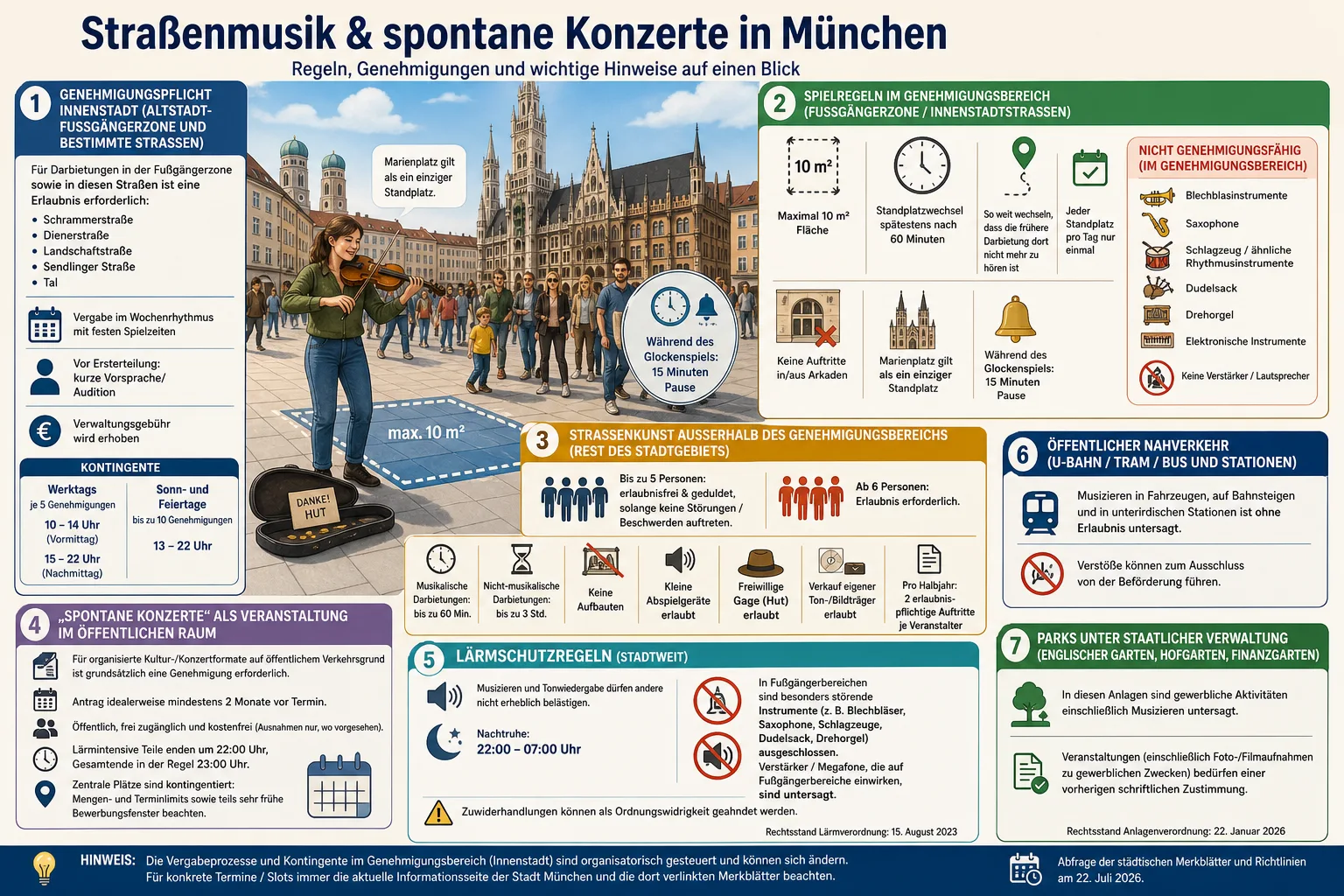
If you want to perform in Munich's city center soon, the most important difference is: In certain streets (especially in the Old Town pedestrian zone), future street music performances regularly require a permit/authorization. The city uses this to control how many acts play at the same time and how well music, commerce, tourism, and resident protection can be reconciled.
Typical Permit-Required Areas
For planned performances in the city center, you should check in advance whether your location is in a street that requires a permit. Frequently mentioned are, among others:
- Old Town pedestrian zone
- Sendlinger Straße
- Tal
- other adjacent streets in the city center (depending on current regulations)
The current municipal regulation/information for the period of your planned performance is always decisive (see sources below).
Slots, Playing Times, and Quotas (Relevant for the Future)
In permit-required areas, the city typically works with time slots (e.g., morning/afternoon) and limited quotas per time slot. This ensures that not too many performances take place in parallel in the future and that visitors can actually perceive individual acts.
Interview/Audition & Fee
Depending on the procedure, a short interview may be required before the first permit is issued to check whether the performance fits the public space (e.g., volume, instrumentation, feasibility without amplifier). Administrative fees may apply for a permit.
Rules in the City: Area, Change, Marienplatz & Glockenspiel Break
If you play in heavily frequented city center areas in the future, you share the space with gastronomy, delivery traffic, pedestrian flows, city tours, and residents. Therefore, there are often specific rules that you should follow in your own interest.
Performance Area, Location Choice, and Change
- Limited performance area: For street music in the city center, a maximum area is often specified (so that paths remain clear).
- Location free – but considerate: Entrances, emergency routes, stands, and other performances must not be blocked.
- Regular location change: After a certain time (often up to 60 minutes), a change is required so that the place is not continuously filled with sound.
- Distance from the last location: The next spot should be chosen so that the previous performance is no longer clearly audible there.
- Not the same spot all day: Many rules prevent a hotspot from being played by the same acts all day.
Marienplatz & the Mandatory Glockenspiel Break
For future performances at Marienplatz, a special feature is relevant: During the town hall Glockenspiel, a short break for street music is usually required (often about 15 minutes). Plan your setlist and breaks so that you can easily comply with this interruption.
Instruments & Volume: What Typically Doesn't Work for Future Performances
The Munich city center usually relies on acoustic, moderately loud performances for street music. For the future, this means: Certain instruments or setups are often excluded or only possible under strict conditions in sensitive areas.
Often Prohibited or Heavily Restricted
- Amplifiers (even small amps) and generally electric sound reinforcement, if they clearly "take over" the public space
- Especially loud instruments (e.g., certain brass instruments, saxophones)
- Drums and similarly penetrating rhythm instruments
- Bagpipes and other very far-carrying sound sources
- Barrel organs in sensitive pedestrian areas (depending on current regulations)
Why This Is Important
These restrictions for future performances are not "anti-culture," but practical noise and conflict prevention: Acoustic sets can be better integrated into a densely used urban space and less often lead to complaints or police action.
Arcades & Sound: An Underestimated Point
For upcoming performances, it often applies: Playing in or from arcades is not allowed or at least viewed critically, because arcades can bundle sound and carry it into courtyards or residential areas.
Outside the Old Town: More Leeway, but Clear Limits
If you play outside the strictly regulated city center in the coming days or weeks, the situation is often more relaxed. Nevertheless: "No permit required" does not mean "no rules."
Small Ensembles & Consideration as a Basic Principle
In the rest of the city, smaller performances (e.g., solo/duo/trio) are often tolerated in practice as long as no one is significantly disturbed and paths remain clear. As soon as an action takes on the character of a planned event (e.g., large audience, technology, promotion), you should treat it as an event.
Time Limit & Movement in the Cityscape
For future street music performances, time limits (often around 60 minutes per location) are common. They are intended to prevent a place from being continuously filled with sound and help you avoid conflicts.
"Hat" Yes – Event Operation No
For upcoming performances, the rule is usually: A voluntary hat for donations is possible in many constellations. What quickly turns the situation into an "event" are larger setups, intensive promotion, or a technical production (see next section).
When "Spontaneous" Becomes Official: Concert as an Event in Public Space
Decisive for the future: A "spontaneous concert" is no longer legally street music as soon as it takes on the character of an event in public space. Then different requirements apply (application, safety issues, noise, traffic areas).
Typical Features That Suggest an Event in the Future
- Sound or lighting technology clearly aimed at an audience
- Platform/stage, barriers, defined audience area
- Targeted promotion (flyers, posters, social media call with meeting point and time)
- Expectation of a larger standing audience
- Supporting program, stands, cooperations
Planning Logic for Upcoming Dates
- Clarify early: If you are planning a concert in public traffic areas, expect lead time (in practice often several weeks to months, depending on location and scope).
- Public & safe: Many approved cultural actions are freely accessible; additional requirements may apply for safety, emergency routes, and noise.
- Observe end times: Noisy parts should generally end by 10:00 p.m.; later overall ends are only possible within the framework of the requirements.
Important: This article does not replace official individual advice. For your specific date and location, the current information sheets and notices from the responsible authorities apply.
Invisible Guardrails: Night Rest, Parks, Public Transport
Night Rest & "Significant Disturbance"
For all future performances in Munich: Music must not significantly disturb others. Particularly relevant is the night rest (typically: 10:00 p.m. to 7:00 a.m.). If you play in the evening, plan your set, volume, and breakdown so that night rest is observed.
Public Transport: No Stage in Subway, Tram, and Bus
If you want to play in vehicles or facilities of public transport in the future, you usually need explicit permission from the operator. Without consent, music-making can be prohibited and lead to measures (e.g., house rules).
State Parks: English Garden, Hofgarten & Co.
For upcoming performances in large parks that are not municipally but state-managed (e.g., English Garden, Hofgarten), particularly strict rules often apply. Commercial activities and events are often only permitted with prior approval. If you are planning something there, check the requirements of the responsible administration in advance.
Practical Checklist for Your Next Performance in Munich
- Choose location: Is the spot in a permit-required city center area?
- Classify format: Street music (small, no technology) or event (audience, promotion, technology, setup)?
- Plan set technically appropriately: Acoustic instead of amplifier; choose instrumentation compatible with the rules.
- Consider time slots: Plan for location change rules; respect night rest in the evening.
- Respect in the space: Keep entrances, emergency routes, delivery zones clear; do not use arcades if prohibited.
- Have a plan B: If a location leads to conflicts, move early – this is usually the best de-escalation.
- Check current info: Check the city's information sheets/info before the date, as procedures can change.
Note (legal): This guide is a general orientation for future performances in Munich and not legal advice. The respective current regulations, information sheets, and official decisions of the responsible authorities are decisive.
Sources & Further Links
- City of Munich (official website) — Entry point for current information, information sheets, and responsibilities regarding the use of public space (accessed 2026-07-22)
- Bavaria.Law / Laws Bavaria (official collection) — for looking up relevant regulations and ordinances in the Free State of Bavaria (accessed 2026-07-22)
- Bavarian Administration of State Castles, Gardens and Lakes — Information on the use of state park facilities (e.g., permits/rules) (accessed 2026-07-22)
- Munich Transport Company (MVG) — Information on house rules and behavior in public transport/facilities (accessed 2026-07-22)