Experience Animals Live: Farms & Petting Zoos Near Munich
Experience Animals Live: Upcoming Farm & Petting Zoo Events Near Munich (from June 2026)
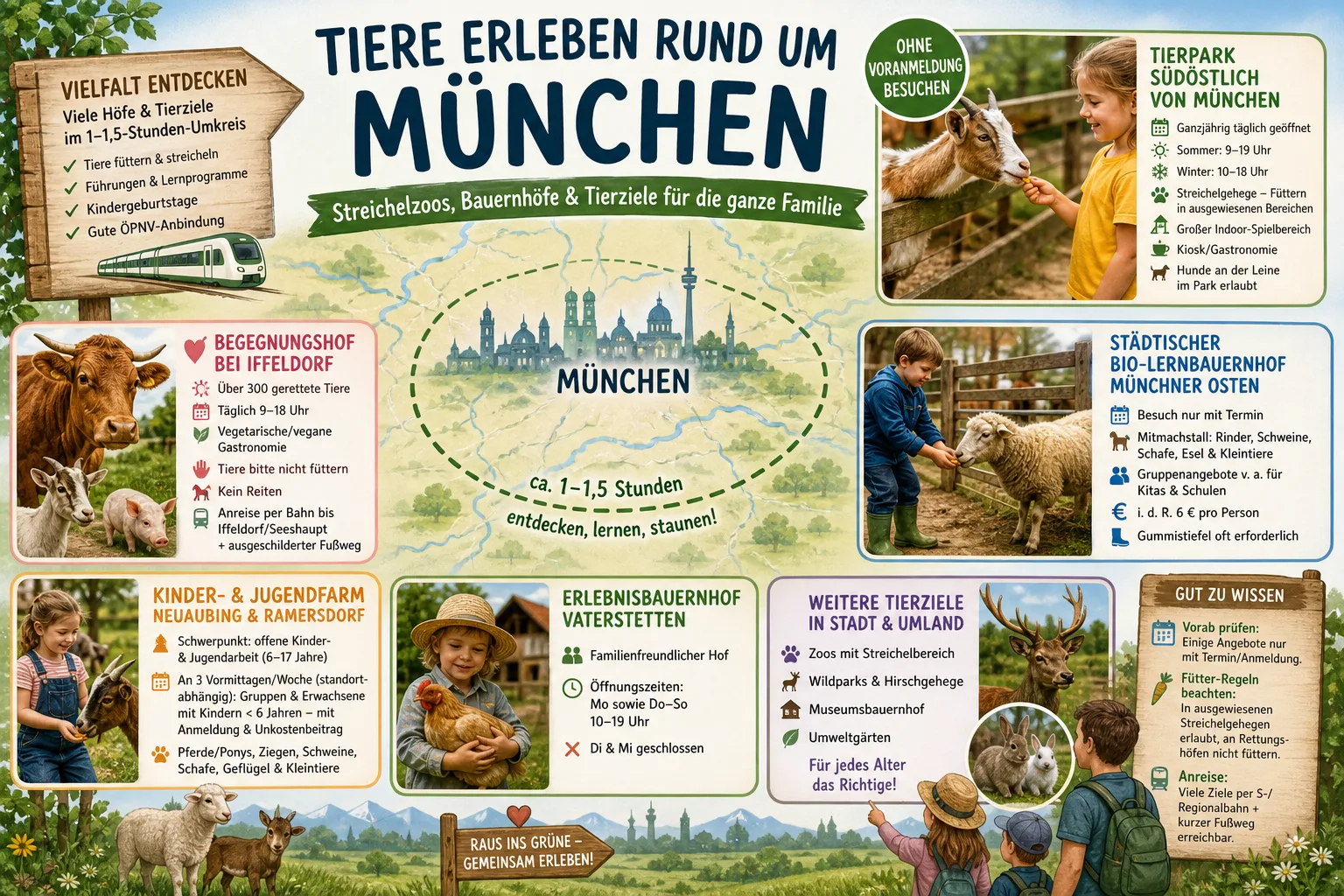
Would you like to experience animals up close in the coming weeks or months – as a family outing, with daycare/school, or simply as an animal-themed change of scenery? Around Munich, there are regularly upcoming events such as holiday programs, hands-on stable times, action days, and guided animal encounters. This guide helps you find suitable dates, plan realistically, and keep animal welfare and hygiene in mind.
Where to find reliable dates for Munich & surrounding areas
For upcoming events, up-to-date information is crucial. The most reliable sources for dates (from today and in the coming months) are:
- Official websites of animal parks, educational farms, youth farms, and adventure farms (sections like "Calendar," "News," "Events," "Holiday Program").
- Municipal portals (e.g., Munich: pages on environmental education, youth farms, holiday offers).
- Provider newsletters & social media: Additional dates, last-minute weather changes, or fully booked slots are often communicated there first.
- Ticket shops/reservation systems: If events can only be booked with time slots, availability is most up-to-date there.
- Google Maps entries as an additional check: helpful for travel, on-site notes, and possibly last-minute updates – but always use the official website for binding information.
If you want to make a quick shortlist, filter dates by three criteria: 1) Age/participation requirements, 2) Travel time, 3) Rules for animal contact (especially feeding, petting areas, group sizes).
Planning your next visits: tickets, travel, weather
Tickets & registration
- Time slot models are becoming more common for highly demanded offers: they reduce waiting times and distribute visitor flows.
- Groups (daycare/school) often require a separate booking and sometimes different time slots than private visitors.
- Check cancellation conditions (especially in case of illness or bad weather): this protects against unnecessary costs.
Travel (public transport & car)
- Public transport: For weekend dates, it is worth checking connections in advance (frequency, transfers, walking distances). For children's groups, additional buffer times are realistic.
- Car: Plan for more traffic during holiday periods and on sunny weekends. Check parking options and whether there are daily quotas.
- Bicycle: For nearby destinations, cycling can be the least stressful option (if routes and weather are suitable).
Weather and equipment check for upcoming dates
- Shoes: Closed, sturdy shoes are almost always sensible for animal events; areas near stables can be slippery or muddy.
- Clothing: Plan for the weather; on cooler days, layering and a rain jacket are often the best solution.
- Food & drink: If there is catering on site, waiting times may occur; snacks and water for children are still helpful (if allowed).
Animal welfare & rules: feeding, petting, distance
At animal events: The rules differ depending on the facility – and they also change if animal health, offspring, weather, or visitor numbers require it. Typical rule areas for future visits:
Feeding: only if expressly allowed
- Allowed (sometimes): In designated petting areas and often only with suitable food provided on site.
- Not allowed (often): At encounter farms, with rescued animals, or with sensitive species/stocks; also with special diets.
- Why this is important: Unsuitable food can cause digestive problems, injuries from jostling, or dangerous habits.
Petting: short, calm, respectful
- Only pet where it is explicitly permitted.
- Do not hold animals, do not startle or crowd them; respect their retreat options.
- Parents/accompanying adults should actively guide: "One hand," "quiet voice," "no chasing."
Distance & behavior: even with "tame" animals
Even animals accustomed to people can react unexpectedly (stress, food envy, young animals). A good event is one where everyone stays relaxed: animals, children, adults.
Hygiene & safety (especially with children)
Animal contact is valuable, but always comes with hygiene requirements. For upcoming dates, this checklist helps:
- Wash hands after animal contact, after the stable, and before eating (soap, thoroughly).
- Do not eat or drink in the direct animal area, if the facility requires it.
- Supervise small children: Hands quickly go to the face; especially consistent supervision is worthwhile here.
- Cover wounds and, if very dirty, change/wash clothes after the visit if necessary.
These points are in line with general recommendations for dealing with animals and infection prevention in everyday life.
Accessibility & special needs
If you are planning your next visits, it is worth taking a quick look at accessibility information – many providers publish specific notes on this. Pay special attention to:
- Path conditions: Gravel, inclines, wet meadows (important for wheelchairs, walkers, strollers).
- Quiet zones: For children with sensory sensitivity or for anyone who needs a break in between.
- Sanitary & changing facilities as well as accessible toilets.
- Assistance dog rules (not the same as "dogs generally allowed").
Sources
- Robert Koch Institute (RKI) — Information on infection protection and hygiene in everyday life (accessed 2026-06-10)
- Federal Ministry of Food and Agriculture (BMEL) — Consumer information on food safety, hygiene, and animal husbandry (accessed 2026-06-10)
- City of Munich — Official information and event overviews of municipal offers (accessed 2026-06-10)
- Hellabrunn Zoo — Official information on visits, programs, and on-site rules (accessed 2026-06-10)
- German Animal Welfare Association — Background knowledge on animal welfare and responsible animal handling (accessed 2026-06-10)