
Franz-Beckenbauer-Platz 5, München
Franz-Beckenbauer-Platz 5, 80939 München, Germany
Allianz Arena | Seating Plan & Parking
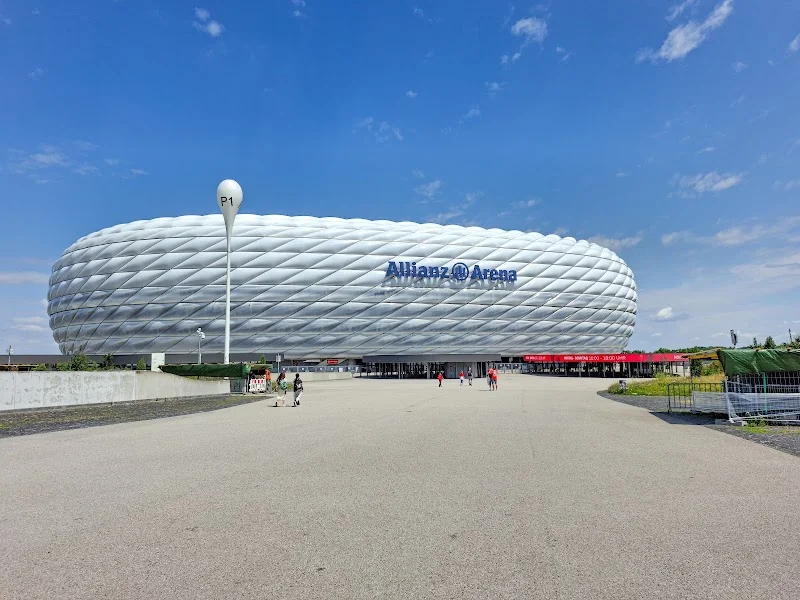
The Allianz Arena in Munich-Fröttmaning is one of the most famous stadiums in Europe and the perfect address for anyone looking for seating plans, parking, tickets, or a stadium tour. The stadium opened in 2005, is designed as a pure football stadium, and is now located at Franz-Beckenbauer-Platz 5. With up to 75,024 seats for national games, a distinctive LED facade, and a clear focus on fan comfort, the arena combines sports, architecture, and event experience in a compact space. Those who want to see the Allianz Arena not just from the outside will find more than 6,000 square meters of gastronomy, the FC Bayern Store, the FC Bayern Museum, and extensive service areas inside. For this reason, the arena is not only the home ground of FC Bayern but also one of the most important visitor attractions in Munich. For seekers, this is practical: those looking for allianz arena seating plan, allianz arena parking, or allianz arena tour want to quickly understand how the arena is structured, how to get there, and what to experience on-site. This overview is precisely aimed at that. It connects the most important search intentions with the official facts of the arena and shows why the Allianz Arena is a strong destination for football fans, families, and visitors from all over the world, both on match days and on free days. ([allianz-arena.com](https://allianz-arena.com/en/arena/facts/nuts-and-bolts))
Seating Plan, Block Plan, and 3D Orientation in the Allianz Arena
Those searching for allianz arena seating plan, allianz arena block plan, or allianz arena seating plan 3d primarily want one thing: to orient themselves securely before the visit. The official logic of the Allianz Arena is surprisingly clear. The ticket indicates the appropriate area with a letter from A to S, and the so-called Core leads directly in front of the respective block. Those with seats in the upper tier use the right staircase. This system is intentionally designed so that visitors can reach their seats more quickly and navigate better on busy match days. Additionally, the architecture of the stadium is focused on football: the distance between spectators and the pitch is at least 7.5 meters, the stands are arranged in three clearly distinguishable levels, and the incline angles of the lower, middle, and upper rows ensure good sightlines. For many visitors, this is precisely why the Allianz Arena appears so compact and impressive inside. For national games, it offers up to 75,024 seats, including 13,342 standing places, 2,152 business seats, 7,500 guest areas, and 106 VIP boxes with a total of 1,371 seats. For international games, the capacity is 70,000 because standing places are not allowed there. So, anyone looking for a seating plan or block plan should not only look at a graphic but also understand the official routing: ticket area, Core, stairs, entrance, and stands fit seamlessly together. This clarity makes the arena pleasant even for first-time visitors. ([allianz-arena.com](https://allianz-arena.com/en/arena/facts/nuts-and-bolts))
Parking and Access to the Allianz Arena in Munich
When it comes to the keyword allianz arena parking, it is not just about parking spaces, but primarily about a stress-free arrival. The official address of the Allianz Arena since May 1, 2025, is Franz-Beckenbauer-Platz 5, 80939 Munich. The location remains in Munich-Fröttmaning, thus north of the city center and well connected to public transport. Those arriving by subway can reach the stadium via the Fröttmaning station; the route leads via Heideweg and the pedestrian bridge to the northern visitor entrance. The route from the subway station to the arena is completely barrier-free. This is an important advantage, especially on days with many guests, as pedestrian traffic, public transport, and stadium access complement each other neatly. A total of 11,900 parking spaces are available for drivers, including four four-story parking garages under the Esplanade and the visitor parking garage for guests. Additionally, there are 350 bus and coach parking spaces. In the stadium area, there are also 150 parking spaces designated for people with disabilities, of which 130 are in P1 and 20 in the guest parking garage. A special feature of the Allianz Arena is the barrier-free parking with license plate recognition: the parking fee can be registered and paid in advance via the website or app. This reduces waiting times and facilitates departure after the game or event. Those arriving by bicycle will find sufficient bicycle parking spaces directly at the entrances on the north side, and taxi zones are also available, including north behind the arena and south at the foot of the Esplanade. On match days, there are also no drop-off and pick-up zones directly at the arena because traffic must remain free at all times. This combination of good public transport connections, ample parking space, and clear visitor guidance makes the Allianz Arena particularly practical for everyday use. ([allianz-arena.com](https://allianz-arena.com/en/faq))
Tickets, Tours, and FC Bayern Museum
When it comes to allianz arena tickets and allianz arena tour, it is usually about the experience beyond the game. The Allianz Arena offers guided arena tours and visits to the FC Bayern Museum as a combination offer on non-match days. The recommended total duration is about 2.5 hours, of which around 60 minutes are for the arena tour and about 1 to 1.5 hours for the museum. Tours take place on non-match days from approximately 10:00 AM to 5:30 PM. The museum is usually open from 10:00 AM to 6:00 PM, with the last admission at 5:15 PM. Those booking a tour in the late afternoon should ideally visit the museum beforehand. Particularly practical: the tours are not only informative but also very close to the action. Depending on the schedule, visitors gain insights into the locker areas, player zones, and the area at the edge of the pitch. Additionally, there is an audio guide for the arena tour and arena view, available in six languages and can be used for free via the Allianz Arena app. In the FC Bayern Museum, Germany's largest club museum awaits with a large, emotionally charged collection on club history. The FC Bayern Store is also part of the visit experience: on 1,000 square meters, there are fan articles, jerseys, accessories, and much more. The store is open daily from 10:00 AM to 6:00 PM on non-match days, and on match days from two hours before kick-off until two hours after the final whistle. Important for families: children under 14 years may only visit the arena tour when accompanied by an adult, and a ticket booking is also required for the museum visit. Thus, the Allianz Arena is not just a stadium but a strong excursion destination for football fans, families, and visitors to Munich. ([allianz-arena.com](https://allianz-arena.com/de/touren-museum/fcbayern-museum-arena-tour?utm_source=openai))
Capacity, Seats, and Facilities of the Allianz Arena
The search queries allianz arena capacity, allianz arena seats, and allianz arena seating show very clearly that visitors want to understand not only the brand but also the size and quality of the stadium. The official figures speak for themselves: for national games, the Allianz Arena accommodates 75,024 spectators, and for international games, 70,000. Additionally, there are 13,342 standing places, 2,152 business seats, 7,500 guest areas, and 106 VIP boxes with a total of 1,371 seats. Thus, the arena is not only large but also extremely differentiated in its structure, as it combines classic stand seats, hospitality areas, media zones, and special service areas in a single compact structure. The facilities also include 32 kiosks, two fan restaurants with 1,000 seats each, a bistro for 400 people, the business club with 2,152 seats, the press club with around 350 seats, the mixed zone, conference rooms, media areas, a kids club, and 54 ticket counters. The stadium is equipped with more than 750 screens, as well as 1,121 restroom stalls. The catering covers around 6,000 square meters, which is particularly important for large events and sold-out games. Technically, the arena is also impressive: the pitch measures 68 by 105 meters, spectators sit very close to the action, and the stand inclines are chosen to keep sightlines as open as possible. Outside, the arena is also unmistakable. The facade and roof together cover 66,500 square meters and consist of 2,784 inflated panels. The LED technology allows for colored illuminations with up to 16 million colors. This combination of size, technology, and fan comfort explains why the Allianz Arena is perceived so strongly worldwide and consistently ranks at the top of search queries regarding seats, seating plans, capacity, and facilities. ([allianz-arena.com](https://allianz-arena.com/en/arena/facts/nuts-and-bolts))
Concerts, Match Days, and Allianz Arena Today
The keyword allianz arena concert shows that the arena offers not only football but also great live moments. For concerts, the Allianz Arena usually opens about one and a half to two hours before the event starts; the Esplanade usually opens two hours before admission. Clear rules apply for food and drinks: only card payments are accepted on-site, and EC, debit, and credit cards are possible, as well as contactless payments via NFC or Apple Pay. Bringing your own food and drinks is not allowed at concerts, and drinks are served in reusable cups with a deposit of 3 euros. The return takes place at all kiosks or at the designated return points. Accessibility is also relevant: the path from the subway station to the arena is completely barrier-free, there are elevators for persons with limited mobility, and the relevant access points and rules are clearly explained on the concert side. For tickets, the view of the stage always depends on the respective stage position, which is why visitors should inform themselves in advance with the ticket provider about possible sight obstructions. There are clear age rules for children, such as that children under 6 years are not admitted and visitors under 14 years may only participate when accompanied by an adult. Therefore, anyone planning to do something in the Allianz Arena today should always check the official event calendar. There, the current opening hours, tours, and events are listed, as they can vary depending on the match day, concert, or special event. This is exactly what makes the keyword allianz arena today so meaningful: it is about current orientation, not just general information. This way, the arena remains planable for fans and visitors even at short notice. ([allianz-arena.com](https://allianz-arena.com/en/events/concerts))
History, Architecture, and Special Facts
The history of the Allianz Arena is closely linked to Munich, FC Bayern, and a remarkable architectural project. The arena opened in 2005 and was legitimized during the planning phase through a referendum in which 65.8 percent of Munich voters supported the project. The foundation stone was laid on October 21, 2002, and the handover by Alpine Bau GmbH took place on April 30, 2005. The opening matches were held on May 30, 2005, with TSV 1860 against Nuremberg and on May 31, 2005, with FC Bayern against the German national team. Originally, FC Bayern and TSV 1860 shared the ownership structure, later FC Bayern gradually took over the shares completely; since 2008, the arena has been under the sole control of the club, and after the lease agreement expired in 2017, TSV 1860 was no longer the home club of the arena. The address has also been further developed in recent times and has been named Franz-Beckenbauer-Platz 5 since May 1, 2025. Architecturally, the stadium is a special case because it was planned from the beginning only for football and not as a multipurpose hall with makeshift solutions. The construction took less than three years and cost 340 million euros. Particularly iconic is the outer shell: with the LED facade renewed in 2014, the Allianz Arena was the first stadium in Germany and the largest in Europe with a continuous outdoor LED lighting that can display up to 16 million colors. The 2,784 air cushions of the facade, the enormous lighting area, and the distinctive shape make the arena unmistakable from afar. This combination of cityscape, club history, modern technology, and emotional football culture explains why the Allianz Arena has become a symbol of contemporary stadium design far beyond Munich. ([allianz-arena.com](https://allianz-arena.com/en/arena/facts/nuts-and-bolts))
Sources:
Show moreShow less
Allianz Arena | Seating Plan & Parking
The Allianz Arena in Munich-Fröttmaning is one of the most famous stadiums in Europe and the perfect address for anyone looking for seating plans, parking, tickets, or a stadium tour. The stadium opened in 2005, is designed as a pure football stadium, and is now located at Franz-Beckenbauer-Platz 5. With up to 75,024 seats for national games, a distinctive LED facade, and a clear focus on fan comfort, the arena combines sports, architecture, and event experience in a compact space. Those who want to see the Allianz Arena not just from the outside will find more than 6,000 square meters of gastronomy, the FC Bayern Store, the FC Bayern Museum, and extensive service areas inside. For this reason, the arena is not only the home ground of FC Bayern but also one of the most important visitor attractions in Munich. For seekers, this is practical: those looking for allianz arena seating plan, allianz arena parking, or allianz arena tour want to quickly understand how the arena is structured, how to get there, and what to experience on-site. This overview is precisely aimed at that. It connects the most important search intentions with the official facts of the arena and shows why the Allianz Arena is a strong destination for football fans, families, and visitors from all over the world, both on match days and on free days. ([allianz-arena.com](https://allianz-arena.com/en/arena/facts/nuts-and-bolts))
Seating Plan, Block Plan, and 3D Orientation in the Allianz Arena
Those searching for allianz arena seating plan, allianz arena block plan, or allianz arena seating plan 3d primarily want one thing: to orient themselves securely before the visit. The official logic of the Allianz Arena is surprisingly clear. The ticket indicates the appropriate area with a letter from A to S, and the so-called Core leads directly in front of the respective block. Those with seats in the upper tier use the right staircase. This system is intentionally designed so that visitors can reach their seats more quickly and navigate better on busy match days. Additionally, the architecture of the stadium is focused on football: the distance between spectators and the pitch is at least 7.5 meters, the stands are arranged in three clearly distinguishable levels, and the incline angles of the lower, middle, and upper rows ensure good sightlines. For many visitors, this is precisely why the Allianz Arena appears so compact and impressive inside. For national games, it offers up to 75,024 seats, including 13,342 standing places, 2,152 business seats, 7,500 guest areas, and 106 VIP boxes with a total of 1,371 seats. For international games, the capacity is 70,000 because standing places are not allowed there. So, anyone looking for a seating plan or block plan should not only look at a graphic but also understand the official routing: ticket area, Core, stairs, entrance, and stands fit seamlessly together. This clarity makes the arena pleasant even for first-time visitors. ([allianz-arena.com](https://allianz-arena.com/en/arena/facts/nuts-and-bolts))
Parking and Access to the Allianz Arena in Munich
When it comes to the keyword allianz arena parking, it is not just about parking spaces, but primarily about a stress-free arrival. The official address of the Allianz Arena since May 1, 2025, is Franz-Beckenbauer-Platz 5, 80939 Munich. The location remains in Munich-Fröttmaning, thus north of the city center and well connected to public transport. Those arriving by subway can reach the stadium via the Fröttmaning station; the route leads via Heideweg and the pedestrian bridge to the northern visitor entrance. The route from the subway station to the arena is completely barrier-free. This is an important advantage, especially on days with many guests, as pedestrian traffic, public transport, and stadium access complement each other neatly. A total of 11,900 parking spaces are available for drivers, including four four-story parking garages under the Esplanade and the visitor parking garage for guests. Additionally, there are 350 bus and coach parking spaces. In the stadium area, there are also 150 parking spaces designated for people with disabilities, of which 130 are in P1 and 20 in the guest parking garage. A special feature of the Allianz Arena is the barrier-free parking with license plate recognition: the parking fee can be registered and paid in advance via the website or app. This reduces waiting times and facilitates departure after the game or event. Those arriving by bicycle will find sufficient bicycle parking spaces directly at the entrances on the north side, and taxi zones are also available, including north behind the arena and south at the foot of the Esplanade. On match days, there are also no drop-off and pick-up zones directly at the arena because traffic must remain free at all times. This combination of good public transport connections, ample parking space, and clear visitor guidance makes the Allianz Arena particularly practical for everyday use. ([allianz-arena.com](https://allianz-arena.com/en/faq))
Tickets, Tours, and FC Bayern Museum
When it comes to allianz arena tickets and allianz arena tour, it is usually about the experience beyond the game. The Allianz Arena offers guided arena tours and visits to the FC Bayern Museum as a combination offer on non-match days. The recommended total duration is about 2.5 hours, of which around 60 minutes are for the arena tour and about 1 to 1.5 hours for the museum. Tours take place on non-match days from approximately 10:00 AM to 5:30 PM. The museum is usually open from 10:00 AM to 6:00 PM, with the last admission at 5:15 PM. Those booking a tour in the late afternoon should ideally visit the museum beforehand. Particularly practical: the tours are not only informative but also very close to the action. Depending on the schedule, visitors gain insights into the locker areas, player zones, and the area at the edge of the pitch. Additionally, there is an audio guide for the arena tour and arena view, available in six languages and can be used for free via the Allianz Arena app. In the FC Bayern Museum, Germany's largest club museum awaits with a large, emotionally charged collection on club history. The FC Bayern Store is also part of the visit experience: on 1,000 square meters, there are fan articles, jerseys, accessories, and much more. The store is open daily from 10:00 AM to 6:00 PM on non-match days, and on match days from two hours before kick-off until two hours after the final whistle. Important for families: children under 14 years may only visit the arena tour when accompanied by an adult, and a ticket booking is also required for the museum visit. Thus, the Allianz Arena is not just a stadium but a strong excursion destination for football fans, families, and visitors to Munich. ([allianz-arena.com](https://allianz-arena.com/de/touren-museum/fcbayern-museum-arena-tour?utm_source=openai))
Capacity, Seats, and Facilities of the Allianz Arena
The search queries allianz arena capacity, allianz arena seats, and allianz arena seating show very clearly that visitors want to understand not only the brand but also the size and quality of the stadium. The official figures speak for themselves: for national games, the Allianz Arena accommodates 75,024 spectators, and for international games, 70,000. Additionally, there are 13,342 standing places, 2,152 business seats, 7,500 guest areas, and 106 VIP boxes with a total of 1,371 seats. Thus, the arena is not only large but also extremely differentiated in its structure, as it combines classic stand seats, hospitality areas, media zones, and special service areas in a single compact structure. The facilities also include 32 kiosks, two fan restaurants with 1,000 seats each, a bistro for 400 people, the business club with 2,152 seats, the press club with around 350 seats, the mixed zone, conference rooms, media areas, a kids club, and 54 ticket counters. The stadium is equipped with more than 750 screens, as well as 1,121 restroom stalls. The catering covers around 6,000 square meters, which is particularly important for large events and sold-out games. Technically, the arena is also impressive: the pitch measures 68 by 105 meters, spectators sit very close to the action, and the stand inclines are chosen to keep sightlines as open as possible. Outside, the arena is also unmistakable. The facade and roof together cover 66,500 square meters and consist of 2,784 inflated panels. The LED technology allows for colored illuminations with up to 16 million colors. This combination of size, technology, and fan comfort explains why the Allianz Arena is perceived so strongly worldwide and consistently ranks at the top of search queries regarding seats, seating plans, capacity, and facilities. ([allianz-arena.com](https://allianz-arena.com/en/arena/facts/nuts-and-bolts))
Concerts, Match Days, and Allianz Arena Today
The keyword allianz arena concert shows that the arena offers not only football but also great live moments. For concerts, the Allianz Arena usually opens about one and a half to two hours before the event starts; the Esplanade usually opens two hours before admission. Clear rules apply for food and drinks: only card payments are accepted on-site, and EC, debit, and credit cards are possible, as well as contactless payments via NFC or Apple Pay. Bringing your own food and drinks is not allowed at concerts, and drinks are served in reusable cups with a deposit of 3 euros. The return takes place at all kiosks or at the designated return points. Accessibility is also relevant: the path from the subway station to the arena is completely barrier-free, there are elevators for persons with limited mobility, and the relevant access points and rules are clearly explained on the concert side. For tickets, the view of the stage always depends on the respective stage position, which is why visitors should inform themselves in advance with the ticket provider about possible sight obstructions. There are clear age rules for children, such as that children under 6 years are not admitted and visitors under 14 years may only participate when accompanied by an adult. Therefore, anyone planning to do something in the Allianz Arena today should always check the official event calendar. There, the current opening hours, tours, and events are listed, as they can vary depending on the match day, concert, or special event. This is exactly what makes the keyword allianz arena today so meaningful: it is about current orientation, not just general information. This way, the arena remains planable for fans and visitors even at short notice. ([allianz-arena.com](https://allianz-arena.com/en/events/concerts))
History, Architecture, and Special Facts
The history of the Allianz Arena is closely linked to Munich, FC Bayern, and a remarkable architectural project. The arena opened in 2005 and was legitimized during the planning phase through a referendum in which 65.8 percent of Munich voters supported the project. The foundation stone was laid on October 21, 2002, and the handover by Alpine Bau GmbH took place on April 30, 2005. The opening matches were held on May 30, 2005, with TSV 1860 against Nuremberg and on May 31, 2005, with FC Bayern against the German national team. Originally, FC Bayern and TSV 1860 shared the ownership structure, later FC Bayern gradually took over the shares completely; since 2008, the arena has been under the sole control of the club, and after the lease agreement expired in 2017, TSV 1860 was no longer the home club of the arena. The address has also been further developed in recent times and has been named Franz-Beckenbauer-Platz 5 since May 1, 2025. Architecturally, the stadium is a special case because it was planned from the beginning only for football and not as a multipurpose hall with makeshift solutions. The construction took less than three years and cost 340 million euros. Particularly iconic is the outer shell: with the LED facade renewed in 2014, the Allianz Arena was the first stadium in Germany and the largest in Europe with a continuous outdoor LED lighting that can display up to 16 million colors. The 2,784 air cushions of the facade, the enormous lighting area, and the distinctive shape make the arena unmistakable from afar. This combination of cityscape, club history, modern technology, and emotional football culture explains why the Allianz Arena has become a symbol of contemporary stadium design far beyond Munich. ([allianz-arena.com](https://allianz-arena.com/en/arena/facts/nuts-and-bolts))
Sources:
Allianz Arena | Seating Plan & Parking
The Allianz Arena in Munich-Fröttmaning is one of the most famous stadiums in Europe and the perfect address for anyone looking for seating plans, parking, tickets, or a stadium tour. The stadium opened in 2005, is designed as a pure football stadium, and is now located at Franz-Beckenbauer-Platz 5. With up to 75,024 seats for national games, a distinctive LED facade, and a clear focus on fan comfort, the arena combines sports, architecture, and event experience in a compact space. Those who want to see the Allianz Arena not just from the outside will find more than 6,000 square meters of gastronomy, the FC Bayern Store, the FC Bayern Museum, and extensive service areas inside. For this reason, the arena is not only the home ground of FC Bayern but also one of the most important visitor attractions in Munich. For seekers, this is practical: those looking for allianz arena seating plan, allianz arena parking, or allianz arena tour want to quickly understand how the arena is structured, how to get there, and what to experience on-site. This overview is precisely aimed at that. It connects the most important search intentions with the official facts of the arena and shows why the Allianz Arena is a strong destination for football fans, families, and visitors from all over the world, both on match days and on free days. ([allianz-arena.com](https://allianz-arena.com/en/arena/facts/nuts-and-bolts))
Seating Plan, Block Plan, and 3D Orientation in the Allianz Arena
Those searching for allianz arena seating plan, allianz arena block plan, or allianz arena seating plan 3d primarily want one thing: to orient themselves securely before the visit. The official logic of the Allianz Arena is surprisingly clear. The ticket indicates the appropriate area with a letter from A to S, and the so-called Core leads directly in front of the respective block. Those with seats in the upper tier use the right staircase. This system is intentionally designed so that visitors can reach their seats more quickly and navigate better on busy match days. Additionally, the architecture of the stadium is focused on football: the distance between spectators and the pitch is at least 7.5 meters, the stands are arranged in three clearly distinguishable levels, and the incline angles of the lower, middle, and upper rows ensure good sightlines. For many visitors, this is precisely why the Allianz Arena appears so compact and impressive inside. For national games, it offers up to 75,024 seats, including 13,342 standing places, 2,152 business seats, 7,500 guest areas, and 106 VIP boxes with a total of 1,371 seats. For international games, the capacity is 70,000 because standing places are not allowed there. So, anyone looking for a seating plan or block plan should not only look at a graphic but also understand the official routing: ticket area, Core, stairs, entrance, and stands fit seamlessly together. This clarity makes the arena pleasant even for first-time visitors. ([allianz-arena.com](https://allianz-arena.com/en/arena/facts/nuts-and-bolts))
Parking and Access to the Allianz Arena in Munich
When it comes to the keyword allianz arena parking, it is not just about parking spaces, but primarily about a stress-free arrival. The official address of the Allianz Arena since May 1, 2025, is Franz-Beckenbauer-Platz 5, 80939 Munich. The location remains in Munich-Fröttmaning, thus north of the city center and well connected to public transport. Those arriving by subway can reach the stadium via the Fröttmaning station; the route leads via Heideweg and the pedestrian bridge to the northern visitor entrance. The route from the subway station to the arena is completely barrier-free. This is an important advantage, especially on days with many guests, as pedestrian traffic, public transport, and stadium access complement each other neatly. A total of 11,900 parking spaces are available for drivers, including four four-story parking garages under the Esplanade and the visitor parking garage for guests. Additionally, there are 350 bus and coach parking spaces. In the stadium area, there are also 150 parking spaces designated for people with disabilities, of which 130 are in P1 and 20 in the guest parking garage. A special feature of the Allianz Arena is the barrier-free parking with license plate recognition: the parking fee can be registered and paid in advance via the website or app. This reduces waiting times and facilitates departure after the game or event. Those arriving by bicycle will find sufficient bicycle parking spaces directly at the entrances on the north side, and taxi zones are also available, including north behind the arena and south at the foot of the Esplanade. On match days, there are also no drop-off and pick-up zones directly at the arena because traffic must remain free at all times. This combination of good public transport connections, ample parking space, and clear visitor guidance makes the Allianz Arena particularly practical for everyday use. ([allianz-arena.com](https://allianz-arena.com/en/faq))
Tickets, Tours, and FC Bayern Museum
When it comes to allianz arena tickets and allianz arena tour, it is usually about the experience beyond the game. The Allianz Arena offers guided arena tours and visits to the FC Bayern Museum as a combination offer on non-match days. The recommended total duration is about 2.5 hours, of which around 60 minutes are for the arena tour and about 1 to 1.5 hours for the museum. Tours take place on non-match days from approximately 10:00 AM to 5:30 PM. The museum is usually open from 10:00 AM to 6:00 PM, with the last admission at 5:15 PM. Those booking a tour in the late afternoon should ideally visit the museum beforehand. Particularly practical: the tours are not only informative but also very close to the action. Depending on the schedule, visitors gain insights into the locker areas, player zones, and the area at the edge of the pitch. Additionally, there is an audio guide for the arena tour and arena view, available in six languages and can be used for free via the Allianz Arena app. In the FC Bayern Museum, Germany's largest club museum awaits with a large, emotionally charged collection on club history. The FC Bayern Store is also part of the visit experience: on 1,000 square meters, there are fan articles, jerseys, accessories, and much more. The store is open daily from 10:00 AM to 6:00 PM on non-match days, and on match days from two hours before kick-off until two hours after the final whistle. Important for families: children under 14 years may only visit the arena tour when accompanied by an adult, and a ticket booking is also required for the museum visit. Thus, the Allianz Arena is not just a stadium but a strong excursion destination for football fans, families, and visitors to Munich. ([allianz-arena.com](https://allianz-arena.com/de/touren-museum/fcbayern-museum-arena-tour?utm_source=openai))
Capacity, Seats, and Facilities of the Allianz Arena
The search queries allianz arena capacity, allianz arena seats, and allianz arena seating show very clearly that visitors want to understand not only the brand but also the size and quality of the stadium. The official figures speak for themselves: for national games, the Allianz Arena accommodates 75,024 spectators, and for international games, 70,000. Additionally, there are 13,342 standing places, 2,152 business seats, 7,500 guest areas, and 106 VIP boxes with a total of 1,371 seats. Thus, the arena is not only large but also extremely differentiated in its structure, as it combines classic stand seats, hospitality areas, media zones, and special service areas in a single compact structure. The facilities also include 32 kiosks, two fan restaurants with 1,000 seats each, a bistro for 400 people, the business club with 2,152 seats, the press club with around 350 seats, the mixed zone, conference rooms, media areas, a kids club, and 54 ticket counters. The stadium is equipped with more than 750 screens, as well as 1,121 restroom stalls. The catering covers around 6,000 square meters, which is particularly important for large events and sold-out games. Technically, the arena is also impressive: the pitch measures 68 by 105 meters, spectators sit very close to the action, and the stand inclines are chosen to keep sightlines as open as possible. Outside, the arena is also unmistakable. The facade and roof together cover 66,500 square meters and consist of 2,784 inflated panels. The LED technology allows for colored illuminations with up to 16 million colors. This combination of size, technology, and fan comfort explains why the Allianz Arena is perceived so strongly worldwide and consistently ranks at the top of search queries regarding seats, seating plans, capacity, and facilities. ([allianz-arena.com](https://allianz-arena.com/en/arena/facts/nuts-and-bolts))
Concerts, Match Days, and Allianz Arena Today
The keyword allianz arena concert shows that the arena offers not only football but also great live moments. For concerts, the Allianz Arena usually opens about one and a half to two hours before the event starts; the Esplanade usually opens two hours before admission. Clear rules apply for food and drinks: only card payments are accepted on-site, and EC, debit, and credit cards are possible, as well as contactless payments via NFC or Apple Pay. Bringing your own food and drinks is not allowed at concerts, and drinks are served in reusable cups with a deposit of 3 euros. The return takes place at all kiosks or at the designated return points. Accessibility is also relevant: the path from the subway station to the arena is completely barrier-free, there are elevators for persons with limited mobility, and the relevant access points and rules are clearly explained on the concert side. For tickets, the view of the stage always depends on the respective stage position, which is why visitors should inform themselves in advance with the ticket provider about possible sight obstructions. There are clear age rules for children, such as that children under 6 years are not admitted and visitors under 14 years may only participate when accompanied by an adult. Therefore, anyone planning to do something in the Allianz Arena today should always check the official event calendar. There, the current opening hours, tours, and events are listed, as they can vary depending on the match day, concert, or special event. This is exactly what makes the keyword allianz arena today so meaningful: it is about current orientation, not just general information. This way, the arena remains planable for fans and visitors even at short notice. ([allianz-arena.com](https://allianz-arena.com/en/events/concerts))
History, Architecture, and Special Facts
The history of the Allianz Arena is closely linked to Munich, FC Bayern, and a remarkable architectural project. The arena opened in 2005 and was legitimized during the planning phase through a referendum in which 65.8 percent of Munich voters supported the project. The foundation stone was laid on October 21, 2002, and the handover by Alpine Bau GmbH took place on April 30, 2005. The opening matches were held on May 30, 2005, with TSV 1860 against Nuremberg and on May 31, 2005, with FC Bayern against the German national team. Originally, FC Bayern and TSV 1860 shared the ownership structure, later FC Bayern gradually took over the shares completely; since 2008, the arena has been under the sole control of the club, and after the lease agreement expired in 2017, TSV 1860 was no longer the home club of the arena. The address has also been further developed in recent times and has been named Franz-Beckenbauer-Platz 5 since May 1, 2025. Architecturally, the stadium is a special case because it was planned from the beginning only for football and not as a multipurpose hall with makeshift solutions. The construction took less than three years and cost 340 million euros. Particularly iconic is the outer shell: with the LED facade renewed in 2014, the Allianz Arena was the first stadium in Germany and the largest in Europe with a continuous outdoor LED lighting that can display up to 16 million colors. The 2,784 air cushions of the facade, the enormous lighting area, and the distinctive shape make the arena unmistakable from afar. This combination of cityscape, club history, modern technology, and emotional football culture explains why the Allianz Arena has become a symbol of contemporary stadium design far beyond Munich. ([allianz-arena.com](https://allianz-arena.com/en/arena/facts/nuts-and-bolts))
Sources:
Upcoming Events

THE WEEKND - Hospitality Package
The Weeknd in Munich: Premium live feeling, Business Club, and arena sound at the Allianz Arena. 27.06.2026, Hospitality Package. Secure now! #TheWeeknd

BTS World Tour 'Arirang' in Munich
BTS will perform live at the Allianz Arena in Munich on July 11 and 12, 2026. Secure your tickets!

Helene Fischer in the Allianz Arena
Experience Helene Fischer live at the Allianz Arena and celebrate 20 years of her greatest hits with a spectacular show!
FC Bayern Munich vs. RB Leipzig – Telekom Cup 2026
Be there live when FC Bayern Munich faces RB Leipzig in the Telekom Cup 2026. Excitement and top football await you at the Allianz Arena.
Frequently Asked Questions
Reviews
Frederik Huys
25. February 2026
Great experience. First did the stadium tour followed by a Bayern Munich match the next day. Both were great and highly recommended. Amazing atmosphere during the game!! The Arena itself is an amazing structure. Definitely recommend visiting!
Leslie Lee
31. December 2025
The Allianz Arena stadium tour was a memorable and enjoyable experience, even though our visit did not start as smoothly as planned. We had signed up for the English guided tour on a weekday at the 2.45 pm slot, but unfortunately arrived about 6 minutes late and the tour had already begun. The staff informed us that we would need to wait for the next available English tour. The next tour was at 3.30pm and explained our situation while the guide was scanning our tickets. There were a few other visitors in the same situation as us, and thankfully the guide was very understanding and kindly allowed us to join the tour. We were very grateful that our tickets did not go to waste. The tour itself was well structured and informative. It started with an introduction to the stadium and its architecture, followed by views from different seating sections. We then visited the press conference room, the players’ changing rooms, the dugout, and finally the bench right next to the pitch, which was a highlight of the experience. After the guided tour, we had time to explore the museum and the merchandise shop at our own pace. Overall, it was a fantastic experience, and we truly appreciated the flexibility and kindness of the staff. The Allianz Arena tour is definitely worth doing, especially for football fans.
Jake
11. February 2026
Definitely worth a visit. Museum is fantastic - well structured - and an audio guide is only 3 euros on top of a standard ticket price (all in cost me around €22 including the audio guide, museum and a viewpoint from the north stand of the stadium. Guided tours would need to be booked in advance which I didn't have the luxury of, having left it too late in my trip. The stadium is beautiful inside and it's worthwhile to take a moment to admire it in silence. I tried some food there and all was good except one of the fries in my portion was still frozen, just need a little attention to detail for the price you pay. Club shop is great but prices were way out of my budget (€100 per shirt with customisation on top of that - which would come to around €25 extra all in and training shirts at €95 to name a couple of things.
Daniel Alexander
31. December 2025
World class stadium. It's a bit of a walk from the tram but it's all clear and spaced well. Lots to do inside and out so worth arriving early. Inside the food is excellent and reasonably priced (for where you are) and the views are impressive. Go to a game here!
Bud Snapdragon
18. October 2025
An iconic stadium and a must-see for football fans! ⚽ The design is incredible especially when it’s lit up at night. The area is clean and well-organized, with easy access by metro. Even if there’s no match, the tour and museum are definitely worth it.