
München
Odeonspl. 3, 80539 München, Deutschland
Bavarian Ministry of the Interior | Address & Organizational Chart
The Bavarian State Ministry of the Interior, for Sport and Integration is not a classic event venue, but a supreme state authority with enormous administrative reach. This is exactly what makes the location at Odeonsplatz interesting for many search queries: people are looking for address, organizational chart, jobs, photos, warning systems, or historical backgrounds. The ministry itself has existed for over 200 years, has carried its current name since the cabinet formation on November 12, 2018, and plays a central role in internal security, municipalities, electoral law, integration, and civil protection. Its headquarters is located at Odeonsplatz 3 in Munich; at the same time, the historic Odeon is a place with strong architectural and political presence. To understand the location, one must therefore see both: the administrative function and the historical stage on which it unfolds to this day. ([stmi.bayern.de](https://www.stmi.bayern.de/ministerium/ueber-uns/))
Address, Directions, and Contact at Odeonsplatz
The official contact page clearly states the headquarters of the Ministry of the Interior as Odeonsplatz 3, 80539 Munich. For postal inquiries, the mailing address 80524 Munich is additionally provided. Those wishing to reach the building will also find the classic contact methods via telephone, email, and secure contact form on the page; the central email address is poststelle@stmi.bayern.de, and the phone number is 089 / 2192-01. For visitors, especially the use of public transport is helpful, as the website refers to the subway lines U3, U4, U5, and U6 with the stop Odeonsplatz as well as bus line 100. This makes the location very well connected to Munich's public transport. ([stmi.bayern.de](https://www.stmi.bayern.de/ser/kontakt/index.php))
In the search context, it is also important what the contact page does not emphasize: it explicitly mentions public transport but does not address visitor parking. This is relevant for many search queries related to parking and access, as especially in the city center, public transport is the most practical option. Therefore, those traveling by car should not assume a classic event parking lot but understand the official contact page as a service basis and plan their arrival in advance. Additionally, the page offers BAYERN | DIREKT as a central service point of the Bavarian State Government. This service point acts as a contact point for citizen concerns without taking on legal advice or conflict mediation, making it an important part of the general authority services related to the Ministry of the Interior. ([stmi.bayern.de](https://www.stmi.bayern.de/ser/kontakt/index.php))
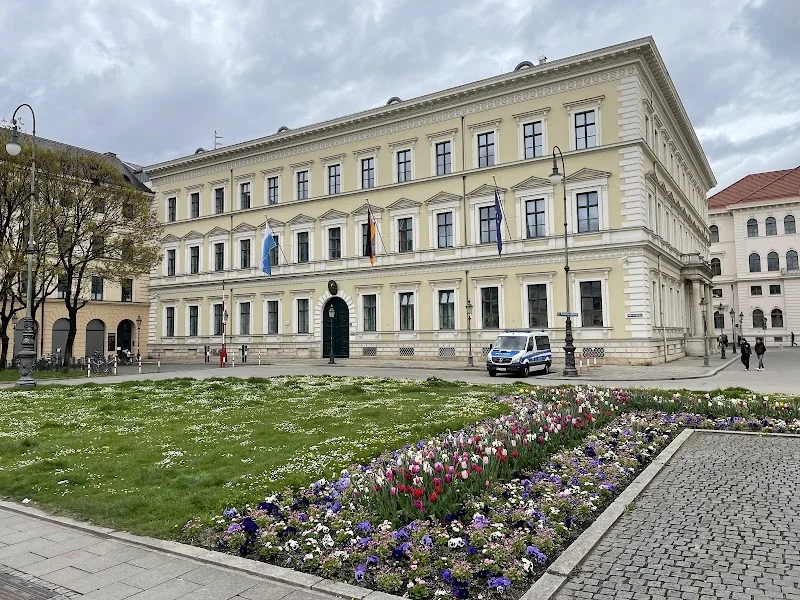
The location appears representative but not aloof. The official imagery shows the building from the outside, the green areas in the entrance area, and the headquarters at Odeonsplatz as a prominent administrative seat in the city center. For the search intention address, directions, or contact, the core message is therefore clear: the headquarters is located in the middle of Munich, is well accessible by public transport, and offers reliable official contact methods for citizens, media, and professional visitors. Those looking for a quick way to the building will find not only the address on the website but also a complete service path for telephone and digital inquiries. ([stmi.bayern.de](https://www.stmi.bayern.de/ser/kontakt/index.php))
Organizational Chart, Business Area, and Value Limits
Under the term business area, the Ministry of the Interior understands not only the ministry itself but also the authorities subordinate to it. The official organizational page explains the three-tier administration in Bavaria and assigns the business area of the Ministry of the Interior to the areas of police and internal administration. Particularly relevant for search queries regarding the organizational chart is the list of eleven departments: Central Affairs, Constitution and State Administration, Municipal Affairs, State Police Headquarters, Fire Department, Emergency Services and Disaster Protection, Constitutional Protection and Cybersecurity, Foreigners and Asylum Law, Integration and Accommodation of Asylum Seekers, Sports, Digitalization and Data Protection, as well as Planning, Communication, and Strategy. This structure is exactly what is interesting for users who want to understand how broadly the ministry is organized. An organizational plan and an organizational chart in PDF format are directly linked. ([stmi.bayern.de](https://www.stmi.bayern.de/ministerium/organisation-und-geschaeftsbereich/))
The size of the business area is also considerable: the website states around 56,940 positions in the business area, with the largest part falling to the Bavarian Police. More than 43,000 employees ensure safety around the clock. For SEO searches related to internal security, police, or disaster protection, this number is not just a statistical detail but a good anchor for the importance of the department. The ministry thus does not merely manage an administrative building but a far-reaching system of middle and subordinate authorities, ranging from governments to police headquarters to district offices and independent cities. Therefore, those inquiring about the organizational chart or business area are actually looking for the power and task model of Bavarian internal administration. ([stmi.bayern.de](https://www.stmi.bayern.de/ministerium/organisation-und-geschaeftsbereich/))
Additionally, the connection between municipal affairs and procurement practice is exciting. The Ministry of the Interior provides work aids, templates, and an RSS service around procurement in the municipal area. The value limits overview from January 1, 2025, specifies concrete procedural limits for municipal contracts below the EU thresholds, such as direct contracts up to 250,000 euros net for construction services and up to 100,000 euros for supply, service, and freelance services. Such information is particularly relevant for municipalities, specialist departments, and service providers searching for value limits Bavaria or municipal procurement. The benefit of this information lies in the fact that the ministry not only politically steers but also standardizes and legally secures practical administrative work. ([stmi.bayern.de](https://www.stmi.bayern.de/kub/komfinanzen/))
Content-wise, this shows a clear thematic focus: The Ministry of the Interior is the interface between security, municipal supervision, legal framework, and digital administration. It influences districts, regions, municipalities, police authorities, and other institutions without fully centralizing them. This federal balance makes the search interest in the organizational chart, value limits, and business area understandable. Those who understand the location or the building only as an address miss the actual core: a large part of the Bavarian administration is coordinated, structured, and professionally managed here. ([stmi.bayern.de](https://www.stmi.bayern.de/ministerium/organisation-und-geschaeftsbereich/))
Jobs and Careers at the Bavarian Ministry of the Interior
A strong keyword block around jobs, careers, and job advertisements is very plausible for the StMI, as the official website regularly points to open positions. The job profiles for assistance, service, and technology, as well as for lawyers, are particularly visible. The assistance positions involve front office and secretarial tasks, business trip bookings, meeting preparation, telephone and video conferences, e-file, incoming mail, document preparation, and event management. In the area of service and technology, the ministry mentions IT service areas, video and system technology, building management, courier and transport services, reception, meeting preparation, and driving services. This range shows that the location is not only a political control center but also a large employer with very different professional profiles. ([stmi.bayern.de](https://www.stmi.bayern.de/a-z/anzeigen/mitarbeiter-assistenz/))
For lawyers, the career page describes a particularly broad range of applications. The ministry hires lawyers for general internal administration, administrative jurisdiction, and the Bavarian Police; separate hiring at the administrative courts does not take place. The page also emphasizes that hiring is continuously taking place throughout Bavaria and that unsolicited applications are expressly welcome. It lists advantages such as an interesting and responsible job, the opportunity to shape leadership positions, statewide deployment options, and an entry salary of over 5,200 euros gross per month for full-time, plus additional benefits. For job seekers, this is a clear indication that jobs in the Ministry of the Interior do not only mean office work but also provide access to a large administrative and security apparatus. ([stmi.bayern.de](https://www.stmi.bayern.de/a-z/anzeigen/juristinnen-und-juristen/))
The job advertisements in the area of communication and social media are also informative. A current advertisement describes the StMI as a supreme state authority located in the heart of Munich and refers to nearly 57,000 employees in the business area. In addition to substantive responsibility, specific employer benefits are mentioned, including a discounted job ticket for public transport, bicycle leasing, company fitness, onboarding, and training opportunities. This information is particularly relevant for search queries related to jobs, careers, or employer benefits. It shows that the Ministry of the Interior is a modern administrative employer that focuses not only on expertise but also on mobility, health, and further education. ([stmi.bayern.de](https://www.stmi.bayern.de/jobs/anzeigen/social-media-manager/))
For keyword prioritization, this means: jobs, careers, applications, and job advertisements are not just side topics but real search intentions with high informational value. The official website provides concrete insights into tasks, requirements, remuneration, and application processes. Therefore, those searching for a job at the StMI will not find vague advertising texts but factual profiles with real responsibilities and clear contacts. This makes the location interesting from an employer branding perspective, even if it is not a classic event location. ([stmi.bayern.de](https://www.stmi.bayern.de/a-z/anzeigen/juristinnen-und-juristen/))
Warning, Disaster Protection, and Sirens in Bavaria
Another particularly strong thematic block is disaster protection, as the Ministry of the Interior in Bavaria bears central responsibility for warning and informing the population. On the official warning services page, the ministry explains that the Bavarian Reporting and Situation Center in the Ministry of the Interior triggers warning messages via warning apps and warning multipliers. Among others, NINA, KATWARN, BIWAPP, and Cell Broadcast are mentioned. During the annual statewide test alarm, the warning occurs from 11:00 AM, and an all-clear is sent at 11:30 AM. These times are not random but part of a clearly structured, Bavaria-wide coordinated warning process. For search queries related to sirens and loudspeaker warnings, this is the authoritative official basis. ([stmi.bayern.de](https://www.stmi.bayern.de/sus/katastrophenschutz/warnungundinformation/sirenenundlautsprecher/))
The same page also explains the siren test alarm. It takes place twice a year: on the second Thursday in March for Bavaria and on the second Thursday in September as a nationwide warning day. Municipalities with corresponding sirens can participate. Additionally, loudspeaker vehicles from fire departments and other organizations, as well as mobile siren systems, are used when the local siren network is insufficient or nonexistent. This is important for citizens because warning does not work through a single signal but through a whole mix of warning tools. The official page links technical preparation, population information, and practical exercises. ([stmi.bayern.de](https://www.stmi.bayern.de/sus/katastrophenschutz/warnungundinformation/sirenenundlautsprecher/))
Since April 2026, the State Office for Civil Protection also belongs to this structure. The official page describes it as located in the Bavarian Ministry of the Interior and as the first of its kind in Germany. Its core competencies lie in strengthening civil protection, better coordinating forces from fire departments, rescue and aid organizations, and the Technical Relief Organization, and improving cooperation in emergencies. Its tasks also include warning the population and leading Bavaria-wide operations through the Disaster Protection Command Group of Bavaria. This not only answers the search interest in disaster protection but also places it in a current organizational context. ([stmi.bayern.de](https://www.stmi.bayern.de/bevoelkerungsschutz/landesamt-fuer-bevoelkerungsschutz/))
For SEO practice, this thematic field is particularly valuable because it connects current relevance with public benefit. Those searching for disaster protection, sirens, warnings, or loudspeaker warnings expect no advertising formulas but precise processes and reliable information. The ministry provides exactly that: times, systems, responsibilities, and organizational integration. This makes the location at Odeonsplatz visible not only as a historical administrative building but also as a crisis and situation center. ([stmi.bayern.de](https://www.stmi.bayern.de/sus/katastrophenschutz/warnungundinformation/sirenenundlautsprecher/))
Photos, Press, Logo, and Social Media
Those searching for photos or images of the location will find clear indications of the media offerings on the official website. The press release page refers to a media portal where press and media representatives are provided with a selection of photos in the best possible resolution as well as videos as editable files. In addition, there is a section for press releases, regional reports, newsletters, and other editorial offerings. For search queries related to photos, images of, or logos, this is relevant because the website itself maintains a very pronounced media and brand communication. The public appearance is visually shaped and associated with a clear ministerial imagery. ([stmi.bayern.de](https://www.stmi.bayern.de/presse-und-medien/pressemitteilungen/2026/01/))
The website also clearly shows which social media channels are officially used: Facebook, Instagram, YouTube, and X. These networks are visible in both the header and footer of the website. An officially highlighted LinkedIn channel is not mentioned on the verified StMI pages; thus, those searching for LinkedIn are more likely to come across individual profiles of employees or external platforms, rather than a prominently linked official channel of the authority. This observation is important as web inference because it places the search intention LinkedIn: the ministry primarily communicates externally through press, media portal, and the mentioned social media channels. ([stmi.bayern.de](https://www.stmi.bayern.de/ser/kontakt/index.php))
The logo is also prominently integrated into the website. It appears in several areas of the pages in the header or alongside editorial content, together with the official designation of the ministry. This does not resemble a classic brand logo of an event organizer but the visual identity of an authority that aims to combine seriousness, recognizability, and informational function. Therefore, those searching for logos will find more of an institutional than a commercial imagery. This fits the character of the house: concise, state-owned, factual, and media-capable. At the same time, the imagery with courtyard, corridor, meeting room, and building exterior makes it clear that this is a real workplace and representation site, not a ticket or event portal. ([stmi.bayern.de](https://www.stmi.bayern.de/news/detail/die-schaeffler-zu-gast-im-bayerischen-innenministerium/))
For visibility on the web, this combination is particularly strong: press, images, videos, newsletters, social channels, and service offerings form a consistent information system. Therefore, those interested not only in the address but also in visual impressions and official communication receive a good overview on the verified pages. This is important for SEO search queries related to photos, logos, LinkedIn, or images of because the search intention lies between media interest, authority knowledge, and brand perception. ([stmi.bayern.de](https://www.stmi.bayern.de/presse-und-medien/pressemitteilungen/2026/01/))
History of the Odeon and Special Use of the Location
The historical dimension of the location is one of its strongest unique selling points. The Odeon has been regarded as a classicist masterpiece by Leo von Klenze since its opening in 1828 and was one of the most famous concert halls in Europe. After a severe air raid in 1944, the building was heavily destroyed during World War II. During the reconstruction, Munich architect Josef Wiedemann led the redesign; the facade was restored to its original state, while the former concert hall and the ground floor were merged into the current courtyard. Since 1952, the historic Odeon has been the headquarters of the Ministry of the Interior. This connection between architectural history and state function makes the location unique. ([stmi.bayern.de](https://www.stmi.bayern.de/ministerium/standorte-und-geschichte/))
The site also has remarkable political weight. The ministry itself traces its history back to November 21, 1806, when King Max I. Joseph established the Department of the Interior. As the first Minister of the Interior, Maximilian Count Montgelas shaped the establishment of a modern Bavarian state. To this day, core areas such as internal security, electoral law, and municipal administration lie within this department. This makes it clear why the location has high significance not only from a historical but also from a state-political perspective. Here, administration in the true sense is designed. ([stmi.bayern.de](https://www.stmi.bayern.de/ministerium/standorte-und-geschichte/))
The historic site is also occasionally used for special events. For example, the Ministry opened the courtyard of the Odeon for the Long Night of Music, referring to the musical tradition of the house. In another current report, the Schäfflertanz was hosted at the Odeon. This shows that the location is occasionally not only an administrative building but also a cultural stage and place of public representation. Those searching for photos, history, or special features receive not only dry administrative data but a vivid picture of a house that connects tradition and present. ([bayern.de](https://www.bayern.de/einladung-herrmann-oeffnet-das-odeon-im-innenministerium-fuer-die-lange-nacht-der-musik/))
Additionally, since 2020, part of the more than 700 employees works in the Angerhof, another location of the ministry. This makes it visible that the ministry is present at several locations in Munich and fulfills its tasks spatially distributed. This complements the headquarters at Odeonsplatz meaningfully and underscores the functional logic of modern state administration. For all search queries related to history, location, photos, Odeon, or special features, the most important insight is therefore: Here stands a historic building in the service of a highly relevant authority. This tension makes the location appealing. ([stmi.bayern.de](https://www.stmi.bayern.de/ministerium/standorte-und-geschichte/))
Sources:
- Contact and Directions – StMI ([stmi.bayern.de](https://www.stmi.bayern.de/ser/kontakt/index.php))
- Organization and Business Area – StMI ([stmi.bayern.de](https://www.stmi.bayern.de/ministerium/organisation-und-geschaeftsbereich/))
- About Us and Locations and History – StMI ([stmi.bayern.de](https://www.stmi.bayern.de/ministerium/ueber-uns/))
- Jobs and Careers – StMI ([stmi.bayern.de](https://www.stmi.bayern.de/a-z/anzeigen/juristinnen-und-juristen/))
- Warning and Information for the Population – StMI ([stmi.bayern.de](https://www.stmi.bayern.de/sus/katastrophenschutz/warnungundinformation/sirenenundlautsprecher/))
- Press Releases and Media Portal – StMI ([stmi.bayern.de](https://www.stmi.bayern.de/presse-und-medien/pressemitteilungen/2026/01/))
- Value Limits in the Municipal Area – StMI ([stmi.bayern.de](https://www.stmi.bayern.de/media/a-z/kommunen/vergaben-im-kommunalen-bereich/zulaessige-vergabeverfahren-unterhalb-der-eu-schwellenwerte/%C3%9Cbersicht_%C3%BCber_die_Wertgrenzen_f%C3%BCr_Direktauftr%C3%A4ge_Stand_1._Januar_2025.pdf))
- Long Night of Music and Schäfflertanz at the Odeon – Bavaria/StMI ([bayern.de](https://www.bayern.de/einladung-herrmann-oeffnet-das-odeon-im-innenministerium-fuer-die-lange-nacht-der-musik/))
Show moreShow less
Bavarian Ministry of the Interior | Address & Organizational Chart
The Bavarian State Ministry of the Interior, for Sport and Integration is not a classic event venue, but a supreme state authority with enormous administrative reach. This is exactly what makes the location at Odeonsplatz interesting for many search queries: people are looking for address, organizational chart, jobs, photos, warning systems, or historical backgrounds. The ministry itself has existed for over 200 years, has carried its current name since the cabinet formation on November 12, 2018, and plays a central role in internal security, municipalities, electoral law, integration, and civil protection. Its headquarters is located at Odeonsplatz 3 in Munich; at the same time, the historic Odeon is a place with strong architectural and political presence. To understand the location, one must therefore see both: the administrative function and the historical stage on which it unfolds to this day. ([stmi.bayern.de](https://www.stmi.bayern.de/ministerium/ueber-uns/))
Address, Directions, and Contact at Odeonsplatz
The official contact page clearly states the headquarters of the Ministry of the Interior as Odeonsplatz 3, 80539 Munich. For postal inquiries, the mailing address 80524 Munich is additionally provided. Those wishing to reach the building will also find the classic contact methods via telephone, email, and secure contact form on the page; the central email address is poststelle@stmi.bayern.de, and the phone number is 089 / 2192-01. For visitors, especially the use of public transport is helpful, as the website refers to the subway lines U3, U4, U5, and U6 with the stop Odeonsplatz as well as bus line 100. This makes the location very well connected to Munich's public transport. ([stmi.bayern.de](https://www.stmi.bayern.de/ser/kontakt/index.php))
In the search context, it is also important what the contact page does not emphasize: it explicitly mentions public transport but does not address visitor parking. This is relevant for many search queries related to parking and access, as especially in the city center, public transport is the most practical option. Therefore, those traveling by car should not assume a classic event parking lot but understand the official contact page as a service basis and plan their arrival in advance. Additionally, the page offers BAYERN | DIREKT as a central service point of the Bavarian State Government. This service point acts as a contact point for citizen concerns without taking on legal advice or conflict mediation, making it an important part of the general authority services related to the Ministry of the Interior. ([stmi.bayern.de](https://www.stmi.bayern.de/ser/kontakt/index.php))
The location appears representative but not aloof. The official imagery shows the building from the outside, the green areas in the entrance area, and the headquarters at Odeonsplatz as a prominent administrative seat in the city center. For the search intention address, directions, or contact, the core message is therefore clear: the headquarters is located in the middle of Munich, is well accessible by public transport, and offers reliable official contact methods for citizens, media, and professional visitors. Those looking for a quick way to the building will find not only the address on the website but also a complete service path for telephone and digital inquiries. ([stmi.bayern.de](https://www.stmi.bayern.de/ser/kontakt/index.php))
Organizational Chart, Business Area, and Value Limits
Under the term business area, the Ministry of the Interior understands not only the ministry itself but also the authorities subordinate to it. The official organizational page explains the three-tier administration in Bavaria and assigns the business area of the Ministry of the Interior to the areas of police and internal administration. Particularly relevant for search queries regarding the organizational chart is the list of eleven departments: Central Affairs, Constitution and State Administration, Municipal Affairs, State Police Headquarters, Fire Department, Emergency Services and Disaster Protection, Constitutional Protection and Cybersecurity, Foreigners and Asylum Law, Integration and Accommodation of Asylum Seekers, Sports, Digitalization and Data Protection, as well as Planning, Communication, and Strategy. This structure is exactly what is interesting for users who want to understand how broadly the ministry is organized. An organizational plan and an organizational chart in PDF format are directly linked. ([stmi.bayern.de](https://www.stmi.bayern.de/ministerium/organisation-und-geschaeftsbereich/))
The size of the business area is also considerable: the website states around 56,940 positions in the business area, with the largest part falling to the Bavarian Police. More than 43,000 employees ensure safety around the clock. For SEO searches related to internal security, police, or disaster protection, this number is not just a statistical detail but a good anchor for the importance of the department. The ministry thus does not merely manage an administrative building but a far-reaching system of middle and subordinate authorities, ranging from governments to police headquarters to district offices and independent cities. Therefore, those inquiring about the organizational chart or business area are actually looking for the power and task model of Bavarian internal administration. ([stmi.bayern.de](https://www.stmi.bayern.de/ministerium/organisation-und-geschaeftsbereich/))
Additionally, the connection between municipal affairs and procurement practice is exciting. The Ministry of the Interior provides work aids, templates, and an RSS service around procurement in the municipal area. The value limits overview from January 1, 2025, specifies concrete procedural limits for municipal contracts below the EU thresholds, such as direct contracts up to 250,000 euros net for construction services and up to 100,000 euros for supply, service, and freelance services. Such information is particularly relevant for municipalities, specialist departments, and service providers searching for value limits Bavaria or municipal procurement. The benefit of this information lies in the fact that the ministry not only politically steers but also standardizes and legally secures practical administrative work. ([stmi.bayern.de](https://www.stmi.bayern.de/kub/komfinanzen/))
Content-wise, this shows a clear thematic focus: The Ministry of the Interior is the interface between security, municipal supervision, legal framework, and digital administration. It influences districts, regions, municipalities, police authorities, and other institutions without fully centralizing them. This federal balance makes the search interest in the organizational chart, value limits, and business area understandable. Those who understand the location or the building only as an address miss the actual core: a large part of the Bavarian administration is coordinated, structured, and professionally managed here. ([stmi.bayern.de](https://www.stmi.bayern.de/ministerium/organisation-und-geschaeftsbereich/))
Jobs and Careers at the Bavarian Ministry of the Interior
A strong keyword block around jobs, careers, and job advertisements is very plausible for the StMI, as the official website regularly points to open positions. The job profiles for assistance, service, and technology, as well as for lawyers, are particularly visible. The assistance positions involve front office and secretarial tasks, business trip bookings, meeting preparation, telephone and video conferences, e-file, incoming mail, document preparation, and event management. In the area of service and technology, the ministry mentions IT service areas, video and system technology, building management, courier and transport services, reception, meeting preparation, and driving services. This range shows that the location is not only a political control center but also a large employer with very different professional profiles. ([stmi.bayern.de](https://www.stmi.bayern.de/a-z/anzeigen/mitarbeiter-assistenz/))
For lawyers, the career page describes a particularly broad range of applications. The ministry hires lawyers for general internal administration, administrative jurisdiction, and the Bavarian Police; separate hiring at the administrative courts does not take place. The page also emphasizes that hiring is continuously taking place throughout Bavaria and that unsolicited applications are expressly welcome. It lists advantages such as an interesting and responsible job, the opportunity to shape leadership positions, statewide deployment options, and an entry salary of over 5,200 euros gross per month for full-time, plus additional benefits. For job seekers, this is a clear indication that jobs in the Ministry of the Interior do not only mean office work but also provide access to a large administrative and security apparatus. ([stmi.bayern.de](https://www.stmi.bayern.de/a-z/anzeigen/juristinnen-und-juristen/))
The job advertisements in the area of communication and social media are also informative. A current advertisement describes the StMI as a supreme state authority located in the heart of Munich and refers to nearly 57,000 employees in the business area. In addition to substantive responsibility, specific employer benefits are mentioned, including a discounted job ticket for public transport, bicycle leasing, company fitness, onboarding, and training opportunities. This information is particularly relevant for search queries related to jobs, careers, or employer benefits. It shows that the Ministry of the Interior is a modern administrative employer that focuses not only on expertise but also on mobility, health, and further education. ([stmi.bayern.de](https://www.stmi.bayern.de/jobs/anzeigen/social-media-manager/))
For keyword prioritization, this means: jobs, careers, applications, and job advertisements are not just side topics but real search intentions with high informational value. The official website provides concrete insights into tasks, requirements, remuneration, and application processes. Therefore, those searching for a job at the StMI will not find vague advertising texts but factual profiles with real responsibilities and clear contacts. This makes the location interesting from an employer branding perspective, even if it is not a classic event location. ([stmi.bayern.de](https://www.stmi.bayern.de/a-z/anzeigen/juristinnen-und-juristen/))
Warning, Disaster Protection, and Sirens in Bavaria
Another particularly strong thematic block is disaster protection, as the Ministry of the Interior in Bavaria bears central responsibility for warning and informing the population. On the official warning services page, the ministry explains that the Bavarian Reporting and Situation Center in the Ministry of the Interior triggers warning messages via warning apps and warning multipliers. Among others, NINA, KATWARN, BIWAPP, and Cell Broadcast are mentioned. During the annual statewide test alarm, the warning occurs from 11:00 AM, and an all-clear is sent at 11:30 AM. These times are not random but part of a clearly structured, Bavaria-wide coordinated warning process. For search queries related to sirens and loudspeaker warnings, this is the authoritative official basis. ([stmi.bayern.de](https://www.stmi.bayern.de/sus/katastrophenschutz/warnungundinformation/sirenenundlautsprecher/))
The same page also explains the siren test alarm. It takes place twice a year: on the second Thursday in March for Bavaria and on the second Thursday in September as a nationwide warning day. Municipalities with corresponding sirens can participate. Additionally, loudspeaker vehicles from fire departments and other organizations, as well as mobile siren systems, are used when the local siren network is insufficient or nonexistent. This is important for citizens because warning does not work through a single signal but through a whole mix of warning tools. The official page links technical preparation, population information, and practical exercises. ([stmi.bayern.de](https://www.stmi.bayern.de/sus/katastrophenschutz/warnungundinformation/sirenenundlautsprecher/))
Since April 2026, the State Office for Civil Protection also belongs to this structure. The official page describes it as located in the Bavarian Ministry of the Interior and as the first of its kind in Germany. Its core competencies lie in strengthening civil protection, better coordinating forces from fire departments, rescue and aid organizations, and the Technical Relief Organization, and improving cooperation in emergencies. Its tasks also include warning the population and leading Bavaria-wide operations through the Disaster Protection Command Group of Bavaria. This not only answers the search interest in disaster protection but also places it in a current organizational context. ([stmi.bayern.de](https://www.stmi.bayern.de/bevoelkerungsschutz/landesamt-fuer-bevoelkerungsschutz/))
For SEO practice, this thematic field is particularly valuable because it connects current relevance with public benefit. Those searching for disaster protection, sirens, warnings, or loudspeaker warnings expect no advertising formulas but precise processes and reliable information. The ministry provides exactly that: times, systems, responsibilities, and organizational integration. This makes the location at Odeonsplatz visible not only as a historical administrative building but also as a crisis and situation center. ([stmi.bayern.de](https://www.stmi.bayern.de/sus/katastrophenschutz/warnungundinformation/sirenenundlautsprecher/))
Photos, Press, Logo, and Social Media
Those searching for photos or images of the location will find clear indications of the media offerings on the official website. The press release page refers to a media portal where press and media representatives are provided with a selection of photos in the best possible resolution as well as videos as editable files. In addition, there is a section for press releases, regional reports, newsletters, and other editorial offerings. For search queries related to photos, images of, or logos, this is relevant because the website itself maintains a very pronounced media and brand communication. The public appearance is visually shaped and associated with a clear ministerial imagery. ([stmi.bayern.de](https://www.stmi.bayern.de/presse-und-medien/pressemitteilungen/2026/01/))
The website also clearly shows which social media channels are officially used: Facebook, Instagram, YouTube, and X. These networks are visible in both the header and footer of the website. An officially highlighted LinkedIn channel is not mentioned on the verified StMI pages; thus, those searching for LinkedIn are more likely to come across individual profiles of employees or external platforms, rather than a prominently linked official channel of the authority. This observation is important as web inference because it places the search intention LinkedIn: the ministry primarily communicates externally through press, media portal, and the mentioned social media channels. ([stmi.bayern.de](https://www.stmi.bayern.de/ser/kontakt/index.php))
The logo is also prominently integrated into the website. It appears in several areas of the pages in the header or alongside editorial content, together with the official designation of the ministry. This does not resemble a classic brand logo of an event organizer but the visual identity of an authority that aims to combine seriousness, recognizability, and informational function. Therefore, those searching for logos will find more of an institutional than a commercial imagery. This fits the character of the house: concise, state-owned, factual, and media-capable. At the same time, the imagery with courtyard, corridor, meeting room, and building exterior makes it clear that this is a real workplace and representation site, not a ticket or event portal. ([stmi.bayern.de](https://www.stmi.bayern.de/news/detail/die-schaeffler-zu-gast-im-bayerischen-innenministerium/))
For visibility on the web, this combination is particularly strong: press, images, videos, newsletters, social channels, and service offerings form a consistent information system. Therefore, those interested not only in the address but also in visual impressions and official communication receive a good overview on the verified pages. This is important for SEO search queries related to photos, logos, LinkedIn, or images of because the search intention lies between media interest, authority knowledge, and brand perception. ([stmi.bayern.de](https://www.stmi.bayern.de/presse-und-medien/pressemitteilungen/2026/01/))
History of the Odeon and Special Use of the Location
The historical dimension of the location is one of its strongest unique selling points. The Odeon has been regarded as a classicist masterpiece by Leo von Klenze since its opening in 1828 and was one of the most famous concert halls in Europe. After a severe air raid in 1944, the building was heavily destroyed during World War II. During the reconstruction, Munich architect Josef Wiedemann led the redesign; the facade was restored to its original state, while the former concert hall and the ground floor were merged into the current courtyard. Since 1952, the historic Odeon has been the headquarters of the Ministry of the Interior. This connection between architectural history and state function makes the location unique. ([stmi.bayern.de](https://www.stmi.bayern.de/ministerium/standorte-und-geschichte/))
The site also has remarkable political weight. The ministry itself traces its history back to November 21, 1806, when King Max I. Joseph established the Department of the Interior. As the first Minister of the Interior, Maximilian Count Montgelas shaped the establishment of a modern Bavarian state. To this day, core areas such as internal security, electoral law, and municipal administration lie within this department. This makes it clear why the location has high significance not only from a historical but also from a state-political perspective. Here, administration in the true sense is designed. ([stmi.bayern.de](https://www.stmi.bayern.de/ministerium/standorte-und-geschichte/))
The historic site is also occasionally used for special events. For example, the Ministry opened the courtyard of the Odeon for the Long Night of Music, referring to the musical tradition of the house. In another current report, the Schäfflertanz was hosted at the Odeon. This shows that the location is occasionally not only an administrative building but also a cultural stage and place of public representation. Those searching for photos, history, or special features receive not only dry administrative data but a vivid picture of a house that connects tradition and present. ([bayern.de](https://www.bayern.de/einladung-herrmann-oeffnet-das-odeon-im-innenministerium-fuer-die-lange-nacht-der-musik/))
Additionally, since 2020, part of the more than 700 employees works in the Angerhof, another location of the ministry. This makes it visible that the ministry is present at several locations in Munich and fulfills its tasks spatially distributed. This complements the headquarters at Odeonsplatz meaningfully and underscores the functional logic of modern state administration. For all search queries related to history, location, photos, Odeon, or special features, the most important insight is therefore: Here stands a historic building in the service of a highly relevant authority. This tension makes the location appealing. ([stmi.bayern.de](https://www.stmi.bayern.de/ministerium/standorte-und-geschichte/))
Sources:
- Contact and Directions – StMI ([stmi.bayern.de](https://www.stmi.bayern.de/ser/kontakt/index.php))
- Organization and Business Area – StMI ([stmi.bayern.de](https://www.stmi.bayern.de/ministerium/organisation-und-geschaeftsbereich/))
- About Us and Locations and History – StMI ([stmi.bayern.de](https://www.stmi.bayern.de/ministerium/ueber-uns/))
- Jobs and Careers – StMI ([stmi.bayern.de](https://www.stmi.bayern.de/a-z/anzeigen/juristinnen-und-juristen/))
- Warning and Information for the Population – StMI ([stmi.bayern.de](https://www.stmi.bayern.de/sus/katastrophenschutz/warnungundinformation/sirenenundlautsprecher/))
- Press Releases and Media Portal – StMI ([stmi.bayern.de](https://www.stmi.bayern.de/presse-und-medien/pressemitteilungen/2026/01/))
- Value Limits in the Municipal Area – StMI ([stmi.bayern.de](https://www.stmi.bayern.de/media/a-z/kommunen/vergaben-im-kommunalen-bereich/zulaessige-vergabeverfahren-unterhalb-der-eu-schwellenwerte/%C3%9Cbersicht_%C3%BCber_die_Wertgrenzen_f%C3%BCr_Direktauftr%C3%A4ge_Stand_1._Januar_2025.pdf))
- Long Night of Music and Schäfflertanz at the Odeon – Bavaria/StMI ([bayern.de](https://www.bayern.de/einladung-herrmann-oeffnet-das-odeon-im-innenministerium-fuer-die-lange-nacht-der-musik/))
Bavarian Ministry of the Interior | Address & Organizational Chart
The Bavarian State Ministry of the Interior, for Sport and Integration is not a classic event venue, but a supreme state authority with enormous administrative reach. This is exactly what makes the location at Odeonsplatz interesting for many search queries: people are looking for address, organizational chart, jobs, photos, warning systems, or historical backgrounds. The ministry itself has existed for over 200 years, has carried its current name since the cabinet formation on November 12, 2018, and plays a central role in internal security, municipalities, electoral law, integration, and civil protection. Its headquarters is located at Odeonsplatz 3 in Munich; at the same time, the historic Odeon is a place with strong architectural and political presence. To understand the location, one must therefore see both: the administrative function and the historical stage on which it unfolds to this day. ([stmi.bayern.de](https://www.stmi.bayern.de/ministerium/ueber-uns/))
Address, Directions, and Contact at Odeonsplatz
The official contact page clearly states the headquarters of the Ministry of the Interior as Odeonsplatz 3, 80539 Munich. For postal inquiries, the mailing address 80524 Munich is additionally provided. Those wishing to reach the building will also find the classic contact methods via telephone, email, and secure contact form on the page; the central email address is poststelle@stmi.bayern.de, and the phone number is 089 / 2192-01. For visitors, especially the use of public transport is helpful, as the website refers to the subway lines U3, U4, U5, and U6 with the stop Odeonsplatz as well as bus line 100. This makes the location very well connected to Munich's public transport. ([stmi.bayern.de](https://www.stmi.bayern.de/ser/kontakt/index.php))
In the search context, it is also important what the contact page does not emphasize: it explicitly mentions public transport but does not address visitor parking. This is relevant for many search queries related to parking and access, as especially in the city center, public transport is the most practical option. Therefore, those traveling by car should not assume a classic event parking lot but understand the official contact page as a service basis and plan their arrival in advance. Additionally, the page offers BAYERN | DIREKT as a central service point of the Bavarian State Government. This service point acts as a contact point for citizen concerns without taking on legal advice or conflict mediation, making it an important part of the general authority services related to the Ministry of the Interior. ([stmi.bayern.de](https://www.stmi.bayern.de/ser/kontakt/index.php))
The location appears representative but not aloof. The official imagery shows the building from the outside, the green areas in the entrance area, and the headquarters at Odeonsplatz as a prominent administrative seat in the city center. For the search intention address, directions, or contact, the core message is therefore clear: the headquarters is located in the middle of Munich, is well accessible by public transport, and offers reliable official contact methods for citizens, media, and professional visitors. Those looking for a quick way to the building will find not only the address on the website but also a complete service path for telephone and digital inquiries. ([stmi.bayern.de](https://www.stmi.bayern.de/ser/kontakt/index.php))
Organizational Chart, Business Area, and Value Limits
Under the term business area, the Ministry of the Interior understands not only the ministry itself but also the authorities subordinate to it. The official organizational page explains the three-tier administration in Bavaria and assigns the business area of the Ministry of the Interior to the areas of police and internal administration. Particularly relevant for search queries regarding the organizational chart is the list of eleven departments: Central Affairs, Constitution and State Administration, Municipal Affairs, State Police Headquarters, Fire Department, Emergency Services and Disaster Protection, Constitutional Protection and Cybersecurity, Foreigners and Asylum Law, Integration and Accommodation of Asylum Seekers, Sports, Digitalization and Data Protection, as well as Planning, Communication, and Strategy. This structure is exactly what is interesting for users who want to understand how broadly the ministry is organized. An organizational plan and an organizational chart in PDF format are directly linked. ([stmi.bayern.de](https://www.stmi.bayern.de/ministerium/organisation-und-geschaeftsbereich/))
The size of the business area is also considerable: the website states around 56,940 positions in the business area, with the largest part falling to the Bavarian Police. More than 43,000 employees ensure safety around the clock. For SEO searches related to internal security, police, or disaster protection, this number is not just a statistical detail but a good anchor for the importance of the department. The ministry thus does not merely manage an administrative building but a far-reaching system of middle and subordinate authorities, ranging from governments to police headquarters to district offices and independent cities. Therefore, those inquiring about the organizational chart or business area are actually looking for the power and task model of Bavarian internal administration. ([stmi.bayern.de](https://www.stmi.bayern.de/ministerium/organisation-und-geschaeftsbereich/))
Additionally, the connection between municipal affairs and procurement practice is exciting. The Ministry of the Interior provides work aids, templates, and an RSS service around procurement in the municipal area. The value limits overview from January 1, 2025, specifies concrete procedural limits for municipal contracts below the EU thresholds, such as direct contracts up to 250,000 euros net for construction services and up to 100,000 euros for supply, service, and freelance services. Such information is particularly relevant for municipalities, specialist departments, and service providers searching for value limits Bavaria or municipal procurement. The benefit of this information lies in the fact that the ministry not only politically steers but also standardizes and legally secures practical administrative work. ([stmi.bayern.de](https://www.stmi.bayern.de/kub/komfinanzen/))
Content-wise, this shows a clear thematic focus: The Ministry of the Interior is the interface between security, municipal supervision, legal framework, and digital administration. It influences districts, regions, municipalities, police authorities, and other institutions without fully centralizing them. This federal balance makes the search interest in the organizational chart, value limits, and business area understandable. Those who understand the location or the building only as an address miss the actual core: a large part of the Bavarian administration is coordinated, structured, and professionally managed here. ([stmi.bayern.de](https://www.stmi.bayern.de/ministerium/organisation-und-geschaeftsbereich/))
Jobs and Careers at the Bavarian Ministry of the Interior
A strong keyword block around jobs, careers, and job advertisements is very plausible for the StMI, as the official website regularly points to open positions. The job profiles for assistance, service, and technology, as well as for lawyers, are particularly visible. The assistance positions involve front office and secretarial tasks, business trip bookings, meeting preparation, telephone and video conferences, e-file, incoming mail, document preparation, and event management. In the area of service and technology, the ministry mentions IT service areas, video and system technology, building management, courier and transport services, reception, meeting preparation, and driving services. This range shows that the location is not only a political control center but also a large employer with very different professional profiles. ([stmi.bayern.de](https://www.stmi.bayern.de/a-z/anzeigen/mitarbeiter-assistenz/))
For lawyers, the career page describes a particularly broad range of applications. The ministry hires lawyers for general internal administration, administrative jurisdiction, and the Bavarian Police; separate hiring at the administrative courts does not take place. The page also emphasizes that hiring is continuously taking place throughout Bavaria and that unsolicited applications are expressly welcome. It lists advantages such as an interesting and responsible job, the opportunity to shape leadership positions, statewide deployment options, and an entry salary of over 5,200 euros gross per month for full-time, plus additional benefits. For job seekers, this is a clear indication that jobs in the Ministry of the Interior do not only mean office work but also provide access to a large administrative and security apparatus. ([stmi.bayern.de](https://www.stmi.bayern.de/a-z/anzeigen/juristinnen-und-juristen/))
The job advertisements in the area of communication and social media are also informative. A current advertisement describes the StMI as a supreme state authority located in the heart of Munich and refers to nearly 57,000 employees in the business area. In addition to substantive responsibility, specific employer benefits are mentioned, including a discounted job ticket for public transport, bicycle leasing, company fitness, onboarding, and training opportunities. This information is particularly relevant for search queries related to jobs, careers, or employer benefits. It shows that the Ministry of the Interior is a modern administrative employer that focuses not only on expertise but also on mobility, health, and further education. ([stmi.bayern.de](https://www.stmi.bayern.de/jobs/anzeigen/social-media-manager/))
For keyword prioritization, this means: jobs, careers, applications, and job advertisements are not just side topics but real search intentions with high informational value. The official website provides concrete insights into tasks, requirements, remuneration, and application processes. Therefore, those searching for a job at the StMI will not find vague advertising texts but factual profiles with real responsibilities and clear contacts. This makes the location interesting from an employer branding perspective, even if it is not a classic event location. ([stmi.bayern.de](https://www.stmi.bayern.de/a-z/anzeigen/juristinnen-und-juristen/))
Warning, Disaster Protection, and Sirens in Bavaria
Another particularly strong thematic block is disaster protection, as the Ministry of the Interior in Bavaria bears central responsibility for warning and informing the population. On the official warning services page, the ministry explains that the Bavarian Reporting and Situation Center in the Ministry of the Interior triggers warning messages via warning apps and warning multipliers. Among others, NINA, KATWARN, BIWAPP, and Cell Broadcast are mentioned. During the annual statewide test alarm, the warning occurs from 11:00 AM, and an all-clear is sent at 11:30 AM. These times are not random but part of a clearly structured, Bavaria-wide coordinated warning process. For search queries related to sirens and loudspeaker warnings, this is the authoritative official basis. ([stmi.bayern.de](https://www.stmi.bayern.de/sus/katastrophenschutz/warnungundinformation/sirenenundlautsprecher/))
The same page also explains the siren test alarm. It takes place twice a year: on the second Thursday in March for Bavaria and on the second Thursday in September as a nationwide warning day. Municipalities with corresponding sirens can participate. Additionally, loudspeaker vehicles from fire departments and other organizations, as well as mobile siren systems, are used when the local siren network is insufficient or nonexistent. This is important for citizens because warning does not work through a single signal but through a whole mix of warning tools. The official page links technical preparation, population information, and practical exercises. ([stmi.bayern.de](https://www.stmi.bayern.de/sus/katastrophenschutz/warnungundinformation/sirenenundlautsprecher/))
Since April 2026, the State Office for Civil Protection also belongs to this structure. The official page describes it as located in the Bavarian Ministry of the Interior and as the first of its kind in Germany. Its core competencies lie in strengthening civil protection, better coordinating forces from fire departments, rescue and aid organizations, and the Technical Relief Organization, and improving cooperation in emergencies. Its tasks also include warning the population and leading Bavaria-wide operations through the Disaster Protection Command Group of Bavaria. This not only answers the search interest in disaster protection but also places it in a current organizational context. ([stmi.bayern.de](https://www.stmi.bayern.de/bevoelkerungsschutz/landesamt-fuer-bevoelkerungsschutz/))
For SEO practice, this thematic field is particularly valuable because it connects current relevance with public benefit. Those searching for disaster protection, sirens, warnings, or loudspeaker warnings expect no advertising formulas but precise processes and reliable information. The ministry provides exactly that: times, systems, responsibilities, and organizational integration. This makes the location at Odeonsplatz visible not only as a historical administrative building but also as a crisis and situation center. ([stmi.bayern.de](https://www.stmi.bayern.de/sus/katastrophenschutz/warnungundinformation/sirenenundlautsprecher/))
Photos, Press, Logo, and Social Media
Those searching for photos or images of the location will find clear indications of the media offerings on the official website. The press release page refers to a media portal where press and media representatives are provided with a selection of photos in the best possible resolution as well as videos as editable files. In addition, there is a section for press releases, regional reports, newsletters, and other editorial offerings. For search queries related to photos, images of, or logos, this is relevant because the website itself maintains a very pronounced media and brand communication. The public appearance is visually shaped and associated with a clear ministerial imagery. ([stmi.bayern.de](https://www.stmi.bayern.de/presse-und-medien/pressemitteilungen/2026/01/))
The website also clearly shows which social media channels are officially used: Facebook, Instagram, YouTube, and X. These networks are visible in both the header and footer of the website. An officially highlighted LinkedIn channel is not mentioned on the verified StMI pages; thus, those searching for LinkedIn are more likely to come across individual profiles of employees or external platforms, rather than a prominently linked official channel of the authority. This observation is important as web inference because it places the search intention LinkedIn: the ministry primarily communicates externally through press, media portal, and the mentioned social media channels. ([stmi.bayern.de](https://www.stmi.bayern.de/ser/kontakt/index.php))
The logo is also prominently integrated into the website. It appears in several areas of the pages in the header or alongside editorial content, together with the official designation of the ministry. This does not resemble a classic brand logo of an event organizer but the visual identity of an authority that aims to combine seriousness, recognizability, and informational function. Therefore, those searching for logos will find more of an institutional than a commercial imagery. This fits the character of the house: concise, state-owned, factual, and media-capable. At the same time, the imagery with courtyard, corridor, meeting room, and building exterior makes it clear that this is a real workplace and representation site, not a ticket or event portal. ([stmi.bayern.de](https://www.stmi.bayern.de/news/detail/die-schaeffler-zu-gast-im-bayerischen-innenministerium/))
For visibility on the web, this combination is particularly strong: press, images, videos, newsletters, social channels, and service offerings form a consistent information system. Therefore, those interested not only in the address but also in visual impressions and official communication receive a good overview on the verified pages. This is important for SEO search queries related to photos, logos, LinkedIn, or images of because the search intention lies between media interest, authority knowledge, and brand perception. ([stmi.bayern.de](https://www.stmi.bayern.de/presse-und-medien/pressemitteilungen/2026/01/))
History of the Odeon and Special Use of the Location
The historical dimension of the location is one of its strongest unique selling points. The Odeon has been regarded as a classicist masterpiece by Leo von Klenze since its opening in 1828 and was one of the most famous concert halls in Europe. After a severe air raid in 1944, the building was heavily destroyed during World War II. During the reconstruction, Munich architect Josef Wiedemann led the redesign; the facade was restored to its original state, while the former concert hall and the ground floor were merged into the current courtyard. Since 1952, the historic Odeon has been the headquarters of the Ministry of the Interior. This connection between architectural history and state function makes the location unique. ([stmi.bayern.de](https://www.stmi.bayern.de/ministerium/standorte-und-geschichte/))
The site also has remarkable political weight. The ministry itself traces its history back to November 21, 1806, when King Max I. Joseph established the Department of the Interior. As the first Minister of the Interior, Maximilian Count Montgelas shaped the establishment of a modern Bavarian state. To this day, core areas such as internal security, electoral law, and municipal administration lie within this department. This makes it clear why the location has high significance not only from a historical but also from a state-political perspective. Here, administration in the true sense is designed. ([stmi.bayern.de](https://www.stmi.bayern.de/ministerium/standorte-und-geschichte/))
The historic site is also occasionally used for special events. For example, the Ministry opened the courtyard of the Odeon for the Long Night of Music, referring to the musical tradition of the house. In another current report, the Schäfflertanz was hosted at the Odeon. This shows that the location is occasionally not only an administrative building but also a cultural stage and place of public representation. Those searching for photos, history, or special features receive not only dry administrative data but a vivid picture of a house that connects tradition and present. ([bayern.de](https://www.bayern.de/einladung-herrmann-oeffnet-das-odeon-im-innenministerium-fuer-die-lange-nacht-der-musik/))
Additionally, since 2020, part of the more than 700 employees works in the Angerhof, another location of the ministry. This makes it visible that the ministry is present at several locations in Munich and fulfills its tasks spatially distributed. This complements the headquarters at Odeonsplatz meaningfully and underscores the functional logic of modern state administration. For all search queries related to history, location, photos, Odeon, or special features, the most important insight is therefore: Here stands a historic building in the service of a highly relevant authority. This tension makes the location appealing. ([stmi.bayern.de](https://www.stmi.bayern.de/ministerium/standorte-und-geschichte/))
Sources:
- Contact and Directions – StMI ([stmi.bayern.de](https://www.stmi.bayern.de/ser/kontakt/index.php))
- Organization and Business Area – StMI ([stmi.bayern.de](https://www.stmi.bayern.de/ministerium/organisation-und-geschaeftsbereich/))
- About Us and Locations and History – StMI ([stmi.bayern.de](https://www.stmi.bayern.de/ministerium/ueber-uns/))
- Jobs and Careers – StMI ([stmi.bayern.de](https://www.stmi.bayern.de/a-z/anzeigen/juristinnen-und-juristen/))
- Warning and Information for the Population – StMI ([stmi.bayern.de](https://www.stmi.bayern.de/sus/katastrophenschutz/warnungundinformation/sirenenundlautsprecher/))
- Press Releases and Media Portal – StMI ([stmi.bayern.de](https://www.stmi.bayern.de/presse-und-medien/pressemitteilungen/2026/01/))
- Value Limits in the Municipal Area – StMI ([stmi.bayern.de](https://www.stmi.bayern.de/media/a-z/kommunen/vergaben-im-kommunalen-bereich/zulaessige-vergabeverfahren-unterhalb-der-eu-schwellenwerte/%C3%9Cbersicht_%C3%BCber_die_Wertgrenzen_f%C3%BCr_Direktauftr%C3%A4ge_Stand_1._Januar_2025.pdf))
- Long Night of Music and Schäfflertanz at the Odeon – Bavaria/StMI ([bayern.de](https://www.bayern.de/einladung-herrmann-oeffnet-das-odeon-im-innenministerium-fuer-die-lange-nacht-der-musik/))
Upcoming Events
No events found
Frequently Asked Questions
Reviews
No reviews found