
München
Residenzstraße 1, 80333 München-Altstadt-Lehel, Deutschland
Fountain Courtyard of the Munich Residence | Concerts & Program 2026
The Fountain Courtyard of the Munich Residence is one of the most impressive venues for open-air concerts in the Bavarian capital and at the same time a space where history and the present meet in a particularly elegant way. The courtyard is part of the Munich Residence, which includes a total of ten courtyards, and was already a representative area for reception, passage, and festive staging during the courtly era. Today, many visitors seek out this location because they want to discover the current program, the entrance, directions, parking options, or special concert series such as concerts in 2026, Queen, ABBA, or Carmina Burana. The Fountain Courtyard is located in the city center, is easily accessible by public transport, and according to official information does not have its own visitor parking; paid parking is available in the underground garage of the National Theater at Max-Joseph-Platz. For a cultural visit in Munich, this is a rare combination of central location, historical atmosphere, and practical accessibility. ([residenz-muenchen.de](https://www.residenz-muenchen.de/englisch/c-yards/index.htm))
Program 2026, Tickets, and Open-Air Concerts
Those searching for the Fountain Courtyard of the Munich Residence and the keyword program 2026 will find a calendar that clearly positions the courtyard as a concert stage in summer. The official event pages of the Bavarian Palace Administration and muenchen.de show several open-air dates in the Fountain Courtyard for July and August 2026, aimed at a broad audience. These include the Summer Proms in the Fountain Courtyard, a classical concert with Munich Symphony Orchestra, as well as themed evenings with different line-ups. This mix makes the courtyard particularly attractive for searches: it is not only a historical site but also a vibrant event venue where classical music, crossover programs, and pop formats take place side by side. This is helpful for visitors as it quickly provides a broad overview of the summer offerings at the location. ([residenz-muenchen.de](https://www.residenz-muenchen.de/deutsch/aktuell/veranst_erg.asp?PN=2&optArt=5&optMonat=999999&optOrt=18&optRaum=999999&optSuchfeld=))
The specific selection for 2026 shows how versatile the Fountain Courtyard is as an open-air location. The official calendar includes events such as A Philharmonic Fun, Fireworks Music, ABBA Summer Night, The Music of Queen - Live, Carmina Burana, Best of Musicals, Festival Son de Cuba, Münchener Freiheit, Pink Floyd performed by echoes, and Italo Pop Night. The city’s event overview also lists Italian Night, Italian Opera Night, Summer Night of Italian Classics, and other concert evenings. This range is a strong SEO signal because search queries revolve not only around a location but also around very specific program requests. The Fountain Courtyard thus becomes a destination for people who are deliberately looking for a specific summer concert, a tribute show, or a classical event in a historical setting. ([residenz-muenchen.de](https://www.residenz-muenchen.de/deutsch/aktuell/veranst_erg.asp?PN=2&optArt=5&optMonat=999999&optOrt=18&optRaum=999999&optSuchfeld=))
When it comes to tickets, the search interest is also clear: The event entries each refer to further information and ticket links, indicating that the Fountain Courtyard is not perceived merely as a museum-like place but as an active event location with a clear audience orientation. This is important for search intent, as users often want not only the address but also to know immediately whether an event is already bookable, which evenings are particularly in demand, and what the sequence of the summer program is. By focusing on evening dates, open-air concerts, and well-known titles, a high click and recognition power is generated. This mix of program diversity, central location, and historical surroundings makes the Fountain Courtyard of the Munich Residence one of the strongest summer terms in the cultural and concert scene of the city. ([residenz-muenchen.de](https://www.residenz-muenchen.de/deutsch/aktuell/veranst_erg.asp?PN=2&optArt=5&optMonat=999999&optOrt=18&optRaum=999999&optSuchfeld=))
Italian Night, ABBA, Queen, and Carmina Burana
The search queries around Italian Night, ABBA, Queen, and Carmina Burana clearly show what kind of experience is expected in the Fountain Courtyard: emotional summer evenings with well-known melodies, high recognition value, and a backdrop that makes the event feel larger than an ordinary concert venue. The official listings for 2026 confirm this mix. In addition to classical formats, there are tribute and themed evenings such as The Music of Queen - Live, ABBA Summer Night, ABBA Night, and Carmina Burana. Additionally, there are Italian-themed program points such as Italian Night, Italian Opera Night, Italo Pop Night, and the Summer Night of Italian Classics. The Fountain Courtyard is thus not limited to a single genre but is used as a stage for very different musical moods. ([muenchen.de](https://www.muenchen.de/veranstaltungen/veranstaltungsorte/brunnenhof-der-residenz?utm_source=openai))
This thematic breadth explains why the Fountain Courtyard often appears in search engines together with specific work and band names. Those searching for Queen or ABBA do not expect an abstract event page but a place that hosts exactly such evenings. The Fountain Courtyard meets this expectation because the program for 2026 bundles rock classics, pop hits, film music, classical music, and vocal spectacles in a summer calendar. From a content perspective, this means: The location is not only architecturally interesting but also content-wise adaptable for different target groups, from classical music fans to visitors looking for an easily accessible summer concert with a nostalgic factor. The search terms thus reflect less coincidence and more a clear usage behavior: People want a special evening, but in a historical setting. ([muenchen.de](https://www.muenchen.de/veranstaltungen/veranstaltungsorte/brunnenhof-der-residenz?utm_source=openai))
Moreover, the historical atmosphere of the Fountain Courtyard enhances the musical experience. An ABBA evening feels different in the open courtyard than in a classical hall, and Carmina Burana gains additional impact from the architectural framework. This is precisely the strength of the location: it does not provide a neutral stage but a space with character. For SEO, this is important because search terms like Italian Night, Queen, or Carmina Burana should not be treated in isolation but as part of a larger promise of experience. The Fountain Courtyard stands for summer, sound, light, and historical representation. This connection between program and location explains why the courtyard has established itself as a fixed feature in the Munich concert summer. ([residenz-muenchen.de](https://www.residenz-muenchen.de/englisch/c-yards/index.htm))
Directions, Maps, and Parking at the Munich Residence
For many visitors, the directions are a crucial practical point, and here the Fountain Courtyard of the Munich Residence is pleasantly centrally located. The official visitor information of the Residence describes the location as being in the city center with very good public transport connections. Nearby are the S-Bahn station Marienplatz, the U-Bahn stations Marienplatz and Odeonsplatz, as well as the bus stops Odeonsplatz and tram National Theater. For those traveling from Munich or further away, there are several comfortable options to reach the courtyard without complicated detours. This is particularly relevant for search queries like directions, maps, or Residenzstraße 1, as the location is clearly situated in the heart of the city and not on the outskirts or in a hard-to-reach area. ([residenz-muenchen.de](https://www.residenz-muenchen.de/deutsch/tourist/anfahrt.htm))
When it comes to parking, the answer is equally clear: The Munich Residence does not have its own visitor parking. Instead, the official directions page refers to paid parking options in the underground garage of the National Theater at Max-Joseph-Platz; additionally, the Residence mentions four disabled parking spaces on Maximilianstraße opposite house number 2. This is a relevant plus point for visitors with limited mobility, as the routes in the city center are not arbitrary and clear prior information avoids unnecessary stress. This transparency is particularly valuable during sold-out summer evenings. ([residenz-muenchen.de](https://www.residenz-muenchen.de/deutsch/tourist/anfahrt.htm))
The location is also favorable for route planning on foot or by bicycle. The Residence explicitly refers to an overview plan as well as map functions, which facilitate orientation in the historical building complex. Those cycling in Munich will also find a generally city-central, well-developed environment. For the content strategy, this is important because the keywords maps, entrance, parking, and directions are not just technical search terms but reflect real user questions. The Fountain Courtyard of the Munich Residence is therefore a classic example of a location where good accessibility complements the cultural appeal rather than replacing it. ([residenz-muenchen.de](https://www.residenz-muenchen.de/deutsch/tourist/anfahrt.htm))
Entrance, Orientation, and Location in the Historical Center
Orientation in the area of the Residence is a central theme because the Fountain Courtyard is not experienced as a freestanding hall but as part of a far-reaching historical ensemble. The Fountain Courtyard is listed in the official courtyard descriptions as Fountain Courtyard and is accessed from Residenzstraße through a large gate flanked by lions. This entrance situation is not only architecturally striking but also important for user-friendliness as it provides a clear pathway. Those visiting the Fountain Courtyard for the first time do not stand before an anonymous entrance but before an impressive, historical access situation that immediately signals they are in one of the most significant areas of the Residence. ([residenz-muenchen.de](https://www.residenz-muenchen.de/englisch/c-yards/index.htm))
Additionally, for many visitors, the entrance to the Cuvilliés Theater is relevant, as this is often visited or sought in the context of the Fountain Courtyard. The official opening hours page mentions the access to the Cuvilliés Theater in the passage between the Fountain Courtyard and the Apothecary Courtyard. The mobility page adds that the theater is barrier-free and that a barrier-free access with a bell is located on the southeast side of the Fountain Courtyard. This is particularly helpful for guests who are not only attending concerts but are also heading to the historical theater space or other parts of the Residence complex. For SEO, this combination of Fountain Courtyard, entrance, and Apothecary Courtyard is important as it reflects typical search intentions: People want to find the place without getting lost in the large Residence ensemble. ([residenz-muenchen.de](https://www.residenz-muenchen.de/deutsch/tourist/oeffnung.htm))
The location in the center of Munich is also an essential part of the experience. The Fountain Courtyard is situated in an environment where the Residence, Hofgarten, Odeonsplatz, and National Theater are closely connected spatially. This creates a coherent overall picture for visitors of culture, city history, and urban mobility. Those arriving early can perceive the path through the Residence complex, the Hofgarten, or the neighboring streets as part of the evening. This is precisely what makes the location so attractive: The journey to the concert is not just a commute but already part of the atmosphere. The search terms maps, entrance, and address are therefore not side questions but central components of the location experience. ([residenz-muenchen.de](https://www.residenz-muenchen.de/deutsch/tourist/anfahrt.htm))
History of the Fountain Courtyard and the Residence Courtyards
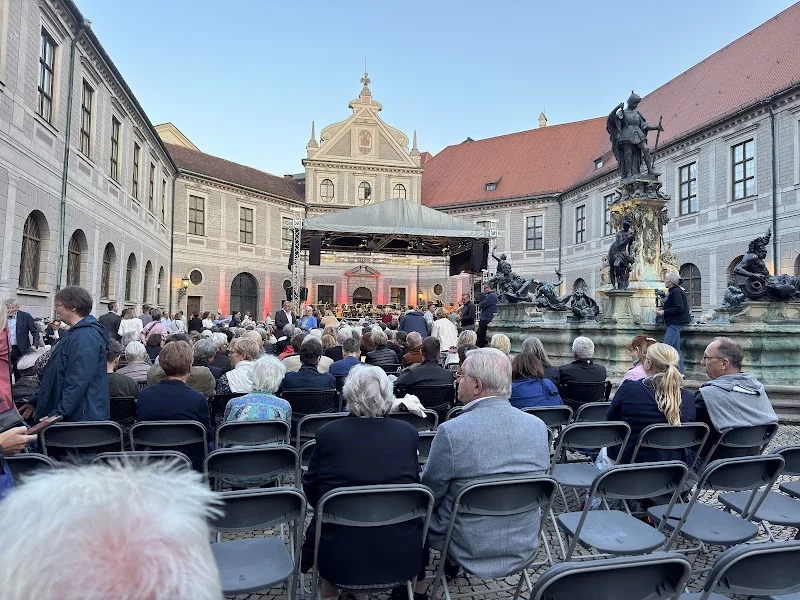
The Fountain Courtyard is one of the most historically significant courtyards of the Munich Residence. The official information on the Residence Courtyards page describes it as an octagonal courtyard, with its southern side formed by the Antiquarium. The courtyard was created during the reign of Duke Maximilian I and received its name from the fountain in the center, on which stands a bronze statue of Duke Otto I, the first Duke of Bavaria from the House of Wittelsbach. These details are not only historically remarkable but also explain why the Fountain Courtyard has such a strong visual presence. It is not a randomly open interior space but a deliberately shaped representation space that impressively continues the courtly architecture of the Residence. ([residenz-muenchen.de](https://www.residenz-muenchen.de/englisch/c-yards/index.htm))
In the history of the Residence, the courtyard played a representative and festive role. In the 17th century, the Fountain Courtyard, with its characteristic gable architecture, was often used as a venue for court tournaments; only high-ranking visitors were allowed to enter the courtyard with their carriages. The courtyard descriptions of the Residence also emphasize that the Fountain Courtyard and the Imperial Courtyard had particularly important functions as open foyers, reception areas, and places for court ceremonies. This is precisely what attracts today's visitors: Those experiencing a concert here are not simply sitting or standing in front of a beautiful facade but in a space that has been shaped for centuries by power, representation, and festive staging. ([residenz-muenchen.de](https://www.residenz-muenchen.de/englisch/c-yards/index.htm))
The Residence itself is an evolved complex that has been expanded over centuries and is now considered the largest urban palace complex in Germany. The Fountain Courtyard is a particularly striking courtyard in this system because it combines historical architecture, open spatial feeling, and modern event use. This makes it understandable why the location is exciting for both culture-historical enthusiasts and event visitors. The place tells Munich's history not in a closed museum tone but in the lively interplay with current events. This coexistence of past and present is one of the strongest reasons why the Fountain Courtyard of the Munich Residence is so frequently searched online. ([residenz-muenchen.de](https://www.residenz-muenchen.de/deutsch/tourist/mobilitaet.htm))
Capacity, Room Size, and Use for Events
The official room page of the Bavarian Palace Administration provides the most important practical facts for organizers and visitors. The Fountain Courtyard is listed as having 2,300 square meters, specifically measuring 30.5 by 83 meters, and can be booked year-round. Additionally, toilets are available, which is an important infrastructural advantage for event use. The description states that the courtyard is suitable for concerts, presentations, and high-profile corporate events. This shows that the Fountain Courtyard is not only interesting for the classical cultural sector but also for representative business formats, provided the historical setting fits the occasion. ([schloesser.bayern.de](https://www.schloesser.bayern.de/deutsch/raeume/objekte/mu_r_br.htm))
The capacity is also frequently searched, and here the official information is clear: The Fountain Courtyard has a maximum occupancy of 1,627 people, both for standing and seated arrangements. This number makes it clear that the area is very generously sized and suitable for large summer concerts. Additionally, the room page states that concert seating and concert stages are provided by specialized agencies, and public events can be accompanied by a fixed gastronomy or accredited caterers. This makes it visible that the Fountain Courtyard is a professionally organized event space whose historical ambiance is connected with clear operational structures. ([schloesser.bayern.de](https://www.schloesser.bayern.de/deutsch/raeume/objekte/mu_r_br.htm))
For visitors, this results in a particularly coherent overall picture: a courtyard with a large area, clear visitor logic, central location, and an event calendar that ranges from classical music to pop and crossover formats. This is precisely why the Fountain Courtyard works so well as a search term for concerts, programs, directions, and parking. The location combines the requirements of a modern event stage with the charm of a historical place without losing its origins. Those looking for a culturally impactful summer evening in Munich that can be easily planned will find one of the most prominent addresses in the city at the Fountain Courtyard of the Munich Residence. ([residenz-muenchen.de](https://www.residenz-muenchen.de/deutsch/aktuell/veranst_erg.asp?PN=2&optArt=5&optMonat=999999&optOrt=18&optRaum=999999&optSuchfeld=))
Sources:
Mehr anzeigenWeniger anzeigen
Fountain Courtyard of the Munich Residence | Concerts & Program 2026
The Fountain Courtyard of the Munich Residence is one of the most impressive venues for open-air concerts in the Bavarian capital and at the same time a space where history and the present meet in a particularly elegant way. The courtyard is part of the Munich Residence, which includes a total of ten courtyards, and was already a representative area for reception, passage, and festive staging during the courtly era. Today, many visitors seek out this location because they want to discover the current program, the entrance, directions, parking options, or special concert series such as concerts in 2026, Queen, ABBA, or Carmina Burana. The Fountain Courtyard is located in the city center, is easily accessible by public transport, and according to official information does not have its own visitor parking; paid parking is available in the underground garage of the National Theater at Max-Joseph-Platz. For a cultural visit in Munich, this is a rare combination of central location, historical atmosphere, and practical accessibility. ([residenz-muenchen.de](https://www.residenz-muenchen.de/englisch/c-yards/index.htm))
Program 2026, Tickets, and Open-Air Concerts
Those searching for the Fountain Courtyard of the Munich Residence and the keyword program 2026 will find a calendar that clearly positions the courtyard as a concert stage in summer. The official event pages of the Bavarian Palace Administration and muenchen.de show several open-air dates in the Fountain Courtyard for July and August 2026, aimed at a broad audience. These include the Summer Proms in the Fountain Courtyard, a classical concert with Munich Symphony Orchestra, as well as themed evenings with different line-ups. This mix makes the courtyard particularly attractive for searches: it is not only a historical site but also a vibrant event venue where classical music, crossover programs, and pop formats take place side by side. This is helpful for visitors as it quickly provides a broad overview of the summer offerings at the location. ([residenz-muenchen.de](https://www.residenz-muenchen.de/deutsch/aktuell/veranst_erg.asp?PN=2&optArt=5&optMonat=999999&optOrt=18&optRaum=999999&optSuchfeld=))
The specific selection for 2026 shows how versatile the Fountain Courtyard is as an open-air location. The official calendar includes events such as A Philharmonic Fun, Fireworks Music, ABBA Summer Night, The Music of Queen - Live, Carmina Burana, Best of Musicals, Festival Son de Cuba, Münchener Freiheit, Pink Floyd performed by echoes, and Italo Pop Night. The city’s event overview also lists Italian Night, Italian Opera Night, Summer Night of Italian Classics, and other concert evenings. This range is a strong SEO signal because search queries revolve not only around a location but also around very specific program requests. The Fountain Courtyard thus becomes a destination for people who are deliberately looking for a specific summer concert, a tribute show, or a classical event in a historical setting. ([residenz-muenchen.de](https://www.residenz-muenchen.de/deutsch/aktuell/veranst_erg.asp?PN=2&optArt=5&optMonat=999999&optOrt=18&optRaum=999999&optSuchfeld=))
When it comes to tickets, the search interest is also clear: The event entries each refer to further information and ticket links, indicating that the Fountain Courtyard is not perceived merely as a museum-like place but as an active event location with a clear audience orientation. This is important for search intent, as users often want not only the address but also to know immediately whether an event is already bookable, which evenings are particularly in demand, and what the sequence of the summer program is. By focusing on evening dates, open-air concerts, and well-known titles, a high click and recognition power is generated. This mix of program diversity, central location, and historical surroundings makes the Fountain Courtyard of the Munich Residence one of the strongest summer terms in the cultural and concert scene of the city. ([residenz-muenchen.de](https://www.residenz-muenchen.de/deutsch/aktuell/veranst_erg.asp?PN=2&optArt=5&optMonat=999999&optOrt=18&optRaum=999999&optSuchfeld=))
Italian Night, ABBA, Queen, and Carmina Burana
The search queries around Italian Night, ABBA, Queen, and Carmina Burana clearly show what kind of experience is expected in the Fountain Courtyard: emotional summer evenings with well-known melodies, high recognition value, and a backdrop that makes the event feel larger than an ordinary concert venue. The official listings for 2026 confirm this mix. In addition to classical formats, there are tribute and themed evenings such as The Music of Queen - Live, ABBA Summer Night, ABBA Night, and Carmina Burana. Additionally, there are Italian-themed program points such as Italian Night, Italian Opera Night, Italo Pop Night, and the Summer Night of Italian Classics. The Fountain Courtyard is thus not limited to a single genre but is used as a stage for very different musical moods. ([muenchen.de](https://www.muenchen.de/veranstaltungen/veranstaltungsorte/brunnenhof-der-residenz?utm_source=openai))
This thematic breadth explains why the Fountain Courtyard often appears in search engines together with specific work and band names. Those searching for Queen or ABBA do not expect an abstract event page but a place that hosts exactly such evenings. The Fountain Courtyard meets this expectation because the program for 2026 bundles rock classics, pop hits, film music, classical music, and vocal spectacles in a summer calendar. From a content perspective, this means: The location is not only architecturally interesting but also content-wise adaptable for different target groups, from classical music fans to visitors looking for an easily accessible summer concert with a nostalgic factor. The search terms thus reflect less coincidence and more a clear usage behavior: People want a special evening, but in a historical setting. ([muenchen.de](https://www.muenchen.de/veranstaltungen/veranstaltungsorte/brunnenhof-der-residenz?utm_source=openai))
Moreover, the historical atmosphere of the Fountain Courtyard enhances the musical experience. An ABBA evening feels different in the open courtyard than in a classical hall, and Carmina Burana gains additional impact from the architectural framework. This is precisely the strength of the location: it does not provide a neutral stage but a space with character. For SEO, this is important because search terms like Italian Night, Queen, or Carmina Burana should not be treated in isolation but as part of a larger promise of experience. The Fountain Courtyard stands for summer, sound, light, and historical representation. This connection between program and location explains why the courtyard has established itself as a fixed feature in the Munich concert summer. ([residenz-muenchen.de](https://www.residenz-muenchen.de/englisch/c-yards/index.htm))
Directions, Maps, and Parking at the Munich Residence
For many visitors, the directions are a crucial practical point, and here the Fountain Courtyard of the Munich Residence is pleasantly centrally located. The official visitor information of the Residence describes the location as being in the city center with very good public transport connections. Nearby are the S-Bahn station Marienplatz, the U-Bahn stations Marienplatz and Odeonsplatz, as well as the bus stops Odeonsplatz and tram National Theater. For those traveling from Munich or further away, there are several comfortable options to reach the courtyard without complicated detours. This is particularly relevant for search queries like directions, maps, or Residenzstraße 1, as the location is clearly situated in the heart of the city and not on the outskirts or in a hard-to-reach area. ([residenz-muenchen.de](https://www.residenz-muenchen.de/deutsch/tourist/anfahrt.htm))
When it comes to parking, the answer is equally clear: The Munich Residence does not have its own visitor parking. Instead, the official directions page refers to paid parking options in the underground garage of the National Theater at Max-Joseph-Platz; additionally, the Residence mentions four disabled parking spaces on Maximilianstraße opposite house number 2. This is a relevant plus point for visitors with limited mobility, as the routes in the city center are not arbitrary and clear prior information avoids unnecessary stress. This transparency is particularly valuable during sold-out summer evenings. ([residenz-muenchen.de](https://www.residenz-muenchen.de/deutsch/tourist/anfahrt.htm))
The location is also favorable for route planning on foot or by bicycle. The Residence explicitly refers to an overview plan as well as map functions, which facilitate orientation in the historical building complex. Those cycling in Munich will also find a generally city-central, well-developed environment. For the content strategy, this is important because the keywords maps, entrance, parking, and directions are not just technical search terms but reflect real user questions. The Fountain Courtyard of the Munich Residence is therefore a classic example of a location where good accessibility complements the cultural appeal rather than replacing it. ([residenz-muenchen.de](https://www.residenz-muenchen.de/deutsch/tourist/anfahrt.htm))
Entrance, Orientation, and Location in the Historical Center
Orientation in the area of the Residence is a central theme because the Fountain Courtyard is not experienced as a freestanding hall but as part of a far-reaching historical ensemble. The Fountain Courtyard is listed in the official courtyard descriptions as Fountain Courtyard and is accessed from Residenzstraße through a large gate flanked by lions. This entrance situation is not only architecturally striking but also important for user-friendliness as it provides a clear pathway. Those visiting the Fountain Courtyard for the first time do not stand before an anonymous entrance but before an impressive, historical access situation that immediately signals they are in one of the most significant areas of the Residence. ([residenz-muenchen.de](https://www.residenz-muenchen.de/englisch/c-yards/index.htm))
Additionally, for many visitors, the entrance to the Cuvilliés Theater is relevant, as this is often visited or sought in the context of the Fountain Courtyard. The official opening hours page mentions the access to the Cuvilliés Theater in the passage between the Fountain Courtyard and the Apothecary Courtyard. The mobility page adds that the theater is barrier-free and that a barrier-free access with a bell is located on the southeast side of the Fountain Courtyard. This is particularly helpful for guests who are not only attending concerts but are also heading to the historical theater space or other parts of the Residence complex. For SEO, this combination of Fountain Courtyard, entrance, and Apothecary Courtyard is important as it reflects typical search intentions: People want to find the place without getting lost in the large Residence ensemble. ([residenz-muenchen.de](https://www.residenz-muenchen.de/deutsch/tourist/oeffnung.htm))
The location in the center of Munich is also an essential part of the experience. The Fountain Courtyard is situated in an environment where the Residence, Hofgarten, Odeonsplatz, and National Theater are closely connected spatially. This creates a coherent overall picture for visitors of culture, city history, and urban mobility. Those arriving early can perceive the path through the Residence complex, the Hofgarten, or the neighboring streets as part of the evening. This is precisely what makes the location so attractive: The journey to the concert is not just a commute but already part of the atmosphere. The search terms maps, entrance, and address are therefore not side questions but central components of the location experience. ([residenz-muenchen.de](https://www.residenz-muenchen.de/deutsch/tourist/anfahrt.htm))
History of the Fountain Courtyard and the Residence Courtyards
The Fountain Courtyard is one of the most historically significant courtyards of the Munich Residence. The official information on the Residence Courtyards page describes it as an octagonal courtyard, with its southern side formed by the Antiquarium. The courtyard was created during the reign of Duke Maximilian I and received its name from the fountain in the center, on which stands a bronze statue of Duke Otto I, the first Duke of Bavaria from the House of Wittelsbach. These details are not only historically remarkable but also explain why the Fountain Courtyard has such a strong visual presence. It is not a randomly open interior space but a deliberately shaped representation space that impressively continues the courtly architecture of the Residence. ([residenz-muenchen.de](https://www.residenz-muenchen.de/englisch/c-yards/index.htm))
In the history of the Residence, the courtyard played a representative and festive role. In the 17th century, the Fountain Courtyard, with its characteristic gable architecture, was often used as a venue for court tournaments; only high-ranking visitors were allowed to enter the courtyard with their carriages. The courtyard descriptions of the Residence also emphasize that the Fountain Courtyard and the Imperial Courtyard had particularly important functions as open foyers, reception areas, and places for court ceremonies. This is precisely what attracts today's visitors: Those experiencing a concert here are not simply sitting or standing in front of a beautiful facade but in a space that has been shaped for centuries by power, representation, and festive staging. ([residenz-muenchen.de](https://www.residenz-muenchen.de/englisch/c-yards/index.htm))
The Residence itself is an evolved complex that has been expanded over centuries and is now considered the largest urban palace complex in Germany. The Fountain Courtyard is a particularly striking courtyard in this system because it combines historical architecture, open spatial feeling, and modern event use. This makes it understandable why the location is exciting for both culture-historical enthusiasts and event visitors. The place tells Munich's history not in a closed museum tone but in the lively interplay with current events. This coexistence of past and present is one of the strongest reasons why the Fountain Courtyard of the Munich Residence is so frequently searched online. ([residenz-muenchen.de](https://www.residenz-muenchen.de/deutsch/tourist/mobilitaet.htm))
Capacity, Room Size, and Use for Events
The official room page of the Bavarian Palace Administration provides the most important practical facts for organizers and visitors. The Fountain Courtyard is listed as having 2,300 square meters, specifically measuring 30.5 by 83 meters, and can be booked year-round. Additionally, toilets are available, which is an important infrastructural advantage for event use. The description states that the courtyard is suitable for concerts, presentations, and high-profile corporate events. This shows that the Fountain Courtyard is not only interesting for the classical cultural sector but also for representative business formats, provided the historical setting fits the occasion. ([schloesser.bayern.de](https://www.schloesser.bayern.de/deutsch/raeume/objekte/mu_r_br.htm))
The capacity is also frequently searched, and here the official information is clear: The Fountain Courtyard has a maximum occupancy of 1,627 people, both for standing and seated arrangements. This number makes it clear that the area is very generously sized and suitable for large summer concerts. Additionally, the room page states that concert seating and concert stages are provided by specialized agencies, and public events can be accompanied by a fixed gastronomy or accredited caterers. This makes it visible that the Fountain Courtyard is a professionally organized event space whose historical ambiance is connected with clear operational structures. ([schloesser.bayern.de](https://www.schloesser.bayern.de/deutsch/raeume/objekte/mu_r_br.htm))
For visitors, this results in a particularly coherent overall picture: a courtyard with a large area, clear visitor logic, central location, and an event calendar that ranges from classical music to pop and crossover formats. This is precisely why the Fountain Courtyard works so well as a search term for concerts, programs, directions, and parking. The location combines the requirements of a modern event stage with the charm of a historical place without losing its origins. Those looking for a culturally impactful summer evening in Munich that can be easily planned will find one of the most prominent addresses in the city at the Fountain Courtyard of the Munich Residence. ([residenz-muenchen.de](https://www.residenz-muenchen.de/deutsch/aktuell/veranst_erg.asp?PN=2&optArt=5&optMonat=999999&optOrt=18&optRaum=999999&optSuchfeld=))
Sources:
Fountain Courtyard of the Munich Residence | Concerts & Program 2026
The Fountain Courtyard of the Munich Residence is one of the most impressive venues for open-air concerts in the Bavarian capital and at the same time a space where history and the present meet in a particularly elegant way. The courtyard is part of the Munich Residence, which includes a total of ten courtyards, and was already a representative area for reception, passage, and festive staging during the courtly era. Today, many visitors seek out this location because they want to discover the current program, the entrance, directions, parking options, or special concert series such as concerts in 2026, Queen, ABBA, or Carmina Burana. The Fountain Courtyard is located in the city center, is easily accessible by public transport, and according to official information does not have its own visitor parking; paid parking is available in the underground garage of the National Theater at Max-Joseph-Platz. For a cultural visit in Munich, this is a rare combination of central location, historical atmosphere, and practical accessibility. ([residenz-muenchen.de](https://www.residenz-muenchen.de/englisch/c-yards/index.htm))
Program 2026, Tickets, and Open-Air Concerts
Those searching for the Fountain Courtyard of the Munich Residence and the keyword program 2026 will find a calendar that clearly positions the courtyard as a concert stage in summer. The official event pages of the Bavarian Palace Administration and muenchen.de show several open-air dates in the Fountain Courtyard for July and August 2026, aimed at a broad audience. These include the Summer Proms in the Fountain Courtyard, a classical concert with Munich Symphony Orchestra, as well as themed evenings with different line-ups. This mix makes the courtyard particularly attractive for searches: it is not only a historical site but also a vibrant event venue where classical music, crossover programs, and pop formats take place side by side. This is helpful for visitors as it quickly provides a broad overview of the summer offerings at the location. ([residenz-muenchen.de](https://www.residenz-muenchen.de/deutsch/aktuell/veranst_erg.asp?PN=2&optArt=5&optMonat=999999&optOrt=18&optRaum=999999&optSuchfeld=))
The specific selection for 2026 shows how versatile the Fountain Courtyard is as an open-air location. The official calendar includes events such as A Philharmonic Fun, Fireworks Music, ABBA Summer Night, The Music of Queen - Live, Carmina Burana, Best of Musicals, Festival Son de Cuba, Münchener Freiheit, Pink Floyd performed by echoes, and Italo Pop Night. The city’s event overview also lists Italian Night, Italian Opera Night, Summer Night of Italian Classics, and other concert evenings. This range is a strong SEO signal because search queries revolve not only around a location but also around very specific program requests. The Fountain Courtyard thus becomes a destination for people who are deliberately looking for a specific summer concert, a tribute show, or a classical event in a historical setting. ([residenz-muenchen.de](https://www.residenz-muenchen.de/deutsch/aktuell/veranst_erg.asp?PN=2&optArt=5&optMonat=999999&optOrt=18&optRaum=999999&optSuchfeld=))
When it comes to tickets, the search interest is also clear: The event entries each refer to further information and ticket links, indicating that the Fountain Courtyard is not perceived merely as a museum-like place but as an active event location with a clear audience orientation. This is important for search intent, as users often want not only the address but also to know immediately whether an event is already bookable, which evenings are particularly in demand, and what the sequence of the summer program is. By focusing on evening dates, open-air concerts, and well-known titles, a high click and recognition power is generated. This mix of program diversity, central location, and historical surroundings makes the Fountain Courtyard of the Munich Residence one of the strongest summer terms in the cultural and concert scene of the city. ([residenz-muenchen.de](https://www.residenz-muenchen.de/deutsch/aktuell/veranst_erg.asp?PN=2&optArt=5&optMonat=999999&optOrt=18&optRaum=999999&optSuchfeld=))
Italian Night, ABBA, Queen, and Carmina Burana
The search queries around Italian Night, ABBA, Queen, and Carmina Burana clearly show what kind of experience is expected in the Fountain Courtyard: emotional summer evenings with well-known melodies, high recognition value, and a backdrop that makes the event feel larger than an ordinary concert venue. The official listings for 2026 confirm this mix. In addition to classical formats, there are tribute and themed evenings such as The Music of Queen - Live, ABBA Summer Night, ABBA Night, and Carmina Burana. Additionally, there are Italian-themed program points such as Italian Night, Italian Opera Night, Italo Pop Night, and the Summer Night of Italian Classics. The Fountain Courtyard is thus not limited to a single genre but is used as a stage for very different musical moods. ([muenchen.de](https://www.muenchen.de/veranstaltungen/veranstaltungsorte/brunnenhof-der-residenz?utm_source=openai))
This thematic breadth explains why the Fountain Courtyard often appears in search engines together with specific work and band names. Those searching for Queen or ABBA do not expect an abstract event page but a place that hosts exactly such evenings. The Fountain Courtyard meets this expectation because the program for 2026 bundles rock classics, pop hits, film music, classical music, and vocal spectacles in a summer calendar. From a content perspective, this means: The location is not only architecturally interesting but also content-wise adaptable for different target groups, from classical music fans to visitors looking for an easily accessible summer concert with a nostalgic factor. The search terms thus reflect less coincidence and more a clear usage behavior: People want a special evening, but in a historical setting. ([muenchen.de](https://www.muenchen.de/veranstaltungen/veranstaltungsorte/brunnenhof-der-residenz?utm_source=openai))
Moreover, the historical atmosphere of the Fountain Courtyard enhances the musical experience. An ABBA evening feels different in the open courtyard than in a classical hall, and Carmina Burana gains additional impact from the architectural framework. This is precisely the strength of the location: it does not provide a neutral stage but a space with character. For SEO, this is important because search terms like Italian Night, Queen, or Carmina Burana should not be treated in isolation but as part of a larger promise of experience. The Fountain Courtyard stands for summer, sound, light, and historical representation. This connection between program and location explains why the courtyard has established itself as a fixed feature in the Munich concert summer. ([residenz-muenchen.de](https://www.residenz-muenchen.de/englisch/c-yards/index.htm))
Directions, Maps, and Parking at the Munich Residence
For many visitors, the directions are a crucial practical point, and here the Fountain Courtyard of the Munich Residence is pleasantly centrally located. The official visitor information of the Residence describes the location as being in the city center with very good public transport connections. Nearby are the S-Bahn station Marienplatz, the U-Bahn stations Marienplatz and Odeonsplatz, as well as the bus stops Odeonsplatz and tram National Theater. For those traveling from Munich or further away, there are several comfortable options to reach the courtyard without complicated detours. This is particularly relevant for search queries like directions, maps, or Residenzstraße 1, as the location is clearly situated in the heart of the city and not on the outskirts or in a hard-to-reach area. ([residenz-muenchen.de](https://www.residenz-muenchen.de/deutsch/tourist/anfahrt.htm))
When it comes to parking, the answer is equally clear: The Munich Residence does not have its own visitor parking. Instead, the official directions page refers to paid parking options in the underground garage of the National Theater at Max-Joseph-Platz; additionally, the Residence mentions four disabled parking spaces on Maximilianstraße opposite house number 2. This is a relevant plus point for visitors with limited mobility, as the routes in the city center are not arbitrary and clear prior information avoids unnecessary stress. This transparency is particularly valuable during sold-out summer evenings. ([residenz-muenchen.de](https://www.residenz-muenchen.de/deutsch/tourist/anfahrt.htm))
The location is also favorable for route planning on foot or by bicycle. The Residence explicitly refers to an overview plan as well as map functions, which facilitate orientation in the historical building complex. Those cycling in Munich will also find a generally city-central, well-developed environment. For the content strategy, this is important because the keywords maps, entrance, parking, and directions are not just technical search terms but reflect real user questions. The Fountain Courtyard of the Munich Residence is therefore a classic example of a location where good accessibility complements the cultural appeal rather than replacing it. ([residenz-muenchen.de](https://www.residenz-muenchen.de/deutsch/tourist/anfahrt.htm))
Entrance, Orientation, and Location in the Historical Center
Orientation in the area of the Residence is a central theme because the Fountain Courtyard is not experienced as a freestanding hall but as part of a far-reaching historical ensemble. The Fountain Courtyard is listed in the official courtyard descriptions as Fountain Courtyard and is accessed from Residenzstraße through a large gate flanked by lions. This entrance situation is not only architecturally striking but also important for user-friendliness as it provides a clear pathway. Those visiting the Fountain Courtyard for the first time do not stand before an anonymous entrance but before an impressive, historical access situation that immediately signals they are in one of the most significant areas of the Residence. ([residenz-muenchen.de](https://www.residenz-muenchen.de/englisch/c-yards/index.htm))
Additionally, for many visitors, the entrance to the Cuvilliés Theater is relevant, as this is often visited or sought in the context of the Fountain Courtyard. The official opening hours page mentions the access to the Cuvilliés Theater in the passage between the Fountain Courtyard and the Apothecary Courtyard. The mobility page adds that the theater is barrier-free and that a barrier-free access with a bell is located on the southeast side of the Fountain Courtyard. This is particularly helpful for guests who are not only attending concerts but are also heading to the historical theater space or other parts of the Residence complex. For SEO, this combination of Fountain Courtyard, entrance, and Apothecary Courtyard is important as it reflects typical search intentions: People want to find the place without getting lost in the large Residence ensemble. ([residenz-muenchen.de](https://www.residenz-muenchen.de/deutsch/tourist/oeffnung.htm))
The location in the center of Munich is also an essential part of the experience. The Fountain Courtyard is situated in an environment where the Residence, Hofgarten, Odeonsplatz, and National Theater are closely connected spatially. This creates a coherent overall picture for visitors of culture, city history, and urban mobility. Those arriving early can perceive the path through the Residence complex, the Hofgarten, or the neighboring streets as part of the evening. This is precisely what makes the location so attractive: The journey to the concert is not just a commute but already part of the atmosphere. The search terms maps, entrance, and address are therefore not side questions but central components of the location experience. ([residenz-muenchen.de](https://www.residenz-muenchen.de/deutsch/tourist/anfahrt.htm))
History of the Fountain Courtyard and the Residence Courtyards
The Fountain Courtyard is one of the most historically significant courtyards of the Munich Residence. The official information on the Residence Courtyards page describes it as an octagonal courtyard, with its southern side formed by the Antiquarium. The courtyard was created during the reign of Duke Maximilian I and received its name from the fountain in the center, on which stands a bronze statue of Duke Otto I, the first Duke of Bavaria from the House of Wittelsbach. These details are not only historically remarkable but also explain why the Fountain Courtyard has such a strong visual presence. It is not a randomly open interior space but a deliberately shaped representation space that impressively continues the courtly architecture of the Residence. ([residenz-muenchen.de](https://www.residenz-muenchen.de/englisch/c-yards/index.htm))
In the history of the Residence, the courtyard played a representative and festive role. In the 17th century, the Fountain Courtyard, with its characteristic gable architecture, was often used as a venue for court tournaments; only high-ranking visitors were allowed to enter the courtyard with their carriages. The courtyard descriptions of the Residence also emphasize that the Fountain Courtyard and the Imperial Courtyard had particularly important functions as open foyers, reception areas, and places for court ceremonies. This is precisely what attracts today's visitors: Those experiencing a concert here are not simply sitting or standing in front of a beautiful facade but in a space that has been shaped for centuries by power, representation, and festive staging. ([residenz-muenchen.de](https://www.residenz-muenchen.de/englisch/c-yards/index.htm))
The Residence itself is an evolved complex that has been expanded over centuries and is now considered the largest urban palace complex in Germany. The Fountain Courtyard is a particularly striking courtyard in this system because it combines historical architecture, open spatial feeling, and modern event use. This makes it understandable why the location is exciting for both culture-historical enthusiasts and event visitors. The place tells Munich's history not in a closed museum tone but in the lively interplay with current events. This coexistence of past and present is one of the strongest reasons why the Fountain Courtyard of the Munich Residence is so frequently searched online. ([residenz-muenchen.de](https://www.residenz-muenchen.de/deutsch/tourist/mobilitaet.htm))
Capacity, Room Size, and Use for Events
The official room page of the Bavarian Palace Administration provides the most important practical facts for organizers and visitors. The Fountain Courtyard is listed as having 2,300 square meters, specifically measuring 30.5 by 83 meters, and can be booked year-round. Additionally, toilets are available, which is an important infrastructural advantage for event use. The description states that the courtyard is suitable for concerts, presentations, and high-profile corporate events. This shows that the Fountain Courtyard is not only interesting for the classical cultural sector but also for representative business formats, provided the historical setting fits the occasion. ([schloesser.bayern.de](https://www.schloesser.bayern.de/deutsch/raeume/objekte/mu_r_br.htm))
The capacity is also frequently searched, and here the official information is clear: The Fountain Courtyard has a maximum occupancy of 1,627 people, both for standing and seated arrangements. This number makes it clear that the area is very generously sized and suitable for large summer concerts. Additionally, the room page states that concert seating and concert stages are provided by specialized agencies, and public events can be accompanied by a fixed gastronomy or accredited caterers. This makes it visible that the Fountain Courtyard is a professionally organized event space whose historical ambiance is connected with clear operational structures. ([schloesser.bayern.de](https://www.schloesser.bayern.de/deutsch/raeume/objekte/mu_r_br.htm))
For visitors, this results in a particularly coherent overall picture: a courtyard with a large area, clear visitor logic, central location, and an event calendar that ranges from classical music to pop and crossover formats. This is precisely why the Fountain Courtyard works so well as a search term for concerts, programs, directions, and parking. The location combines the requirements of a modern event stage with the charm of a historical place without losing its origins. Those looking for a culturally impactful summer evening in Munich that can be easily planned will find one of the most prominent addresses in the city at the Fountain Courtyard of the Munich Residence. ([residenz-muenchen.de](https://www.residenz-muenchen.de/deutsch/aktuell/veranst_erg.asp?PN=2&optArt=5&optMonat=999999&optOrt=18&optRaum=999999&optSuchfeld=))
Sources:
Upcoming Events
Frequently Asked Questions
Reviews
No reviews found