
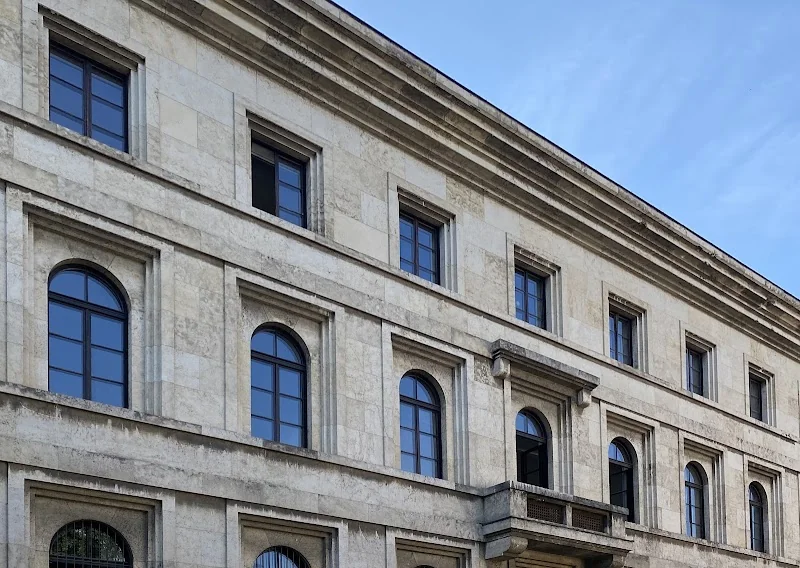
Katharina-von-Bora-Straße 10, München-Maxvorstadt
Katharina-von-Bora-Straße 10, 80333 München, Germany
Central Institute of Art History | Opening Hours & Library
The Central Institute of Art History in Munich is not an ordinary place, but a scientific center with international outreach that consolidates research, literature, images, and public discussion under one roof. Those searching for the Central Institute of Art History Munich usually refer to the ZI in the Munich art area, a place where art historical research is not only managed but actively produced, documented, and communicated. The institute is the only non-university art historical research institute in Germany and sees itself as a forum for exchange, methodological discussion, and new perspectives on art history. At the same time, it serves as a service location for research, as the library, photo library, and digital offerings are deeply interconnected. Since its founding in 1946 and the start of its activities in 1947, the ZI has stood for international networking, historical responsibility, and the attempt to live art history as an open, contemporary science. This is precisely what makes the location so interesting for seekers: those looking for opening hours, directions, photos, library, events, or the history of the building will find not just an address but a complete knowledge infrastructure. ([zikg.eu](https://www.zikg.eu/institut))
Opening Hours, Library, and On-Site Use
The library of the Central Institute of Art History is a reference library with limited access and primarily serves scientific research but also professional work and further education. For many users, this is the most important reason to visit the ZI: one comes not only to read but to work at one of the largest art historical knowledge centers in Germany. The reading rooms are open Monday to Friday from 9:00 AM to 10:00 PM, and Saturdays from 9:00 AM to 1:00 PM. The library is closed on public holidays, including the Assumption of Mary in Munich. Those needing a library card can obtain it in person on-site during exhibition hours Monday to Friday from 9:00 AM to 1:00 PM and from 2:00 PM to 5:00 PM. For registration, an ID and proof of scientific, professional, or student employment are required. These clear rules are practical for visitors as they make the visit planable and explain why the ZI is particularly focused on concentrated work. ([zikg.eu](https://www.zikg.eu/bibliothek))
The collection is exceptionally large and precisely tailored to art history. With over 773,000 media units, 1,147 regularly subscribed journals, over 79,000 auction catalogs, and 1,088 permanently acquired e-books, the library is internationally one of the largest art libraries and is considered the largest art science library in Germany. The vast majority of the collection is directly accessible in a free access system, which significantly facilitates practical use. The library covers the entire history of art from the early Middle Ages to the present and maintains focuses on art from France, art and art scientific literature from Eastern and Southeastern Europe, art theory and the history of science, as well as iconography. In addition, it includes theoretical architectural source texts, art historical garden literature, and literature on art and architecture of the 20th and 21st centuries. Therefore, anyone searching for art historical library, ZI Munich, or central art in connection with scientific research will find a place here that not only provides impressive numbers but is also highly specialized in content. ([zikg.eu](https://www.zikg.eu/bibliothek))
Directions, Parking, and Accessibility
The address of the institute is Katharina-von-Bora-Straße 10, 80333 Munich. This places the Central Institute of Art History in Munich-Maxvorstadt in the art area, in close proximity to museums, universities, and other scientific institutions. This location is a real advantage for visitors because the building is not isolated but embedded in a dense scientific environment. For travel, the institute recommends using OpenStreetMap as well as the information systems of MVV, Deutsche Bahn, and Bayerninfo. Therefore, those arriving by public transport, long-distance train, or from the surrounding area can easily combine their visit with other stops in the art area. This proximity to cultural and scientific institutions is not only practical but also part of the institution's self-understanding as a research location. ([zikg.eu](https://www.zikg.eu/institut/kontakt))
When parking, it is important that the building offers a specific, accessibility-oriented solution: there is a disabled parking space directly at the south gate. The accessible entrance is via an outdoor elevator at the south gate, which is operated via a bell with an intercom. Additionally, the building has two passenger elevators that allow access to the library and magazine levels, as well as accessible restrooms on the first floor. At the same time, the institute openly points out that accessible access is currently only limited because a third elevator has been decommissioned. Those with mobility impairments should therefore contact the secretariat or the gate before their visit. For inquiries such as parking, accessible access, or directions, this is particularly relevant because the ZI provides very concrete and honest visitor information. ([zikg.eu](https://www.zikg.eu/institut/kontakt/barrierefreiheit))
History of the Central Institute and Its Foundation
The history of the Central Institute for Art History is closely linked to the immediate post-war period. According to the official account, the institute was founded in November 1946 and began its activities in March 1947. Its historical origin is connected to the Central Art Collecting Point that the American military government established in Munich in 1945. This institution served to collect art that had been looted or removed under problematic circumstances in Europe and to return it to its rightful owners. Thus, the ZI is not only a research institution but also a place where scientific work, historical responsibility, and questions of restitution have intersected since its inception. This origin explains why provenance research plays such an important role at the ZI to this day and why topics such as Nazi art, post-war history, and cultural heritage are firmly part of the institutional identity. ([zikg.eu](https://www.zikg.eu/institut/geschichte?utm_source=openai))
The historical development can also be traced through the leadership of the institute. The official chronicle mentions Wolfgang Lotz as Acting Director, Ludwig Heinrich Heydenreich, Willibald Sauerländer, Wolf Tegethoff, and since 2018 Ulrich Pfisterer. Since 1979, the ZI has been solely owned by the Free State of Bavaria and is subordinate to the Bavarian State Ministry of Science and the Arts. Today's research work is thematically divided into the areas of object and materiality, art history as knowledge and science, and art in the historical-political space and global context. In addition, there is the study center for modern and contemporary art, which is particularly well-equipped for research on 20th and 21st-century art. Therefore, anyone searching for history, foundation 1946, or Central European Research Institute for Art History will find here an institute that emerged from a specific historical situation yet has developed a very open, international horizon. ([zikg.eu](https://www.zikg.eu/institut))
Library and Collections: From Specialized Literature to Auction Catalogs
The library is one of the strongest reasons why the Central Institute of Art History is so well-known in the professional world. It is not only large but also methodically organized: the majority of the collection is in a free access system, and the magazines are organized both substantively and formally. This significantly eases work on-site, especially for researchers who need to quickly switch between literature, auction catalogs, journals, and digital resources. With over 773,000 media units, 1,147 regularly subscribed journals, over 79,000 auction catalogs, and 1,088 e-books, the library is not just a local institution but an international reference. Additionally, the institute provides numerous online offerings and databases that extend the research process far beyond the building. For a search intent like central institute of art history munich photos, it is particularly exciting that the library does not work in isolation but is linked with image databases, catalogs, and digital collections. This makes the house a place where texts and images are not separated but understood as part of the same research practice. ([zikg.eu](https://www.zikg.eu/bibliothek))
Content-wise, the library is exceptionally broad. It not only collects general art historical literature but also maintains focuses that are not brought together in this depth in many other institutions. These include art from France, art and art scientific literature from Eastern and Southeastern Europe, art theory and the history of science, as well as iconography. The profile is complemented by theoretical architectural source texts, art historical garden literature, and publications on art and architecture of the 20th and 21st centuries. The digital collection of the ZI library also provides current and retro-digitized ZI publications in open access, which is particularly valuable for research, teaching, and quick initial orientation. Therefore, anyone who wants to understand the institute not just as a building but as a workplace quickly recognizes the core: the ZI is a research machine for art historical questions that creates a robust knowledge base from literature, sources, and digital tools. ([zikg.eu](https://www.zikg.eu/bibliothek/bestaende?utm_source=openai))
Photo Library and Collections: Image Research at a High Level
The photo library of the Central Institute for Art History is a central component of the house and for many users even the actual magnet. It is one of the largest photographic study collections on European art history from the early Middle Ages to the 20th century. The collections are freely accessible to visitors and are divided into five sections: topography, artists, museum topography, manuscripts, and applied arts. With around 900,000 media units, the photo library is enormous, and it includes the image archive of German art, built between 1961 and 1975 with the support of the Fritz Thyssen Foundation, containing 275,000 photographs. For inquiries related to photos, image research, or art historical image collections, the photo library is therefore a key location. Those searching for central institute of art history munich photos will find exactly here, in a collection that not only provides individual images but systematically explores image history. ([zikg.eu](https://www.zikg.eu/photothek))
The thematic focuses of the photo library show how broad the spectrum actually is. These include German topography, cathedral architecture in Germany and France, Central European wall and ceiling painting, panel painting from the pre-Dürer period, medieval applied arts, book painting, and art of the Nazi period. This combination makes the collection relevant for various research projects, from medieval art to architectural history to critical engagement with modernity and the Nazi era. The photo library is also a member of the working group of art historical image archives and photo libraries founded in 2004. For visitors, this means: the ZI is not just an archive but part of a larger network of image research aimed at international visibility and scientific reusability. Therefore, anyone who combines the terms photo library, images, art historical library, or Central European art history will find one of the most important places in Germany at the ZI. ([zikg.eu](https://www.zikg.eu/photothek))
Research, Events, and Publications
The Central Institute of Art History is not only a collection and working place but also an active research institute with its own scientific agenda. The research is supported in various working areas, by project groups, individuals, and scholarship holders. According to the official account, it consists of basic research, publication activities, and events. The institute sees itself as a place for international encounters and as a forum for scholarly discourse. Thematically, the research is divided into three large areas: object and materiality, art history as knowledge and science, and art in the historical-political space and global context. This structure is equally important for SEO and for the content orientation, as it shows what the ZI stands for: for methodological reflection, for historical depth, and for the opening of art history into global contexts. Additionally, the promotion of young researchers plays a special role. ([zikg.eu](https://www.zikg.eu/forschung))
The public event program is also a significant feature of the institute. The ZI organizes and accompanies conferences, colloquia, study days, exhibitions, and hybrid formats aimed at a professional audience and interested visitors. On the official event pages, one can find study days, doctoral colloquia, exhibitions, and thematic conferences, which usually take place directly in the house or in combination with digital formats. Additionally, there is the publication page: the Journal for Art History is published quarterly and has been available in digital format in open access since 2023. Furthermore, the digital collection of the library provides retro-digitized and current ZI publications. Therefore, anyone searching for events, programs, tickets in a broader sense, or scientific dates should understand the ZI as an actively ongoing event location where research does not remain behind closed doors but regularly becomes publicly visible. ([zikg.eu](https://www.zikg.eu/aktuelles/veranstaltungen/2024/studientag-giotto-renaissance?utm_source=openai))
Digital Offers, Catalogs, and Practical Tips
For concrete use on-site and online, the ZI offers a whole range of tools that significantly simplify research. Particularly important is the joint library catalog kubikat, which is supported by several leading art historical research institutes and serves as a central platform for searching for literature. Through the institute's research tools, library catalogs, art historical subject databases, journals, article databases, auction catalogs, and image databases can also be accessed. This infrastructure is enormously useful for researchers as it consolidates and systematically expands access to literature, images, and directories. For visitors, this means: if one has a specialized question, they do not have to search laboriously in many places but receive a professionally curated research environment at the ZI. This digital and analog connection is crucial, especially for search inquiries related to Central Art, art history Munich, or photos. ([zikg.eu](https://www.zikg.eu/institut/kontakt/anfahrt))
Practically, visitors should especially note three things: First, the building is well usable during regular opening hours but closed on public holidays. Second, anyone staying longer or arriving late in the day needs a valid library card; in the evening after 8:00 PM and on Saturdays, access is only possible with a card, and a new issuance on-site is not possible then. Third, accessible access is currently limited, so a prior inquiry is advisable. For photo research, scientific work, and art historical questions, the ZI remains an exceptionally attractive place because it combines library, photo library, research projects, databases, and events at one location. Therefore, those visiting the Central Institute of Art History will not experience a classic event location but a highly specialized scientific address with genuine international significance, embedded in the Munich art area and closely connected with the art history of the present and the past. ([zikg.eu](https://www.zikg.eu/institut/kontakt/oeffnungszeiten))
Sources:
- Central Institute for Art History – Institute / Overview ([zikg.eu](https://www.zikg.eu/institut))
- Central Institute for Art History – Library ([zikg.eu](https://www.zikg.eu/bibliothek))
- Central Institute for Art History – Photo Library / Collections ([zikg.eu](https://www.zikg.eu/photothek))
- Central Institute for Art History – History ([zikg.eu](https://www.zikg.eu/institut/geschichte?utm_source=openai))
- Central Institute for Art History – Directions ([zikg.eu](https://www.zikg.eu/institut/kontakt/anfahrt))
- Central Institute for Art History – Accessibility ([zikg.eu](https://www.zikg.eu/institut/kontakt/barrierefreiheit))
- Central Institute for Art History – Research ([zikg.eu](https://www.zikg.eu/forschung))
- Central Institute for Art History – Opening Hours ([zikg.eu](https://www.zikg.eu/institut/kontakt/oeffnungszeiten))
- Central Institute for Art History – Journal for Art History / Publication ([zikg.eu](https://www.zikg.eu/forschung/publikationen/laufende-publikationen/zeitschrift-fuer-kunstgeschichte/erscheinen?utm_source=openai))
- Central Institute for Art History – Digital Collection and Open Access Offers ([zikg.eu](https://www.zikg.eu/?utm_source=openai))
Show moreShow less
Central Institute of Art History | Opening Hours & Library
The Central Institute of Art History in Munich is not an ordinary place, but a scientific center with international outreach that consolidates research, literature, images, and public discussion under one roof. Those searching for the Central Institute of Art History Munich usually refer to the ZI in the Munich art area, a place where art historical research is not only managed but actively produced, documented, and communicated. The institute is the only non-university art historical research institute in Germany and sees itself as a forum for exchange, methodological discussion, and new perspectives on art history. At the same time, it serves as a service location for research, as the library, photo library, and digital offerings are deeply interconnected. Since its founding in 1946 and the start of its activities in 1947, the ZI has stood for international networking, historical responsibility, and the attempt to live art history as an open, contemporary science. This is precisely what makes the location so interesting for seekers: those looking for opening hours, directions, photos, library, events, or the history of the building will find not just an address but a complete knowledge infrastructure. ([zikg.eu](https://www.zikg.eu/institut))
Opening Hours, Library, and On-Site Use
The library of the Central Institute of Art History is a reference library with limited access and primarily serves scientific research but also professional work and further education. For many users, this is the most important reason to visit the ZI: one comes not only to read but to work at one of the largest art historical knowledge centers in Germany. The reading rooms are open Monday to Friday from 9:00 AM to 10:00 PM, and Saturdays from 9:00 AM to 1:00 PM. The library is closed on public holidays, including the Assumption of Mary in Munich. Those needing a library card can obtain it in person on-site during exhibition hours Monday to Friday from 9:00 AM to 1:00 PM and from 2:00 PM to 5:00 PM. For registration, an ID and proof of scientific, professional, or student employment are required. These clear rules are practical for visitors as they make the visit planable and explain why the ZI is particularly focused on concentrated work. ([zikg.eu](https://www.zikg.eu/bibliothek))
The collection is exceptionally large and precisely tailored to art history. With over 773,000 media units, 1,147 regularly subscribed journals, over 79,000 auction catalogs, and 1,088 permanently acquired e-books, the library is internationally one of the largest art libraries and is considered the largest art science library in Germany. The vast majority of the collection is directly accessible in a free access system, which significantly facilitates practical use. The library covers the entire history of art from the early Middle Ages to the present and maintains focuses on art from France, art and art scientific literature from Eastern and Southeastern Europe, art theory and the history of science, as well as iconography. In addition, it includes theoretical architectural source texts, art historical garden literature, and literature on art and architecture of the 20th and 21st centuries. Therefore, anyone searching for art historical library, ZI Munich, or central art in connection with scientific research will find a place here that not only provides impressive numbers but is also highly specialized in content. ([zikg.eu](https://www.zikg.eu/bibliothek))
Directions, Parking, and Accessibility
The address of the institute is Katharina-von-Bora-Straße 10, 80333 Munich. This places the Central Institute of Art History in Munich-Maxvorstadt in the art area, in close proximity to museums, universities, and other scientific institutions. This location is a real advantage for visitors because the building is not isolated but embedded in a dense scientific environment. For travel, the institute recommends using OpenStreetMap as well as the information systems of MVV, Deutsche Bahn, and Bayerninfo. Therefore, those arriving by public transport, long-distance train, or from the surrounding area can easily combine their visit with other stops in the art area. This proximity to cultural and scientific institutions is not only practical but also part of the institution's self-understanding as a research location. ([zikg.eu](https://www.zikg.eu/institut/kontakt))
When parking, it is important that the building offers a specific, accessibility-oriented solution: there is a disabled parking space directly at the south gate. The accessible entrance is via an outdoor elevator at the south gate, which is operated via a bell with an intercom. Additionally, the building has two passenger elevators that allow access to the library and magazine levels, as well as accessible restrooms on the first floor. At the same time, the institute openly points out that accessible access is currently only limited because a third elevator has been decommissioned. Those with mobility impairments should therefore contact the secretariat or the gate before their visit. For inquiries such as parking, accessible access, or directions, this is particularly relevant because the ZI provides very concrete and honest visitor information. ([zikg.eu](https://www.zikg.eu/institut/kontakt/barrierefreiheit))
History of the Central Institute and Its Foundation
The history of the Central Institute for Art History is closely linked to the immediate post-war period. According to the official account, the institute was founded in November 1946 and began its activities in March 1947. Its historical origin is connected to the Central Art Collecting Point that the American military government established in Munich in 1945. This institution served to collect art that had been looted or removed under problematic circumstances in Europe and to return it to its rightful owners. Thus, the ZI is not only a research institution but also a place where scientific work, historical responsibility, and questions of restitution have intersected since its inception. This origin explains why provenance research plays such an important role at the ZI to this day and why topics such as Nazi art, post-war history, and cultural heritage are firmly part of the institutional identity. ([zikg.eu](https://www.zikg.eu/institut/geschichte?utm_source=openai))
The historical development can also be traced through the leadership of the institute. The official chronicle mentions Wolfgang Lotz as Acting Director, Ludwig Heinrich Heydenreich, Willibald Sauerländer, Wolf Tegethoff, and since 2018 Ulrich Pfisterer. Since 1979, the ZI has been solely owned by the Free State of Bavaria and is subordinate to the Bavarian State Ministry of Science and the Arts. Today's research work is thematically divided into the areas of object and materiality, art history as knowledge and science, and art in the historical-political space and global context. In addition, there is the study center for modern and contemporary art, which is particularly well-equipped for research on 20th and 21st-century art. Therefore, anyone searching for history, foundation 1946, or Central European Research Institute for Art History will find here an institute that emerged from a specific historical situation yet has developed a very open, international horizon. ([zikg.eu](https://www.zikg.eu/institut))
Library and Collections: From Specialized Literature to Auction Catalogs
The library is one of the strongest reasons why the Central Institute of Art History is so well-known in the professional world. It is not only large but also methodically organized: the majority of the collection is in a free access system, and the magazines are organized both substantively and formally. This significantly eases work on-site, especially for researchers who need to quickly switch between literature, auction catalogs, journals, and digital resources. With over 773,000 media units, 1,147 regularly subscribed journals, over 79,000 auction catalogs, and 1,088 e-books, the library is not just a local institution but an international reference. Additionally, the institute provides numerous online offerings and databases that extend the research process far beyond the building. For a search intent like central institute of art history munich photos, it is particularly exciting that the library does not work in isolation but is linked with image databases, catalogs, and digital collections. This makes the house a place where texts and images are not separated but understood as part of the same research practice. ([zikg.eu](https://www.zikg.eu/bibliothek))
Content-wise, the library is exceptionally broad. It not only collects general art historical literature but also maintains focuses that are not brought together in this depth in many other institutions. These include art from France, art and art scientific literature from Eastern and Southeastern Europe, art theory and the history of science, as well as iconography. The profile is complemented by theoretical architectural source texts, art historical garden literature, and publications on art and architecture of the 20th and 21st centuries. The digital collection of the ZI library also provides current and retro-digitized ZI publications in open access, which is particularly valuable for research, teaching, and quick initial orientation. Therefore, anyone who wants to understand the institute not just as a building but as a workplace quickly recognizes the core: the ZI is a research machine for art historical questions that creates a robust knowledge base from literature, sources, and digital tools. ([zikg.eu](https://www.zikg.eu/bibliothek/bestaende?utm_source=openai))
Photo Library and Collections: Image Research at a High Level
The photo library of the Central Institute for Art History is a central component of the house and for many users even the actual magnet. It is one of the largest photographic study collections on European art history from the early Middle Ages to the 20th century. The collections are freely accessible to visitors and are divided into five sections: topography, artists, museum topography, manuscripts, and applied arts. With around 900,000 media units, the photo library is enormous, and it includes the image archive of German art, built between 1961 and 1975 with the support of the Fritz Thyssen Foundation, containing 275,000 photographs. For inquiries related to photos, image research, or art historical image collections, the photo library is therefore a key location. Those searching for central institute of art history munich photos will find exactly here, in a collection that not only provides individual images but systematically explores image history. ([zikg.eu](https://www.zikg.eu/photothek))
The thematic focuses of the photo library show how broad the spectrum actually is. These include German topography, cathedral architecture in Germany and France, Central European wall and ceiling painting, panel painting from the pre-Dürer period, medieval applied arts, book painting, and art of the Nazi period. This combination makes the collection relevant for various research projects, from medieval art to architectural history to critical engagement with modernity and the Nazi era. The photo library is also a member of the working group of art historical image archives and photo libraries founded in 2004. For visitors, this means: the ZI is not just an archive but part of a larger network of image research aimed at international visibility and scientific reusability. Therefore, anyone who combines the terms photo library, images, art historical library, or Central European art history will find one of the most important places in Germany at the ZI. ([zikg.eu](https://www.zikg.eu/photothek))
Research, Events, and Publications
The Central Institute of Art History is not only a collection and working place but also an active research institute with its own scientific agenda. The research is supported in various working areas, by project groups, individuals, and scholarship holders. According to the official account, it consists of basic research, publication activities, and events. The institute sees itself as a place for international encounters and as a forum for scholarly discourse. Thematically, the research is divided into three large areas: object and materiality, art history as knowledge and science, and art in the historical-political space and global context. This structure is equally important for SEO and for the content orientation, as it shows what the ZI stands for: for methodological reflection, for historical depth, and for the opening of art history into global contexts. Additionally, the promotion of young researchers plays a special role. ([zikg.eu](https://www.zikg.eu/forschung))
The public event program is also a significant feature of the institute. The ZI organizes and accompanies conferences, colloquia, study days, exhibitions, and hybrid formats aimed at a professional audience and interested visitors. On the official event pages, one can find study days, doctoral colloquia, exhibitions, and thematic conferences, which usually take place directly in the house or in combination with digital formats. Additionally, there is the publication page: the Journal for Art History is published quarterly and has been available in digital format in open access since 2023. Furthermore, the digital collection of the library provides retro-digitized and current ZI publications. Therefore, anyone searching for events, programs, tickets in a broader sense, or scientific dates should understand the ZI as an actively ongoing event location where research does not remain behind closed doors but regularly becomes publicly visible. ([zikg.eu](https://www.zikg.eu/aktuelles/veranstaltungen/2024/studientag-giotto-renaissance?utm_source=openai))
Digital Offers, Catalogs, and Practical Tips
For concrete use on-site and online, the ZI offers a whole range of tools that significantly simplify research. Particularly important is the joint library catalog kubikat, which is supported by several leading art historical research institutes and serves as a central platform for searching for literature. Through the institute's research tools, library catalogs, art historical subject databases, journals, article databases, auction catalogs, and image databases can also be accessed. This infrastructure is enormously useful for researchers as it consolidates and systematically expands access to literature, images, and directories. For visitors, this means: if one has a specialized question, they do not have to search laboriously in many places but receive a professionally curated research environment at the ZI. This digital and analog connection is crucial, especially for search inquiries related to Central Art, art history Munich, or photos. ([zikg.eu](https://www.zikg.eu/institut/kontakt/anfahrt))
Practically, visitors should especially note three things: First, the building is well usable during regular opening hours but closed on public holidays. Second, anyone staying longer or arriving late in the day needs a valid library card; in the evening after 8:00 PM and on Saturdays, access is only possible with a card, and a new issuance on-site is not possible then. Third, accessible access is currently limited, so a prior inquiry is advisable. For photo research, scientific work, and art historical questions, the ZI remains an exceptionally attractive place because it combines library, photo library, research projects, databases, and events at one location. Therefore, those visiting the Central Institute of Art History will not experience a classic event location but a highly specialized scientific address with genuine international significance, embedded in the Munich art area and closely connected with the art history of the present and the past. ([zikg.eu](https://www.zikg.eu/institut/kontakt/oeffnungszeiten))
Sources:
- Central Institute for Art History – Institute / Overview ([zikg.eu](https://www.zikg.eu/institut))
- Central Institute for Art History – Library ([zikg.eu](https://www.zikg.eu/bibliothek))
- Central Institute for Art History – Photo Library / Collections ([zikg.eu](https://www.zikg.eu/photothek))
- Central Institute for Art History – History ([zikg.eu](https://www.zikg.eu/institut/geschichte?utm_source=openai))
- Central Institute for Art History – Directions ([zikg.eu](https://www.zikg.eu/institut/kontakt/anfahrt))
- Central Institute for Art History – Accessibility ([zikg.eu](https://www.zikg.eu/institut/kontakt/barrierefreiheit))
- Central Institute for Art History – Research ([zikg.eu](https://www.zikg.eu/forschung))
- Central Institute for Art History – Opening Hours ([zikg.eu](https://www.zikg.eu/institut/kontakt/oeffnungszeiten))
- Central Institute for Art History – Journal for Art History / Publication ([zikg.eu](https://www.zikg.eu/forschung/publikationen/laufende-publikationen/zeitschrift-fuer-kunstgeschichte/erscheinen?utm_source=openai))
- Central Institute for Art History – Digital Collection and Open Access Offers ([zikg.eu](https://www.zikg.eu/?utm_source=openai))
Central Institute of Art History | Opening Hours & Library
The Central Institute of Art History in Munich is not an ordinary place, but a scientific center with international outreach that consolidates research, literature, images, and public discussion under one roof. Those searching for the Central Institute of Art History Munich usually refer to the ZI in the Munich art area, a place where art historical research is not only managed but actively produced, documented, and communicated. The institute is the only non-university art historical research institute in Germany and sees itself as a forum for exchange, methodological discussion, and new perspectives on art history. At the same time, it serves as a service location for research, as the library, photo library, and digital offerings are deeply interconnected. Since its founding in 1946 and the start of its activities in 1947, the ZI has stood for international networking, historical responsibility, and the attempt to live art history as an open, contemporary science. This is precisely what makes the location so interesting for seekers: those looking for opening hours, directions, photos, library, events, or the history of the building will find not just an address but a complete knowledge infrastructure. ([zikg.eu](https://www.zikg.eu/institut))
Opening Hours, Library, and On-Site Use
The library of the Central Institute of Art History is a reference library with limited access and primarily serves scientific research but also professional work and further education. For many users, this is the most important reason to visit the ZI: one comes not only to read but to work at one of the largest art historical knowledge centers in Germany. The reading rooms are open Monday to Friday from 9:00 AM to 10:00 PM, and Saturdays from 9:00 AM to 1:00 PM. The library is closed on public holidays, including the Assumption of Mary in Munich. Those needing a library card can obtain it in person on-site during exhibition hours Monday to Friday from 9:00 AM to 1:00 PM and from 2:00 PM to 5:00 PM. For registration, an ID and proof of scientific, professional, or student employment are required. These clear rules are practical for visitors as they make the visit planable and explain why the ZI is particularly focused on concentrated work. ([zikg.eu](https://www.zikg.eu/bibliothek))
The collection is exceptionally large and precisely tailored to art history. With over 773,000 media units, 1,147 regularly subscribed journals, over 79,000 auction catalogs, and 1,088 permanently acquired e-books, the library is internationally one of the largest art libraries and is considered the largest art science library in Germany. The vast majority of the collection is directly accessible in a free access system, which significantly facilitates practical use. The library covers the entire history of art from the early Middle Ages to the present and maintains focuses on art from France, art and art scientific literature from Eastern and Southeastern Europe, art theory and the history of science, as well as iconography. In addition, it includes theoretical architectural source texts, art historical garden literature, and literature on art and architecture of the 20th and 21st centuries. Therefore, anyone searching for art historical library, ZI Munich, or central art in connection with scientific research will find a place here that not only provides impressive numbers but is also highly specialized in content. ([zikg.eu](https://www.zikg.eu/bibliothek))
Directions, Parking, and Accessibility
The address of the institute is Katharina-von-Bora-Straße 10, 80333 Munich. This places the Central Institute of Art History in Munich-Maxvorstadt in the art area, in close proximity to museums, universities, and other scientific institutions. This location is a real advantage for visitors because the building is not isolated but embedded in a dense scientific environment. For travel, the institute recommends using OpenStreetMap as well as the information systems of MVV, Deutsche Bahn, and Bayerninfo. Therefore, those arriving by public transport, long-distance train, or from the surrounding area can easily combine their visit with other stops in the art area. This proximity to cultural and scientific institutions is not only practical but also part of the institution's self-understanding as a research location. ([zikg.eu](https://www.zikg.eu/institut/kontakt))
When parking, it is important that the building offers a specific, accessibility-oriented solution: there is a disabled parking space directly at the south gate. The accessible entrance is via an outdoor elevator at the south gate, which is operated via a bell with an intercom. Additionally, the building has two passenger elevators that allow access to the library and magazine levels, as well as accessible restrooms on the first floor. At the same time, the institute openly points out that accessible access is currently only limited because a third elevator has been decommissioned. Those with mobility impairments should therefore contact the secretariat or the gate before their visit. For inquiries such as parking, accessible access, or directions, this is particularly relevant because the ZI provides very concrete and honest visitor information. ([zikg.eu](https://www.zikg.eu/institut/kontakt/barrierefreiheit))
History of the Central Institute and Its Foundation
The history of the Central Institute for Art History is closely linked to the immediate post-war period. According to the official account, the institute was founded in November 1946 and began its activities in March 1947. Its historical origin is connected to the Central Art Collecting Point that the American military government established in Munich in 1945. This institution served to collect art that had been looted or removed under problematic circumstances in Europe and to return it to its rightful owners. Thus, the ZI is not only a research institution but also a place where scientific work, historical responsibility, and questions of restitution have intersected since its inception. This origin explains why provenance research plays such an important role at the ZI to this day and why topics such as Nazi art, post-war history, and cultural heritage are firmly part of the institutional identity. ([zikg.eu](https://www.zikg.eu/institut/geschichte?utm_source=openai))
The historical development can also be traced through the leadership of the institute. The official chronicle mentions Wolfgang Lotz as Acting Director, Ludwig Heinrich Heydenreich, Willibald Sauerländer, Wolf Tegethoff, and since 2018 Ulrich Pfisterer. Since 1979, the ZI has been solely owned by the Free State of Bavaria and is subordinate to the Bavarian State Ministry of Science and the Arts. Today's research work is thematically divided into the areas of object and materiality, art history as knowledge and science, and art in the historical-political space and global context. In addition, there is the study center for modern and contemporary art, which is particularly well-equipped for research on 20th and 21st-century art. Therefore, anyone searching for history, foundation 1946, or Central European Research Institute for Art History will find here an institute that emerged from a specific historical situation yet has developed a very open, international horizon. ([zikg.eu](https://www.zikg.eu/institut))
Library and Collections: From Specialized Literature to Auction Catalogs
The library is one of the strongest reasons why the Central Institute of Art History is so well-known in the professional world. It is not only large but also methodically organized: the majority of the collection is in a free access system, and the magazines are organized both substantively and formally. This significantly eases work on-site, especially for researchers who need to quickly switch between literature, auction catalogs, journals, and digital resources. With over 773,000 media units, 1,147 regularly subscribed journals, over 79,000 auction catalogs, and 1,088 e-books, the library is not just a local institution but an international reference. Additionally, the institute provides numerous online offerings and databases that extend the research process far beyond the building. For a search intent like central institute of art history munich photos, it is particularly exciting that the library does not work in isolation but is linked with image databases, catalogs, and digital collections. This makes the house a place where texts and images are not separated but understood as part of the same research practice. ([zikg.eu](https://www.zikg.eu/bibliothek))
Content-wise, the library is exceptionally broad. It not only collects general art historical literature but also maintains focuses that are not brought together in this depth in many other institutions. These include art from France, art and art scientific literature from Eastern and Southeastern Europe, art theory and the history of science, as well as iconography. The profile is complemented by theoretical architectural source texts, art historical garden literature, and publications on art and architecture of the 20th and 21st centuries. The digital collection of the ZI library also provides current and retro-digitized ZI publications in open access, which is particularly valuable for research, teaching, and quick initial orientation. Therefore, anyone who wants to understand the institute not just as a building but as a workplace quickly recognizes the core: the ZI is a research machine for art historical questions that creates a robust knowledge base from literature, sources, and digital tools. ([zikg.eu](https://www.zikg.eu/bibliothek/bestaende?utm_source=openai))
Photo Library and Collections: Image Research at a High Level
The photo library of the Central Institute for Art History is a central component of the house and for many users even the actual magnet. It is one of the largest photographic study collections on European art history from the early Middle Ages to the 20th century. The collections are freely accessible to visitors and are divided into five sections: topography, artists, museum topography, manuscripts, and applied arts. With around 900,000 media units, the photo library is enormous, and it includes the image archive of German art, built between 1961 and 1975 with the support of the Fritz Thyssen Foundation, containing 275,000 photographs. For inquiries related to photos, image research, or art historical image collections, the photo library is therefore a key location. Those searching for central institute of art history munich photos will find exactly here, in a collection that not only provides individual images but systematically explores image history. ([zikg.eu](https://www.zikg.eu/photothek))
The thematic focuses of the photo library show how broad the spectrum actually is. These include German topography, cathedral architecture in Germany and France, Central European wall and ceiling painting, panel painting from the pre-Dürer period, medieval applied arts, book painting, and art of the Nazi period. This combination makes the collection relevant for various research projects, from medieval art to architectural history to critical engagement with modernity and the Nazi era. The photo library is also a member of the working group of art historical image archives and photo libraries founded in 2004. For visitors, this means: the ZI is not just an archive but part of a larger network of image research aimed at international visibility and scientific reusability. Therefore, anyone who combines the terms photo library, images, art historical library, or Central European art history will find one of the most important places in Germany at the ZI. ([zikg.eu](https://www.zikg.eu/photothek))
Research, Events, and Publications
The Central Institute of Art History is not only a collection and working place but also an active research institute with its own scientific agenda. The research is supported in various working areas, by project groups, individuals, and scholarship holders. According to the official account, it consists of basic research, publication activities, and events. The institute sees itself as a place for international encounters and as a forum for scholarly discourse. Thematically, the research is divided into three large areas: object and materiality, art history as knowledge and science, and art in the historical-political space and global context. This structure is equally important for SEO and for the content orientation, as it shows what the ZI stands for: for methodological reflection, for historical depth, and for the opening of art history into global contexts. Additionally, the promotion of young researchers plays a special role. ([zikg.eu](https://www.zikg.eu/forschung))
The public event program is also a significant feature of the institute. The ZI organizes and accompanies conferences, colloquia, study days, exhibitions, and hybrid formats aimed at a professional audience and interested visitors. On the official event pages, one can find study days, doctoral colloquia, exhibitions, and thematic conferences, which usually take place directly in the house or in combination with digital formats. Additionally, there is the publication page: the Journal for Art History is published quarterly and has been available in digital format in open access since 2023. Furthermore, the digital collection of the library provides retro-digitized and current ZI publications. Therefore, anyone searching for events, programs, tickets in a broader sense, or scientific dates should understand the ZI as an actively ongoing event location where research does not remain behind closed doors but regularly becomes publicly visible. ([zikg.eu](https://www.zikg.eu/aktuelles/veranstaltungen/2024/studientag-giotto-renaissance?utm_source=openai))
Digital Offers, Catalogs, and Practical Tips
For concrete use on-site and online, the ZI offers a whole range of tools that significantly simplify research. Particularly important is the joint library catalog kubikat, which is supported by several leading art historical research institutes and serves as a central platform for searching for literature. Through the institute's research tools, library catalogs, art historical subject databases, journals, article databases, auction catalogs, and image databases can also be accessed. This infrastructure is enormously useful for researchers as it consolidates and systematically expands access to literature, images, and directories. For visitors, this means: if one has a specialized question, they do not have to search laboriously in many places but receive a professionally curated research environment at the ZI. This digital and analog connection is crucial, especially for search inquiries related to Central Art, art history Munich, or photos. ([zikg.eu](https://www.zikg.eu/institut/kontakt/anfahrt))
Practically, visitors should especially note three things: First, the building is well usable during regular opening hours but closed on public holidays. Second, anyone staying longer or arriving late in the day needs a valid library card; in the evening after 8:00 PM and on Saturdays, access is only possible with a card, and a new issuance on-site is not possible then. Third, accessible access is currently limited, so a prior inquiry is advisable. For photo research, scientific work, and art historical questions, the ZI remains an exceptionally attractive place because it combines library, photo library, research projects, databases, and events at one location. Therefore, those visiting the Central Institute of Art History will not experience a classic event location but a highly specialized scientific address with genuine international significance, embedded in the Munich art area and closely connected with the art history of the present and the past. ([zikg.eu](https://www.zikg.eu/institut/kontakt/oeffnungszeiten))
Sources:
- Central Institute for Art History – Institute / Overview ([zikg.eu](https://www.zikg.eu/institut))
- Central Institute for Art History – Library ([zikg.eu](https://www.zikg.eu/bibliothek))
- Central Institute for Art History – Photo Library / Collections ([zikg.eu](https://www.zikg.eu/photothek))
- Central Institute for Art History – History ([zikg.eu](https://www.zikg.eu/institut/geschichte?utm_source=openai))
- Central Institute for Art History – Directions ([zikg.eu](https://www.zikg.eu/institut/kontakt/anfahrt))
- Central Institute for Art History – Accessibility ([zikg.eu](https://www.zikg.eu/institut/kontakt/barrierefreiheit))
- Central Institute for Art History – Research ([zikg.eu](https://www.zikg.eu/forschung))
- Central Institute for Art History – Opening Hours ([zikg.eu](https://www.zikg.eu/institut/kontakt/oeffnungszeiten))
- Central Institute for Art History – Journal for Art History / Publication ([zikg.eu](https://www.zikg.eu/forschung/publikationen/laufende-publikationen/zeitschrift-fuer-kunstgeschichte/erscheinen?utm_source=openai))
- Central Institute for Art History – Digital Collection and Open Access Offers ([zikg.eu](https://www.zikg.eu/?utm_source=openai))
Upcoming Events
No events found
Frequently Asked Questions
Reviews
Marius Wittke
29. March 2021
Art historians already know this: the ZI is THE place for literature on art history! They have absolutely everything there, including access to otherwise fee-based online portals. Fantastic. Also located in the building: the State Graphic Collection, part of the Cast Collection, and the Archaeological Institute.
Chioma Villacorta
14. December 2022
Eman Elsheshtawy
19. July 2022
Martin Martin
30. November 2021
Michael Grassl
16. September 2021