
München
Englischer Garten 3, 80538 München, Deutschland
Chinese Tower | Opening Hours & Menu
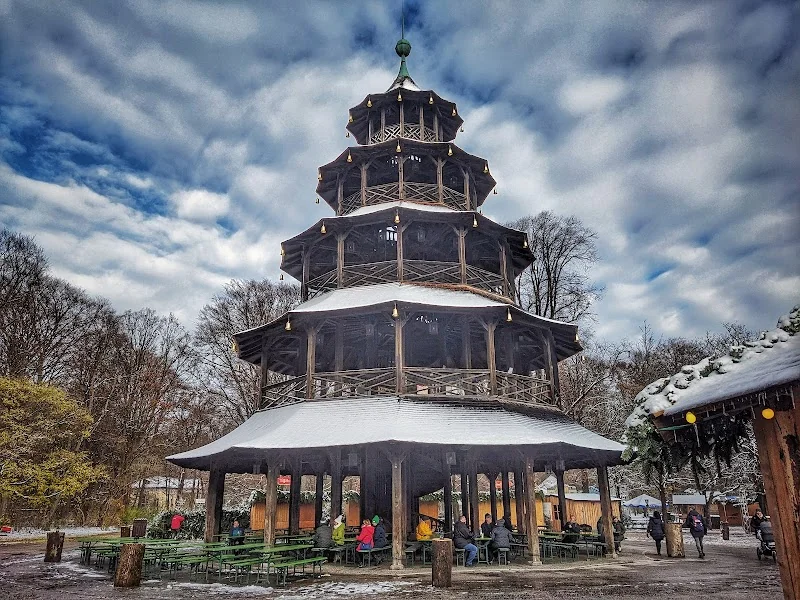
The Chinese Tower is one of those places in Munich where city history, everyday culture, and excursion vibes meet in a particularly uncomplicated way. In the middle of the English Garden, the wooden pagoda rises above the trees, below lies one of the city's most famous beer gardens with around 7,000 seats. Those who visit the place come not only for the tower itself but for the mix of location, atmosphere, music, snacks, and the unique rhythm of a Munich beer garden. The Chinese Tower is therefore a sight, a meeting point, and a culinary classic all in one. ([muenchen.de](https://www.muenchen.de/sehenswuerdigkeiten/top-sehenswuerdigkeiten/chinesischer-turm?utm_source=openai))
At the same time, the location is very practical: The beer garden is located in the south of the English Garden and is accessible by bus, tram, subway, bicycle, and car. The operation follows the classic beer garden weather, meaning it operates on dry and warm days, while in cold or uncertain weather, only the kiosk is open. The restaurant is currently listed as closed on the official contact page. This mix of tradition, seasonal operation, and clear visitor information makes the Chinese Tower a place that can be well planned and still experienced in a relaxed manner. ([chinaturm.de](https://www.chinaturm.de/kontakt/))
Opening Hours at the Chinese Tower: When is the Beer Garden Open?
The opening hours at the Chinese Tower are intentionally kept simple and follow what is considered the classic beer garden rule in Munich: The operation runs in dry and warm weather. According to the official website, the beer garden opens from Monday to Friday at 11 am, and on Saturdays and Sundays at 10 am. This is particularly pleasant for visitors, as the day can be well combined with a walk through the English Garden, a visit to the Monopteros, or a longer stay outdoors. So, if you plan to visit the Chinese Tower for a relaxed afternoon or an early snack, you will find clear and reliable time slots. ([chinaturm.de](https://www.chinaturm.de/))
However, it is important to note the weather: If it is too cold or the weather seems uncertain, not the entire beer garden operation is open, but only the kiosk. This is then open from Monday to Sunday at 12 pm and offers a smaller selection of food and drinks for a quick visit. This is important for outings with changeable weather or for spontaneous stops, as the Chinese Tower is not a regular indoor operation with fixed restaurant hours, but a lively outdoor place. The restaurant itself is also currently referred to as closed on the official contact page, so the focus is on the beer garden operation and the kiosk. Those who want to be on the safe side should always plan the current weather conditions and the day's status of the beer garden before visiting. ([chinaturm.de](https://www.chinaturm.de/kontakt/?utm_source=openai))
This weather-dependent opening is part of the character of the place. It explains why the Chinese Tower is not only popular in summer but also attracts many visitors on sunny spring days and in the warm autumn weeks. For families, groups, and day visitors, this is practical, as the visit can be flexibly combined with a walk, a bike ride, or a park visit. Those interested in larger events will find additional programs such as Kocherlball or the Christmas market at the same location throughout the year, making the site a recurring fixture in Munich's event calendar. ([muenchen.de](https://www.muenchen.de/veranstaltungen/brauchtum/tanz/kocherlball-im-englischen-garten-2026?utm_source=openai))
Menu at the Chinese Tower: What Delicacies are Available
In terms of the menu, the Chinese Tower focuses on what a good Munich beer garden promises: simple, regional, fresh, and without unnecessary detours. The official website emphasizes that all cold and hot dishes are prepared on-site. The meat comes from the ox stables of the municipal estate Karlshof and from regional farms, while vegetables and fruits come from farmers and suppliers from the surrounding area. The pretzels are also baked on-site. This creates an offering that clearly focuses on beer garden classics and honest cuisine rather than complicated fine dining concepts. ([chinaturm.de](https://www.chinaturm.de/))
Visible classics include the ox sandwich from the ox roastery, the vegan ox sandwich based on peas, homemade Obatzda from Munich Camembert according to a Haberl recipe from 1970, potato noodle pan with fresh market vegetables, Swiss sausage salad from straw pigs, grilled fish on a stick, daily changing salad bowls, and hot fried dough. The homepage also mentions chicken, vegan delicacies, and cakes from the on-site bakery. Additionally, Hofbräu München, wine, juice spritzers, and Aperol Spritz are typical companions for a long beer garden afternoon. The offering is broad enough to cater to both snack fans and families, groups, and vegetarian or vegan guests. ([chinaturm.de](https://www.chinaturm.de/))
Particularly interesting is the combination of freshness and tradition. According to the official representation, the beer garden has been working with Haberl Gastronomie since 1974, which has focused its culinary philosophy on natural ingredients, regional partners, and artisanal preparation for decades. This is important for SEO because several search intents meet here: menu, beer garden, regional food, and Munich classics. Therefore, those searching for the menu of the Chinese Tower usually want not just a list of dishes but also to know if there are typical Munich delicacies, vegetarian options, and authentic beer garden cuisine. The official website answers this very clearly. ([chinaturm.de](https://www.chinaturm.de/regional/?utm_source=openai))
Directions, Parking, and Route to the Chinese Tower
The route to the Chinese Tower is surprisingly uncomplicated for a place in the middle of the English Garden. The beer garden lists several direct connections on its contact page: Bus 54, 58, 68, and 154 to the stop Chinese Tower, Tram 16 and 36 to Tivolistraße, and U3 and U6 to Giselastraße. From the subway station Giselastraße, it is about a 10-minute walk. This is particularly important for visitors looking for routes or directions and wanting to reach the place without detours. Since the stops are directly oriented towards the destination, the visit can be easily combined with a city walk or an appointment in the city center. ([chinaturm.de](https://www.chinaturm.de/kontakt/))
For those arriving by car, the official website states that access is via the Tivoli Bridge. There is a paid parking lot directly at the beer garden, and for the navigation system, you should enter Tivolistraße. This is particularly relevant for search queries regarding parking at the Chinese Tower, as the visitor does not have to search long in the city area but receives a clear access logic. At the same time, the place is also very well accessible by bicycle, and the site even describes the bike path as the most beautiful way to arrive. Especially for guests who want to use the English Garden as part of a longer day trip, the bike is a convenient option. ([chinaturm.de](https://www.chinaturm.de/kontakt/))
In practice, this means: Those coming from the city center, Lehel, Schwabing, or Isartor have several good routes to the destination. The tram to Tivolistraße is particularly convenient for visitors who do not want to walk far. The bus is ideal if you want to drive directly to the beer garden. The subway to Giselastraße is a good choice for those who want to walk the last stretch through the English Garden. This mix of public transport, car, and bike makes the Chinese Tower a destination that works very well both spontaneously and planned. ([chinaturm.de](https://www.chinaturm.de/kontakt/))
History of the Chinese Tower in the English Garden
The history of the Chinese Tower begins during the creation of the English Garden. According to the Bavarian state government, the Chinese Tower was built between 1789 and 1791 by engineer Johann Baptist Lechner according to plans by military architect Joseph Frey. The restaurant opened on April 1, 1792, and the tower was inaugurated in the same year. This makes the place a very early example of the connection between landscape garden, viewpoint, and sociability. The tower was thus from the beginning not just decoration but part of a consciously developed public use of the park. ([bayern.de](https://www.bayern.de/pdf/data/bayernde_102200.pdf))
The further history is closely linked to the upheavals of the 19th and 20th centuries. In 1804, Friedrich Ludwig Sckell expressed the desire to remove the structure understood as chinoiserie, but this was prohibited. In July 1944, an aerial bomb hit the tower, causing it to burn down completely. The reconstruction took place in 1951 and 1952 authentically, and on September 9, 1952, the rebuilt Chinese Tower was ceremoniously opened. The Bavarian state government highlighted the 70th anniversary of this reconstruction in 2022. Thus, the tower today stands not only for a historical form but also for Munich's ability to rebuild a cultural landmark after a rupture. ([bayern.de](https://www.bayern.de/pdf/data/bayernde_102200.pdf))
The urban planning context is also exciting: The tower is part of the ensemble of the English Garden, a landscape garden that was laid out starting in 1789 and opened in 1792. The rebuilt tower is a wooden structure in five-story form and is treated in monument preservation as an important part of the garden monument. Therefore, those searching for the history of the Chinese Tower will find not only an anecdote but a multifaceted chapter of Munich's garden, architecture, and memory culture. This is one of the reasons why the place has significance far beyond its function as a beer garden. ([hdbg.eu](https://hdbg.eu/wiederaufbau/gebaeude/detail/chinesischer-turm/391))
Music, Kocherlball, and Christmas Market at the Chinese Tower
The Chinese Tower is not only about food and history but also about music. The official website mentions live music with Mathias Achatz and his band. According to the status as of March 2026, the playing times are Wednesdays from 4 pm, Fridays from 3 pm, Saturdays from 2 pm, and Sundays from 12 pm. This is a crucial point for many visitors, as music shapes the atmosphere of the beer garden and makes the stay significantly more lively. The place is thus not only a meeting point for snack guests but also for all those seeking a classic Munich beer garden atmosphere with musical accompaniment. ([chinaturm.de](https://www.chinaturm.de/))
Special events include the Kocherlball, which according to muenchen.de takes place every year at the Chinese Tower in the English Garden. The event is based on old Sunday balls of the household staff and brings Munich together early in the morning when thousands gather to dance and celebrate. The date currently mentioned on the city page for 2026 is July 19 from 6 to 10 am. This form of tradition is so typical for the place that many visitors know the Chinese Tower precisely because of this mix of tradition and vibrant urban experience. ([muenchen.de](https://www.muenchen.de/veranstaltungen/brauchtum/tanz/kocherlball-im-englischen-garten-2026?utm_source=openai))
In winter, the place takes on a different character: The Christmas market at the Chinese Tower runs according to the official website from November 20 to December 23, 2025, each Wednesday to Sunday with fixed opening hours. There, there are wooden huts, delicacies, handicrafts, ice stock lanes, a historic children's carousel, a children's train, carriage rides, tower trumpeters, visits from St. Nicholas, and Advent caroling. For the search intent of the Chinese Tower Christmas market, this is particularly relevant because the location thus covers not only summer but also Advent and tradition. The place functions seasonally in a very versatile way but remains clearly recognizable as a Munich classic. ([weihnachtsmarkt-chinaturm.de](https://weihnachtsmarkt-chinaturm.de/))
The Chinese Tower in the English Garden: Location, Atmosphere, and Practical Tips
The Chinese Tower is located in the middle of the English Garden, one of Munich's most famous park areas. Muenchen.de describes the English Garden as Munich's largest park and refers to classics like Monopteros and the Chinese Tower in the south. This location is a key part of its attractiveness: You sit in greenery but are still close to the city, can use paths, meadows, and sight lines, and experience Munich as both a natural and cultural space. For guests searching for the Chinese Tower English Garden Munich, this combination is the reason for their visit. ([muenchen.de](https://www.muenchen.de/en/sights/attractions/english-garden?utm_source=openai))
Practically, this also means: The place is suitable for very different types of visits. Those who just want to stop by briefly will find a straightforward point of contact with the kiosk and snacks. Those who want to stay longer can sit with family, friends, or colleagues at one of the large tables and extend the afternoon. Those wanting to take photos will get the typical Munich contrast of a historic wooden pagoda, old trees, and lively beer garden operation. And those who understand the place as a destination can combine visit, walk, and meal without complicated planning. This is one of the reasons why the Chinese Tower works not only as a sight but also as a functional meeting point. ([chinaturm.de](https://www.chinaturm.de/?utm_source=openai))
For good planning, three simple rules help: First, it is worth checking the weather, as it affects the opening hours. Second, public transport is often the most relaxed choice, as buses and trams lead directly to the destination, and the last stretch on foot is pleasant. Third, it is worth connecting the visit with the surroundings, such as a longer stay in the English Garden or an appointment at other nearby Munich landmarks. This way, the Chinese Tower becomes not just a single stop but a very coherent part of a day in Munich. ([chinaturm.de](https://www.chinaturm.de/kontakt/))
Sources:
- Beer Garden at the Chinese Tower – Official Website
- Beer Garden at the Chinese Tower – Contact and Directions
- Beer Garden at the Chinese Tower – Regional & Natural
- Beer Garden at the Chinese Tower – Music
- Christmas Market at the Chinese Tower – Official Website
- muenchen.de – Chinese Tower: Munich Landmark with Beer Garden
- muenchen.de – English Garden: Information about Munich's largest park
- Bavarian State Government – Chinese Tower in the English Garden Celebrates 70th Anniversary of Reconstruction
- House of Bavarian History – Reconstruction Atlas Chinese Tower
Mehr anzeigenWeniger anzeigen
Chinese Tower | Opening Hours & Menu
The Chinese Tower is one of those places in Munich where city history, everyday culture, and excursion vibes meet in a particularly uncomplicated way. In the middle of the English Garden, the wooden pagoda rises above the trees, below lies one of the city's most famous beer gardens with around 7,000 seats. Those who visit the place come not only for the tower itself but for the mix of location, atmosphere, music, snacks, and the unique rhythm of a Munich beer garden. The Chinese Tower is therefore a sight, a meeting point, and a culinary classic all in one. ([muenchen.de](https://www.muenchen.de/sehenswuerdigkeiten/top-sehenswuerdigkeiten/chinesischer-turm?utm_source=openai))
At the same time, the location is very practical: The beer garden is located in the south of the English Garden and is accessible by bus, tram, subway, bicycle, and car. The operation follows the classic beer garden weather, meaning it operates on dry and warm days, while in cold or uncertain weather, only the kiosk is open. The restaurant is currently listed as closed on the official contact page. This mix of tradition, seasonal operation, and clear visitor information makes the Chinese Tower a place that can be well planned and still experienced in a relaxed manner. ([chinaturm.de](https://www.chinaturm.de/kontakt/))
Opening Hours at the Chinese Tower: When is the Beer Garden Open?
The opening hours at the Chinese Tower are intentionally kept simple and follow what is considered the classic beer garden rule in Munich: The operation runs in dry and warm weather. According to the official website, the beer garden opens from Monday to Friday at 11 am, and on Saturdays and Sundays at 10 am. This is particularly pleasant for visitors, as the day can be well combined with a walk through the English Garden, a visit to the Monopteros, or a longer stay outdoors. So, if you plan to visit the Chinese Tower for a relaxed afternoon or an early snack, you will find clear and reliable time slots. ([chinaturm.de](https://www.chinaturm.de/))
However, it is important to note the weather: If it is too cold or the weather seems uncertain, not the entire beer garden operation is open, but only the kiosk. This is then open from Monday to Sunday at 12 pm and offers a smaller selection of food and drinks for a quick visit. This is important for outings with changeable weather or for spontaneous stops, as the Chinese Tower is not a regular indoor operation with fixed restaurant hours, but a lively outdoor place. The restaurant itself is also currently referred to as closed on the official contact page, so the focus is on the beer garden operation and the kiosk. Those who want to be on the safe side should always plan the current weather conditions and the day's status of the beer garden before visiting. ([chinaturm.de](https://www.chinaturm.de/kontakt/?utm_source=openai))
This weather-dependent opening is part of the character of the place. It explains why the Chinese Tower is not only popular in summer but also attracts many visitors on sunny spring days and in the warm autumn weeks. For families, groups, and day visitors, this is practical, as the visit can be flexibly combined with a walk, a bike ride, or a park visit. Those interested in larger events will find additional programs such as Kocherlball or the Christmas market at the same location throughout the year, making the site a recurring fixture in Munich's event calendar. ([muenchen.de](https://www.muenchen.de/veranstaltungen/brauchtum/tanz/kocherlball-im-englischen-garten-2026?utm_source=openai))
Menu at the Chinese Tower: What Delicacies are Available
In terms of the menu, the Chinese Tower focuses on what a good Munich beer garden promises: simple, regional, fresh, and without unnecessary detours. The official website emphasizes that all cold and hot dishes are prepared on-site. The meat comes from the ox stables of the municipal estate Karlshof and from regional farms, while vegetables and fruits come from farmers and suppliers from the surrounding area. The pretzels are also baked on-site. This creates an offering that clearly focuses on beer garden classics and honest cuisine rather than complicated fine dining concepts. ([chinaturm.de](https://www.chinaturm.de/))
Visible classics include the ox sandwich from the ox roastery, the vegan ox sandwich based on peas, homemade Obatzda from Munich Camembert according to a Haberl recipe from 1970, potato noodle pan with fresh market vegetables, Swiss sausage salad from straw pigs, grilled fish on a stick, daily changing salad bowls, and hot fried dough. The homepage also mentions chicken, vegan delicacies, and cakes from the on-site bakery. Additionally, Hofbräu München, wine, juice spritzers, and Aperol Spritz are typical companions for a long beer garden afternoon. The offering is broad enough to cater to both snack fans and families, groups, and vegetarian or vegan guests. ([chinaturm.de](https://www.chinaturm.de/))
Particularly interesting is the combination of freshness and tradition. According to the official representation, the beer garden has been working with Haberl Gastronomie since 1974, which has focused its culinary philosophy on natural ingredients, regional partners, and artisanal preparation for decades. This is important for SEO because several search intents meet here: menu, beer garden, regional food, and Munich classics. Therefore, those searching for the menu of the Chinese Tower usually want not just a list of dishes but also to know if there are typical Munich delicacies, vegetarian options, and authentic beer garden cuisine. The official website answers this very clearly. ([chinaturm.de](https://www.chinaturm.de/regional/?utm_source=openai))
Directions, Parking, and Route to the Chinese Tower
The route to the Chinese Tower is surprisingly uncomplicated for a place in the middle of the English Garden. The beer garden lists several direct connections on its contact page: Bus 54, 58, 68, and 154 to the stop Chinese Tower, Tram 16 and 36 to Tivolistraße, and U3 and U6 to Giselastraße. From the subway station Giselastraße, it is about a 10-minute walk. This is particularly important for visitors looking for routes or directions and wanting to reach the place without detours. Since the stops are directly oriented towards the destination, the visit can be easily combined with a city walk or an appointment in the city center. ([chinaturm.de](https://www.chinaturm.de/kontakt/))
For those arriving by car, the official website states that access is via the Tivoli Bridge. There is a paid parking lot directly at the beer garden, and for the navigation system, you should enter Tivolistraße. This is particularly relevant for search queries regarding parking at the Chinese Tower, as the visitor does not have to search long in the city area but receives a clear access logic. At the same time, the place is also very well accessible by bicycle, and the site even describes the bike path as the most beautiful way to arrive. Especially for guests who want to use the English Garden as part of a longer day trip, the bike is a convenient option. ([chinaturm.de](https://www.chinaturm.de/kontakt/))
In practice, this means: Those coming from the city center, Lehel, Schwabing, or Isartor have several good routes to the destination. The tram to Tivolistraße is particularly convenient for visitors who do not want to walk far. The bus is ideal if you want to drive directly to the beer garden. The subway to Giselastraße is a good choice for those who want to walk the last stretch through the English Garden. This mix of public transport, car, and bike makes the Chinese Tower a destination that works very well both spontaneously and planned. ([chinaturm.de](https://www.chinaturm.de/kontakt/))
History of the Chinese Tower in the English Garden
The history of the Chinese Tower begins during the creation of the English Garden. According to the Bavarian state government, the Chinese Tower was built between 1789 and 1791 by engineer Johann Baptist Lechner according to plans by military architect Joseph Frey. The restaurant opened on April 1, 1792, and the tower was inaugurated in the same year. This makes the place a very early example of the connection between landscape garden, viewpoint, and sociability. The tower was thus from the beginning not just decoration but part of a consciously developed public use of the park. ([bayern.de](https://www.bayern.de/pdf/data/bayernde_102200.pdf))
The further history is closely linked to the upheavals of the 19th and 20th centuries. In 1804, Friedrich Ludwig Sckell expressed the desire to remove the structure understood as chinoiserie, but this was prohibited. In July 1944, an aerial bomb hit the tower, causing it to burn down completely. The reconstruction took place in 1951 and 1952 authentically, and on September 9, 1952, the rebuilt Chinese Tower was ceremoniously opened. The Bavarian state government highlighted the 70th anniversary of this reconstruction in 2022. Thus, the tower today stands not only for a historical form but also for Munich's ability to rebuild a cultural landmark after a rupture. ([bayern.de](https://www.bayern.de/pdf/data/bayernde_102200.pdf))
The urban planning context is also exciting: The tower is part of the ensemble of the English Garden, a landscape garden that was laid out starting in 1789 and opened in 1792. The rebuilt tower is a wooden structure in five-story form and is treated in monument preservation as an important part of the garden monument. Therefore, those searching for the history of the Chinese Tower will find not only an anecdote but a multifaceted chapter of Munich's garden, architecture, and memory culture. This is one of the reasons why the place has significance far beyond its function as a beer garden. ([hdbg.eu](https://hdbg.eu/wiederaufbau/gebaeude/detail/chinesischer-turm/391))
Music, Kocherlball, and Christmas Market at the Chinese Tower
The Chinese Tower is not only about food and history but also about music. The official website mentions live music with Mathias Achatz and his band. According to the status as of March 2026, the playing times are Wednesdays from 4 pm, Fridays from 3 pm, Saturdays from 2 pm, and Sundays from 12 pm. This is a crucial point for many visitors, as music shapes the atmosphere of the beer garden and makes the stay significantly more lively. The place is thus not only a meeting point for snack guests but also for all those seeking a classic Munich beer garden atmosphere with musical accompaniment. ([chinaturm.de](https://www.chinaturm.de/))
Special events include the Kocherlball, which according to muenchen.de takes place every year at the Chinese Tower in the English Garden. The event is based on old Sunday balls of the household staff and brings Munich together early in the morning when thousands gather to dance and celebrate. The date currently mentioned on the city page for 2026 is July 19 from 6 to 10 am. This form of tradition is so typical for the place that many visitors know the Chinese Tower precisely because of this mix of tradition and vibrant urban experience. ([muenchen.de](https://www.muenchen.de/veranstaltungen/brauchtum/tanz/kocherlball-im-englischen-garten-2026?utm_source=openai))
In winter, the place takes on a different character: The Christmas market at the Chinese Tower runs according to the official website from November 20 to December 23, 2025, each Wednesday to Sunday with fixed opening hours. There, there are wooden huts, delicacies, handicrafts, ice stock lanes, a historic children's carousel, a children's train, carriage rides, tower trumpeters, visits from St. Nicholas, and Advent caroling. For the search intent of the Chinese Tower Christmas market, this is particularly relevant because the location thus covers not only summer but also Advent and tradition. The place functions seasonally in a very versatile way but remains clearly recognizable as a Munich classic. ([weihnachtsmarkt-chinaturm.de](https://weihnachtsmarkt-chinaturm.de/))
The Chinese Tower in the English Garden: Location, Atmosphere, and Practical Tips
The Chinese Tower is located in the middle of the English Garden, one of Munich's most famous park areas. Muenchen.de describes the English Garden as Munich's largest park and refers to classics like Monopteros and the Chinese Tower in the south. This location is a key part of its attractiveness: You sit in greenery but are still close to the city, can use paths, meadows, and sight lines, and experience Munich as both a natural and cultural space. For guests searching for the Chinese Tower English Garden Munich, this combination is the reason for their visit. ([muenchen.de](https://www.muenchen.de/en/sights/attractions/english-garden?utm_source=openai))
Practically, this also means: The place is suitable for very different types of visits. Those who just want to stop by briefly will find a straightforward point of contact with the kiosk and snacks. Those who want to stay longer can sit with family, friends, or colleagues at one of the large tables and extend the afternoon. Those wanting to take photos will get the typical Munich contrast of a historic wooden pagoda, old trees, and lively beer garden operation. And those who understand the place as a destination can combine visit, walk, and meal without complicated planning. This is one of the reasons why the Chinese Tower works not only as a sight but also as a functional meeting point. ([chinaturm.de](https://www.chinaturm.de/?utm_source=openai))
For good planning, three simple rules help: First, it is worth checking the weather, as it affects the opening hours. Second, public transport is often the most relaxed choice, as buses and trams lead directly to the destination, and the last stretch on foot is pleasant. Third, it is worth connecting the visit with the surroundings, such as a longer stay in the English Garden or an appointment at other nearby Munich landmarks. This way, the Chinese Tower becomes not just a single stop but a very coherent part of a day in Munich. ([chinaturm.de](https://www.chinaturm.de/kontakt/))
Sources:
- Beer Garden at the Chinese Tower – Official Website
- Beer Garden at the Chinese Tower – Contact and Directions
- Beer Garden at the Chinese Tower – Regional & Natural
- Beer Garden at the Chinese Tower – Music
- Christmas Market at the Chinese Tower – Official Website
- muenchen.de – Chinese Tower: Munich Landmark with Beer Garden
- muenchen.de – English Garden: Information about Munich's largest park
- Bavarian State Government – Chinese Tower in the English Garden Celebrates 70th Anniversary of Reconstruction
- House of Bavarian History – Reconstruction Atlas Chinese Tower
Chinese Tower | Opening Hours & Menu
The Chinese Tower is one of those places in Munich where city history, everyday culture, and excursion vibes meet in a particularly uncomplicated way. In the middle of the English Garden, the wooden pagoda rises above the trees, below lies one of the city's most famous beer gardens with around 7,000 seats. Those who visit the place come not only for the tower itself but for the mix of location, atmosphere, music, snacks, and the unique rhythm of a Munich beer garden. The Chinese Tower is therefore a sight, a meeting point, and a culinary classic all in one. ([muenchen.de](https://www.muenchen.de/sehenswuerdigkeiten/top-sehenswuerdigkeiten/chinesischer-turm?utm_source=openai))
At the same time, the location is very practical: The beer garden is located in the south of the English Garden and is accessible by bus, tram, subway, bicycle, and car. The operation follows the classic beer garden weather, meaning it operates on dry and warm days, while in cold or uncertain weather, only the kiosk is open. The restaurant is currently listed as closed on the official contact page. This mix of tradition, seasonal operation, and clear visitor information makes the Chinese Tower a place that can be well planned and still experienced in a relaxed manner. ([chinaturm.de](https://www.chinaturm.de/kontakt/))
Opening Hours at the Chinese Tower: When is the Beer Garden Open?
The opening hours at the Chinese Tower are intentionally kept simple and follow what is considered the classic beer garden rule in Munich: The operation runs in dry and warm weather. According to the official website, the beer garden opens from Monday to Friday at 11 am, and on Saturdays and Sundays at 10 am. This is particularly pleasant for visitors, as the day can be well combined with a walk through the English Garden, a visit to the Monopteros, or a longer stay outdoors. So, if you plan to visit the Chinese Tower for a relaxed afternoon or an early snack, you will find clear and reliable time slots. ([chinaturm.de](https://www.chinaturm.de/))
However, it is important to note the weather: If it is too cold or the weather seems uncertain, not the entire beer garden operation is open, but only the kiosk. This is then open from Monday to Sunday at 12 pm and offers a smaller selection of food and drinks for a quick visit. This is important for outings with changeable weather or for spontaneous stops, as the Chinese Tower is not a regular indoor operation with fixed restaurant hours, but a lively outdoor place. The restaurant itself is also currently referred to as closed on the official contact page, so the focus is on the beer garden operation and the kiosk. Those who want to be on the safe side should always plan the current weather conditions and the day's status of the beer garden before visiting. ([chinaturm.de](https://www.chinaturm.de/kontakt/?utm_source=openai))
This weather-dependent opening is part of the character of the place. It explains why the Chinese Tower is not only popular in summer but also attracts many visitors on sunny spring days and in the warm autumn weeks. For families, groups, and day visitors, this is practical, as the visit can be flexibly combined with a walk, a bike ride, or a park visit. Those interested in larger events will find additional programs such as Kocherlball or the Christmas market at the same location throughout the year, making the site a recurring fixture in Munich's event calendar. ([muenchen.de](https://www.muenchen.de/veranstaltungen/brauchtum/tanz/kocherlball-im-englischen-garten-2026?utm_source=openai))
Menu at the Chinese Tower: What Delicacies are Available
In terms of the menu, the Chinese Tower focuses on what a good Munich beer garden promises: simple, regional, fresh, and without unnecessary detours. The official website emphasizes that all cold and hot dishes are prepared on-site. The meat comes from the ox stables of the municipal estate Karlshof and from regional farms, while vegetables and fruits come from farmers and suppliers from the surrounding area. The pretzels are also baked on-site. This creates an offering that clearly focuses on beer garden classics and honest cuisine rather than complicated fine dining concepts. ([chinaturm.de](https://www.chinaturm.de/))
Visible classics include the ox sandwich from the ox roastery, the vegan ox sandwich based on peas, homemade Obatzda from Munich Camembert according to a Haberl recipe from 1970, potato noodle pan with fresh market vegetables, Swiss sausage salad from straw pigs, grilled fish on a stick, daily changing salad bowls, and hot fried dough. The homepage also mentions chicken, vegan delicacies, and cakes from the on-site bakery. Additionally, Hofbräu München, wine, juice spritzers, and Aperol Spritz are typical companions for a long beer garden afternoon. The offering is broad enough to cater to both snack fans and families, groups, and vegetarian or vegan guests. ([chinaturm.de](https://www.chinaturm.de/))
Particularly interesting is the combination of freshness and tradition. According to the official representation, the beer garden has been working with Haberl Gastronomie since 1974, which has focused its culinary philosophy on natural ingredients, regional partners, and artisanal preparation for decades. This is important for SEO because several search intents meet here: menu, beer garden, regional food, and Munich classics. Therefore, those searching for the menu of the Chinese Tower usually want not just a list of dishes but also to know if there are typical Munich delicacies, vegetarian options, and authentic beer garden cuisine. The official website answers this very clearly. ([chinaturm.de](https://www.chinaturm.de/regional/?utm_source=openai))
Directions, Parking, and Route to the Chinese Tower
The route to the Chinese Tower is surprisingly uncomplicated for a place in the middle of the English Garden. The beer garden lists several direct connections on its contact page: Bus 54, 58, 68, and 154 to the stop Chinese Tower, Tram 16 and 36 to Tivolistraße, and U3 and U6 to Giselastraße. From the subway station Giselastraße, it is about a 10-minute walk. This is particularly important for visitors looking for routes or directions and wanting to reach the place without detours. Since the stops are directly oriented towards the destination, the visit can be easily combined with a city walk or an appointment in the city center. ([chinaturm.de](https://www.chinaturm.de/kontakt/))
For those arriving by car, the official website states that access is via the Tivoli Bridge. There is a paid parking lot directly at the beer garden, and for the navigation system, you should enter Tivolistraße. This is particularly relevant for search queries regarding parking at the Chinese Tower, as the visitor does not have to search long in the city area but receives a clear access logic. At the same time, the place is also very well accessible by bicycle, and the site even describes the bike path as the most beautiful way to arrive. Especially for guests who want to use the English Garden as part of a longer day trip, the bike is a convenient option. ([chinaturm.de](https://www.chinaturm.de/kontakt/))
In practice, this means: Those coming from the city center, Lehel, Schwabing, or Isartor have several good routes to the destination. The tram to Tivolistraße is particularly convenient for visitors who do not want to walk far. The bus is ideal if you want to drive directly to the beer garden. The subway to Giselastraße is a good choice for those who want to walk the last stretch through the English Garden. This mix of public transport, car, and bike makes the Chinese Tower a destination that works very well both spontaneously and planned. ([chinaturm.de](https://www.chinaturm.de/kontakt/))
History of the Chinese Tower in the English Garden
The history of the Chinese Tower begins during the creation of the English Garden. According to the Bavarian state government, the Chinese Tower was built between 1789 and 1791 by engineer Johann Baptist Lechner according to plans by military architect Joseph Frey. The restaurant opened on April 1, 1792, and the tower was inaugurated in the same year. This makes the place a very early example of the connection between landscape garden, viewpoint, and sociability. The tower was thus from the beginning not just decoration but part of a consciously developed public use of the park. ([bayern.de](https://www.bayern.de/pdf/data/bayernde_102200.pdf))
The further history is closely linked to the upheavals of the 19th and 20th centuries. In 1804, Friedrich Ludwig Sckell expressed the desire to remove the structure understood as chinoiserie, but this was prohibited. In July 1944, an aerial bomb hit the tower, causing it to burn down completely. The reconstruction took place in 1951 and 1952 authentically, and on September 9, 1952, the rebuilt Chinese Tower was ceremoniously opened. The Bavarian state government highlighted the 70th anniversary of this reconstruction in 2022. Thus, the tower today stands not only for a historical form but also for Munich's ability to rebuild a cultural landmark after a rupture. ([bayern.de](https://www.bayern.de/pdf/data/bayernde_102200.pdf))
The urban planning context is also exciting: The tower is part of the ensemble of the English Garden, a landscape garden that was laid out starting in 1789 and opened in 1792. The rebuilt tower is a wooden structure in five-story form and is treated in monument preservation as an important part of the garden monument. Therefore, those searching for the history of the Chinese Tower will find not only an anecdote but a multifaceted chapter of Munich's garden, architecture, and memory culture. This is one of the reasons why the place has significance far beyond its function as a beer garden. ([hdbg.eu](https://hdbg.eu/wiederaufbau/gebaeude/detail/chinesischer-turm/391))
Music, Kocherlball, and Christmas Market at the Chinese Tower
The Chinese Tower is not only about food and history but also about music. The official website mentions live music with Mathias Achatz and his band. According to the status as of March 2026, the playing times are Wednesdays from 4 pm, Fridays from 3 pm, Saturdays from 2 pm, and Sundays from 12 pm. This is a crucial point for many visitors, as music shapes the atmosphere of the beer garden and makes the stay significantly more lively. The place is thus not only a meeting point for snack guests but also for all those seeking a classic Munich beer garden atmosphere with musical accompaniment. ([chinaturm.de](https://www.chinaturm.de/))
Special events include the Kocherlball, which according to muenchen.de takes place every year at the Chinese Tower in the English Garden. The event is based on old Sunday balls of the household staff and brings Munich together early in the morning when thousands gather to dance and celebrate. The date currently mentioned on the city page for 2026 is July 19 from 6 to 10 am. This form of tradition is so typical for the place that many visitors know the Chinese Tower precisely because of this mix of tradition and vibrant urban experience. ([muenchen.de](https://www.muenchen.de/veranstaltungen/brauchtum/tanz/kocherlball-im-englischen-garten-2026?utm_source=openai))
In winter, the place takes on a different character: The Christmas market at the Chinese Tower runs according to the official website from November 20 to December 23, 2025, each Wednesday to Sunday with fixed opening hours. There, there are wooden huts, delicacies, handicrafts, ice stock lanes, a historic children's carousel, a children's train, carriage rides, tower trumpeters, visits from St. Nicholas, and Advent caroling. For the search intent of the Chinese Tower Christmas market, this is particularly relevant because the location thus covers not only summer but also Advent and tradition. The place functions seasonally in a very versatile way but remains clearly recognizable as a Munich classic. ([weihnachtsmarkt-chinaturm.de](https://weihnachtsmarkt-chinaturm.de/))
The Chinese Tower in the English Garden: Location, Atmosphere, and Practical Tips
The Chinese Tower is located in the middle of the English Garden, one of Munich's most famous park areas. Muenchen.de describes the English Garden as Munich's largest park and refers to classics like Monopteros and the Chinese Tower in the south. This location is a key part of its attractiveness: You sit in greenery but are still close to the city, can use paths, meadows, and sight lines, and experience Munich as both a natural and cultural space. For guests searching for the Chinese Tower English Garden Munich, this combination is the reason for their visit. ([muenchen.de](https://www.muenchen.de/en/sights/attractions/english-garden?utm_source=openai))
Practically, this also means: The place is suitable for very different types of visits. Those who just want to stop by briefly will find a straightforward point of contact with the kiosk and snacks. Those who want to stay longer can sit with family, friends, or colleagues at one of the large tables and extend the afternoon. Those wanting to take photos will get the typical Munich contrast of a historic wooden pagoda, old trees, and lively beer garden operation. And those who understand the place as a destination can combine visit, walk, and meal without complicated planning. This is one of the reasons why the Chinese Tower works not only as a sight but also as a functional meeting point. ([chinaturm.de](https://www.chinaturm.de/?utm_source=openai))
For good planning, three simple rules help: First, it is worth checking the weather, as it affects the opening hours. Second, public transport is often the most relaxed choice, as buses and trams lead directly to the destination, and the last stretch on foot is pleasant. Third, it is worth connecting the visit with the surroundings, such as a longer stay in the English Garden or an appointment at other nearby Munich landmarks. This way, the Chinese Tower becomes not just a single stop but a very coherent part of a day in Munich. ([chinaturm.de](https://www.chinaturm.de/kontakt/))
Sources:
- Beer Garden at the Chinese Tower – Official Website
- Beer Garden at the Chinese Tower – Contact and Directions
- Beer Garden at the Chinese Tower – Regional & Natural
- Beer Garden at the Chinese Tower – Music
- Christmas Market at the Chinese Tower – Official Website
- muenchen.de – Chinese Tower: Munich Landmark with Beer Garden
- muenchen.de – English Garden: Information about Munich's largest park
- Bavarian State Government – Chinese Tower in the English Garden Celebrates 70th Anniversary of Reconstruction
- House of Bavarian History – Reconstruction Atlas Chinese Tower
Upcoming Events
No events found
Frequently Asked Questions
Reviews
Metka Krajnc
22. May 2026
The Chinese Tower (German: Chinesischer Turm) is a famous 25-meter-high wooden pagoda located in the center of Munich’s English Garden. Built between 1789 and 1790, the five-story structure was inspired by the Great Pagoda in London's Kew Gardens. Although it was completely destroyed during World War II bombings in 1944, the beloved landmark was faithfully rebuilt to its original design in 1952. Today, it is the centerpiece of Munich’s second-largest beer garden, which seats around 7,000 people under historic chestnut trees. Visitors come to enjoy traditional Bavarian food and beer while listening to live brass bands playing from the upper floors of the tower.
Nuch Rapatsorn
6. May 2026
Located inside the English Garden, this is a wonderful place to relax, enjoy good food, and drink beer. The weather is incredibly pleasant, making the atmosphere feel even more enjoyable and comfortable.
Ghazal Tayebirad
12. June 2026
Nice beer garden in Englische Garten, with great atmosphere. Playground besides the beer garden is very convenient. Good variety of foods and beverages.
A BM
4. March 2026
Very nice place to have a coffee or beer, there are toilets available(not sure if you have to pay).
Calece Johnson
21. January 2026
Not great parking (signs with english would be helpful). Went out of way to see this Christmas market and besides the structure being unique and different nothing special about markets (same as downtown). Would be nice place to walk around in warmer weather.