
Oberschleißheim
Effnerstraße 18, 85764 Oberschleißheim, Deutschland
German Museum Flight Hangar Schleißheim | Tickets & Directions
The Flight Hangar Schleißheim of the German Museum is a place where the history of technology, architecture, and vibrant visitor experiences come together in a special way. The official website states that the exhibition area covers 8000 square meters; at the same time, the Flight Hangar showcases more than 70 aircraft, as well as engines and models, from the Lilienthal glider to the Eurofighter. The museum is located in Oberschleißheim on the edge of a historic airfield, making it not only a classic exhibition destination but also an authentic site of aviation history. It is precisely this mix that makes it appealing: historical buildings from the early days of aviation, a modern exhibition hall, an outdoor area with a runway, and a program that ranges from regular museum visits to demonstrations, guided tours, and special events. Those looking for a location with clear visitor information, good accessibility, and high recognition value will find one of the most distinctive places for aviation enthusiasts in Bavaria here. ([deutsches-museum.de](https://www.deutsches-museum.de/flugwerft-schleissheim))
Opening Hours and Tickets for the Flight Hangar Schleißheim
Planning a visit to the Flight Hangar is straightforward: The opening hours are daily from 9 AM to 5 PM, allowing for both short visits and longer stays to be easily planned. The official visitor page also directly provides the most important ticket information so that one knows what to expect in advance. The day ticket for adults costs 9 euros, reduced 6 euros. Families can use the family ticket, and for regular visits, there are annual tickets valid for the Munich locations of the German Museum. Online tickets are also explicitly offered, making the journey particularly convenient. For many visitors, this is a clear advantage as entry can be organized before the visit, reducing queues at the ticket counter. ([deutsches-museum.de](https://www.deutsches-museum.de/flugwerft-schleissheim/besuch/preise-und-tickets))
Especially helpful are the clear regulations for discounts and free entry. Children and teenagers aged 6 to 17, trainees, students, and people with disabilities receive a day ticket for 6 euros; children up to and including 5 years enter for free. Families with a Munich family pass can also benefit from a discounted family ticket. It is also important to note that children under 12 years may only visit the German Museum when accompanied by adults. Those who wish to visit the museum more frequently can choose between the regular annual ticket and the reduced annual ticket; both are valid for the three Munich locations of the German Museum. This makes the Flight Hangar not only an interesting one-time excursion destination but also a recurring place for families, technology enthusiasts, and aviation fans. ([deutsches-museum.de](https://www.deutsches-museum.de/flugwerft-schleissheim/besuch/preise-und-tickets))
Directions, Parking, and Site Plan in Oberschleißheim
The official recommendation is clear: it is best to arrive by public transport. The S-Bahn S1 towards Freising/Airport brings visitors to the Oberschleißheim stop; from there, it is about a 15-minute walk along Mittenheimer Straße. Additionally, bus lines 292 operate daily and 295 from Monday to Friday to the Mittenheimerstraße stop. This is particularly convenient for visitors from Munich and the surrounding area, as the journey can be organized without searching for parking and without traffic jams. The Flight Hangar also provides a site plan and refers to further aids such as the MVV timetable information and information on barrier-free public transport. For a location with a high volume of visitors, this clear public transport orientation is a plus, as it makes the journey simple and transparent. ([deutsches-museum.de](https://www.deutsches-museum.de/flugwerft-schleissheim/besuch/anfahrt-und-lageplan))
For those who still come by car, the official directions state to take the A99, exit Neuherberg, and continue via Jägerstraße. For navigation systems, Ferdinand-Schulz-Allee in 85764 Oberschleißheim is mentioned. At the same time, the museum points out that parking spaces, including for buses, are only available in limited numbers. For this reason, it makes sense to plan the journey early, especially on busy days or during special events. Additionally, the Flight Hangar emphasizes that it is even accessible by air, as it is located on the edge of the special airfield Schleißheim; special notes apply for pilots, and PPR is required. This combination of classic access, historical airfield context, and limited parking space underscores the unique character of the location. ([deutsches-museum.de](https://www.deutsches-museum.de/flugwerft-schleissheim/besuch/anfahrt-und-lageplan))
History of the Flight Hangar Schleißheim and its Historical Buildings
The history of the Flight Hangar Schleißheim begins in 1912 when the area south of the Schleißheim palaces was designated as the site for the newly founded Royal Bavarian Flying Corps. During this period, the first buildings for flight operations were constructed, including the command building, which is now part of the museum and housed administrative offices and workshops at that time. It was flanked by two wooden aircraft hangars. During World War I, the site was further expanded; towards the end of the war, the hangar building was constructed, which today forms the core of the museum. The naming is also historically significant: the central hangar hall was originally a place for storing and repairing aircraft, and this designation later became the name of the museum. Thus, the architecture directly reflects the usage history of the site. ([deutsches-museum.de](https://www.deutsches-museum.de/flugwerft-schleissheim/ausstellung/historische-flugplatzgebaeude))
During the Weimar Republic, Schleißheim temporarily operated scheduled postal and passenger flights before the German Air Transport School trained pilots there starting in 1927. From 1933 to 1945, the airfield was expanded into a Luftwaffe airbase as part of rearmament. After the war, it was used by the US Army, later by the Bundeswehr, and the military flight operations ended in 1981. The fact that the historic facility was not demolished but preserved is thanks to the commitment in the 1980s. In 1992, the Flight Hangar Schleißheim finally opened as a museum for aerospace and thus became the first branch of the German Museum. A modern exhibition hall complemented the historical buildings and expanded the area to 8000 square meters. This development makes the Flight Hangar a rare example of how a historic airfield became a vibrant museum site. ([deutsches-museum.de](https://www.deutsches-museum.de/flugwerft-schleissheim/ausstellung/historische-flugplatzgebaeude))
Exhibition, Aircraft, and Aviation Highlights
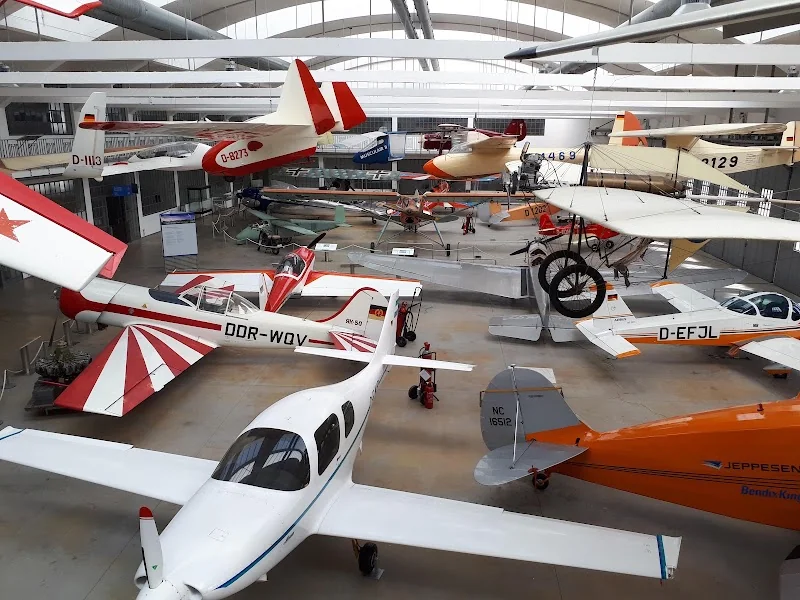
The exhibition of the Flight Hangar Schleißheim is clearly focused on aviation history and covers a very large period. On the homepage, the German Museum lists 74 exhibited aircraft, as well as 39 engines and motors, models, and a rocket engine A4. The focus is not only on individual aircraft but on the entire development of flying: from the Lilienthal glider from 1894 to the hang glider from 1999, from flying boats to rockets. This way, aviation is not presented as an abstract topic but as a comprehensible technical development. Visitors gain an impression of how diverse the ideas, materials, and forms have been over the decades and how an entire engineering culture has developed from experiments, constructions, and practical applications. ([deutsches-museum.de](https://www.deutsches-museum.de/flugwerft-schleissheim))
Especially characteristic is the interplay of historical hall, modern architecture, and outdoor area. The museum has an outdoor area with a runway, and according to the official description, aircraft can roll directly in front of the museum. This makes the place attractive for both technology fans and families, as movement is not only narrated in the exhibition but also becomes spatially visible. The Flight Hangar thus conveys not only content but also atmosphere: glass, steel, historical hangar buildings, and large exhibits create a framework that makes aviation almost physically tangible. Therefore, visitors to the Flight Hangar experience not just a collection of exhibits but an ensemble of history, space, and technology that vividly and impressively traces the journey from the early glider to modern aviation. ([deutsches-museum.de](https://www.deutsches-museum.de/flugwerft-schleissheim))
Events, Tours, and Rentals
The Flight Hangar Schleißheim is not only a museum but also an active event venue. The official website has a dedicated section for tours and demonstrations aimed at both families and individual visitors, which is regularly updated. Additionally, there are special programs that further emphasize the unique character of the location. Examples include the Hall Flight Day 2026 with super-light indoor, micro, and glider models, the LVB model flying days with flight shows and participation offers, as well as antique model flying with historical model aircraft and push-flying in the museum building. Such formats show that the Flight Hangar is not only an exhibition but also a meeting point for model flying and aviation culture. ([deutsches-museum.de](https://www.deutsches-museum.de/flugwerft-schleissheim/programm/fuehrungen-und-vorfuehrungen))
As an event location, the Flight Hangar is also exceptionally well-equipped. The exhibition halls can be rented after 5 PM, and additional rooms are available all day. Options include the historical hangar, the Grade Room, the Lilienthal Hall, the Wright Gallery, and the Montgolfier Room. For the historical hangar, the museum states an event area of about 120 square meters, a standing reception for 199 people, and usage from 5 PM to 2 AM. The Grade Room is described as a seminar and workshop room with a capacity of 80 people, presentation technology, and furniture. Thus, the Flight Hangar is suitable not only for visits but also for exclusive receptions, lectures, product presentations, readings, and evening events in an environment that is hard to find elsewhere. ([deutsches-museum.de](https://www.deutsches-museum.de/museum/ueber-uns/vermietung/flugwerft-schleissheim))
Plan Your Visit: Families, Groups, and Practical Tips
Those who want to visit the Flight Hangar Schleißheim in a relaxed manner should read the official visitor information in advance. The museum not only provides opening hours and tickets but also practical topics such as food and drinks, cloakroom and lockers, books and accompanying materials, as well as visit planning. This is particularly helpful for families, school groups, and anyone who wants to structure their stay a bit more precisely. Additionally, the museum points out that due to rearrangements of the aircraft, there may occasionally be disruptions until the end of the year. This information is important as it shows that the exhibition is dynamic and regularly maintained. Therefore, those who want to see specific exhibits should perhaps combine their visit with a look at the current program or the website. ([deutsches-museum.de](https://www.deutsches-museum.de/flugwerft-schleissheim/besuch))
Especially for families and groups, there are many good reasons to plan a visit to the Flight Hangar. Children up to and including 5 years have free entry, children under 12 must be accompanied by adults, and there are special rates and accompanying regulations for groups. The annual ticket can also be worthwhile for frequent visits, as it is valid for the three Munich locations of the German Museum. Those interested in aviation, the history of technology, model flying, or historical architecture will find here an excursion destination that can be experienced both spontaneously and well-prepared. The combination of clear visitor information, special access, exciting history, and lively events makes the Flight Hangar Schleißheim a place that one does not just visit once but enjoys rediscovering. ([deutsches-museum.de](https://www.deutsches-museum.de/flugwerft-schleissheim/besuch/preise-und-tickets))
Sources:
- German Museum Flight Hangar Schleißheim - Official Website
- German Museum Flight Hangar Schleißheim - Prices and Tickets
- German Museum Flight Hangar Schleißheim - Directions and Site Plan
- German Museum Flight Hangar Schleißheim - Historical Airfield Buildings
- German Museum Flight Hangar Schleißheim - Rentals and Event Rooms
Mehr anzeigenWeniger anzeigen
German Museum Flight Hangar Schleißheim | Tickets & Directions
The Flight Hangar Schleißheim of the German Museum is a place where the history of technology, architecture, and vibrant visitor experiences come together in a special way. The official website states that the exhibition area covers 8000 square meters; at the same time, the Flight Hangar showcases more than 70 aircraft, as well as engines and models, from the Lilienthal glider to the Eurofighter. The museum is located in Oberschleißheim on the edge of a historic airfield, making it not only a classic exhibition destination but also an authentic site of aviation history. It is precisely this mix that makes it appealing: historical buildings from the early days of aviation, a modern exhibition hall, an outdoor area with a runway, and a program that ranges from regular museum visits to demonstrations, guided tours, and special events. Those looking for a location with clear visitor information, good accessibility, and high recognition value will find one of the most distinctive places for aviation enthusiasts in Bavaria here. ([deutsches-museum.de](https://www.deutsches-museum.de/flugwerft-schleissheim))
Opening Hours and Tickets for the Flight Hangar Schleißheim
Planning a visit to the Flight Hangar is straightforward: The opening hours are daily from 9 AM to 5 PM, allowing for both short visits and longer stays to be easily planned. The official visitor page also directly provides the most important ticket information so that one knows what to expect in advance. The day ticket for adults costs 9 euros, reduced 6 euros. Families can use the family ticket, and for regular visits, there are annual tickets valid for the Munich locations of the German Museum. Online tickets are also explicitly offered, making the journey particularly convenient. For many visitors, this is a clear advantage as entry can be organized before the visit, reducing queues at the ticket counter. ([deutsches-museum.de](https://www.deutsches-museum.de/flugwerft-schleissheim/besuch/preise-und-tickets))
Especially helpful are the clear regulations for discounts and free entry. Children and teenagers aged 6 to 17, trainees, students, and people with disabilities receive a day ticket for 6 euros; children up to and including 5 years enter for free. Families with a Munich family pass can also benefit from a discounted family ticket. It is also important to note that children under 12 years may only visit the German Museum when accompanied by adults. Those who wish to visit the museum more frequently can choose between the regular annual ticket and the reduced annual ticket; both are valid for the three Munich locations of the German Museum. This makes the Flight Hangar not only an interesting one-time excursion destination but also a recurring place for families, technology enthusiasts, and aviation fans. ([deutsches-museum.de](https://www.deutsches-museum.de/flugwerft-schleissheim/besuch/preise-und-tickets))
Directions, Parking, and Site Plan in Oberschleißheim
The official recommendation is clear: it is best to arrive by public transport. The S-Bahn S1 towards Freising/Airport brings visitors to the Oberschleißheim stop; from there, it is about a 15-minute walk along Mittenheimer Straße. Additionally, bus lines 292 operate daily and 295 from Monday to Friday to the Mittenheimerstraße stop. This is particularly convenient for visitors from Munich and the surrounding area, as the journey can be organized without searching for parking and without traffic jams. The Flight Hangar also provides a site plan and refers to further aids such as the MVV timetable information and information on barrier-free public transport. For a location with a high volume of visitors, this clear public transport orientation is a plus, as it makes the journey simple and transparent. ([deutsches-museum.de](https://www.deutsches-museum.de/flugwerft-schleissheim/besuch/anfahrt-und-lageplan))
For those who still come by car, the official directions state to take the A99, exit Neuherberg, and continue via Jägerstraße. For navigation systems, Ferdinand-Schulz-Allee in 85764 Oberschleißheim is mentioned. At the same time, the museum points out that parking spaces, including for buses, are only available in limited numbers. For this reason, it makes sense to plan the journey early, especially on busy days or during special events. Additionally, the Flight Hangar emphasizes that it is even accessible by air, as it is located on the edge of the special airfield Schleißheim; special notes apply for pilots, and PPR is required. This combination of classic access, historical airfield context, and limited parking space underscores the unique character of the location. ([deutsches-museum.de](https://www.deutsches-museum.de/flugwerft-schleissheim/besuch/anfahrt-und-lageplan))
History of the Flight Hangar Schleißheim and its Historical Buildings
The history of the Flight Hangar Schleißheim begins in 1912 when the area south of the Schleißheim palaces was designated as the site for the newly founded Royal Bavarian Flying Corps. During this period, the first buildings for flight operations were constructed, including the command building, which is now part of the museum and housed administrative offices and workshops at that time. It was flanked by two wooden aircraft hangars. During World War I, the site was further expanded; towards the end of the war, the hangar building was constructed, which today forms the core of the museum. The naming is also historically significant: the central hangar hall was originally a place for storing and repairing aircraft, and this designation later became the name of the museum. Thus, the architecture directly reflects the usage history of the site. ([deutsches-museum.de](https://www.deutsches-museum.de/flugwerft-schleissheim/ausstellung/historische-flugplatzgebaeude))
During the Weimar Republic, Schleißheim temporarily operated scheduled postal and passenger flights before the German Air Transport School trained pilots there starting in 1927. From 1933 to 1945, the airfield was expanded into a Luftwaffe airbase as part of rearmament. After the war, it was used by the US Army, later by the Bundeswehr, and the military flight operations ended in 1981. The fact that the historic facility was not demolished but preserved is thanks to the commitment in the 1980s. In 1992, the Flight Hangar Schleißheim finally opened as a museum for aerospace and thus became the first branch of the German Museum. A modern exhibition hall complemented the historical buildings and expanded the area to 8000 square meters. This development makes the Flight Hangar a rare example of how a historic airfield became a vibrant museum site. ([deutsches-museum.de](https://www.deutsches-museum.de/flugwerft-schleissheim/ausstellung/historische-flugplatzgebaeude))
Exhibition, Aircraft, and Aviation Highlights
The exhibition of the Flight Hangar Schleißheim is clearly focused on aviation history and covers a very large period. On the homepage, the German Museum lists 74 exhibited aircraft, as well as 39 engines and motors, models, and a rocket engine A4. The focus is not only on individual aircraft but on the entire development of flying: from the Lilienthal glider from 1894 to the hang glider from 1999, from flying boats to rockets. This way, aviation is not presented as an abstract topic but as a comprehensible technical development. Visitors gain an impression of how diverse the ideas, materials, and forms have been over the decades and how an entire engineering culture has developed from experiments, constructions, and practical applications. ([deutsches-museum.de](https://www.deutsches-museum.de/flugwerft-schleissheim))
Especially characteristic is the interplay of historical hall, modern architecture, and outdoor area. The museum has an outdoor area with a runway, and according to the official description, aircraft can roll directly in front of the museum. This makes the place attractive for both technology fans and families, as movement is not only narrated in the exhibition but also becomes spatially visible. The Flight Hangar thus conveys not only content but also atmosphere: glass, steel, historical hangar buildings, and large exhibits create a framework that makes aviation almost physically tangible. Therefore, visitors to the Flight Hangar experience not just a collection of exhibits but an ensemble of history, space, and technology that vividly and impressively traces the journey from the early glider to modern aviation. ([deutsches-museum.de](https://www.deutsches-museum.de/flugwerft-schleissheim))
Events, Tours, and Rentals
The Flight Hangar Schleißheim is not only a museum but also an active event venue. The official website has a dedicated section for tours and demonstrations aimed at both families and individual visitors, which is regularly updated. Additionally, there are special programs that further emphasize the unique character of the location. Examples include the Hall Flight Day 2026 with super-light indoor, micro, and glider models, the LVB model flying days with flight shows and participation offers, as well as antique model flying with historical model aircraft and push-flying in the museum building. Such formats show that the Flight Hangar is not only an exhibition but also a meeting point for model flying and aviation culture. ([deutsches-museum.de](https://www.deutsches-museum.de/flugwerft-schleissheim/programm/fuehrungen-und-vorfuehrungen))
As an event location, the Flight Hangar is also exceptionally well-equipped. The exhibition halls can be rented after 5 PM, and additional rooms are available all day. Options include the historical hangar, the Grade Room, the Lilienthal Hall, the Wright Gallery, and the Montgolfier Room. For the historical hangar, the museum states an event area of about 120 square meters, a standing reception for 199 people, and usage from 5 PM to 2 AM. The Grade Room is described as a seminar and workshop room with a capacity of 80 people, presentation technology, and furniture. Thus, the Flight Hangar is suitable not only for visits but also for exclusive receptions, lectures, product presentations, readings, and evening events in an environment that is hard to find elsewhere. ([deutsches-museum.de](https://www.deutsches-museum.de/museum/ueber-uns/vermietung/flugwerft-schleissheim))
Plan Your Visit: Families, Groups, and Practical Tips
Those who want to visit the Flight Hangar Schleißheim in a relaxed manner should read the official visitor information in advance. The museum not only provides opening hours and tickets but also practical topics such as food and drinks, cloakroom and lockers, books and accompanying materials, as well as visit planning. This is particularly helpful for families, school groups, and anyone who wants to structure their stay a bit more precisely. Additionally, the museum points out that due to rearrangements of the aircraft, there may occasionally be disruptions until the end of the year. This information is important as it shows that the exhibition is dynamic and regularly maintained. Therefore, those who want to see specific exhibits should perhaps combine their visit with a look at the current program or the website. ([deutsches-museum.de](https://www.deutsches-museum.de/flugwerft-schleissheim/besuch))
Especially for families and groups, there are many good reasons to plan a visit to the Flight Hangar. Children up to and including 5 years have free entry, children under 12 must be accompanied by adults, and there are special rates and accompanying regulations for groups. The annual ticket can also be worthwhile for frequent visits, as it is valid for the three Munich locations of the German Museum. Those interested in aviation, the history of technology, model flying, or historical architecture will find here an excursion destination that can be experienced both spontaneously and well-prepared. The combination of clear visitor information, special access, exciting history, and lively events makes the Flight Hangar Schleißheim a place that one does not just visit once but enjoys rediscovering. ([deutsches-museum.de](https://www.deutsches-museum.de/flugwerft-schleissheim/besuch/preise-und-tickets))
Sources:
- German Museum Flight Hangar Schleißheim - Official Website
- German Museum Flight Hangar Schleißheim - Prices and Tickets
- German Museum Flight Hangar Schleißheim - Directions and Site Plan
- German Museum Flight Hangar Schleißheim - Historical Airfield Buildings
- German Museum Flight Hangar Schleißheim - Rentals and Event Rooms
German Museum Flight Hangar Schleißheim | Tickets & Directions
The Flight Hangar Schleißheim of the German Museum is a place where the history of technology, architecture, and vibrant visitor experiences come together in a special way. The official website states that the exhibition area covers 8000 square meters; at the same time, the Flight Hangar showcases more than 70 aircraft, as well as engines and models, from the Lilienthal glider to the Eurofighter. The museum is located in Oberschleißheim on the edge of a historic airfield, making it not only a classic exhibition destination but also an authentic site of aviation history. It is precisely this mix that makes it appealing: historical buildings from the early days of aviation, a modern exhibition hall, an outdoor area with a runway, and a program that ranges from regular museum visits to demonstrations, guided tours, and special events. Those looking for a location with clear visitor information, good accessibility, and high recognition value will find one of the most distinctive places for aviation enthusiasts in Bavaria here. ([deutsches-museum.de](https://www.deutsches-museum.de/flugwerft-schleissheim))
Opening Hours and Tickets for the Flight Hangar Schleißheim
Planning a visit to the Flight Hangar is straightforward: The opening hours are daily from 9 AM to 5 PM, allowing for both short visits and longer stays to be easily planned. The official visitor page also directly provides the most important ticket information so that one knows what to expect in advance. The day ticket for adults costs 9 euros, reduced 6 euros. Families can use the family ticket, and for regular visits, there are annual tickets valid for the Munich locations of the German Museum. Online tickets are also explicitly offered, making the journey particularly convenient. For many visitors, this is a clear advantage as entry can be organized before the visit, reducing queues at the ticket counter. ([deutsches-museum.de](https://www.deutsches-museum.de/flugwerft-schleissheim/besuch/preise-und-tickets))
Especially helpful are the clear regulations for discounts and free entry. Children and teenagers aged 6 to 17, trainees, students, and people with disabilities receive a day ticket for 6 euros; children up to and including 5 years enter for free. Families with a Munich family pass can also benefit from a discounted family ticket. It is also important to note that children under 12 years may only visit the German Museum when accompanied by adults. Those who wish to visit the museum more frequently can choose between the regular annual ticket and the reduced annual ticket; both are valid for the three Munich locations of the German Museum. This makes the Flight Hangar not only an interesting one-time excursion destination but also a recurring place for families, technology enthusiasts, and aviation fans. ([deutsches-museum.de](https://www.deutsches-museum.de/flugwerft-schleissheim/besuch/preise-und-tickets))
Directions, Parking, and Site Plan in Oberschleißheim
The official recommendation is clear: it is best to arrive by public transport. The S-Bahn S1 towards Freising/Airport brings visitors to the Oberschleißheim stop; from there, it is about a 15-minute walk along Mittenheimer Straße. Additionally, bus lines 292 operate daily and 295 from Monday to Friday to the Mittenheimerstraße stop. This is particularly convenient for visitors from Munich and the surrounding area, as the journey can be organized without searching for parking and without traffic jams. The Flight Hangar also provides a site plan and refers to further aids such as the MVV timetable information and information on barrier-free public transport. For a location with a high volume of visitors, this clear public transport orientation is a plus, as it makes the journey simple and transparent. ([deutsches-museum.de](https://www.deutsches-museum.de/flugwerft-schleissheim/besuch/anfahrt-und-lageplan))
For those who still come by car, the official directions state to take the A99, exit Neuherberg, and continue via Jägerstraße. For navigation systems, Ferdinand-Schulz-Allee in 85764 Oberschleißheim is mentioned. At the same time, the museum points out that parking spaces, including for buses, are only available in limited numbers. For this reason, it makes sense to plan the journey early, especially on busy days or during special events. Additionally, the Flight Hangar emphasizes that it is even accessible by air, as it is located on the edge of the special airfield Schleißheim; special notes apply for pilots, and PPR is required. This combination of classic access, historical airfield context, and limited parking space underscores the unique character of the location. ([deutsches-museum.de](https://www.deutsches-museum.de/flugwerft-schleissheim/besuch/anfahrt-und-lageplan))
History of the Flight Hangar Schleißheim and its Historical Buildings
The history of the Flight Hangar Schleißheim begins in 1912 when the area south of the Schleißheim palaces was designated as the site for the newly founded Royal Bavarian Flying Corps. During this period, the first buildings for flight operations were constructed, including the command building, which is now part of the museum and housed administrative offices and workshops at that time. It was flanked by two wooden aircraft hangars. During World War I, the site was further expanded; towards the end of the war, the hangar building was constructed, which today forms the core of the museum. The naming is also historically significant: the central hangar hall was originally a place for storing and repairing aircraft, and this designation later became the name of the museum. Thus, the architecture directly reflects the usage history of the site. ([deutsches-museum.de](https://www.deutsches-museum.de/flugwerft-schleissheim/ausstellung/historische-flugplatzgebaeude))
During the Weimar Republic, Schleißheim temporarily operated scheduled postal and passenger flights before the German Air Transport School trained pilots there starting in 1927. From 1933 to 1945, the airfield was expanded into a Luftwaffe airbase as part of rearmament. After the war, it was used by the US Army, later by the Bundeswehr, and the military flight operations ended in 1981. The fact that the historic facility was not demolished but preserved is thanks to the commitment in the 1980s. In 1992, the Flight Hangar Schleißheim finally opened as a museum for aerospace and thus became the first branch of the German Museum. A modern exhibition hall complemented the historical buildings and expanded the area to 8000 square meters. This development makes the Flight Hangar a rare example of how a historic airfield became a vibrant museum site. ([deutsches-museum.de](https://www.deutsches-museum.de/flugwerft-schleissheim/ausstellung/historische-flugplatzgebaeude))
Exhibition, Aircraft, and Aviation Highlights
The exhibition of the Flight Hangar Schleißheim is clearly focused on aviation history and covers a very large period. On the homepage, the German Museum lists 74 exhibited aircraft, as well as 39 engines and motors, models, and a rocket engine A4. The focus is not only on individual aircraft but on the entire development of flying: from the Lilienthal glider from 1894 to the hang glider from 1999, from flying boats to rockets. This way, aviation is not presented as an abstract topic but as a comprehensible technical development. Visitors gain an impression of how diverse the ideas, materials, and forms have been over the decades and how an entire engineering culture has developed from experiments, constructions, and practical applications. ([deutsches-museum.de](https://www.deutsches-museum.de/flugwerft-schleissheim))
Especially characteristic is the interplay of historical hall, modern architecture, and outdoor area. The museum has an outdoor area with a runway, and according to the official description, aircraft can roll directly in front of the museum. This makes the place attractive for both technology fans and families, as movement is not only narrated in the exhibition but also becomes spatially visible. The Flight Hangar thus conveys not only content but also atmosphere: glass, steel, historical hangar buildings, and large exhibits create a framework that makes aviation almost physically tangible. Therefore, visitors to the Flight Hangar experience not just a collection of exhibits but an ensemble of history, space, and technology that vividly and impressively traces the journey from the early glider to modern aviation. ([deutsches-museum.de](https://www.deutsches-museum.de/flugwerft-schleissheim))
Events, Tours, and Rentals
The Flight Hangar Schleißheim is not only a museum but also an active event venue. The official website has a dedicated section for tours and demonstrations aimed at both families and individual visitors, which is regularly updated. Additionally, there are special programs that further emphasize the unique character of the location. Examples include the Hall Flight Day 2026 with super-light indoor, micro, and glider models, the LVB model flying days with flight shows and participation offers, as well as antique model flying with historical model aircraft and push-flying in the museum building. Such formats show that the Flight Hangar is not only an exhibition but also a meeting point for model flying and aviation culture. ([deutsches-museum.de](https://www.deutsches-museum.de/flugwerft-schleissheim/programm/fuehrungen-und-vorfuehrungen))
As an event location, the Flight Hangar is also exceptionally well-equipped. The exhibition halls can be rented after 5 PM, and additional rooms are available all day. Options include the historical hangar, the Grade Room, the Lilienthal Hall, the Wright Gallery, and the Montgolfier Room. For the historical hangar, the museum states an event area of about 120 square meters, a standing reception for 199 people, and usage from 5 PM to 2 AM. The Grade Room is described as a seminar and workshop room with a capacity of 80 people, presentation technology, and furniture. Thus, the Flight Hangar is suitable not only for visits but also for exclusive receptions, lectures, product presentations, readings, and evening events in an environment that is hard to find elsewhere. ([deutsches-museum.de](https://www.deutsches-museum.de/museum/ueber-uns/vermietung/flugwerft-schleissheim))
Plan Your Visit: Families, Groups, and Practical Tips
Those who want to visit the Flight Hangar Schleißheim in a relaxed manner should read the official visitor information in advance. The museum not only provides opening hours and tickets but also practical topics such as food and drinks, cloakroom and lockers, books and accompanying materials, as well as visit planning. This is particularly helpful for families, school groups, and anyone who wants to structure their stay a bit more precisely. Additionally, the museum points out that due to rearrangements of the aircraft, there may occasionally be disruptions until the end of the year. This information is important as it shows that the exhibition is dynamic and regularly maintained. Therefore, those who want to see specific exhibits should perhaps combine their visit with a look at the current program or the website. ([deutsches-museum.de](https://www.deutsches-museum.de/flugwerft-schleissheim/besuch))
Especially for families and groups, there are many good reasons to plan a visit to the Flight Hangar. Children up to and including 5 years have free entry, children under 12 must be accompanied by adults, and there are special rates and accompanying regulations for groups. The annual ticket can also be worthwhile for frequent visits, as it is valid for the three Munich locations of the German Museum. Those interested in aviation, the history of technology, model flying, or historical architecture will find here an excursion destination that can be experienced both spontaneously and well-prepared. The combination of clear visitor information, special access, exciting history, and lively events makes the Flight Hangar Schleißheim a place that one does not just visit once but enjoys rediscovering. ([deutsches-museum.de](https://www.deutsches-museum.de/flugwerft-schleissheim/besuch/preise-und-tickets))
Sources:
- German Museum Flight Hangar Schleißheim - Official Website
- German Museum Flight Hangar Schleißheim - Prices and Tickets
- German Museum Flight Hangar Schleißheim - Directions and Site Plan
- German Museum Flight Hangar Schleißheim - Historical Airfield Buildings
- German Museum Flight Hangar Schleißheim - Rentals and Event Rooms
Upcoming Events
No events found
Frequently Asked Questions
Reviews
No reviews found