
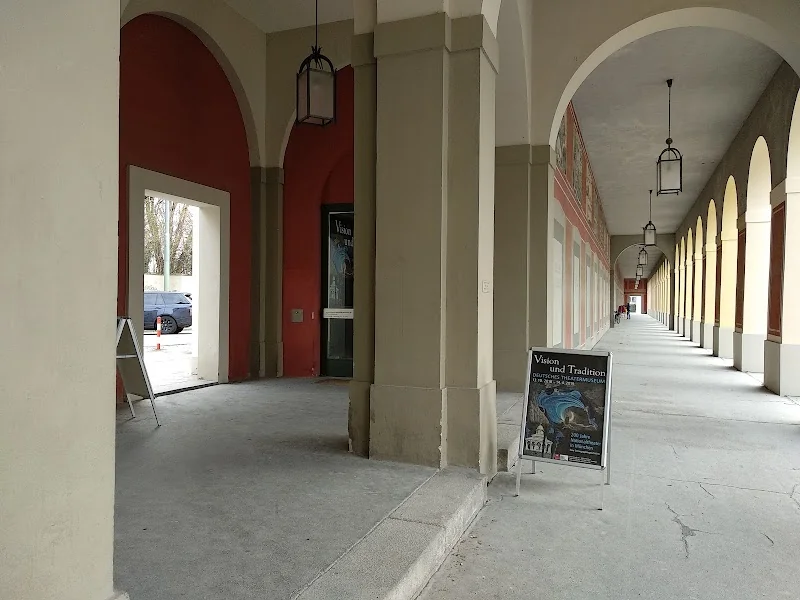
Galeriestraße 4A, München-Altstadt-Lehel
Galeriestraße 4A, 80539 München, Germany
German Theatre Museum | Opening Hours & Exhibition
The German Theatre Museum in Munich is a place for theatre history, research, and changing special exhibitions that goes far beyond the mere presentation of objects. Located in the Hofgartenarkaden, the museum connects its collection with a clear cultural-historical mission: not only to preserve theatre but to make it visible as a living, debatable cultural form. The museum traces its origins back to the actress Clara Ziegler, whose foundation was opened in 1910 and laid the groundwork for the current institution. Therefore, visitors to the German Theatre Museum do not experience a static tour through a fixed permanent exhibition, but rather an institution that regularly opens new perspectives on stage, costume, photography, graphics, autographs, and set design. This mixture of historical depth, scientific collection, and current exhibition practice is what makes the museum appealing. For visitors to Munich, theatre fans, researchers, and school classes, the museum is a compact yet content-rich destination with a strong cultural identity and a clear connection between past and present. ([deutschestheatermuseum.de](https://www.deutschestheatermuseum.de/de/museum))
Opening Hours, Tickets, and Visitor Information at the German Theatre Museum
For planning a visit, the current visitor information is particularly important, as the German Theatre Museum opens exclusively in the context of special exhibitions. The regular opening hours are from Tuesday to Sunday from 11 AM to 5 PM. There are also clear closing days on selected holidays, including Shrove Tuesday, Good Friday, May 1, All Saints' Day, Christmas Eve, Christmas Day, and New Year's Eve. At the same time, there are open holidays, such as New Year's Day, Epiphany, Easter Sunday, Easter Monday, Ascension Day, Whit Monday, Corpus Christi, Assumption Day, the Day of German Unity, and Boxing Day. Therefore, those who want to come spontaneously should check the exhibition period in advance and not only pay attention to the weekdays. This structure fits the profile of the museum as a changing exhibition venue rather than a classic institution with a continuous permanent exhibition. ([deutschestheatermuseum.de](https://www.deutschestheatermuseum.de/de/besuch))
Transparency is also provided regarding tickets. The regular museum admission is 7 euros, and the reduced admission is 5 euros. Reductions apply, among others, to seniors aged 65 and over, students, those doing voluntary service, certain professional associations, as well as people in wheelchairs and people with disabilities; an accompanying person with the B mark receives free admission. Free admission is also available for children and young people up to the age of 18, for students over 18 years, for students of fine arts and theatre studies, and for other eligible groups. This makes the museum suitable not only for individual visits but also for culture-interested families, school classes, and academic guests looking for a well-calculated museum visit in Munich. ([deutschestheatermuseum.de](https://www.deutschestheatermuseum.de/de/besuch))
For people with mobility restrictions, the official visitor information contains an important note: The cabinet exhibitions on the ground floor are accessible by wheelchair, and a mobile ramp is available for the steps at Galeriestraße as well as from the Hofgarten side. At the same time, unfortunately, there is no barrier-free access to the event and exhibition rooms on the upper floor or to the toilets on the mezzanine. Those who wish to use the library can do so on Tuesdays and Thursdays from 11 AM to 5 PM by prior arrangement. This shows that the museum is very service-oriented in practice but also honestly points out spatial limitations. This clarity is helpful, especially for a visit with a specific exhibition interest, as travel, time planning, and ticket purchase can be better coordinated. ([deutschestheatermuseum.de](https://www.deutschestheatermuseum.de/de/besuch))
making THEATRE: The Current Exhibition and Program until 2026
The current special exhibition of the German Theatre Museum is called making THEATRE and runs from June 25, 2025, to May 23, 2026. In content, the museum accompanies the creation of Shakespeare's Romeo and Juliet at the Munich Residenztheater and focuses on the work behind the scenes. This is more than just a look at finished performances: the exhibition shows how dramaturgy, workshops, rehearsal work, and technical processes interact to ensure a successful premiere evening. The exhibition was created in cooperation with the Residenztheater and with funding from the Cultural Foundation of the Federal States. It connects current theatre practice with objects and perspectives from the historical collection, thus making visible how closely present and memory are intertwined in theatre operations. ([deutschestheatermuseum.de](https://www.deutschestheatermuseum.de/de/ausstellungen/making-theatre))
What is particularly strong about this exhibition is the change of perspective. Instead of only showing finished costumes or stage designs, making THEATRE directs attention to the collaboration of different professions in theatre: artistic, craft, and technical activities that often remain invisible, although they are essential for the success of a production. The museum explicitly describes this work as a creative, collective, and dynamic process, and this is exactly what the exhibition conveys in content. Additionally, the exhibition spans the arc from the current production through the historical holdings of the house to questions about the future of theatre. This creates a visit that not only informs but also stimulates discussions: How is theatre made, why does it have the effect it does today, and what forms of work have changed over decades? ([deutschestheatermuseum.de](https://www.deutschestheatermuseum.de/de/ausstellungen/making-theatre))
Those interested in upcoming events can find specific dates related to the exhibition on the official homepage and in the program calendar. For April 2026, a special opening for the Day of Provenance Research on April 8, a Sunday tour on April 12, and an evening tour on April 15 are announced. Such formats show that the museum not only offers exhibitions but also mediation, conversation, and special programs. This is particularly valuable for visitors looking for a second or third incentive: tours, special openings, and thematic events expand the pure tour and provide additional insights into backgrounds, collections, and current issues. Thus, the German Theatre Museum becomes a place where program and exhibition are closely linked. ([deutschestheatermuseum.de](https://www.deutschestheatermuseum.de/))
Library, Photo Collection, and Collections of the German Theatre Museum
The library is one of the most important reasons why the German Theatre Museum is so highly regarded in professional circles. It comprises around 100,000 volumes and specializes in various areas of theatre. This includes play texts, librettos, and secondary literature as well as publications on spoken, dance, and music theatre. The historical collection dates back to the end of the 15th century, and among the particularly notable objects are two incunabula with comedies by Terence and a collection of nearly 1,000 librettos from the period between 1660 and 1800. For researchers, the museum is therefore not only an exhibition space but also a workplace where theatre history can be systematically explored and traced in individual holdings. The library is thus a quiet but central part of the house that strongly shapes the scientific character of the museum. ([deutschestheatermuseum.de](https://www.deutschestheatermuseum.de/de/recherche/bibliothek?utm_source=openai))
Equally impressive is the photo collection. With around 5 million analog photographs and further digital images, it is considered the largest collection of theatre photography in the world. Thematically, it is based on over 20 estates as well as other smaller bundles and historical holdings that together provide an extraordinarily broad picture of theatre events. Local focuses are on Munich, Stuttgart, and Berlin, while partial collections document productions and theatre life in many other places. This diversity makes the photo collection so valuable: it preserves not only individual images but also production history, playing styles, stage aesthetics, and the development of the perception of theatre over many decades. Those interested in photos, image archives, or theatre documentation will find here a core collection of international significance. ([deutschestheatermuseum.de](https://www.deutschestheatermuseum.de/de/recherche/die-fotosammlung-des-deutschen-theatermuseums?utm_source=openai))
Other notable areas of the collection include the graphic collection, the program booklet collection, the collection of written materials, and the model collection. The graphic collection comprises around 350,000 objects and ranges from drawings to etchings, copper engravings, and lithographs to more recent reproduction methods. Thematically, it covers stage designs, scene designs, costume designs, role portraits, as well as materials on theatre architecture and theatre technology. The program booklet collection includes about 500,000 theatre posters and program booklets that document the development of German-language theatre from the 18th century to the present. This is complemented by around 400 stage model designs and a collection of approximately 500,000 autographs. Together, these collections show why the museum is much more than just an exhibition space: it is a memory space for theatre in image, text, model, and handwriting. ([deutschestheatermuseum.de](https://www.deutschestheatermuseum.de/de/recherche/die-grafische-sammlung-des-deutschen-theatermuseums?utm_source=openai))
Directions to the German Theatre Museum in Munich
The address of the German Theatre Museum is Galeriestr. 4a in 80539 Munich, specifically in the Hofgartenarkaden. The location is central and particularly attractive from a cultural-historical perspective, as the museum is located in close proximity to the Munich Hofgarten. For public transport, the museum clearly states the stop Odeonsplatz, accessible by U-Bahn lines U4/U5 and U3/U6; additionally, bus line 100 operates as a museum line. Those traveling in Munich and wishing to combine a museum visit with a walk through the city center will find here a location that fits well into a city tour. Especially for guests who are already visiting the old town, the Hofgarten, or the area around Odeonsplatz, the theatre museum is therefore easy to plan and reachable without complicated detours. ([deutschestheatermuseum.de](https://www.deutschestheatermuseum.de/de/kontakt))
It is also practical that the museum combines directions and official visitor information on its contact page. This allows for quick checking of address, phone, email, and opening hours before heading out. For visitors with limited mobility, it is also relevant that a mobile ramp is available for the steps from Galeriestraße and from the Hofgarten side. Therefore, those preparing a visit can directly adjust the route to their own situation and should specifically plan for the barrier-free parts of the exhibition if necessary. Together with the central location, this results in a museum that is very conveniently accessible, especially by public transport, and integrates well into a longer day trip due to its proximity to other cultural sites in Munich. ([deutschestheatermuseum.de](https://www.deutschestheatermuseum.de/de/kontakt))
History, Management, and Special Services at the German Theatre Museum
The history of the house is closely linked to Clara Ziegler. The actress donated her villa in the English Garden, her fortune, and her own collection of theatrical items in 1909 to establish a theatre museum; the museum of the Clara Ziegler Foundation was opened on June 24, 1910. In 1944, the villa was destroyed in the war, but a large part of the collection had been stored elsewhere beforehand. In 1953, the foundation moved to the gallery wing at the Hofgarten, and since 1979, the German Theatre Museum has held the status of an independent state museum with its own exhibition and collection mandate. This development explains why the house is today both historically deeply rooted and institutionally clearly focused on research, preservation, and exhibition. ([deutschestheatermuseum.de](https://www.deutschestheatermuseum.de/de/museum))
The official museum description makes clear what the mission of the house is: to make theatre history visible as cultural history, to preserve it, and to put it up for discussion. This is not an empty formula but is reflected in the collections and the program. In addition to critiques and program booklets, the museum preserves over 250,000 graphic sheets, around 400 stage model designs, approximately 500,000 autographs, and a world-leading photo collection with nearly 5 million analog images. The most valuable holdings of the library date back to the Renaissance, and numerous estates and legacies are available for research and the public. Therefore, those who visit the German Theatre Museum encounter not only individual exhibits but also an infrastructure of remembering, collecting, and categorizing that has grown over decades. This is precisely what creates the special quality of the house compared to many other cultural sites. ([deutschestheatermuseum.de](https://www.deutschestheatermuseum.de/de/museum))
The current management is named as Dr. Dorothea Volz on the official contact page. There, the central contacts for research, library, collection, press, mediation, and exhibition organization can also be found. This is particularly helpful when searching for specific holdings, requesting a viewing in the collection area, or wanting to contact the museum for scientific purposes. In addition, the current exhibition, the program with tours and special dates, and the library by prior arrangement offer several ways to use the house beyond a simple visit. Thus, the German Theatre Museum is aimed at a very broad audience: theatre enthusiasts, researchers, students, school classes, and guests to Munich who are looking for a place where cultural history is not only explained but made tangible. ([deutschestheatermuseum.de](https://www.deutschestheatermuseum.de/de/kontakt))
Sources:
Show moreShow less
German Theatre Museum | Opening Hours & Exhibition
The German Theatre Museum in Munich is a place for theatre history, research, and changing special exhibitions that goes far beyond the mere presentation of objects. Located in the Hofgartenarkaden, the museum connects its collection with a clear cultural-historical mission: not only to preserve theatre but to make it visible as a living, debatable cultural form. The museum traces its origins back to the actress Clara Ziegler, whose foundation was opened in 1910 and laid the groundwork for the current institution. Therefore, visitors to the German Theatre Museum do not experience a static tour through a fixed permanent exhibition, but rather an institution that regularly opens new perspectives on stage, costume, photography, graphics, autographs, and set design. This mixture of historical depth, scientific collection, and current exhibition practice is what makes the museum appealing. For visitors to Munich, theatre fans, researchers, and school classes, the museum is a compact yet content-rich destination with a strong cultural identity and a clear connection between past and present. ([deutschestheatermuseum.de](https://www.deutschestheatermuseum.de/de/museum))
Opening Hours, Tickets, and Visitor Information at the German Theatre Museum
For planning a visit, the current visitor information is particularly important, as the German Theatre Museum opens exclusively in the context of special exhibitions. The regular opening hours are from Tuesday to Sunday from 11 AM to 5 PM. There are also clear closing days on selected holidays, including Shrove Tuesday, Good Friday, May 1, All Saints' Day, Christmas Eve, Christmas Day, and New Year's Eve. At the same time, there are open holidays, such as New Year's Day, Epiphany, Easter Sunday, Easter Monday, Ascension Day, Whit Monday, Corpus Christi, Assumption Day, the Day of German Unity, and Boxing Day. Therefore, those who want to come spontaneously should check the exhibition period in advance and not only pay attention to the weekdays. This structure fits the profile of the museum as a changing exhibition venue rather than a classic institution with a continuous permanent exhibition. ([deutschestheatermuseum.de](https://www.deutschestheatermuseum.de/de/besuch))
Transparency is also provided regarding tickets. The regular museum admission is 7 euros, and the reduced admission is 5 euros. Reductions apply, among others, to seniors aged 65 and over, students, those doing voluntary service, certain professional associations, as well as people in wheelchairs and people with disabilities; an accompanying person with the B mark receives free admission. Free admission is also available for children and young people up to the age of 18, for students over 18 years, for students of fine arts and theatre studies, and for other eligible groups. This makes the museum suitable not only for individual visits but also for culture-interested families, school classes, and academic guests looking for a well-calculated museum visit in Munich. ([deutschestheatermuseum.de](https://www.deutschestheatermuseum.de/de/besuch))
For people with mobility restrictions, the official visitor information contains an important note: The cabinet exhibitions on the ground floor are accessible by wheelchair, and a mobile ramp is available for the steps at Galeriestraße as well as from the Hofgarten side. At the same time, unfortunately, there is no barrier-free access to the event and exhibition rooms on the upper floor or to the toilets on the mezzanine. Those who wish to use the library can do so on Tuesdays and Thursdays from 11 AM to 5 PM by prior arrangement. This shows that the museum is very service-oriented in practice but also honestly points out spatial limitations. This clarity is helpful, especially for a visit with a specific exhibition interest, as travel, time planning, and ticket purchase can be better coordinated. ([deutschestheatermuseum.de](https://www.deutschestheatermuseum.de/de/besuch))
making THEATRE: The Current Exhibition and Program until 2026
The current special exhibition of the German Theatre Museum is called making THEATRE and runs from June 25, 2025, to May 23, 2026. In content, the museum accompanies the creation of Shakespeare's Romeo and Juliet at the Munich Residenztheater and focuses on the work behind the scenes. This is more than just a look at finished performances: the exhibition shows how dramaturgy, workshops, rehearsal work, and technical processes interact to ensure a successful premiere evening. The exhibition was created in cooperation with the Residenztheater and with funding from the Cultural Foundation of the Federal States. It connects current theatre practice with objects and perspectives from the historical collection, thus making visible how closely present and memory are intertwined in theatre operations. ([deutschestheatermuseum.de](https://www.deutschestheatermuseum.de/de/ausstellungen/making-theatre))
What is particularly strong about this exhibition is the change of perspective. Instead of only showing finished costumes or stage designs, making THEATRE directs attention to the collaboration of different professions in theatre: artistic, craft, and technical activities that often remain invisible, although they are essential for the success of a production. The museum explicitly describes this work as a creative, collective, and dynamic process, and this is exactly what the exhibition conveys in content. Additionally, the exhibition spans the arc from the current production through the historical holdings of the house to questions about the future of theatre. This creates a visit that not only informs but also stimulates discussions: How is theatre made, why does it have the effect it does today, and what forms of work have changed over decades? ([deutschestheatermuseum.de](https://www.deutschestheatermuseum.de/de/ausstellungen/making-theatre))
Those interested in upcoming events can find specific dates related to the exhibition on the official homepage and in the program calendar. For April 2026, a special opening for the Day of Provenance Research on April 8, a Sunday tour on April 12, and an evening tour on April 15 are announced. Such formats show that the museum not only offers exhibitions but also mediation, conversation, and special programs. This is particularly valuable for visitors looking for a second or third incentive: tours, special openings, and thematic events expand the pure tour and provide additional insights into backgrounds, collections, and current issues. Thus, the German Theatre Museum becomes a place where program and exhibition are closely linked. ([deutschestheatermuseum.de](https://www.deutschestheatermuseum.de/))
Library, Photo Collection, and Collections of the German Theatre Museum
The library is one of the most important reasons why the German Theatre Museum is so highly regarded in professional circles. It comprises around 100,000 volumes and specializes in various areas of theatre. This includes play texts, librettos, and secondary literature as well as publications on spoken, dance, and music theatre. The historical collection dates back to the end of the 15th century, and among the particularly notable objects are two incunabula with comedies by Terence and a collection of nearly 1,000 librettos from the period between 1660 and 1800. For researchers, the museum is therefore not only an exhibition space but also a workplace where theatre history can be systematically explored and traced in individual holdings. The library is thus a quiet but central part of the house that strongly shapes the scientific character of the museum. ([deutschestheatermuseum.de](https://www.deutschestheatermuseum.de/de/recherche/bibliothek?utm_source=openai))
Equally impressive is the photo collection. With around 5 million analog photographs and further digital images, it is considered the largest collection of theatre photography in the world. Thematically, it is based on over 20 estates as well as other smaller bundles and historical holdings that together provide an extraordinarily broad picture of theatre events. Local focuses are on Munich, Stuttgart, and Berlin, while partial collections document productions and theatre life in many other places. This diversity makes the photo collection so valuable: it preserves not only individual images but also production history, playing styles, stage aesthetics, and the development of the perception of theatre over many decades. Those interested in photos, image archives, or theatre documentation will find here a core collection of international significance. ([deutschestheatermuseum.de](https://www.deutschestheatermuseum.de/de/recherche/die-fotosammlung-des-deutschen-theatermuseums?utm_source=openai))
Other notable areas of the collection include the graphic collection, the program booklet collection, the collection of written materials, and the model collection. The graphic collection comprises around 350,000 objects and ranges from drawings to etchings, copper engravings, and lithographs to more recent reproduction methods. Thematically, it covers stage designs, scene designs, costume designs, role portraits, as well as materials on theatre architecture and theatre technology. The program booklet collection includes about 500,000 theatre posters and program booklets that document the development of German-language theatre from the 18th century to the present. This is complemented by around 400 stage model designs and a collection of approximately 500,000 autographs. Together, these collections show why the museum is much more than just an exhibition space: it is a memory space for theatre in image, text, model, and handwriting. ([deutschestheatermuseum.de](https://www.deutschestheatermuseum.de/de/recherche/die-grafische-sammlung-des-deutschen-theatermuseums?utm_source=openai))
Directions to the German Theatre Museum in Munich
The address of the German Theatre Museum is Galeriestr. 4a in 80539 Munich, specifically in the Hofgartenarkaden. The location is central and particularly attractive from a cultural-historical perspective, as the museum is located in close proximity to the Munich Hofgarten. For public transport, the museum clearly states the stop Odeonsplatz, accessible by U-Bahn lines U4/U5 and U3/U6; additionally, bus line 100 operates as a museum line. Those traveling in Munich and wishing to combine a museum visit with a walk through the city center will find here a location that fits well into a city tour. Especially for guests who are already visiting the old town, the Hofgarten, or the area around Odeonsplatz, the theatre museum is therefore easy to plan and reachable without complicated detours. ([deutschestheatermuseum.de](https://www.deutschestheatermuseum.de/de/kontakt))
It is also practical that the museum combines directions and official visitor information on its contact page. This allows for quick checking of address, phone, email, and opening hours before heading out. For visitors with limited mobility, it is also relevant that a mobile ramp is available for the steps from Galeriestraße and from the Hofgarten side. Therefore, those preparing a visit can directly adjust the route to their own situation and should specifically plan for the barrier-free parts of the exhibition if necessary. Together with the central location, this results in a museum that is very conveniently accessible, especially by public transport, and integrates well into a longer day trip due to its proximity to other cultural sites in Munich. ([deutschestheatermuseum.de](https://www.deutschestheatermuseum.de/de/kontakt))
History, Management, and Special Services at the German Theatre Museum
The history of the house is closely linked to Clara Ziegler. The actress donated her villa in the English Garden, her fortune, and her own collection of theatrical items in 1909 to establish a theatre museum; the museum of the Clara Ziegler Foundation was opened on June 24, 1910. In 1944, the villa was destroyed in the war, but a large part of the collection had been stored elsewhere beforehand. In 1953, the foundation moved to the gallery wing at the Hofgarten, and since 1979, the German Theatre Museum has held the status of an independent state museum with its own exhibition and collection mandate. This development explains why the house is today both historically deeply rooted and institutionally clearly focused on research, preservation, and exhibition. ([deutschestheatermuseum.de](https://www.deutschestheatermuseum.de/de/museum))
The official museum description makes clear what the mission of the house is: to make theatre history visible as cultural history, to preserve it, and to put it up for discussion. This is not an empty formula but is reflected in the collections and the program. In addition to critiques and program booklets, the museum preserves over 250,000 graphic sheets, around 400 stage model designs, approximately 500,000 autographs, and a world-leading photo collection with nearly 5 million analog images. The most valuable holdings of the library date back to the Renaissance, and numerous estates and legacies are available for research and the public. Therefore, those who visit the German Theatre Museum encounter not only individual exhibits but also an infrastructure of remembering, collecting, and categorizing that has grown over decades. This is precisely what creates the special quality of the house compared to many other cultural sites. ([deutschestheatermuseum.de](https://www.deutschestheatermuseum.de/de/museum))
The current management is named as Dr. Dorothea Volz on the official contact page. There, the central contacts for research, library, collection, press, mediation, and exhibition organization can also be found. This is particularly helpful when searching for specific holdings, requesting a viewing in the collection area, or wanting to contact the museum for scientific purposes. In addition, the current exhibition, the program with tours and special dates, and the library by prior arrangement offer several ways to use the house beyond a simple visit. Thus, the German Theatre Museum is aimed at a very broad audience: theatre enthusiasts, researchers, students, school classes, and guests to Munich who are looking for a place where cultural history is not only explained but made tangible. ([deutschestheatermuseum.de](https://www.deutschestheatermuseum.de/de/kontakt))
Sources:
German Theatre Museum | Opening Hours & Exhibition
The German Theatre Museum in Munich is a place for theatre history, research, and changing special exhibitions that goes far beyond the mere presentation of objects. Located in the Hofgartenarkaden, the museum connects its collection with a clear cultural-historical mission: not only to preserve theatre but to make it visible as a living, debatable cultural form. The museum traces its origins back to the actress Clara Ziegler, whose foundation was opened in 1910 and laid the groundwork for the current institution. Therefore, visitors to the German Theatre Museum do not experience a static tour through a fixed permanent exhibition, but rather an institution that regularly opens new perspectives on stage, costume, photography, graphics, autographs, and set design. This mixture of historical depth, scientific collection, and current exhibition practice is what makes the museum appealing. For visitors to Munich, theatre fans, researchers, and school classes, the museum is a compact yet content-rich destination with a strong cultural identity and a clear connection between past and present. ([deutschestheatermuseum.de](https://www.deutschestheatermuseum.de/de/museum))
Opening Hours, Tickets, and Visitor Information at the German Theatre Museum
For planning a visit, the current visitor information is particularly important, as the German Theatre Museum opens exclusively in the context of special exhibitions. The regular opening hours are from Tuesday to Sunday from 11 AM to 5 PM. There are also clear closing days on selected holidays, including Shrove Tuesday, Good Friday, May 1, All Saints' Day, Christmas Eve, Christmas Day, and New Year's Eve. At the same time, there are open holidays, such as New Year's Day, Epiphany, Easter Sunday, Easter Monday, Ascension Day, Whit Monday, Corpus Christi, Assumption Day, the Day of German Unity, and Boxing Day. Therefore, those who want to come spontaneously should check the exhibition period in advance and not only pay attention to the weekdays. This structure fits the profile of the museum as a changing exhibition venue rather than a classic institution with a continuous permanent exhibition. ([deutschestheatermuseum.de](https://www.deutschestheatermuseum.de/de/besuch))
Transparency is also provided regarding tickets. The regular museum admission is 7 euros, and the reduced admission is 5 euros. Reductions apply, among others, to seniors aged 65 and over, students, those doing voluntary service, certain professional associations, as well as people in wheelchairs and people with disabilities; an accompanying person with the B mark receives free admission. Free admission is also available for children and young people up to the age of 18, for students over 18 years, for students of fine arts and theatre studies, and for other eligible groups. This makes the museum suitable not only for individual visits but also for culture-interested families, school classes, and academic guests looking for a well-calculated museum visit in Munich. ([deutschestheatermuseum.de](https://www.deutschestheatermuseum.de/de/besuch))
For people with mobility restrictions, the official visitor information contains an important note: The cabinet exhibitions on the ground floor are accessible by wheelchair, and a mobile ramp is available for the steps at Galeriestraße as well as from the Hofgarten side. At the same time, unfortunately, there is no barrier-free access to the event and exhibition rooms on the upper floor or to the toilets on the mezzanine. Those who wish to use the library can do so on Tuesdays and Thursdays from 11 AM to 5 PM by prior arrangement. This shows that the museum is very service-oriented in practice but also honestly points out spatial limitations. This clarity is helpful, especially for a visit with a specific exhibition interest, as travel, time planning, and ticket purchase can be better coordinated. ([deutschestheatermuseum.de](https://www.deutschestheatermuseum.de/de/besuch))
making THEATRE: The Current Exhibition and Program until 2026
The current special exhibition of the German Theatre Museum is called making THEATRE and runs from June 25, 2025, to May 23, 2026. In content, the museum accompanies the creation of Shakespeare's Romeo and Juliet at the Munich Residenztheater and focuses on the work behind the scenes. This is more than just a look at finished performances: the exhibition shows how dramaturgy, workshops, rehearsal work, and technical processes interact to ensure a successful premiere evening. The exhibition was created in cooperation with the Residenztheater and with funding from the Cultural Foundation of the Federal States. It connects current theatre practice with objects and perspectives from the historical collection, thus making visible how closely present and memory are intertwined in theatre operations. ([deutschestheatermuseum.de](https://www.deutschestheatermuseum.de/de/ausstellungen/making-theatre))
What is particularly strong about this exhibition is the change of perspective. Instead of only showing finished costumes or stage designs, making THEATRE directs attention to the collaboration of different professions in theatre: artistic, craft, and technical activities that often remain invisible, although they are essential for the success of a production. The museum explicitly describes this work as a creative, collective, and dynamic process, and this is exactly what the exhibition conveys in content. Additionally, the exhibition spans the arc from the current production through the historical holdings of the house to questions about the future of theatre. This creates a visit that not only informs but also stimulates discussions: How is theatre made, why does it have the effect it does today, and what forms of work have changed over decades? ([deutschestheatermuseum.de](https://www.deutschestheatermuseum.de/de/ausstellungen/making-theatre))
Those interested in upcoming events can find specific dates related to the exhibition on the official homepage and in the program calendar. For April 2026, a special opening for the Day of Provenance Research on April 8, a Sunday tour on April 12, and an evening tour on April 15 are announced. Such formats show that the museum not only offers exhibitions but also mediation, conversation, and special programs. This is particularly valuable for visitors looking for a second or third incentive: tours, special openings, and thematic events expand the pure tour and provide additional insights into backgrounds, collections, and current issues. Thus, the German Theatre Museum becomes a place where program and exhibition are closely linked. ([deutschestheatermuseum.de](https://www.deutschestheatermuseum.de/))
Library, Photo Collection, and Collections of the German Theatre Museum
The library is one of the most important reasons why the German Theatre Museum is so highly regarded in professional circles. It comprises around 100,000 volumes and specializes in various areas of theatre. This includes play texts, librettos, and secondary literature as well as publications on spoken, dance, and music theatre. The historical collection dates back to the end of the 15th century, and among the particularly notable objects are two incunabula with comedies by Terence and a collection of nearly 1,000 librettos from the period between 1660 and 1800. For researchers, the museum is therefore not only an exhibition space but also a workplace where theatre history can be systematically explored and traced in individual holdings. The library is thus a quiet but central part of the house that strongly shapes the scientific character of the museum. ([deutschestheatermuseum.de](https://www.deutschestheatermuseum.de/de/recherche/bibliothek?utm_source=openai))
Equally impressive is the photo collection. With around 5 million analog photographs and further digital images, it is considered the largest collection of theatre photography in the world. Thematically, it is based on over 20 estates as well as other smaller bundles and historical holdings that together provide an extraordinarily broad picture of theatre events. Local focuses are on Munich, Stuttgart, and Berlin, while partial collections document productions and theatre life in many other places. This diversity makes the photo collection so valuable: it preserves not only individual images but also production history, playing styles, stage aesthetics, and the development of the perception of theatre over many decades. Those interested in photos, image archives, or theatre documentation will find here a core collection of international significance. ([deutschestheatermuseum.de](https://www.deutschestheatermuseum.de/de/recherche/die-fotosammlung-des-deutschen-theatermuseums?utm_source=openai))
Other notable areas of the collection include the graphic collection, the program booklet collection, the collection of written materials, and the model collection. The graphic collection comprises around 350,000 objects and ranges from drawings to etchings, copper engravings, and lithographs to more recent reproduction methods. Thematically, it covers stage designs, scene designs, costume designs, role portraits, as well as materials on theatre architecture and theatre technology. The program booklet collection includes about 500,000 theatre posters and program booklets that document the development of German-language theatre from the 18th century to the present. This is complemented by around 400 stage model designs and a collection of approximately 500,000 autographs. Together, these collections show why the museum is much more than just an exhibition space: it is a memory space for theatre in image, text, model, and handwriting. ([deutschestheatermuseum.de](https://www.deutschestheatermuseum.de/de/recherche/die-grafische-sammlung-des-deutschen-theatermuseums?utm_source=openai))
Directions to the German Theatre Museum in Munich
The address of the German Theatre Museum is Galeriestr. 4a in 80539 Munich, specifically in the Hofgartenarkaden. The location is central and particularly attractive from a cultural-historical perspective, as the museum is located in close proximity to the Munich Hofgarten. For public transport, the museum clearly states the stop Odeonsplatz, accessible by U-Bahn lines U4/U5 and U3/U6; additionally, bus line 100 operates as a museum line. Those traveling in Munich and wishing to combine a museum visit with a walk through the city center will find here a location that fits well into a city tour. Especially for guests who are already visiting the old town, the Hofgarten, or the area around Odeonsplatz, the theatre museum is therefore easy to plan and reachable without complicated detours. ([deutschestheatermuseum.de](https://www.deutschestheatermuseum.de/de/kontakt))
It is also practical that the museum combines directions and official visitor information on its contact page. This allows for quick checking of address, phone, email, and opening hours before heading out. For visitors with limited mobility, it is also relevant that a mobile ramp is available for the steps from Galeriestraße and from the Hofgarten side. Therefore, those preparing a visit can directly adjust the route to their own situation and should specifically plan for the barrier-free parts of the exhibition if necessary. Together with the central location, this results in a museum that is very conveniently accessible, especially by public transport, and integrates well into a longer day trip due to its proximity to other cultural sites in Munich. ([deutschestheatermuseum.de](https://www.deutschestheatermuseum.de/de/kontakt))
History, Management, and Special Services at the German Theatre Museum
The history of the house is closely linked to Clara Ziegler. The actress donated her villa in the English Garden, her fortune, and her own collection of theatrical items in 1909 to establish a theatre museum; the museum of the Clara Ziegler Foundation was opened on June 24, 1910. In 1944, the villa was destroyed in the war, but a large part of the collection had been stored elsewhere beforehand. In 1953, the foundation moved to the gallery wing at the Hofgarten, and since 1979, the German Theatre Museum has held the status of an independent state museum with its own exhibition and collection mandate. This development explains why the house is today both historically deeply rooted and institutionally clearly focused on research, preservation, and exhibition. ([deutschestheatermuseum.de](https://www.deutschestheatermuseum.de/de/museum))
The official museum description makes clear what the mission of the house is: to make theatre history visible as cultural history, to preserve it, and to put it up for discussion. This is not an empty formula but is reflected in the collections and the program. In addition to critiques and program booklets, the museum preserves over 250,000 graphic sheets, around 400 stage model designs, approximately 500,000 autographs, and a world-leading photo collection with nearly 5 million analog images. The most valuable holdings of the library date back to the Renaissance, and numerous estates and legacies are available for research and the public. Therefore, those who visit the German Theatre Museum encounter not only individual exhibits but also an infrastructure of remembering, collecting, and categorizing that has grown over decades. This is precisely what creates the special quality of the house compared to many other cultural sites. ([deutschestheatermuseum.de](https://www.deutschestheatermuseum.de/de/museum))
The current management is named as Dr. Dorothea Volz on the official contact page. There, the central contacts for research, library, collection, press, mediation, and exhibition organization can also be found. This is particularly helpful when searching for specific holdings, requesting a viewing in the collection area, or wanting to contact the museum for scientific purposes. In addition, the current exhibition, the program with tours and special dates, and the library by prior arrangement offer several ways to use the house beyond a simple visit. Thus, the German Theatre Museum is aimed at a very broad audience: theatre enthusiasts, researchers, students, school classes, and guests to Munich who are looking for a place where cultural history is not only explained but made tangible. ([deutschestheatermuseum.de](https://www.deutschestheatermuseum.de/de/kontakt))
Sources:
Upcoming Events
No events found
Frequently Asked Questions
Reviews
EA F
7. September 2025
Regular ticket is 7 instead of 5€ euro, as stated. I went to the "Making Theater" exhibition. Very interesting and well curated! Descriptions both in German and English. Places available for sitting, e.g. to watch videos. Interactive elements.
Jason Koeppel
23. June 2019
The war memorial is well done.
Max Mykhailyna
15. August 2024
Amazing museum!
Darko Šmider
23. September 2020
Super
Abdullah TATAR
9. March 2025
The Deutsches Theatermuseum is a museum worth exploring for anyone interested in theatrical arts. It's beautifully located in the heart of Munich, next to the Hofgarten. The museum is filled with costumes, stage designs, photographs, and documents that shed light on the history of German theatre. The exhibitions are generally changing, so each visit offers a different experience. The space is small but quite rich in content. There are particularly interesting details for those curious about the behind-the-scenes world of theatre. However, the museum could be a little more interactive; the exhibits are mostly based on information panels and visual materials. The limited English explanations might be a disadvantage for foreign visitors. If you are interested in theatrical arts and want to take a cultural break in Munich, it's worth a visit. But it's best not to go expecting a large and comprehensive museum.