
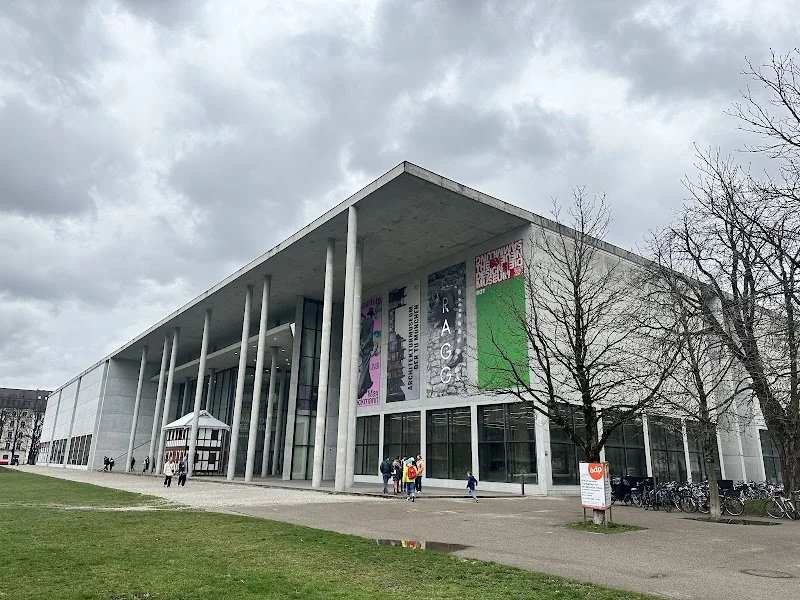
Barer Str. 40, München-Maxvorstadt
Barer Str. 40, 80333 München, Germany
The New Collection | Munich & Pinakothek der Moderne
The New Collection – The Design Museum is the internationally leading design museum in Munich and part of the Pinakothek der Moderne in the heart of the art district. Under one roof, design, art, graphics, and architecture meet here – a unique constellation that allows for a view of design from different perspectives. Visitors experience icons of industrial design, contemporary positions, material studies, and extraordinary jewelry art in close proximity. Particularly convenient: The New Collection is located at Barer Straße 40 and is therefore easily accessible by subway, tram, and bus. It is open from Tuesday to Sunday from 10 am to 6 pm, and on Thursdays even until 8 pm; it is closed on Mondays. Tickets are available online and at the ticket counter; on Museum Sunday, admission costs 1 Euro, and children and young people under 18 years of age are generally free. On-site, the café in the winter garden and the CEDON museum shop round off the visit. For those who want to get inspired in advance, highlights, dossiers, and object stories can be found in the online collection and in the editorial format Design in Dialogue.
Tickets and Opening Hours: Admission, Sunday 1 Euro, Combination Tickets and Benefits
Your visit to The New Collection ideally begins with a look at opening hours and ticket options. The regular opening hours are Tuesday to Sunday from 10:00 am to 6:00 pm; on Thursdays, there are extended hours until 8:00 pm. The Pinakothek der Moderne is closed on Mondays. The ticket structure is clear and visitor-friendly: The regular ticket costs 10 Euros, reduced 7 Euros. A special tip for families, students, and culture enthusiasts is Museum Sunday: Every Sunday, admission is only 1 Euro, making spontaneous visits attractive. Children and young people under 18 years of age receive free admission – a strong signal for cultural participation. For those who wish to explore multiple venues in one day, there is a combination ticket that covers the Alte Pinakothek, the Pinakothek der Moderne, the Museum Brandhorst, and the Sammlung Schack; this allows for a flexible art district day. Regular visitors benefit from an annual pass for the Pinakotheken, which allows free or discounted admission to the participating venues and usually pays off after just a few visits. Another plus for aspiring designers: In the Pinakothek der Moderne, students of architecture, design, and graphics enjoy free admission upon proof – ideal for engaging repeatedly with originals and material studies. Tickets can be conveniently purchased online through the official webshop or directly at the ticket counter. Online tickets are sent via email and can be shown on a smartphone; free tickets for annual pass holders and the 1-Euro Sunday ticket are also available digitally. Tip: For particularly sought-after special exhibitions, it is advisable to plan a time slot early, as there may be separate contingents and possibly differing prices for special presentations. For groups and exclusive tours, a lead time of at least 14 days is recommended; booking can be done directly via the corresponding form. This way, you prepare for a smooth, inspiring visit and have enough time to let the installations take effect.
Directions and Parking: Barer Straße 40, Public Transport to the Pinakotheken Stop, Barrier-Free Access
The New Collection is centrally located in the Munich art district and is therefore ideally connected to public transport. From the subway station Odeonsplatz (U3/U6), you can reach the Pinakotheken stop in just a few minutes with the city bus 100; this so-called museum line connects numerous cultural institutions, allowing for spontaneous combinations. Alternatively, you can take tram 27 from Karlsplatz Stachus towards Petuelring or tram 28 towards Scheidplatz to the Pinakotheken stop. The walking distances are short and lead directly to the entrance at Barer Straße 40. For those arriving by bicycle, the wide open spaces and bike paths around the art district are suitable. If you come by car, please note that the museum's own parking lot is reserved exclusively for visitors with a disabled parking permit; therefore, the Pinakothek der Moderne generally recommends arriving by public transport or on foot. Accessibility is particularly well addressed: A step-free access is possible from Barer Straße; another barrier-free access is located at Gabelsbergerstraße/corner Türkenstraße. Two elevators connect the levels, including the elevator in the rotunda by the museum shop, which leads to the basement with cloakrooms and barrier-free sanitary facilities as well as to the upper floor with the exhibition rooms. Another, staff-operated elevator at the Barer Straße entrance brings visitors directly to the basement to the design area. For additional relief, light, portable folding chairs and two wheelchairs are available at the information desk. Those sensitive to noise will find particularly quiet times usually from Tuesday to Thursday between 10:00 am and 2:00 pm, and designated quiet zones are marked in the upper floors. For groups: Please register tours and larger visits in advance; the maximum group size in large exhibition rooms is usually 25 people plus guide. This makes the visit pleasant for everyone. Also, plan for short breaks – the café in the winter garden is located directly in the building and offers a welcome break during your tour.
Discover Highlights: X-D-E-P-O-T, Danner Rotunde, The Color of Glass and More
The curatorial range of The New Collection reflects the diversity of design from everyday objects to visionary designs. A focal point is X-D-E-P-O-T, a novel exhibition and thinking space in the basement of the Pinakothek der Moderne. Here, over 600 objects from different decades and countries are presented not according to classical canons, but rather in surprising arrangements. This creates unusual dialogues – for example, when a bathtub stands next to a chair and a bicycle, and material, form, and use suddenly enter into new relationships. X-D-E-P-O-T sees itself as an open storage and discussion space that dynamically connects content, allows for interventions, and invites visitors to think along and rethink. Also legendary is the Danner Rotunde: This independent jewelry space presents international positions of author jewelry and is regularly curated anew. Since its opening in 2004, the rotunda has experienced various curatorial signatures, each offering fresh perspectives on material, technique, and artistic attitude. High-profile acquisitions, donations, and long-term loans shape the profile and make the rotunda a central meeting point for all who want to experience contemporary jewelry art at the highest level. Another focus is the exploration of glass as a cult and functional material: The thematic presentations focus on color, light, surfaces, and processing techniques, showing how glass mediates between craft, industry, and art. Additionally, programs and permanent themes like Kitchen Culture bring design to the center of daily life, and the large-scale anniversary project 100 Years – 100 Objects bundles key objects across epochs to provide insights into innovation, society, and aesthetics. Those who love typography and graphic design will find inspiration in exhibition formats featuring designers like Paula Scher. The New Collection also responds with interventions and collaborations to current issues – for example, when students interpret democratic design approaches in X-D-E-P-O-T. This creates a vibrant panorama that honors icons, makes new voices visible, and allows the presence of design in everyday life to become tangible.
The New Collection Online and On-Site: Collection Online, Design in Dialogue, Shop and Café
The journey of discovery often begins digitally today: On the website of The New Collection, Collection Online offers insights into selected objects and contexts that bring together history, technology, and design. On the occasion of the 100th anniversary of the Munich institution, the project It’s a match – 100 Years of Design & Technology opens additional perspectives, developed in collaboration with the Deutsches Museum: While the technology museum collects objects based on technical criteria, The New Collection focuses on design; some key objects shape both and appear in both institutions. Additionally, Design in Dialogue creates an editorial environment with essays, interviews, and case studies reflecting on design processes, typography, iconic designs, and future questions. On-site, the CEDON museum shop connects: Here you will find catalogs, high-quality stationery, posters, accessories, and selected design products that extend the exhibition experience. The shop's opening hours are daily except Mondays from 10:00 am to 6:00 pm, Thursdays until 8:00 pm. For a delightful break, the café in the winter garden is open from Tuesday to Sunday from morning until late afternoon; on Thursdays, the hours are extended. During ongoing renovations, access to the café may temporarily occur via the terrace, with reduced seating available indoors. Convenient for your schedule: The cloakroom and lockers are located in the basement, as well as barrier-free sanitary facilities. If you come with a school class, a team, or a group, you can book tours starting from 60 or 90 minutes; the topics are coordinated in advance and are based on objects, epochs, or questions. Thanks to the integration into the Pinakothek der Moderne, exhibition visits can be well combined – for example, starting in The New Collection, followed by graphics, architecture, or modern art in the neighboring departments. This way, individual views grow into a connected perspective on design, material culture, and society.
Photography, Service, and Accessibility: House Rules, Bag Regulations, and Helpful Tips
To ensure everyone feels comfortable, clear, visitor-friendly rules apply in the Pinakothek der Moderne. Private photography is generally allowed, but only without flash, tripod, or holders; this protects sensitive surfaces, ensures safe pathways, and respects the rights to the displayed works. For commercial photo and film recordings, prior approval from the press office is required; corresponding requests are coordinated via a form. The bag regulation states that only bags up to the size of DIN A4 may be taken into the exhibition rooms. Larger bags and backpacks must be left at the cloakroom or lockers; small fees or deposits apply. Particularly user-oriented is the offer of folding chairs for those who wish to sit down in between, as well as two loan wheelchairs. The barrier-free sanitary facilities are located in the basement, which is accessible by elevator. The barrier-free access via Barer Straße and the additional option at Gabelsbergerstraße/corner Türkenstraße facilitate arrival for all. If you are sensitive to noise, plan your tour during the quieter times in the morning from Tuesday to Thursday; designated quiet zones in the upper floors offer moments of relaxation. For families: Strollers are allowed; however, please pay attention to the pathways in more frequented areas. School classes and groups should observe the maximum group sizes and register their visit so that the supervisory staff can optimize room distribution. Information, audio tours, and notes are also available in English for international guests. This creates an atmosphere where intense observation, questioning, and comparison are always welcome – in the spirit of a design museum that promotes discourse and discovery.
History, Context, and Program: 100 Years of Design Museum in the Art District
The New Collection looks back on a hundred-year history and is considered one of the oldest design museums in the world. Emerging in the context of the reform movements of the early 20th century and inspired by networks such as the Deutscher Werkbund, it helped establish design as an independent cultural and social force. Since 2002, The New Collection has been anchored in the building of the Pinakothek der Moderne, a light-flooded house where four independent museums come together: Modern Art, Graphics, Architecture, and Design. This spatial proximity allows design objects to be embedded in larger contexts – from artistic avant-gardes to graphic experiments to architectural visions. Anniversary formats like 100 Years – 100 Objects make this interplay visible and show how designs, materials, and production methods respond to technical, social, and political developments. The curatorial practice of The New Collection combines iconic milestones with new voices: In the jewelry space of the Danner Rotunde, established positions enter into dialogue with emerging generations; in X-D-E-P-O-T, questions about material affinities, use, and sustainability arise that extend far beyond the individual object. Thematic focuses such as glass or kitchen translate design history into tactile, comprehensible narratives of everyday life and innovation. Continuously, acquisitions, donations, and long-term loans are integrated into the presentations; collaborations with universities and partner institutions ensure that the content remains vibrant and moves with the pulse of time. Therefore, those who visit The New Collection not only expand their knowledge of forms, processes, and icons but also experience design as a shaping practice that influences our present – from the typography on the city poster to the ergonomic chair, from the energy-efficient household appliance to the digital interface.
Current and Upcoming Programs: Exhibitions and Formats at a Glance
In addition to the permanent focuses, the calendar offers new access points again and again. A crowd puller is X-D-E-P-O-T, opened as a permanent space in 2021 and regularly enlivened by interventions, workshops, or thematic focuses. In the Danner Rotunde, positions of author jewelry are shown in curated cycles; over the years, a global network of workshops, schools, and scenes is emerging that makes the development of the medium comprehensible. Among the thematic settings of recent times, the exploration of glass stands out: Color, light, surface, and form language are demonstrated using historical and contemporary examples. Additionally, typographic and graphic narratives play a role, for example, when posters, orientation systems, and book design are brought together exemplarily. Anniversary-related series like 100 Years – 100 Objects bundle milestones and unexpected discoveries and invite you to reorder familiar narratives. The New Collection also connects with the everyday world: Formats on the kitchen, material cycles, or social innovations illuminate how design responds to ecological and societal challenges. Particularly appealing is the exchange with students, which tests and makes visible democratic design practices in the museum. When planning your visit, pay attention to seasonal focuses, extended Thursdays, and special openings around holidays. The program maintenance on the website is current and reliable; there you will find running times, room information, and notes on bookable tours. This way, the balance between iconic permanent experiences and fresh input is achieved with each new visit.
Sources:
- The New Collection – The Design Museum – Official Website
- Pinakothek der Moderne – Plan Your Visit, Opening Hours, Tickets, Directions, Accessibility
- Pinakothek der Moderne – House Rules and Photography Regulations
- Pinakothek der Moderne – X-D-E-P-O-T
- Pinakothek – 4 Museums – 1 Modernity, 100 Years The New Collection
- Pinakothek – Visit, Sunday 1 Euro, Combination Tickets, Discounts
Show moreShow less
The New Collection | Munich & Pinakothek der Moderne
The New Collection – The Design Museum is the internationally leading design museum in Munich and part of the Pinakothek der Moderne in the heart of the art district. Under one roof, design, art, graphics, and architecture meet here – a unique constellation that allows for a view of design from different perspectives. Visitors experience icons of industrial design, contemporary positions, material studies, and extraordinary jewelry art in close proximity. Particularly convenient: The New Collection is located at Barer Straße 40 and is therefore easily accessible by subway, tram, and bus. It is open from Tuesday to Sunday from 10 am to 6 pm, and on Thursdays even until 8 pm; it is closed on Mondays. Tickets are available online and at the ticket counter; on Museum Sunday, admission costs 1 Euro, and children and young people under 18 years of age are generally free. On-site, the café in the winter garden and the CEDON museum shop round off the visit. For those who want to get inspired in advance, highlights, dossiers, and object stories can be found in the online collection and in the editorial format Design in Dialogue.
Tickets and Opening Hours: Admission, Sunday 1 Euro, Combination Tickets and Benefits
Your visit to The New Collection ideally begins with a look at opening hours and ticket options. The regular opening hours are Tuesday to Sunday from 10:00 am to 6:00 pm; on Thursdays, there are extended hours until 8:00 pm. The Pinakothek der Moderne is closed on Mondays. The ticket structure is clear and visitor-friendly: The regular ticket costs 10 Euros, reduced 7 Euros. A special tip for families, students, and culture enthusiasts is Museum Sunday: Every Sunday, admission is only 1 Euro, making spontaneous visits attractive. Children and young people under 18 years of age receive free admission – a strong signal for cultural participation. For those who wish to explore multiple venues in one day, there is a combination ticket that covers the Alte Pinakothek, the Pinakothek der Moderne, the Museum Brandhorst, and the Sammlung Schack; this allows for a flexible art district day. Regular visitors benefit from an annual pass for the Pinakotheken, which allows free or discounted admission to the participating venues and usually pays off after just a few visits. Another plus for aspiring designers: In the Pinakothek der Moderne, students of architecture, design, and graphics enjoy free admission upon proof – ideal for engaging repeatedly with originals and material studies. Tickets can be conveniently purchased online through the official webshop or directly at the ticket counter. Online tickets are sent via email and can be shown on a smartphone; free tickets for annual pass holders and the 1-Euro Sunday ticket are also available digitally. Tip: For particularly sought-after special exhibitions, it is advisable to plan a time slot early, as there may be separate contingents and possibly differing prices for special presentations. For groups and exclusive tours, a lead time of at least 14 days is recommended; booking can be done directly via the corresponding form. This way, you prepare for a smooth, inspiring visit and have enough time to let the installations take effect.
Directions and Parking: Barer Straße 40, Public Transport to the Pinakotheken Stop, Barrier-Free Access
The New Collection is centrally located in the Munich art district and is therefore ideally connected to public transport. From the subway station Odeonsplatz (U3/U6), you can reach the Pinakotheken stop in just a few minutes with the city bus 100; this so-called museum line connects numerous cultural institutions, allowing for spontaneous combinations. Alternatively, you can take tram 27 from Karlsplatz Stachus towards Petuelring or tram 28 towards Scheidplatz to the Pinakotheken stop. The walking distances are short and lead directly to the entrance at Barer Straße 40. For those arriving by bicycle, the wide open spaces and bike paths around the art district are suitable. If you come by car, please note that the museum's own parking lot is reserved exclusively for visitors with a disabled parking permit; therefore, the Pinakothek der Moderne generally recommends arriving by public transport or on foot. Accessibility is particularly well addressed: A step-free access is possible from Barer Straße; another barrier-free access is located at Gabelsbergerstraße/corner Türkenstraße. Two elevators connect the levels, including the elevator in the rotunda by the museum shop, which leads to the basement with cloakrooms and barrier-free sanitary facilities as well as to the upper floor with the exhibition rooms. Another, staff-operated elevator at the Barer Straße entrance brings visitors directly to the basement to the design area. For additional relief, light, portable folding chairs and two wheelchairs are available at the information desk. Those sensitive to noise will find particularly quiet times usually from Tuesday to Thursday between 10:00 am and 2:00 pm, and designated quiet zones are marked in the upper floors. For groups: Please register tours and larger visits in advance; the maximum group size in large exhibition rooms is usually 25 people plus guide. This makes the visit pleasant for everyone. Also, plan for short breaks – the café in the winter garden is located directly in the building and offers a welcome break during your tour.
Discover Highlights: X-D-E-P-O-T, Danner Rotunde, The Color of Glass and More
The curatorial range of The New Collection reflects the diversity of design from everyday objects to visionary designs. A focal point is X-D-E-P-O-T, a novel exhibition and thinking space in the basement of the Pinakothek der Moderne. Here, over 600 objects from different decades and countries are presented not according to classical canons, but rather in surprising arrangements. This creates unusual dialogues – for example, when a bathtub stands next to a chair and a bicycle, and material, form, and use suddenly enter into new relationships. X-D-E-P-O-T sees itself as an open storage and discussion space that dynamically connects content, allows for interventions, and invites visitors to think along and rethink. Also legendary is the Danner Rotunde: This independent jewelry space presents international positions of author jewelry and is regularly curated anew. Since its opening in 2004, the rotunda has experienced various curatorial signatures, each offering fresh perspectives on material, technique, and artistic attitude. High-profile acquisitions, donations, and long-term loans shape the profile and make the rotunda a central meeting point for all who want to experience contemporary jewelry art at the highest level. Another focus is the exploration of glass as a cult and functional material: The thematic presentations focus on color, light, surfaces, and processing techniques, showing how glass mediates between craft, industry, and art. Additionally, programs and permanent themes like Kitchen Culture bring design to the center of daily life, and the large-scale anniversary project 100 Years – 100 Objects bundles key objects across epochs to provide insights into innovation, society, and aesthetics. Those who love typography and graphic design will find inspiration in exhibition formats featuring designers like Paula Scher. The New Collection also responds with interventions and collaborations to current issues – for example, when students interpret democratic design approaches in X-D-E-P-O-T. This creates a vibrant panorama that honors icons, makes new voices visible, and allows the presence of design in everyday life to become tangible.
The New Collection Online and On-Site: Collection Online, Design in Dialogue, Shop and Café
The journey of discovery often begins digitally today: On the website of The New Collection, Collection Online offers insights into selected objects and contexts that bring together history, technology, and design. On the occasion of the 100th anniversary of the Munich institution, the project It’s a match – 100 Years of Design & Technology opens additional perspectives, developed in collaboration with the Deutsches Museum: While the technology museum collects objects based on technical criteria, The New Collection focuses on design; some key objects shape both and appear in both institutions. Additionally, Design in Dialogue creates an editorial environment with essays, interviews, and case studies reflecting on design processes, typography, iconic designs, and future questions. On-site, the CEDON museum shop connects: Here you will find catalogs, high-quality stationery, posters, accessories, and selected design products that extend the exhibition experience. The shop's opening hours are daily except Mondays from 10:00 am to 6:00 pm, Thursdays until 8:00 pm. For a delightful break, the café in the winter garden is open from Tuesday to Sunday from morning until late afternoon; on Thursdays, the hours are extended. During ongoing renovations, access to the café may temporarily occur via the terrace, with reduced seating available indoors. Convenient for your schedule: The cloakroom and lockers are located in the basement, as well as barrier-free sanitary facilities. If you come with a school class, a team, or a group, you can book tours starting from 60 or 90 minutes; the topics are coordinated in advance and are based on objects, epochs, or questions. Thanks to the integration into the Pinakothek der Moderne, exhibition visits can be well combined – for example, starting in The New Collection, followed by graphics, architecture, or modern art in the neighboring departments. This way, individual views grow into a connected perspective on design, material culture, and society.
Photography, Service, and Accessibility: House Rules, Bag Regulations, and Helpful Tips
To ensure everyone feels comfortable, clear, visitor-friendly rules apply in the Pinakothek der Moderne. Private photography is generally allowed, but only without flash, tripod, or holders; this protects sensitive surfaces, ensures safe pathways, and respects the rights to the displayed works. For commercial photo and film recordings, prior approval from the press office is required; corresponding requests are coordinated via a form. The bag regulation states that only bags up to the size of DIN A4 may be taken into the exhibition rooms. Larger bags and backpacks must be left at the cloakroom or lockers; small fees or deposits apply. Particularly user-oriented is the offer of folding chairs for those who wish to sit down in between, as well as two loan wheelchairs. The barrier-free sanitary facilities are located in the basement, which is accessible by elevator. The barrier-free access via Barer Straße and the additional option at Gabelsbergerstraße/corner Türkenstraße facilitate arrival for all. If you are sensitive to noise, plan your tour during the quieter times in the morning from Tuesday to Thursday; designated quiet zones in the upper floors offer moments of relaxation. For families: Strollers are allowed; however, please pay attention to the pathways in more frequented areas. School classes and groups should observe the maximum group sizes and register their visit so that the supervisory staff can optimize room distribution. Information, audio tours, and notes are also available in English for international guests. This creates an atmosphere where intense observation, questioning, and comparison are always welcome – in the spirit of a design museum that promotes discourse and discovery.
History, Context, and Program: 100 Years of Design Museum in the Art District
The New Collection looks back on a hundred-year history and is considered one of the oldest design museums in the world. Emerging in the context of the reform movements of the early 20th century and inspired by networks such as the Deutscher Werkbund, it helped establish design as an independent cultural and social force. Since 2002, The New Collection has been anchored in the building of the Pinakothek der Moderne, a light-flooded house where four independent museums come together: Modern Art, Graphics, Architecture, and Design. This spatial proximity allows design objects to be embedded in larger contexts – from artistic avant-gardes to graphic experiments to architectural visions. Anniversary formats like 100 Years – 100 Objects make this interplay visible and show how designs, materials, and production methods respond to technical, social, and political developments. The curatorial practice of The New Collection combines iconic milestones with new voices: In the jewelry space of the Danner Rotunde, established positions enter into dialogue with emerging generations; in X-D-E-P-O-T, questions about material affinities, use, and sustainability arise that extend far beyond the individual object. Thematic focuses such as glass or kitchen translate design history into tactile, comprehensible narratives of everyday life and innovation. Continuously, acquisitions, donations, and long-term loans are integrated into the presentations; collaborations with universities and partner institutions ensure that the content remains vibrant and moves with the pulse of time. Therefore, those who visit The New Collection not only expand their knowledge of forms, processes, and icons but also experience design as a shaping practice that influences our present – from the typography on the city poster to the ergonomic chair, from the energy-efficient household appliance to the digital interface.
Current and Upcoming Programs: Exhibitions and Formats at a Glance
In addition to the permanent focuses, the calendar offers new access points again and again. A crowd puller is X-D-E-P-O-T, opened as a permanent space in 2021 and regularly enlivened by interventions, workshops, or thematic focuses. In the Danner Rotunde, positions of author jewelry are shown in curated cycles; over the years, a global network of workshops, schools, and scenes is emerging that makes the development of the medium comprehensible. Among the thematic settings of recent times, the exploration of glass stands out: Color, light, surface, and form language are demonstrated using historical and contemporary examples. Additionally, typographic and graphic narratives play a role, for example, when posters, orientation systems, and book design are brought together exemplarily. Anniversary-related series like 100 Years – 100 Objects bundle milestones and unexpected discoveries and invite you to reorder familiar narratives. The New Collection also connects with the everyday world: Formats on the kitchen, material cycles, or social innovations illuminate how design responds to ecological and societal challenges. Particularly appealing is the exchange with students, which tests and makes visible democratic design practices in the museum. When planning your visit, pay attention to seasonal focuses, extended Thursdays, and special openings around holidays. The program maintenance on the website is current and reliable; there you will find running times, room information, and notes on bookable tours. This way, the balance between iconic permanent experiences and fresh input is achieved with each new visit.
Sources:
- The New Collection – The Design Museum – Official Website
- Pinakothek der Moderne – Plan Your Visit, Opening Hours, Tickets, Directions, Accessibility
- Pinakothek der Moderne – House Rules and Photography Regulations
- Pinakothek der Moderne – X-D-E-P-O-T
- Pinakothek – 4 Museums – 1 Modernity, 100 Years The New Collection
- Pinakothek – Visit, Sunday 1 Euro, Combination Tickets, Discounts
The New Collection | Munich & Pinakothek der Moderne
The New Collection – The Design Museum is the internationally leading design museum in Munich and part of the Pinakothek der Moderne in the heart of the art district. Under one roof, design, art, graphics, and architecture meet here – a unique constellation that allows for a view of design from different perspectives. Visitors experience icons of industrial design, contemporary positions, material studies, and extraordinary jewelry art in close proximity. Particularly convenient: The New Collection is located at Barer Straße 40 and is therefore easily accessible by subway, tram, and bus. It is open from Tuesday to Sunday from 10 am to 6 pm, and on Thursdays even until 8 pm; it is closed on Mondays. Tickets are available online and at the ticket counter; on Museum Sunday, admission costs 1 Euro, and children and young people under 18 years of age are generally free. On-site, the café in the winter garden and the CEDON museum shop round off the visit. For those who want to get inspired in advance, highlights, dossiers, and object stories can be found in the online collection and in the editorial format Design in Dialogue.
Tickets and Opening Hours: Admission, Sunday 1 Euro, Combination Tickets and Benefits
Your visit to The New Collection ideally begins with a look at opening hours and ticket options. The regular opening hours are Tuesday to Sunday from 10:00 am to 6:00 pm; on Thursdays, there are extended hours until 8:00 pm. The Pinakothek der Moderne is closed on Mondays. The ticket structure is clear and visitor-friendly: The regular ticket costs 10 Euros, reduced 7 Euros. A special tip for families, students, and culture enthusiasts is Museum Sunday: Every Sunday, admission is only 1 Euro, making spontaneous visits attractive. Children and young people under 18 years of age receive free admission – a strong signal for cultural participation. For those who wish to explore multiple venues in one day, there is a combination ticket that covers the Alte Pinakothek, the Pinakothek der Moderne, the Museum Brandhorst, and the Sammlung Schack; this allows for a flexible art district day. Regular visitors benefit from an annual pass for the Pinakotheken, which allows free or discounted admission to the participating venues and usually pays off after just a few visits. Another plus for aspiring designers: In the Pinakothek der Moderne, students of architecture, design, and graphics enjoy free admission upon proof – ideal for engaging repeatedly with originals and material studies. Tickets can be conveniently purchased online through the official webshop or directly at the ticket counter. Online tickets are sent via email and can be shown on a smartphone; free tickets for annual pass holders and the 1-Euro Sunday ticket are also available digitally. Tip: For particularly sought-after special exhibitions, it is advisable to plan a time slot early, as there may be separate contingents and possibly differing prices for special presentations. For groups and exclusive tours, a lead time of at least 14 days is recommended; booking can be done directly via the corresponding form. This way, you prepare for a smooth, inspiring visit and have enough time to let the installations take effect.
Directions and Parking: Barer Straße 40, Public Transport to the Pinakotheken Stop, Barrier-Free Access
The New Collection is centrally located in the Munich art district and is therefore ideally connected to public transport. From the subway station Odeonsplatz (U3/U6), you can reach the Pinakotheken stop in just a few minutes with the city bus 100; this so-called museum line connects numerous cultural institutions, allowing for spontaneous combinations. Alternatively, you can take tram 27 from Karlsplatz Stachus towards Petuelring or tram 28 towards Scheidplatz to the Pinakotheken stop. The walking distances are short and lead directly to the entrance at Barer Straße 40. For those arriving by bicycle, the wide open spaces and bike paths around the art district are suitable. If you come by car, please note that the museum's own parking lot is reserved exclusively for visitors with a disabled parking permit; therefore, the Pinakothek der Moderne generally recommends arriving by public transport or on foot. Accessibility is particularly well addressed: A step-free access is possible from Barer Straße; another barrier-free access is located at Gabelsbergerstraße/corner Türkenstraße. Two elevators connect the levels, including the elevator in the rotunda by the museum shop, which leads to the basement with cloakrooms and barrier-free sanitary facilities as well as to the upper floor with the exhibition rooms. Another, staff-operated elevator at the Barer Straße entrance brings visitors directly to the basement to the design area. For additional relief, light, portable folding chairs and two wheelchairs are available at the information desk. Those sensitive to noise will find particularly quiet times usually from Tuesday to Thursday between 10:00 am and 2:00 pm, and designated quiet zones are marked in the upper floors. For groups: Please register tours and larger visits in advance; the maximum group size in large exhibition rooms is usually 25 people plus guide. This makes the visit pleasant for everyone. Also, plan for short breaks – the café in the winter garden is located directly in the building and offers a welcome break during your tour.
Discover Highlights: X-D-E-P-O-T, Danner Rotunde, The Color of Glass and More
The curatorial range of The New Collection reflects the diversity of design from everyday objects to visionary designs. A focal point is X-D-E-P-O-T, a novel exhibition and thinking space in the basement of the Pinakothek der Moderne. Here, over 600 objects from different decades and countries are presented not according to classical canons, but rather in surprising arrangements. This creates unusual dialogues – for example, when a bathtub stands next to a chair and a bicycle, and material, form, and use suddenly enter into new relationships. X-D-E-P-O-T sees itself as an open storage and discussion space that dynamically connects content, allows for interventions, and invites visitors to think along and rethink. Also legendary is the Danner Rotunde: This independent jewelry space presents international positions of author jewelry and is regularly curated anew. Since its opening in 2004, the rotunda has experienced various curatorial signatures, each offering fresh perspectives on material, technique, and artistic attitude. High-profile acquisitions, donations, and long-term loans shape the profile and make the rotunda a central meeting point for all who want to experience contemporary jewelry art at the highest level. Another focus is the exploration of glass as a cult and functional material: The thematic presentations focus on color, light, surfaces, and processing techniques, showing how glass mediates between craft, industry, and art. Additionally, programs and permanent themes like Kitchen Culture bring design to the center of daily life, and the large-scale anniversary project 100 Years – 100 Objects bundles key objects across epochs to provide insights into innovation, society, and aesthetics. Those who love typography and graphic design will find inspiration in exhibition formats featuring designers like Paula Scher. The New Collection also responds with interventions and collaborations to current issues – for example, when students interpret democratic design approaches in X-D-E-P-O-T. This creates a vibrant panorama that honors icons, makes new voices visible, and allows the presence of design in everyday life to become tangible.
The New Collection Online and On-Site: Collection Online, Design in Dialogue, Shop and Café
The journey of discovery often begins digitally today: On the website of The New Collection, Collection Online offers insights into selected objects and contexts that bring together history, technology, and design. On the occasion of the 100th anniversary of the Munich institution, the project It’s a match – 100 Years of Design & Technology opens additional perspectives, developed in collaboration with the Deutsches Museum: While the technology museum collects objects based on technical criteria, The New Collection focuses on design; some key objects shape both and appear in both institutions. Additionally, Design in Dialogue creates an editorial environment with essays, interviews, and case studies reflecting on design processes, typography, iconic designs, and future questions. On-site, the CEDON museum shop connects: Here you will find catalogs, high-quality stationery, posters, accessories, and selected design products that extend the exhibition experience. The shop's opening hours are daily except Mondays from 10:00 am to 6:00 pm, Thursdays until 8:00 pm. For a delightful break, the café in the winter garden is open from Tuesday to Sunday from morning until late afternoon; on Thursdays, the hours are extended. During ongoing renovations, access to the café may temporarily occur via the terrace, with reduced seating available indoors. Convenient for your schedule: The cloakroom and lockers are located in the basement, as well as barrier-free sanitary facilities. If you come with a school class, a team, or a group, you can book tours starting from 60 or 90 minutes; the topics are coordinated in advance and are based on objects, epochs, or questions. Thanks to the integration into the Pinakothek der Moderne, exhibition visits can be well combined – for example, starting in The New Collection, followed by graphics, architecture, or modern art in the neighboring departments. This way, individual views grow into a connected perspective on design, material culture, and society.
Photography, Service, and Accessibility: House Rules, Bag Regulations, and Helpful Tips
To ensure everyone feels comfortable, clear, visitor-friendly rules apply in the Pinakothek der Moderne. Private photography is generally allowed, but only without flash, tripod, or holders; this protects sensitive surfaces, ensures safe pathways, and respects the rights to the displayed works. For commercial photo and film recordings, prior approval from the press office is required; corresponding requests are coordinated via a form. The bag regulation states that only bags up to the size of DIN A4 may be taken into the exhibition rooms. Larger bags and backpacks must be left at the cloakroom or lockers; small fees or deposits apply. Particularly user-oriented is the offer of folding chairs for those who wish to sit down in between, as well as two loan wheelchairs. The barrier-free sanitary facilities are located in the basement, which is accessible by elevator. The barrier-free access via Barer Straße and the additional option at Gabelsbergerstraße/corner Türkenstraße facilitate arrival for all. If you are sensitive to noise, plan your tour during the quieter times in the morning from Tuesday to Thursday; designated quiet zones in the upper floors offer moments of relaxation. For families: Strollers are allowed; however, please pay attention to the pathways in more frequented areas. School classes and groups should observe the maximum group sizes and register their visit so that the supervisory staff can optimize room distribution. Information, audio tours, and notes are also available in English for international guests. This creates an atmosphere where intense observation, questioning, and comparison are always welcome – in the spirit of a design museum that promotes discourse and discovery.
History, Context, and Program: 100 Years of Design Museum in the Art District
The New Collection looks back on a hundred-year history and is considered one of the oldest design museums in the world. Emerging in the context of the reform movements of the early 20th century and inspired by networks such as the Deutscher Werkbund, it helped establish design as an independent cultural and social force. Since 2002, The New Collection has been anchored in the building of the Pinakothek der Moderne, a light-flooded house where four independent museums come together: Modern Art, Graphics, Architecture, and Design. This spatial proximity allows design objects to be embedded in larger contexts – from artistic avant-gardes to graphic experiments to architectural visions. Anniversary formats like 100 Years – 100 Objects make this interplay visible and show how designs, materials, and production methods respond to technical, social, and political developments. The curatorial practice of The New Collection combines iconic milestones with new voices: In the jewelry space of the Danner Rotunde, established positions enter into dialogue with emerging generations; in X-D-E-P-O-T, questions about material affinities, use, and sustainability arise that extend far beyond the individual object. Thematic focuses such as glass or kitchen translate design history into tactile, comprehensible narratives of everyday life and innovation. Continuously, acquisitions, donations, and long-term loans are integrated into the presentations; collaborations with universities and partner institutions ensure that the content remains vibrant and moves with the pulse of time. Therefore, those who visit The New Collection not only expand their knowledge of forms, processes, and icons but also experience design as a shaping practice that influences our present – from the typography on the city poster to the ergonomic chair, from the energy-efficient household appliance to the digital interface.
Current and Upcoming Programs: Exhibitions and Formats at a Glance
In addition to the permanent focuses, the calendar offers new access points again and again. A crowd puller is X-D-E-P-O-T, opened as a permanent space in 2021 and regularly enlivened by interventions, workshops, or thematic focuses. In the Danner Rotunde, positions of author jewelry are shown in curated cycles; over the years, a global network of workshops, schools, and scenes is emerging that makes the development of the medium comprehensible. Among the thematic settings of recent times, the exploration of glass stands out: Color, light, surface, and form language are demonstrated using historical and contemporary examples. Additionally, typographic and graphic narratives play a role, for example, when posters, orientation systems, and book design are brought together exemplarily. Anniversary-related series like 100 Years – 100 Objects bundle milestones and unexpected discoveries and invite you to reorder familiar narratives. The New Collection also connects with the everyday world: Formats on the kitchen, material cycles, or social innovations illuminate how design responds to ecological and societal challenges. Particularly appealing is the exchange with students, which tests and makes visible democratic design practices in the museum. When planning your visit, pay attention to seasonal focuses, extended Thursdays, and special openings around holidays. The program maintenance on the website is current and reliable; there you will find running times, room information, and notes on bookable tours. This way, the balance between iconic permanent experiences and fresh input is achieved with each new visit.
Sources:
- The New Collection – The Design Museum – Official Website
- Pinakothek der Moderne – Plan Your Visit, Opening Hours, Tickets, Directions, Accessibility
- Pinakothek der Moderne – House Rules and Photography Regulations
- Pinakothek der Moderne – X-D-E-P-O-T
- Pinakothek – 4 Museums – 1 Modernity, 100 Years The New Collection
- Pinakothek – Visit, Sunday 1 Euro, Combination Tickets, Discounts
Upcoming Events
No events found
Frequently Asked Questions
Reviews
Gesche Capin
11. December 2023
This museum is a total must if you are an architect, designer, or simply interested in art and design! The collection they have is amazing because the pieces are old and well-preserved! You can see how the furniture prices were made back in the day! All German designers!! There were also some temporary exhibits, but I’m sure you’ll find something you like! Don’t miss the bookstore! Tip: If you are an architecture or design student, you get to go in for free!
BradinHK
28. July 2018
Die Neue Sammlung (€10 per adult) is housed in the same building as the Pinakothek der Moderne and is recognized as one of the most important design and applied art museums in the world. Opening hours are 10am to 6pm daily with extended hours on Thursdays evening until 8pm. The museum is closed on Mondays. Entry ticket includes access to both the Pinakothek der Moderne and Die Neue Sammlung. Located in the underground floor, here you find some intensive exhibitions on industrial, graphic and furniture design. There are also impressive jewelry, ceramics as well as artistically created objects on display. We spent around 45 minutes browsing the galleries of the Die Neue Sammlung, finding this to be a very good complement to the traditional Modern Art galleries and exhibitions in the upstairs floors of the Pinakothek der Moderne. Note: There is a ground floor cafe with outdoor seating at the museum. This makes for a good rest break in between your visits to Die Neue Sammlung and Pinakothek der Moderne. The cafe is open from 10am to 4pm daily with extended hours on Thursday. Note: Entrance to all Die Pinakotheken museums in Munich are €1 on Sundays. As such, you can save quite a bit on museum fees if you visit 2-3 on the day.
JuZZepE Qebab
11. March 2024
Die Sammlung Gallery offers a unique blend of contemporary and classical art, drawing art enthusiasts from around the globe. One of its most remarkable aspects is its extensive collection of Bauhaus school artworks. These pieces not only reflect the significance and influence of this art movement but also provide a unique immersion into its innovative approach to design and architecture.
Mon
27. June 2025
I have to limit my criticism since this museum is €0-10 depending on when you go. To really enjoy this museum, you need to already know industrial design history or be willing to do your own research using the catalogue. The sprawling array of objects is certainly an impressive spectacle to behold, but totally lacking in context. I was particularly disappointed that the Futuro house on the lawn doesn’t have any kind of stairs up to the windows so that visitors can peer inside; seems like kind of a missed opportunity to acquire such a rare piece of design history for only its exterior to be visible and cared for. The staff here are very curt, but probably aren’t getting paid enough to be chipper. I would be happy to pay a few more euros to have a higher quality experience of this remarkable collection.
Tomasz Boczek
2. November 2025
Very nice museum, well organized. Especially recommended for those interested in architecture and design :)