
München
Ehrenbürgstraße 9, 81249 München, Deutschland
Former Forced Labor Camp Neuaubing | History & Photos
The former forced labor camp Neuaubing is not a classic event venue, but a historically significant memorial site in the western part of Munich. Today, those who come to Ehrenbürgstraße 9 encounter a site still marked by the traces of its past: eight preserved barracks, historical buildings, a place of forced labor, and at the same time an area that has been used for decades and is now gradually being developed into a visible memorial site. It is precisely this overlay of history and present that makes Neuaubing so special. The site is currently not fully accessible, is being renovated, and is still shaped by its future role as a branch of the NS Documentation Center Munich. At the same time, tours are already taking place that make the history of the site, its current use, and the architectural remnants tangible. For those looking for information about the former forced labor camp Neuaubing, photos, background knowledge, or practical visitor information, this site is therefore much more than an entry on a map: it is a place of learning, a memorial site, and a testament to NS forced labor in Munich. ([nsdoku.de](https://www.nsdoku.de/erinnerungsort-neuaubing/das-lager-in-neuaubing))
History of the Former Forced Labor Camp Neuaubing
The history of the camp in Neuaubing is closely linked to the war economy and NS forced labor. According to official information from the NS Documentation Center, the camp was established in 1942 by the Reichsbahn and used until 1945 as a collective accommodation for up to 1,000 forced laborers who had to work in the nearby repair shop Neuaubing, the RAW. At that time, there were numerous collective accommodations and camps in the western districts of Munich, as Munich was a center of forced labor during World War II. The people housed here came from various European countries; initially, the area was intended for civilian forced laborers from the Soviet Union, later people from Poland, Italy, and possibly the Netherlands and France were also accommodated there. Among them were many women, children, and young people. The information from the city of Munich and the NS Documentation Center places the camp in the larger dimension of the crime: Between 1939 and 1945, about 13.5 million people had to perform forced labor in the German Reich, and in the Munich area, more than 120,000 people were affected. ([nsdoku.de](https://www.nsdoku.de/presse/newsroom/erinnerungsort-neuaubing))
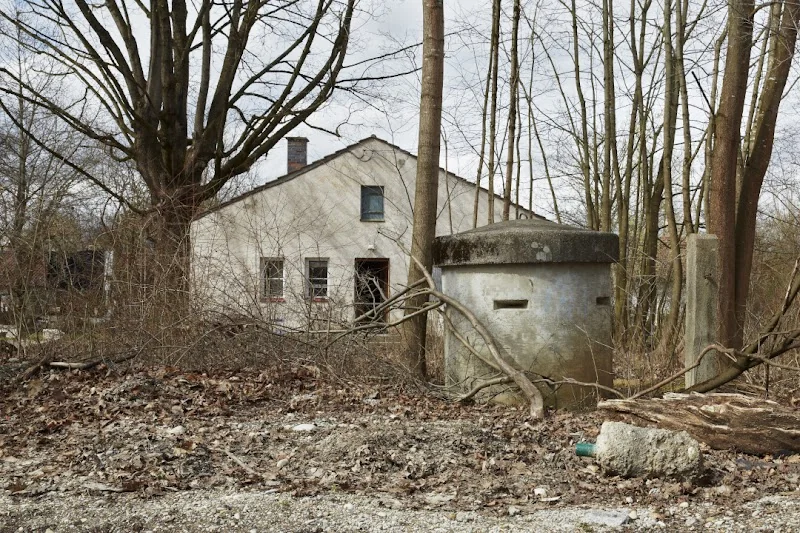
The architectural structure of the site also tells this story very clearly. According to historical documents, eleven barracks were originally planned, but not all were built. Today, eight barracks and further traces such as remnants of fencing from the construction period and two small bunkers are preserved. The site is thus one of the last architecturally preserved camp ensembles of this kind in Germany and is protected as an ensemble as well as an individual monument. The story does not end in 1945: After the liberation in the early hours of April 30, 1945, the area remained a collective accommodation for displaced persons for several months. Later, the Deutsche Bundesbahn used the site as a dormitory for apprentices from at least 1949; from the 1970s, commercial uses were added, and in the 1980s, a kindergarten, a leisure farm, as well as studios and workshops were established. It is precisely these subsequent uses that contributed to the preservation of the site despite numerous changes in its substance. Since the year 2000, its history has been rediscovered, a historical report was created in 2008, in 2014 the city initially purchased one barrack, the following year the entire site, and since 2017 all buildings have been under monument protection. ([nsdoku.de](https://www.nsdoku.de/erinnerungsort-neuaubing/das-lager-in-neuaubing))
Photos, Images, and Architectural Traces at the Memorial Site
Those looking for photos or images of the former forced labor camp Neuaubing will find a remarkable photographic documentation on the official pages of the NS Documentation Center. There, not only current images of the barracks and the site are shown, but also historical source images and archival material. This includes the barrack and the splinter protection bunker of the former camp, interior views of barrack 5, an exterior view of barrack 5 after renovation, a historical site plan from the construction file Ehrenbürgstraße 9, and personal documents such as work cards and employment IDs. This mix of architecture, sources, and biographies makes it clear that the site must be read not only as a building ensemble but as a testament to the living and working conditions of the forced laborers. Images here are therefore not just illustrations but historical material. They help to understand the spatial structure of the camp, the cramped conditions of the accommodations, and the later transformation of the site. ([nsdoku.de](https://www.nsdoku.de/presse/newsroom/erinnerungsort-neuaubing))
Particularly enlightening is the fact that the visual language on the official pages connects two levels: on the one hand, the current state of the site, and on the other hand, the historical depth of the material. The photos of barrack 5 show that the site is not presented in a museum-like smooth condition, but as a place with layers, alterations, and visible remnants. At the same time, the historical photographs and the depicted objects refer to specific individuals, such as former forced laborers like Anna Wladimirowna or to work documents from the Reichsbahn repair shop. Therefore, anyone interested in images of Neuaubing should consider the official pages as the first point of contact. There, it becomes clear how knowledge is generated from visual sources: about the design of the camp, about the organization of work at the Reichsbahn, about post-war history, and about the current steps towards the memorial site. Precisely for this reason, the search queries for photos, images, and knowledge are closely connected here. ([nsdoku.de](https://www.nsdoku.de/presse/newsroom/erinnerungsort-neuaubing))
Access, Entry, and Parking in Neuaubing
For visiting the memorial site, the practical information is clear and straightforward. The official address is Ehrenbürgstraße 9, 81249 Munich. The recommended way to arrive is by S-Bahn line S8 to Freiham Bahnhof, as well as bus lines 57 and 143 to Freiham Bahnhof. Those arriving by car should know that there are no parking spaces available for visitors. Therefore, public transport is the most sensible and officially recommended option. These notes are particularly important because many people searching for the term Neuaubing access or Neuaubing parking expect exactly such information. However, the answer for the memorial site Neuaubing is not a comfortable parking solution, but the clear recommendation to rely on trains and buses. ([nsdoku.de](https://www.nsdoku.de/erinnerungsort-neuaubing/das-lager-in-neuaubing))
Equally important is the note that the site is currently being renovated and is only partially accessible. The memorial site is also not barrier-free, and there are no public sanitary facilities. This means: a visit should be well prepared, especially if one wants to participate in a guided tour. The official page also points out that the paths and the use of the site may change as part of the renovation. This is not only a practical aspect for a historical site like Neuaubing but also part of its character: the area is not a closed museum building but a historically grown site that must mediate between protection, use, and future educational work. Those who truly want to understand the uniqueness of the site should keep these framework conditions in mind. Access is therefore easy when using public transport, but the visit also requires some flexibility and attention to the current information from the NS Documentation Center. ([nsdoku.de](https://www.nsdoku.de/erinnerungsort-neuaubing/das-lager-in-neuaubing))
Guided Tours, Opening Hours, and Current Use
Even though the memorial site is not yet fully opened, there is already a running program. The official page regularly announces upcoming guided tours, and the program information shows that tours are a central part of the educational work. The tours tell the history of the site, explain the architectural traces, and inform about the plans for establishing the memorial site. For groups, bookable tours of the site are available, during which the history of the site, the current use, and barrack 5 are visited. This is particularly relevant for school classes, educational groups, and anyone who wants to engage more intensively with the topic of NS forced labor. The tours are therefore not just a supplementary offer but the most important format to read the site in its present and past. ([nsdoku.de](https://www.nsdoku.de/programm/archiv/detailseite/das-ehemalige-zwangsarbeiterinnenlager-neuaubing-2049))
The current use of the site is part of this narrative. The eight barracks are predominantly used today as studios and workshops; there is also a kindergarten and a leisure farm for children and young people on the site. This diverse use has kept the site alive for decades and ensured that it did not become an isolated monument. It is precisely from this that the special tension of the site arises: it is both a memorial site and a place of everyday life. The official representation emphasizes that the different uses should be preserved and that a vibrant form of memory culture emerges from this. Additionally, the opening of the branch of the NS Documentation Center Munich is planned for 2027. Until then, the site remains in transition, but this transition is already part of its character. Therefore, those who open themselves to Neuaubing discover not only a historical relic but a place where memory, education, culture, and community are intertwined. ([nsdoku.de](https://www.nsdoku.de/presse/newsroom/neuaubing))
Memorial Site Neuaubing, Branch, and Digital Knowledge
The future memorial site Neuaubing is conceived as a branch of the NS Documentation Center Munich. According to official information, the site is to be renovated in accordance with monument and nature conservation and supplemented with exhibitions and educational offerings. In two barracks and the outdoor area, exhibitions, events, workshops, and seminars are to take place later. The project is thus not only a renovation but a substantive development: Neuaubing is to become a place where the history of NS forced labor is conveyed permanently and accessibly. It is particularly important that the current use is not displaced but integrated into the concept. This way, the site remains a real, vibrant urban building block and at the same time becomes a publicly visible place of learning. The official opening is planned for 2027. ([nsdoku.de](https://www.nsdoku.de/erinnerungsort-neuaubing/das-lager-in-neuaubing))
Digital offerings are also part of the educational work. The project Departure Neuaubing. European Stories of Forced Labor accompanies the establishment of the memorial site and makes the history of Nazi forced labor accessible through artistic and narrative formats. Additionally, the site refers to the mobile game Forced Abroad. Days of a Forced Laborer, which is based on the diary of 19-year-old Dutchman Jan, who was deported to Munich in 1945. Therefore, anyone who wants to engage with the site online will find not only static information but also digital narratives that translate historical facts into contemporary formats. Furthermore, the NS Documentation Center is seeking photos, documents, and objects related to NS forced labor in Munich and the surrounding area. This shows: memory work in Neuaubing is not completed but open to new sources, new perspectives, and new contributions from the urban society. This is precisely where the special strength of this site lies. It connects historical research, concrete biographies, digital mediation, and future exhibitions into a place of learning that extends far beyond a single building. ([nsdoku.de](https://www.nsdoku.de/erinnerungsort-neuaubing/das-lager-in-neuaubing))
Sources:
- NS Documentation Center Munich - Memorial Site Neuaubing ([nsdoku.de](https://www.nsdoku.de/erinnerungsort-neuaubing/das-lager-in-neuaubing))
- NS Documentation Center Munich - Former Forced Labor Camp in Neuaubing Becomes Memorial Site ([nsdoku.de](https://www.nsdoku.de/presse/newsroom/neuaubing))
- NS Documentation Center Munich - Memorial Site Neuaubing ([nsdoku.de](https://www.nsdoku.de/presse/newsroom/erinnerungsort-neuaubing))
- City of Munich - Memorial for Forced Laborers in Neuaubing ([ru.muenchen.de](https://ru.muenchen.de/2025/132/Erinnerungszeichen-fuer-Zwangsarbeiterinnen-in-Neuaubing-119317))
- NS Documentation Center Munich - The Former Forced Labor Camp Neuaubing ([nsdoku.de](https://www.nsdoku.de/programm/archiv/detailseite/das-ehemalige-zwangsarbeiterinnenlager-neuaubing-2049))
Show moreShow less
Former Forced Labor Camp Neuaubing | History & Photos
The former forced labor camp Neuaubing is not a classic event venue, but a historically significant memorial site in the western part of Munich. Today, those who come to Ehrenbürgstraße 9 encounter a site still marked by the traces of its past: eight preserved barracks, historical buildings, a place of forced labor, and at the same time an area that has been used for decades and is now gradually being developed into a visible memorial site. It is precisely this overlay of history and present that makes Neuaubing so special. The site is currently not fully accessible, is being renovated, and is still shaped by its future role as a branch of the NS Documentation Center Munich. At the same time, tours are already taking place that make the history of the site, its current use, and the architectural remnants tangible. For those looking for information about the former forced labor camp Neuaubing, photos, background knowledge, or practical visitor information, this site is therefore much more than an entry on a map: it is a place of learning, a memorial site, and a testament to NS forced labor in Munich. ([nsdoku.de](https://www.nsdoku.de/erinnerungsort-neuaubing/das-lager-in-neuaubing))
History of the Former Forced Labor Camp Neuaubing
The history of the camp in Neuaubing is closely linked to the war economy and NS forced labor. According to official information from the NS Documentation Center, the camp was established in 1942 by the Reichsbahn and used until 1945 as a collective accommodation for up to 1,000 forced laborers who had to work in the nearby repair shop Neuaubing, the RAW. At that time, there were numerous collective accommodations and camps in the western districts of Munich, as Munich was a center of forced labor during World War II. The people housed here came from various European countries; initially, the area was intended for civilian forced laborers from the Soviet Union, later people from Poland, Italy, and possibly the Netherlands and France were also accommodated there. Among them were many women, children, and young people. The information from the city of Munich and the NS Documentation Center places the camp in the larger dimension of the crime: Between 1939 and 1945, about 13.5 million people had to perform forced labor in the German Reich, and in the Munich area, more than 120,000 people were affected. ([nsdoku.de](https://www.nsdoku.de/presse/newsroom/erinnerungsort-neuaubing))
The architectural structure of the site also tells this story very clearly. According to historical documents, eleven barracks were originally planned, but not all were built. Today, eight barracks and further traces such as remnants of fencing from the construction period and two small bunkers are preserved. The site is thus one of the last architecturally preserved camp ensembles of this kind in Germany and is protected as an ensemble as well as an individual monument. The story does not end in 1945: After the liberation in the early hours of April 30, 1945, the area remained a collective accommodation for displaced persons for several months. Later, the Deutsche Bundesbahn used the site as a dormitory for apprentices from at least 1949; from the 1970s, commercial uses were added, and in the 1980s, a kindergarten, a leisure farm, as well as studios and workshops were established. It is precisely these subsequent uses that contributed to the preservation of the site despite numerous changes in its substance. Since the year 2000, its history has been rediscovered, a historical report was created in 2008, in 2014 the city initially purchased one barrack, the following year the entire site, and since 2017 all buildings have been under monument protection. ([nsdoku.de](https://www.nsdoku.de/erinnerungsort-neuaubing/das-lager-in-neuaubing))
Photos, Images, and Architectural Traces at the Memorial Site
Those looking for photos or images of the former forced labor camp Neuaubing will find a remarkable photographic documentation on the official pages of the NS Documentation Center. There, not only current images of the barracks and the site are shown, but also historical source images and archival material. This includes the barrack and the splinter protection bunker of the former camp, interior views of barrack 5, an exterior view of barrack 5 after renovation, a historical site plan from the construction file Ehrenbürgstraße 9, and personal documents such as work cards and employment IDs. This mix of architecture, sources, and biographies makes it clear that the site must be read not only as a building ensemble but as a testament to the living and working conditions of the forced laborers. Images here are therefore not just illustrations but historical material. They help to understand the spatial structure of the camp, the cramped conditions of the accommodations, and the later transformation of the site. ([nsdoku.de](https://www.nsdoku.de/presse/newsroom/erinnerungsort-neuaubing))
Particularly enlightening is the fact that the visual language on the official pages connects two levels: on the one hand, the current state of the site, and on the other hand, the historical depth of the material. The photos of barrack 5 show that the site is not presented in a museum-like smooth condition, but as a place with layers, alterations, and visible remnants. At the same time, the historical photographs and the depicted objects refer to specific individuals, such as former forced laborers like Anna Wladimirowna or to work documents from the Reichsbahn repair shop. Therefore, anyone interested in images of Neuaubing should consider the official pages as the first point of contact. There, it becomes clear how knowledge is generated from visual sources: about the design of the camp, about the organization of work at the Reichsbahn, about post-war history, and about the current steps towards the memorial site. Precisely for this reason, the search queries for photos, images, and knowledge are closely connected here. ([nsdoku.de](https://www.nsdoku.de/presse/newsroom/erinnerungsort-neuaubing))
Access, Entry, and Parking in Neuaubing
For visiting the memorial site, the practical information is clear and straightforward. The official address is Ehrenbürgstraße 9, 81249 Munich. The recommended way to arrive is by S-Bahn line S8 to Freiham Bahnhof, as well as bus lines 57 and 143 to Freiham Bahnhof. Those arriving by car should know that there are no parking spaces available for visitors. Therefore, public transport is the most sensible and officially recommended option. These notes are particularly important because many people searching for the term Neuaubing access or Neuaubing parking expect exactly such information. However, the answer for the memorial site Neuaubing is not a comfortable parking solution, but the clear recommendation to rely on trains and buses. ([nsdoku.de](https://www.nsdoku.de/erinnerungsort-neuaubing/das-lager-in-neuaubing))
Equally important is the note that the site is currently being renovated and is only partially accessible. The memorial site is also not barrier-free, and there are no public sanitary facilities. This means: a visit should be well prepared, especially if one wants to participate in a guided tour. The official page also points out that the paths and the use of the site may change as part of the renovation. This is not only a practical aspect for a historical site like Neuaubing but also part of its character: the area is not a closed museum building but a historically grown site that must mediate between protection, use, and future educational work. Those who truly want to understand the uniqueness of the site should keep these framework conditions in mind. Access is therefore easy when using public transport, but the visit also requires some flexibility and attention to the current information from the NS Documentation Center. ([nsdoku.de](https://www.nsdoku.de/erinnerungsort-neuaubing/das-lager-in-neuaubing))
Guided Tours, Opening Hours, and Current Use
Even though the memorial site is not yet fully opened, there is already a running program. The official page regularly announces upcoming guided tours, and the program information shows that tours are a central part of the educational work. The tours tell the history of the site, explain the architectural traces, and inform about the plans for establishing the memorial site. For groups, bookable tours of the site are available, during which the history of the site, the current use, and barrack 5 are visited. This is particularly relevant for school classes, educational groups, and anyone who wants to engage more intensively with the topic of NS forced labor. The tours are therefore not just a supplementary offer but the most important format to read the site in its present and past. ([nsdoku.de](https://www.nsdoku.de/programm/archiv/detailseite/das-ehemalige-zwangsarbeiterinnenlager-neuaubing-2049))
The current use of the site is part of this narrative. The eight barracks are predominantly used today as studios and workshops; there is also a kindergarten and a leisure farm for children and young people on the site. This diverse use has kept the site alive for decades and ensured that it did not become an isolated monument. It is precisely from this that the special tension of the site arises: it is both a memorial site and a place of everyday life. The official representation emphasizes that the different uses should be preserved and that a vibrant form of memory culture emerges from this. Additionally, the opening of the branch of the NS Documentation Center Munich is planned for 2027. Until then, the site remains in transition, but this transition is already part of its character. Therefore, those who open themselves to Neuaubing discover not only a historical relic but a place where memory, education, culture, and community are intertwined. ([nsdoku.de](https://www.nsdoku.de/presse/newsroom/neuaubing))
Memorial Site Neuaubing, Branch, and Digital Knowledge
The future memorial site Neuaubing is conceived as a branch of the NS Documentation Center Munich. According to official information, the site is to be renovated in accordance with monument and nature conservation and supplemented with exhibitions and educational offerings. In two barracks and the outdoor area, exhibitions, events, workshops, and seminars are to take place later. The project is thus not only a renovation but a substantive development: Neuaubing is to become a place where the history of NS forced labor is conveyed permanently and accessibly. It is particularly important that the current use is not displaced but integrated into the concept. This way, the site remains a real, vibrant urban building block and at the same time becomes a publicly visible place of learning. The official opening is planned for 2027. ([nsdoku.de](https://www.nsdoku.de/erinnerungsort-neuaubing/das-lager-in-neuaubing))
Digital offerings are also part of the educational work. The project Departure Neuaubing. European Stories of Forced Labor accompanies the establishment of the memorial site and makes the history of Nazi forced labor accessible through artistic and narrative formats. Additionally, the site refers to the mobile game Forced Abroad. Days of a Forced Laborer, which is based on the diary of 19-year-old Dutchman Jan, who was deported to Munich in 1945. Therefore, anyone who wants to engage with the site online will find not only static information but also digital narratives that translate historical facts into contemporary formats. Furthermore, the NS Documentation Center is seeking photos, documents, and objects related to NS forced labor in Munich and the surrounding area. This shows: memory work in Neuaubing is not completed but open to new sources, new perspectives, and new contributions from the urban society. This is precisely where the special strength of this site lies. It connects historical research, concrete biographies, digital mediation, and future exhibitions into a place of learning that extends far beyond a single building. ([nsdoku.de](https://www.nsdoku.de/erinnerungsort-neuaubing/das-lager-in-neuaubing))
Sources:
- NS Documentation Center Munich - Memorial Site Neuaubing ([nsdoku.de](https://www.nsdoku.de/erinnerungsort-neuaubing/das-lager-in-neuaubing))
- NS Documentation Center Munich - Former Forced Labor Camp in Neuaubing Becomes Memorial Site ([nsdoku.de](https://www.nsdoku.de/presse/newsroom/neuaubing))
- NS Documentation Center Munich - Memorial Site Neuaubing ([nsdoku.de](https://www.nsdoku.de/presse/newsroom/erinnerungsort-neuaubing))
- City of Munich - Memorial for Forced Laborers in Neuaubing ([ru.muenchen.de](https://ru.muenchen.de/2025/132/Erinnerungszeichen-fuer-Zwangsarbeiterinnen-in-Neuaubing-119317))
- NS Documentation Center Munich - The Former Forced Labor Camp Neuaubing ([nsdoku.de](https://www.nsdoku.de/programm/archiv/detailseite/das-ehemalige-zwangsarbeiterinnenlager-neuaubing-2049))
Former Forced Labor Camp Neuaubing | History & Photos
The former forced labor camp Neuaubing is not a classic event venue, but a historically significant memorial site in the western part of Munich. Today, those who come to Ehrenbürgstraße 9 encounter a site still marked by the traces of its past: eight preserved barracks, historical buildings, a place of forced labor, and at the same time an area that has been used for decades and is now gradually being developed into a visible memorial site. It is precisely this overlay of history and present that makes Neuaubing so special. The site is currently not fully accessible, is being renovated, and is still shaped by its future role as a branch of the NS Documentation Center Munich. At the same time, tours are already taking place that make the history of the site, its current use, and the architectural remnants tangible. For those looking for information about the former forced labor camp Neuaubing, photos, background knowledge, or practical visitor information, this site is therefore much more than an entry on a map: it is a place of learning, a memorial site, and a testament to NS forced labor in Munich. ([nsdoku.de](https://www.nsdoku.de/erinnerungsort-neuaubing/das-lager-in-neuaubing))
History of the Former Forced Labor Camp Neuaubing
The history of the camp in Neuaubing is closely linked to the war economy and NS forced labor. According to official information from the NS Documentation Center, the camp was established in 1942 by the Reichsbahn and used until 1945 as a collective accommodation for up to 1,000 forced laborers who had to work in the nearby repair shop Neuaubing, the RAW. At that time, there were numerous collective accommodations and camps in the western districts of Munich, as Munich was a center of forced labor during World War II. The people housed here came from various European countries; initially, the area was intended for civilian forced laborers from the Soviet Union, later people from Poland, Italy, and possibly the Netherlands and France were also accommodated there. Among them were many women, children, and young people. The information from the city of Munich and the NS Documentation Center places the camp in the larger dimension of the crime: Between 1939 and 1945, about 13.5 million people had to perform forced labor in the German Reich, and in the Munich area, more than 120,000 people were affected. ([nsdoku.de](https://www.nsdoku.de/presse/newsroom/erinnerungsort-neuaubing))
The architectural structure of the site also tells this story very clearly. According to historical documents, eleven barracks were originally planned, but not all were built. Today, eight barracks and further traces such as remnants of fencing from the construction period and two small bunkers are preserved. The site is thus one of the last architecturally preserved camp ensembles of this kind in Germany and is protected as an ensemble as well as an individual monument. The story does not end in 1945: After the liberation in the early hours of April 30, 1945, the area remained a collective accommodation for displaced persons for several months. Later, the Deutsche Bundesbahn used the site as a dormitory for apprentices from at least 1949; from the 1970s, commercial uses were added, and in the 1980s, a kindergarten, a leisure farm, as well as studios and workshops were established. It is precisely these subsequent uses that contributed to the preservation of the site despite numerous changes in its substance. Since the year 2000, its history has been rediscovered, a historical report was created in 2008, in 2014 the city initially purchased one barrack, the following year the entire site, and since 2017 all buildings have been under monument protection. ([nsdoku.de](https://www.nsdoku.de/erinnerungsort-neuaubing/das-lager-in-neuaubing))
Photos, Images, and Architectural Traces at the Memorial Site
Those looking for photos or images of the former forced labor camp Neuaubing will find a remarkable photographic documentation on the official pages of the NS Documentation Center. There, not only current images of the barracks and the site are shown, but also historical source images and archival material. This includes the barrack and the splinter protection bunker of the former camp, interior views of barrack 5, an exterior view of barrack 5 after renovation, a historical site plan from the construction file Ehrenbürgstraße 9, and personal documents such as work cards and employment IDs. This mix of architecture, sources, and biographies makes it clear that the site must be read not only as a building ensemble but as a testament to the living and working conditions of the forced laborers. Images here are therefore not just illustrations but historical material. They help to understand the spatial structure of the camp, the cramped conditions of the accommodations, and the later transformation of the site. ([nsdoku.de](https://www.nsdoku.de/presse/newsroom/erinnerungsort-neuaubing))
Particularly enlightening is the fact that the visual language on the official pages connects two levels: on the one hand, the current state of the site, and on the other hand, the historical depth of the material. The photos of barrack 5 show that the site is not presented in a museum-like smooth condition, but as a place with layers, alterations, and visible remnants. At the same time, the historical photographs and the depicted objects refer to specific individuals, such as former forced laborers like Anna Wladimirowna or to work documents from the Reichsbahn repair shop. Therefore, anyone interested in images of Neuaubing should consider the official pages as the first point of contact. There, it becomes clear how knowledge is generated from visual sources: about the design of the camp, about the organization of work at the Reichsbahn, about post-war history, and about the current steps towards the memorial site. Precisely for this reason, the search queries for photos, images, and knowledge are closely connected here. ([nsdoku.de](https://www.nsdoku.de/presse/newsroom/erinnerungsort-neuaubing))
Access, Entry, and Parking in Neuaubing
For visiting the memorial site, the practical information is clear and straightforward. The official address is Ehrenbürgstraße 9, 81249 Munich. The recommended way to arrive is by S-Bahn line S8 to Freiham Bahnhof, as well as bus lines 57 and 143 to Freiham Bahnhof. Those arriving by car should know that there are no parking spaces available for visitors. Therefore, public transport is the most sensible and officially recommended option. These notes are particularly important because many people searching for the term Neuaubing access or Neuaubing parking expect exactly such information. However, the answer for the memorial site Neuaubing is not a comfortable parking solution, but the clear recommendation to rely on trains and buses. ([nsdoku.de](https://www.nsdoku.de/erinnerungsort-neuaubing/das-lager-in-neuaubing))
Equally important is the note that the site is currently being renovated and is only partially accessible. The memorial site is also not barrier-free, and there are no public sanitary facilities. This means: a visit should be well prepared, especially if one wants to participate in a guided tour. The official page also points out that the paths and the use of the site may change as part of the renovation. This is not only a practical aspect for a historical site like Neuaubing but also part of its character: the area is not a closed museum building but a historically grown site that must mediate between protection, use, and future educational work. Those who truly want to understand the uniqueness of the site should keep these framework conditions in mind. Access is therefore easy when using public transport, but the visit also requires some flexibility and attention to the current information from the NS Documentation Center. ([nsdoku.de](https://www.nsdoku.de/erinnerungsort-neuaubing/das-lager-in-neuaubing))
Guided Tours, Opening Hours, and Current Use
Even though the memorial site is not yet fully opened, there is already a running program. The official page regularly announces upcoming guided tours, and the program information shows that tours are a central part of the educational work. The tours tell the history of the site, explain the architectural traces, and inform about the plans for establishing the memorial site. For groups, bookable tours of the site are available, during which the history of the site, the current use, and barrack 5 are visited. This is particularly relevant for school classes, educational groups, and anyone who wants to engage more intensively with the topic of NS forced labor. The tours are therefore not just a supplementary offer but the most important format to read the site in its present and past. ([nsdoku.de](https://www.nsdoku.de/programm/archiv/detailseite/das-ehemalige-zwangsarbeiterinnenlager-neuaubing-2049))
The current use of the site is part of this narrative. The eight barracks are predominantly used today as studios and workshops; there is also a kindergarten and a leisure farm for children and young people on the site. This diverse use has kept the site alive for decades and ensured that it did not become an isolated monument. It is precisely from this that the special tension of the site arises: it is both a memorial site and a place of everyday life. The official representation emphasizes that the different uses should be preserved and that a vibrant form of memory culture emerges from this. Additionally, the opening of the branch of the NS Documentation Center Munich is planned for 2027. Until then, the site remains in transition, but this transition is already part of its character. Therefore, those who open themselves to Neuaubing discover not only a historical relic but a place where memory, education, culture, and community are intertwined. ([nsdoku.de](https://www.nsdoku.de/presse/newsroom/neuaubing))
Memorial Site Neuaubing, Branch, and Digital Knowledge
The future memorial site Neuaubing is conceived as a branch of the NS Documentation Center Munich. According to official information, the site is to be renovated in accordance with monument and nature conservation and supplemented with exhibitions and educational offerings. In two barracks and the outdoor area, exhibitions, events, workshops, and seminars are to take place later. The project is thus not only a renovation but a substantive development: Neuaubing is to become a place where the history of NS forced labor is conveyed permanently and accessibly. It is particularly important that the current use is not displaced but integrated into the concept. This way, the site remains a real, vibrant urban building block and at the same time becomes a publicly visible place of learning. The official opening is planned for 2027. ([nsdoku.de](https://www.nsdoku.de/erinnerungsort-neuaubing/das-lager-in-neuaubing))
Digital offerings are also part of the educational work. The project Departure Neuaubing. European Stories of Forced Labor accompanies the establishment of the memorial site and makes the history of Nazi forced labor accessible through artistic and narrative formats. Additionally, the site refers to the mobile game Forced Abroad. Days of a Forced Laborer, which is based on the diary of 19-year-old Dutchman Jan, who was deported to Munich in 1945. Therefore, anyone who wants to engage with the site online will find not only static information but also digital narratives that translate historical facts into contemporary formats. Furthermore, the NS Documentation Center is seeking photos, documents, and objects related to NS forced labor in Munich and the surrounding area. This shows: memory work in Neuaubing is not completed but open to new sources, new perspectives, and new contributions from the urban society. This is precisely where the special strength of this site lies. It connects historical research, concrete biographies, digital mediation, and future exhibitions into a place of learning that extends far beyond a single building. ([nsdoku.de](https://www.nsdoku.de/erinnerungsort-neuaubing/das-lager-in-neuaubing))
Sources:
- NS Documentation Center Munich - Memorial Site Neuaubing ([nsdoku.de](https://www.nsdoku.de/erinnerungsort-neuaubing/das-lager-in-neuaubing))
- NS Documentation Center Munich - Former Forced Labor Camp in Neuaubing Becomes Memorial Site ([nsdoku.de](https://www.nsdoku.de/presse/newsroom/neuaubing))
- NS Documentation Center Munich - Memorial Site Neuaubing ([nsdoku.de](https://www.nsdoku.de/presse/newsroom/erinnerungsort-neuaubing))
- City of Munich - Memorial for Forced Laborers in Neuaubing ([ru.muenchen.de](https://ru.muenchen.de/2025/132/Erinnerungszeichen-fuer-Zwangsarbeiterinnen-in-Neuaubing-119317))
- NS Documentation Center Munich - The Former Forced Labor Camp Neuaubing ([nsdoku.de](https://www.nsdoku.de/programm/archiv/detailseite/das-ehemalige-zwangsarbeiterinnenlager-neuaubing-2049))
Upcoming Events
No events found
Frequently Asked Questions
Reviews
No reviews found