
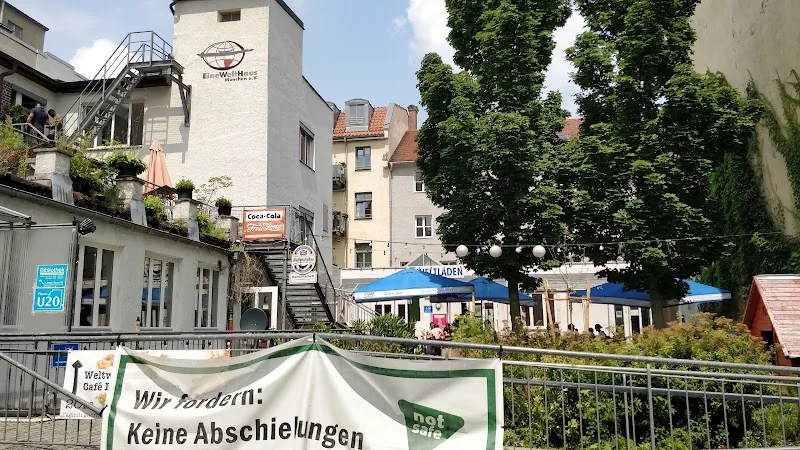
München
Schwanthalerstraße 80, 80336 München-Ludwigsvorstadt-Isarvorstadt, Deutschland
EineWeltHaus Munich | Program & Legal Advice
The EineWeltHaus Munich at Schwanthalerstraße 80 is much more than just an event venue: it is an open house for dialogue, solidarity, intercultural exchange, and global issues. The supporting group EineWeltHaus Munich e.V. operates the house in Munich-Ludwigsvorstadt-Isarvorstadt; the city describes it as an educational and meeting place with a variety of offerings and affordable spaces for workshops and self-organized events. Those who come here will find a program that ranges from political discussions to film nights, music, exhibitions, and advisory services. For visitors, the house is also centrally located, accessible, and well connected by subway. This combination of cultural programming, social engagement, and practical usability makes the EineWeltHaus one of the most well-known addresses for an engaged urban public in Munich. ([einewelthaus.de](https://www.einewelthaus.de/))
Program, Events, and Monthly Calendar at EineWeltHaus Munich
The search interest surrounding the EineWeltHaus Munich is strongly focused on the program, and this is where the location shows its full strength. On the official website, there is a running event calendar, an archive, and a monthly program available as a PDF. A glance at the current entries shows how broad the spectrum is: exhibitions, openings, readings, discussion events, workshops, lectures, concerts, dance formats, film nights, improvisational theater, informational events, and festivals stand side by side. In addition, there are recurring formats such as open meeting points, political education evenings, cultural evenings with music and language, and events with international relevance. The EineWeltHaus is thus not a classic hall operation, but an open program hub where very different target groups can come together. ([einewelthaus.de](https://www.einewelthaus.de/))
It is particularly striking that the program cannot be reduced to individual genres. The website features events on global responsibility, socio-political issues, migration, cultural diversity, literature, and music. At the same time, there are cultural and meeting formats that are deliberately kept low-threshold, such as open terraces, exchange evenings, or informational events. This diversity is typical for the EineWeltHaus: the house connects culture, education, activism, and social practice in a single place. Those looking for a program for 2025 or 2026 will therefore not only find concert dates but a wide range of topics that span from local urban society to international perspectives. For SEO and user intent, this is important because the search terms related to program, events, calendar, and dates actually reflect a real, current offering. ([einewelthaus.de](https://www.einewelthaus.de/))
Additionally, the house functions as a platform for actors from civil society, culture, and political education. The website regularly lists events that are supported by different groups in the house or with partner organizations. This creates a calendar that is not only audience-oriented but also makes the work of associations, initiatives, and educational projects visible. This makes the program page a valuable point of contact for anyone who wants not only to consume but also to inform, exchange, or contribute themselves. Particularly in the context of search queries for EineWeltHaus Munich program, photo, reviews, or photos, it becomes clear: interested parties want to know not only what is happening but also what character the place has. And this character is conveyed very clearly by the program: lively, diverse, international, and socially relevant. ([einewelthaus.de](https://www.einewelthaus.de/))
Legal Advice, Advisory Services, and Help for Migrants
A second central theme of the search queries is legal advice or legal assistance. Although the website often refers to advisory services, the content direction is clear: the EineWeltHaus offers various consultations for migrants as well as support for development projects in the Global South or for the establishment of support associations in Munich. Particularly relevant is the initial consultation on residence and asylum issues of legal assistance. According to the website, this takes place both by phone and at the EineWeltHaus itself on Tuesdays between 6:00 PM and 8:30 PM. Registration is done via a form. Thus, the house is not only a cultural meeting point but also a practical point of contact for people with specific social and legal questions. ([einewelthaus.de](https://www.einewelthaus.de/))
For the search terms legal advice, legal assistance, and einewelthaus munich legal advice, it is important that there is not just a mere advertising formula behind it but a real support network. The website also lists the Intercultural Migration Service of the initiative group and other groups with regular use in the house. This shows that the EineWeltHaus functions as a roof for various aid, advisory, and migration structures. Additionally, the website refers to current support offers for advice, food, clothing, and hygiene. Therefore, those searching for specific assistance regarding residence, asylum, migration, or social orientation will find a place here where advice is not considered in isolation but embedded in a broader solidarity context. ([einewelthaus.de](https://www.einewelthaus.de/))
It is precisely this connection between cultural center and advisory place that makes the EineWeltHaus so relevant for many target groups. Unlike pure event locations, it is not just about tickets or a nice hall, but also about everyday help, networks, and orientation. The search intent behind terms like einewelthaus legal assistance or einewelthaus munich legal advice is therefore closely linked to the self-understanding of the house. Those searching for information here often want to know if there are contact persons, how consultations are organized, and whether the house is open to social issues. The answer based on the official website is: yes, and in a broad, continuous, and very practical sense. ([einewelthaus.de](https://www.einewelthaus.de/))
Directions to Schwanthalerstraße 80 and Parking
The location of the EineWeltHaus Munich is one of the most important practical advantages. The official contact page lists the orientation point as Schwanthalerstraße 80 RGB in 80336 Munich and describes the walking distance as about 5 minutes from the Theresienwiese subway station, lines U4/U5, exit Schwanthalerstraße, or about 10 minutes from the main train station. For visitors, this means very good accessibility by public transport, especially for evening events or appointments during the day. The assignment to the district Ludwigvorstadt-Isarvorstadt is also noted on the city's learning location page. ([einewelthaus.de](https://www.einewelthaus.de/kontakt/))
When it comes to parking, the situation is somewhat more nuanced. The house rules make it clear that users generally have no claim to a parking space. Exceptions should be clarified in advance with the room booking, for example for people with disabilities or for loading and unloading. Additionally, according to the barrier-free location description, there are two designated private disabled parking spaces in the courtyard of the house. Therefore, those arriving by car should not expect a classic visitor parking situation but rather plan to arrive by subway, on foot, or by taxi. This combination of central location and limited parking options is typical for urban event venues, but is communicated transparently here. ([einewelthaus.de](https://www.einewelthaus.de/service/hausordnung/?utm_source=openai))
For search queries like einewelthaus schwanthalerstraße munich, einewelthaus schwanthalerstr 80, or einewelthaus schwanthalerstraße munich ludwigvorstadt isarvorstadt, these details are particularly relevant as they directly support the location search. The EineWeltHaus is not hidden but located at a well-known Munich address that is well connected to both the main train station and Theresienwiese. At the same time, the official communication shows that the focus is clearly on public transport and barrier-free access. Therefore, anyone wishing to attend an event or rent a room should ideally plan their arrival in advance and consider public transport as the standard route. ([einewelthaus.de](https://www.einewelthaus.de/kontakt/))
Renting Rooms, Capacity, and Hall Overview
Also regarding the search terms related to rooms, seating, and capacity, the EineWeltHaus provides very concrete data. According to the official room page, 10 rooms are available, from a small group room of 24 m² for 15 people to a large hall of 122 m² for 110 people. The usage fees range depending on the day of the week, time of day, and room size from 13.00 euros to 158.50 euros plus VAT per four hours. Additionally, there is a deposit that depends on the room rental, but is at least 100 euros. It is also important to note the clear rule that no rooms are rented for private celebrations. This makes the house particularly interesting for seminars, workshops, club meetings, public events, and educational formats. ([einewelthaus.de](https://www.einewelthaus.de/das-haus/raeume-mieten/))
The city’s room list complements this information with further technical and organizational details. For one of the listed rooms, for example, 84 m², a room height of 2.90 meters, and a capacity of 20 to 50 people are mentioned. The equipment includes seating, a screen, barrier-free access, a disabled toilet, catering by an external service, slide projector, beamer, and elevator. This information shows that the EineWeltHaus is not only an event venue with atmosphere but also functionally designed for different formats. Therefore, those looking for seating plans, seats, or best seats will not find a classic theater seating plan here, but rather a number of flexibly usable rooms with clearly defined sizes and capacities. ([stadt.muenchen.de](https://stadt.muenchen.de/service/info/einewelthaus/10102014/))
For SEO, this is particularly valuable because users often search for very specific usage questions at a location like the EineWeltHaus: How big is the hall? How many people fit in? Can a room be reserved? Is there technology on site? The official information answers these points exactly and makes it clear that the location is primarily intended for non-profit, cultural, and educational use. Those wishing to rent a room will find an affordable and centrally located place with basic technical equipment, flexible room sizes, and a clear content profile. Thus, the house is equally suitable for small working groups as well as for events with a larger audience. ([einewelthaus.de](https://www.einewelthaus.de/das-haus/raeume-mieten/))
Barrier-Free Access and Inclusive Equipment
The EineWeltHaus is, according to several official sources, barrier-free accessible and its architectural structure is adapted to different needs. The barrier-free location page describes a spacious courtyard, a main building with a basement, ground floor, and two upper floors, as well as an auxiliary building with a workshop. The floors of the main building are accessible via an elevator and a barrier-free entrance; the entrance has a switch to open the door. Additionally, a ramp with a handrail is mentioned. The city’s room list also confirms step-free access, disabled parking spaces, and a disabled toilet. ([kultur-barrierefrei-muenchen.de](https://www.kultur-barrierefrei-muenchen.de/einewelthaus/))
Inside the building, there are differences in the equipment of individual rooms, such as thresholds at doors, according to the barrier-free description. At the same time, escape routes are clearly marked, and it is explicitly noted that the wheelchair-accessible toilet is located in the restaurant, which can be reached barrier-free via the courtyard or the ground floor. Additionally, various seating options are mentioned, including armchairs, chairs, and stools. For people with different mobility needs, it is also relevant that walkers can be parked everywhere and that visits can be made without an accompanying person. The house positions itself as a cultural place that not only claims inclusion but also thinks about it architecturally and organizationally. ([kultur-barrierefrei-muenchen.de](https://www.kultur-barrierefrei-muenchen.de/einewelthaus/))
Particularly helpful for visitors is that the website also addresses accessibility from the perspective of various needs. For people with guide dogs, it is stated that these dogs are allowed; there is also a clear description of the outdoor area with cobblestones and the main entrance with stairs and ramp. For people with hearing impairments, learning difficulties, or psychological impairments, concrete hints are also given, such as contrasting overview plans, pictograms at toilets, and clearly marked escape routes. For search terms like photos, reviews, or einewelthaus photos, this transparency is very relevant because it shows that the house is well documented not only visually but also functionally. ([kultur-barrierefrei-muenchen.de](https://www.kultur-barrierefrei-muenchen.de/einewelthaus/))
History, Focus Areas, and Special Offers
The history of the EineWeltHaus Munich does not begin in 2001 but much earlier. According to the official history, the predecessor project was the Third World Café on Daiserstraße, which had been located there since 1988. When the rooms became too cramped, the idea of an EineWeltHaus for Munich developed in a future workshop. On December 10, 1997, the supporting group EineWeltHaus Munich e.V. was founded; after many discussions and negotiations, the EineWeltHaus opened in July 2001 as a project of the local Agenda 21 Munich. The state capital Munich, Cultural Department, is the owner of the house; since January 1, 2006, there has been an indefinite usage contract. This development explains why the house is now so clearly positioned between culture, urban society, and international solidarity. ([einewelthaus.de](https://www.einewelthaus.de/wir-uber-uns/entstehungsgeschichte/))
Among the special features of the house is also the mural project from 2002, which was restored in 2009. Such visible traces show that the EineWeltHaus is not intended as a sterile event hall but as a lively place with its own history and identity. In addition, there are numerous offerings in the house itself: the library offers books, DVDs, and CDs in various languages with a focus on migration and internationality. There is a free book exchange, a circular cupboard for well-preserved everyday items, a community garden, a monthly changing exhibition space in the foyer, and the EineWeltRadio on Radio Lora, which runs on Mondays from 5 to 6 PM. Such offerings make the house attractive beyond individual dates and explain why people specifically search for photos, reviews, or the house itself. ([einewelthaus.de](https://www.einewelthaus.de/das-haus/))
Newer initiatives complement this profile with sustainability and circular economy. The house page mentions that since July 2025, a mobile aluminum collection box has been placed in the house, where used mobile phones and tablets can be dropped off for recycling raw materials. Additionally, the cargo bike Lara can be borrowed free of charge. This combination of cultural programming, social counseling, educational work, environmental issues, and practical services is the actual unique selling point of the EineWeltHaus Munich. It is a place where content is not only presented but lived in everyday life. This is precisely why the search terms related to program, legal assistance, renting rooms, photos, and directions work so well together here: they each describe a different access to the same, very versatile location. ([einewelthaus.de](https://www.einewelthaus.de/das-haus/))
Sources:
Mehr anzeigenWeniger anzeigen
EineWeltHaus Munich | Program & Legal Advice
The EineWeltHaus Munich at Schwanthalerstraße 80 is much more than just an event venue: it is an open house for dialogue, solidarity, intercultural exchange, and global issues. The supporting group EineWeltHaus Munich e.V. operates the house in Munich-Ludwigsvorstadt-Isarvorstadt; the city describes it as an educational and meeting place with a variety of offerings and affordable spaces for workshops and self-organized events. Those who come here will find a program that ranges from political discussions to film nights, music, exhibitions, and advisory services. For visitors, the house is also centrally located, accessible, and well connected by subway. This combination of cultural programming, social engagement, and practical usability makes the EineWeltHaus one of the most well-known addresses for an engaged urban public in Munich. ([einewelthaus.de](https://www.einewelthaus.de/))
Program, Events, and Monthly Calendar at EineWeltHaus Munich
The search interest surrounding the EineWeltHaus Munich is strongly focused on the program, and this is where the location shows its full strength. On the official website, there is a running event calendar, an archive, and a monthly program available as a PDF. A glance at the current entries shows how broad the spectrum is: exhibitions, openings, readings, discussion events, workshops, lectures, concerts, dance formats, film nights, improvisational theater, informational events, and festivals stand side by side. In addition, there are recurring formats such as open meeting points, political education evenings, cultural evenings with music and language, and events with international relevance. The EineWeltHaus is thus not a classic hall operation, but an open program hub where very different target groups can come together. ([einewelthaus.de](https://www.einewelthaus.de/))
It is particularly striking that the program cannot be reduced to individual genres. The website features events on global responsibility, socio-political issues, migration, cultural diversity, literature, and music. At the same time, there are cultural and meeting formats that are deliberately kept low-threshold, such as open terraces, exchange evenings, or informational events. This diversity is typical for the EineWeltHaus: the house connects culture, education, activism, and social practice in a single place. Those looking for a program for 2025 or 2026 will therefore not only find concert dates but a wide range of topics that span from local urban society to international perspectives. For SEO and user intent, this is important because the search terms related to program, events, calendar, and dates actually reflect a real, current offering. ([einewelthaus.de](https://www.einewelthaus.de/))
Additionally, the house functions as a platform for actors from civil society, culture, and political education. The website regularly lists events that are supported by different groups in the house or with partner organizations. This creates a calendar that is not only audience-oriented but also makes the work of associations, initiatives, and educational projects visible. This makes the program page a valuable point of contact for anyone who wants not only to consume but also to inform, exchange, or contribute themselves. Particularly in the context of search queries for EineWeltHaus Munich program, photo, reviews, or photos, it becomes clear: interested parties want to know not only what is happening but also what character the place has. And this character is conveyed very clearly by the program: lively, diverse, international, and socially relevant. ([einewelthaus.de](https://www.einewelthaus.de/))
Legal Advice, Advisory Services, and Help for Migrants
A second central theme of the search queries is legal advice or legal assistance. Although the website often refers to advisory services, the content direction is clear: the EineWeltHaus offers various consultations for migrants as well as support for development projects in the Global South or for the establishment of support associations in Munich. Particularly relevant is the initial consultation on residence and asylum issues of legal assistance. According to the website, this takes place both by phone and at the EineWeltHaus itself on Tuesdays between 6:00 PM and 8:30 PM. Registration is done via a form. Thus, the house is not only a cultural meeting point but also a practical point of contact for people with specific social and legal questions. ([einewelthaus.de](https://www.einewelthaus.de/))
For the search terms legal advice, legal assistance, and einewelthaus munich legal advice, it is important that there is not just a mere advertising formula behind it but a real support network. The website also lists the Intercultural Migration Service of the initiative group and other groups with regular use in the house. This shows that the EineWeltHaus functions as a roof for various aid, advisory, and migration structures. Additionally, the website refers to current support offers for advice, food, clothing, and hygiene. Therefore, those searching for specific assistance regarding residence, asylum, migration, or social orientation will find a place here where advice is not considered in isolation but embedded in a broader solidarity context. ([einewelthaus.de](https://www.einewelthaus.de/))
It is precisely this connection between cultural center and advisory place that makes the EineWeltHaus so relevant for many target groups. Unlike pure event locations, it is not just about tickets or a nice hall, but also about everyday help, networks, and orientation. The search intent behind terms like einewelthaus legal assistance or einewelthaus munich legal advice is therefore closely linked to the self-understanding of the house. Those searching for information here often want to know if there are contact persons, how consultations are organized, and whether the house is open to social issues. The answer based on the official website is: yes, and in a broad, continuous, and very practical sense. ([einewelthaus.de](https://www.einewelthaus.de/))
Directions to Schwanthalerstraße 80 and Parking
The location of the EineWeltHaus Munich is one of the most important practical advantages. The official contact page lists the orientation point as Schwanthalerstraße 80 RGB in 80336 Munich and describes the walking distance as about 5 minutes from the Theresienwiese subway station, lines U4/U5, exit Schwanthalerstraße, or about 10 minutes from the main train station. For visitors, this means very good accessibility by public transport, especially for evening events or appointments during the day. The assignment to the district Ludwigvorstadt-Isarvorstadt is also noted on the city's learning location page. ([einewelthaus.de](https://www.einewelthaus.de/kontakt/))
When it comes to parking, the situation is somewhat more nuanced. The house rules make it clear that users generally have no claim to a parking space. Exceptions should be clarified in advance with the room booking, for example for people with disabilities or for loading and unloading. Additionally, according to the barrier-free location description, there are two designated private disabled parking spaces in the courtyard of the house. Therefore, those arriving by car should not expect a classic visitor parking situation but rather plan to arrive by subway, on foot, or by taxi. This combination of central location and limited parking options is typical for urban event venues, but is communicated transparently here. ([einewelthaus.de](https://www.einewelthaus.de/service/hausordnung/?utm_source=openai))
For search queries like einewelthaus schwanthalerstraße munich, einewelthaus schwanthalerstr 80, or einewelthaus schwanthalerstraße munich ludwigvorstadt isarvorstadt, these details are particularly relevant as they directly support the location search. The EineWeltHaus is not hidden but located at a well-known Munich address that is well connected to both the main train station and Theresienwiese. At the same time, the official communication shows that the focus is clearly on public transport and barrier-free access. Therefore, anyone wishing to attend an event or rent a room should ideally plan their arrival in advance and consider public transport as the standard route. ([einewelthaus.de](https://www.einewelthaus.de/kontakt/))
Renting Rooms, Capacity, and Hall Overview
Also regarding the search terms related to rooms, seating, and capacity, the EineWeltHaus provides very concrete data. According to the official room page, 10 rooms are available, from a small group room of 24 m² for 15 people to a large hall of 122 m² for 110 people. The usage fees range depending on the day of the week, time of day, and room size from 13.00 euros to 158.50 euros plus VAT per four hours. Additionally, there is a deposit that depends on the room rental, but is at least 100 euros. It is also important to note the clear rule that no rooms are rented for private celebrations. This makes the house particularly interesting for seminars, workshops, club meetings, public events, and educational formats. ([einewelthaus.de](https://www.einewelthaus.de/das-haus/raeume-mieten/))
The city’s room list complements this information with further technical and organizational details. For one of the listed rooms, for example, 84 m², a room height of 2.90 meters, and a capacity of 20 to 50 people are mentioned. The equipment includes seating, a screen, barrier-free access, a disabled toilet, catering by an external service, slide projector, beamer, and elevator. This information shows that the EineWeltHaus is not only an event venue with atmosphere but also functionally designed for different formats. Therefore, those looking for seating plans, seats, or best seats will not find a classic theater seating plan here, but rather a number of flexibly usable rooms with clearly defined sizes and capacities. ([stadt.muenchen.de](https://stadt.muenchen.de/service/info/einewelthaus/10102014/))
For SEO, this is particularly valuable because users often search for very specific usage questions at a location like the EineWeltHaus: How big is the hall? How many people fit in? Can a room be reserved? Is there technology on site? The official information answers these points exactly and makes it clear that the location is primarily intended for non-profit, cultural, and educational use. Those wishing to rent a room will find an affordable and centrally located place with basic technical equipment, flexible room sizes, and a clear content profile. Thus, the house is equally suitable for small working groups as well as for events with a larger audience. ([einewelthaus.de](https://www.einewelthaus.de/das-haus/raeume-mieten/))
Barrier-Free Access and Inclusive Equipment
The EineWeltHaus is, according to several official sources, barrier-free accessible and its architectural structure is adapted to different needs. The barrier-free location page describes a spacious courtyard, a main building with a basement, ground floor, and two upper floors, as well as an auxiliary building with a workshop. The floors of the main building are accessible via an elevator and a barrier-free entrance; the entrance has a switch to open the door. Additionally, a ramp with a handrail is mentioned. The city’s room list also confirms step-free access, disabled parking spaces, and a disabled toilet. ([kultur-barrierefrei-muenchen.de](https://www.kultur-barrierefrei-muenchen.de/einewelthaus/))
Inside the building, there are differences in the equipment of individual rooms, such as thresholds at doors, according to the barrier-free description. At the same time, escape routes are clearly marked, and it is explicitly noted that the wheelchair-accessible toilet is located in the restaurant, which can be reached barrier-free via the courtyard or the ground floor. Additionally, various seating options are mentioned, including armchairs, chairs, and stools. For people with different mobility needs, it is also relevant that walkers can be parked everywhere and that visits can be made without an accompanying person. The house positions itself as a cultural place that not only claims inclusion but also thinks about it architecturally and organizationally. ([kultur-barrierefrei-muenchen.de](https://www.kultur-barrierefrei-muenchen.de/einewelthaus/))
Particularly helpful for visitors is that the website also addresses accessibility from the perspective of various needs. For people with guide dogs, it is stated that these dogs are allowed; there is also a clear description of the outdoor area with cobblestones and the main entrance with stairs and ramp. For people with hearing impairments, learning difficulties, or psychological impairments, concrete hints are also given, such as contrasting overview plans, pictograms at toilets, and clearly marked escape routes. For search terms like photos, reviews, or einewelthaus photos, this transparency is very relevant because it shows that the house is well documented not only visually but also functionally. ([kultur-barrierefrei-muenchen.de](https://www.kultur-barrierefrei-muenchen.de/einewelthaus/))
History, Focus Areas, and Special Offers
The history of the EineWeltHaus Munich does not begin in 2001 but much earlier. According to the official history, the predecessor project was the Third World Café on Daiserstraße, which had been located there since 1988. When the rooms became too cramped, the idea of an EineWeltHaus for Munich developed in a future workshop. On December 10, 1997, the supporting group EineWeltHaus Munich e.V. was founded; after many discussions and negotiations, the EineWeltHaus opened in July 2001 as a project of the local Agenda 21 Munich. The state capital Munich, Cultural Department, is the owner of the house; since January 1, 2006, there has been an indefinite usage contract. This development explains why the house is now so clearly positioned between culture, urban society, and international solidarity. ([einewelthaus.de](https://www.einewelthaus.de/wir-uber-uns/entstehungsgeschichte/))
Among the special features of the house is also the mural project from 2002, which was restored in 2009. Such visible traces show that the EineWeltHaus is not intended as a sterile event hall but as a lively place with its own history and identity. In addition, there are numerous offerings in the house itself: the library offers books, DVDs, and CDs in various languages with a focus on migration and internationality. There is a free book exchange, a circular cupboard for well-preserved everyday items, a community garden, a monthly changing exhibition space in the foyer, and the EineWeltRadio on Radio Lora, which runs on Mondays from 5 to 6 PM. Such offerings make the house attractive beyond individual dates and explain why people specifically search for photos, reviews, or the house itself. ([einewelthaus.de](https://www.einewelthaus.de/das-haus/))
Newer initiatives complement this profile with sustainability and circular economy. The house page mentions that since July 2025, a mobile aluminum collection box has been placed in the house, where used mobile phones and tablets can be dropped off for recycling raw materials. Additionally, the cargo bike Lara can be borrowed free of charge. This combination of cultural programming, social counseling, educational work, environmental issues, and practical services is the actual unique selling point of the EineWeltHaus Munich. It is a place where content is not only presented but lived in everyday life. This is precisely why the search terms related to program, legal assistance, renting rooms, photos, and directions work so well together here: they each describe a different access to the same, very versatile location. ([einewelthaus.de](https://www.einewelthaus.de/das-haus/))
Sources:
EineWeltHaus Munich | Program & Legal Advice
The EineWeltHaus Munich at Schwanthalerstraße 80 is much more than just an event venue: it is an open house for dialogue, solidarity, intercultural exchange, and global issues. The supporting group EineWeltHaus Munich e.V. operates the house in Munich-Ludwigsvorstadt-Isarvorstadt; the city describes it as an educational and meeting place with a variety of offerings and affordable spaces for workshops and self-organized events. Those who come here will find a program that ranges from political discussions to film nights, music, exhibitions, and advisory services. For visitors, the house is also centrally located, accessible, and well connected by subway. This combination of cultural programming, social engagement, and practical usability makes the EineWeltHaus one of the most well-known addresses for an engaged urban public in Munich. ([einewelthaus.de](https://www.einewelthaus.de/))
Program, Events, and Monthly Calendar at EineWeltHaus Munich
The search interest surrounding the EineWeltHaus Munich is strongly focused on the program, and this is where the location shows its full strength. On the official website, there is a running event calendar, an archive, and a monthly program available as a PDF. A glance at the current entries shows how broad the spectrum is: exhibitions, openings, readings, discussion events, workshops, lectures, concerts, dance formats, film nights, improvisational theater, informational events, and festivals stand side by side. In addition, there are recurring formats such as open meeting points, political education evenings, cultural evenings with music and language, and events with international relevance. The EineWeltHaus is thus not a classic hall operation, but an open program hub where very different target groups can come together. ([einewelthaus.de](https://www.einewelthaus.de/))
It is particularly striking that the program cannot be reduced to individual genres. The website features events on global responsibility, socio-political issues, migration, cultural diversity, literature, and music. At the same time, there are cultural and meeting formats that are deliberately kept low-threshold, such as open terraces, exchange evenings, or informational events. This diversity is typical for the EineWeltHaus: the house connects culture, education, activism, and social practice in a single place. Those looking for a program for 2025 or 2026 will therefore not only find concert dates but a wide range of topics that span from local urban society to international perspectives. For SEO and user intent, this is important because the search terms related to program, events, calendar, and dates actually reflect a real, current offering. ([einewelthaus.de](https://www.einewelthaus.de/))
Additionally, the house functions as a platform for actors from civil society, culture, and political education. The website regularly lists events that are supported by different groups in the house or with partner organizations. This creates a calendar that is not only audience-oriented but also makes the work of associations, initiatives, and educational projects visible. This makes the program page a valuable point of contact for anyone who wants not only to consume but also to inform, exchange, or contribute themselves. Particularly in the context of search queries for EineWeltHaus Munich program, photo, reviews, or photos, it becomes clear: interested parties want to know not only what is happening but also what character the place has. And this character is conveyed very clearly by the program: lively, diverse, international, and socially relevant. ([einewelthaus.de](https://www.einewelthaus.de/))
Legal Advice, Advisory Services, and Help for Migrants
A second central theme of the search queries is legal advice or legal assistance. Although the website often refers to advisory services, the content direction is clear: the EineWeltHaus offers various consultations for migrants as well as support for development projects in the Global South or for the establishment of support associations in Munich. Particularly relevant is the initial consultation on residence and asylum issues of legal assistance. According to the website, this takes place both by phone and at the EineWeltHaus itself on Tuesdays between 6:00 PM and 8:30 PM. Registration is done via a form. Thus, the house is not only a cultural meeting point but also a practical point of contact for people with specific social and legal questions. ([einewelthaus.de](https://www.einewelthaus.de/))
For the search terms legal advice, legal assistance, and einewelthaus munich legal advice, it is important that there is not just a mere advertising formula behind it but a real support network. The website also lists the Intercultural Migration Service of the initiative group and other groups with regular use in the house. This shows that the EineWeltHaus functions as a roof for various aid, advisory, and migration structures. Additionally, the website refers to current support offers for advice, food, clothing, and hygiene. Therefore, those searching for specific assistance regarding residence, asylum, migration, or social orientation will find a place here where advice is not considered in isolation but embedded in a broader solidarity context. ([einewelthaus.de](https://www.einewelthaus.de/))
It is precisely this connection between cultural center and advisory place that makes the EineWeltHaus so relevant for many target groups. Unlike pure event locations, it is not just about tickets or a nice hall, but also about everyday help, networks, and orientation. The search intent behind terms like einewelthaus legal assistance or einewelthaus munich legal advice is therefore closely linked to the self-understanding of the house. Those searching for information here often want to know if there are contact persons, how consultations are organized, and whether the house is open to social issues. The answer based on the official website is: yes, and in a broad, continuous, and very practical sense. ([einewelthaus.de](https://www.einewelthaus.de/))
Directions to Schwanthalerstraße 80 and Parking
The location of the EineWeltHaus Munich is one of the most important practical advantages. The official contact page lists the orientation point as Schwanthalerstraße 80 RGB in 80336 Munich and describes the walking distance as about 5 minutes from the Theresienwiese subway station, lines U4/U5, exit Schwanthalerstraße, or about 10 minutes from the main train station. For visitors, this means very good accessibility by public transport, especially for evening events or appointments during the day. The assignment to the district Ludwigvorstadt-Isarvorstadt is also noted on the city's learning location page. ([einewelthaus.de](https://www.einewelthaus.de/kontakt/))
When it comes to parking, the situation is somewhat more nuanced. The house rules make it clear that users generally have no claim to a parking space. Exceptions should be clarified in advance with the room booking, for example for people with disabilities or for loading and unloading. Additionally, according to the barrier-free location description, there are two designated private disabled parking spaces in the courtyard of the house. Therefore, those arriving by car should not expect a classic visitor parking situation but rather plan to arrive by subway, on foot, or by taxi. This combination of central location and limited parking options is typical for urban event venues, but is communicated transparently here. ([einewelthaus.de](https://www.einewelthaus.de/service/hausordnung/?utm_source=openai))
For search queries like einewelthaus schwanthalerstraße munich, einewelthaus schwanthalerstr 80, or einewelthaus schwanthalerstraße munich ludwigvorstadt isarvorstadt, these details are particularly relevant as they directly support the location search. The EineWeltHaus is not hidden but located at a well-known Munich address that is well connected to both the main train station and Theresienwiese. At the same time, the official communication shows that the focus is clearly on public transport and barrier-free access. Therefore, anyone wishing to attend an event or rent a room should ideally plan their arrival in advance and consider public transport as the standard route. ([einewelthaus.de](https://www.einewelthaus.de/kontakt/))
Renting Rooms, Capacity, and Hall Overview
Also regarding the search terms related to rooms, seating, and capacity, the EineWeltHaus provides very concrete data. According to the official room page, 10 rooms are available, from a small group room of 24 m² for 15 people to a large hall of 122 m² for 110 people. The usage fees range depending on the day of the week, time of day, and room size from 13.00 euros to 158.50 euros plus VAT per four hours. Additionally, there is a deposit that depends on the room rental, but is at least 100 euros. It is also important to note the clear rule that no rooms are rented for private celebrations. This makes the house particularly interesting for seminars, workshops, club meetings, public events, and educational formats. ([einewelthaus.de](https://www.einewelthaus.de/das-haus/raeume-mieten/))
The city’s room list complements this information with further technical and organizational details. For one of the listed rooms, for example, 84 m², a room height of 2.90 meters, and a capacity of 20 to 50 people are mentioned. The equipment includes seating, a screen, barrier-free access, a disabled toilet, catering by an external service, slide projector, beamer, and elevator. This information shows that the EineWeltHaus is not only an event venue with atmosphere but also functionally designed for different formats. Therefore, those looking for seating plans, seats, or best seats will not find a classic theater seating plan here, but rather a number of flexibly usable rooms with clearly defined sizes and capacities. ([stadt.muenchen.de](https://stadt.muenchen.de/service/info/einewelthaus/10102014/))
For SEO, this is particularly valuable because users often search for very specific usage questions at a location like the EineWeltHaus: How big is the hall? How many people fit in? Can a room be reserved? Is there technology on site? The official information answers these points exactly and makes it clear that the location is primarily intended for non-profit, cultural, and educational use. Those wishing to rent a room will find an affordable and centrally located place with basic technical equipment, flexible room sizes, and a clear content profile. Thus, the house is equally suitable for small working groups as well as for events with a larger audience. ([einewelthaus.de](https://www.einewelthaus.de/das-haus/raeume-mieten/))
Barrier-Free Access and Inclusive Equipment
The EineWeltHaus is, according to several official sources, barrier-free accessible and its architectural structure is adapted to different needs. The barrier-free location page describes a spacious courtyard, a main building with a basement, ground floor, and two upper floors, as well as an auxiliary building with a workshop. The floors of the main building are accessible via an elevator and a barrier-free entrance; the entrance has a switch to open the door. Additionally, a ramp with a handrail is mentioned. The city’s room list also confirms step-free access, disabled parking spaces, and a disabled toilet. ([kultur-barrierefrei-muenchen.de](https://www.kultur-barrierefrei-muenchen.de/einewelthaus/))
Inside the building, there are differences in the equipment of individual rooms, such as thresholds at doors, according to the barrier-free description. At the same time, escape routes are clearly marked, and it is explicitly noted that the wheelchair-accessible toilet is located in the restaurant, which can be reached barrier-free via the courtyard or the ground floor. Additionally, various seating options are mentioned, including armchairs, chairs, and stools. For people with different mobility needs, it is also relevant that walkers can be parked everywhere and that visits can be made without an accompanying person. The house positions itself as a cultural place that not only claims inclusion but also thinks about it architecturally and organizationally. ([kultur-barrierefrei-muenchen.de](https://www.kultur-barrierefrei-muenchen.de/einewelthaus/))
Particularly helpful for visitors is that the website also addresses accessibility from the perspective of various needs. For people with guide dogs, it is stated that these dogs are allowed; there is also a clear description of the outdoor area with cobblestones and the main entrance with stairs and ramp. For people with hearing impairments, learning difficulties, or psychological impairments, concrete hints are also given, such as contrasting overview plans, pictograms at toilets, and clearly marked escape routes. For search terms like photos, reviews, or einewelthaus photos, this transparency is very relevant because it shows that the house is well documented not only visually but also functionally. ([kultur-barrierefrei-muenchen.de](https://www.kultur-barrierefrei-muenchen.de/einewelthaus/))
History, Focus Areas, and Special Offers
The history of the EineWeltHaus Munich does not begin in 2001 but much earlier. According to the official history, the predecessor project was the Third World Café on Daiserstraße, which had been located there since 1988. When the rooms became too cramped, the idea of an EineWeltHaus for Munich developed in a future workshop. On December 10, 1997, the supporting group EineWeltHaus Munich e.V. was founded; after many discussions and negotiations, the EineWeltHaus opened in July 2001 as a project of the local Agenda 21 Munich. The state capital Munich, Cultural Department, is the owner of the house; since January 1, 2006, there has been an indefinite usage contract. This development explains why the house is now so clearly positioned between culture, urban society, and international solidarity. ([einewelthaus.de](https://www.einewelthaus.de/wir-uber-uns/entstehungsgeschichte/))
Among the special features of the house is also the mural project from 2002, which was restored in 2009. Such visible traces show that the EineWeltHaus is not intended as a sterile event hall but as a lively place with its own history and identity. In addition, there are numerous offerings in the house itself: the library offers books, DVDs, and CDs in various languages with a focus on migration and internationality. There is a free book exchange, a circular cupboard for well-preserved everyday items, a community garden, a monthly changing exhibition space in the foyer, and the EineWeltRadio on Radio Lora, which runs on Mondays from 5 to 6 PM. Such offerings make the house attractive beyond individual dates and explain why people specifically search for photos, reviews, or the house itself. ([einewelthaus.de](https://www.einewelthaus.de/das-haus/))
Newer initiatives complement this profile with sustainability and circular economy. The house page mentions that since July 2025, a mobile aluminum collection box has been placed in the house, where used mobile phones and tablets can be dropped off for recycling raw materials. Additionally, the cargo bike Lara can be borrowed free of charge. This combination of cultural programming, social counseling, educational work, environmental issues, and practical services is the actual unique selling point of the EineWeltHaus Munich. It is a place where content is not only presented but lived in everyday life. This is precisely why the search terms related to program, legal assistance, renting rooms, photos, and directions work so well together here: they each describe a different access to the same, very versatile location. ([einewelthaus.de](https://www.einewelthaus.de/das-haus/))
Sources:
Frequently Asked Questions
Reviews
No reviews found