
Munich
Munich, Germany
English Garden Munich | Park & Attractions
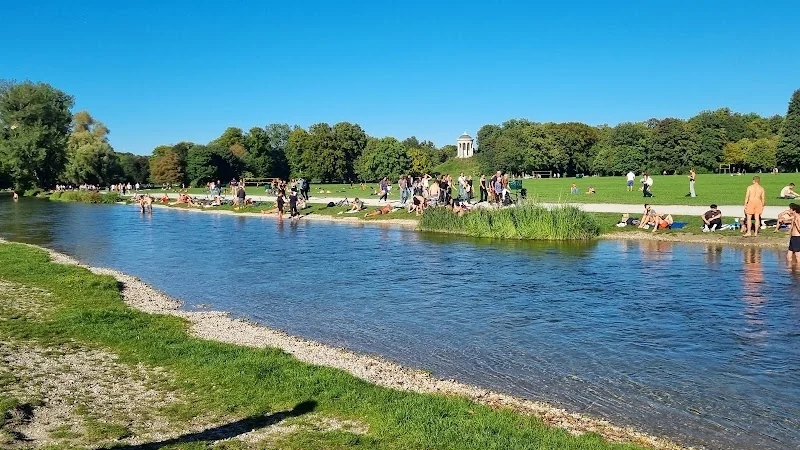
The English Garden, in German der Englische Garten, is much more than just a green space in Munich: It connects the landscape along the Isar river with the city center and stretches over approximately 5.5 kilometers through the city. With about 375 hectares, it is one of the largest urban parks in the world and is also a place where Munich's everyday culture can be observed particularly well. Walks, jogging routes, bike tours, meadow breaks, viewpoints, and beer gardens come together here in a very natural way. Among the most famous landmarks are the Eisbach wave, the Monopteros, the Japanese tea house, the Kleinhesseloher See, and the beer garden at the Chinese Tower. Anyone visiting the park for the first time quickly realizes why it is regarded as the green main attraction of the city by both locals and guests. ([munich.travel](https://www.munich.travel/en/pois/sports-leisure/english-garden))
English Garden Munich: Location, Size, and the Typical Park Feeling
The English Garden is located in the heart of Munich and creates a rare connection between urban movement and open landscape. Officially, it is described as one of the largest urban green spaces in the world; depending on the source, the area is around 370 to 376 hectares, with the representation of 375 hectares being particularly common. The park is not designed as a strict Baroque layout but follows the model of an English landscape park. This characterizes it to this day: no rigid axes, but flowing paths, large meadows, watercourses, sight axes, and repeatedly surprising changes in space. Those coming from the center experience the transition from the urban environment to an open, almost rural scenery, which is best explored on foot or by bike. ([munich.travel](https://www.munich.travel/en/pois/sports-leisure/english-garden))
Particularly exciting is the different atmosphere in the various areas of the park. The southern part attracts more people due to its proximity to the old town, while the northern area appears quieter and more pastoral. There, the English Garden almost becomes rural, with more meadows, less activity, and a more relaxed atmosphere. The official representation also describes a network of over 70 kilometers of paths used for jogging, cycling, and walking, as well as around 12 kilometers of riding paths. Additionally, there are over 600 park benches and several large lounging areas that make the park a true everyday space. Thus, the English Garden is not only a destination but also a functioning leisure area for many different uses. ([schloesser.bayern.de](https://schloesser.bayern.de/englisch/service/tourism/Gartenpraesentation_Suedbayern2023_EN.pdf))
This very mix is what makes the park's strength. Those looking for a classic sightseeing spot will find historical buildings and well-known photo spots. Those seeking tranquility can retreat to the areas further north. And those who want to experience Munich in the best sense simply observe the many small scenes: cyclists on the paths, people on the meadows, runners along the watercourses, families with picnic blankets, walkers by the lake, and visitors who need to orient themselves first. The park is open and accessible, but at the same time rich in details that are often overlooked during a short visit. For this reason, a longer stay is worthwhile, best with enough time for several stops. ([munich.travel](https://www.munich.travel/en/pois/sports-leisure/english-garden))
Access and Parking at the English Garden in Munich
The English Garden is excellently connected to public transport. The official Bavarian Palace Administration mentions, among other things, the subway lines U3 and U6 as well as the stations Giselastrasse, Münchner Freiheit, and Universität as easily accessible entrances. Additionally, Odeonsplatz and Studentenstadt are mentioned, depending on whether one wants to head to the southern or northern part of the park. This structure is practical because the park does not have a single entrance situation but is accessed through many entrances. Thus, one can start the visit depending on the planned focus: for Eisbach wave and city center reference rather in the south, for quieter paths and more expansive sections rather in the north. ([munich.travel](https://www.munich.travel/en/pois/sports-leisure/english-garden))
The park is also easily accessible by tram and bus. Among others, the tram stops Tivolistraße, Paradiesstraße, and Lärchenfeldstraße as well as the bus stop Chinese Tower are mentioned. Those coming by car should know that the official information refers to parking spaces at restaurants in and around the English Garden. Additionally, paid parking options for cars and buses are mentioned. For tour buses, the parking lot at the Chinese Tower is particularly relevant, which can be used after prior registration. Practically, this means: The English Garden is accessible by car, but the park is so central and well-connected that public transport is usually the more convenient and stress-free solution. ([schloesser.bayern.de](https://www.schloesser.bayern.de/deutsch/service/infomat/screen-pdf/muenchen_engl.pdf))
For planning a visit, it is also important that different attractions have different entry points. Those who want to see the Monopteros or the Japanese tea house are in the right place in the southern area. Those who want to go to the Kleinhesseloher See or the northern meadows are better oriented towards the corresponding stops heading north. This allows for a meaningful structuring of the visit, rather than just starting somewhere at the edge of the park. The English Garden is not a compact attraction with a single entrance, but a spacious urban space. For this reason, good travel planning is valuable, especially on sunny weekends or during the festival season. ([munich.travel](https://www.munich.travel/en/pois/sports-leisure/english-garden))
Eisbach Wave, Monopteros, and the Most Famous Highlights
Among the most famous attractions in the English Garden is the Eisbach wave. The official tourism site describes it as one of the most consistent and well-known river waves in the world, right in the middle of a big city. For decades, surfing has taken place there almost in any weather, making the spot a magnet for spectators from Munich and far beyond. For the park, the wave is not only a sports spot but also a symbol of the special mix of nature, city, and urban lifestyle. Right next to it, the English Garden shows a very lively side: people stop, film, watch, or continue walking while the surfers take turns entering the wave. Anyone wanting to understand Munich should have seen this place. ([munich.travel](https://www.munich.travel/en/pois/sports-leisure/english-garden))
A second central landmark is the Monopteros. The small temple stands on a hill and offers an unobstructed view over parts of Munich's city center. From there, one can recognize, among other things, the Frauenkirche, the Theatinerkirche, and the New Town Hall. The Monopteros appears at first glance almost like a classic viewpoint, but it is also a strong design element of the park. Additionally, there is the Japanese tea house, which acts as a quiet cultural spot in the greenery, and the Kleinhesseloher See, which, with its shore areas, paths, and proximity to dining options, forms a particularly popular place to stay. This makes the park not only a walking area but also a collection of very different experiential spaces. ([munich.travel](https://www.munich.travel/en/pois/sports-leisure/english-garden))
The Chinese Tower is also one of the defining places in the park. It is closely linked to the beer garden, events, and the historical development of the English Garden. Nearby, there is also a historic children's carousel and the Rumford Hall, which together set a stronger cultural-historical accent. So, those who are not only looking for nature but also want to get to know characteristic Munich places have several very different destinations in close proximity in the English Garden. This density makes the location so strong: between river wave, temple, lake, beer garden, and historical buildings, a picture of an excursion emerges that is rarely found in this form. ([schloesser.bayern.de](https://www.schloesser.bayern.de/deutsch/service/infomat/screen-pdf/muenchen_engl.pdf))
History of the English Garden since 1789
The creation of the English Garden began in 1789. At that time, Elector Karl Theodor ordered the establishment of a public park that should be accessible not only to individual social groups but to the entire population. The idea was initiated by Sir Benjamin Thompson, the later Count Rumford. The official Bavarian Palace Administration describes that in a short time paths were laid out, trees and shrubs were planted, bridges were built, and the first notable buildings were erected. These include the Chinese Tower and the Rumford House, both from 1790. The park was thus from the very beginning more than mere decoration: it was a consciously planned public space for leisure and recreation. ([schloesser.bayern.de](https://www.schloesser.bayern.de/englisch/garden/objects/mu_engl.htm))
The park received its name because it was not designed geometrically like a French Baroque garden but followed the natural style of an English landscape park. This is a crucial point for understanding the layout. From 1804, Friedrich Ludwig von Sckell took over the further design and developed the park into a classic landscape facility with wide open spaces, various sight axes, and diverse vegetation. The Monopteros also belongs to this development, as it was completed in 1836 according to a design by Leo von Klenze. Over decades, a park emerged that combined historical planning, landscape aesthetics, and public use. ([schloesser.bayern.de](https://www.schloesser.bayern.de/englisch/garden/objects/mu_engl.htm))
The historical significance of the English Garden extends far beyond Munich. Official sources emphasize that the park is not only one of the largest urban parks in the world but also marks an important step in the history of public green spaces. It was intended as an open recreational area for the population and was thus ahead of its time in its idea. Today, this vision seems self-evident, but therein lies the quality of the place: the English Garden is not just preserved cultural heritage but a historical urban space that is still actively used. This combination of history and vibrant everyday life gives it its special charm. ([schloesser.bayern.de](https://www.schloesser.bayern.de/englisch/garden/objects/mu_engl.htm))
Beer Gardens, Events, and Munich's Lifestyle in the Park
Anyone visiting the English Garden cannot miss the beer gardens. The official tourism site mentions four beer gardens within the park: Aumeister, Chinese Tower, Hirschau, and Seehaus directly at the Kleinhesseloher See. Additionally, there are several kiosks, such as Milchhäusl and Fräulein Grüneis, which make the park attractive for short breaks and small snacks. This gastronomic diversity particularly shapes the Munich lifestyle in the English Garden. The park is not only green but also socially and culinarily vibrant. Depending on the time of day, the atmosphere changes significantly: calm and spacious in the morning, livelier at noon, often particularly atmospheric in the evening. ([munich.travel](https://www.munich.travel/en/pois/sports-leisure/english-garden))
Events are also an important part of the profile. Particularly well-known is the Kocherlball, which takes place every year in the early morning hours on the third Sunday in July at the Chinese Tower. Thousands of visitors in traditional costumes and with picnic utensils gather there for a tradition that is strongly connected to Munich's customs. In the pre-Christmas season, the Christkindlmarkt at the Chinese Tower also adds to the festive atmosphere of the park. Such events show that the English Garden not only functions as a landscape space but also as a venue for recurring cultural highlights. ([munich.travel](https://www.munich.travel/en/pois/sports-leisure/english-garden))
This profile is complemented by special usage cultures that have developed over decades. Official information today mentions designated nudist areas such as the Schönfeldwiese and the Schwabinger Bucht. At the same time, the history of the park tells of changing social habits, movements of leisure culture, and the open use of urban green spaces. The English Garden is therefore not only a sight but also a mirror of Munich's urban culture. Thus, those visiting the park experience not only nature and architecture but also a form of city life that does not rely on grand staging and is particularly credible for that reason. ([munich.travel](https://www.munich.travel/en/pois/sports-leisure/english-garden))
Practical Tips for Walks, Sports, and Relaxing Hours
For active visitors, the English Garden offers many possibilities. Official sources explicitly mention walks, jogging, cycling, horseback riding, and in winter, depending on the weather, even cross-country skiing or ice skating at the Kleinhesseloher See. Those who use the park for sports benefit from the long network of paths, open meadows, and different surfaces. This makes the English Garden one of the most flexible leisure spots in the city. At the same time, there are enough quiet zones to simply sit on a bench or let the gaze wander over the landscape. Particularly helpful is that the park operates openly and without complicated entrance situations. One can come spontaneously, take a round, stay longer, or divide the visit into several sections. ([munich.travel](https://www.munich.travel/en/pois/sports-leisure/english-garden))
The park is also interesting for families and groups because it allows for versatile uses. There are meadows for playing and resting, paths for bicycles and walks, lakes and watercourses for beautiful perspectives, as well as dining stations for longer stays. Those who plan their visit wisely best combine different zones: for example, Eisbach wave and Monopteros in the south, followed by a walk towards Kleinhesseloher See or further north. This change between lively and quieter areas is what makes the park appealing. The official representation describes the northern part as significantly quieter and more rural, while the south is naturally livelier due to its proximity to the city center. Thus, the visit can be very individually designed. ([munich.travel](https://www.munich.travel/en/pois/sports-leisure/english-garden))
Anyone visiting the English Garden for the first time should take enough time. The park is large enough for half or a whole day without getting bored. It is highly recommended not only to aim for the well-known highlights but also to simply follow the paths and let oneself drift. This is the best way to understand the character of the facility: not as a rigid monument but as a living, historically grown urban space. This is the special strength of the English Garden in Munich. It is simultaneously large, accessible, historically significant, and deeply rooted in everyday life. Anyone who truly wants to experience Munich should not just tick off this park but consciously discover it. ([munich.travel](https://www.munich.travel/en/pois/sports-leisure/english-garden))
Sources:
Show moreShow less
English Garden Munich | Park & Attractions
The English Garden, in German der Englische Garten, is much more than just a green space in Munich: It connects the landscape along the Isar river with the city center and stretches over approximately 5.5 kilometers through the city. With about 375 hectares, it is one of the largest urban parks in the world and is also a place where Munich's everyday culture can be observed particularly well. Walks, jogging routes, bike tours, meadow breaks, viewpoints, and beer gardens come together here in a very natural way. Among the most famous landmarks are the Eisbach wave, the Monopteros, the Japanese tea house, the Kleinhesseloher See, and the beer garden at the Chinese Tower. Anyone visiting the park for the first time quickly realizes why it is regarded as the green main attraction of the city by both locals and guests. ([munich.travel](https://www.munich.travel/en/pois/sports-leisure/english-garden))
English Garden Munich: Location, Size, and the Typical Park Feeling
The English Garden is located in the heart of Munich and creates a rare connection between urban movement and open landscape. Officially, it is described as one of the largest urban green spaces in the world; depending on the source, the area is around 370 to 376 hectares, with the representation of 375 hectares being particularly common. The park is not designed as a strict Baroque layout but follows the model of an English landscape park. This characterizes it to this day: no rigid axes, but flowing paths, large meadows, watercourses, sight axes, and repeatedly surprising changes in space. Those coming from the center experience the transition from the urban environment to an open, almost rural scenery, which is best explored on foot or by bike. ([munich.travel](https://www.munich.travel/en/pois/sports-leisure/english-garden))
Particularly exciting is the different atmosphere in the various areas of the park. The southern part attracts more people due to its proximity to the old town, while the northern area appears quieter and more pastoral. There, the English Garden almost becomes rural, with more meadows, less activity, and a more relaxed atmosphere. The official representation also describes a network of over 70 kilometers of paths used for jogging, cycling, and walking, as well as around 12 kilometers of riding paths. Additionally, there are over 600 park benches and several large lounging areas that make the park a true everyday space. Thus, the English Garden is not only a destination but also a functioning leisure area for many different uses. ([schloesser.bayern.de](https://schloesser.bayern.de/englisch/service/tourism/Gartenpraesentation_Suedbayern2023_EN.pdf))
This very mix is what makes the park's strength. Those looking for a classic sightseeing spot will find historical buildings and well-known photo spots. Those seeking tranquility can retreat to the areas further north. And those who want to experience Munich in the best sense simply observe the many small scenes: cyclists on the paths, people on the meadows, runners along the watercourses, families with picnic blankets, walkers by the lake, and visitors who need to orient themselves first. The park is open and accessible, but at the same time rich in details that are often overlooked during a short visit. For this reason, a longer stay is worthwhile, best with enough time for several stops. ([munich.travel](https://www.munich.travel/en/pois/sports-leisure/english-garden))
Access and Parking at the English Garden in Munich
The English Garden is excellently connected to public transport. The official Bavarian Palace Administration mentions, among other things, the subway lines U3 and U6 as well as the stations Giselastrasse, Münchner Freiheit, and Universität as easily accessible entrances. Additionally, Odeonsplatz and Studentenstadt are mentioned, depending on whether one wants to head to the southern or northern part of the park. This structure is practical because the park does not have a single entrance situation but is accessed through many entrances. Thus, one can start the visit depending on the planned focus: for Eisbach wave and city center reference rather in the south, for quieter paths and more expansive sections rather in the north. ([munich.travel](https://www.munich.travel/en/pois/sports-leisure/english-garden))
The park is also easily accessible by tram and bus. Among others, the tram stops Tivolistraße, Paradiesstraße, and Lärchenfeldstraße as well as the bus stop Chinese Tower are mentioned. Those coming by car should know that the official information refers to parking spaces at restaurants in and around the English Garden. Additionally, paid parking options for cars and buses are mentioned. For tour buses, the parking lot at the Chinese Tower is particularly relevant, which can be used after prior registration. Practically, this means: The English Garden is accessible by car, but the park is so central and well-connected that public transport is usually the more convenient and stress-free solution. ([schloesser.bayern.de](https://www.schloesser.bayern.de/deutsch/service/infomat/screen-pdf/muenchen_engl.pdf))
For planning a visit, it is also important that different attractions have different entry points. Those who want to see the Monopteros or the Japanese tea house are in the right place in the southern area. Those who want to go to the Kleinhesseloher See or the northern meadows are better oriented towards the corresponding stops heading north. This allows for a meaningful structuring of the visit, rather than just starting somewhere at the edge of the park. The English Garden is not a compact attraction with a single entrance, but a spacious urban space. For this reason, good travel planning is valuable, especially on sunny weekends or during the festival season. ([munich.travel](https://www.munich.travel/en/pois/sports-leisure/english-garden))
Eisbach Wave, Monopteros, and the Most Famous Highlights
Among the most famous attractions in the English Garden is the Eisbach wave. The official tourism site describes it as one of the most consistent and well-known river waves in the world, right in the middle of a big city. For decades, surfing has taken place there almost in any weather, making the spot a magnet for spectators from Munich and far beyond. For the park, the wave is not only a sports spot but also a symbol of the special mix of nature, city, and urban lifestyle. Right next to it, the English Garden shows a very lively side: people stop, film, watch, or continue walking while the surfers take turns entering the wave. Anyone wanting to understand Munich should have seen this place. ([munich.travel](https://www.munich.travel/en/pois/sports-leisure/english-garden))
A second central landmark is the Monopteros. The small temple stands on a hill and offers an unobstructed view over parts of Munich's city center. From there, one can recognize, among other things, the Frauenkirche, the Theatinerkirche, and the New Town Hall. The Monopteros appears at first glance almost like a classic viewpoint, but it is also a strong design element of the park. Additionally, there is the Japanese tea house, which acts as a quiet cultural spot in the greenery, and the Kleinhesseloher See, which, with its shore areas, paths, and proximity to dining options, forms a particularly popular place to stay. This makes the park not only a walking area but also a collection of very different experiential spaces. ([munich.travel](https://www.munich.travel/en/pois/sports-leisure/english-garden))
The Chinese Tower is also one of the defining places in the park. It is closely linked to the beer garden, events, and the historical development of the English Garden. Nearby, there is also a historic children's carousel and the Rumford Hall, which together set a stronger cultural-historical accent. So, those who are not only looking for nature but also want to get to know characteristic Munich places have several very different destinations in close proximity in the English Garden. This density makes the location so strong: between river wave, temple, lake, beer garden, and historical buildings, a picture of an excursion emerges that is rarely found in this form. ([schloesser.bayern.de](https://www.schloesser.bayern.de/deutsch/service/infomat/screen-pdf/muenchen_engl.pdf))
History of the English Garden since 1789
The creation of the English Garden began in 1789. At that time, Elector Karl Theodor ordered the establishment of a public park that should be accessible not only to individual social groups but to the entire population. The idea was initiated by Sir Benjamin Thompson, the later Count Rumford. The official Bavarian Palace Administration describes that in a short time paths were laid out, trees and shrubs were planted, bridges were built, and the first notable buildings were erected. These include the Chinese Tower and the Rumford House, both from 1790. The park was thus from the very beginning more than mere decoration: it was a consciously planned public space for leisure and recreation. ([schloesser.bayern.de](https://www.schloesser.bayern.de/englisch/garden/objects/mu_engl.htm))
The park received its name because it was not designed geometrically like a French Baroque garden but followed the natural style of an English landscape park. This is a crucial point for understanding the layout. From 1804, Friedrich Ludwig von Sckell took over the further design and developed the park into a classic landscape facility with wide open spaces, various sight axes, and diverse vegetation. The Monopteros also belongs to this development, as it was completed in 1836 according to a design by Leo von Klenze. Over decades, a park emerged that combined historical planning, landscape aesthetics, and public use. ([schloesser.bayern.de](https://www.schloesser.bayern.de/englisch/garden/objects/mu_engl.htm))
The historical significance of the English Garden extends far beyond Munich. Official sources emphasize that the park is not only one of the largest urban parks in the world but also marks an important step in the history of public green spaces. It was intended as an open recreational area for the population and was thus ahead of its time in its idea. Today, this vision seems self-evident, but therein lies the quality of the place: the English Garden is not just preserved cultural heritage but a historical urban space that is still actively used. This combination of history and vibrant everyday life gives it its special charm. ([schloesser.bayern.de](https://www.schloesser.bayern.de/englisch/garden/objects/mu_engl.htm))
Beer Gardens, Events, and Munich's Lifestyle in the Park
Anyone visiting the English Garden cannot miss the beer gardens. The official tourism site mentions four beer gardens within the park: Aumeister, Chinese Tower, Hirschau, and Seehaus directly at the Kleinhesseloher See. Additionally, there are several kiosks, such as Milchhäusl and Fräulein Grüneis, which make the park attractive for short breaks and small snacks. This gastronomic diversity particularly shapes the Munich lifestyle in the English Garden. The park is not only green but also socially and culinarily vibrant. Depending on the time of day, the atmosphere changes significantly: calm and spacious in the morning, livelier at noon, often particularly atmospheric in the evening. ([munich.travel](https://www.munich.travel/en/pois/sports-leisure/english-garden))
Events are also an important part of the profile. Particularly well-known is the Kocherlball, which takes place every year in the early morning hours on the third Sunday in July at the Chinese Tower. Thousands of visitors in traditional costumes and with picnic utensils gather there for a tradition that is strongly connected to Munich's customs. In the pre-Christmas season, the Christkindlmarkt at the Chinese Tower also adds to the festive atmosphere of the park. Such events show that the English Garden not only functions as a landscape space but also as a venue for recurring cultural highlights. ([munich.travel](https://www.munich.travel/en/pois/sports-leisure/english-garden))
This profile is complemented by special usage cultures that have developed over decades. Official information today mentions designated nudist areas such as the Schönfeldwiese and the Schwabinger Bucht. At the same time, the history of the park tells of changing social habits, movements of leisure culture, and the open use of urban green spaces. The English Garden is therefore not only a sight but also a mirror of Munich's urban culture. Thus, those visiting the park experience not only nature and architecture but also a form of city life that does not rely on grand staging and is particularly credible for that reason. ([munich.travel](https://www.munich.travel/en/pois/sports-leisure/english-garden))
Practical Tips for Walks, Sports, and Relaxing Hours
For active visitors, the English Garden offers many possibilities. Official sources explicitly mention walks, jogging, cycling, horseback riding, and in winter, depending on the weather, even cross-country skiing or ice skating at the Kleinhesseloher See. Those who use the park for sports benefit from the long network of paths, open meadows, and different surfaces. This makes the English Garden one of the most flexible leisure spots in the city. At the same time, there are enough quiet zones to simply sit on a bench or let the gaze wander over the landscape. Particularly helpful is that the park operates openly and without complicated entrance situations. One can come spontaneously, take a round, stay longer, or divide the visit into several sections. ([munich.travel](https://www.munich.travel/en/pois/sports-leisure/english-garden))
The park is also interesting for families and groups because it allows for versatile uses. There are meadows for playing and resting, paths for bicycles and walks, lakes and watercourses for beautiful perspectives, as well as dining stations for longer stays. Those who plan their visit wisely best combine different zones: for example, Eisbach wave and Monopteros in the south, followed by a walk towards Kleinhesseloher See or further north. This change between lively and quieter areas is what makes the park appealing. The official representation describes the northern part as significantly quieter and more rural, while the south is naturally livelier due to its proximity to the city center. Thus, the visit can be very individually designed. ([munich.travel](https://www.munich.travel/en/pois/sports-leisure/english-garden))
Anyone visiting the English Garden for the first time should take enough time. The park is large enough for half or a whole day without getting bored. It is highly recommended not only to aim for the well-known highlights but also to simply follow the paths and let oneself drift. This is the best way to understand the character of the facility: not as a rigid monument but as a living, historically grown urban space. This is the special strength of the English Garden in Munich. It is simultaneously large, accessible, historically significant, and deeply rooted in everyday life. Anyone who truly wants to experience Munich should not just tick off this park but consciously discover it. ([munich.travel](https://www.munich.travel/en/pois/sports-leisure/english-garden))
Sources:
English Garden Munich | Park & Attractions
The English Garden, in German der Englische Garten, is much more than just a green space in Munich: It connects the landscape along the Isar river with the city center and stretches over approximately 5.5 kilometers through the city. With about 375 hectares, it is one of the largest urban parks in the world and is also a place where Munich's everyday culture can be observed particularly well. Walks, jogging routes, bike tours, meadow breaks, viewpoints, and beer gardens come together here in a very natural way. Among the most famous landmarks are the Eisbach wave, the Monopteros, the Japanese tea house, the Kleinhesseloher See, and the beer garden at the Chinese Tower. Anyone visiting the park for the first time quickly realizes why it is regarded as the green main attraction of the city by both locals and guests. ([munich.travel](https://www.munich.travel/en/pois/sports-leisure/english-garden))
English Garden Munich: Location, Size, and the Typical Park Feeling
The English Garden is located in the heart of Munich and creates a rare connection between urban movement and open landscape. Officially, it is described as one of the largest urban green spaces in the world; depending on the source, the area is around 370 to 376 hectares, with the representation of 375 hectares being particularly common. The park is not designed as a strict Baroque layout but follows the model of an English landscape park. This characterizes it to this day: no rigid axes, but flowing paths, large meadows, watercourses, sight axes, and repeatedly surprising changes in space. Those coming from the center experience the transition from the urban environment to an open, almost rural scenery, which is best explored on foot or by bike. ([munich.travel](https://www.munich.travel/en/pois/sports-leisure/english-garden))
Particularly exciting is the different atmosphere in the various areas of the park. The southern part attracts more people due to its proximity to the old town, while the northern area appears quieter and more pastoral. There, the English Garden almost becomes rural, with more meadows, less activity, and a more relaxed atmosphere. The official representation also describes a network of over 70 kilometers of paths used for jogging, cycling, and walking, as well as around 12 kilometers of riding paths. Additionally, there are over 600 park benches and several large lounging areas that make the park a true everyday space. Thus, the English Garden is not only a destination but also a functioning leisure area for many different uses. ([schloesser.bayern.de](https://schloesser.bayern.de/englisch/service/tourism/Gartenpraesentation_Suedbayern2023_EN.pdf))
This very mix is what makes the park's strength. Those looking for a classic sightseeing spot will find historical buildings and well-known photo spots. Those seeking tranquility can retreat to the areas further north. And those who want to experience Munich in the best sense simply observe the many small scenes: cyclists on the paths, people on the meadows, runners along the watercourses, families with picnic blankets, walkers by the lake, and visitors who need to orient themselves first. The park is open and accessible, but at the same time rich in details that are often overlooked during a short visit. For this reason, a longer stay is worthwhile, best with enough time for several stops. ([munich.travel](https://www.munich.travel/en/pois/sports-leisure/english-garden))
Access and Parking at the English Garden in Munich
The English Garden is excellently connected to public transport. The official Bavarian Palace Administration mentions, among other things, the subway lines U3 and U6 as well as the stations Giselastrasse, Münchner Freiheit, and Universität as easily accessible entrances. Additionally, Odeonsplatz and Studentenstadt are mentioned, depending on whether one wants to head to the southern or northern part of the park. This structure is practical because the park does not have a single entrance situation but is accessed through many entrances. Thus, one can start the visit depending on the planned focus: for Eisbach wave and city center reference rather in the south, for quieter paths and more expansive sections rather in the north. ([munich.travel](https://www.munich.travel/en/pois/sports-leisure/english-garden))
The park is also easily accessible by tram and bus. Among others, the tram stops Tivolistraße, Paradiesstraße, and Lärchenfeldstraße as well as the bus stop Chinese Tower are mentioned. Those coming by car should know that the official information refers to parking spaces at restaurants in and around the English Garden. Additionally, paid parking options for cars and buses are mentioned. For tour buses, the parking lot at the Chinese Tower is particularly relevant, which can be used after prior registration. Practically, this means: The English Garden is accessible by car, but the park is so central and well-connected that public transport is usually the more convenient and stress-free solution. ([schloesser.bayern.de](https://www.schloesser.bayern.de/deutsch/service/infomat/screen-pdf/muenchen_engl.pdf))
For planning a visit, it is also important that different attractions have different entry points. Those who want to see the Monopteros or the Japanese tea house are in the right place in the southern area. Those who want to go to the Kleinhesseloher See or the northern meadows are better oriented towards the corresponding stops heading north. This allows for a meaningful structuring of the visit, rather than just starting somewhere at the edge of the park. The English Garden is not a compact attraction with a single entrance, but a spacious urban space. For this reason, good travel planning is valuable, especially on sunny weekends or during the festival season. ([munich.travel](https://www.munich.travel/en/pois/sports-leisure/english-garden))
Eisbach Wave, Monopteros, and the Most Famous Highlights
Among the most famous attractions in the English Garden is the Eisbach wave. The official tourism site describes it as one of the most consistent and well-known river waves in the world, right in the middle of a big city. For decades, surfing has taken place there almost in any weather, making the spot a magnet for spectators from Munich and far beyond. For the park, the wave is not only a sports spot but also a symbol of the special mix of nature, city, and urban lifestyle. Right next to it, the English Garden shows a very lively side: people stop, film, watch, or continue walking while the surfers take turns entering the wave. Anyone wanting to understand Munich should have seen this place. ([munich.travel](https://www.munich.travel/en/pois/sports-leisure/english-garden))
A second central landmark is the Monopteros. The small temple stands on a hill and offers an unobstructed view over parts of Munich's city center. From there, one can recognize, among other things, the Frauenkirche, the Theatinerkirche, and the New Town Hall. The Monopteros appears at first glance almost like a classic viewpoint, but it is also a strong design element of the park. Additionally, there is the Japanese tea house, which acts as a quiet cultural spot in the greenery, and the Kleinhesseloher See, which, with its shore areas, paths, and proximity to dining options, forms a particularly popular place to stay. This makes the park not only a walking area but also a collection of very different experiential spaces. ([munich.travel](https://www.munich.travel/en/pois/sports-leisure/english-garden))
The Chinese Tower is also one of the defining places in the park. It is closely linked to the beer garden, events, and the historical development of the English Garden. Nearby, there is also a historic children's carousel and the Rumford Hall, which together set a stronger cultural-historical accent. So, those who are not only looking for nature but also want to get to know characteristic Munich places have several very different destinations in close proximity in the English Garden. This density makes the location so strong: between river wave, temple, lake, beer garden, and historical buildings, a picture of an excursion emerges that is rarely found in this form. ([schloesser.bayern.de](https://www.schloesser.bayern.de/deutsch/service/infomat/screen-pdf/muenchen_engl.pdf))
History of the English Garden since 1789
The creation of the English Garden began in 1789. At that time, Elector Karl Theodor ordered the establishment of a public park that should be accessible not only to individual social groups but to the entire population. The idea was initiated by Sir Benjamin Thompson, the later Count Rumford. The official Bavarian Palace Administration describes that in a short time paths were laid out, trees and shrubs were planted, bridges were built, and the first notable buildings were erected. These include the Chinese Tower and the Rumford House, both from 1790. The park was thus from the very beginning more than mere decoration: it was a consciously planned public space for leisure and recreation. ([schloesser.bayern.de](https://www.schloesser.bayern.de/englisch/garden/objects/mu_engl.htm))
The park received its name because it was not designed geometrically like a French Baroque garden but followed the natural style of an English landscape park. This is a crucial point for understanding the layout. From 1804, Friedrich Ludwig von Sckell took over the further design and developed the park into a classic landscape facility with wide open spaces, various sight axes, and diverse vegetation. The Monopteros also belongs to this development, as it was completed in 1836 according to a design by Leo von Klenze. Over decades, a park emerged that combined historical planning, landscape aesthetics, and public use. ([schloesser.bayern.de](https://www.schloesser.bayern.de/englisch/garden/objects/mu_engl.htm))
The historical significance of the English Garden extends far beyond Munich. Official sources emphasize that the park is not only one of the largest urban parks in the world but also marks an important step in the history of public green spaces. It was intended as an open recreational area for the population and was thus ahead of its time in its idea. Today, this vision seems self-evident, but therein lies the quality of the place: the English Garden is not just preserved cultural heritage but a historical urban space that is still actively used. This combination of history and vibrant everyday life gives it its special charm. ([schloesser.bayern.de](https://www.schloesser.bayern.de/englisch/garden/objects/mu_engl.htm))
Beer Gardens, Events, and Munich's Lifestyle in the Park
Anyone visiting the English Garden cannot miss the beer gardens. The official tourism site mentions four beer gardens within the park: Aumeister, Chinese Tower, Hirschau, and Seehaus directly at the Kleinhesseloher See. Additionally, there are several kiosks, such as Milchhäusl and Fräulein Grüneis, which make the park attractive for short breaks and small snacks. This gastronomic diversity particularly shapes the Munich lifestyle in the English Garden. The park is not only green but also socially and culinarily vibrant. Depending on the time of day, the atmosphere changes significantly: calm and spacious in the morning, livelier at noon, often particularly atmospheric in the evening. ([munich.travel](https://www.munich.travel/en/pois/sports-leisure/english-garden))
Events are also an important part of the profile. Particularly well-known is the Kocherlball, which takes place every year in the early morning hours on the third Sunday in July at the Chinese Tower. Thousands of visitors in traditional costumes and with picnic utensils gather there for a tradition that is strongly connected to Munich's customs. In the pre-Christmas season, the Christkindlmarkt at the Chinese Tower also adds to the festive atmosphere of the park. Such events show that the English Garden not only functions as a landscape space but also as a venue for recurring cultural highlights. ([munich.travel](https://www.munich.travel/en/pois/sports-leisure/english-garden))
This profile is complemented by special usage cultures that have developed over decades. Official information today mentions designated nudist areas such as the Schönfeldwiese and the Schwabinger Bucht. At the same time, the history of the park tells of changing social habits, movements of leisure culture, and the open use of urban green spaces. The English Garden is therefore not only a sight but also a mirror of Munich's urban culture. Thus, those visiting the park experience not only nature and architecture but also a form of city life that does not rely on grand staging and is particularly credible for that reason. ([munich.travel](https://www.munich.travel/en/pois/sports-leisure/english-garden))
Practical Tips for Walks, Sports, and Relaxing Hours
For active visitors, the English Garden offers many possibilities. Official sources explicitly mention walks, jogging, cycling, horseback riding, and in winter, depending on the weather, even cross-country skiing or ice skating at the Kleinhesseloher See. Those who use the park for sports benefit from the long network of paths, open meadows, and different surfaces. This makes the English Garden one of the most flexible leisure spots in the city. At the same time, there are enough quiet zones to simply sit on a bench or let the gaze wander over the landscape. Particularly helpful is that the park operates openly and without complicated entrance situations. One can come spontaneously, take a round, stay longer, or divide the visit into several sections. ([munich.travel](https://www.munich.travel/en/pois/sports-leisure/english-garden))
The park is also interesting for families and groups because it allows for versatile uses. There are meadows for playing and resting, paths for bicycles and walks, lakes and watercourses for beautiful perspectives, as well as dining stations for longer stays. Those who plan their visit wisely best combine different zones: for example, Eisbach wave and Monopteros in the south, followed by a walk towards Kleinhesseloher See or further north. This change between lively and quieter areas is what makes the park appealing. The official representation describes the northern part as significantly quieter and more rural, while the south is naturally livelier due to its proximity to the city center. Thus, the visit can be very individually designed. ([munich.travel](https://www.munich.travel/en/pois/sports-leisure/english-garden))
Anyone visiting the English Garden for the first time should take enough time. The park is large enough for half or a whole day without getting bored. It is highly recommended not only to aim for the well-known highlights but also to simply follow the paths and let oneself drift. This is the best way to understand the character of the facility: not as a rigid monument but as a living, historically grown urban space. This is the special strength of the English Garden in Munich. It is simultaneously large, accessible, historically significant, and deeply rooted in everyday life. Anyone who truly wants to experience Munich should not just tick off this park but consciously discover it. ([munich.travel](https://www.munich.travel/en/pois/sports-leisure/english-garden))
Sources:
Upcoming Events
Frequently Asked Questions
Reviews
bala guhan
22. February 2026
"This is an awesome, spacious place with so much to do! While it wasn't ideal in the winter, I imagine it would be perfect in the summer. I still thoroughly enjoyed my time; it's a great spot for walking, running, or playing with kids. You can easily spend a few hours here, and the morning atmosphere was absolutely fantastic. It's a great place to people-watch and take in the views!"
Victor Iliescu
8. December 2025
One of the biggest urban parks we've been too. Was surprised by the size of it and the amount of activities you can do here. It's perfect for a stroll, regardless the seasons. If you're into nature and bird photography, you'll feel right at home here. It's an oasis far from the hustle of bustle of the city. Though we've visited the English Garden during winter time, it's still a magical place nonetheless. Can't wait to visit again.
Richard Holder
9. December 2025
Stunning gardens and beautifully kept. We wandered around for a few hours on a summers day and enjoyed a mix of the river, the surfing, the grounds and the Chinese beer garden complete with live music. Definitely recommend.
Yuksel Horuz
22. February 2026
I believe it would be more enjoyable to go in the summer. Unfortunately, there's not much to do in winter except walk, but it was still very beautiful. It's one of the places you should visit.
Ernesto Jurado
11. December 2025
We visited the English Garden in Munich in December. Despite the cold, it was a lovely and peaceful place to stroll around. The park is quite tranquil and a great escape from the city’s hustle. During our visit, we also came across a charming Christmas market, which added a festive touch to the experience. Definitely worth a visit if you enjoy nature and a calm atmosphere, even in winter!