
Unterschleißheim
Südliche Ingolstädter Straße, Hollerner Weg, 85386 Unterschleißheim, Deutschland
Memorial Site Flax Roasting Lohhof | History & Tour
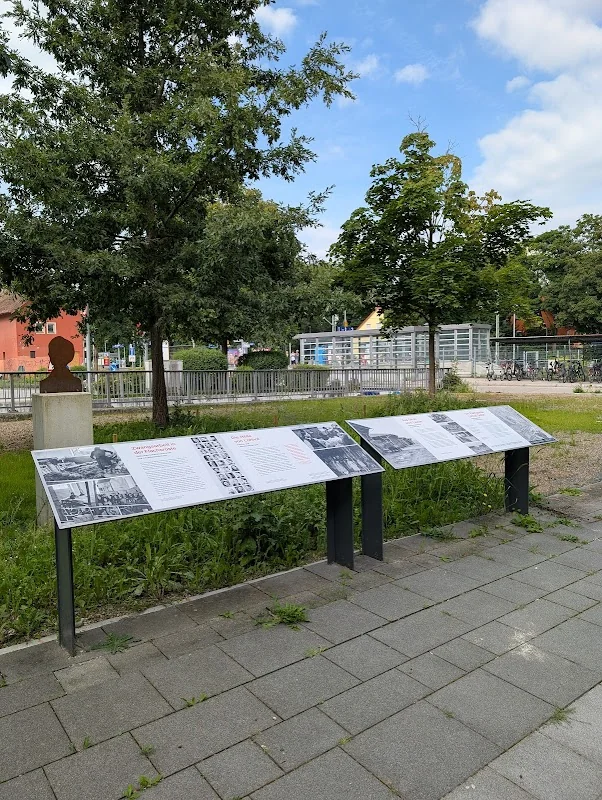
The Memorial Site Flax Roasting Lohhof in Unterschleißheim is not a classic event venue, but a three-part memorial that makes the history of Nazi forced labor visible at a historical site. Those looking for Flax Roasting Lohhof, Memorial Lohhof, or a virtual learning site usually do not want tickets or a stage program, but rather orientation, background, and a reliable classification. This is exactly what this site was created for: It connects the memorial at Lohhof train station, the path of remembrance, and the virtual learning site in the flax field into a coherent public memorial space. The focus is on the people who had to work here, on their names, and on a form of remembrance that does not remain distant but allows the place itself to speak. The city of Unterschleißheim explicitly describes the project as a responsible approach to the Nazi past and as a clear stance against right-wing extremism, anti-Semitism, and misanthropy. Thus, Flax Roasting Lohhof today is not only a historical site but also a current educational and memorial site with a public function. ([denkmal-lohhof.de](https://www.denkmal-lohhof.de/?utm_source=openai))
History of Flax Roasting Lohhof and Nazi Forced Labor
To understand the significance of the memorial site, it helps to first look at the historical operation. A flax roasting facility is a plant where flax straw is first roasted and then processed further to obtain the flax fiber. The Flax Roasting Lohhof began operations in the spring of 1938 with an elongated factory building, storage barns, and its own rail connection. According to the official project page, up to 77 railway wagons of flax were processed there annually. From 1941, there was also a company-owned camp where some of the forced laborers were housed. This shows that it was not a marginal operation but a war-essential facility directly integrated into the Nazi exploitation economy. When the US Army liberated southern Germany in April 1945, a tank division of the SS even entrenched itself in the flax roasting facility according to historical accounts; during the fighting, the buildings were heavily damaged, and operations were suspended after the war. ([denkmal-lohhof.de](https://www.denkmal-lohhof.de/geschichte))
The history of Flax Roasting Lohhof is particularly difficult because it is closely linked to systematic forced labor. Initially, in 1940 and 1941, French prisoners of war and Belgian civilian workers worked there. From the summer of 1941, around 200 Jewish women and men from Munich, as well as 68 Jewish women from the Litzmannstadt ghetto, were forced to work at the flax roasting facility; many of them were later deported and murdered by the Gestapo. Subsequently, they were replaced by forced laborers from the occupied territories of the Soviet Union and presumably also from Poland. The project page describes the use as the notorious “Hell of Lohhof”: hard physical labor, heat in the fields, dusty halls, beatings, mistreatment, accidents, and harsh punishments were part of everyday life. Individuals deemed disobedient or lazy were sent to work education camps or directly deported to Auschwitz and murdered. These facts make it clear why the memorial site today is more than just an information board: It is a place for historical learning about dehumanization, violence, and exploitation. ([denkmal-lohhof.de](https://www.denkmal-lohhof.de/geschichte))
Memorial at Lohhof Train Station and Path of Remembrance
The current memorial site was not randomly divided into several elements. The concept emerged from a long-term research and communication process that the city of Unterschleißheim began in 2010 at the initiative of the then local archivist Wolfgang Christoph. From the research of historian Dr. Maximilian Strnad, the study on Flax Roasting Lohhof emerged in 2013; thereafter, the desire for a permanent visibility of the topic grew within the city community. In cooperation with the Academy of Fine Arts Munich, a competition was held in 2019, which was won by artist Kirsten Zeitz. The result is a three-part memorial site that was handed over to the public in September 2023 and has since been supplemented with further formats. The parts are deliberately anchored at historical sites so that the communication does not remain abstract but makes the path of the forced laborers of that time comprehensible. ([denkmal-lohhof.de](https://www.denkmal-lohhof.de/konzept))
Particularly defining is the so-called Path of Remembrance. It connects the memorial at Lohhof train station with the learning site and is about 500 meters long. On this path, the names of the forced laborers who had to take the same route daily are inscribed. The memorial at the train station welcomes visitors where the people arrived by train at that time. This connection of arrival, path, and place is conceptually important because it translates the historical sequence into the urban space: from Lohhof train station through the public street space to the former factory. The memorial site thus carries the memory out of the museum and into the everyday life of the city. Those who walk the tour experience not only information but also spatial orientation and a very concrete form of remembrance that makes the path itself part of the narrative. ([denkmal-lohhof.de](https://www.denkmal-lohhof.de/konzept))
Blue Flowers, Portrait Stele, and the Artistic Concept
The artistic language of the site is deliberately designed to be contrasting. Kirsten Zeitz works with blue flowers, portrait steles, and a name band to make the memory of the forced laborers visible. The official concept page describes her work as a tribute to those affected and at the same time as a resistance against forgetting. The contrast between the fine, organic lines of flax and the hard materiality of concrete and steel is crucial. This creates a tension between the vulnerability of human biographies and the brutality of the Nazi system. The site aims not only to inform but also to make it sensually experienceable that behind every name stood an individual. That is why it does not rely on an anonymous memorial area but on design elements that work at both a distance and a closeness. The blue-flowering flax plants refer to the material flax, while the stele and the name plates give the site a permanent, public presence. ([denkmal-lohhof.de](https://www.denkmal-lohhof.de/konzept))
The location of the memorial is also part of the artistic idea. The memorial at Lohhof train station marks the spot where the forced laborers arrived, and the path leads from there to the former flax roasting facility. In the official descriptions, the learning site is understood as a visual reference to the former factory, not as an isolated art object. After the re-planning, which was necessitated by various factors including COVID-19 and land issues, some of the originally planned elements were integrated into the memorial at the train station. This makes the ensemble particularly interesting: It connects historical research, memory culture, and modern communication into a single, spatially comprehensible concept. Thus, a seemingly inconspicuous stretch becomes a consciously designed memorial path that focuses on the individual stories of those affected and does not romanticize the industrial past of the site but makes it visible in a sober and respectful manner. ([denkmal-lohhof.de](https://www.denkmal-lohhof.de/konzept))
Virtual Learning Site, Augmented Reality, and Digital Reconstruction
The virtual learning site is the response to a difficult structural and legal situation. The official page explains that it is located within sight of the former Flax Roasting Lohhof, but the area is now heavily built up and privately owned. Therefore, it cannot be accessed. For this reason, the virtual learning site provides access to a digital reconstruction of the historical site. A QR code on the stele leads to a mixed-reality and augmented reality application, where the originally planned learning site can first be viewed. Information panels and a portrait stele that could not be erected on-site due to ownership and construction situations appear there digitally. This is not a technical end in itself but a sensible solution to create historical visibility, even though the real site is not fully accessible. The virtual learning site thus complements the memorial at the train station and does not replace it. ([denkmal-lohhof.de](https://www.denkmal-lohhof.de/lernort))
Particularly impressive is the virtual time travel through the years 1940 to 1945. The middle stele serves as a portal to a 360-degree experience that makes the area experienceable from various camera perspectives. Behind individual buildings and landscape markers are historical photos and further information. This way, the site is not only documented but spatially reconstructively made comprehensible. The application can even be used with one's own mobile device, even if one is not directly on-site. For search queries such as virtual learning site, augmented reality, or digital reconstruction, this is central: The memorial site Flax Roasting Lohhof connects historical research with contemporary communication and enables learning that switches between real urban space and digital extension. Especially in an environment where the historical building is hardly visible, the digital level creates the necessary access to history without losing respect for the site. ([denkmal-lohhof.de](https://www.denkmal-lohhof.de/lernort))
Guided Tours, Educational Offers, and Public Walks
The memorial site sees itself not only as a memorial but also as an educational site. From the very beginning, the involvement of schools played an important role in the concept: From the initial research, an exhibition was created at FOSBOS and an Actionbound at COG on Flax Roasting Lohhof. This makes it clear that the communication to young people and interested citizens was considered from the outset. The official website continuously publishes programs with public walks and other events. In the programs, the tour is described as an opportunity to engage with the lives and fates of the people who had to perform forced labor here during the Nazi regime. The tours are free of charge and, according to the official announcements, do not require registration. The focus is on the biographies of the former forced laborers, not just the architectural history of the site. ([denkmal-lohhof.de](https://www.denkmal-lohhof.de/konzept))
The tours last about one and a half hours according to the official information and are accompanied by historian Dr. Maximilian Strnad, who has been intensively dealing with the history of forced labor at this site since 2011. This is particularly relevant for interested parties because scientific research and public communication come together here. The city emphasizes on its website that the memorial site is now a reality after a long development phase and will continue to be filled with educational offerings in the future. Various formats around the memorial site have also been developed and are being developed, including public walks, workshops, and thematic programs. Therefore, those looking for the memorial site are not just looking for a place to see but an opportunity to understand historical contexts in a supervised and respectful framework. This makes the site an important point of contact in Unterschleißheim, especially for schools, groups, and those interested in history. ([denkmal-lohhof.de](https://www.denkmal-lohhof.de/aktuelles/aktuelles/naechste-oeffentliche-rundgaenge-am-erinnerungsort-flachsroeste-lohhof?utm_source=openai))
Biographies, Names, and Personal Remembrance
A central feature of the memorial site is the concentration on individual people. On the official page, 350 women and men are now known by name, who had to perform forced labor in the Flax Roasting Lohhof during the Nazi regime. This number is important because it shows that the site does not only tell an abstract Nazi history but makes concrete life paths visible. The digital memorial book and the biographies on the website allow the affected individuals to be perceived as individuals: with origins, persecution, work assignments, deportation, or survival. This is crucial in historical remembrance because Nazi violence aimed to systematically reduce people to numbers. The memorial site counters this with a different form of seeing. Names, portraits, and short life stories bring the individuals back into public consciousness and make it clear that behind each biographical entry stood a real family, a daily life, and often a destroyed life. ([denkmal-lohhof.de](https://www.denkmal-lohhof.de/aktuelles/aktuelles/naechste-oeffentliche-rundgaenge-am-erinnerungsort-flachsroeste-lohhof?utm_source=openai))
The public commemoration also follows a clear stance. The city of Unterschleißheim describes the memorial site as a contribution to a responsible approach to the Nazi past and as a statement against right-wing extremism, anti-Semitism, and any form of misanthropy. This stance is particularly credible in the context of Flax Roasting Lohhof because forced labor, disenfranchisement, and deportation were historically closely linked here. The memorial site thus becomes a place where remembrance is not concluded but continued. This applies to both research and educational work and the public space. Those who walk here encounter not only history but also a conscious decision for a democratic culture of remembrance. This is precisely where the special strength of the site lies: It combines factual information with moral clarity and shows that local commemoration can be an important part of a vibrant urban society. ([denkmal-lohhof.de](https://www.denkmal-lohhof.de/?utm_source=openai))
Travel to Lohhof Train Station and Practical Orientation
For practical orientation, Lohhof train station is the most important reference point. The official tours start at the main entrance of FOS/BOS at Südliche Ingolstädter Straße 1 or at the bus stop Lohhof train station or at the entrance of the FOS/BOS site. This makes it clear: The memorial site is oriented towards public urban space and easily accessible paths. Those arriving should best follow the signage and the instructions on the official website, as the tour leads from the train station along the path of remembrance to the virtual learning site. For public transport access, the connection to Lohhof S-Bahn station is particularly important. The city also points out park-and-ride offers at the S-Bahn stations and mentions nearly 900 bicycle parking spaces at the Unterschleißheim and Lohhof train stations. Thus, arriving by train and bicycle is particularly straightforward, while the specific focus of the memorial site itself is not on a separate visitor parking lot but on public access via the train station and school entrance. ([denkmal-lohhof.de](https://www.denkmal-lohhof.de/aktuelles/aktuelles/naechste-oeffentliche-rundgaenge-am-erinnerungsort-flachsroeste-lohhof?utm_source=openai))
For visitors, this means: The site is easily findable but is deliberately not staged as a classic leisure location. There is no ticket logic, no cash register, and no event operation, but a public memorial and learning space that is explored through tours, QR codes, and historical stations. Those arriving by bicycle benefit from the numerous parking facilities at the train stations; those arriving by S-Bahn find Lohhof train station as a clear reference point. This also fits the character of the project, as the historical narrative begins with the arrival at the train station and not with a spectacular facade. Thus, the path itself remains part of the experience. Practical orientation is therefore closely linked to the substantive idea: The memorial site aims not only to be found but also to be consciously walked. This is what makes it a special destination for those interested in history, school classes, groups, and anyone looking for a quiet, well-explained, and respectfully designed place of remembrance in Unterschleißheim. ([denkmal-lohhof.de](https://www.denkmal-lohhof.de/konzept))
Sources:
Show moreShow less
Memorial Site Flax Roasting Lohhof | History & Tour
The Memorial Site Flax Roasting Lohhof in Unterschleißheim is not a classic event venue, but a three-part memorial that makes the history of Nazi forced labor visible at a historical site. Those looking for Flax Roasting Lohhof, Memorial Lohhof, or a virtual learning site usually do not want tickets or a stage program, but rather orientation, background, and a reliable classification. This is exactly what this site was created for: It connects the memorial at Lohhof train station, the path of remembrance, and the virtual learning site in the flax field into a coherent public memorial space. The focus is on the people who had to work here, on their names, and on a form of remembrance that does not remain distant but allows the place itself to speak. The city of Unterschleißheim explicitly describes the project as a responsible approach to the Nazi past and as a clear stance against right-wing extremism, anti-Semitism, and misanthropy. Thus, Flax Roasting Lohhof today is not only a historical site but also a current educational and memorial site with a public function. ([denkmal-lohhof.de](https://www.denkmal-lohhof.de/?utm_source=openai))
History of Flax Roasting Lohhof and Nazi Forced Labor
To understand the significance of the memorial site, it helps to first look at the historical operation. A flax roasting facility is a plant where flax straw is first roasted and then processed further to obtain the flax fiber. The Flax Roasting Lohhof began operations in the spring of 1938 with an elongated factory building, storage barns, and its own rail connection. According to the official project page, up to 77 railway wagons of flax were processed there annually. From 1941, there was also a company-owned camp where some of the forced laborers were housed. This shows that it was not a marginal operation but a war-essential facility directly integrated into the Nazi exploitation economy. When the US Army liberated southern Germany in April 1945, a tank division of the SS even entrenched itself in the flax roasting facility according to historical accounts; during the fighting, the buildings were heavily damaged, and operations were suspended after the war. ([denkmal-lohhof.de](https://www.denkmal-lohhof.de/geschichte))
The history of Flax Roasting Lohhof is particularly difficult because it is closely linked to systematic forced labor. Initially, in 1940 and 1941, French prisoners of war and Belgian civilian workers worked there. From the summer of 1941, around 200 Jewish women and men from Munich, as well as 68 Jewish women from the Litzmannstadt ghetto, were forced to work at the flax roasting facility; many of them were later deported and murdered by the Gestapo. Subsequently, they were replaced by forced laborers from the occupied territories of the Soviet Union and presumably also from Poland. The project page describes the use as the notorious “Hell of Lohhof”: hard physical labor, heat in the fields, dusty halls, beatings, mistreatment, accidents, and harsh punishments were part of everyday life. Individuals deemed disobedient or lazy were sent to work education camps or directly deported to Auschwitz and murdered. These facts make it clear why the memorial site today is more than just an information board: It is a place for historical learning about dehumanization, violence, and exploitation. ([denkmal-lohhof.de](https://www.denkmal-lohhof.de/geschichte))
Memorial at Lohhof Train Station and Path of Remembrance
The current memorial site was not randomly divided into several elements. The concept emerged from a long-term research and communication process that the city of Unterschleißheim began in 2010 at the initiative of the then local archivist Wolfgang Christoph. From the research of historian Dr. Maximilian Strnad, the study on Flax Roasting Lohhof emerged in 2013; thereafter, the desire for a permanent visibility of the topic grew within the city community. In cooperation with the Academy of Fine Arts Munich, a competition was held in 2019, which was won by artist Kirsten Zeitz. The result is a three-part memorial site that was handed over to the public in September 2023 and has since been supplemented with further formats. The parts are deliberately anchored at historical sites so that the communication does not remain abstract but makes the path of the forced laborers of that time comprehensible. ([denkmal-lohhof.de](https://www.denkmal-lohhof.de/konzept))
Particularly defining is the so-called Path of Remembrance. It connects the memorial at Lohhof train station with the learning site and is about 500 meters long. On this path, the names of the forced laborers who had to take the same route daily are inscribed. The memorial at the train station welcomes visitors where the people arrived by train at that time. This connection of arrival, path, and place is conceptually important because it translates the historical sequence into the urban space: from Lohhof train station through the public street space to the former factory. The memorial site thus carries the memory out of the museum and into the everyday life of the city. Those who walk the tour experience not only information but also spatial orientation and a very concrete form of remembrance that makes the path itself part of the narrative. ([denkmal-lohhof.de](https://www.denkmal-lohhof.de/konzept))
Blue Flowers, Portrait Stele, and the Artistic Concept
The artistic language of the site is deliberately designed to be contrasting. Kirsten Zeitz works with blue flowers, portrait steles, and a name band to make the memory of the forced laborers visible. The official concept page describes her work as a tribute to those affected and at the same time as a resistance against forgetting. The contrast between the fine, organic lines of flax and the hard materiality of concrete and steel is crucial. This creates a tension between the vulnerability of human biographies and the brutality of the Nazi system. The site aims not only to inform but also to make it sensually experienceable that behind every name stood an individual. That is why it does not rely on an anonymous memorial area but on design elements that work at both a distance and a closeness. The blue-flowering flax plants refer to the material flax, while the stele and the name plates give the site a permanent, public presence. ([denkmal-lohhof.de](https://www.denkmal-lohhof.de/konzept))
The location of the memorial is also part of the artistic idea. The memorial at Lohhof train station marks the spot where the forced laborers arrived, and the path leads from there to the former flax roasting facility. In the official descriptions, the learning site is understood as a visual reference to the former factory, not as an isolated art object. After the re-planning, which was necessitated by various factors including COVID-19 and land issues, some of the originally planned elements were integrated into the memorial at the train station. This makes the ensemble particularly interesting: It connects historical research, memory culture, and modern communication into a single, spatially comprehensible concept. Thus, a seemingly inconspicuous stretch becomes a consciously designed memorial path that focuses on the individual stories of those affected and does not romanticize the industrial past of the site but makes it visible in a sober and respectful manner. ([denkmal-lohhof.de](https://www.denkmal-lohhof.de/konzept))
Virtual Learning Site, Augmented Reality, and Digital Reconstruction
The virtual learning site is the response to a difficult structural and legal situation. The official page explains that it is located within sight of the former Flax Roasting Lohhof, but the area is now heavily built up and privately owned. Therefore, it cannot be accessed. For this reason, the virtual learning site provides access to a digital reconstruction of the historical site. A QR code on the stele leads to a mixed-reality and augmented reality application, where the originally planned learning site can first be viewed. Information panels and a portrait stele that could not be erected on-site due to ownership and construction situations appear there digitally. This is not a technical end in itself but a sensible solution to create historical visibility, even though the real site is not fully accessible. The virtual learning site thus complements the memorial at the train station and does not replace it. ([denkmal-lohhof.de](https://www.denkmal-lohhof.de/lernort))
Particularly impressive is the virtual time travel through the years 1940 to 1945. The middle stele serves as a portal to a 360-degree experience that makes the area experienceable from various camera perspectives. Behind individual buildings and landscape markers are historical photos and further information. This way, the site is not only documented but spatially reconstructively made comprehensible. The application can even be used with one's own mobile device, even if one is not directly on-site. For search queries such as virtual learning site, augmented reality, or digital reconstruction, this is central: The memorial site Flax Roasting Lohhof connects historical research with contemporary communication and enables learning that switches between real urban space and digital extension. Especially in an environment where the historical building is hardly visible, the digital level creates the necessary access to history without losing respect for the site. ([denkmal-lohhof.de](https://www.denkmal-lohhof.de/lernort))
Guided Tours, Educational Offers, and Public Walks
The memorial site sees itself not only as a memorial but also as an educational site. From the very beginning, the involvement of schools played an important role in the concept: From the initial research, an exhibition was created at FOSBOS and an Actionbound at COG on Flax Roasting Lohhof. This makes it clear that the communication to young people and interested citizens was considered from the outset. The official website continuously publishes programs with public walks and other events. In the programs, the tour is described as an opportunity to engage with the lives and fates of the people who had to perform forced labor here during the Nazi regime. The tours are free of charge and, according to the official announcements, do not require registration. The focus is on the biographies of the former forced laborers, not just the architectural history of the site. ([denkmal-lohhof.de](https://www.denkmal-lohhof.de/konzept))
The tours last about one and a half hours according to the official information and are accompanied by historian Dr. Maximilian Strnad, who has been intensively dealing with the history of forced labor at this site since 2011. This is particularly relevant for interested parties because scientific research and public communication come together here. The city emphasizes on its website that the memorial site is now a reality after a long development phase and will continue to be filled with educational offerings in the future. Various formats around the memorial site have also been developed and are being developed, including public walks, workshops, and thematic programs. Therefore, those looking for the memorial site are not just looking for a place to see but an opportunity to understand historical contexts in a supervised and respectful framework. This makes the site an important point of contact in Unterschleißheim, especially for schools, groups, and those interested in history. ([denkmal-lohhof.de](https://www.denkmal-lohhof.de/aktuelles/aktuelles/naechste-oeffentliche-rundgaenge-am-erinnerungsort-flachsroeste-lohhof?utm_source=openai))
Biographies, Names, and Personal Remembrance
A central feature of the memorial site is the concentration on individual people. On the official page, 350 women and men are now known by name, who had to perform forced labor in the Flax Roasting Lohhof during the Nazi regime. This number is important because it shows that the site does not only tell an abstract Nazi history but makes concrete life paths visible. The digital memorial book and the biographies on the website allow the affected individuals to be perceived as individuals: with origins, persecution, work assignments, deportation, or survival. This is crucial in historical remembrance because Nazi violence aimed to systematically reduce people to numbers. The memorial site counters this with a different form of seeing. Names, portraits, and short life stories bring the individuals back into public consciousness and make it clear that behind each biographical entry stood a real family, a daily life, and often a destroyed life. ([denkmal-lohhof.de](https://www.denkmal-lohhof.de/aktuelles/aktuelles/naechste-oeffentliche-rundgaenge-am-erinnerungsort-flachsroeste-lohhof?utm_source=openai))
The public commemoration also follows a clear stance. The city of Unterschleißheim describes the memorial site as a contribution to a responsible approach to the Nazi past and as a statement against right-wing extremism, anti-Semitism, and any form of misanthropy. This stance is particularly credible in the context of Flax Roasting Lohhof because forced labor, disenfranchisement, and deportation were historically closely linked here. The memorial site thus becomes a place where remembrance is not concluded but continued. This applies to both research and educational work and the public space. Those who walk here encounter not only history but also a conscious decision for a democratic culture of remembrance. This is precisely where the special strength of the site lies: It combines factual information with moral clarity and shows that local commemoration can be an important part of a vibrant urban society. ([denkmal-lohhof.de](https://www.denkmal-lohhof.de/?utm_source=openai))
Travel to Lohhof Train Station and Practical Orientation
For practical orientation, Lohhof train station is the most important reference point. The official tours start at the main entrance of FOS/BOS at Südliche Ingolstädter Straße 1 or at the bus stop Lohhof train station or at the entrance of the FOS/BOS site. This makes it clear: The memorial site is oriented towards public urban space and easily accessible paths. Those arriving should best follow the signage and the instructions on the official website, as the tour leads from the train station along the path of remembrance to the virtual learning site. For public transport access, the connection to Lohhof S-Bahn station is particularly important. The city also points out park-and-ride offers at the S-Bahn stations and mentions nearly 900 bicycle parking spaces at the Unterschleißheim and Lohhof train stations. Thus, arriving by train and bicycle is particularly straightforward, while the specific focus of the memorial site itself is not on a separate visitor parking lot but on public access via the train station and school entrance. ([denkmal-lohhof.de](https://www.denkmal-lohhof.de/aktuelles/aktuelles/naechste-oeffentliche-rundgaenge-am-erinnerungsort-flachsroeste-lohhof?utm_source=openai))
For visitors, this means: The site is easily findable but is deliberately not staged as a classic leisure location. There is no ticket logic, no cash register, and no event operation, but a public memorial and learning space that is explored through tours, QR codes, and historical stations. Those arriving by bicycle benefit from the numerous parking facilities at the train stations; those arriving by S-Bahn find Lohhof train station as a clear reference point. This also fits the character of the project, as the historical narrative begins with the arrival at the train station and not with a spectacular facade. Thus, the path itself remains part of the experience. Practical orientation is therefore closely linked to the substantive idea: The memorial site aims not only to be found but also to be consciously walked. This is what makes it a special destination for those interested in history, school classes, groups, and anyone looking for a quiet, well-explained, and respectfully designed place of remembrance in Unterschleißheim. ([denkmal-lohhof.de](https://www.denkmal-lohhof.de/konzept))
Sources:
Memorial Site Flax Roasting Lohhof | History & Tour
The Memorial Site Flax Roasting Lohhof in Unterschleißheim is not a classic event venue, but a three-part memorial that makes the history of Nazi forced labor visible at a historical site. Those looking for Flax Roasting Lohhof, Memorial Lohhof, or a virtual learning site usually do not want tickets or a stage program, but rather orientation, background, and a reliable classification. This is exactly what this site was created for: It connects the memorial at Lohhof train station, the path of remembrance, and the virtual learning site in the flax field into a coherent public memorial space. The focus is on the people who had to work here, on their names, and on a form of remembrance that does not remain distant but allows the place itself to speak. The city of Unterschleißheim explicitly describes the project as a responsible approach to the Nazi past and as a clear stance against right-wing extremism, anti-Semitism, and misanthropy. Thus, Flax Roasting Lohhof today is not only a historical site but also a current educational and memorial site with a public function. ([denkmal-lohhof.de](https://www.denkmal-lohhof.de/?utm_source=openai))
History of Flax Roasting Lohhof and Nazi Forced Labor
To understand the significance of the memorial site, it helps to first look at the historical operation. A flax roasting facility is a plant where flax straw is first roasted and then processed further to obtain the flax fiber. The Flax Roasting Lohhof began operations in the spring of 1938 with an elongated factory building, storage barns, and its own rail connection. According to the official project page, up to 77 railway wagons of flax were processed there annually. From 1941, there was also a company-owned camp where some of the forced laborers were housed. This shows that it was not a marginal operation but a war-essential facility directly integrated into the Nazi exploitation economy. When the US Army liberated southern Germany in April 1945, a tank division of the SS even entrenched itself in the flax roasting facility according to historical accounts; during the fighting, the buildings were heavily damaged, and operations were suspended after the war. ([denkmal-lohhof.de](https://www.denkmal-lohhof.de/geschichte))
The history of Flax Roasting Lohhof is particularly difficult because it is closely linked to systematic forced labor. Initially, in 1940 and 1941, French prisoners of war and Belgian civilian workers worked there. From the summer of 1941, around 200 Jewish women and men from Munich, as well as 68 Jewish women from the Litzmannstadt ghetto, were forced to work at the flax roasting facility; many of them were later deported and murdered by the Gestapo. Subsequently, they were replaced by forced laborers from the occupied territories of the Soviet Union and presumably also from Poland. The project page describes the use as the notorious “Hell of Lohhof”: hard physical labor, heat in the fields, dusty halls, beatings, mistreatment, accidents, and harsh punishments were part of everyday life. Individuals deemed disobedient or lazy were sent to work education camps or directly deported to Auschwitz and murdered. These facts make it clear why the memorial site today is more than just an information board: It is a place for historical learning about dehumanization, violence, and exploitation. ([denkmal-lohhof.de](https://www.denkmal-lohhof.de/geschichte))
Memorial at Lohhof Train Station and Path of Remembrance
The current memorial site was not randomly divided into several elements. The concept emerged from a long-term research and communication process that the city of Unterschleißheim began in 2010 at the initiative of the then local archivist Wolfgang Christoph. From the research of historian Dr. Maximilian Strnad, the study on Flax Roasting Lohhof emerged in 2013; thereafter, the desire for a permanent visibility of the topic grew within the city community. In cooperation with the Academy of Fine Arts Munich, a competition was held in 2019, which was won by artist Kirsten Zeitz. The result is a three-part memorial site that was handed over to the public in September 2023 and has since been supplemented with further formats. The parts are deliberately anchored at historical sites so that the communication does not remain abstract but makes the path of the forced laborers of that time comprehensible. ([denkmal-lohhof.de](https://www.denkmal-lohhof.de/konzept))
Particularly defining is the so-called Path of Remembrance. It connects the memorial at Lohhof train station with the learning site and is about 500 meters long. On this path, the names of the forced laborers who had to take the same route daily are inscribed. The memorial at the train station welcomes visitors where the people arrived by train at that time. This connection of arrival, path, and place is conceptually important because it translates the historical sequence into the urban space: from Lohhof train station through the public street space to the former factory. The memorial site thus carries the memory out of the museum and into the everyday life of the city. Those who walk the tour experience not only information but also spatial orientation and a very concrete form of remembrance that makes the path itself part of the narrative. ([denkmal-lohhof.de](https://www.denkmal-lohhof.de/konzept))
Blue Flowers, Portrait Stele, and the Artistic Concept
The artistic language of the site is deliberately designed to be contrasting. Kirsten Zeitz works with blue flowers, portrait steles, and a name band to make the memory of the forced laborers visible. The official concept page describes her work as a tribute to those affected and at the same time as a resistance against forgetting. The contrast between the fine, organic lines of flax and the hard materiality of concrete and steel is crucial. This creates a tension between the vulnerability of human biographies and the brutality of the Nazi system. The site aims not only to inform but also to make it sensually experienceable that behind every name stood an individual. That is why it does not rely on an anonymous memorial area but on design elements that work at both a distance and a closeness. The blue-flowering flax plants refer to the material flax, while the stele and the name plates give the site a permanent, public presence. ([denkmal-lohhof.de](https://www.denkmal-lohhof.de/konzept))
The location of the memorial is also part of the artistic idea. The memorial at Lohhof train station marks the spot where the forced laborers arrived, and the path leads from there to the former flax roasting facility. In the official descriptions, the learning site is understood as a visual reference to the former factory, not as an isolated art object. After the re-planning, which was necessitated by various factors including COVID-19 and land issues, some of the originally planned elements were integrated into the memorial at the train station. This makes the ensemble particularly interesting: It connects historical research, memory culture, and modern communication into a single, spatially comprehensible concept. Thus, a seemingly inconspicuous stretch becomes a consciously designed memorial path that focuses on the individual stories of those affected and does not romanticize the industrial past of the site but makes it visible in a sober and respectful manner. ([denkmal-lohhof.de](https://www.denkmal-lohhof.de/konzept))
Virtual Learning Site, Augmented Reality, and Digital Reconstruction
The virtual learning site is the response to a difficult structural and legal situation. The official page explains that it is located within sight of the former Flax Roasting Lohhof, but the area is now heavily built up and privately owned. Therefore, it cannot be accessed. For this reason, the virtual learning site provides access to a digital reconstruction of the historical site. A QR code on the stele leads to a mixed-reality and augmented reality application, where the originally planned learning site can first be viewed. Information panels and a portrait stele that could not be erected on-site due to ownership and construction situations appear there digitally. This is not a technical end in itself but a sensible solution to create historical visibility, even though the real site is not fully accessible. The virtual learning site thus complements the memorial at the train station and does not replace it. ([denkmal-lohhof.de](https://www.denkmal-lohhof.de/lernort))
Particularly impressive is the virtual time travel through the years 1940 to 1945. The middle stele serves as a portal to a 360-degree experience that makes the area experienceable from various camera perspectives. Behind individual buildings and landscape markers are historical photos and further information. This way, the site is not only documented but spatially reconstructively made comprehensible. The application can even be used with one's own mobile device, even if one is not directly on-site. For search queries such as virtual learning site, augmented reality, or digital reconstruction, this is central: The memorial site Flax Roasting Lohhof connects historical research with contemporary communication and enables learning that switches between real urban space and digital extension. Especially in an environment where the historical building is hardly visible, the digital level creates the necessary access to history without losing respect for the site. ([denkmal-lohhof.de](https://www.denkmal-lohhof.de/lernort))
Guided Tours, Educational Offers, and Public Walks
The memorial site sees itself not only as a memorial but also as an educational site. From the very beginning, the involvement of schools played an important role in the concept: From the initial research, an exhibition was created at FOSBOS and an Actionbound at COG on Flax Roasting Lohhof. This makes it clear that the communication to young people and interested citizens was considered from the outset. The official website continuously publishes programs with public walks and other events. In the programs, the tour is described as an opportunity to engage with the lives and fates of the people who had to perform forced labor here during the Nazi regime. The tours are free of charge and, according to the official announcements, do not require registration. The focus is on the biographies of the former forced laborers, not just the architectural history of the site. ([denkmal-lohhof.de](https://www.denkmal-lohhof.de/konzept))
The tours last about one and a half hours according to the official information and are accompanied by historian Dr. Maximilian Strnad, who has been intensively dealing with the history of forced labor at this site since 2011. This is particularly relevant for interested parties because scientific research and public communication come together here. The city emphasizes on its website that the memorial site is now a reality after a long development phase and will continue to be filled with educational offerings in the future. Various formats around the memorial site have also been developed and are being developed, including public walks, workshops, and thematic programs. Therefore, those looking for the memorial site are not just looking for a place to see but an opportunity to understand historical contexts in a supervised and respectful framework. This makes the site an important point of contact in Unterschleißheim, especially for schools, groups, and those interested in history. ([denkmal-lohhof.de](https://www.denkmal-lohhof.de/aktuelles/aktuelles/naechste-oeffentliche-rundgaenge-am-erinnerungsort-flachsroeste-lohhof?utm_source=openai))
Biographies, Names, and Personal Remembrance
A central feature of the memorial site is the concentration on individual people. On the official page, 350 women and men are now known by name, who had to perform forced labor in the Flax Roasting Lohhof during the Nazi regime. This number is important because it shows that the site does not only tell an abstract Nazi history but makes concrete life paths visible. The digital memorial book and the biographies on the website allow the affected individuals to be perceived as individuals: with origins, persecution, work assignments, deportation, or survival. This is crucial in historical remembrance because Nazi violence aimed to systematically reduce people to numbers. The memorial site counters this with a different form of seeing. Names, portraits, and short life stories bring the individuals back into public consciousness and make it clear that behind each biographical entry stood a real family, a daily life, and often a destroyed life. ([denkmal-lohhof.de](https://www.denkmal-lohhof.de/aktuelles/aktuelles/naechste-oeffentliche-rundgaenge-am-erinnerungsort-flachsroeste-lohhof?utm_source=openai))
The public commemoration also follows a clear stance. The city of Unterschleißheim describes the memorial site as a contribution to a responsible approach to the Nazi past and as a statement against right-wing extremism, anti-Semitism, and any form of misanthropy. This stance is particularly credible in the context of Flax Roasting Lohhof because forced labor, disenfranchisement, and deportation were historically closely linked here. The memorial site thus becomes a place where remembrance is not concluded but continued. This applies to both research and educational work and the public space. Those who walk here encounter not only history but also a conscious decision for a democratic culture of remembrance. This is precisely where the special strength of the site lies: It combines factual information with moral clarity and shows that local commemoration can be an important part of a vibrant urban society. ([denkmal-lohhof.de](https://www.denkmal-lohhof.de/?utm_source=openai))
Travel to Lohhof Train Station and Practical Orientation
For practical orientation, Lohhof train station is the most important reference point. The official tours start at the main entrance of FOS/BOS at Südliche Ingolstädter Straße 1 or at the bus stop Lohhof train station or at the entrance of the FOS/BOS site. This makes it clear: The memorial site is oriented towards public urban space and easily accessible paths. Those arriving should best follow the signage and the instructions on the official website, as the tour leads from the train station along the path of remembrance to the virtual learning site. For public transport access, the connection to Lohhof S-Bahn station is particularly important. The city also points out park-and-ride offers at the S-Bahn stations and mentions nearly 900 bicycle parking spaces at the Unterschleißheim and Lohhof train stations. Thus, arriving by train and bicycle is particularly straightforward, while the specific focus of the memorial site itself is not on a separate visitor parking lot but on public access via the train station and school entrance. ([denkmal-lohhof.de](https://www.denkmal-lohhof.de/aktuelles/aktuelles/naechste-oeffentliche-rundgaenge-am-erinnerungsort-flachsroeste-lohhof?utm_source=openai))
For visitors, this means: The site is easily findable but is deliberately not staged as a classic leisure location. There is no ticket logic, no cash register, and no event operation, but a public memorial and learning space that is explored through tours, QR codes, and historical stations. Those arriving by bicycle benefit from the numerous parking facilities at the train stations; those arriving by S-Bahn find Lohhof train station as a clear reference point. This also fits the character of the project, as the historical narrative begins with the arrival at the train station and not with a spectacular facade. Thus, the path itself remains part of the experience. Practical orientation is therefore closely linked to the substantive idea: The memorial site aims not only to be found but also to be consciously walked. This is what makes it a special destination for those interested in history, school classes, groups, and anyone looking for a quiet, well-explained, and respectfully designed place of remembrance in Unterschleißheim. ([denkmal-lohhof.de](https://www.denkmal-lohhof.de/konzept))
Sources:
Upcoming Events
No events found
Frequently Asked Questions
Reviews
No reviews found