
Karl-Schwarzschild-Straße 2, Garching bei München
Karl-Schwarzschild-Straße 2, 85748 Garching bei München, Germany
ESO Supernova Planetarium & Visitor Centre | Tickets & Shows
The ESO Supernova Planetarium & Visitor Centre in Garching near Munich is one of the most exciting astronomy locations in the region: it combines a modern fulldome planetarium with a free, interactive permanent exhibition and is located directly at the ESO headquarters. The building was jointly developed by ESO and HITS, made possible by the Klaus Tschira Foundation, and is operated by ESO. Those who come here experience not only shows but a whole world of science with architecture, exhibitions, guided tours, and event spaces under one roof. For families, school groups, technology fans, and companies, the location is therefore equally a destination for excursions, a place for learning, and an extraordinary event venue. ([supernova.eso.org](https://supernova.eso.org/visit/))
Tickets, Opening Hours, and Booking
Those looking for tickets for the ESO Supernova should first check the program, as planetarium shows, guided tours, and evening events are booked online and are based on fixed time slots. A planetarium show costs 6.50 euros per person, the exhibition is free, and public evening events have their own prices depending on the format. Booking is straightforward: you can either select a show directly through the calendar view or jump to the desired booking page via activities & events. Vouchers are also available and sold in increments of 6.50 euros. The ESO Supernova does not offer discounted tickets, and refunds are excluded. School groups with registration can attend the educational program for free, making the location particularly attractive for teachers and organized learning groups. ([supernova.eso.org](https://supernova.eso.org/visit/))
The opening hours are clearly structured and relevant for spontaneous visits as well as planned family outings. The ESO Supernova is closed on Mondays and Tuesdays. On Wednesdays, Thursdays, and Fridays, it is open from 9 AM to 5 PM, and on Saturdays and Sundays from 12 PM to 5 PM. On the first Friday of the month, there are extended opening hours until 8 PM, and on the last full weekend of the month, the building is closed for operational reasons. Additionally, those wishing to attend a show should arrive on time, as no new visitors will be admitted after 4:45 PM. Special events such as evening lectures may take place outside regular hours, so checking the daily program is always worthwhile. ([supernova.eso.org](https://supernova.eso.org/visit/))
Directions and Parking in Garching near Munich
Getting to the ESO Supernova is particularly easy by public transport. The address is Karl-Schwarzschild-Straße 2 in 85748 Garching near Munich, located on the research center grounds northeast of Garching and about 15 kilometers northeast of Munich. Take the U6 to the final station Garching Forschungszentrum; from there, it is only about a four-minute walk to the entrance. Bus connections are also available: The stop Anna-Boyksen Straße is served by lines 292 via Oberschleißheim, 230 via Ismaning, and 690 via Eching. Those arriving by car should take the Garching-Nord exit on the A9 and follow the route directly to the research center. For visitors from the region, the location is particularly convenient, as it is approximately 15 minutes from Munich Airport and about 30 minutes from downtown Munich. ([supernova.eso.org](https://supernova.eso.org/visit/directions/))
When it comes to parking, ESO clearly recommends using buses and trains, as parking spaces are limited. There is a designated bus area for dropping off groups between the ESO headquarters and the Max Planck Institute for Astrophysics. If a bus needs to be parked, prior contact is recommended. Very important for visitors with limited mobility: Disabled parking spaces are located close to the entrance. This makes access for individual guests, school classes, and corporate groups well-planned, as long as the limited parking space is kept in mind. For many guests, the combination of good U6 connections, clear signage in the research center, and proximity to Munich is a real plus. ([supernova.eso.org](https://supernova.eso.org/visit/directions/))
Planetarium Shows in the Fulldome Dome Room
The centerpiece of the location is the planetarium, which offers up to 109 seats and operates with a 14-meter dome. The official planetarium technology includes five Velvet projectors with a total resolution of about 4250 pixels, as well as software solutions such as Digistar 7, Uniview, Powerdome, World Wide Telescope, Resolume, and Space Engine. This combination provides an intense fulldome experience that clearly differs from a classic cinema visit. The ESO Supernova also refers to its planetarium as the world's first open-source planetarium and provides its own planetarium products with the community. The content is not only about spectacular images but also about knowledge: each show often combines a live introduction to the current night sky with a cinematic experience under the 360-degree dome. ([supernova.eso.org](https://supernova.eso.org/about/planetarium/))
The shows are scheduled months in advance; on weekdays, four performances take place daily. Particularly family-friendly is the age orientation of the programs: The show The Sky Above Us is particularly suitable for children aged 4 to 7 years, and A Tour of the Solar System is for children aged 8 to 11 years. At the same time, clear rules apply to ensure that the experience works for everyone: once the doors are closed, no entry is allowed, food and drink are not permitted in the planetarium, and photography is strictly prohibited there. Those who need to leave the planetarium early should reserve seats at the end of the rows and inform the staff in advance. This consistent organization shows how strongly the ESO Supernova focuses on concentrated, high-quality presentations. ([supernova.eso.org](https://supernova.eso.org/germany/visit/faq/))
The Exhibition The Living Universe
The permanent exhibition The Living Universe is one of the main reasons why the ESO Supernova is so often sought after and recommended. Covering 2200 square meters, it presents 13 topics that span from astronomy and Earth to stars, exoplanets, galaxies, cosmology, technological questions, and current news from astronomy. The tour begins at the entrance of the ESO Supernova and leads along a 255-meter-long, gently sloping path through the building up and later back down. Along the way, visitors encounter large image walls, real astronomical artifacts, and a model of the Atacama Desert, which is home to many ESO telescopes. The exhibition is deliberately designed to be interactive: it can be touched, tried out, and explored with all senses, making it particularly accessible for both adults and children. ([supernova.eso.org](https://supernova.eso.org/about/exhibition/))
The exhibition is free and can be visited without a guided tour, making it very flexible. Those with little time can complete a short tour in about 30 minutes; those who want to dive deeper can spend up to four hours or more in the building. All information is available in German and English, so international guests can navigate just as easily as local visitors. The permanent exhibition is always available during opening hours, and temporary exhibitions can also be shown in the World Space. The QR codes on the panels are also practical: they allow content to be saved on the ticket and retrieved later at home. Additionally, the exhibition offers three small telescopes with which visitors can view the high-resolution Milky Way image on the walls, even though there is no public observatory on site. ([supernova.eso.org](https://supernova.eso.org/about/exhibition/))
Accessibility, Family, and Practical Tips
The ESO Supernova places noticeable importance on accessibility. All areas of the exhibition are accessible via ramps or an elevator, the meeting rooms are also barrier-free, and a wheelchair-accessible toilet is available in the basement. The exhibition concept was explicitly designed with wheelchair users in mind, although the ramps are steep in some places. Those who need assistance can take the elevator to the third floor and experience the exhibition from top to bottom. The planetarium is also accessible; however, rows 2 to 8 are only accessible via steps. Wheelchair users can still participate in performances but should contact in advance via email to ensure the necessary space is reserved. For people with hearing impairments, headsets are available for a deposit of 5 euros, and all panels are equipped with QR codes that allow texts to be read aloud via smartphone for guests with visual impairments. ([supernova.eso.org](https://supernova.eso.org/visit/accessibility/))
Visiting the ESO Supernova is also well thought out for families. Children under 12 years may only visit the ESO Supernova and the planetarium when accompanied by adults, and shows in the planetarium are recommended for ages four and up. At the same time, all age groups are generally allowed. If parents come with a baby, the stroller should remain at the entrance for safety reasons; additionally, ESO recommends reserving seats at the end of the rows in case one needs to leave the performance early. School classes are welcome; however, no educational activities are organized on weekends. Practically in everyday life: there is no café or restaurant in the building, but there is a picnic area as well as snack and beverage vending machines. Lockers are available, but in limited numbers, so large backpacks should be left at home. Dogs are not allowed in the exhibition and planetarium, except for trained assistance dogs. ([supernova.eso.org](https://supernova.eso.org/visit/))
Architecture, History, and Corporate Events
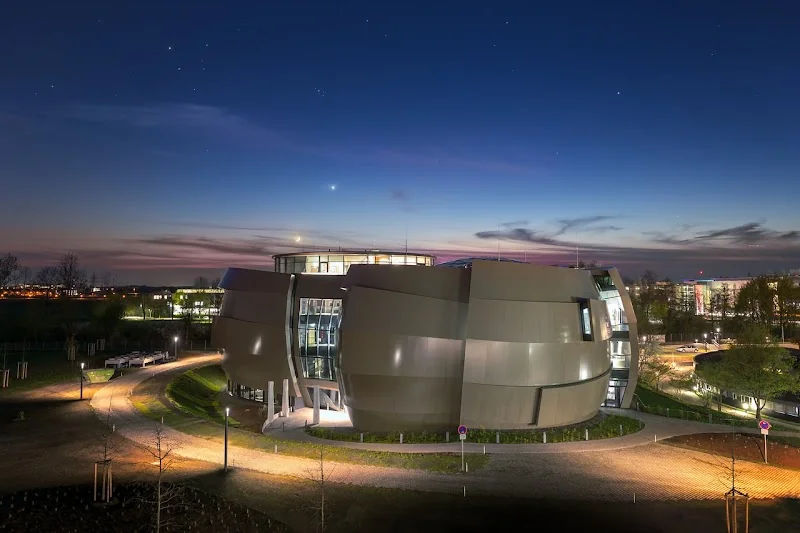
Architecturally, the ESO Supernova is also remarkable. The building was designed by Bernhardt + Partner and its floor plan resembles a tight binary star system where one star transfers matter to its companion. This idea perfectly fits the name of the building and the astronomical narrative that runs throughout the entire visitor center. The exterior and interior design is not only symbolically strong but also officially awarded: the building received a DGNB Gold certificate for sustainability. Historically, the project began with the collaboration between ESO and the Klaus Tschira Foundation, which officially made the donation to ESO in 2013. Construction began in 2015, the star roof of the World Space was installed in 2016, and on April 26, 2018, the ESO Supernova was officially inaugurated; it opened to the public on April 28, 2018. ([supernova.eso.org](https://supernova.eso.org/about/architecture/))
As an event location, the ESO Supernova offers significantly more than just the planetarium. Companies can hold conferences, workshops, seminars, team-building events, product presentations, and evening receptions here. The bookable space includes not only the large planetarium but also the World Space, foyer, seminar rooms, and a rooftop terrace. For the business setting, free Wi-Fi, projectors, screens, sound systems, microphones, lecterns, flip charts, chairs, tables, air conditioning, accessibility, and elevators are available. The planetarium can accommodate up to 109 people for events, guided tours are designed for groups of up to 25 people and cost a flat fee of 200 euros. Inquiries can be sent via email to events@eso.org, and private events are generally possible outside regular opening hours. Thus, the location uniquely combines science, architecture, and professional event comfort. ([supernova.eso.org](https://supernova.eso.org/your-event/))
Sources:
Show moreShow less
ESO Supernova Planetarium & Visitor Centre | Tickets & Shows
The ESO Supernova Planetarium & Visitor Centre in Garching near Munich is one of the most exciting astronomy locations in the region: it combines a modern fulldome planetarium with a free, interactive permanent exhibition and is located directly at the ESO headquarters. The building was jointly developed by ESO and HITS, made possible by the Klaus Tschira Foundation, and is operated by ESO. Those who come here experience not only shows but a whole world of science with architecture, exhibitions, guided tours, and event spaces under one roof. For families, school groups, technology fans, and companies, the location is therefore equally a destination for excursions, a place for learning, and an extraordinary event venue. ([supernova.eso.org](https://supernova.eso.org/visit/))
Tickets, Opening Hours, and Booking
Those looking for tickets for the ESO Supernova should first check the program, as planetarium shows, guided tours, and evening events are booked online and are based on fixed time slots. A planetarium show costs 6.50 euros per person, the exhibition is free, and public evening events have their own prices depending on the format. Booking is straightforward: you can either select a show directly through the calendar view or jump to the desired booking page via activities & events. Vouchers are also available and sold in increments of 6.50 euros. The ESO Supernova does not offer discounted tickets, and refunds are excluded. School groups with registration can attend the educational program for free, making the location particularly attractive for teachers and organized learning groups. ([supernova.eso.org](https://supernova.eso.org/visit/))
The opening hours are clearly structured and relevant for spontaneous visits as well as planned family outings. The ESO Supernova is closed on Mondays and Tuesdays. On Wednesdays, Thursdays, and Fridays, it is open from 9 AM to 5 PM, and on Saturdays and Sundays from 12 PM to 5 PM. On the first Friday of the month, there are extended opening hours until 8 PM, and on the last full weekend of the month, the building is closed for operational reasons. Additionally, those wishing to attend a show should arrive on time, as no new visitors will be admitted after 4:45 PM. Special events such as evening lectures may take place outside regular hours, so checking the daily program is always worthwhile. ([supernova.eso.org](https://supernova.eso.org/visit/))
Directions and Parking in Garching near Munich
Getting to the ESO Supernova is particularly easy by public transport. The address is Karl-Schwarzschild-Straße 2 in 85748 Garching near Munich, located on the research center grounds northeast of Garching and about 15 kilometers northeast of Munich. Take the U6 to the final station Garching Forschungszentrum; from there, it is only about a four-minute walk to the entrance. Bus connections are also available: The stop Anna-Boyksen Straße is served by lines 292 via Oberschleißheim, 230 via Ismaning, and 690 via Eching. Those arriving by car should take the Garching-Nord exit on the A9 and follow the route directly to the research center. For visitors from the region, the location is particularly convenient, as it is approximately 15 minutes from Munich Airport and about 30 minutes from downtown Munich. ([supernova.eso.org](https://supernova.eso.org/visit/directions/))
When it comes to parking, ESO clearly recommends using buses and trains, as parking spaces are limited. There is a designated bus area for dropping off groups between the ESO headquarters and the Max Planck Institute for Astrophysics. If a bus needs to be parked, prior contact is recommended. Very important for visitors with limited mobility: Disabled parking spaces are located close to the entrance. This makes access for individual guests, school classes, and corporate groups well-planned, as long as the limited parking space is kept in mind. For many guests, the combination of good U6 connections, clear signage in the research center, and proximity to Munich is a real plus. ([supernova.eso.org](https://supernova.eso.org/visit/directions/))
Planetarium Shows in the Fulldome Dome Room
The centerpiece of the location is the planetarium, which offers up to 109 seats and operates with a 14-meter dome. The official planetarium technology includes five Velvet projectors with a total resolution of about 4250 pixels, as well as software solutions such as Digistar 7, Uniview, Powerdome, World Wide Telescope, Resolume, and Space Engine. This combination provides an intense fulldome experience that clearly differs from a classic cinema visit. The ESO Supernova also refers to its planetarium as the world's first open-source planetarium and provides its own planetarium products with the community. The content is not only about spectacular images but also about knowledge: each show often combines a live introduction to the current night sky with a cinematic experience under the 360-degree dome. ([supernova.eso.org](https://supernova.eso.org/about/planetarium/))
The shows are scheduled months in advance; on weekdays, four performances take place daily. Particularly family-friendly is the age orientation of the programs: The show The Sky Above Us is particularly suitable for children aged 4 to 7 years, and A Tour of the Solar System is for children aged 8 to 11 years. At the same time, clear rules apply to ensure that the experience works for everyone: once the doors are closed, no entry is allowed, food and drink are not permitted in the planetarium, and photography is strictly prohibited there. Those who need to leave the planetarium early should reserve seats at the end of the rows and inform the staff in advance. This consistent organization shows how strongly the ESO Supernova focuses on concentrated, high-quality presentations. ([supernova.eso.org](https://supernova.eso.org/germany/visit/faq/))
The Exhibition The Living Universe
The permanent exhibition The Living Universe is one of the main reasons why the ESO Supernova is so often sought after and recommended. Covering 2200 square meters, it presents 13 topics that span from astronomy and Earth to stars, exoplanets, galaxies, cosmology, technological questions, and current news from astronomy. The tour begins at the entrance of the ESO Supernova and leads along a 255-meter-long, gently sloping path through the building up and later back down. Along the way, visitors encounter large image walls, real astronomical artifacts, and a model of the Atacama Desert, which is home to many ESO telescopes. The exhibition is deliberately designed to be interactive: it can be touched, tried out, and explored with all senses, making it particularly accessible for both adults and children. ([supernova.eso.org](https://supernova.eso.org/about/exhibition/))
The exhibition is free and can be visited without a guided tour, making it very flexible. Those with little time can complete a short tour in about 30 minutes; those who want to dive deeper can spend up to four hours or more in the building. All information is available in German and English, so international guests can navigate just as easily as local visitors. The permanent exhibition is always available during opening hours, and temporary exhibitions can also be shown in the World Space. The QR codes on the panels are also practical: they allow content to be saved on the ticket and retrieved later at home. Additionally, the exhibition offers three small telescopes with which visitors can view the high-resolution Milky Way image on the walls, even though there is no public observatory on site. ([supernova.eso.org](https://supernova.eso.org/about/exhibition/))
Accessibility, Family, and Practical Tips
The ESO Supernova places noticeable importance on accessibility. All areas of the exhibition are accessible via ramps or an elevator, the meeting rooms are also barrier-free, and a wheelchair-accessible toilet is available in the basement. The exhibition concept was explicitly designed with wheelchair users in mind, although the ramps are steep in some places. Those who need assistance can take the elevator to the third floor and experience the exhibition from top to bottom. The planetarium is also accessible; however, rows 2 to 8 are only accessible via steps. Wheelchair users can still participate in performances but should contact in advance via email to ensure the necessary space is reserved. For people with hearing impairments, headsets are available for a deposit of 5 euros, and all panels are equipped with QR codes that allow texts to be read aloud via smartphone for guests with visual impairments. ([supernova.eso.org](https://supernova.eso.org/visit/accessibility/))
Visiting the ESO Supernova is also well thought out for families. Children under 12 years may only visit the ESO Supernova and the planetarium when accompanied by adults, and shows in the planetarium are recommended for ages four and up. At the same time, all age groups are generally allowed. If parents come with a baby, the stroller should remain at the entrance for safety reasons; additionally, ESO recommends reserving seats at the end of the rows in case one needs to leave the performance early. School classes are welcome; however, no educational activities are organized on weekends. Practically in everyday life: there is no café or restaurant in the building, but there is a picnic area as well as snack and beverage vending machines. Lockers are available, but in limited numbers, so large backpacks should be left at home. Dogs are not allowed in the exhibition and planetarium, except for trained assistance dogs. ([supernova.eso.org](https://supernova.eso.org/visit/))
Architecture, History, and Corporate Events
Architecturally, the ESO Supernova is also remarkable. The building was designed by Bernhardt + Partner and its floor plan resembles a tight binary star system where one star transfers matter to its companion. This idea perfectly fits the name of the building and the astronomical narrative that runs throughout the entire visitor center. The exterior and interior design is not only symbolically strong but also officially awarded: the building received a DGNB Gold certificate for sustainability. Historically, the project began with the collaboration between ESO and the Klaus Tschira Foundation, which officially made the donation to ESO in 2013. Construction began in 2015, the star roof of the World Space was installed in 2016, and on April 26, 2018, the ESO Supernova was officially inaugurated; it opened to the public on April 28, 2018. ([supernova.eso.org](https://supernova.eso.org/about/architecture/))
As an event location, the ESO Supernova offers significantly more than just the planetarium. Companies can hold conferences, workshops, seminars, team-building events, product presentations, and evening receptions here. The bookable space includes not only the large planetarium but also the World Space, foyer, seminar rooms, and a rooftop terrace. For the business setting, free Wi-Fi, projectors, screens, sound systems, microphones, lecterns, flip charts, chairs, tables, air conditioning, accessibility, and elevators are available. The planetarium can accommodate up to 109 people for events, guided tours are designed for groups of up to 25 people and cost a flat fee of 200 euros. Inquiries can be sent via email to events@eso.org, and private events are generally possible outside regular opening hours. Thus, the location uniquely combines science, architecture, and professional event comfort. ([supernova.eso.org](https://supernova.eso.org/your-event/))
Sources:
ESO Supernova Planetarium & Visitor Centre | Tickets & Shows
The ESO Supernova Planetarium & Visitor Centre in Garching near Munich is one of the most exciting astronomy locations in the region: it combines a modern fulldome planetarium with a free, interactive permanent exhibition and is located directly at the ESO headquarters. The building was jointly developed by ESO and HITS, made possible by the Klaus Tschira Foundation, and is operated by ESO. Those who come here experience not only shows but a whole world of science with architecture, exhibitions, guided tours, and event spaces under one roof. For families, school groups, technology fans, and companies, the location is therefore equally a destination for excursions, a place for learning, and an extraordinary event venue. ([supernova.eso.org](https://supernova.eso.org/visit/))
Tickets, Opening Hours, and Booking
Those looking for tickets for the ESO Supernova should first check the program, as planetarium shows, guided tours, and evening events are booked online and are based on fixed time slots. A planetarium show costs 6.50 euros per person, the exhibition is free, and public evening events have their own prices depending on the format. Booking is straightforward: you can either select a show directly through the calendar view or jump to the desired booking page via activities & events. Vouchers are also available and sold in increments of 6.50 euros. The ESO Supernova does not offer discounted tickets, and refunds are excluded. School groups with registration can attend the educational program for free, making the location particularly attractive for teachers and organized learning groups. ([supernova.eso.org](https://supernova.eso.org/visit/))
The opening hours are clearly structured and relevant for spontaneous visits as well as planned family outings. The ESO Supernova is closed on Mondays and Tuesdays. On Wednesdays, Thursdays, and Fridays, it is open from 9 AM to 5 PM, and on Saturdays and Sundays from 12 PM to 5 PM. On the first Friday of the month, there are extended opening hours until 8 PM, and on the last full weekend of the month, the building is closed for operational reasons. Additionally, those wishing to attend a show should arrive on time, as no new visitors will be admitted after 4:45 PM. Special events such as evening lectures may take place outside regular hours, so checking the daily program is always worthwhile. ([supernova.eso.org](https://supernova.eso.org/visit/))
Directions and Parking in Garching near Munich
Getting to the ESO Supernova is particularly easy by public transport. The address is Karl-Schwarzschild-Straße 2 in 85748 Garching near Munich, located on the research center grounds northeast of Garching and about 15 kilometers northeast of Munich. Take the U6 to the final station Garching Forschungszentrum; from there, it is only about a four-minute walk to the entrance. Bus connections are also available: The stop Anna-Boyksen Straße is served by lines 292 via Oberschleißheim, 230 via Ismaning, and 690 via Eching. Those arriving by car should take the Garching-Nord exit on the A9 and follow the route directly to the research center. For visitors from the region, the location is particularly convenient, as it is approximately 15 minutes from Munich Airport and about 30 minutes from downtown Munich. ([supernova.eso.org](https://supernova.eso.org/visit/directions/))
When it comes to parking, ESO clearly recommends using buses and trains, as parking spaces are limited. There is a designated bus area for dropping off groups between the ESO headquarters and the Max Planck Institute for Astrophysics. If a bus needs to be parked, prior contact is recommended. Very important for visitors with limited mobility: Disabled parking spaces are located close to the entrance. This makes access for individual guests, school classes, and corporate groups well-planned, as long as the limited parking space is kept in mind. For many guests, the combination of good U6 connections, clear signage in the research center, and proximity to Munich is a real plus. ([supernova.eso.org](https://supernova.eso.org/visit/directions/))
Planetarium Shows in the Fulldome Dome Room
The centerpiece of the location is the planetarium, which offers up to 109 seats and operates with a 14-meter dome. The official planetarium technology includes five Velvet projectors with a total resolution of about 4250 pixels, as well as software solutions such as Digistar 7, Uniview, Powerdome, World Wide Telescope, Resolume, and Space Engine. This combination provides an intense fulldome experience that clearly differs from a classic cinema visit. The ESO Supernova also refers to its planetarium as the world's first open-source planetarium and provides its own planetarium products with the community. The content is not only about spectacular images but also about knowledge: each show often combines a live introduction to the current night sky with a cinematic experience under the 360-degree dome. ([supernova.eso.org](https://supernova.eso.org/about/planetarium/))
The shows are scheduled months in advance; on weekdays, four performances take place daily. Particularly family-friendly is the age orientation of the programs: The show The Sky Above Us is particularly suitable for children aged 4 to 7 years, and A Tour of the Solar System is for children aged 8 to 11 years. At the same time, clear rules apply to ensure that the experience works for everyone: once the doors are closed, no entry is allowed, food and drink are not permitted in the planetarium, and photography is strictly prohibited there. Those who need to leave the planetarium early should reserve seats at the end of the rows and inform the staff in advance. This consistent organization shows how strongly the ESO Supernova focuses on concentrated, high-quality presentations. ([supernova.eso.org](https://supernova.eso.org/germany/visit/faq/))
The Exhibition The Living Universe
The permanent exhibition The Living Universe is one of the main reasons why the ESO Supernova is so often sought after and recommended. Covering 2200 square meters, it presents 13 topics that span from astronomy and Earth to stars, exoplanets, galaxies, cosmology, technological questions, and current news from astronomy. The tour begins at the entrance of the ESO Supernova and leads along a 255-meter-long, gently sloping path through the building up and later back down. Along the way, visitors encounter large image walls, real astronomical artifacts, and a model of the Atacama Desert, which is home to many ESO telescopes. The exhibition is deliberately designed to be interactive: it can be touched, tried out, and explored with all senses, making it particularly accessible for both adults and children. ([supernova.eso.org](https://supernova.eso.org/about/exhibition/))
The exhibition is free and can be visited without a guided tour, making it very flexible. Those with little time can complete a short tour in about 30 minutes; those who want to dive deeper can spend up to four hours or more in the building. All information is available in German and English, so international guests can navigate just as easily as local visitors. The permanent exhibition is always available during opening hours, and temporary exhibitions can also be shown in the World Space. The QR codes on the panels are also practical: they allow content to be saved on the ticket and retrieved later at home. Additionally, the exhibition offers three small telescopes with which visitors can view the high-resolution Milky Way image on the walls, even though there is no public observatory on site. ([supernova.eso.org](https://supernova.eso.org/about/exhibition/))
Accessibility, Family, and Practical Tips
The ESO Supernova places noticeable importance on accessibility. All areas of the exhibition are accessible via ramps or an elevator, the meeting rooms are also barrier-free, and a wheelchair-accessible toilet is available in the basement. The exhibition concept was explicitly designed with wheelchair users in mind, although the ramps are steep in some places. Those who need assistance can take the elevator to the third floor and experience the exhibition from top to bottom. The planetarium is also accessible; however, rows 2 to 8 are only accessible via steps. Wheelchair users can still participate in performances but should contact in advance via email to ensure the necessary space is reserved. For people with hearing impairments, headsets are available for a deposit of 5 euros, and all panels are equipped with QR codes that allow texts to be read aloud via smartphone for guests with visual impairments. ([supernova.eso.org](https://supernova.eso.org/visit/accessibility/))
Visiting the ESO Supernova is also well thought out for families. Children under 12 years may only visit the ESO Supernova and the planetarium when accompanied by adults, and shows in the planetarium are recommended for ages four and up. At the same time, all age groups are generally allowed. If parents come with a baby, the stroller should remain at the entrance for safety reasons; additionally, ESO recommends reserving seats at the end of the rows in case one needs to leave the performance early. School classes are welcome; however, no educational activities are organized on weekends. Practically in everyday life: there is no café or restaurant in the building, but there is a picnic area as well as snack and beverage vending machines. Lockers are available, but in limited numbers, so large backpacks should be left at home. Dogs are not allowed in the exhibition and planetarium, except for trained assistance dogs. ([supernova.eso.org](https://supernova.eso.org/visit/))
Architecture, History, and Corporate Events
Architecturally, the ESO Supernova is also remarkable. The building was designed by Bernhardt + Partner and its floor plan resembles a tight binary star system where one star transfers matter to its companion. This idea perfectly fits the name of the building and the astronomical narrative that runs throughout the entire visitor center. The exterior and interior design is not only symbolically strong but also officially awarded: the building received a DGNB Gold certificate for sustainability. Historically, the project began with the collaboration between ESO and the Klaus Tschira Foundation, which officially made the donation to ESO in 2013. Construction began in 2015, the star roof of the World Space was installed in 2016, and on April 26, 2018, the ESO Supernova was officially inaugurated; it opened to the public on April 28, 2018. ([supernova.eso.org](https://supernova.eso.org/about/architecture/))
As an event location, the ESO Supernova offers significantly more than just the planetarium. Companies can hold conferences, workshops, seminars, team-building events, product presentations, and evening receptions here. The bookable space includes not only the large planetarium but also the World Space, foyer, seminar rooms, and a rooftop terrace. For the business setting, free Wi-Fi, projectors, screens, sound systems, microphones, lecterns, flip charts, chairs, tables, air conditioning, accessibility, and elevators are available. The planetarium can accommodate up to 109 people for events, guided tours are designed for groups of up to 25 people and cost a flat fee of 200 euros. Inquiries can be sent via email to events@eso.org, and private events are generally possible outside regular opening hours. Thus, the location uniquely combines science, architecture, and professional event comfort. ([supernova.eso.org](https://supernova.eso.org/your-event/))
Sources:
Upcoming Events
No events found
Frequently Asked Questions
Reviews
Yiannis Strouthos
1. May 2025
The ESO Supernova Planetarium is an incredible experience for space lovers and curious minds alike 🌌🔭! The architecture alone is stunning, and the exhibitions are super interactive and beautifully designed, making complex astronomy topics fun and easy to understand 🌠🛸. The planetarium shows are breathtaking, with crystal-clear visuals that truly transport you across the universe 🚀✨. It’s well-organized, family-friendly, and a fantastic way to dive into the wonders of space—highly recommended for all ages!
ankit shrivastava
13. May 2023
The planetarium is a must visit place. Very cool place. It is clear that best views are row 8 to 5. Tickets must be booked in advance. Most shows are booked 100%. The content and the presenter are excellent and make the show fun. And the exhibition is fun to spend time at. If one reads everything, one can easily spend 4-5 hours here.
Bigmike Beebee
5. January 2025
Fantastic and fun shows and exhibitions for young and old to learn about the planets and space science. Highly recommend!
Marco Horstmann
8. August 2024
Excellent place to learn about our planet, our galaxy and the universe. Amazing super modern planetarium. Book your tickets in advance for the shows as seats are quickly sold out!
Kelsi Sawitri
28. August 2022
The show was really cool! They even showed us the most updated Nebula picture of James Webb Telescope. The exhibition was attractive and informative. I recommend you all to visit this planetarium.