
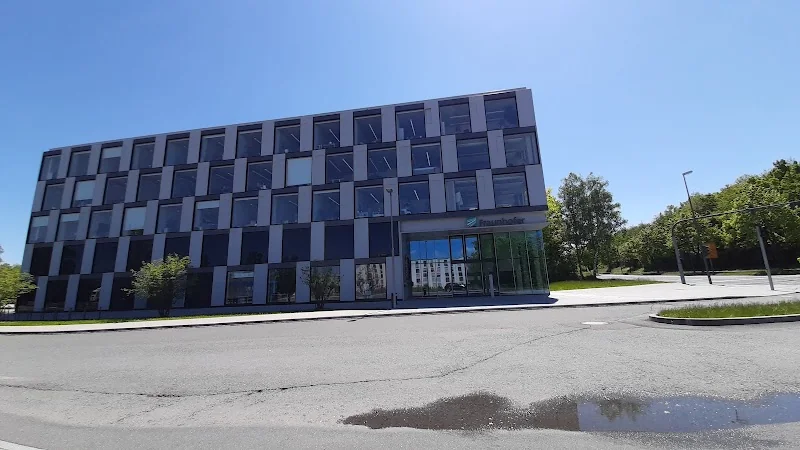
Universitätsstraße 9, Bayreuth-Frankengut
Universitätsstraße 9, 95447 Bayreuth, Germany
Fraunhofer IPA Process Innovation | 3D Printing & Factory Planning
The Fraunhofer Project Group Process Innovation in Bayreuth is a practice-oriented research institution of the Fraunhofer IPA, closely linked to the University of Bayreuth and oriented towards the needs of industry. At this location, methods, components, and devices up to complete machines and systems are developed, tested, and exemplarily used. This is particularly relevant for companies seeking solutions for additive manufacturing, factory planning, resource efficiency, remanufacturing, quality improvement, and digitalization. Currently, around 50 engineers and scientists work interdisciplinary on industrial tasks, while the technical equipment ranges from production technology to additive manufacturing systems to electronics laboratories and RemanLab. This combination of scientific depth and direct practical relevance makes the location an important contact for modern production in Northern Bavaria. ([prozessinnovation.fraunhofer.de](https://www.prozessinnovation.fraunhofer.de/de/ueber-uns.html))
Additive Manufacturing and 3D Printing in Bayreuth
Additive manufacturing is one of the clear focal points of the project group and extends far beyond a mere 3D printing trend in Bayreuth. On the official page, additive manufacturing is mentioned as its own subject area, which is thought together with intelligent value chains, efficient value creation systems, and AI for sustainably optimized value creation. This is particularly important for industry because additive processes rarely function in isolation in practice. Material choice, process parameters, post-processing, quality assurance, and economic scaling must be considered together so that a prototype becomes a robust production solution. Therefore, research in Bayreuth is not limited to individual machines but is focused on the question of how processes, data, and value creation can be interconnected. ([prozessinnovation.fraunhofer.de](https://www.prozessinnovation.fraunhofer.de/de/ueber-uns.html))
A strong example of this is the research facility Campus Additive.Innovationen, which the University of Bayreuth established together with the Project Group Process Innovation in April 2020. The press release describes this facility as an interdisciplinary approach where materials, technologies, applications, and business models of additive manufacturing are jointly investigated, developed, and optimized. This is noteworthy because additive manufacturing is not only understood here as a manufacturing process but as a strategic lever for new products, new processes, and new business models. Companies involved in 3D printing thus have a contact person who considers both technical and organizational as well as economic questions. Especially for medium-sized companies, this can be the difference between an interesting pilot project and a truly viable industrial application. ([ipa.fraunhofer.de](https://www.ipa.fraunhofer.de/de/presse/presseinformationen/interdisziplinaeres-zentrum-fuer-3d-druck-gegruendet.html))
The event offerings on the website also align with the transfer orientation. Among other things, workshops on additive manufacturing in practical use, an AI workshop, a 3D workshop, and online seminars on handling metal and plastic powders are advertised. This shows that knowledge at the location is not only generated in the laboratory but is specifically passed on to companies and users in the form of qualification and technical training. For visitors and professionals, Bayreuth is thus not only a research site but also a place where concrete competencies around additive processes, safe material handling, and successful application in industrial everyday life can be built. ([prozessinnovation.fraunhofer.de](https://www.prozessinnovation.fraunhofer.de/de/ueber-uns.html))
Factory Planning, Process Optimization, and Industry 4.0
In addition to additive manufacturing, factory planning, production management, process optimization, quality, logistics, and Industry 4.0 are clearly defined areas of work and research for the project group. The Bayreuth infrastructure is unusually well-equipped for this purpose, as it includes a production technology center with numerous interconnected machine tools and additive manufacturing systems, an electronics laboratory, and the RemanLab as a learning factory for remanufacturing. This allows real processes to be analyzed not only theoretically but also tested, modified, and evaluated on a small scale. Therefore, those looking for a Fraunhofer solution for factory planning will find in Bayreuth not just a pure consulting address but a research environment where production systems are viewed holistically. This is a significant advantage for companies that want to reliably test new processes, new layouts, or new manufacturing concepts. ([prozessinnovation.fraunhofer.de](https://www.prozessinnovation.fraunhofer.de/de/ueber-uns.html))
The breadth of content is not coincidental but follows the goal of developing efficient and resource-saving value creation systems. On the official page, the project group names production, resource efficiency, service engineering, refabrication, regenerative mechatronics, quality, logistics, and Industry 4.0 as areas of work and research. In earlier Fraunhofer announcements, Bayreuth was described with topics such as regenerative production, logistics, quality, intelligent production, and resource efficiency. This combination explains why the location is so interesting for companies from mechanical engineering, manufacturing, development, and related industries: Here, not only ideas are gathered, but methods are developed that can make processes more stable, economical, and robust. Especially with increasing demands for productivity and sustainability, this is a crucial added value. ([prozessinnovation.fraunhofer.de](https://www.prozessinnovation.fraunhofer.de/de/ueber-uns.html))
The current website structure also makes it clear how the topics are interconnected. In addition to additive manufacturing, there are areas such as intelligent value chains, efficient value creation systems, and AI-noW, meaning artificial intelligence for sustainably optimized value creation. This is important content-wise because modern factory planning today no longer consists solely of buildings, machines, and material flows. Data, assistance systems, digital evaluation, and flexible processes are also part of it. Bayreuth addresses exactly this connection by merging classical production technology with data-driven methods. This results in solutions that are not only technically plausible but also usable in operational everyday life. ([prozessinnovation.fraunhofer.de](https://www.prozessinnovation.fraunhofer.de/de/ueber-uns.html))
Projects, Research Focus Areas, and Applications in Industry
The official external presentation of the project group makes it clear that work is strongly application-oriented here. The page describes that researchers develop a deep understanding of their clients' individual tasks and have implemented more than 125 tailored projects in the past five years. For a Fraunhofer team, this is an important signal as it visibly demonstrates the transfer strength of the location. It is not about research in a vacuum but about concrete production questions that are addressed together with companies. Typical projects include improving digital processes, making manufacturing processes more efficient, or transferring new assistance and AI approaches into practice. The location thus acts as a bridge between scientific methodology and industrial implementation. ([prozessinnovation.fraunhofer.de](https://www.prozessinnovation.fraunhofer.de/de/ueber-uns.html))
Concrete examples show how broad the application range is. In the Fraunhofer project Desire4Electronics, the Bayreuth team works on automated disassembly processes for the reprocessing of electronic waste and incorporates methods of machine learning. In another official contribution, it is described how AI can help reduce machine downtimes and improve maintenance. Such projects make it clear that the location covers not only classical production but also circular economy, reuse, data-based maintenance, and intelligent disassembly processes. For companies that want to set up their value creation more sustainably, digitally, and resiliently, this is an important building block. ([ipa.fraunhofer.de](https://www.ipa.fraunhofer.de/de/presse/presseinformationen/maschinelles-lernen-verbessert-die-wiederaufarbeitung-von-elektroschrott.html?utm_source=openai))
Additionally, there is a close transfer to practice. Fraunhofer describes the collaboration with the University of Bayreuth and the development of individually tailored solutions for companies that want to improve their production. Under the umbrella brand Produktion.Besser.Machen., this claim is also communicatively visible: Science and industry are to be brought together to achieve concrete improvements in product development, manufacturing, and management. The location is thus less a closed research space than a network point for companies seeking reliable support for technical and organizational questions. Especially in the context of digitalization, sustainability, and skilled labor shortages, such a network is particularly valuable for many companies. ([ipa.fraunhofer.de](https://www.ipa.fraunhofer.de/de/presse/presseinformationen/fraunhofer-ipa-und-universitaet-bayreuth-buendeln-kompetenzen.html?utm_source=openai))
History and Development since 2006
The history of the Project Group Process Innovation dates back to 2006 in Bayreuth. According to Fraunhofer, Professor Rolf Steinhilper established the group from March 2006; it was closely linked to the Chair of Environmentally Friendly Production Technology at the University of Bayreuth. Even in this early phase, production and logistics were in the foreground, and the group grew so quickly that the original location soon became too small. From today's perspective, this development shows why Bayreuth is so strongly linked to the University as a Fraunhofer location: The research grew out of an academic-industrial cooperation and gradually became an independent, professional research unit with clear focuses in the area of industrial value creation. ([ipa.fraunhofer.de](https://www.ipa.fraunhofer.de/de/presse/presseinformationen/Steinhilper_geht_Doepper_uebernimmt.html))
In 2015, a decisive step followed with the new building. The Fraunhofer press reported at that time on the opening of a building of around 3000 square meters with a technology hall, two laboratories, offices, and meeting rooms. At that time, 44 employees and more than 60 student assistants worked at the location. The proximity to the university campus, the wood-glass facade, and the combined heat and power plant that generates electricity and heat were particularly highlighted. The strategic background is also important: It was already clear back then that the location should build learning factories and practice-oriented demonstration environments so that companies could directly experience methods such as lean production and energy-efficient manufacturing. The new building project was thus not only a structural step but a visible commitment to application-oriented research. ([ipa.fraunhofer.de](https://www.ipa.fraunhofer.de/content/dam/ipa/de/documents/Presse/Presseinformationen/2015/August/PM_2015-08-07_Neubau_Bayreuth.pdf))
In 2018, Professor Frank Döpper took over the leadership of the project group. The accompanying Fraunhofer announcement mentioned around 40 engineers and 60 student assistants working on topics such as regenerative production, logistics and quality, intelligent production and resource efficiency, as well as innovative processes and additive manufacturing. In 2020, Campus Additive.Innovationen marked another milestone, and in 2025, the cooperation with the Institute of Business Informatics of Fraunhofer FIT was further expanded within the framework of the research campus Twin Transformation. The development thus shows a clear red thread: From a local project group, a highly specialized location has emerged that systematically connects production technology, digitalization, and sustainability today. ([ipa.fraunhofer.de](https://www.ipa.fraunhofer.de/de/presse/presseinformationen/Steinhilper_geht_Doepper_uebernimmt.html))
Directions, Parking, and Visiting the Location Universitätsstraße 9
The location is situated at Universitätsstraße 9 in Bayreuth on or directly at the campus of the University of Bayreuth. The official directions for arriving by car mention the A9 motorway and the Bayreuth Süd exit. After that, follow the signs towards the university, turn right at the end of Dr.-Konrad-Pöhner-Straße into Universitätsstraße, and find the building on the right side opposite the university entrance. Those arriving by taxi can reach the location from the main train station in about 3.5 kilometers. For public transport, the Fraunhofer site mentions bus lines 304 and 306 from ZOH to the stop Bayreuth Uni-Verwaltung. This makes visiting relatively uncomplicated, even if one does not use a car. ([prozessinnovation.fraunhofer.de](https://www.prozessinnovation.fraunhofer.de/de/kontakt.html?utm_source=openai))
For visitors, the location on the campus is practical because it fits into a larger university environment. At the same time, it is worthwhile to check the current campus notices before the trip, as the university currently points out construction sites and temporary parking restrictions. Among other things, the restricted use of P1 and parts of P2 are mentioned, as well as additional parking options south of the campus near the TAO building; there are also public parking spaces at Kreuzsteinbad. For a visit to Fraunhofer in Bayreuth, this means: The journey is easy to plan, but one should expect the current parking notices on site. Especially for appointments with multiple people or deliveries, a quick look at the campus information can help avoid unnecessary detours. ([uni-bayreuth.de](https://www.uni-bayreuth.de/en/construction-work?utm_source=openai))
The location itself is also a plus point. The project group is located in close proximity to the university, which facilitates daily collaboration with academic institutions, students, and guest researchers. Even at the opening of the new building, it was emphasized how important the spatial proximity to the campus is for student assistants and project work. This is still relevant today because many of the research topics in Bayreuth lie precisely at the interface between teaching, transfer, and industrial practice. Therefore, those visiting the location experience not just a single building but a research space that has been consciously embedded in the university environment. ([ipa.fraunhofer.de](https://www.ipa.fraunhofer.de/content/dam/ipa/de/documents/Presse/Presseinformationen/2015/August/PM_2015-08-07_Neubau_Bayreuth.pdf))
Team, Collaborations, and Research Campus Twin Transformation
Content-wise, the location is strongly shaped by its team and its collaborations. The current about us page speaks of around 50 engineers and scientists who work interdisciplinary and have implemented more than 125 projects in the past five years. At the same time, the project partners in Bayreuth are equipped with modern technical facilities. This includes the production technology center, the electronics laboratory, and the RemanLab, which is precisely the infrastructure that enables quick transitions between research, prototyping, and industrial application. For companies, this is a significant advantage because questions can be examined not theoretically but on real machines, processes, and data. This working method explains why the location is perceived as practical and reliable by industry partners. ([prozessinnovation.fraunhofer.de](https://www.prozessinnovation.fraunhofer.de/de/ueber-uns.html))
The close connection to the University of Bayreuth is still a defining feature today. The emerging Fraunhofer Research Campus Twin Transformation is, according to the official description, jointly operated by the Institute of Business Informatics of Fraunhofer FIT and the Project Group Process Innovation of Fraunhofer IPA. The focus there is on the synergistic implementation of digital transformation and sustainability transformation. This expands the Bayreuth location with an additional perspective because technical production, data-driven business models, and sustainable value creation are thought together. This is exactly where the strength of the location lies: It connects production technology, digitalization, and sustainability into a research environment that is as interesting for medium-sized companies as it is for larger industry partners. ([twin-transformation.fraunhofer.de](https://www.twin-transformation.fraunhofer.de/de/ueber-uns.html))
The research campus is also intended as a platform for collaboration. The official description emphasizes that cooperation between science and industry should be improved and practical solutions for the challenges of digital and sustainable transformation should be developed. For visitors and companies, this means: Bayreuth is not only a place for classical production technology but also for interdisciplinary project work, for the development of new demonstrators, and for the transfer of research into concrete applications. Those looking for a location where 3D printing, factory planning, optimization, and digitalization are addressed in a common environment will find one of the most exciting Fraunhofer points of contact in Northern Bavaria here. ([twin-transformation.fraunhofer.de](https://www.twin-transformation.fraunhofer.de/de/ueber-uns.html))
Sources:
Show moreShow less
Fraunhofer IPA Process Innovation | 3D Printing & Factory Planning
The Fraunhofer Project Group Process Innovation in Bayreuth is a practice-oriented research institution of the Fraunhofer IPA, closely linked to the University of Bayreuth and oriented towards the needs of industry. At this location, methods, components, and devices up to complete machines and systems are developed, tested, and exemplarily used. This is particularly relevant for companies seeking solutions for additive manufacturing, factory planning, resource efficiency, remanufacturing, quality improvement, and digitalization. Currently, around 50 engineers and scientists work interdisciplinary on industrial tasks, while the technical equipment ranges from production technology to additive manufacturing systems to electronics laboratories and RemanLab. This combination of scientific depth and direct practical relevance makes the location an important contact for modern production in Northern Bavaria. ([prozessinnovation.fraunhofer.de](https://www.prozessinnovation.fraunhofer.de/de/ueber-uns.html))
Additive Manufacturing and 3D Printing in Bayreuth
Additive manufacturing is one of the clear focal points of the project group and extends far beyond a mere 3D printing trend in Bayreuth. On the official page, additive manufacturing is mentioned as its own subject area, which is thought together with intelligent value chains, efficient value creation systems, and AI for sustainably optimized value creation. This is particularly important for industry because additive processes rarely function in isolation in practice. Material choice, process parameters, post-processing, quality assurance, and economic scaling must be considered together so that a prototype becomes a robust production solution. Therefore, research in Bayreuth is not limited to individual machines but is focused on the question of how processes, data, and value creation can be interconnected. ([prozessinnovation.fraunhofer.de](https://www.prozessinnovation.fraunhofer.de/de/ueber-uns.html))
A strong example of this is the research facility Campus Additive.Innovationen, which the University of Bayreuth established together with the Project Group Process Innovation in April 2020. The press release describes this facility as an interdisciplinary approach where materials, technologies, applications, and business models of additive manufacturing are jointly investigated, developed, and optimized. This is noteworthy because additive manufacturing is not only understood here as a manufacturing process but as a strategic lever for new products, new processes, and new business models. Companies involved in 3D printing thus have a contact person who considers both technical and organizational as well as economic questions. Especially for medium-sized companies, this can be the difference between an interesting pilot project and a truly viable industrial application. ([ipa.fraunhofer.de](https://www.ipa.fraunhofer.de/de/presse/presseinformationen/interdisziplinaeres-zentrum-fuer-3d-druck-gegruendet.html))
The event offerings on the website also align with the transfer orientation. Among other things, workshops on additive manufacturing in practical use, an AI workshop, a 3D workshop, and online seminars on handling metal and plastic powders are advertised. This shows that knowledge at the location is not only generated in the laboratory but is specifically passed on to companies and users in the form of qualification and technical training. For visitors and professionals, Bayreuth is thus not only a research site but also a place where concrete competencies around additive processes, safe material handling, and successful application in industrial everyday life can be built. ([prozessinnovation.fraunhofer.de](https://www.prozessinnovation.fraunhofer.de/de/ueber-uns.html))
Factory Planning, Process Optimization, and Industry 4.0
In addition to additive manufacturing, factory planning, production management, process optimization, quality, logistics, and Industry 4.0 are clearly defined areas of work and research for the project group. The Bayreuth infrastructure is unusually well-equipped for this purpose, as it includes a production technology center with numerous interconnected machine tools and additive manufacturing systems, an electronics laboratory, and the RemanLab as a learning factory for remanufacturing. This allows real processes to be analyzed not only theoretically but also tested, modified, and evaluated on a small scale. Therefore, those looking for a Fraunhofer solution for factory planning will find in Bayreuth not just a pure consulting address but a research environment where production systems are viewed holistically. This is a significant advantage for companies that want to reliably test new processes, new layouts, or new manufacturing concepts. ([prozessinnovation.fraunhofer.de](https://www.prozessinnovation.fraunhofer.de/de/ueber-uns.html))
The breadth of content is not coincidental but follows the goal of developing efficient and resource-saving value creation systems. On the official page, the project group names production, resource efficiency, service engineering, refabrication, regenerative mechatronics, quality, logistics, and Industry 4.0 as areas of work and research. In earlier Fraunhofer announcements, Bayreuth was described with topics such as regenerative production, logistics, quality, intelligent production, and resource efficiency. This combination explains why the location is so interesting for companies from mechanical engineering, manufacturing, development, and related industries: Here, not only ideas are gathered, but methods are developed that can make processes more stable, economical, and robust. Especially with increasing demands for productivity and sustainability, this is a crucial added value. ([prozessinnovation.fraunhofer.de](https://www.prozessinnovation.fraunhofer.de/de/ueber-uns.html))
The current website structure also makes it clear how the topics are interconnected. In addition to additive manufacturing, there are areas such as intelligent value chains, efficient value creation systems, and AI-noW, meaning artificial intelligence for sustainably optimized value creation. This is important content-wise because modern factory planning today no longer consists solely of buildings, machines, and material flows. Data, assistance systems, digital evaluation, and flexible processes are also part of it. Bayreuth addresses exactly this connection by merging classical production technology with data-driven methods. This results in solutions that are not only technically plausible but also usable in operational everyday life. ([prozessinnovation.fraunhofer.de](https://www.prozessinnovation.fraunhofer.de/de/ueber-uns.html))
Projects, Research Focus Areas, and Applications in Industry
The official external presentation of the project group makes it clear that work is strongly application-oriented here. The page describes that researchers develop a deep understanding of their clients' individual tasks and have implemented more than 125 tailored projects in the past five years. For a Fraunhofer team, this is an important signal as it visibly demonstrates the transfer strength of the location. It is not about research in a vacuum but about concrete production questions that are addressed together with companies. Typical projects include improving digital processes, making manufacturing processes more efficient, or transferring new assistance and AI approaches into practice. The location thus acts as a bridge between scientific methodology and industrial implementation. ([prozessinnovation.fraunhofer.de](https://www.prozessinnovation.fraunhofer.de/de/ueber-uns.html))
Concrete examples show how broad the application range is. In the Fraunhofer project Desire4Electronics, the Bayreuth team works on automated disassembly processes for the reprocessing of electronic waste and incorporates methods of machine learning. In another official contribution, it is described how AI can help reduce machine downtimes and improve maintenance. Such projects make it clear that the location covers not only classical production but also circular economy, reuse, data-based maintenance, and intelligent disassembly processes. For companies that want to set up their value creation more sustainably, digitally, and resiliently, this is an important building block. ([ipa.fraunhofer.de](https://www.ipa.fraunhofer.de/de/presse/presseinformationen/maschinelles-lernen-verbessert-die-wiederaufarbeitung-von-elektroschrott.html?utm_source=openai))
Additionally, there is a close transfer to practice. Fraunhofer describes the collaboration with the University of Bayreuth and the development of individually tailored solutions for companies that want to improve their production. Under the umbrella brand Produktion.Besser.Machen., this claim is also communicatively visible: Science and industry are to be brought together to achieve concrete improvements in product development, manufacturing, and management. The location is thus less a closed research space than a network point for companies seeking reliable support for technical and organizational questions. Especially in the context of digitalization, sustainability, and skilled labor shortages, such a network is particularly valuable for many companies. ([ipa.fraunhofer.de](https://www.ipa.fraunhofer.de/de/presse/presseinformationen/fraunhofer-ipa-und-universitaet-bayreuth-buendeln-kompetenzen.html?utm_source=openai))
History and Development since 2006
The history of the Project Group Process Innovation dates back to 2006 in Bayreuth. According to Fraunhofer, Professor Rolf Steinhilper established the group from March 2006; it was closely linked to the Chair of Environmentally Friendly Production Technology at the University of Bayreuth. Even in this early phase, production and logistics were in the foreground, and the group grew so quickly that the original location soon became too small. From today's perspective, this development shows why Bayreuth is so strongly linked to the University as a Fraunhofer location: The research grew out of an academic-industrial cooperation and gradually became an independent, professional research unit with clear focuses in the area of industrial value creation. ([ipa.fraunhofer.de](https://www.ipa.fraunhofer.de/de/presse/presseinformationen/Steinhilper_geht_Doepper_uebernimmt.html))
In 2015, a decisive step followed with the new building. The Fraunhofer press reported at that time on the opening of a building of around 3000 square meters with a technology hall, two laboratories, offices, and meeting rooms. At that time, 44 employees and more than 60 student assistants worked at the location. The proximity to the university campus, the wood-glass facade, and the combined heat and power plant that generates electricity and heat were particularly highlighted. The strategic background is also important: It was already clear back then that the location should build learning factories and practice-oriented demonstration environments so that companies could directly experience methods such as lean production and energy-efficient manufacturing. The new building project was thus not only a structural step but a visible commitment to application-oriented research. ([ipa.fraunhofer.de](https://www.ipa.fraunhofer.de/content/dam/ipa/de/documents/Presse/Presseinformationen/2015/August/PM_2015-08-07_Neubau_Bayreuth.pdf))
In 2018, Professor Frank Döpper took over the leadership of the project group. The accompanying Fraunhofer announcement mentioned around 40 engineers and 60 student assistants working on topics such as regenerative production, logistics and quality, intelligent production and resource efficiency, as well as innovative processes and additive manufacturing. In 2020, Campus Additive.Innovationen marked another milestone, and in 2025, the cooperation with the Institute of Business Informatics of Fraunhofer FIT was further expanded within the framework of the research campus Twin Transformation. The development thus shows a clear red thread: From a local project group, a highly specialized location has emerged that systematically connects production technology, digitalization, and sustainability today. ([ipa.fraunhofer.de](https://www.ipa.fraunhofer.de/de/presse/presseinformationen/Steinhilper_geht_Doepper_uebernimmt.html))
Directions, Parking, and Visiting the Location Universitätsstraße 9
The location is situated at Universitätsstraße 9 in Bayreuth on or directly at the campus of the University of Bayreuth. The official directions for arriving by car mention the A9 motorway and the Bayreuth Süd exit. After that, follow the signs towards the university, turn right at the end of Dr.-Konrad-Pöhner-Straße into Universitätsstraße, and find the building on the right side opposite the university entrance. Those arriving by taxi can reach the location from the main train station in about 3.5 kilometers. For public transport, the Fraunhofer site mentions bus lines 304 and 306 from ZOH to the stop Bayreuth Uni-Verwaltung. This makes visiting relatively uncomplicated, even if one does not use a car. ([prozessinnovation.fraunhofer.de](https://www.prozessinnovation.fraunhofer.de/de/kontakt.html?utm_source=openai))
For visitors, the location on the campus is practical because it fits into a larger university environment. At the same time, it is worthwhile to check the current campus notices before the trip, as the university currently points out construction sites and temporary parking restrictions. Among other things, the restricted use of P1 and parts of P2 are mentioned, as well as additional parking options south of the campus near the TAO building; there are also public parking spaces at Kreuzsteinbad. For a visit to Fraunhofer in Bayreuth, this means: The journey is easy to plan, but one should expect the current parking notices on site. Especially for appointments with multiple people or deliveries, a quick look at the campus information can help avoid unnecessary detours. ([uni-bayreuth.de](https://www.uni-bayreuth.de/en/construction-work?utm_source=openai))
The location itself is also a plus point. The project group is located in close proximity to the university, which facilitates daily collaboration with academic institutions, students, and guest researchers. Even at the opening of the new building, it was emphasized how important the spatial proximity to the campus is for student assistants and project work. This is still relevant today because many of the research topics in Bayreuth lie precisely at the interface between teaching, transfer, and industrial practice. Therefore, those visiting the location experience not just a single building but a research space that has been consciously embedded in the university environment. ([ipa.fraunhofer.de](https://www.ipa.fraunhofer.de/content/dam/ipa/de/documents/Presse/Presseinformationen/2015/August/PM_2015-08-07_Neubau_Bayreuth.pdf))
Team, Collaborations, and Research Campus Twin Transformation
Content-wise, the location is strongly shaped by its team and its collaborations. The current about us page speaks of around 50 engineers and scientists who work interdisciplinary and have implemented more than 125 projects in the past five years. At the same time, the project partners in Bayreuth are equipped with modern technical facilities. This includes the production technology center, the electronics laboratory, and the RemanLab, which is precisely the infrastructure that enables quick transitions between research, prototyping, and industrial application. For companies, this is a significant advantage because questions can be examined not theoretically but on real machines, processes, and data. This working method explains why the location is perceived as practical and reliable by industry partners. ([prozessinnovation.fraunhofer.de](https://www.prozessinnovation.fraunhofer.de/de/ueber-uns.html))
The close connection to the University of Bayreuth is still a defining feature today. The emerging Fraunhofer Research Campus Twin Transformation is, according to the official description, jointly operated by the Institute of Business Informatics of Fraunhofer FIT and the Project Group Process Innovation of Fraunhofer IPA. The focus there is on the synergistic implementation of digital transformation and sustainability transformation. This expands the Bayreuth location with an additional perspective because technical production, data-driven business models, and sustainable value creation are thought together. This is exactly where the strength of the location lies: It connects production technology, digitalization, and sustainability into a research environment that is as interesting for medium-sized companies as it is for larger industry partners. ([twin-transformation.fraunhofer.de](https://www.twin-transformation.fraunhofer.de/de/ueber-uns.html))
The research campus is also intended as a platform for collaboration. The official description emphasizes that cooperation between science and industry should be improved and practical solutions for the challenges of digital and sustainable transformation should be developed. For visitors and companies, this means: Bayreuth is not only a place for classical production technology but also for interdisciplinary project work, for the development of new demonstrators, and for the transfer of research into concrete applications. Those looking for a location where 3D printing, factory planning, optimization, and digitalization are addressed in a common environment will find one of the most exciting Fraunhofer points of contact in Northern Bavaria here. ([twin-transformation.fraunhofer.de](https://www.twin-transformation.fraunhofer.de/de/ueber-uns.html))
Sources:
Fraunhofer IPA Process Innovation | 3D Printing & Factory Planning
The Fraunhofer Project Group Process Innovation in Bayreuth is a practice-oriented research institution of the Fraunhofer IPA, closely linked to the University of Bayreuth and oriented towards the needs of industry. At this location, methods, components, and devices up to complete machines and systems are developed, tested, and exemplarily used. This is particularly relevant for companies seeking solutions for additive manufacturing, factory planning, resource efficiency, remanufacturing, quality improvement, and digitalization. Currently, around 50 engineers and scientists work interdisciplinary on industrial tasks, while the technical equipment ranges from production technology to additive manufacturing systems to electronics laboratories and RemanLab. This combination of scientific depth and direct practical relevance makes the location an important contact for modern production in Northern Bavaria. ([prozessinnovation.fraunhofer.de](https://www.prozessinnovation.fraunhofer.de/de/ueber-uns.html))
Additive Manufacturing and 3D Printing in Bayreuth
Additive manufacturing is one of the clear focal points of the project group and extends far beyond a mere 3D printing trend in Bayreuth. On the official page, additive manufacturing is mentioned as its own subject area, which is thought together with intelligent value chains, efficient value creation systems, and AI for sustainably optimized value creation. This is particularly important for industry because additive processes rarely function in isolation in practice. Material choice, process parameters, post-processing, quality assurance, and economic scaling must be considered together so that a prototype becomes a robust production solution. Therefore, research in Bayreuth is not limited to individual machines but is focused on the question of how processes, data, and value creation can be interconnected. ([prozessinnovation.fraunhofer.de](https://www.prozessinnovation.fraunhofer.de/de/ueber-uns.html))
A strong example of this is the research facility Campus Additive.Innovationen, which the University of Bayreuth established together with the Project Group Process Innovation in April 2020. The press release describes this facility as an interdisciplinary approach where materials, technologies, applications, and business models of additive manufacturing are jointly investigated, developed, and optimized. This is noteworthy because additive manufacturing is not only understood here as a manufacturing process but as a strategic lever for new products, new processes, and new business models. Companies involved in 3D printing thus have a contact person who considers both technical and organizational as well as economic questions. Especially for medium-sized companies, this can be the difference between an interesting pilot project and a truly viable industrial application. ([ipa.fraunhofer.de](https://www.ipa.fraunhofer.de/de/presse/presseinformationen/interdisziplinaeres-zentrum-fuer-3d-druck-gegruendet.html))
The event offerings on the website also align with the transfer orientation. Among other things, workshops on additive manufacturing in practical use, an AI workshop, a 3D workshop, and online seminars on handling metal and plastic powders are advertised. This shows that knowledge at the location is not only generated in the laboratory but is specifically passed on to companies and users in the form of qualification and technical training. For visitors and professionals, Bayreuth is thus not only a research site but also a place where concrete competencies around additive processes, safe material handling, and successful application in industrial everyday life can be built. ([prozessinnovation.fraunhofer.de](https://www.prozessinnovation.fraunhofer.de/de/ueber-uns.html))
Factory Planning, Process Optimization, and Industry 4.0
In addition to additive manufacturing, factory planning, production management, process optimization, quality, logistics, and Industry 4.0 are clearly defined areas of work and research for the project group. The Bayreuth infrastructure is unusually well-equipped for this purpose, as it includes a production technology center with numerous interconnected machine tools and additive manufacturing systems, an electronics laboratory, and the RemanLab as a learning factory for remanufacturing. This allows real processes to be analyzed not only theoretically but also tested, modified, and evaluated on a small scale. Therefore, those looking for a Fraunhofer solution for factory planning will find in Bayreuth not just a pure consulting address but a research environment where production systems are viewed holistically. This is a significant advantage for companies that want to reliably test new processes, new layouts, or new manufacturing concepts. ([prozessinnovation.fraunhofer.de](https://www.prozessinnovation.fraunhofer.de/de/ueber-uns.html))
The breadth of content is not coincidental but follows the goal of developing efficient and resource-saving value creation systems. On the official page, the project group names production, resource efficiency, service engineering, refabrication, regenerative mechatronics, quality, logistics, and Industry 4.0 as areas of work and research. In earlier Fraunhofer announcements, Bayreuth was described with topics such as regenerative production, logistics, quality, intelligent production, and resource efficiency. This combination explains why the location is so interesting for companies from mechanical engineering, manufacturing, development, and related industries: Here, not only ideas are gathered, but methods are developed that can make processes more stable, economical, and robust. Especially with increasing demands for productivity and sustainability, this is a crucial added value. ([prozessinnovation.fraunhofer.de](https://www.prozessinnovation.fraunhofer.de/de/ueber-uns.html))
The current website structure also makes it clear how the topics are interconnected. In addition to additive manufacturing, there are areas such as intelligent value chains, efficient value creation systems, and AI-noW, meaning artificial intelligence for sustainably optimized value creation. This is important content-wise because modern factory planning today no longer consists solely of buildings, machines, and material flows. Data, assistance systems, digital evaluation, and flexible processes are also part of it. Bayreuth addresses exactly this connection by merging classical production technology with data-driven methods. This results in solutions that are not only technically plausible but also usable in operational everyday life. ([prozessinnovation.fraunhofer.de](https://www.prozessinnovation.fraunhofer.de/de/ueber-uns.html))
Projects, Research Focus Areas, and Applications in Industry
The official external presentation of the project group makes it clear that work is strongly application-oriented here. The page describes that researchers develop a deep understanding of their clients' individual tasks and have implemented more than 125 tailored projects in the past five years. For a Fraunhofer team, this is an important signal as it visibly demonstrates the transfer strength of the location. It is not about research in a vacuum but about concrete production questions that are addressed together with companies. Typical projects include improving digital processes, making manufacturing processes more efficient, or transferring new assistance and AI approaches into practice. The location thus acts as a bridge between scientific methodology and industrial implementation. ([prozessinnovation.fraunhofer.de](https://www.prozessinnovation.fraunhofer.de/de/ueber-uns.html))
Concrete examples show how broad the application range is. In the Fraunhofer project Desire4Electronics, the Bayreuth team works on automated disassembly processes for the reprocessing of electronic waste and incorporates methods of machine learning. In another official contribution, it is described how AI can help reduce machine downtimes and improve maintenance. Such projects make it clear that the location covers not only classical production but also circular economy, reuse, data-based maintenance, and intelligent disassembly processes. For companies that want to set up their value creation more sustainably, digitally, and resiliently, this is an important building block. ([ipa.fraunhofer.de](https://www.ipa.fraunhofer.de/de/presse/presseinformationen/maschinelles-lernen-verbessert-die-wiederaufarbeitung-von-elektroschrott.html?utm_source=openai))
Additionally, there is a close transfer to practice. Fraunhofer describes the collaboration with the University of Bayreuth and the development of individually tailored solutions for companies that want to improve their production. Under the umbrella brand Produktion.Besser.Machen., this claim is also communicatively visible: Science and industry are to be brought together to achieve concrete improvements in product development, manufacturing, and management. The location is thus less a closed research space than a network point for companies seeking reliable support for technical and organizational questions. Especially in the context of digitalization, sustainability, and skilled labor shortages, such a network is particularly valuable for many companies. ([ipa.fraunhofer.de](https://www.ipa.fraunhofer.de/de/presse/presseinformationen/fraunhofer-ipa-und-universitaet-bayreuth-buendeln-kompetenzen.html?utm_source=openai))
History and Development since 2006
The history of the Project Group Process Innovation dates back to 2006 in Bayreuth. According to Fraunhofer, Professor Rolf Steinhilper established the group from March 2006; it was closely linked to the Chair of Environmentally Friendly Production Technology at the University of Bayreuth. Even in this early phase, production and logistics were in the foreground, and the group grew so quickly that the original location soon became too small. From today's perspective, this development shows why Bayreuth is so strongly linked to the University as a Fraunhofer location: The research grew out of an academic-industrial cooperation and gradually became an independent, professional research unit with clear focuses in the area of industrial value creation. ([ipa.fraunhofer.de](https://www.ipa.fraunhofer.de/de/presse/presseinformationen/Steinhilper_geht_Doepper_uebernimmt.html))
In 2015, a decisive step followed with the new building. The Fraunhofer press reported at that time on the opening of a building of around 3000 square meters with a technology hall, two laboratories, offices, and meeting rooms. At that time, 44 employees and more than 60 student assistants worked at the location. The proximity to the university campus, the wood-glass facade, and the combined heat and power plant that generates electricity and heat were particularly highlighted. The strategic background is also important: It was already clear back then that the location should build learning factories and practice-oriented demonstration environments so that companies could directly experience methods such as lean production and energy-efficient manufacturing. The new building project was thus not only a structural step but a visible commitment to application-oriented research. ([ipa.fraunhofer.de](https://www.ipa.fraunhofer.de/content/dam/ipa/de/documents/Presse/Presseinformationen/2015/August/PM_2015-08-07_Neubau_Bayreuth.pdf))
In 2018, Professor Frank Döpper took over the leadership of the project group. The accompanying Fraunhofer announcement mentioned around 40 engineers and 60 student assistants working on topics such as regenerative production, logistics and quality, intelligent production and resource efficiency, as well as innovative processes and additive manufacturing. In 2020, Campus Additive.Innovationen marked another milestone, and in 2025, the cooperation with the Institute of Business Informatics of Fraunhofer FIT was further expanded within the framework of the research campus Twin Transformation. The development thus shows a clear red thread: From a local project group, a highly specialized location has emerged that systematically connects production technology, digitalization, and sustainability today. ([ipa.fraunhofer.de](https://www.ipa.fraunhofer.de/de/presse/presseinformationen/Steinhilper_geht_Doepper_uebernimmt.html))
Directions, Parking, and Visiting the Location Universitätsstraße 9
The location is situated at Universitätsstraße 9 in Bayreuth on or directly at the campus of the University of Bayreuth. The official directions for arriving by car mention the A9 motorway and the Bayreuth Süd exit. After that, follow the signs towards the university, turn right at the end of Dr.-Konrad-Pöhner-Straße into Universitätsstraße, and find the building on the right side opposite the university entrance. Those arriving by taxi can reach the location from the main train station in about 3.5 kilometers. For public transport, the Fraunhofer site mentions bus lines 304 and 306 from ZOH to the stop Bayreuth Uni-Verwaltung. This makes visiting relatively uncomplicated, even if one does not use a car. ([prozessinnovation.fraunhofer.de](https://www.prozessinnovation.fraunhofer.de/de/kontakt.html?utm_source=openai))
For visitors, the location on the campus is practical because it fits into a larger university environment. At the same time, it is worthwhile to check the current campus notices before the trip, as the university currently points out construction sites and temporary parking restrictions. Among other things, the restricted use of P1 and parts of P2 are mentioned, as well as additional parking options south of the campus near the TAO building; there are also public parking spaces at Kreuzsteinbad. For a visit to Fraunhofer in Bayreuth, this means: The journey is easy to plan, but one should expect the current parking notices on site. Especially for appointments with multiple people or deliveries, a quick look at the campus information can help avoid unnecessary detours. ([uni-bayreuth.de](https://www.uni-bayreuth.de/en/construction-work?utm_source=openai))
The location itself is also a plus point. The project group is located in close proximity to the university, which facilitates daily collaboration with academic institutions, students, and guest researchers. Even at the opening of the new building, it was emphasized how important the spatial proximity to the campus is for student assistants and project work. This is still relevant today because many of the research topics in Bayreuth lie precisely at the interface between teaching, transfer, and industrial practice. Therefore, those visiting the location experience not just a single building but a research space that has been consciously embedded in the university environment. ([ipa.fraunhofer.de](https://www.ipa.fraunhofer.de/content/dam/ipa/de/documents/Presse/Presseinformationen/2015/August/PM_2015-08-07_Neubau_Bayreuth.pdf))
Team, Collaborations, and Research Campus Twin Transformation
Content-wise, the location is strongly shaped by its team and its collaborations. The current about us page speaks of around 50 engineers and scientists who work interdisciplinary and have implemented more than 125 projects in the past five years. At the same time, the project partners in Bayreuth are equipped with modern technical facilities. This includes the production technology center, the electronics laboratory, and the RemanLab, which is precisely the infrastructure that enables quick transitions between research, prototyping, and industrial application. For companies, this is a significant advantage because questions can be examined not theoretically but on real machines, processes, and data. This working method explains why the location is perceived as practical and reliable by industry partners. ([prozessinnovation.fraunhofer.de](https://www.prozessinnovation.fraunhofer.de/de/ueber-uns.html))
The close connection to the University of Bayreuth is still a defining feature today. The emerging Fraunhofer Research Campus Twin Transformation is, according to the official description, jointly operated by the Institute of Business Informatics of Fraunhofer FIT and the Project Group Process Innovation of Fraunhofer IPA. The focus there is on the synergistic implementation of digital transformation and sustainability transformation. This expands the Bayreuth location with an additional perspective because technical production, data-driven business models, and sustainable value creation are thought together. This is exactly where the strength of the location lies: It connects production technology, digitalization, and sustainability into a research environment that is as interesting for medium-sized companies as it is for larger industry partners. ([twin-transformation.fraunhofer.de](https://www.twin-transformation.fraunhofer.de/de/ueber-uns.html))
The research campus is also intended as a platform for collaboration. The official description emphasizes that cooperation between science and industry should be improved and practical solutions for the challenges of digital and sustainable transformation should be developed. For visitors and companies, this means: Bayreuth is not only a place for classical production technology but also for interdisciplinary project work, for the development of new demonstrators, and for the transfer of research into concrete applications. Those looking for a location where 3D printing, factory planning, optimization, and digitalization are addressed in a common environment will find one of the most exciting Fraunhofer points of contact in Northern Bavaria here. ([twin-transformation.fraunhofer.de](https://www.twin-transformation.fraunhofer.de/de/ueber-uns.html))
Sources:
Upcoming Events
No events found
Frequently Asked Questions
Reviews
kirkdis
28. March 2019
Best location to get informed about the latest industrial technology. They have a special focus on 3D printing. Thanks for your invitation and see you next time.