
Kirchheim bei München
Bajuwarenhof Kirchheim, Bajuwarenstraße 11, 85551 Kirchheim bei München-Heimstetten, Deutschland
Bavarian Farm Kirchheim | Opening Hours & Directions
The Bavarian Farm Kirchheim is not a museum that merely explains history, but a place where one can experience it in its spatial, craft, and landscape dimensions. As an archaeological open-air museum in Kirchheim near Munich, it shows what an early medieval homestead might have looked like in the 6th to 8th century, and connects reconstruction, research, and visitor experience in a particularly vivid way. Since 2003, a project for living archaeology has been established here, based on finds and evidence from Kirchheim and the surrounding area. Upon entering the site, visitors not only see reconstructed buildings but also a place where questions about everyday life, nutrition, crafts, living forms, and landscape become immediately visible. This is precisely the strength of the Bavarian Farm: it translates scientific findings into an environment that is tangible, family-friendly, and suitable for a day trip. ([bavarianfarm.de](https://www.bajuwarenhof.de/startseite))
History of the Bavarian Farm and the Bavarians
The history of the project began in 2003, when a group of Munich archaeologists initiated the Bavarian Farm Kirchheim as a project for living archaeology of the early Middle Ages. The municipality of Kirchheim b. Munich and the Munich district office supported the project early on, providing land and practical assistance, thus enabling the establishment of a museum that from the beginning focused on collaboration between research, the community, and volunteers. A significant turning point was the year 2018, when the museum, initially operated as a civil law association, transitioned to municipal sponsorship. The support association has also played a central role from the start, as professionals and interested laypeople engage together in and around the museum. For visitors, this development is important because it explains why the Bavarian Farm appears both academically grounded and community-oriented: it is not merely an exhibition object but a collaboratively supported long-term project. ([bavarianfarm.de](https://www.bajuwarenhof.de/geschichte))
The content basis of the museum lies in the early settlement of the Munich region. The page on archaeology in Kirchheim explains that remnants of an early medieval settlement were discovered here as early as 1970 and excavated for the first time in southern Bavaria on a larger scale. Several adjacent farms with residential and economic buildings along a road provided important clues for reconstruction. Additionally, further finds from the Munich gravel plain and later excavations under the museum grounds revealed traces of settlement and graves from the Neolithic period to the Roman Empire. The name of the Bavarians has been documented in writing since the mid-6th century; the most important written source is the lex baiuariorum, a collection of laws dated to the period between the 6th and 8th centuries. This is crucial for historical classification: the Bavarian Farm does not show some fantasy world but relies on a combination of written sources, archaeology, and regional research. ([bavarianfarm.de](https://www.bajuwarenhof.de/die-geschichte-der-bajuwaren))
Site, Buildings, and Experimental Archaeology
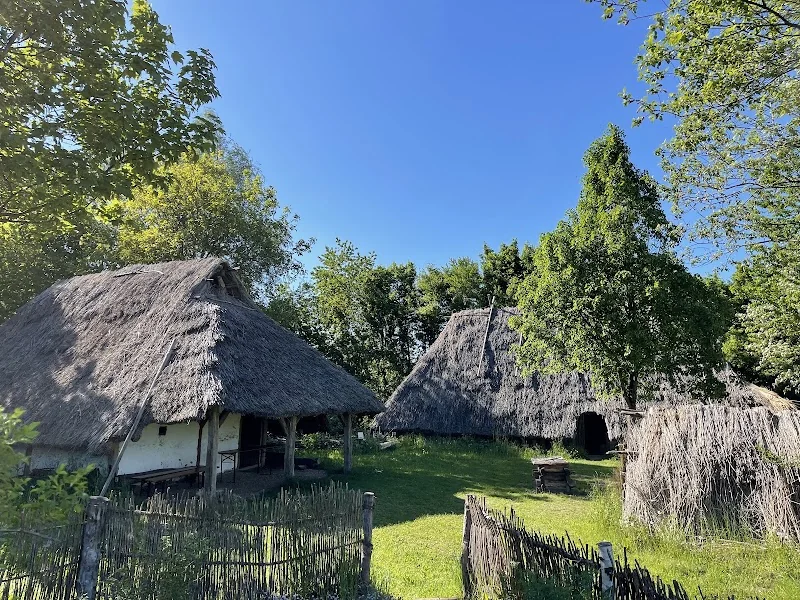
The site of the Bavarian Farm covers about 1,700 square meters and is designed so that an early medieval homestead from the 6th to 8th centuries can be traced in its spatial structure. So far, two large post-and-beam buildings with approximately 110 and 80 square meters of floor space have been constructed, as well as several smaller pit houses. The buildings are not decorative backdrops but reconstructions based on archaeologically proven or plausibly reconstructed techniques. Only tools and materials that are documented or at least likely for the early Middle Ages have been and are being used. Wood, clay, and reeds dominate the image; traditional wooden joints were used, and metal nails were deliberately avoided. This craft consistency makes the place credible and particularly interesting for many visitors, as it becomes visible how strongly construction methods, material availability, and landscape are interconnected. ([bavarianfarm.de](https://www.bajuwarenhof.de/gelaende))
Inside the buildings, the early medieval living environment is not only suggested but made spatially tangible. The larger longhouse and the smaller side building could serve as residential and stable buildings as well as for storage, while the pit houses are interpreted as workshops or storage rooms. One pit house is designed as a weaving house because archaeological finds have repeatedly uncovered loom weights. Additionally, there are fire pits, furniture, and everyday objects that enhance the impression of daily life, work, and closeness to crafts. The museum's approach is also important: the Bavarian Farm does not aim to give the impression that the past looked exactly this way and not otherwise. Instead, it consciously shows different building and construction possibilities, such as rafter roofs or thatched roofs, split planks or wattle, rammed earth, wooden floors, or stone pavements. This openness to variations is not only scientifically correct but also pedagogically wise, as it invites visitors to ask questions and makes the reconstruction itself a subject of learning. ([bavarianfarm.de](https://www.bajuwarenhof.de/gelaende))
Directions, Location, and Parking
The location of the Bavarian Farm is convenient for day-trippers from Munich and the surrounding area, as the museum is accessible by both public transport and car. The official travel page names the Heimstetten train station as a central starting point. The S-Bahn line S2 takes you there, and you can reach the farm on foot after about 1 kilometer through the town center of Heimstetten. Alternatively, you can take bus 263 from Heimstetten station to Räterstraße and walk the rest of the way via Bajuwarenstraße. The municipality of Kirchheim adds to this information with additional travel options, such as taking the S2 to Heimstetten with a short bike path or via Feldkirchen station with a walking path. For visitors, this means: the Bavarian Farm is not a remote specialty destination but can be easily incorporated into a half-day or day trip. ([bavarianfarm.de](https://www.bajuwarenhof.de/anreise))
By car, the museum's website describes access via the A99: exit 15 Kirchheim b. Munich, then turn right, at the next roundabout turn right again into Heimstettener Moosweg and continue to Bajuwarenstraße, where you turn right again. From there, you can turn left onto the gravel parking lot below the Bavarian Farm. The municipality also mentions a route via the A94, exit Feldkirchen-West, B 471, and Seestraße towards Heimstettener See, before reaching a parking lot at the Bavarian Farm on the right. Both hints make it clear that the museum is closely connected to the surroundings of Heimstetten, the sports park, and the lake area. In practice, this means: those who pay attention to good signage will find the way without major detours. At the same time, it is worth planning some time for the surroundings, as the combination of museum, lake, and green spaces makes the location particularly attractive for families, school classes, and history enthusiasts. ([bavarianfarm.de](https://www.bajuwarenhof.de/anreise))
Opening Hours, Admission, and Tours
For planning a visit, the opening hours are one of the most important pieces of information. The Bavarian Farm is open from late April to late September every Sunday from 11 am to 5 pm. Outside of this season, group tours and educational tours can be booked by arrangement. The website also points out that in winter, some facilities are not accessible and there are no heated rooms available. This is important for expectations: the farm is an open-air museum, thus a place in the open air that works precisely because of its openness. Those planning a visit should therefore bring weather-appropriate clothing and sufficient time. At the same time, the clear Sunday structure is an advantage because it makes the museum visit reliably planable and can be easily combined with a weekend trip. ([bavarianfarm.de](https://www.bajuwarenhof.de/oeffnungszeiten-preise))
Admission is free during regular opening hours on Sundays, making the Bavarian Farm particularly family-friendly. There are separate prices for groups: a regular tour lasts about 45 to 60 minutes, a large tour about 2 hours, and an educational program about 3 hours, each partly with material costs. Especially for students, there is the opportunity to touch and try out museum pieces, significantly increasing the learning value. This combination of free Sunday access and bookable in-depth offerings is a strong unique selling point. It makes the farm interesting for both spontaneous visits and organized educational trips. So, if you are looking for free admission, tours, group offers, or school programs, you will find an uncomplicated and academically demanding offer at the Bavarian Farm. ([bavarianfarm.de](https://www.bajuwarenhof.de/oeffnungszeiten-preise))
Gardens, Ecology, and Hands-On Experience
A significant part of the experience at the Bavarian Farm is the gardens and the experimental field. Different areas are cultivated on the site to vividly demonstrate the use of plants in the early Middle Ages. In the experimental field, old grain varieties such as barley, spelt, emmer, einkorn, oats, and rye grow; additionally, legumes such as beans, peas, and lentils are included. In a herb and vegetable garden, the selection of plants is based on botanically documented crops from southern Bavaria and on plants known from ancient and early medieval writings. This creates a vivid picture of how closely nutrition, food storage, and seasonal work were interconnected. Visitors thus not only recognize which plants were cultivated but also how much knowledge and effort were behind an early medieval farm economy. ([bavarianfarm.de](https://www.bajuwarenhof.de/oekologie))
Particularly interesting is the dye garden. There, plants that are not used for nutrition but for the production of linen fabrics, colors, and lyes are grown. These include flax, dye plants such as madder and woad, as well as soapwort. At the same time, the farm shows that a historical museum can also be ecologically effective. The thatched roofs provide nesting opportunities for wild bees, the meadows and gardens provide food for insects, and the wildflower meadow, which is mowed only two to three times a year, promotes biodiversity. Bumblebees use the clay-plastered walls, butterflies benefit from the diversity of flowers, and thus the Bavarian Farm itself becomes a small habitat. This connection between archaeology and nature conservation is not just an added benefit but fits perfectly with the museum's approach: those who want to understand the early Middle Ages must also consider the landscape and its use at that time. ([bavarianfarm.de](https://www.bajuwarenhof.de/oekologie))
Events, Action Days, and Visiting Tips
The Bavarian Farm thrives not only on its building substance but also on events, demonstrations, and theme days. The official events page lists for 2026, among other things, lectures, workshops, live demonstrations, and educational formats, often in collaboration with the AschheiMuseum. The theme year 2026 is dedicated to textile crafts in the early Middle Ages, which fits very well with the profile of the house: clothing, dyeing, weaving, and fiber processing are among the most important areas of early medieval daily life. Such offerings significantly enhance the visit because they transform the museum from a mere showcase into a learning and experience space. So, if you are looking for programs, action days, workshops, or events, you will find regularly changing occasions for a return visit here. ([bavarianfarm.de](https://www.bajuwarenhof.de/veranstaltungen))
The connection between the museum and its surroundings is also worth a visit. The official travel page explicitly mentions the proximity to Heimstettener See with beer garden and swimming opportunities. This makes the Bavarian Farm a destination that can be very well combined with leisure and relaxation. A sensible visiting tip is therefore to plan Sunday not too tightly: first, view the site with the reconstructed houses, then explore the gardens and the experimental field, perhaps take a tour, and then enjoy the surroundings. For families, school groups, and culture-interested day-trippers, this is particularly pleasant because the farm offers both knowledge and quality of stay. If you are looking for an authentic open-air museum in Kirchheim near Munich that connects history, research, nature, and hands-on elements, the Bavarian Farm is a very fitting address. The combination of free admission, clear opening hours, booking options for groups, and changing events ensures that the place remains not only informative but also attractively recurring. ([bavarianfarm.de](https://www.bajuwarenhof.de/anreise))
Sources:
- Bavarian Farm Kirchheim - Home ([bavarianfarm.de](https://www.bajuwarenhof.de/startseite))
- Bavarian Farm Kirchheim - History ([bavarianfarm.de](https://www.bajuwarenhof.de/geschichte))
- Bavarian Farm Kirchheim - Site ([bavarianfarm.de](https://www.bajuwarenhof.de/gelaende))
- Bavarian Farm Kirchheim - Directions ([bavarianfarm.de](https://www.bajuwarenhof.de/anreise))
- Bavarian Farm Kirchheim - Opening Hours & Prices ([bavarianfarm.de](https://www.bajuwarenhof.de/oeffnungszeiten-preise))
- Bavarian Farm Kirchheim - Events ([bavarianfarm.de](https://www.bajuwarenhof.de/veranstaltungen))
- Municipality of Kirchheim b. Munich - Bavarian Farm Kirchheim ([kirchheim-heimstetten.de](https://www.kirchheim-heimstetten.de/leben-kirchheim/freizeitangebot/bajuwarenhof/))
Mehr anzeigenWeniger anzeigen
Bavarian Farm Kirchheim | Opening Hours & Directions
The Bavarian Farm Kirchheim is not a museum that merely explains history, but a place where one can experience it in its spatial, craft, and landscape dimensions. As an archaeological open-air museum in Kirchheim near Munich, it shows what an early medieval homestead might have looked like in the 6th to 8th century, and connects reconstruction, research, and visitor experience in a particularly vivid way. Since 2003, a project for living archaeology has been established here, based on finds and evidence from Kirchheim and the surrounding area. Upon entering the site, visitors not only see reconstructed buildings but also a place where questions about everyday life, nutrition, crafts, living forms, and landscape become immediately visible. This is precisely the strength of the Bavarian Farm: it translates scientific findings into an environment that is tangible, family-friendly, and suitable for a day trip. ([bavarianfarm.de](https://www.bajuwarenhof.de/startseite))
History of the Bavarian Farm and the Bavarians
The history of the project began in 2003, when a group of Munich archaeologists initiated the Bavarian Farm Kirchheim as a project for living archaeology of the early Middle Ages. The municipality of Kirchheim b. Munich and the Munich district office supported the project early on, providing land and practical assistance, thus enabling the establishment of a museum that from the beginning focused on collaboration between research, the community, and volunteers. A significant turning point was the year 2018, when the museum, initially operated as a civil law association, transitioned to municipal sponsorship. The support association has also played a central role from the start, as professionals and interested laypeople engage together in and around the museum. For visitors, this development is important because it explains why the Bavarian Farm appears both academically grounded and community-oriented: it is not merely an exhibition object but a collaboratively supported long-term project. ([bavarianfarm.de](https://www.bajuwarenhof.de/geschichte))
The content basis of the museum lies in the early settlement of the Munich region. The page on archaeology in Kirchheim explains that remnants of an early medieval settlement were discovered here as early as 1970 and excavated for the first time in southern Bavaria on a larger scale. Several adjacent farms with residential and economic buildings along a road provided important clues for reconstruction. Additionally, further finds from the Munich gravel plain and later excavations under the museum grounds revealed traces of settlement and graves from the Neolithic period to the Roman Empire. The name of the Bavarians has been documented in writing since the mid-6th century; the most important written source is the lex baiuariorum, a collection of laws dated to the period between the 6th and 8th centuries. This is crucial for historical classification: the Bavarian Farm does not show some fantasy world but relies on a combination of written sources, archaeology, and regional research. ([bavarianfarm.de](https://www.bajuwarenhof.de/die-geschichte-der-bajuwaren))
Site, Buildings, and Experimental Archaeology
The site of the Bavarian Farm covers about 1,700 square meters and is designed so that an early medieval homestead from the 6th to 8th centuries can be traced in its spatial structure. So far, two large post-and-beam buildings with approximately 110 and 80 square meters of floor space have been constructed, as well as several smaller pit houses. The buildings are not decorative backdrops but reconstructions based on archaeologically proven or plausibly reconstructed techniques. Only tools and materials that are documented or at least likely for the early Middle Ages have been and are being used. Wood, clay, and reeds dominate the image; traditional wooden joints were used, and metal nails were deliberately avoided. This craft consistency makes the place credible and particularly interesting for many visitors, as it becomes visible how strongly construction methods, material availability, and landscape are interconnected. ([bavarianfarm.de](https://www.bajuwarenhof.de/gelaende))
Inside the buildings, the early medieval living environment is not only suggested but made spatially tangible. The larger longhouse and the smaller side building could serve as residential and stable buildings as well as for storage, while the pit houses are interpreted as workshops or storage rooms. One pit house is designed as a weaving house because archaeological finds have repeatedly uncovered loom weights. Additionally, there are fire pits, furniture, and everyday objects that enhance the impression of daily life, work, and closeness to crafts. The museum's approach is also important: the Bavarian Farm does not aim to give the impression that the past looked exactly this way and not otherwise. Instead, it consciously shows different building and construction possibilities, such as rafter roofs or thatched roofs, split planks or wattle, rammed earth, wooden floors, or stone pavements. This openness to variations is not only scientifically correct but also pedagogically wise, as it invites visitors to ask questions and makes the reconstruction itself a subject of learning. ([bavarianfarm.de](https://www.bajuwarenhof.de/gelaende))
Directions, Location, and Parking
The location of the Bavarian Farm is convenient for day-trippers from Munich and the surrounding area, as the museum is accessible by both public transport and car. The official travel page names the Heimstetten train station as a central starting point. The S-Bahn line S2 takes you there, and you can reach the farm on foot after about 1 kilometer through the town center of Heimstetten. Alternatively, you can take bus 263 from Heimstetten station to Räterstraße and walk the rest of the way via Bajuwarenstraße. The municipality of Kirchheim adds to this information with additional travel options, such as taking the S2 to Heimstetten with a short bike path or via Feldkirchen station with a walking path. For visitors, this means: the Bavarian Farm is not a remote specialty destination but can be easily incorporated into a half-day or day trip. ([bavarianfarm.de](https://www.bajuwarenhof.de/anreise))
By car, the museum's website describes access via the A99: exit 15 Kirchheim b. Munich, then turn right, at the next roundabout turn right again into Heimstettener Moosweg and continue to Bajuwarenstraße, where you turn right again. From there, you can turn left onto the gravel parking lot below the Bavarian Farm. The municipality also mentions a route via the A94, exit Feldkirchen-West, B 471, and Seestraße towards Heimstettener See, before reaching a parking lot at the Bavarian Farm on the right. Both hints make it clear that the museum is closely connected to the surroundings of Heimstetten, the sports park, and the lake area. In practice, this means: those who pay attention to good signage will find the way without major detours. At the same time, it is worth planning some time for the surroundings, as the combination of museum, lake, and green spaces makes the location particularly attractive for families, school classes, and history enthusiasts. ([bavarianfarm.de](https://www.bajuwarenhof.de/anreise))
Opening Hours, Admission, and Tours
For planning a visit, the opening hours are one of the most important pieces of information. The Bavarian Farm is open from late April to late September every Sunday from 11 am to 5 pm. Outside of this season, group tours and educational tours can be booked by arrangement. The website also points out that in winter, some facilities are not accessible and there are no heated rooms available. This is important for expectations: the farm is an open-air museum, thus a place in the open air that works precisely because of its openness. Those planning a visit should therefore bring weather-appropriate clothing and sufficient time. At the same time, the clear Sunday structure is an advantage because it makes the museum visit reliably planable and can be easily combined with a weekend trip. ([bavarianfarm.de](https://www.bajuwarenhof.de/oeffnungszeiten-preise))
Admission is free during regular opening hours on Sundays, making the Bavarian Farm particularly family-friendly. There are separate prices for groups: a regular tour lasts about 45 to 60 minutes, a large tour about 2 hours, and an educational program about 3 hours, each partly with material costs. Especially for students, there is the opportunity to touch and try out museum pieces, significantly increasing the learning value. This combination of free Sunday access and bookable in-depth offerings is a strong unique selling point. It makes the farm interesting for both spontaneous visits and organized educational trips. So, if you are looking for free admission, tours, group offers, or school programs, you will find an uncomplicated and academically demanding offer at the Bavarian Farm. ([bavarianfarm.de](https://www.bajuwarenhof.de/oeffnungszeiten-preise))
Gardens, Ecology, and Hands-On Experience
A significant part of the experience at the Bavarian Farm is the gardens and the experimental field. Different areas are cultivated on the site to vividly demonstrate the use of plants in the early Middle Ages. In the experimental field, old grain varieties such as barley, spelt, emmer, einkorn, oats, and rye grow; additionally, legumes such as beans, peas, and lentils are included. In a herb and vegetable garden, the selection of plants is based on botanically documented crops from southern Bavaria and on plants known from ancient and early medieval writings. This creates a vivid picture of how closely nutrition, food storage, and seasonal work were interconnected. Visitors thus not only recognize which plants were cultivated but also how much knowledge and effort were behind an early medieval farm economy. ([bavarianfarm.de](https://www.bajuwarenhof.de/oekologie))
Particularly interesting is the dye garden. There, plants that are not used for nutrition but for the production of linen fabrics, colors, and lyes are grown. These include flax, dye plants such as madder and woad, as well as soapwort. At the same time, the farm shows that a historical museum can also be ecologically effective. The thatched roofs provide nesting opportunities for wild bees, the meadows and gardens provide food for insects, and the wildflower meadow, which is mowed only two to three times a year, promotes biodiversity. Bumblebees use the clay-plastered walls, butterflies benefit from the diversity of flowers, and thus the Bavarian Farm itself becomes a small habitat. This connection between archaeology and nature conservation is not just an added benefit but fits perfectly with the museum's approach: those who want to understand the early Middle Ages must also consider the landscape and its use at that time. ([bavarianfarm.de](https://www.bajuwarenhof.de/oekologie))
Events, Action Days, and Visiting Tips
The Bavarian Farm thrives not only on its building substance but also on events, demonstrations, and theme days. The official events page lists for 2026, among other things, lectures, workshops, live demonstrations, and educational formats, often in collaboration with the AschheiMuseum. The theme year 2026 is dedicated to textile crafts in the early Middle Ages, which fits very well with the profile of the house: clothing, dyeing, weaving, and fiber processing are among the most important areas of early medieval daily life. Such offerings significantly enhance the visit because they transform the museum from a mere showcase into a learning and experience space. So, if you are looking for programs, action days, workshops, or events, you will find regularly changing occasions for a return visit here. ([bavarianfarm.de](https://www.bajuwarenhof.de/veranstaltungen))
The connection between the museum and its surroundings is also worth a visit. The official travel page explicitly mentions the proximity to Heimstettener See with beer garden and swimming opportunities. This makes the Bavarian Farm a destination that can be very well combined with leisure and relaxation. A sensible visiting tip is therefore to plan Sunday not too tightly: first, view the site with the reconstructed houses, then explore the gardens and the experimental field, perhaps take a tour, and then enjoy the surroundings. For families, school groups, and culture-interested day-trippers, this is particularly pleasant because the farm offers both knowledge and quality of stay. If you are looking for an authentic open-air museum in Kirchheim near Munich that connects history, research, nature, and hands-on elements, the Bavarian Farm is a very fitting address. The combination of free admission, clear opening hours, booking options for groups, and changing events ensures that the place remains not only informative but also attractively recurring. ([bavarianfarm.de](https://www.bajuwarenhof.de/anreise))
Sources:
- Bavarian Farm Kirchheim - Home ([bavarianfarm.de](https://www.bajuwarenhof.de/startseite))
- Bavarian Farm Kirchheim - History ([bavarianfarm.de](https://www.bajuwarenhof.de/geschichte))
- Bavarian Farm Kirchheim - Site ([bavarianfarm.de](https://www.bajuwarenhof.de/gelaende))
- Bavarian Farm Kirchheim - Directions ([bavarianfarm.de](https://www.bajuwarenhof.de/anreise))
- Bavarian Farm Kirchheim - Opening Hours & Prices ([bavarianfarm.de](https://www.bajuwarenhof.de/oeffnungszeiten-preise))
- Bavarian Farm Kirchheim - Events ([bavarianfarm.de](https://www.bajuwarenhof.de/veranstaltungen))
- Municipality of Kirchheim b. Munich - Bavarian Farm Kirchheim ([kirchheim-heimstetten.de](https://www.kirchheim-heimstetten.de/leben-kirchheim/freizeitangebot/bajuwarenhof/))
Bavarian Farm Kirchheim | Opening Hours & Directions
The Bavarian Farm Kirchheim is not a museum that merely explains history, but a place where one can experience it in its spatial, craft, and landscape dimensions. As an archaeological open-air museum in Kirchheim near Munich, it shows what an early medieval homestead might have looked like in the 6th to 8th century, and connects reconstruction, research, and visitor experience in a particularly vivid way. Since 2003, a project for living archaeology has been established here, based on finds and evidence from Kirchheim and the surrounding area. Upon entering the site, visitors not only see reconstructed buildings but also a place where questions about everyday life, nutrition, crafts, living forms, and landscape become immediately visible. This is precisely the strength of the Bavarian Farm: it translates scientific findings into an environment that is tangible, family-friendly, and suitable for a day trip. ([bavarianfarm.de](https://www.bajuwarenhof.de/startseite))
History of the Bavarian Farm and the Bavarians
The history of the project began in 2003, when a group of Munich archaeologists initiated the Bavarian Farm Kirchheim as a project for living archaeology of the early Middle Ages. The municipality of Kirchheim b. Munich and the Munich district office supported the project early on, providing land and practical assistance, thus enabling the establishment of a museum that from the beginning focused on collaboration between research, the community, and volunteers. A significant turning point was the year 2018, when the museum, initially operated as a civil law association, transitioned to municipal sponsorship. The support association has also played a central role from the start, as professionals and interested laypeople engage together in and around the museum. For visitors, this development is important because it explains why the Bavarian Farm appears both academically grounded and community-oriented: it is not merely an exhibition object but a collaboratively supported long-term project. ([bavarianfarm.de](https://www.bajuwarenhof.de/geschichte))
The content basis of the museum lies in the early settlement of the Munich region. The page on archaeology in Kirchheim explains that remnants of an early medieval settlement were discovered here as early as 1970 and excavated for the first time in southern Bavaria on a larger scale. Several adjacent farms with residential and economic buildings along a road provided important clues for reconstruction. Additionally, further finds from the Munich gravel plain and later excavations under the museum grounds revealed traces of settlement and graves from the Neolithic period to the Roman Empire. The name of the Bavarians has been documented in writing since the mid-6th century; the most important written source is the lex baiuariorum, a collection of laws dated to the period between the 6th and 8th centuries. This is crucial for historical classification: the Bavarian Farm does not show some fantasy world but relies on a combination of written sources, archaeology, and regional research. ([bavarianfarm.de](https://www.bajuwarenhof.de/die-geschichte-der-bajuwaren))
Site, Buildings, and Experimental Archaeology
The site of the Bavarian Farm covers about 1,700 square meters and is designed so that an early medieval homestead from the 6th to 8th centuries can be traced in its spatial structure. So far, two large post-and-beam buildings with approximately 110 and 80 square meters of floor space have been constructed, as well as several smaller pit houses. The buildings are not decorative backdrops but reconstructions based on archaeologically proven or plausibly reconstructed techniques. Only tools and materials that are documented or at least likely for the early Middle Ages have been and are being used. Wood, clay, and reeds dominate the image; traditional wooden joints were used, and metal nails were deliberately avoided. This craft consistency makes the place credible and particularly interesting for many visitors, as it becomes visible how strongly construction methods, material availability, and landscape are interconnected. ([bavarianfarm.de](https://www.bajuwarenhof.de/gelaende))
Inside the buildings, the early medieval living environment is not only suggested but made spatially tangible. The larger longhouse and the smaller side building could serve as residential and stable buildings as well as for storage, while the pit houses are interpreted as workshops or storage rooms. One pit house is designed as a weaving house because archaeological finds have repeatedly uncovered loom weights. Additionally, there are fire pits, furniture, and everyday objects that enhance the impression of daily life, work, and closeness to crafts. The museum's approach is also important: the Bavarian Farm does not aim to give the impression that the past looked exactly this way and not otherwise. Instead, it consciously shows different building and construction possibilities, such as rafter roofs or thatched roofs, split planks or wattle, rammed earth, wooden floors, or stone pavements. This openness to variations is not only scientifically correct but also pedagogically wise, as it invites visitors to ask questions and makes the reconstruction itself a subject of learning. ([bavarianfarm.de](https://www.bajuwarenhof.de/gelaende))
Directions, Location, and Parking
The location of the Bavarian Farm is convenient for day-trippers from Munich and the surrounding area, as the museum is accessible by both public transport and car. The official travel page names the Heimstetten train station as a central starting point. The S-Bahn line S2 takes you there, and you can reach the farm on foot after about 1 kilometer through the town center of Heimstetten. Alternatively, you can take bus 263 from Heimstetten station to Räterstraße and walk the rest of the way via Bajuwarenstraße. The municipality of Kirchheim adds to this information with additional travel options, such as taking the S2 to Heimstetten with a short bike path or via Feldkirchen station with a walking path. For visitors, this means: the Bavarian Farm is not a remote specialty destination but can be easily incorporated into a half-day or day trip. ([bavarianfarm.de](https://www.bajuwarenhof.de/anreise))
By car, the museum's website describes access via the A99: exit 15 Kirchheim b. Munich, then turn right, at the next roundabout turn right again into Heimstettener Moosweg and continue to Bajuwarenstraße, where you turn right again. From there, you can turn left onto the gravel parking lot below the Bavarian Farm. The municipality also mentions a route via the A94, exit Feldkirchen-West, B 471, and Seestraße towards Heimstettener See, before reaching a parking lot at the Bavarian Farm on the right. Both hints make it clear that the museum is closely connected to the surroundings of Heimstetten, the sports park, and the lake area. In practice, this means: those who pay attention to good signage will find the way without major detours. At the same time, it is worth planning some time for the surroundings, as the combination of museum, lake, and green spaces makes the location particularly attractive for families, school classes, and history enthusiasts. ([bavarianfarm.de](https://www.bajuwarenhof.de/anreise))
Opening Hours, Admission, and Tours
For planning a visit, the opening hours are one of the most important pieces of information. The Bavarian Farm is open from late April to late September every Sunday from 11 am to 5 pm. Outside of this season, group tours and educational tours can be booked by arrangement. The website also points out that in winter, some facilities are not accessible and there are no heated rooms available. This is important for expectations: the farm is an open-air museum, thus a place in the open air that works precisely because of its openness. Those planning a visit should therefore bring weather-appropriate clothing and sufficient time. At the same time, the clear Sunday structure is an advantage because it makes the museum visit reliably planable and can be easily combined with a weekend trip. ([bavarianfarm.de](https://www.bajuwarenhof.de/oeffnungszeiten-preise))
Admission is free during regular opening hours on Sundays, making the Bavarian Farm particularly family-friendly. There are separate prices for groups: a regular tour lasts about 45 to 60 minutes, a large tour about 2 hours, and an educational program about 3 hours, each partly with material costs. Especially for students, there is the opportunity to touch and try out museum pieces, significantly increasing the learning value. This combination of free Sunday access and bookable in-depth offerings is a strong unique selling point. It makes the farm interesting for both spontaneous visits and organized educational trips. So, if you are looking for free admission, tours, group offers, or school programs, you will find an uncomplicated and academically demanding offer at the Bavarian Farm. ([bavarianfarm.de](https://www.bajuwarenhof.de/oeffnungszeiten-preise))
Gardens, Ecology, and Hands-On Experience
A significant part of the experience at the Bavarian Farm is the gardens and the experimental field. Different areas are cultivated on the site to vividly demonstrate the use of plants in the early Middle Ages. In the experimental field, old grain varieties such as barley, spelt, emmer, einkorn, oats, and rye grow; additionally, legumes such as beans, peas, and lentils are included. In a herb and vegetable garden, the selection of plants is based on botanically documented crops from southern Bavaria and on plants known from ancient and early medieval writings. This creates a vivid picture of how closely nutrition, food storage, and seasonal work were interconnected. Visitors thus not only recognize which plants were cultivated but also how much knowledge and effort were behind an early medieval farm economy. ([bavarianfarm.de](https://www.bajuwarenhof.de/oekologie))
Particularly interesting is the dye garden. There, plants that are not used for nutrition but for the production of linen fabrics, colors, and lyes are grown. These include flax, dye plants such as madder and woad, as well as soapwort. At the same time, the farm shows that a historical museum can also be ecologically effective. The thatched roofs provide nesting opportunities for wild bees, the meadows and gardens provide food for insects, and the wildflower meadow, which is mowed only two to three times a year, promotes biodiversity. Bumblebees use the clay-plastered walls, butterflies benefit from the diversity of flowers, and thus the Bavarian Farm itself becomes a small habitat. This connection between archaeology and nature conservation is not just an added benefit but fits perfectly with the museum's approach: those who want to understand the early Middle Ages must also consider the landscape and its use at that time. ([bavarianfarm.de](https://www.bajuwarenhof.de/oekologie))
Events, Action Days, and Visiting Tips
The Bavarian Farm thrives not only on its building substance but also on events, demonstrations, and theme days. The official events page lists for 2026, among other things, lectures, workshops, live demonstrations, and educational formats, often in collaboration with the AschheiMuseum. The theme year 2026 is dedicated to textile crafts in the early Middle Ages, which fits very well with the profile of the house: clothing, dyeing, weaving, and fiber processing are among the most important areas of early medieval daily life. Such offerings significantly enhance the visit because they transform the museum from a mere showcase into a learning and experience space. So, if you are looking for programs, action days, workshops, or events, you will find regularly changing occasions for a return visit here. ([bavarianfarm.de](https://www.bajuwarenhof.de/veranstaltungen))
The connection between the museum and its surroundings is also worth a visit. The official travel page explicitly mentions the proximity to Heimstettener See with beer garden and swimming opportunities. This makes the Bavarian Farm a destination that can be very well combined with leisure and relaxation. A sensible visiting tip is therefore to plan Sunday not too tightly: first, view the site with the reconstructed houses, then explore the gardens and the experimental field, perhaps take a tour, and then enjoy the surroundings. For families, school groups, and culture-interested day-trippers, this is particularly pleasant because the farm offers both knowledge and quality of stay. If you are looking for an authentic open-air museum in Kirchheim near Munich that connects history, research, nature, and hands-on elements, the Bavarian Farm is a very fitting address. The combination of free admission, clear opening hours, booking options for groups, and changing events ensures that the place remains not only informative but also attractively recurring. ([bavarianfarm.de](https://www.bajuwarenhof.de/anreise))
Sources:
- Bavarian Farm Kirchheim - Home ([bavarianfarm.de](https://www.bajuwarenhof.de/startseite))
- Bavarian Farm Kirchheim - History ([bavarianfarm.de](https://www.bajuwarenhof.de/geschichte))
- Bavarian Farm Kirchheim - Site ([bavarianfarm.de](https://www.bajuwarenhof.de/gelaende))
- Bavarian Farm Kirchheim - Directions ([bavarianfarm.de](https://www.bajuwarenhof.de/anreise))
- Bavarian Farm Kirchheim - Opening Hours & Prices ([bavarianfarm.de](https://www.bajuwarenhof.de/oeffnungszeiten-preise))
- Bavarian Farm Kirchheim - Events ([bavarianfarm.de](https://www.bajuwarenhof.de/veranstaltungen))
- Municipality of Kirchheim b. Munich - Bavarian Farm Kirchheim ([kirchheim-heimstetten.de](https://www.kirchheim-heimstetten.de/leben-kirchheim/freizeitangebot/bajuwarenhof/))

Frequently Asked Questions
Reviews
No reviews found