München
Lothstraße 34, 80335 München, Deutschland
Munich University of Applied Sciences | Degree Programs & Applications 2026
The Munich University of Applied Sciences is one of the most diverse universities for applied sciences in Germany, combining a wide range of degree programs with application-oriented research, regional networking, and a clear focus on practical experience. According to official information, over 18,500 people study here in 14 scientific faculties as well as the study faculties MUC.DAI and MUC.HEALTH. For prospective students and current students, the central locations of Lothstraße and Pasing are particularly important, as they encompass large parts of university life, from administration and counseling to teaching, library, and services. HM works closely with partners from business, society, politics, and science and sees itself as entrepreneurial and future-oriented. ([hm.edu](https://hm.edu/hochschule_muenchen/portraet/index.de.html))
What degree programs shape the Munich University of Applied Sciences?
Those searching for the degree programs at the Munich University of Applied Sciences quickly encounter the great thematic breadth of HM. On the official homepage, the university lists around 100 degree programs in the fields of engineering, business, social sciences, and design. Additionally, there are faculties and study faculties from architecture to tourism, from mechanical engineering to computer science, and from applied social sciences to digital study offerings. This is not a random collection, but part of the profile: HM aims to always connect scientific foundations with concrete applications. That is why practical relevance, interdisciplinary formats, and collaborations with the region are so pronounced. Those starting a bachelor's program will find suitable offerings just like students who wish to transition to a master's program or further develop within the university. For the search terms around 'degree programs' and 'master's', this means: HM is not only large but also very differentiated in terms of subjects. ([hm.edu](https://hm.edu/?utm_source=openai))
This profile can be particularly well recognized in individual fields of study. For example, the Bachelor of Social Work is located at the Pasing campus, lasts seven semesters, includes 210 ECTS credits, and contains an integrated practical semester in the fifth semester. The Faculty of Architecture, on the other hand, works at the Campus Bauwende, where research, teaching, and practice are oriented towards sustainable and resource-saving building culture; there are both bachelor's and master's degree programs available. This combination of classical subject knowledge, practical components, and current societal relevance makes the Munich University of Applied Sciences attractive to many target groups. ([hm.edu](https://hm.edu/studiengange_de/studiengang_detail_33.de.html))
How does the application process work at the Munich University of Applied Sciences?
The application process at the Munich University of Applied Sciences is deliberately organized program-specifically. The university explicitly points out on its application page that deadlines are exclusion deadlines and that application documents must be complete and submitted on time. This is important because late or incomplete applications will not be considered. Depending on the degree program, the timeframes differ significantly. A good example is architecture: For the bachelor's and master's programs for the winter semester 2026/27, applications can be submitted from May 2 to June 15, 2026, supplemented by the aptitude test for the bachelor's program on July 14, 2026, and admission interviews for the master's program on July 23, 2026. Social Work also operates with its own application window: Here, applications can be submitted annually from May 2 to July 15. ([hm.edu](https://hm.edu/studium_1/bewerbung/termine_1/index.de.html))
For prospective students, the most important step is therefore not to look for a single generic application date, but to always check the relevant program page. On the official pages of HM, both general application deadlines and program-specific information can be found, for example, regarding aptitude tests, admission interviews, admission requirements, or later enrollment steps. Those who wish to receive advice within the university can find the study information as a central first point of contact at Lothstraße 34; there are telephone and personal consultation hours as well as the appropriate contact paths for bachelor's and master's applications. This transforms the often complicated search for 'Munich University of Applied Sciences application' into a clear, comprehensible process. ([hm.edu](https://hm.edu/studiengange_de/studiengang_detail_33.de.html))
What deadlines and dates apply in the summer semester 2026?
For many search queries regarding 'deadlines and dates', the official semester overview of HM is the most important source. The summer semester 2026 begins on Sunday, March 15, 2026, and ends on Wednesday, September 30, 2026. The lecture period runs from Monday, March 16, 2026, to Friday, July 10, 2026. In between, there are lecture-free periods during Easter from April 2 to April 7, 2026, and during Pentecost from May 22 to May 26, 2026; afterwards, the lecture-free phase begins from July 11, 2026, until the end of the semester. This overview is very helpful for planning semester projects, part-time jobs, family time, or travel, as it shows the complete rhythm of the semester at a glance. ([hm.edu](https://hm.edu/studium_1/im_studium/mein_studium/verlauf/termine.de.html))
Particularly important for university life is the examination phase. Registration for exams is possible from April 24 to May 8, 2026, and according to HM, is generally only provided online via the PRIMUSS portal. The examination period is from July 11 to July 27, 2026; in some degree programs, exams may already take place from July 6, 2026. The centrally planned AW exams are scheduled for July 4, 2026, with the announcement of grades and the review of graded examination results each set for July 31, 2026. Therefore, anyone searching for 'Munich University of Applied Sciences summer semester 2026' primarily needs these numbers, as they represent the most important milestones of the semester. ([hm.edu](https://hm.edu/studium_1/im_studium/mein_studium/verlauf/termine.de.html))
How do PRIMUSS and Moodle function in university life?
PRIMUSS is the operational backbone for many student administrative processes at the Munich University of Applied Sciences. The official semester overview explicitly states that exam registration is to be conducted online via the PRIMUSS portal. Other services such as certificates, grade confirmations, and other student documents are also linked to PRIMUSS; the university describes on its service pages that official certificates can be requested through PRIMUSS Online Services. For students, this means: PRIMUSS is not just a login, but a central place for organized processes in studies, especially when deadlines, exams, and documents come into play. ([hm.edu](https://hm.edu/studium_1/im_studium/mein_studium/verlauf/termine.de.html))
Moodle complements this administrative area through the learning platform. On the Moodle homepage, HM directly welcomes students to the learning platform and provides login assistance as well as a video explaining registration and course enrollment. This is important in university life because here teaching materials, course rooms, and digital learning content converge. Additionally, the HM app refers to functions such as emails, tasks, dates, the average grade through the PRIMUSS connection, and reminders for library loan deadlines. This shows that digital tools do not stand isolated next to each other but closely accompany university life. Therefore, those searching for 'Munich University of Applied Sciences Moodle' or 'Munich University of Applied Sciences PRIMUSS' are essentially looking for exactly these management tools of their studies. ([moodle.hm.edu](https://moodle.hm.edu/))
What does the library of the Munich University of Applied Sciences offer?
The library of the Munich University of Applied Sciences is much more than a classic lending location. It supports study, teaching, and research and sees itself as a central point of contact for literature and information procurement; at the same time, it is also open to external users as a public scientific library. The central library is located at Lothstraße 13d, in close proximity to the largest HM location. There are more than 100,000 print media units, around 2,585 current journal titles, a wide collection of textbooks, online databases, self-checkout systems, and an automatic return system. For daily use, learning space booking, Book-a-Librarian, and catalog search are also important services. ([bib.hm.edu](https://bib.hm.edu/diebibliothek/zentralbibliothek/index.de.html))
Even at the branch libraries, the supply is well organized. The Pasing branch library serves the faculties of business administration and applied social sciences and holds more than 100,000 print media units, about 200 current journal titles, as well as numerous eBooks, eJournals, and subject-specific databases. There is also free open access, self-checkout, PC workstations, Wi-Fi, and a book scanner. Particularly convenient are the return options: In all three libraries, books can be returned regardless of the lending location; in Pasing, a return system is available in the entrance area. This makes the library a true learning and service center for the entire university location. ([bib.hm.edu](https://bib.hm.edu/diebibliothek/teilbibliothekpasing/index.de.html))
How do Campus Lothstraße and Campus Pasing differ?
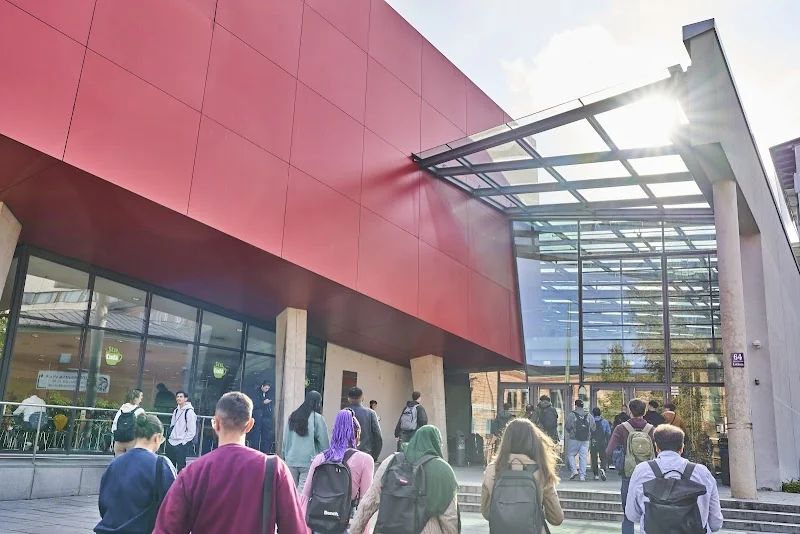
Campus Lothstraße is the heart of the Munich University of Applied Sciences. Officially, it is described as the largest location of HM; 12,502 people study there, and the central administration, nine faculties, the library, the CAREER Center, the E-Learning Center, and the continuing education center are located there. The location is also formative for everyday life, as many central routes converge there. The university simultaneously points out that there are only a few parking spaces available around HM and recommends arriving by public transport. From the main train station, tram lines 20, 21, and 29, as well as bus line 153, are relevant. Therefore, anyone looking for Campus Lothstraße should think more of a well-connected urban location than a parking area. ([hm.edu](https://hm.edu/hochschule_muenchen/kontakt/umfeld_standort/campus_lothstrasse/lothstrasse.de.html))
Campus Pasing appears significantly greener and quieter. The Faculty of Applied Social Sciences describes the area as spacious, with traditional and modern buildings, many facilities, a nature-friendly location near Pasinger Stadtpark, and good access to public transport. The address is Am Stadtpark 20 in 81243 Munich; the location can be reached by S-Bahn, tram 19, and several bus lines. Additionally, there is a cafeteria and StuCafé, and the university aims for the campus to become climate-neutral by 2028. Therefore, those searching for 'Munich University of Applied Sciences Pasing' will find not only a study environment but a distinct campus with a clear identity, historical buildings, and a noticeably sustainable orientation. ([sw.hm.edu](https://sw.hm.edu/fakultaet/campus_pasing/index.de.html))
What role do architecture, social work, and job offers play at HM?
The architecture at the Munich University of Applied Sciences is strongly shaped by the topic of building transformation. The faculty speaks of the Campus Bauwende and describes a connection between research, teaching, and practice for sustainable and resource-saving building culture. Students design spaces, reflect on concepts, and work on a development that aims to make cities future-proof. For the winter semester 2026/27, applications can be submitted from May 2 to June 15, 2026; in the bachelor's program, an aptitude test is added, and in the master's program, an admission interview. This shows that HM understands architecture not only as a creative field but as a demanding, socially relevant discipline. ([ar.hm.edu](https://ar.hm.edu/))
Social work is also strongly anchored in practical relevance at HM. The bachelor's program is located at the Pasing campus, runs over seven semesters, includes 210 ECTS credits, and integrates a 22-week practical semester in the fifth semester. The study contents range from methods and theories to professional ethics and social science foundations; at the same time, the program prepares students for various fields of activity such as youth welfare, school social work, family assistance, or addiction counseling. Those who wish to not only study but also work at HM can find all currently advertised positions on the personnel page, as well as offers for student assistants, tutorials, and teaching assignments, along with the appropriate contact paths for applications and inquiries. The search terms 'Munich University of Applied Sciences job offers' and 'Munich University of Applied Sciences social work' thus refer to two very concrete, official contact points of HM. ([hm.edu](https://hm.edu/studiengange_de/studiengang_detail_33.de.html))
Sources:
- Munich University of Applied Sciences - Homepage
- Munich University of Applied Sciences - Portrait
- Munich University of Applied Sciences - Deadlines and Dates
- Munich University of Applied Sciences - Application and Deadlines
- Munich University of Applied Sciences - Moodle Learning Platform
- Munich University of Applied Sciences - Library
- Munich University of Applied Sciences - Campus Lothstraße
- Munich University of Applied Sciences - Campus Pasing
- Munich University of Applied Sciences - Faculty of Architecture
- Munich University of Applied Sciences - Social Work B.A.
- Munich University of Applied Sciences - Personnel and Job Offers
Show moreShow less
Munich University of Applied Sciences | Degree Programs & Applications 2026
The Munich University of Applied Sciences is one of the most diverse universities for applied sciences in Germany, combining a wide range of degree programs with application-oriented research, regional networking, and a clear focus on practical experience. According to official information, over 18,500 people study here in 14 scientific faculties as well as the study faculties MUC.DAI and MUC.HEALTH. For prospective students and current students, the central locations of Lothstraße and Pasing are particularly important, as they encompass large parts of university life, from administration and counseling to teaching, library, and services. HM works closely with partners from business, society, politics, and science and sees itself as entrepreneurial and future-oriented. ([hm.edu](https://hm.edu/hochschule_muenchen/portraet/index.de.html))
What degree programs shape the Munich University of Applied Sciences?
Those searching for the degree programs at the Munich University of Applied Sciences quickly encounter the great thematic breadth of HM. On the official homepage, the university lists around 100 degree programs in the fields of engineering, business, social sciences, and design. Additionally, there are faculties and study faculties from architecture to tourism, from mechanical engineering to computer science, and from applied social sciences to digital study offerings. This is not a random collection, but part of the profile: HM aims to always connect scientific foundations with concrete applications. That is why practical relevance, interdisciplinary formats, and collaborations with the region are so pronounced. Those starting a bachelor's program will find suitable offerings just like students who wish to transition to a master's program or further develop within the university. For the search terms around 'degree programs' and 'master's', this means: HM is not only large but also very differentiated in terms of subjects. ([hm.edu](https://hm.edu/?utm_source=openai))
This profile can be particularly well recognized in individual fields of study. For example, the Bachelor of Social Work is located at the Pasing campus, lasts seven semesters, includes 210 ECTS credits, and contains an integrated practical semester in the fifth semester. The Faculty of Architecture, on the other hand, works at the Campus Bauwende, where research, teaching, and practice are oriented towards sustainable and resource-saving building culture; there are both bachelor's and master's degree programs available. This combination of classical subject knowledge, practical components, and current societal relevance makes the Munich University of Applied Sciences attractive to many target groups. ([hm.edu](https://hm.edu/studiengange_de/studiengang_detail_33.de.html))
How does the application process work at the Munich University of Applied Sciences?
The application process at the Munich University of Applied Sciences is deliberately organized program-specifically. The university explicitly points out on its application page that deadlines are exclusion deadlines and that application documents must be complete and submitted on time. This is important because late or incomplete applications will not be considered. Depending on the degree program, the timeframes differ significantly. A good example is architecture: For the bachelor's and master's programs for the winter semester 2026/27, applications can be submitted from May 2 to June 15, 2026, supplemented by the aptitude test for the bachelor's program on July 14, 2026, and admission interviews for the master's program on July 23, 2026. Social Work also operates with its own application window: Here, applications can be submitted annually from May 2 to July 15. ([hm.edu](https://hm.edu/studium_1/bewerbung/termine_1/index.de.html))
For prospective students, the most important step is therefore not to look for a single generic application date, but to always check the relevant program page. On the official pages of HM, both general application deadlines and program-specific information can be found, for example, regarding aptitude tests, admission interviews, admission requirements, or later enrollment steps. Those who wish to receive advice within the university can find the study information as a central first point of contact at Lothstraße 34; there are telephone and personal consultation hours as well as the appropriate contact paths for bachelor's and master's applications. This transforms the often complicated search for 'Munich University of Applied Sciences application' into a clear, comprehensible process. ([hm.edu](https://hm.edu/studiengange_de/studiengang_detail_33.de.html))
What deadlines and dates apply in the summer semester 2026?
For many search queries regarding 'deadlines and dates', the official semester overview of HM is the most important source. The summer semester 2026 begins on Sunday, March 15, 2026, and ends on Wednesday, September 30, 2026. The lecture period runs from Monday, March 16, 2026, to Friday, July 10, 2026. In between, there are lecture-free periods during Easter from April 2 to April 7, 2026, and during Pentecost from May 22 to May 26, 2026; afterwards, the lecture-free phase begins from July 11, 2026, until the end of the semester. This overview is very helpful for planning semester projects, part-time jobs, family time, or travel, as it shows the complete rhythm of the semester at a glance. ([hm.edu](https://hm.edu/studium_1/im_studium/mein_studium/verlauf/termine.de.html))
Particularly important for university life is the examination phase. Registration for exams is possible from April 24 to May 8, 2026, and according to HM, is generally only provided online via the PRIMUSS portal. The examination period is from July 11 to July 27, 2026; in some degree programs, exams may already take place from July 6, 2026. The centrally planned AW exams are scheduled for July 4, 2026, with the announcement of grades and the review of graded examination results each set for July 31, 2026. Therefore, anyone searching for 'Munich University of Applied Sciences summer semester 2026' primarily needs these numbers, as they represent the most important milestones of the semester. ([hm.edu](https://hm.edu/studium_1/im_studium/mein_studium/verlauf/termine.de.html))
How do PRIMUSS and Moodle function in university life?
PRIMUSS is the operational backbone for many student administrative processes at the Munich University of Applied Sciences. The official semester overview explicitly states that exam registration is to be conducted online via the PRIMUSS portal. Other services such as certificates, grade confirmations, and other student documents are also linked to PRIMUSS; the university describes on its service pages that official certificates can be requested through PRIMUSS Online Services. For students, this means: PRIMUSS is not just a login, but a central place for organized processes in studies, especially when deadlines, exams, and documents come into play. ([hm.edu](https://hm.edu/studium_1/im_studium/mein_studium/verlauf/termine.de.html))
Moodle complements this administrative area through the learning platform. On the Moodle homepage, HM directly welcomes students to the learning platform and provides login assistance as well as a video explaining registration and course enrollment. This is important in university life because here teaching materials, course rooms, and digital learning content converge. Additionally, the HM app refers to functions such as emails, tasks, dates, the average grade through the PRIMUSS connection, and reminders for library loan deadlines. This shows that digital tools do not stand isolated next to each other but closely accompany university life. Therefore, those searching for 'Munich University of Applied Sciences Moodle' or 'Munich University of Applied Sciences PRIMUSS' are essentially looking for exactly these management tools of their studies. ([moodle.hm.edu](https://moodle.hm.edu/))
What does the library of the Munich University of Applied Sciences offer?
The library of the Munich University of Applied Sciences is much more than a classic lending location. It supports study, teaching, and research and sees itself as a central point of contact for literature and information procurement; at the same time, it is also open to external users as a public scientific library. The central library is located at Lothstraße 13d, in close proximity to the largest HM location. There are more than 100,000 print media units, around 2,585 current journal titles, a wide collection of textbooks, online databases, self-checkout systems, and an automatic return system. For daily use, learning space booking, Book-a-Librarian, and catalog search are also important services. ([bib.hm.edu](https://bib.hm.edu/diebibliothek/zentralbibliothek/index.de.html))
Even at the branch libraries, the supply is well organized. The Pasing branch library serves the faculties of business administration and applied social sciences and holds more than 100,000 print media units, about 200 current journal titles, as well as numerous eBooks, eJournals, and subject-specific databases. There is also free open access, self-checkout, PC workstations, Wi-Fi, and a book scanner. Particularly convenient are the return options: In all three libraries, books can be returned regardless of the lending location; in Pasing, a return system is available in the entrance area. This makes the library a true learning and service center for the entire university location. ([bib.hm.edu](https://bib.hm.edu/diebibliothek/teilbibliothekpasing/index.de.html))
How do Campus Lothstraße and Campus Pasing differ?
Campus Lothstraße is the heart of the Munich University of Applied Sciences. Officially, it is described as the largest location of HM; 12,502 people study there, and the central administration, nine faculties, the library, the CAREER Center, the E-Learning Center, and the continuing education center are located there. The location is also formative for everyday life, as many central routes converge there. The university simultaneously points out that there are only a few parking spaces available around HM and recommends arriving by public transport. From the main train station, tram lines 20, 21, and 29, as well as bus line 153, are relevant. Therefore, anyone looking for Campus Lothstraße should think more of a well-connected urban location than a parking area. ([hm.edu](https://hm.edu/hochschule_muenchen/kontakt/umfeld_standort/campus_lothstrasse/lothstrasse.de.html))
Campus Pasing appears significantly greener and quieter. The Faculty of Applied Social Sciences describes the area as spacious, with traditional and modern buildings, many facilities, a nature-friendly location near Pasinger Stadtpark, and good access to public transport. The address is Am Stadtpark 20 in 81243 Munich; the location can be reached by S-Bahn, tram 19, and several bus lines. Additionally, there is a cafeteria and StuCafé, and the university aims for the campus to become climate-neutral by 2028. Therefore, those searching for 'Munich University of Applied Sciences Pasing' will find not only a study environment but a distinct campus with a clear identity, historical buildings, and a noticeably sustainable orientation. ([sw.hm.edu](https://sw.hm.edu/fakultaet/campus_pasing/index.de.html))
What role do architecture, social work, and job offers play at HM?
The architecture at the Munich University of Applied Sciences is strongly shaped by the topic of building transformation. The faculty speaks of the Campus Bauwende and describes a connection between research, teaching, and practice for sustainable and resource-saving building culture. Students design spaces, reflect on concepts, and work on a development that aims to make cities future-proof. For the winter semester 2026/27, applications can be submitted from May 2 to June 15, 2026; in the bachelor's program, an aptitude test is added, and in the master's program, an admission interview. This shows that HM understands architecture not only as a creative field but as a demanding, socially relevant discipline. ([ar.hm.edu](https://ar.hm.edu/))
Social work is also strongly anchored in practical relevance at HM. The bachelor's program is located at the Pasing campus, runs over seven semesters, includes 210 ECTS credits, and integrates a 22-week practical semester in the fifth semester. The study contents range from methods and theories to professional ethics and social science foundations; at the same time, the program prepares students for various fields of activity such as youth welfare, school social work, family assistance, or addiction counseling. Those who wish to not only study but also work at HM can find all currently advertised positions on the personnel page, as well as offers for student assistants, tutorials, and teaching assignments, along with the appropriate contact paths for applications and inquiries. The search terms 'Munich University of Applied Sciences job offers' and 'Munich University of Applied Sciences social work' thus refer to two very concrete, official contact points of HM. ([hm.edu](https://hm.edu/studiengange_de/studiengang_detail_33.de.html))
Sources:
- Munich University of Applied Sciences - Homepage
- Munich University of Applied Sciences - Portrait
- Munich University of Applied Sciences - Deadlines and Dates
- Munich University of Applied Sciences - Application and Deadlines
- Munich University of Applied Sciences - Moodle Learning Platform
- Munich University of Applied Sciences - Library
- Munich University of Applied Sciences - Campus Lothstraße
- Munich University of Applied Sciences - Campus Pasing
- Munich University of Applied Sciences - Faculty of Architecture
- Munich University of Applied Sciences - Social Work B.A.
- Munich University of Applied Sciences - Personnel and Job Offers
Munich University of Applied Sciences | Degree Programs & Applications 2026
The Munich University of Applied Sciences is one of the most diverse universities for applied sciences in Germany, combining a wide range of degree programs with application-oriented research, regional networking, and a clear focus on practical experience. According to official information, over 18,500 people study here in 14 scientific faculties as well as the study faculties MUC.DAI and MUC.HEALTH. For prospective students and current students, the central locations of Lothstraße and Pasing are particularly important, as they encompass large parts of university life, from administration and counseling to teaching, library, and services. HM works closely with partners from business, society, politics, and science and sees itself as entrepreneurial and future-oriented. ([hm.edu](https://hm.edu/hochschule_muenchen/portraet/index.de.html))
What degree programs shape the Munich University of Applied Sciences?
Those searching for the degree programs at the Munich University of Applied Sciences quickly encounter the great thematic breadth of HM. On the official homepage, the university lists around 100 degree programs in the fields of engineering, business, social sciences, and design. Additionally, there are faculties and study faculties from architecture to tourism, from mechanical engineering to computer science, and from applied social sciences to digital study offerings. This is not a random collection, but part of the profile: HM aims to always connect scientific foundations with concrete applications. That is why practical relevance, interdisciplinary formats, and collaborations with the region are so pronounced. Those starting a bachelor's program will find suitable offerings just like students who wish to transition to a master's program or further develop within the university. For the search terms around 'degree programs' and 'master's', this means: HM is not only large but also very differentiated in terms of subjects. ([hm.edu](https://hm.edu/?utm_source=openai))
This profile can be particularly well recognized in individual fields of study. For example, the Bachelor of Social Work is located at the Pasing campus, lasts seven semesters, includes 210 ECTS credits, and contains an integrated practical semester in the fifth semester. The Faculty of Architecture, on the other hand, works at the Campus Bauwende, where research, teaching, and practice are oriented towards sustainable and resource-saving building culture; there are both bachelor's and master's degree programs available. This combination of classical subject knowledge, practical components, and current societal relevance makes the Munich University of Applied Sciences attractive to many target groups. ([hm.edu](https://hm.edu/studiengange_de/studiengang_detail_33.de.html))
How does the application process work at the Munich University of Applied Sciences?
The application process at the Munich University of Applied Sciences is deliberately organized program-specifically. The university explicitly points out on its application page that deadlines are exclusion deadlines and that application documents must be complete and submitted on time. This is important because late or incomplete applications will not be considered. Depending on the degree program, the timeframes differ significantly. A good example is architecture: For the bachelor's and master's programs for the winter semester 2026/27, applications can be submitted from May 2 to June 15, 2026, supplemented by the aptitude test for the bachelor's program on July 14, 2026, and admission interviews for the master's program on July 23, 2026. Social Work also operates with its own application window: Here, applications can be submitted annually from May 2 to July 15. ([hm.edu](https://hm.edu/studium_1/bewerbung/termine_1/index.de.html))
For prospective students, the most important step is therefore not to look for a single generic application date, but to always check the relevant program page. On the official pages of HM, both general application deadlines and program-specific information can be found, for example, regarding aptitude tests, admission interviews, admission requirements, or later enrollment steps. Those who wish to receive advice within the university can find the study information as a central first point of contact at Lothstraße 34; there are telephone and personal consultation hours as well as the appropriate contact paths for bachelor's and master's applications. This transforms the often complicated search for 'Munich University of Applied Sciences application' into a clear, comprehensible process. ([hm.edu](https://hm.edu/studiengange_de/studiengang_detail_33.de.html))
What deadlines and dates apply in the summer semester 2026?
For many search queries regarding 'deadlines and dates', the official semester overview of HM is the most important source. The summer semester 2026 begins on Sunday, March 15, 2026, and ends on Wednesday, September 30, 2026. The lecture period runs from Monday, March 16, 2026, to Friday, July 10, 2026. In between, there are lecture-free periods during Easter from April 2 to April 7, 2026, and during Pentecost from May 22 to May 26, 2026; afterwards, the lecture-free phase begins from July 11, 2026, until the end of the semester. This overview is very helpful for planning semester projects, part-time jobs, family time, or travel, as it shows the complete rhythm of the semester at a glance. ([hm.edu](https://hm.edu/studium_1/im_studium/mein_studium/verlauf/termine.de.html))
Particularly important for university life is the examination phase. Registration for exams is possible from April 24 to May 8, 2026, and according to HM, is generally only provided online via the PRIMUSS portal. The examination period is from July 11 to July 27, 2026; in some degree programs, exams may already take place from July 6, 2026. The centrally planned AW exams are scheduled for July 4, 2026, with the announcement of grades and the review of graded examination results each set for July 31, 2026. Therefore, anyone searching for 'Munich University of Applied Sciences summer semester 2026' primarily needs these numbers, as they represent the most important milestones of the semester. ([hm.edu](https://hm.edu/studium_1/im_studium/mein_studium/verlauf/termine.de.html))
How do PRIMUSS and Moodle function in university life?
PRIMUSS is the operational backbone for many student administrative processes at the Munich University of Applied Sciences. The official semester overview explicitly states that exam registration is to be conducted online via the PRIMUSS portal. Other services such as certificates, grade confirmations, and other student documents are also linked to PRIMUSS; the university describes on its service pages that official certificates can be requested through PRIMUSS Online Services. For students, this means: PRIMUSS is not just a login, but a central place for organized processes in studies, especially when deadlines, exams, and documents come into play. ([hm.edu](https://hm.edu/studium_1/im_studium/mein_studium/verlauf/termine.de.html))
Moodle complements this administrative area through the learning platform. On the Moodle homepage, HM directly welcomes students to the learning platform and provides login assistance as well as a video explaining registration and course enrollment. This is important in university life because here teaching materials, course rooms, and digital learning content converge. Additionally, the HM app refers to functions such as emails, tasks, dates, the average grade through the PRIMUSS connection, and reminders for library loan deadlines. This shows that digital tools do not stand isolated next to each other but closely accompany university life. Therefore, those searching for 'Munich University of Applied Sciences Moodle' or 'Munich University of Applied Sciences PRIMUSS' are essentially looking for exactly these management tools of their studies. ([moodle.hm.edu](https://moodle.hm.edu/))
What does the library of the Munich University of Applied Sciences offer?
The library of the Munich University of Applied Sciences is much more than a classic lending location. It supports study, teaching, and research and sees itself as a central point of contact for literature and information procurement; at the same time, it is also open to external users as a public scientific library. The central library is located at Lothstraße 13d, in close proximity to the largest HM location. There are more than 100,000 print media units, around 2,585 current journal titles, a wide collection of textbooks, online databases, self-checkout systems, and an automatic return system. For daily use, learning space booking, Book-a-Librarian, and catalog search are also important services. ([bib.hm.edu](https://bib.hm.edu/diebibliothek/zentralbibliothek/index.de.html))
Even at the branch libraries, the supply is well organized. The Pasing branch library serves the faculties of business administration and applied social sciences and holds more than 100,000 print media units, about 200 current journal titles, as well as numerous eBooks, eJournals, and subject-specific databases. There is also free open access, self-checkout, PC workstations, Wi-Fi, and a book scanner. Particularly convenient are the return options: In all three libraries, books can be returned regardless of the lending location; in Pasing, a return system is available in the entrance area. This makes the library a true learning and service center for the entire university location. ([bib.hm.edu](https://bib.hm.edu/diebibliothek/teilbibliothekpasing/index.de.html))
How do Campus Lothstraße and Campus Pasing differ?
Campus Lothstraße is the heart of the Munich University of Applied Sciences. Officially, it is described as the largest location of HM; 12,502 people study there, and the central administration, nine faculties, the library, the CAREER Center, the E-Learning Center, and the continuing education center are located there. The location is also formative for everyday life, as many central routes converge there. The university simultaneously points out that there are only a few parking spaces available around HM and recommends arriving by public transport. From the main train station, tram lines 20, 21, and 29, as well as bus line 153, are relevant. Therefore, anyone looking for Campus Lothstraße should think more of a well-connected urban location than a parking area. ([hm.edu](https://hm.edu/hochschule_muenchen/kontakt/umfeld_standort/campus_lothstrasse/lothstrasse.de.html))
Campus Pasing appears significantly greener and quieter. The Faculty of Applied Social Sciences describes the area as spacious, with traditional and modern buildings, many facilities, a nature-friendly location near Pasinger Stadtpark, and good access to public transport. The address is Am Stadtpark 20 in 81243 Munich; the location can be reached by S-Bahn, tram 19, and several bus lines. Additionally, there is a cafeteria and StuCafé, and the university aims for the campus to become climate-neutral by 2028. Therefore, those searching for 'Munich University of Applied Sciences Pasing' will find not only a study environment but a distinct campus with a clear identity, historical buildings, and a noticeably sustainable orientation. ([sw.hm.edu](https://sw.hm.edu/fakultaet/campus_pasing/index.de.html))
What role do architecture, social work, and job offers play at HM?
The architecture at the Munich University of Applied Sciences is strongly shaped by the topic of building transformation. The faculty speaks of the Campus Bauwende and describes a connection between research, teaching, and practice for sustainable and resource-saving building culture. Students design spaces, reflect on concepts, and work on a development that aims to make cities future-proof. For the winter semester 2026/27, applications can be submitted from May 2 to June 15, 2026; in the bachelor's program, an aptitude test is added, and in the master's program, an admission interview. This shows that HM understands architecture not only as a creative field but as a demanding, socially relevant discipline. ([ar.hm.edu](https://ar.hm.edu/))
Social work is also strongly anchored in practical relevance at HM. The bachelor's program is located at the Pasing campus, runs over seven semesters, includes 210 ECTS credits, and integrates a 22-week practical semester in the fifth semester. The study contents range from methods and theories to professional ethics and social science foundations; at the same time, the program prepares students for various fields of activity such as youth welfare, school social work, family assistance, or addiction counseling. Those who wish to not only study but also work at HM can find all currently advertised positions on the personnel page, as well as offers for student assistants, tutorials, and teaching assignments, along with the appropriate contact paths for applications and inquiries. The search terms 'Munich University of Applied Sciences job offers' and 'Munich University of Applied Sciences social work' thus refer to two very concrete, official contact points of HM. ([hm.edu](https://hm.edu/studiengange_de/studiengang_detail_33.de.html))
Sources:
- Munich University of Applied Sciences - Homepage
- Munich University of Applied Sciences - Portrait
- Munich University of Applied Sciences - Deadlines and Dates
- Munich University of Applied Sciences - Application and Deadlines
- Munich University of Applied Sciences - Moodle Learning Platform
- Munich University of Applied Sciences - Library
- Munich University of Applied Sciences - Campus Lothstraße
- Munich University of Applied Sciences - Campus Pasing
- Munich University of Applied Sciences - Faculty of Architecture
- Munich University of Applied Sciences - Social Work B.A.
- Munich University of Applied Sciences - Personnel and Job Offers
Upcoming Events
No events found
Frequently Asked Questions
Reviews
Haris Aslanidis
13. August 2019
Passed by with my company from this quiet neighborhood and enjoyed the buildings, churches, and the parks near the science university.
Jacob Danielson
2. August 2017
Came for a summer engineering program. The campus was great and the buildings were really nice. Wonderful place to learn.
Peter Fröhlich
13. July 2016
Got my CS degree here and now, 20 years later, I get to teach a summer course. What's not to like? :-)
Peace Meditation
26. February 2024
The high class engineering brings the best between practical science and theoretical knowledge!
CHINNARI BINESH
28. October 2021
One of the best places I found in Germany for studies and yeah the atmosphere over here is really great no words for it........