
Tal 50, München-Altstadt-Lehel
Tal 50, 80331 München, Germany
Isar Gate | Isartor, Photos & History
Isar Gate refers to the Isartor at Tal 50 in Munich, a place that densely connects old town, city history, museum character, and urban orientation. When arriving here, one does not stand before a mere sight, but at one of the most distinctive transitions of the city: between the Tal as a historical axis towards Marienplatz, the Isartorplatz as a traffic hub, and the eastern gate to Munich's old town. The Isartor is today a monument with daily life surrounding it, a photographic motif with cultural significance, and a meeting point where historical architecture meets contemporary urban movement. Particularly striking are the towers with their museum usage, the mirrored or reverse-running clock, and the immediate proximity to paths that lead directly into the city center. This makes the place interesting for visitors who want to read the urban space rather than just consume Munich. At the same time, the location is practical: S-Bahn, tram, and bus stop at Isartor, and several parking garages are nearby. Currently, the Valentin-Karlstadt Museum is closed due to fire protection renovations; the reopening is officially announced for July 10, 2026. ([muenchen.de](https://www.muenchen.de/en/sights/isartor?utm_source=openai))
Isartor Munich: History, Fresco, and Medieval Architecture
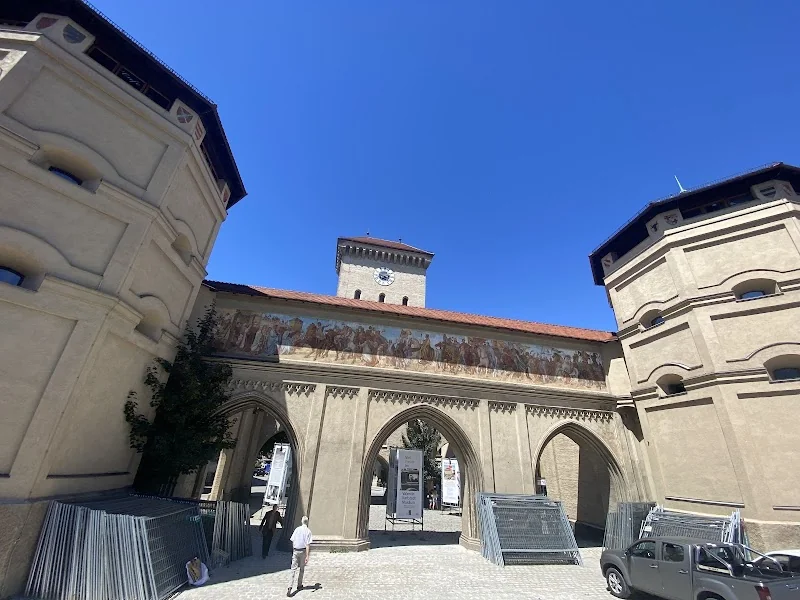
The Isartor is one of the most impressive remnants of Munich's medieval city fortifications. It was built in the 14th century and is today one of the few almost completely preserved city gates of the old town. In the official descriptions of the city and the Munich tourism website, the gate is highlighted as the eastern city gate that still makes the historical urban space visible today. This continuity is particularly important for the place: here one can trace how Munich has developed from a fortified city to a modern city center, without the old city limits completely disappearing. The Isartor is not an isolated monument, but a piece of urban structure that connects the old axis of the Tal with the path to the Isar and access to the historical center. Particularly valuable is that the gate has retained its impact despite war destruction and later interventions and can still be read as an authentic city gate. The restoration by Friedrich von Gärtner in the 19th century shaped its current appearance, and the facade painting with the historical triumphal procession of Emperor Ludwig is one of the defining visual details of the building. This creates an interplay of fortification architecture, restoration history, and historical memory that goes far beyond the function of a passage. Thus, the Isartor is not only a monument but also a narrative of stone, image, and urban space. It shows how Munich tells its own story in architecture: as a city of continuities, reinterpretations, and carefully preserved transitions. ([muenchen.de](https://www.muenchen.de/en/sights/isartor?utm_source=openai))
Even in its later use, the Isartor remains remarkably versatile. Official sources describe that the building has played many roles throughout its history: city gate, part of the fortification, customs station, ruin, national monument, and finally a museum site. This adaptability explains why the Isartor is exciting not only for historians but also for walkers, city photographers, and culture enthusiasts. Unlike many other historical gate structures, here not only the outer shell has been preserved, but also a piece of urban memory culture that continues to live on in modern Munich. The location at the beginning of the Tal also makes the gate an urban marker: those coming from Marienplatz experience a clear transition from dense city center to a gate area that marks the direction east. This transition is architecturally and atmospherically appealing. Therefore, the Isartor is not just a backdrop, but a point of orientation where historical scale and contemporary urban movement overlap. For visitors, this means: standing here, one sees not only a beautiful gate but a condensed excerpt of Munich's identity. ([valentin-karlstadt-musaeum.de](https://www.valentin-karlstadt-musaeum.de/musaeum/isartor?utm_source=openai))
Karl Valentin, Liesl Karlstadt, and the Valentin-Karlstadt Museum
The towers of the Isartor have been inseparably linked to Karl Valentin and Liesl Karlstadt for decades. The Valentin-Karlstadt Museum was opened in 1959 in the Isartor and has been a museum of the city of Munich since 2018. Thus, the building is not only a monument but also a cultural narrative space for Munich's most famous humor duo. Official museum sources emphasize that the museum can be understood as a place for quirky thinking, curious details, and a very unique perspective on Munich. This fits perfectly with the character of the Isartor: the winding corridors, the towers, and the historical framework provide a stage for content where cabaret, folk singing, and Munich's uniqueness come to life particularly well. The permanent exhibition has dedicated many years to the life and work of Karl Valentin and Liesl Karlstadt, and even the more recent exhibition projects continue this line. The museum is never just a classic biography museum, but always also a place of city history, Munich's entertainment culture, and the colorful in-between spaces of seriousness and comedy. This explains why the museum is almost as much a part of the Isartor as the architecture itself for many guests. It is part of the identity of the place and explains why the towers are not perceived as mere shells but as vibrant cultural spaces. ([valentin-karlstadt-musaeum.de](https://www.valentin-karlstadt-musaeum.de/musaeum/musaeum?utm_source=openai))
Currently, the Valentin-Karlstadt Museum is in an important renovation and restoration phase. The official pages inform that the museum has been closed since October 7, 2024, due to fire protection renovations. At the same time, work is already underway on content renewal, and the reopening is scheduled for July 10, 2026. For visitors, this primarily means: the place remains relevant, even if the interiors are temporarily not regularly accessible. During the renovation, exhibitions and educational offerings have taken place or are taking place in other contexts, and projects continue to be made visible in the courtyard of the Isartor. This is important because the Isartor cannot be reduced to the museum hall. The place also lives on in its surroundings, in its courtyard, on its facades, and in public perception. Additionally, the museum spaces and the café will remain accessible only via a spiral staircase after the renovation; an elevator is not planned. This makes the place architecturally authentic but also challenging to use from today's perspective. This mix of historical structure, museum content, and current construction phase makes the Isartor a very typical Munich cultural site: rich in tradition, distinctive, a bit quirky, and always in motion. ([valentin-karlstadt-musaeum.de](https://www.valentin-karlstadt-musaeum.de/info/besucherinfo?utm_source=openai))
Directions, S-Bahn, Tram, and Parking at Isartor
For practical orientation, the Isartor is one of the most pleasant points in Munich's city center because it is easily accessible by both public transport and car. The visitor information from the museum mentions bus 132, tram 16 and 18, as well as S-Bahn lines 1 to 8 with a stop at Isartor. The Isartorplatz itself is described by the city as an important traffic hub where several tram lines and the S-Bahn converge. Those coming from the old town often follow the Tal, which leads directly to Marienplatz; this is why the Isartor is so important for urban walking. This location is particularly helpful for first-time visitors because it automatically integrates the city gate into a pathway system: to the west lies the center around Marienplatz and Viktualienmarkt, while to the east opens the direction to the Isar. This makes the Isartor not only a destination but also a point of orientation for entire city routes. Therefore, those asking about access, city center connections, and walking paths receive several answers at the Isartor: local public transport right on site, short paths into the old town, and a clear topographical position between historical axes. This is ideal for city walks because one can intuitively continue from here. ([valentin-karlstadt-musaeum.de](https://www.valentin-karlstadt-musaeum.de/info/besucherinfo?utm_source=openai))
There are also good parking options nearby. The city's page for the Isar parking garage describes the garage as a centrally located parking option almost directly at the Isartor on Baaderstraße 6; from there, Marienplatz and Viktualienmarkt can be reached in just a few minutes on foot. Additionally, the city of Munich lists the Rieger-City parking garage at Isartor as a nearby city center parking option. For visitors arriving by car, this is particularly pleasant because one does not have to drive far into the old town. Instead, one can park in an inner-city garage and take care of the rest on foot. This is especially sensible for a destination like the Isartor, as the place unfolds its effect best on foot: one perceives facades, street edges, square spaces, and sight lines much more consciously than from a moving car. Therefore, those looking for a combination of parking, old town strolls, and views of historical architecture will find the right place here. The Isartor is thus a place that supports both spontaneous photos and planned city walks. The proximity to taxi stands, parking garages, and footpaths makes it an uncomplicated entry point into Munich's city center. ([muenchen.de](https://www.muenchen.de/verkehr/isarparkhaus?utm_source=openai))
Photos at Isar Gate: Reverse-Running Clock, Sight Lines, and Details
The Isartor is so popular for photos because it offers several strong image layers simultaneously. On one side stands the monumental architecture of the medieval gate with its preserved main tower and the flanking towers. On the other side, there are unusual details that keep the building in memory: the special clock on the main tower that runs backwards or counterclockwise, and the historical facade painting that gives the gate an almost narrative character. The official tourism site highlights these features as visual characteristics. Additionally, the Isartor does not stand isolated in an open space but offers very different perspectives from the Tal and Isartorplatz. Those coming from the Tal experience the gate as the end of a historical street leading directly to Marienplatz; those photographing from the square perceive more the gate's effect and the traffic hub. Thus, the Isartor becomes a place where city and history come together in one image. This is equally interesting for social media, travel blogging, and classic Munich photos because the motif is well-known but never banal. The combination of fortification architecture, museum function, and urban everyday life creates the charm. ([muenchen.de](https://www.muenchen.de/en/sights/isartor?utm_source=openai))
The Isartor is particularly strong because the place generates different moods throughout the day. In the morning, the facade appears clear and factual; at noon, it feels more vibrant and urban; in the evening and winter, it often seems atmospheric and contrasting. The courtyard is reportedly used for exhibitions and concerts, so the building is perceived not only from the outside but also as a cultural space. This courtyard is particularly interesting because it connects the historical shell with temporary content. For photos, this is relevant because architecture and exhibition signs can overlap there. At the same time, the surroundings are photogenic: the Tal, Isartorplatz, and the axis towards Marienplatz create sight lines that make the historical context visible. Therefore, those photographing the Isartor capture not just a gate but an urban connection. This distinction makes a pure facade snapshot different from a truly good city image. Thus, it is worthwhile to photograph the Isartor not only from the front but also from slightly lateral perspectives or as part of a path. This way, the function as a city gate, monument, and museum site becomes much clearer. ([muenchen.de](https://www.muenchen.de/en/sights/isartor?utm_source=openai))
Advent at Isartor: Feuerzangenbowle and Munich Winter Feeling
In the cold season, the Isartor takes on an additional, almost festive layer. The official tourism site describes that the Isartor becomes a popular meeting point during Advent, where Munich's Feuerzangenbowle is served. Particularly impressive is the large copper kettle with a capacity of 9,000 liters, which transforms the place into a winter scene. This fits very well with the character of the Isartor, as historical architecture and seasonal city experience almost seamlessly merge here. Those wandering in Munich during Advent will find at the Isartor not only a monument but also a winter atmosphere that works with light, steam, movement, and city life. The gate thus becomes a place of stay and not just a passage. The effect is strong because the medieval building appears particularly plastic in the dark season. This combination is part of its charm: the Isartor is a monument during the day, but in the evening and during Advent, it almost becomes a stage for urban mood. Those looking for seasonal motifs or a place with genuine winter radiance will find more here than a classic sight. ([muenchen.de](https://www.muenchen.de/en/sights/isartor?utm_source=openai))
For the classification as a Christmas and Advent location, it is also important that the Tal leads directly to Marienplatz, where Munich's traditional Christkindlmarkt takes place. The official Christmas market information from the city of Munich describes the market at Marienplatz as a classic and traditional Christmas market of the city. Thus, the Isartor is a very good starting point for a winter city walk: first the historical gate, then the axis of the Tal, and finally the marketplace with Christmas atmosphere. This is practical and atmospheric for visitors alike. Therefore, those searching for the term Isartor Christmas Market or Isar Gate Christmas Market will most likely find this combination of Isartor, Tal, and the Christmas center around Marienplatz. At the same time, one should not confuse the place with the actual Christkindlmarkt: the Isartor is not a classic Christmas market location itself but rather a prominent meeting point in close proximity to the winter city events. This distinction is important because it creates a precise expectation. The Isartor stands for winter atmosphere, Feuerzangenbowle, and the path into the festive old town, while the large Christmas market at Marienplatz takes on the actual market staging. Together, this creates a coherent Munich Advent image. ([muenchen.de](https://www.muenchen.de/sehenswuerdigkeiten/orte/153198.html?utm_source=openai))
Practical Information for the Visit: Opening, Accessibility, and Surroundings
Those wishing to visit the Isartor today should consider the current state of renovations. The Valentin-Karlstadt Museum is closed due to fire protection renovations, and the official reopening is scheduled for July 10, 2026. Nevertheless, the Isartor remains visible and relevant as a place because the courtyard and external presentation continue to play a role, and because the building itself is naturally always experienceable in the urban space. For a practical visit, this means: the focus is currently more on the outdoor space, architecture, and surroundings than on a regular museum visit. Those planning a cultural walk can easily combine this with a path through the Tal, a detour to Marienplatz, or with destinations like Viktualienmarkt and the Deutsches Museum. The city describes the Isartorplatz as a hub from which Gasteig, Deutsches Museum, Glockenbachviertel, and Isar are also easily reachable. This makes the place a real starting point for various city routes. For a pure museum plan, however, one must wait for the reopening. Thus, the Isartor is currently primarily a place for architecture, photography, history, and urban exploration in the larger environment. ([valentin-karlstadt-musaeum.de](https://www.valentin-karlstadt-musaeum.de/info/besucherinfo?utm_source=openai))
Another practical point is accessibility. The official notes clearly state that the museum is not barrier-free and that the rooms and café are accessible via a spiral staircase; an elevator is not planned. This is important for planning because one can better align the visit with one's own requirements. For some guests, this is not a problem, while for others it is a criterion for exclusion. For this reason, it is also sensible to see the Isartor not only as a museum address but as a historical city gate with many functions, of which currently the external and urban impact is primarily in focus. Those arriving by car will find nearby parking garages; those coming by train and tram have direct stops; those walking will intuitively reach the old town through the Tal. This mix of historical substance and modern accessibility makes the place interesting. The Isartor is thus suitable for both spontaneous visits and carefully planned Munich tours. And because it is located in a closely networked city center area, it is often more valuable to experience the place in context rather than as an isolated destination. Those who take the time for this will receive history, urban spaces, and photographic motifs in a single visit. ([valentin-karlstadt-musaeum.de](https://www.valentin-karlstadt-musaeum.de/info/besucherinfo?utm_source=openai))
Sources:
Show moreShow less
Isar Gate | Isartor, Photos & History
Isar Gate refers to the Isartor at Tal 50 in Munich, a place that densely connects old town, city history, museum character, and urban orientation. When arriving here, one does not stand before a mere sight, but at one of the most distinctive transitions of the city: between the Tal as a historical axis towards Marienplatz, the Isartorplatz as a traffic hub, and the eastern gate to Munich's old town. The Isartor is today a monument with daily life surrounding it, a photographic motif with cultural significance, and a meeting point where historical architecture meets contemporary urban movement. Particularly striking are the towers with their museum usage, the mirrored or reverse-running clock, and the immediate proximity to paths that lead directly into the city center. This makes the place interesting for visitors who want to read the urban space rather than just consume Munich. At the same time, the location is practical: S-Bahn, tram, and bus stop at Isartor, and several parking garages are nearby. Currently, the Valentin-Karlstadt Museum is closed due to fire protection renovations; the reopening is officially announced for July 10, 2026. ([muenchen.de](https://www.muenchen.de/en/sights/isartor?utm_source=openai))
Isartor Munich: History, Fresco, and Medieval Architecture
The Isartor is one of the most impressive remnants of Munich's medieval city fortifications. It was built in the 14th century and is today one of the few almost completely preserved city gates of the old town. In the official descriptions of the city and the Munich tourism website, the gate is highlighted as the eastern city gate that still makes the historical urban space visible today. This continuity is particularly important for the place: here one can trace how Munich has developed from a fortified city to a modern city center, without the old city limits completely disappearing. The Isartor is not an isolated monument, but a piece of urban structure that connects the old axis of the Tal with the path to the Isar and access to the historical center. Particularly valuable is that the gate has retained its impact despite war destruction and later interventions and can still be read as an authentic city gate. The restoration by Friedrich von Gärtner in the 19th century shaped its current appearance, and the facade painting with the historical triumphal procession of Emperor Ludwig is one of the defining visual details of the building. This creates an interplay of fortification architecture, restoration history, and historical memory that goes far beyond the function of a passage. Thus, the Isartor is not only a monument but also a narrative of stone, image, and urban space. It shows how Munich tells its own story in architecture: as a city of continuities, reinterpretations, and carefully preserved transitions. ([muenchen.de](https://www.muenchen.de/en/sights/isartor?utm_source=openai))
Even in its later use, the Isartor remains remarkably versatile. Official sources describe that the building has played many roles throughout its history: city gate, part of the fortification, customs station, ruin, national monument, and finally a museum site. This adaptability explains why the Isartor is exciting not only for historians but also for walkers, city photographers, and culture enthusiasts. Unlike many other historical gate structures, here not only the outer shell has been preserved, but also a piece of urban memory culture that continues to live on in modern Munich. The location at the beginning of the Tal also makes the gate an urban marker: those coming from Marienplatz experience a clear transition from dense city center to a gate area that marks the direction east. This transition is architecturally and atmospherically appealing. Therefore, the Isartor is not just a backdrop, but a point of orientation where historical scale and contemporary urban movement overlap. For visitors, this means: standing here, one sees not only a beautiful gate but a condensed excerpt of Munich's identity. ([valentin-karlstadt-musaeum.de](https://www.valentin-karlstadt-musaeum.de/musaeum/isartor?utm_source=openai))
Karl Valentin, Liesl Karlstadt, and the Valentin-Karlstadt Museum
The towers of the Isartor have been inseparably linked to Karl Valentin and Liesl Karlstadt for decades. The Valentin-Karlstadt Museum was opened in 1959 in the Isartor and has been a museum of the city of Munich since 2018. Thus, the building is not only a monument but also a cultural narrative space for Munich's most famous humor duo. Official museum sources emphasize that the museum can be understood as a place for quirky thinking, curious details, and a very unique perspective on Munich. This fits perfectly with the character of the Isartor: the winding corridors, the towers, and the historical framework provide a stage for content where cabaret, folk singing, and Munich's uniqueness come to life particularly well. The permanent exhibition has dedicated many years to the life and work of Karl Valentin and Liesl Karlstadt, and even the more recent exhibition projects continue this line. The museum is never just a classic biography museum, but always also a place of city history, Munich's entertainment culture, and the colorful in-between spaces of seriousness and comedy. This explains why the museum is almost as much a part of the Isartor as the architecture itself for many guests. It is part of the identity of the place and explains why the towers are not perceived as mere shells but as vibrant cultural spaces. ([valentin-karlstadt-musaeum.de](https://www.valentin-karlstadt-musaeum.de/musaeum/musaeum?utm_source=openai))
Currently, the Valentin-Karlstadt Museum is in an important renovation and restoration phase. The official pages inform that the museum has been closed since October 7, 2024, due to fire protection renovations. At the same time, work is already underway on content renewal, and the reopening is scheduled for July 10, 2026. For visitors, this primarily means: the place remains relevant, even if the interiors are temporarily not regularly accessible. During the renovation, exhibitions and educational offerings have taken place or are taking place in other contexts, and projects continue to be made visible in the courtyard of the Isartor. This is important because the Isartor cannot be reduced to the museum hall. The place also lives on in its surroundings, in its courtyard, on its facades, and in public perception. Additionally, the museum spaces and the café will remain accessible only via a spiral staircase after the renovation; an elevator is not planned. This makes the place architecturally authentic but also challenging to use from today's perspective. This mix of historical structure, museum content, and current construction phase makes the Isartor a very typical Munich cultural site: rich in tradition, distinctive, a bit quirky, and always in motion. ([valentin-karlstadt-musaeum.de](https://www.valentin-karlstadt-musaeum.de/info/besucherinfo?utm_source=openai))
Directions, S-Bahn, Tram, and Parking at Isartor
For practical orientation, the Isartor is one of the most pleasant points in Munich's city center because it is easily accessible by both public transport and car. The visitor information from the museum mentions bus 132, tram 16 and 18, as well as S-Bahn lines 1 to 8 with a stop at Isartor. The Isartorplatz itself is described by the city as an important traffic hub where several tram lines and the S-Bahn converge. Those coming from the old town often follow the Tal, which leads directly to Marienplatz; this is why the Isartor is so important for urban walking. This location is particularly helpful for first-time visitors because it automatically integrates the city gate into a pathway system: to the west lies the center around Marienplatz and Viktualienmarkt, while to the east opens the direction to the Isar. This makes the Isartor not only a destination but also a point of orientation for entire city routes. Therefore, those asking about access, city center connections, and walking paths receive several answers at the Isartor: local public transport right on site, short paths into the old town, and a clear topographical position between historical axes. This is ideal for city walks because one can intuitively continue from here. ([valentin-karlstadt-musaeum.de](https://www.valentin-karlstadt-musaeum.de/info/besucherinfo?utm_source=openai))
There are also good parking options nearby. The city's page for the Isar parking garage describes the garage as a centrally located parking option almost directly at the Isartor on Baaderstraße 6; from there, Marienplatz and Viktualienmarkt can be reached in just a few minutes on foot. Additionally, the city of Munich lists the Rieger-City parking garage at Isartor as a nearby city center parking option. For visitors arriving by car, this is particularly pleasant because one does not have to drive far into the old town. Instead, one can park in an inner-city garage and take care of the rest on foot. This is especially sensible for a destination like the Isartor, as the place unfolds its effect best on foot: one perceives facades, street edges, square spaces, and sight lines much more consciously than from a moving car. Therefore, those looking for a combination of parking, old town strolls, and views of historical architecture will find the right place here. The Isartor is thus a place that supports both spontaneous photos and planned city walks. The proximity to taxi stands, parking garages, and footpaths makes it an uncomplicated entry point into Munich's city center. ([muenchen.de](https://www.muenchen.de/verkehr/isarparkhaus?utm_source=openai))
Photos at Isar Gate: Reverse-Running Clock, Sight Lines, and Details
The Isartor is so popular for photos because it offers several strong image layers simultaneously. On one side stands the monumental architecture of the medieval gate with its preserved main tower and the flanking towers. On the other side, there are unusual details that keep the building in memory: the special clock on the main tower that runs backwards or counterclockwise, and the historical facade painting that gives the gate an almost narrative character. The official tourism site highlights these features as visual characteristics. Additionally, the Isartor does not stand isolated in an open space but offers very different perspectives from the Tal and Isartorplatz. Those coming from the Tal experience the gate as the end of a historical street leading directly to Marienplatz; those photographing from the square perceive more the gate's effect and the traffic hub. Thus, the Isartor becomes a place where city and history come together in one image. This is equally interesting for social media, travel blogging, and classic Munich photos because the motif is well-known but never banal. The combination of fortification architecture, museum function, and urban everyday life creates the charm. ([muenchen.de](https://www.muenchen.de/en/sights/isartor?utm_source=openai))
The Isartor is particularly strong because the place generates different moods throughout the day. In the morning, the facade appears clear and factual; at noon, it feels more vibrant and urban; in the evening and winter, it often seems atmospheric and contrasting. The courtyard is reportedly used for exhibitions and concerts, so the building is perceived not only from the outside but also as a cultural space. This courtyard is particularly interesting because it connects the historical shell with temporary content. For photos, this is relevant because architecture and exhibition signs can overlap there. At the same time, the surroundings are photogenic: the Tal, Isartorplatz, and the axis towards Marienplatz create sight lines that make the historical context visible. Therefore, those photographing the Isartor capture not just a gate but an urban connection. This distinction makes a pure facade snapshot different from a truly good city image. Thus, it is worthwhile to photograph the Isartor not only from the front but also from slightly lateral perspectives or as part of a path. This way, the function as a city gate, monument, and museum site becomes much clearer. ([muenchen.de](https://www.muenchen.de/en/sights/isartor?utm_source=openai))
Advent at Isartor: Feuerzangenbowle and Munich Winter Feeling
In the cold season, the Isartor takes on an additional, almost festive layer. The official tourism site describes that the Isartor becomes a popular meeting point during Advent, where Munich's Feuerzangenbowle is served. Particularly impressive is the large copper kettle with a capacity of 9,000 liters, which transforms the place into a winter scene. This fits very well with the character of the Isartor, as historical architecture and seasonal city experience almost seamlessly merge here. Those wandering in Munich during Advent will find at the Isartor not only a monument but also a winter atmosphere that works with light, steam, movement, and city life. The gate thus becomes a place of stay and not just a passage. The effect is strong because the medieval building appears particularly plastic in the dark season. This combination is part of its charm: the Isartor is a monument during the day, but in the evening and during Advent, it almost becomes a stage for urban mood. Those looking for seasonal motifs or a place with genuine winter radiance will find more here than a classic sight. ([muenchen.de](https://www.muenchen.de/en/sights/isartor?utm_source=openai))
For the classification as a Christmas and Advent location, it is also important that the Tal leads directly to Marienplatz, where Munich's traditional Christkindlmarkt takes place. The official Christmas market information from the city of Munich describes the market at Marienplatz as a classic and traditional Christmas market of the city. Thus, the Isartor is a very good starting point for a winter city walk: first the historical gate, then the axis of the Tal, and finally the marketplace with Christmas atmosphere. This is practical and atmospheric for visitors alike. Therefore, those searching for the term Isartor Christmas Market or Isar Gate Christmas Market will most likely find this combination of Isartor, Tal, and the Christmas center around Marienplatz. At the same time, one should not confuse the place with the actual Christkindlmarkt: the Isartor is not a classic Christmas market location itself but rather a prominent meeting point in close proximity to the winter city events. This distinction is important because it creates a precise expectation. The Isartor stands for winter atmosphere, Feuerzangenbowle, and the path into the festive old town, while the large Christmas market at Marienplatz takes on the actual market staging. Together, this creates a coherent Munich Advent image. ([muenchen.de](https://www.muenchen.de/sehenswuerdigkeiten/orte/153198.html?utm_source=openai))
Practical Information for the Visit: Opening, Accessibility, and Surroundings
Those wishing to visit the Isartor today should consider the current state of renovations. The Valentin-Karlstadt Museum is closed due to fire protection renovations, and the official reopening is scheduled for July 10, 2026. Nevertheless, the Isartor remains visible and relevant as a place because the courtyard and external presentation continue to play a role, and because the building itself is naturally always experienceable in the urban space. For a practical visit, this means: the focus is currently more on the outdoor space, architecture, and surroundings than on a regular museum visit. Those planning a cultural walk can easily combine this with a path through the Tal, a detour to Marienplatz, or with destinations like Viktualienmarkt and the Deutsches Museum. The city describes the Isartorplatz as a hub from which Gasteig, Deutsches Museum, Glockenbachviertel, and Isar are also easily reachable. This makes the place a real starting point for various city routes. For a pure museum plan, however, one must wait for the reopening. Thus, the Isartor is currently primarily a place for architecture, photography, history, and urban exploration in the larger environment. ([valentin-karlstadt-musaeum.de](https://www.valentin-karlstadt-musaeum.de/info/besucherinfo?utm_source=openai))
Another practical point is accessibility. The official notes clearly state that the museum is not barrier-free and that the rooms and café are accessible via a spiral staircase; an elevator is not planned. This is important for planning because one can better align the visit with one's own requirements. For some guests, this is not a problem, while for others it is a criterion for exclusion. For this reason, it is also sensible to see the Isartor not only as a museum address but as a historical city gate with many functions, of which currently the external and urban impact is primarily in focus. Those arriving by car will find nearby parking garages; those coming by train and tram have direct stops; those walking will intuitively reach the old town through the Tal. This mix of historical substance and modern accessibility makes the place interesting. The Isartor is thus suitable for both spontaneous visits and carefully planned Munich tours. And because it is located in a closely networked city center area, it is often more valuable to experience the place in context rather than as an isolated destination. Those who take the time for this will receive history, urban spaces, and photographic motifs in a single visit. ([valentin-karlstadt-musaeum.de](https://www.valentin-karlstadt-musaeum.de/info/besucherinfo?utm_source=openai))
Sources:
Isar Gate | Isartor, Photos & History
Isar Gate refers to the Isartor at Tal 50 in Munich, a place that densely connects old town, city history, museum character, and urban orientation. When arriving here, one does not stand before a mere sight, but at one of the most distinctive transitions of the city: between the Tal as a historical axis towards Marienplatz, the Isartorplatz as a traffic hub, and the eastern gate to Munich's old town. The Isartor is today a monument with daily life surrounding it, a photographic motif with cultural significance, and a meeting point where historical architecture meets contemporary urban movement. Particularly striking are the towers with their museum usage, the mirrored or reverse-running clock, and the immediate proximity to paths that lead directly into the city center. This makes the place interesting for visitors who want to read the urban space rather than just consume Munich. At the same time, the location is practical: S-Bahn, tram, and bus stop at Isartor, and several parking garages are nearby. Currently, the Valentin-Karlstadt Museum is closed due to fire protection renovations; the reopening is officially announced for July 10, 2026. ([muenchen.de](https://www.muenchen.de/en/sights/isartor?utm_source=openai))
Isartor Munich: History, Fresco, and Medieval Architecture
The Isartor is one of the most impressive remnants of Munich's medieval city fortifications. It was built in the 14th century and is today one of the few almost completely preserved city gates of the old town. In the official descriptions of the city and the Munich tourism website, the gate is highlighted as the eastern city gate that still makes the historical urban space visible today. This continuity is particularly important for the place: here one can trace how Munich has developed from a fortified city to a modern city center, without the old city limits completely disappearing. The Isartor is not an isolated monument, but a piece of urban structure that connects the old axis of the Tal with the path to the Isar and access to the historical center. Particularly valuable is that the gate has retained its impact despite war destruction and later interventions and can still be read as an authentic city gate. The restoration by Friedrich von Gärtner in the 19th century shaped its current appearance, and the facade painting with the historical triumphal procession of Emperor Ludwig is one of the defining visual details of the building. This creates an interplay of fortification architecture, restoration history, and historical memory that goes far beyond the function of a passage. Thus, the Isartor is not only a monument but also a narrative of stone, image, and urban space. It shows how Munich tells its own story in architecture: as a city of continuities, reinterpretations, and carefully preserved transitions. ([muenchen.de](https://www.muenchen.de/en/sights/isartor?utm_source=openai))
Even in its later use, the Isartor remains remarkably versatile. Official sources describe that the building has played many roles throughout its history: city gate, part of the fortification, customs station, ruin, national monument, and finally a museum site. This adaptability explains why the Isartor is exciting not only for historians but also for walkers, city photographers, and culture enthusiasts. Unlike many other historical gate structures, here not only the outer shell has been preserved, but also a piece of urban memory culture that continues to live on in modern Munich. The location at the beginning of the Tal also makes the gate an urban marker: those coming from Marienplatz experience a clear transition from dense city center to a gate area that marks the direction east. This transition is architecturally and atmospherically appealing. Therefore, the Isartor is not just a backdrop, but a point of orientation where historical scale and contemporary urban movement overlap. For visitors, this means: standing here, one sees not only a beautiful gate but a condensed excerpt of Munich's identity. ([valentin-karlstadt-musaeum.de](https://www.valentin-karlstadt-musaeum.de/musaeum/isartor?utm_source=openai))
Karl Valentin, Liesl Karlstadt, and the Valentin-Karlstadt Museum
The towers of the Isartor have been inseparably linked to Karl Valentin and Liesl Karlstadt for decades. The Valentin-Karlstadt Museum was opened in 1959 in the Isartor and has been a museum of the city of Munich since 2018. Thus, the building is not only a monument but also a cultural narrative space for Munich's most famous humor duo. Official museum sources emphasize that the museum can be understood as a place for quirky thinking, curious details, and a very unique perspective on Munich. This fits perfectly with the character of the Isartor: the winding corridors, the towers, and the historical framework provide a stage for content where cabaret, folk singing, and Munich's uniqueness come to life particularly well. The permanent exhibition has dedicated many years to the life and work of Karl Valentin and Liesl Karlstadt, and even the more recent exhibition projects continue this line. The museum is never just a classic biography museum, but always also a place of city history, Munich's entertainment culture, and the colorful in-between spaces of seriousness and comedy. This explains why the museum is almost as much a part of the Isartor as the architecture itself for many guests. It is part of the identity of the place and explains why the towers are not perceived as mere shells but as vibrant cultural spaces. ([valentin-karlstadt-musaeum.de](https://www.valentin-karlstadt-musaeum.de/musaeum/musaeum?utm_source=openai))
Currently, the Valentin-Karlstadt Museum is in an important renovation and restoration phase. The official pages inform that the museum has been closed since October 7, 2024, due to fire protection renovations. At the same time, work is already underway on content renewal, and the reopening is scheduled for July 10, 2026. For visitors, this primarily means: the place remains relevant, even if the interiors are temporarily not regularly accessible. During the renovation, exhibitions and educational offerings have taken place or are taking place in other contexts, and projects continue to be made visible in the courtyard of the Isartor. This is important because the Isartor cannot be reduced to the museum hall. The place also lives on in its surroundings, in its courtyard, on its facades, and in public perception. Additionally, the museum spaces and the café will remain accessible only via a spiral staircase after the renovation; an elevator is not planned. This makes the place architecturally authentic but also challenging to use from today's perspective. This mix of historical structure, museum content, and current construction phase makes the Isartor a very typical Munich cultural site: rich in tradition, distinctive, a bit quirky, and always in motion. ([valentin-karlstadt-musaeum.de](https://www.valentin-karlstadt-musaeum.de/info/besucherinfo?utm_source=openai))
Directions, S-Bahn, Tram, and Parking at Isartor
For practical orientation, the Isartor is one of the most pleasant points in Munich's city center because it is easily accessible by both public transport and car. The visitor information from the museum mentions bus 132, tram 16 and 18, as well as S-Bahn lines 1 to 8 with a stop at Isartor. The Isartorplatz itself is described by the city as an important traffic hub where several tram lines and the S-Bahn converge. Those coming from the old town often follow the Tal, which leads directly to Marienplatz; this is why the Isartor is so important for urban walking. This location is particularly helpful for first-time visitors because it automatically integrates the city gate into a pathway system: to the west lies the center around Marienplatz and Viktualienmarkt, while to the east opens the direction to the Isar. This makes the Isartor not only a destination but also a point of orientation for entire city routes. Therefore, those asking about access, city center connections, and walking paths receive several answers at the Isartor: local public transport right on site, short paths into the old town, and a clear topographical position between historical axes. This is ideal for city walks because one can intuitively continue from here. ([valentin-karlstadt-musaeum.de](https://www.valentin-karlstadt-musaeum.de/info/besucherinfo?utm_source=openai))
There are also good parking options nearby. The city's page for the Isar parking garage describes the garage as a centrally located parking option almost directly at the Isartor on Baaderstraße 6; from there, Marienplatz and Viktualienmarkt can be reached in just a few minutes on foot. Additionally, the city of Munich lists the Rieger-City parking garage at Isartor as a nearby city center parking option. For visitors arriving by car, this is particularly pleasant because one does not have to drive far into the old town. Instead, one can park in an inner-city garage and take care of the rest on foot. This is especially sensible for a destination like the Isartor, as the place unfolds its effect best on foot: one perceives facades, street edges, square spaces, and sight lines much more consciously than from a moving car. Therefore, those looking for a combination of parking, old town strolls, and views of historical architecture will find the right place here. The Isartor is thus a place that supports both spontaneous photos and planned city walks. The proximity to taxi stands, parking garages, and footpaths makes it an uncomplicated entry point into Munich's city center. ([muenchen.de](https://www.muenchen.de/verkehr/isarparkhaus?utm_source=openai))
Photos at Isar Gate: Reverse-Running Clock, Sight Lines, and Details
The Isartor is so popular for photos because it offers several strong image layers simultaneously. On one side stands the monumental architecture of the medieval gate with its preserved main tower and the flanking towers. On the other side, there are unusual details that keep the building in memory: the special clock on the main tower that runs backwards or counterclockwise, and the historical facade painting that gives the gate an almost narrative character. The official tourism site highlights these features as visual characteristics. Additionally, the Isartor does not stand isolated in an open space but offers very different perspectives from the Tal and Isartorplatz. Those coming from the Tal experience the gate as the end of a historical street leading directly to Marienplatz; those photographing from the square perceive more the gate's effect and the traffic hub. Thus, the Isartor becomes a place where city and history come together in one image. This is equally interesting for social media, travel blogging, and classic Munich photos because the motif is well-known but never banal. The combination of fortification architecture, museum function, and urban everyday life creates the charm. ([muenchen.de](https://www.muenchen.de/en/sights/isartor?utm_source=openai))
The Isartor is particularly strong because the place generates different moods throughout the day. In the morning, the facade appears clear and factual; at noon, it feels more vibrant and urban; in the evening and winter, it often seems atmospheric and contrasting. The courtyard is reportedly used for exhibitions and concerts, so the building is perceived not only from the outside but also as a cultural space. This courtyard is particularly interesting because it connects the historical shell with temporary content. For photos, this is relevant because architecture and exhibition signs can overlap there. At the same time, the surroundings are photogenic: the Tal, Isartorplatz, and the axis towards Marienplatz create sight lines that make the historical context visible. Therefore, those photographing the Isartor capture not just a gate but an urban connection. This distinction makes a pure facade snapshot different from a truly good city image. Thus, it is worthwhile to photograph the Isartor not only from the front but also from slightly lateral perspectives or as part of a path. This way, the function as a city gate, monument, and museum site becomes much clearer. ([muenchen.de](https://www.muenchen.de/en/sights/isartor?utm_source=openai))
Advent at Isartor: Feuerzangenbowle and Munich Winter Feeling
In the cold season, the Isartor takes on an additional, almost festive layer. The official tourism site describes that the Isartor becomes a popular meeting point during Advent, where Munich's Feuerzangenbowle is served. Particularly impressive is the large copper kettle with a capacity of 9,000 liters, which transforms the place into a winter scene. This fits very well with the character of the Isartor, as historical architecture and seasonal city experience almost seamlessly merge here. Those wandering in Munich during Advent will find at the Isartor not only a monument but also a winter atmosphere that works with light, steam, movement, and city life. The gate thus becomes a place of stay and not just a passage. The effect is strong because the medieval building appears particularly plastic in the dark season. This combination is part of its charm: the Isartor is a monument during the day, but in the evening and during Advent, it almost becomes a stage for urban mood. Those looking for seasonal motifs or a place with genuine winter radiance will find more here than a classic sight. ([muenchen.de](https://www.muenchen.de/en/sights/isartor?utm_source=openai))
For the classification as a Christmas and Advent location, it is also important that the Tal leads directly to Marienplatz, where Munich's traditional Christkindlmarkt takes place. The official Christmas market information from the city of Munich describes the market at Marienplatz as a classic and traditional Christmas market of the city. Thus, the Isartor is a very good starting point for a winter city walk: first the historical gate, then the axis of the Tal, and finally the marketplace with Christmas atmosphere. This is practical and atmospheric for visitors alike. Therefore, those searching for the term Isartor Christmas Market or Isar Gate Christmas Market will most likely find this combination of Isartor, Tal, and the Christmas center around Marienplatz. At the same time, one should not confuse the place with the actual Christkindlmarkt: the Isartor is not a classic Christmas market location itself but rather a prominent meeting point in close proximity to the winter city events. This distinction is important because it creates a precise expectation. The Isartor stands for winter atmosphere, Feuerzangenbowle, and the path into the festive old town, while the large Christmas market at Marienplatz takes on the actual market staging. Together, this creates a coherent Munich Advent image. ([muenchen.de](https://www.muenchen.de/sehenswuerdigkeiten/orte/153198.html?utm_source=openai))
Practical Information for the Visit: Opening, Accessibility, and Surroundings
Those wishing to visit the Isartor today should consider the current state of renovations. The Valentin-Karlstadt Museum is closed due to fire protection renovations, and the official reopening is scheduled for July 10, 2026. Nevertheless, the Isartor remains visible and relevant as a place because the courtyard and external presentation continue to play a role, and because the building itself is naturally always experienceable in the urban space. For a practical visit, this means: the focus is currently more on the outdoor space, architecture, and surroundings than on a regular museum visit. Those planning a cultural walk can easily combine this with a path through the Tal, a detour to Marienplatz, or with destinations like Viktualienmarkt and the Deutsches Museum. The city describes the Isartorplatz as a hub from which Gasteig, Deutsches Museum, Glockenbachviertel, and Isar are also easily reachable. This makes the place a real starting point for various city routes. For a pure museum plan, however, one must wait for the reopening. Thus, the Isartor is currently primarily a place for architecture, photography, history, and urban exploration in the larger environment. ([valentin-karlstadt-musaeum.de](https://www.valentin-karlstadt-musaeum.de/info/besucherinfo?utm_source=openai))
Another practical point is accessibility. The official notes clearly state that the museum is not barrier-free and that the rooms and café are accessible via a spiral staircase; an elevator is not planned. This is important for planning because one can better align the visit with one's own requirements. For some guests, this is not a problem, while for others it is a criterion for exclusion. For this reason, it is also sensible to see the Isartor not only as a museum address but as a historical city gate with many functions, of which currently the external and urban impact is primarily in focus. Those arriving by car will find nearby parking garages; those coming by train and tram have direct stops; those walking will intuitively reach the old town through the Tal. This mix of historical substance and modern accessibility makes the place interesting. The Isartor is thus suitable for both spontaneous visits and carefully planned Munich tours. And because it is located in a closely networked city center area, it is often more valuable to experience the place in context rather than as an isolated destination. Those who take the time for this will receive history, urban spaces, and photographic motifs in a single visit. ([valentin-karlstadt-musaeum.de](https://www.valentin-karlstadt-musaeum.de/info/besucherinfo?utm_source=openai))
Sources:
Upcoming Events
No events found
Frequently Asked Questions
Reviews
The Man!
4. August 2025
Under remodeling construction when observed in July of 2025. Appears to be authentic site of one of the city's medieval portal entry gates. Good historical display boards are nearby.
Santiago German Perrone
31. December 2025
Very nice location to take some pictures, full of history.
Amanda Geismann
2. July 2025
I haven't gone into the museum yet but it's still awesome if only because of the backwards working clock on the 'Tal' (Salzstrasse') side. Also the huge fire bowl in the middle at Christmas market time.
singrai soren
28. April 2025
The Isartor (Isar Gate) is one of Munich’s most iconic and historic landmarks. Built in the 14th century, it served as part of the medieval fortifications protecting the city. Today, it stands as a beautifully preserved reminder of Munich’s rich past. Architecturally, the Isartor is impressive, with its tall central tower and two side arches that are still intact. The frescoes on the tower, depicting Emperor Ludwig the Bavarian’s victory, are a highlight and add an artistic flair. It's not just a monument — the gate also houses the Valentin-Karlstadt Museum, dedicated to the beloved Munich comedian Karl Valentin, offering a charming and humorous look into Bavarian culture. Located near the Isar River and right at the edge of Munich’s bustling city center, the area around Isartor is lively, with cafés, shops, and easy access to public transportation. Whether you're interested in history, architecture, or simply taking a stroll, visiting Isartor is a pleasant experience that connects you to Munich’s medieval roots. Pros: Beautiful and well-preserved historical structure Central location, easy to combine with a city walk Museum inside adds a unique cultural touch Cons: It’s relatively small compared to other historical sites, so the visit can be quite short The area can be crowded, especially during tourist seasons.
Kamila Świerska
19. March 2023
One of the four gates to the medieval city wall. Currently, you can still see some displays in this place. Worth visiting if you have some time.