
München
Werner-Eckert-Straße 1, 81829 München, Deutschland
Kopfbau (Cultural Center) | Program & Tickets
The Kopfbau in Munich-Riem is much more than a venue for individual events. It is a culturally charged space, an experimental house for community, art, and encounters, and at the same time a monument that makes the history of the former Munich-Riem airport visible. Today, the Kopfbau is used as a rent-free cultural and social space under the framework of expeRIEMent Kopfbau, which will remain open with changing occupancy until 2027. The initiative KopfbauT e.V. and the city of Munich connect culture, social issues, and neighborhood work into a format that is intentionally open, accessible, and adaptable. For visitors, this means: no rigid large house with the same dramaturgy, but a lively place where the program, atmosphere, and usage change regularly. Therefore, those searching for Kopfbau program, Kopfbau events, or Kopfbau Riem will find a location that tells both history and present. ([kopfbaut.de](https://www.kopfbaut.de/der-verein/))
Program and Performance Times at Kopfbau
The program of the Kopfbau does not follow a single fixed template but thrives on performance times, projects, and changing formats. The homepage of KopfbauT e.V. currently announces the summer season 2026, which is set to run from July 30 to August 16. At the same time, it states that the program is still taking shape and that no upcoming events are currently listed. This is typical for the place: The Kopfbau works with advance announcements, curated project phases, and thematic weekends instead of permanently playing the same sequence. Therefore, anyone looking for Kopfbau program should keep an eye on the initiative's calendar and expect short-term updates. This is not a disadvantage but part of the concept, as the space is explicitly intended as a testing ground for changing actors. ([kopfbaut.de](https://www.kopfbaut.de/))
The city of Munich describes the Kopfbau as a place that has been open since 2022 under the title expeRIEMent Kopfbau for social and cultural uses. This experimental phase runs until 2027, and the spaces are usually rented for limited time slots of up to eight weeks. This explains why the program heavily depends on current projects: Artists, associations, and initiatives activate the space anew each time. On the official KopfbauT page, the offerings are described with terms like workshops, music, theater, café, bar, and disco, while previous performance times also highlighted exhibitions, dance, and discussions. For SEO, therefore, not only the keyword program is relevant, but also events, performance time, calendar, and cultural center. Those visiting the Kopfbau typically do not experience a standardized house but rather a curated intermediate form of neighborhood space, cultural venue, and public laboratory. ([entdecken.muenchen.de](https://entdecken.muenchen.de/en/station/20-6/))
It is precisely this openness that makes the location interesting for those specifically searching for Kopfbau program 2026, Kopfbau Munich, or expeRIEMent Kopfbau. The current communication is intentionally concise and direct: Dates are announced, program lines are named, and performance times are communicated as soon as they are confirmed. From an SEO perspective, one should not reduce the information needs to individual events but understand the entire usage system. The Kopfbau is not a house with a constantly identical seasonal plan but a place with changing modules. This dynamic is equally important for visitors as it is for search intentions around program, ticket, and event calendar. ([kopfbaut.de](https://www.kopfbaut.de/))
Tickets, Box Office, and Event Formats
Those searching for tickets for the Kopfbau should consider the character of the house. Here, there are not only classic ticket evenings like in a large theater but very different formats that can range from free admission to registered workshops. Several official pages mention workshops, concerts, readings, dance performances, cinema, open studios, and discussion formats. This mix shows that Kopfbau tickets must always be read in connection with the respective program. For some events, registration is sufficient, others are free, and still others have a box office. This fits the open, participatory concept of the house and explains why the search terms tickets, workshop, and events are particularly relevant in the context of the Kopfbau. The clear recommendation is therefore: check the current date carefully before visiting, as access type and price may vary depending on the format. ([unsere-messestadt.de](https://unsere-messestadt.de/der-kopfbau-was-ist-das-faqs-kopfbau/))
A good practical tip is that the initiative has explicitly pointed out in previous performance times that evening events may be available at the box office. At the same time, workshops were announced separately and sometimes organized with registration. This makes it clear that while the Kopfbau is a cultural center, it is not one with a rigid ticket regime. Instead, the house is oriented towards the event itself: An open studio requires different rules than a concert evening or a reading. For visitors, this means more flexibility but also more personal responsibility when looking at the calendar. Therefore, those searching for Kopfbau tickets or Kopfbau box office should always read the respective project page or announcement. This way, misunderstandings can be avoided, and the visit becomes easier to plan. ([kopfbaut.de](https://www.kopfbaut.de/aufgehts/?utm_source=openai))
In terms of content, the Kopfbau covers a remarkably broad spectrum. The official FAQ mentions exhibitions, installations, theater, dance, music, literature, film, photography, readings, panel discussions, courses, and cooperative projects. Additionally, there are recurring café and bar offerings that further embed the house into the daily life of the neighborhood. This diversity is not coincidental but part of the guiding principle: accessible, interdisciplinary, and focused on encounters. Therefore, those searching for Kopfbau events will not find a narrow genre profile but an open cultural framework that addresses very different target groups. This is what makes the place attractive for search queries with the terms cultural center, program, workshop, and tickets. The Kopfbau is thus less a single event location than a flexible stage for content that develops together with the neighborhood. ([unsere-messestadt.de](https://unsere-messestadt.de/der-kopfbau-was-ist-das-faqs-kopfbau/))
Directions and Parking in the Messestadt Riem
The address of the Kopfbau location is currently given as Werner-Eckert-Straße 1, 81829 Munich on event pages. This is important because the Kopfbau is often associated with the broader surroundings of the Messestadt Riem on maps. For orientation, it helps to classify it as a location at the edge of the Riem Park or in the area of the Messestadt Riem. Practically, this means: Those searching for Kopfbau directions should not only know the building name but also check the exact street address. The location is well connected urban-wise, but the paths through the neighborhood can vary depending on the starting point. Therefore, precise route planning is advisable, especially for evening appointments or formats that expect a lot of foot traffic. ([experimentkopfbau.de](https://experimentkopfbau.de/veranstaltungen/kopfbar-im-kopfbau/?utm_source=openai))
Regarding Kopfbau parking, the official city information is particularly important. In the Messestadt Riem, there is high parking pressure, and the city points out a zone parking ban. Short-term parking is only allowed at designated blue-marked spots with a parking disc: daily from 9 AM to 6 PM for two hours, and parking is free from 6 PM to 9 AM. Therefore, those arriving by car should not expect comfortable long-term parking directly at the house. A sensible alternative is the Park-and-Ride parking lot Riem on Mittbacher Straße. This is particularly relevant for visitors searching for Kopfbau parking or directions by car who want to start the evening relaxed. Those who plan early can avoid stress in the neighborhood. ([stadt.muenchen.de](https://stadt.muenchen.de/infos/zonenhalteverbot-riem.html?utm_source=openai))
Bicycles also play a role in the journey. The official page for expressions of interest points out that bicycles can be parked west of the Kopfbau and that especially in summer, arriving by bike is recommended. Additionally, it is described that the route from public transport hubs goes through residential areas and parks, making a good route description helpful for event announcements. This fits well with the character of the place: The Kopfbau is not located in the middle of a classic city center backdrop but in a neighborhood that connects park, living, fair, and culture. For SEO, therefore, terms like directions, parking, bicycle, and Messestadt Riem are also sensible as they reflect the practical information needs of visitors. ([experimentkopfbau.de](https://experimentkopfbau.de/interessenbekundung/?utm_source=openai))
Facilities, Seating, and Accessibility
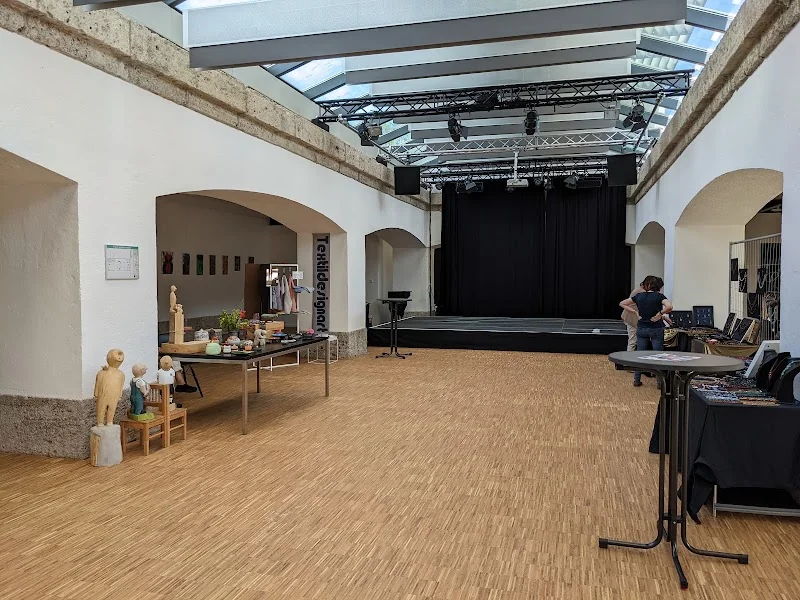
The facilities of the Kopfbau are surprisingly functional for a cultural and meeting place. According to the official FAQ, after renovation, a large ground-level room with industrial flooring and heating is available, along with a mobile bar and basic kitchen equipment. In the café area, there is a fixed kitchen unit with a cooling counter and dishwasher, as well as chairs, tables, and basic infrastructure for beverage and catering offerings. The building has toilets, a staff toilet, and changing rooms, but not a multitude of side rooms. This clarity is important because it shapes the usage logic of the house: The Kopfbau is not a complex event apparatus with many backstage levels but an open, compact space with a very direct atmosphere. This supports formats that require closeness, exchange, and flexibility. ([unsere-messestadt.de](https://unsere-messestadt.de/der-kopfbau-was-ist-das-faqs-kopfbau/))
For the search intention seating plan, it is particularly interesting that the Kopfbau is not set up like a traditional auditorium. Instead of a fixed, always the same seating plan, there is a flexible room with columns, two usage zones, 120 chairs, 20 conference tables, and a mobile stage. The seating is therefore adjusted flexibly depending on the event. ([unsere-messestadt.de](https://unsere-messestadt.de/der-kopfbau-was-ist-das-faqs-kopfbau/))
Accessibility is also clearly regulated. The FAQ states that all areas of the house are ground-level and accessible, and there is a barrier-free toilet. Access to the main entrance is via the access road leading west to the building, and the main entrance and exterior doors can also be opened manually. For visitors with mobility restrictions, this is central information as it directly affects the usability of the place. At the same time, the description shows that the Kopfbau is open but technically simple. The strength lies not in luxury fittings or a large foyer but in good usability, clear accessibility, and a space that allows for many formats. This makes the location particularly relevant for search queries with barrier-free, seating plan, and facilities. ([unsere-messestadt.de](https://unsere-messestadt.de/der-kopfbau-was-ist-das-faqs-kopfbau/))
History of the Kopfbau and its Significance for Munich-Riem
The Kopfbau is a historically significant building with a past closely linked to the former Munich-Riem airport. According to the FAQ, the former ticket hall of the airport grandstand was built between 1937 and 1939 according to plans by architect Ernst Sagebiel. It originally belonged to a large spectator grandstand for flight days and remained as a rare relic after the airport's closure. The city and the initiative emphasize that the place should also serve as a discourse space due to its history, where the past of the place, including the Nazi era, is reflected upon. This makes the Kopfbau much more than a pretty shell for events: it is a material memory of the neighborhood and a visible piece of Munich's city history. ([unsere-messestadt.de](https://unsere-messestadt.de/der-kopfbau-was-ist-das-faqs-kopfbau/))
The development from a historical remnant to today's cultural venue was long. The official association page describes that the initiative KopfbauT was formed in 2018 and is committed to preserving and revitalizing the building. Since 2021, the renovated Kopfbau has been available for an experimental phase as part of a declaration of interest by the city of Munich. The city of Munich itself describes the use as rent-free and socially as well as culturally oriented, supported by Unsere Messestadt and ECHO e.V. This results in a very conscious governance model: no commercial permanent operation, but a temporary use supported by public and civil society actors. Therefore, those searching for Kopfbau history will find an example of how listed remaining architecture can transition into a vibrant neighborhood project. ([kopfbaut.de](https://www.kopfbaut.de/der-verein/))
The location in Riemer Park is also historically and urbanistically significant. After the end of flight operations, the Messestadt Riem became a large development area, and the Kopfbau remained as a publicly usable building from the airport era. The city describes the district as one of the largest urban development areas in Europe, while the surroundings of the Kopfbau today lie between parks, fairs, and residential quarters. This connection of old and new is central to the relevance of the place: The Kopfbau serves not only cultural events but also the identity formation of the district. That is why many texts speak of encounters, neighborhood reference, memory, and future. For search engines and visitors, this is a strong unique selling point because here architectural history, urban development, and cultural production come together. ([entdecken.muenchen.de](https://www.entdecken.muenchen.de/tour/20/?utm_source=openai))
Why the Kopfbau is so Special as a Cultural Center
The Kopfbau is special because it cannot be reduced to a single function. It is a monument, event venue, community house, experimental space, and a place for engaging with local history. The official association description emphasizes the connection of culture and social issues, the development of ideas for the future, and the interdisciplinary character of the house. This mix gives the location its added value: visitors experience not just an event but a space that is consciously designed as an open house. This also explains why terms like cultural center, program, workshop, and events fit so well together in digital searches. The Kopfbau is not a pure event container but a content-rich place with a clear stance. ([kopfbaut.de](https://www.kopfbaut.de/der-verein/))
Additionally, there is the flexibility of use. The city of Munich states that the Kopfbau will be available for interim and project uses until 2027. This makes the house particularly attractive for artists, associations, and initiatives that want to develop content in dialogue with the neighborhood, not just use spaces. Project management is handled by Unsere Messestadt and ECHO e.V., which visibly connects civil society, city administration, and cultural practice. For visitors, this structure means a changing, often surprising experience: one might come for a workshop, stay for the atmosphere, and discover the history of the place in the process. This multilayeredness ensures that the Kopfbau takes on an independent role as a cultural center in Munich-Riem. ([entdecken.muenchen.de](https://entdecken.muenchen.de/en/station/20-6/))
Therefore, those visiting the Kopfbau should understand it not just as an address but as a narrative. The historical ticket hall, the flexible facilities, the barrier-free accessibility, the focus on workshops and artistic formats, the connection to Riemer Park, and the experimental use until 2027 together form a profile that is unique in the eastern part of Munich. For search intentions around Kopfbau Munich, Kopfbau Riem, Kopfbau tickets, or Kopfbau parking, this context provides the best orientation. The place is changeable but not arbitrary; open but clearly defined; historical but current. This is precisely why the Kopfbau remains an exciting destination for culture enthusiasts, neighborhood visits, and anyone looking for an unusual event venue with real history in Munich. ([kopfbaut.de](https://www.kopfbaut.de/der-verein/))
Sources:
Show moreShow less
Kopfbau (Cultural Center) | Program & Tickets
The Kopfbau in Munich-Riem is much more than a venue for individual events. It is a culturally charged space, an experimental house for community, art, and encounters, and at the same time a monument that makes the history of the former Munich-Riem airport visible. Today, the Kopfbau is used as a rent-free cultural and social space under the framework of expeRIEMent Kopfbau, which will remain open with changing occupancy until 2027. The initiative KopfbauT e.V. and the city of Munich connect culture, social issues, and neighborhood work into a format that is intentionally open, accessible, and adaptable. For visitors, this means: no rigid large house with the same dramaturgy, but a lively place where the program, atmosphere, and usage change regularly. Therefore, those searching for Kopfbau program, Kopfbau events, or Kopfbau Riem will find a location that tells both history and present. ([kopfbaut.de](https://www.kopfbaut.de/der-verein/))
Program and Performance Times at Kopfbau
The program of the Kopfbau does not follow a single fixed template but thrives on performance times, projects, and changing formats. The homepage of KopfbauT e.V. currently announces the summer season 2026, which is set to run from July 30 to August 16. At the same time, it states that the program is still taking shape and that no upcoming events are currently listed. This is typical for the place: The Kopfbau works with advance announcements, curated project phases, and thematic weekends instead of permanently playing the same sequence. Therefore, anyone looking for Kopfbau program should keep an eye on the initiative's calendar and expect short-term updates. This is not a disadvantage but part of the concept, as the space is explicitly intended as a testing ground for changing actors. ([kopfbaut.de](https://www.kopfbaut.de/))
The city of Munich describes the Kopfbau as a place that has been open since 2022 under the title expeRIEMent Kopfbau for social and cultural uses. This experimental phase runs until 2027, and the spaces are usually rented for limited time slots of up to eight weeks. This explains why the program heavily depends on current projects: Artists, associations, and initiatives activate the space anew each time. On the official KopfbauT page, the offerings are described with terms like workshops, music, theater, café, bar, and disco, while previous performance times also highlighted exhibitions, dance, and discussions. For SEO, therefore, not only the keyword program is relevant, but also events, performance time, calendar, and cultural center. Those visiting the Kopfbau typically do not experience a standardized house but rather a curated intermediate form of neighborhood space, cultural venue, and public laboratory. ([entdecken.muenchen.de](https://entdecken.muenchen.de/en/station/20-6/))
It is precisely this openness that makes the location interesting for those specifically searching for Kopfbau program 2026, Kopfbau Munich, or expeRIEMent Kopfbau. The current communication is intentionally concise and direct: Dates are announced, program lines are named, and performance times are communicated as soon as they are confirmed. From an SEO perspective, one should not reduce the information needs to individual events but understand the entire usage system. The Kopfbau is not a house with a constantly identical seasonal plan but a place with changing modules. This dynamic is equally important for visitors as it is for search intentions around program, ticket, and event calendar. ([kopfbaut.de](https://www.kopfbaut.de/))
Tickets, Box Office, and Event Formats
Those searching for tickets for the Kopfbau should consider the character of the house. Here, there are not only classic ticket evenings like in a large theater but very different formats that can range from free admission to registered workshops. Several official pages mention workshops, concerts, readings, dance performances, cinema, open studios, and discussion formats. This mix shows that Kopfbau tickets must always be read in connection with the respective program. For some events, registration is sufficient, others are free, and still others have a box office. This fits the open, participatory concept of the house and explains why the search terms tickets, workshop, and events are particularly relevant in the context of the Kopfbau. The clear recommendation is therefore: check the current date carefully before visiting, as access type and price may vary depending on the format. ([unsere-messestadt.de](https://unsere-messestadt.de/der-kopfbau-was-ist-das-faqs-kopfbau/))
A good practical tip is that the initiative has explicitly pointed out in previous performance times that evening events may be available at the box office. At the same time, workshops were announced separately and sometimes organized with registration. This makes it clear that while the Kopfbau is a cultural center, it is not one with a rigid ticket regime. Instead, the house is oriented towards the event itself: An open studio requires different rules than a concert evening or a reading. For visitors, this means more flexibility but also more personal responsibility when looking at the calendar. Therefore, those searching for Kopfbau tickets or Kopfbau box office should always read the respective project page or announcement. This way, misunderstandings can be avoided, and the visit becomes easier to plan. ([kopfbaut.de](https://www.kopfbaut.de/aufgehts/?utm_source=openai))
In terms of content, the Kopfbau covers a remarkably broad spectrum. The official FAQ mentions exhibitions, installations, theater, dance, music, literature, film, photography, readings, panel discussions, courses, and cooperative projects. Additionally, there are recurring café and bar offerings that further embed the house into the daily life of the neighborhood. This diversity is not coincidental but part of the guiding principle: accessible, interdisciplinary, and focused on encounters. Therefore, those searching for Kopfbau events will not find a narrow genre profile but an open cultural framework that addresses very different target groups. This is what makes the place attractive for search queries with the terms cultural center, program, workshop, and tickets. The Kopfbau is thus less a single event location than a flexible stage for content that develops together with the neighborhood. ([unsere-messestadt.de](https://unsere-messestadt.de/der-kopfbau-was-ist-das-faqs-kopfbau/))
Directions and Parking in the Messestadt Riem
The address of the Kopfbau location is currently given as Werner-Eckert-Straße 1, 81829 Munich on event pages. This is important because the Kopfbau is often associated with the broader surroundings of the Messestadt Riem on maps. For orientation, it helps to classify it as a location at the edge of the Riem Park or in the area of the Messestadt Riem. Practically, this means: Those searching for Kopfbau directions should not only know the building name but also check the exact street address. The location is well connected urban-wise, but the paths through the neighborhood can vary depending on the starting point. Therefore, precise route planning is advisable, especially for evening appointments or formats that expect a lot of foot traffic. ([experimentkopfbau.de](https://experimentkopfbau.de/veranstaltungen/kopfbar-im-kopfbau/?utm_source=openai))
Regarding Kopfbau parking, the official city information is particularly important. In the Messestadt Riem, there is high parking pressure, and the city points out a zone parking ban. Short-term parking is only allowed at designated blue-marked spots with a parking disc: daily from 9 AM to 6 PM for two hours, and parking is free from 6 PM to 9 AM. Therefore, those arriving by car should not expect comfortable long-term parking directly at the house. A sensible alternative is the Park-and-Ride parking lot Riem on Mittbacher Straße. This is particularly relevant for visitors searching for Kopfbau parking or directions by car who want to start the evening relaxed. Those who plan early can avoid stress in the neighborhood. ([stadt.muenchen.de](https://stadt.muenchen.de/infos/zonenhalteverbot-riem.html?utm_source=openai))
Bicycles also play a role in the journey. The official page for expressions of interest points out that bicycles can be parked west of the Kopfbau and that especially in summer, arriving by bike is recommended. Additionally, it is described that the route from public transport hubs goes through residential areas and parks, making a good route description helpful for event announcements. This fits well with the character of the place: The Kopfbau is not located in the middle of a classic city center backdrop but in a neighborhood that connects park, living, fair, and culture. For SEO, therefore, terms like directions, parking, bicycle, and Messestadt Riem are also sensible as they reflect the practical information needs of visitors. ([experimentkopfbau.de](https://experimentkopfbau.de/interessenbekundung/?utm_source=openai))
Facilities, Seating, and Accessibility
The facilities of the Kopfbau are surprisingly functional for a cultural and meeting place. According to the official FAQ, after renovation, a large ground-level room with industrial flooring and heating is available, along with a mobile bar and basic kitchen equipment. In the café area, there is a fixed kitchen unit with a cooling counter and dishwasher, as well as chairs, tables, and basic infrastructure for beverage and catering offerings. The building has toilets, a staff toilet, and changing rooms, but not a multitude of side rooms. This clarity is important because it shapes the usage logic of the house: The Kopfbau is not a complex event apparatus with many backstage levels but an open, compact space with a very direct atmosphere. This supports formats that require closeness, exchange, and flexibility. ([unsere-messestadt.de](https://unsere-messestadt.de/der-kopfbau-was-ist-das-faqs-kopfbau/))
For the search intention seating plan, it is particularly interesting that the Kopfbau is not set up like a traditional auditorium. Instead of a fixed, always the same seating plan, there is a flexible room with columns, two usage zones, 120 chairs, 20 conference tables, and a mobile stage. The seating is therefore adjusted flexibly depending on the event. ([unsere-messestadt.de](https://unsere-messestadt.de/der-kopfbau-was-ist-das-faqs-kopfbau/))
Accessibility is also clearly regulated. The FAQ states that all areas of the house are ground-level and accessible, and there is a barrier-free toilet. Access to the main entrance is via the access road leading west to the building, and the main entrance and exterior doors can also be opened manually. For visitors with mobility restrictions, this is central information as it directly affects the usability of the place. At the same time, the description shows that the Kopfbau is open but technically simple. The strength lies not in luxury fittings or a large foyer but in good usability, clear accessibility, and a space that allows for many formats. This makes the location particularly relevant for search queries with barrier-free, seating plan, and facilities. ([unsere-messestadt.de](https://unsere-messestadt.de/der-kopfbau-was-ist-das-faqs-kopfbau/))
History of the Kopfbau and its Significance for Munich-Riem
The Kopfbau is a historically significant building with a past closely linked to the former Munich-Riem airport. According to the FAQ, the former ticket hall of the airport grandstand was built between 1937 and 1939 according to plans by architect Ernst Sagebiel. It originally belonged to a large spectator grandstand for flight days and remained as a rare relic after the airport's closure. The city and the initiative emphasize that the place should also serve as a discourse space due to its history, where the past of the place, including the Nazi era, is reflected upon. This makes the Kopfbau much more than a pretty shell for events: it is a material memory of the neighborhood and a visible piece of Munich's city history. ([unsere-messestadt.de](https://unsere-messestadt.de/der-kopfbau-was-ist-das-faqs-kopfbau/))
The development from a historical remnant to today's cultural venue was long. The official association page describes that the initiative KopfbauT was formed in 2018 and is committed to preserving and revitalizing the building. Since 2021, the renovated Kopfbau has been available for an experimental phase as part of a declaration of interest by the city of Munich. The city of Munich itself describes the use as rent-free and socially as well as culturally oriented, supported by Unsere Messestadt and ECHO e.V. This results in a very conscious governance model: no commercial permanent operation, but a temporary use supported by public and civil society actors. Therefore, those searching for Kopfbau history will find an example of how listed remaining architecture can transition into a vibrant neighborhood project. ([kopfbaut.de](https://www.kopfbaut.de/der-verein/))
The location in Riemer Park is also historically and urbanistically significant. After the end of flight operations, the Messestadt Riem became a large development area, and the Kopfbau remained as a publicly usable building from the airport era. The city describes the district as one of the largest urban development areas in Europe, while the surroundings of the Kopfbau today lie between parks, fairs, and residential quarters. This connection of old and new is central to the relevance of the place: The Kopfbau serves not only cultural events but also the identity formation of the district. That is why many texts speak of encounters, neighborhood reference, memory, and future. For search engines and visitors, this is a strong unique selling point because here architectural history, urban development, and cultural production come together. ([entdecken.muenchen.de](https://www.entdecken.muenchen.de/tour/20/?utm_source=openai))
Why the Kopfbau is so Special as a Cultural Center
The Kopfbau is special because it cannot be reduced to a single function. It is a monument, event venue, community house, experimental space, and a place for engaging with local history. The official association description emphasizes the connection of culture and social issues, the development of ideas for the future, and the interdisciplinary character of the house. This mix gives the location its added value: visitors experience not just an event but a space that is consciously designed as an open house. This also explains why terms like cultural center, program, workshop, and events fit so well together in digital searches. The Kopfbau is not a pure event container but a content-rich place with a clear stance. ([kopfbaut.de](https://www.kopfbaut.de/der-verein/))
Additionally, there is the flexibility of use. The city of Munich states that the Kopfbau will be available for interim and project uses until 2027. This makes the house particularly attractive for artists, associations, and initiatives that want to develop content in dialogue with the neighborhood, not just use spaces. Project management is handled by Unsere Messestadt and ECHO e.V., which visibly connects civil society, city administration, and cultural practice. For visitors, this structure means a changing, often surprising experience: one might come for a workshop, stay for the atmosphere, and discover the history of the place in the process. This multilayeredness ensures that the Kopfbau takes on an independent role as a cultural center in Munich-Riem. ([entdecken.muenchen.de](https://entdecken.muenchen.de/en/station/20-6/))
Therefore, those visiting the Kopfbau should understand it not just as an address but as a narrative. The historical ticket hall, the flexible facilities, the barrier-free accessibility, the focus on workshops and artistic formats, the connection to Riemer Park, and the experimental use until 2027 together form a profile that is unique in the eastern part of Munich. For search intentions around Kopfbau Munich, Kopfbau Riem, Kopfbau tickets, or Kopfbau parking, this context provides the best orientation. The place is changeable but not arbitrary; open but clearly defined; historical but current. This is precisely why the Kopfbau remains an exciting destination for culture enthusiasts, neighborhood visits, and anyone looking for an unusual event venue with real history in Munich. ([kopfbaut.de](https://www.kopfbaut.de/der-verein/))
Sources:
Kopfbau (Cultural Center) | Program & Tickets
The Kopfbau in Munich-Riem is much more than a venue for individual events. It is a culturally charged space, an experimental house for community, art, and encounters, and at the same time a monument that makes the history of the former Munich-Riem airport visible. Today, the Kopfbau is used as a rent-free cultural and social space under the framework of expeRIEMent Kopfbau, which will remain open with changing occupancy until 2027. The initiative KopfbauT e.V. and the city of Munich connect culture, social issues, and neighborhood work into a format that is intentionally open, accessible, and adaptable. For visitors, this means: no rigid large house with the same dramaturgy, but a lively place where the program, atmosphere, and usage change regularly. Therefore, those searching for Kopfbau program, Kopfbau events, or Kopfbau Riem will find a location that tells both history and present. ([kopfbaut.de](https://www.kopfbaut.de/der-verein/))
Program and Performance Times at Kopfbau
The program of the Kopfbau does not follow a single fixed template but thrives on performance times, projects, and changing formats. The homepage of KopfbauT e.V. currently announces the summer season 2026, which is set to run from July 30 to August 16. At the same time, it states that the program is still taking shape and that no upcoming events are currently listed. This is typical for the place: The Kopfbau works with advance announcements, curated project phases, and thematic weekends instead of permanently playing the same sequence. Therefore, anyone looking for Kopfbau program should keep an eye on the initiative's calendar and expect short-term updates. This is not a disadvantage but part of the concept, as the space is explicitly intended as a testing ground for changing actors. ([kopfbaut.de](https://www.kopfbaut.de/))
The city of Munich describes the Kopfbau as a place that has been open since 2022 under the title expeRIEMent Kopfbau for social and cultural uses. This experimental phase runs until 2027, and the spaces are usually rented for limited time slots of up to eight weeks. This explains why the program heavily depends on current projects: Artists, associations, and initiatives activate the space anew each time. On the official KopfbauT page, the offerings are described with terms like workshops, music, theater, café, bar, and disco, while previous performance times also highlighted exhibitions, dance, and discussions. For SEO, therefore, not only the keyword program is relevant, but also events, performance time, calendar, and cultural center. Those visiting the Kopfbau typically do not experience a standardized house but rather a curated intermediate form of neighborhood space, cultural venue, and public laboratory. ([entdecken.muenchen.de](https://entdecken.muenchen.de/en/station/20-6/))
It is precisely this openness that makes the location interesting for those specifically searching for Kopfbau program 2026, Kopfbau Munich, or expeRIEMent Kopfbau. The current communication is intentionally concise and direct: Dates are announced, program lines are named, and performance times are communicated as soon as they are confirmed. From an SEO perspective, one should not reduce the information needs to individual events but understand the entire usage system. The Kopfbau is not a house with a constantly identical seasonal plan but a place with changing modules. This dynamic is equally important for visitors as it is for search intentions around program, ticket, and event calendar. ([kopfbaut.de](https://www.kopfbaut.de/))
Tickets, Box Office, and Event Formats
Those searching for tickets for the Kopfbau should consider the character of the house. Here, there are not only classic ticket evenings like in a large theater but very different formats that can range from free admission to registered workshops. Several official pages mention workshops, concerts, readings, dance performances, cinema, open studios, and discussion formats. This mix shows that Kopfbau tickets must always be read in connection with the respective program. For some events, registration is sufficient, others are free, and still others have a box office. This fits the open, participatory concept of the house and explains why the search terms tickets, workshop, and events are particularly relevant in the context of the Kopfbau. The clear recommendation is therefore: check the current date carefully before visiting, as access type and price may vary depending on the format. ([unsere-messestadt.de](https://unsere-messestadt.de/der-kopfbau-was-ist-das-faqs-kopfbau/))
A good practical tip is that the initiative has explicitly pointed out in previous performance times that evening events may be available at the box office. At the same time, workshops were announced separately and sometimes organized with registration. This makes it clear that while the Kopfbau is a cultural center, it is not one with a rigid ticket regime. Instead, the house is oriented towards the event itself: An open studio requires different rules than a concert evening or a reading. For visitors, this means more flexibility but also more personal responsibility when looking at the calendar. Therefore, those searching for Kopfbau tickets or Kopfbau box office should always read the respective project page or announcement. This way, misunderstandings can be avoided, and the visit becomes easier to plan. ([kopfbaut.de](https://www.kopfbaut.de/aufgehts/?utm_source=openai))
In terms of content, the Kopfbau covers a remarkably broad spectrum. The official FAQ mentions exhibitions, installations, theater, dance, music, literature, film, photography, readings, panel discussions, courses, and cooperative projects. Additionally, there are recurring café and bar offerings that further embed the house into the daily life of the neighborhood. This diversity is not coincidental but part of the guiding principle: accessible, interdisciplinary, and focused on encounters. Therefore, those searching for Kopfbau events will not find a narrow genre profile but an open cultural framework that addresses very different target groups. This is what makes the place attractive for search queries with the terms cultural center, program, workshop, and tickets. The Kopfbau is thus less a single event location than a flexible stage for content that develops together with the neighborhood. ([unsere-messestadt.de](https://unsere-messestadt.de/der-kopfbau-was-ist-das-faqs-kopfbau/))
Directions and Parking in the Messestadt Riem
The address of the Kopfbau location is currently given as Werner-Eckert-Straße 1, 81829 Munich on event pages. This is important because the Kopfbau is often associated with the broader surroundings of the Messestadt Riem on maps. For orientation, it helps to classify it as a location at the edge of the Riem Park or in the area of the Messestadt Riem. Practically, this means: Those searching for Kopfbau directions should not only know the building name but also check the exact street address. The location is well connected urban-wise, but the paths through the neighborhood can vary depending on the starting point. Therefore, precise route planning is advisable, especially for evening appointments or formats that expect a lot of foot traffic. ([experimentkopfbau.de](https://experimentkopfbau.de/veranstaltungen/kopfbar-im-kopfbau/?utm_source=openai))
Regarding Kopfbau parking, the official city information is particularly important. In the Messestadt Riem, there is high parking pressure, and the city points out a zone parking ban. Short-term parking is only allowed at designated blue-marked spots with a parking disc: daily from 9 AM to 6 PM for two hours, and parking is free from 6 PM to 9 AM. Therefore, those arriving by car should not expect comfortable long-term parking directly at the house. A sensible alternative is the Park-and-Ride parking lot Riem on Mittbacher Straße. This is particularly relevant for visitors searching for Kopfbau parking or directions by car who want to start the evening relaxed. Those who plan early can avoid stress in the neighborhood. ([stadt.muenchen.de](https://stadt.muenchen.de/infos/zonenhalteverbot-riem.html?utm_source=openai))
Bicycles also play a role in the journey. The official page for expressions of interest points out that bicycles can be parked west of the Kopfbau and that especially in summer, arriving by bike is recommended. Additionally, it is described that the route from public transport hubs goes through residential areas and parks, making a good route description helpful for event announcements. This fits well with the character of the place: The Kopfbau is not located in the middle of a classic city center backdrop but in a neighborhood that connects park, living, fair, and culture. For SEO, therefore, terms like directions, parking, bicycle, and Messestadt Riem are also sensible as they reflect the practical information needs of visitors. ([experimentkopfbau.de](https://experimentkopfbau.de/interessenbekundung/?utm_source=openai))
Facilities, Seating, and Accessibility
The facilities of the Kopfbau are surprisingly functional for a cultural and meeting place. According to the official FAQ, after renovation, a large ground-level room with industrial flooring and heating is available, along with a mobile bar and basic kitchen equipment. In the café area, there is a fixed kitchen unit with a cooling counter and dishwasher, as well as chairs, tables, and basic infrastructure for beverage and catering offerings. The building has toilets, a staff toilet, and changing rooms, but not a multitude of side rooms. This clarity is important because it shapes the usage logic of the house: The Kopfbau is not a complex event apparatus with many backstage levels but an open, compact space with a very direct atmosphere. This supports formats that require closeness, exchange, and flexibility. ([unsere-messestadt.de](https://unsere-messestadt.de/der-kopfbau-was-ist-das-faqs-kopfbau/))
For the search intention seating plan, it is particularly interesting that the Kopfbau is not set up like a traditional auditorium. Instead of a fixed, always the same seating plan, there is a flexible room with columns, two usage zones, 120 chairs, 20 conference tables, and a mobile stage. The seating is therefore adjusted flexibly depending on the event. ([unsere-messestadt.de](https://unsere-messestadt.de/der-kopfbau-was-ist-das-faqs-kopfbau/))
Accessibility is also clearly regulated. The FAQ states that all areas of the house are ground-level and accessible, and there is a barrier-free toilet. Access to the main entrance is via the access road leading west to the building, and the main entrance and exterior doors can also be opened manually. For visitors with mobility restrictions, this is central information as it directly affects the usability of the place. At the same time, the description shows that the Kopfbau is open but technically simple. The strength lies not in luxury fittings or a large foyer but in good usability, clear accessibility, and a space that allows for many formats. This makes the location particularly relevant for search queries with barrier-free, seating plan, and facilities. ([unsere-messestadt.de](https://unsere-messestadt.de/der-kopfbau-was-ist-das-faqs-kopfbau/))
History of the Kopfbau and its Significance for Munich-Riem
The Kopfbau is a historically significant building with a past closely linked to the former Munich-Riem airport. According to the FAQ, the former ticket hall of the airport grandstand was built between 1937 and 1939 according to plans by architect Ernst Sagebiel. It originally belonged to a large spectator grandstand for flight days and remained as a rare relic after the airport's closure. The city and the initiative emphasize that the place should also serve as a discourse space due to its history, where the past of the place, including the Nazi era, is reflected upon. This makes the Kopfbau much more than a pretty shell for events: it is a material memory of the neighborhood and a visible piece of Munich's city history. ([unsere-messestadt.de](https://unsere-messestadt.de/der-kopfbau-was-ist-das-faqs-kopfbau/))
The development from a historical remnant to today's cultural venue was long. The official association page describes that the initiative KopfbauT was formed in 2018 and is committed to preserving and revitalizing the building. Since 2021, the renovated Kopfbau has been available for an experimental phase as part of a declaration of interest by the city of Munich. The city of Munich itself describes the use as rent-free and socially as well as culturally oriented, supported by Unsere Messestadt and ECHO e.V. This results in a very conscious governance model: no commercial permanent operation, but a temporary use supported by public and civil society actors. Therefore, those searching for Kopfbau history will find an example of how listed remaining architecture can transition into a vibrant neighborhood project. ([kopfbaut.de](https://www.kopfbaut.de/der-verein/))
The location in Riemer Park is also historically and urbanistically significant. After the end of flight operations, the Messestadt Riem became a large development area, and the Kopfbau remained as a publicly usable building from the airport era. The city describes the district as one of the largest urban development areas in Europe, while the surroundings of the Kopfbau today lie between parks, fairs, and residential quarters. This connection of old and new is central to the relevance of the place: The Kopfbau serves not only cultural events but also the identity formation of the district. That is why many texts speak of encounters, neighborhood reference, memory, and future. For search engines and visitors, this is a strong unique selling point because here architectural history, urban development, and cultural production come together. ([entdecken.muenchen.de](https://www.entdecken.muenchen.de/tour/20/?utm_source=openai))
Why the Kopfbau is so Special as a Cultural Center
The Kopfbau is special because it cannot be reduced to a single function. It is a monument, event venue, community house, experimental space, and a place for engaging with local history. The official association description emphasizes the connection of culture and social issues, the development of ideas for the future, and the interdisciplinary character of the house. This mix gives the location its added value: visitors experience not just an event but a space that is consciously designed as an open house. This also explains why terms like cultural center, program, workshop, and events fit so well together in digital searches. The Kopfbau is not a pure event container but a content-rich place with a clear stance. ([kopfbaut.de](https://www.kopfbaut.de/der-verein/))
Additionally, there is the flexibility of use. The city of Munich states that the Kopfbau will be available for interim and project uses until 2027. This makes the house particularly attractive for artists, associations, and initiatives that want to develop content in dialogue with the neighborhood, not just use spaces. Project management is handled by Unsere Messestadt and ECHO e.V., which visibly connects civil society, city administration, and cultural practice. For visitors, this structure means a changing, often surprising experience: one might come for a workshop, stay for the atmosphere, and discover the history of the place in the process. This multilayeredness ensures that the Kopfbau takes on an independent role as a cultural center in Munich-Riem. ([entdecken.muenchen.de](https://entdecken.muenchen.de/en/station/20-6/))
Therefore, those visiting the Kopfbau should understand it not just as an address but as a narrative. The historical ticket hall, the flexible facilities, the barrier-free accessibility, the focus on workshops and artistic formats, the connection to Riemer Park, and the experimental use until 2027 together form a profile that is unique in the eastern part of Munich. For search intentions around Kopfbau Munich, Kopfbau Riem, Kopfbau tickets, or Kopfbau parking, this context provides the best orientation. The place is changeable but not arbitrary; open but clearly defined; historical but current. This is precisely why the Kopfbau remains an exciting destination for culture enthusiasts, neighborhood visits, and anyone looking for an unusual event venue with real history in Munich. ([kopfbaut.de](https://www.kopfbaut.de/der-verein/))
Sources:
Frequently Asked Questions
Reviews
No reviews found