
München
Curt-Mezger-Platz 1, 80809 München, Deutschland
Cultural Center Milbertshofen | Program & Events
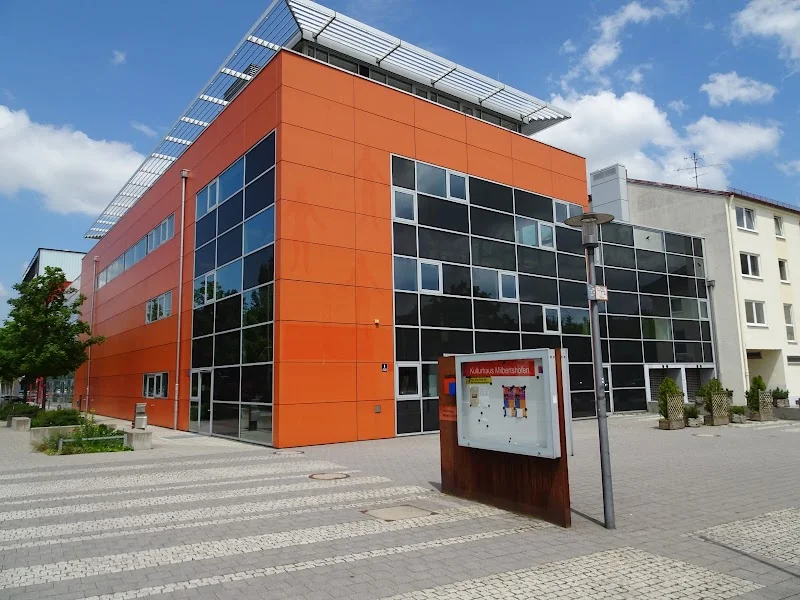
The Cultural Center Milbertshofen at Curt-Mezger-Platz 1 is a vibrant cultural venue in northern Munich and sees itself as an open house for the neighborhood, artistic formats, and community projects. On its own website, the facility describes itself as the largest district cultural center in Munich; the city of Munich lists it as one of the largest decentralized cultural centers in the state capital. Since its opening in 2005, it has become a versatile meeting point where concerts, readings, theater, workshops, club meetings, and discussion formats have their place alongside smaller and larger neighborhood initiatives. Particularly defining is the combination of event hall, foyer, group rooms, cultural café, and the adjacent outdoor areas, which make the place not only functional but also atmospherically strong. Those searching for Cultural Center Milbertshofen program, Cultural Center Milbertshofen events, or Cultural Center Milbertshofen today will find here not a rigid house with a single purpose, but an open center that makes cultural diversity visible in everyday life and consciously understands itself as a place for encounters. ([kulturhaus-milbertshofen.de](https://kulturhaus-milbertshofen.de/))
Events, Program, and Upcoming Dates
The program of the Cultural Center Milbertshofen is broadly structured and clearly follows the profile of a district cultural center that aims to appeal to as many target groups as possible. The website features a continuously updated section for events as well as a retrospective, making it easy to find current and past formats. The selection shows how diverse the house is utilized: In the official event pages, one can find, among other things, the Poetry Slam Stadtgeflüster, concert series like ProVokal, concert and choir evenings, Hoagartn, musical projects, cultural cafés, neighborhood dinners, and flea market formats. This caters precisely to the search intent behind terms like Cultural Center Milbertshofen upcoming events, program, or flea market, as it offers not only individual evenings but a whole spectrum of culture, encounters, and participation. Seasonal and recurring offerings are also part of the concept, such as the indoor flea market at the Cultural Center, which explicitly takes place in any weather and combines browsing, selling, and exchanging. Thus, a program emerges that is not limited to one genre but consciously brings together different interests. ([kulturhaus-milbertshofen.de](https://kulturhaus-milbertshofen.de/veranstaltungen/?utm_source=openai))
Particularly interesting is that the house, in its program design, not only reflects classic stage formats but also makes participatory and neighborhood offerings visible. The category Meeting Point Milbertshofen, for example, bundles open formats like yoga, language cafés, chess meetings, community music, consultation hours, and board game evenings. This shows that culture here is not conceived as a one-way street but as an everyday practice in the neighborhood. Therefore, those searching for Cultural Center Milbertshofen today or Cultural Center Milbertshofen upcoming events will find not only a monthly program but a place where music, language, exchange, play, and local networking intersect. Additionally, individual events are announced well in advance, such as recurring poetry slam dates or musical projects with rehearsal days and performances. This is practical for visitors as well as for families, clubs, or groups that specifically seek reliable cultural offerings. For SEO relevance, this means: The search volume is distributed across program, events, today, upcoming events, and flea market, and these topics are indeed present in the offerings of the house. ([kulturhaus-milbertshofen.de](https://kulturhaus-milbertshofen.de/mec-category/treffpunkt-milbertshofen/?utm_source=openai))
Renting Space: Hall, Foyer, and Other Rooms
A central theme around the Cultural Center Milbertshofen is room rental. The website directly refers to the possibility of inquiring about rooms without obligation and organizing bookings, and also specifies fixed consultation hours for this purpose. This is particularly relevant for anyone looking to rent space at Cultural Center Milbertshofen, as the house is explicitly not only a venue for its own program but also a rentable location for cultural and community projects. The city of Munich describes the facility as a hall plus foyer and also mentions barrier-free accessibility and various equipment features. In practice, this means: Anyone planning a reading, a rehearsal, a concert, a meeting, a workshop, or a larger private or non-profit event will find here not only a hall but a modular house structure with various levels of use. This makes the Cultural Center interesting for organizers who depend on flexible spaces and a central location in Munich. ([kulturhaus-milbertshofen.de](https://kulturhaus-milbertshofen.de/))
The room structure is remarkably versatile. According to the official hall capacities, the house on the ground floor includes the Erbslöh Hall with 270 square meters and a mobile stage, as well as a black box in the foyer area plus the front part of the hall, a foyer on the ground floor, and another foyer on the first floor. Additionally, on the second floor, there is a soundproof music room, the Toni-Pfülf room, the divisible Freundorfer room, and the Esther-Cohn room; on the third floor, among others, Triebenbacher and Martina-Badhorn follow. This variety explains why the house can be used for very different formats, from small workshops to larger cultural events. Particularly important for search queries related to renting space, hall plan, seats, or seating plan is: The Cultural Center not only offers a large hall but several rooms of different sizes and usage options, which can be combined or used separately as needed. This mix of size, flexibility, and neighborhood reference makes the house attractive for cultural carriers, clubs, and initiatives. ([kulturhaus-milbertshofen.de](https://kulturhaus-milbertshofen.de/wp-content/uploads/pdf-files/Saalkapazitaeten_03052022.pdf))
Capacity, Equipment, and Barrier-Free Use
In terms of capacity, it shows that the Cultural Center Milbertshofen is suitable for both small groups and significantly larger events. The city of Munich states a size class of 200 to 400 people for the entire facility. The detailed overview of the hall capacities specifies this further: The Erbslöh Hall accommodates up to 273 people in row seating, and up to 160 with tables; if the hall is reduced in size, 189 people in rows or 120 at tables are possible. For the black box, 60 or 30 seats are mentioned, for the gallery 26 or 20, for the music room 6, and for other rooms like Freundorfer, Esther-Cohn, Triebenbacher, and Martina-Badhorn, each smaller capacities. This is ideal for SEO topics like capacity, seating plan, best seats, and room size, as the information is concrete and reliable. At the same time, it shows that the location is not geared towards a single event format but consciously works with different room sizes. ([stadt.muenchen.de](https://stadt.muenchen.de/service/info/kulturhaus-milbertshofen/10102023/))
The equipment is also convincingly documented for cultural use. The city of Munich mentions seating, stage with curtain, piano, screen, barrier-free access, disabled toilet, and gastronomy as external operations. Additionally, there are power connections with 230 and 380 volts, internet access, PC network connections, lighting and sound technology with mixing console, and a projector. This makes the house suitable for both classical cultural events and for presentations, seminars, sound and light productions, or hybrid formats. Particularly relevant is the barrier-free access: step-free access, disabled parking, accessible entrance, and a disabled toilet are explicitly mentioned; furthermore, the city refers to access via MVV. In a current city contribution, the building is additionally described as a place with a large event hall, several group rooms, a music practice room, a two-story foyer with a cultural café, and the adjacent publicly accessible glass palace. This underscores how strongly the house is integrated into the public and cultural infrastructure of the neighborhood. ([stadt.muenchen.de](https://stadt.muenchen.de/service/info/kulturhaus-milbertshofen/10102023/))
Access, Opening Hours, and Parking
For practical planning, the opening hours of the Cultural Center Milbertshofen are clearly regulated: Tuesday to Sunday, the house is open from 12 to 20 hours, Monday is a rest day. Additionally, the website specifies consultation hours for administration and booking, so inquiries can be made not only by email but also in fixed defined time slots. For administration, Tuesday and Wednesday from 10 to 13 hours, for booking Tuesday and Thursday from 16 to 19 hours. This is particularly helpful for anyone needing short-term information about Cultural Center Milbertshofen opening hours, room rental, or upcoming events. The city of Munich also explicitly refers to the MVV for access, i.e., public transport, and a current information sheet about the musical project mentions the location at Curt-Mezger-Platz near U2 Milbertshofen. Those planning access thus have at least two reliable reference points: public transport connection and the exact location in the Milbertshofen district. ([kulturhaus-milbertshofen.de](https://kulturhaus-milbertshofen.de/))
Regarding parking, the data on the official pages is deliberately reserved but still useful. The municipal room list mentions disabled parking and step-free access; however, a general list of public parking spaces is not published there. This leads to one main conclusion for visitors: For a stress-free arrival, public transport should be planned, and those arriving by car should consider the specific traffic situation on-site. Precisely for this reason, the search interest in Cultural Center Milbertshofen parking is understandable, but the cleanest answer is not to promise an unoccupied parking situation but to refer to the existing, officially mentioned barrier-free and MVV indications. The house is centrally located in the neighborhood and thus easily accessible for many routes; however, the official communication does not provide a blanket statement about public parking spaces. This honesty is more important for a serious location description than any assumption. ([stadt.muenchen.de](https://stadt.muenchen.de/service/info/kulturhaus-milbertshofen/10102023/))
Cultural Café, Flea Market, Dancing, and Participation
The profile of the Cultural Center Milbertshofen includes not only the stage but also everyday life in the house. A current municipal document describes a two-story foyer with a cultural café and refers to the publicly accessible glass palace as an additional area. A call for the cultural café mentions 36 seats, an outdoor area, and a concept with a small but quality offering. This shows that the café is not just a side show but a central component of the house. This is complemented by offerings such as the vegan café, neighborhood dinners, open consultation hours, and cultural exchange in the foyer. Therefore, those searching for Cultural Center Milbertshofen café will find not just any bistro, but a place where encounters, sustainability, and neighborhood life come together. The cultural flea market is also officially documented: indoor flea market in any weather, with browsing, bargaining, live music, coffee gossip, and children's programs. Such formats explain why the house is so frequently searched in connection with flea market, event, and community. ([ru.muenchen.de](https://ru.muenchen.de/2025/27/Neuer-Betriebstraeger-fuer-das-Kulturhaus-Milbertshofen-116915))
The topic of dancing is also more than just a peripheral aspect in the house. On the participation page, the Cultural Center emphasizes that there are rooms for dancing, singing, playing, and trying things out together, and that people with their own ideas receive support in organization and public relations. Formats like Move & Feel, the musical workshop with dance, stage, and rehearsal phases, as well as open meetings and community offerings come into play. The house is thus not only designed for an audience but aims to enable active participation. For SEO logic, this is precisely crucial: users often search for dancing, café, today, or photos, but actually expect a place that practically enables culture. The Cultural Center meets this expectation with open spaces, citizen-friendly formats, and a clear invitation to co-design. Those coming here can not only watch but also participate, meet new groups, or try out their own ideas. This is an essential part of the character of this house and one of the reasons why it stands out so distinctly from a mere event hall in northern Munich. ([kulturhaus-milbertshofen.de](https://kulturhaus-milbertshofen.de/machen/?utm_source=openai))
History and Significance for Milbertshofen
The history of the Cultural Center Milbertshofen is closely linked to the neighborhood renovation and the cultural policy goals of Munich. A municipal document on the development of Milbertshofen describes that the city council already decided in 1986 to build a community center, that in May 2001 the vote for the cultural center at the corner of Schleißheimer and Keferloher Straße was unanimous, and that the cultural center was opened in 2005. Another municipal dossier adds that the construction was approved following decisions in 2001 and 2003, and the opening took place after almost two years of construction in July 2005. The house is therefore not a coincidence but the result of a long planning and renovation process aimed at establishing a stable center for social and cultural activities in the neighborhood. From the project emerged a place that not only hosts events but has also become a spatial focal point of the district. ([stadt.muenchen.de](https://stadt.muenchen.de/dam/jcr%3A6a2542f4-2d44-4372-be72-cf88f07fc48d/240617_Ausschreibung-Milbertshofen_FINAL.pdf))
The city description emphasizes that the Cultural Center, with around 4,700 square meters, is the largest district center in Munich in independent sponsorship and was planned by a Munich architectural firm. It was conceived from the beginning as a lively meeting place for people of different cultures, for young and old, and for residents far beyond the city district. This idea can still be felt today in the mix of hall, group rooms, cultural café, foyer, and public square. The Cultural Center Milbertshofen is therefore more than just a place for tickets and dates: it is a social anchor in the neighborhood, a space for formats from flea market to concert, from consultation hour to musical, and from workshop to poetry slam. So, those searching for Cultural Center Milbertshofen Munich are often looking for a place where culture, neighborhood, and participation come together. And this is what this house stands for to this day. ([stadt.muenchen.de](https://stadt.muenchen.de/dam/jcr%3A1acc0acd-8aac-4f3d-aee4-6c5216700ac5/Stadtteilsanierung_Milbertshofen.pdf))
Sources:
Show moreShow less
Cultural Center Milbertshofen | Program & Events
The Cultural Center Milbertshofen at Curt-Mezger-Platz 1 is a vibrant cultural venue in northern Munich and sees itself as an open house for the neighborhood, artistic formats, and community projects. On its own website, the facility describes itself as the largest district cultural center in Munich; the city of Munich lists it as one of the largest decentralized cultural centers in the state capital. Since its opening in 2005, it has become a versatile meeting point where concerts, readings, theater, workshops, club meetings, and discussion formats have their place alongside smaller and larger neighborhood initiatives. Particularly defining is the combination of event hall, foyer, group rooms, cultural café, and the adjacent outdoor areas, which make the place not only functional but also atmospherically strong. Those searching for Cultural Center Milbertshofen program, Cultural Center Milbertshofen events, or Cultural Center Milbertshofen today will find here not a rigid house with a single purpose, but an open center that makes cultural diversity visible in everyday life and consciously understands itself as a place for encounters. ([kulturhaus-milbertshofen.de](https://kulturhaus-milbertshofen.de/))
Events, Program, and Upcoming Dates
The program of the Cultural Center Milbertshofen is broadly structured and clearly follows the profile of a district cultural center that aims to appeal to as many target groups as possible. The website features a continuously updated section for events as well as a retrospective, making it easy to find current and past formats. The selection shows how diverse the house is utilized: In the official event pages, one can find, among other things, the Poetry Slam Stadtgeflüster, concert series like ProVokal, concert and choir evenings, Hoagartn, musical projects, cultural cafés, neighborhood dinners, and flea market formats. This caters precisely to the search intent behind terms like Cultural Center Milbertshofen upcoming events, program, or flea market, as it offers not only individual evenings but a whole spectrum of culture, encounters, and participation. Seasonal and recurring offerings are also part of the concept, such as the indoor flea market at the Cultural Center, which explicitly takes place in any weather and combines browsing, selling, and exchanging. Thus, a program emerges that is not limited to one genre but consciously brings together different interests. ([kulturhaus-milbertshofen.de](https://kulturhaus-milbertshofen.de/veranstaltungen/?utm_source=openai))
Particularly interesting is that the house, in its program design, not only reflects classic stage formats but also makes participatory and neighborhood offerings visible. The category Meeting Point Milbertshofen, for example, bundles open formats like yoga, language cafés, chess meetings, community music, consultation hours, and board game evenings. This shows that culture here is not conceived as a one-way street but as an everyday practice in the neighborhood. Therefore, those searching for Cultural Center Milbertshofen today or Cultural Center Milbertshofen upcoming events will find not only a monthly program but a place where music, language, exchange, play, and local networking intersect. Additionally, individual events are announced well in advance, such as recurring poetry slam dates or musical projects with rehearsal days and performances. This is practical for visitors as well as for families, clubs, or groups that specifically seek reliable cultural offerings. For SEO relevance, this means: The search volume is distributed across program, events, today, upcoming events, and flea market, and these topics are indeed present in the offerings of the house. ([kulturhaus-milbertshofen.de](https://kulturhaus-milbertshofen.de/mec-category/treffpunkt-milbertshofen/?utm_source=openai))
Renting Space: Hall, Foyer, and Other Rooms
A central theme around the Cultural Center Milbertshofen is room rental. The website directly refers to the possibility of inquiring about rooms without obligation and organizing bookings, and also specifies fixed consultation hours for this purpose. This is particularly relevant for anyone looking to rent space at Cultural Center Milbertshofen, as the house is explicitly not only a venue for its own program but also a rentable location for cultural and community projects. The city of Munich describes the facility as a hall plus foyer and also mentions barrier-free accessibility and various equipment features. In practice, this means: Anyone planning a reading, a rehearsal, a concert, a meeting, a workshop, or a larger private or non-profit event will find here not only a hall but a modular house structure with various levels of use. This makes the Cultural Center interesting for organizers who depend on flexible spaces and a central location in Munich. ([kulturhaus-milbertshofen.de](https://kulturhaus-milbertshofen.de/))
The room structure is remarkably versatile. According to the official hall capacities, the house on the ground floor includes the Erbslöh Hall with 270 square meters and a mobile stage, as well as a black box in the foyer area plus the front part of the hall, a foyer on the ground floor, and another foyer on the first floor. Additionally, on the second floor, there is a soundproof music room, the Toni-Pfülf room, the divisible Freundorfer room, and the Esther-Cohn room; on the third floor, among others, Triebenbacher and Martina-Badhorn follow. This variety explains why the house can be used for very different formats, from small workshops to larger cultural events. Particularly important for search queries related to renting space, hall plan, seats, or seating plan is: The Cultural Center not only offers a large hall but several rooms of different sizes and usage options, which can be combined or used separately as needed. This mix of size, flexibility, and neighborhood reference makes the house attractive for cultural carriers, clubs, and initiatives. ([kulturhaus-milbertshofen.de](https://kulturhaus-milbertshofen.de/wp-content/uploads/pdf-files/Saalkapazitaeten_03052022.pdf))
Capacity, Equipment, and Barrier-Free Use
In terms of capacity, it shows that the Cultural Center Milbertshofen is suitable for both small groups and significantly larger events. The city of Munich states a size class of 200 to 400 people for the entire facility. The detailed overview of the hall capacities specifies this further: The Erbslöh Hall accommodates up to 273 people in row seating, and up to 160 with tables; if the hall is reduced in size, 189 people in rows or 120 at tables are possible. For the black box, 60 or 30 seats are mentioned, for the gallery 26 or 20, for the music room 6, and for other rooms like Freundorfer, Esther-Cohn, Triebenbacher, and Martina-Badhorn, each smaller capacities. This is ideal for SEO topics like capacity, seating plan, best seats, and room size, as the information is concrete and reliable. At the same time, it shows that the location is not geared towards a single event format but consciously works with different room sizes. ([stadt.muenchen.de](https://stadt.muenchen.de/service/info/kulturhaus-milbertshofen/10102023/))
The equipment is also convincingly documented for cultural use. The city of Munich mentions seating, stage with curtain, piano, screen, barrier-free access, disabled toilet, and gastronomy as external operations. Additionally, there are power connections with 230 and 380 volts, internet access, PC network connections, lighting and sound technology with mixing console, and a projector. This makes the house suitable for both classical cultural events and for presentations, seminars, sound and light productions, or hybrid formats. Particularly relevant is the barrier-free access: step-free access, disabled parking, accessible entrance, and a disabled toilet are explicitly mentioned; furthermore, the city refers to access via MVV. In a current city contribution, the building is additionally described as a place with a large event hall, several group rooms, a music practice room, a two-story foyer with a cultural café, and the adjacent publicly accessible glass palace. This underscores how strongly the house is integrated into the public and cultural infrastructure of the neighborhood. ([stadt.muenchen.de](https://stadt.muenchen.de/service/info/kulturhaus-milbertshofen/10102023/))
Access, Opening Hours, and Parking
For practical planning, the opening hours of the Cultural Center Milbertshofen are clearly regulated: Tuesday to Sunday, the house is open from 12 to 20 hours, Monday is a rest day. Additionally, the website specifies consultation hours for administration and booking, so inquiries can be made not only by email but also in fixed defined time slots. For administration, Tuesday and Wednesday from 10 to 13 hours, for booking Tuesday and Thursday from 16 to 19 hours. This is particularly helpful for anyone needing short-term information about Cultural Center Milbertshofen opening hours, room rental, or upcoming events. The city of Munich also explicitly refers to the MVV for access, i.e., public transport, and a current information sheet about the musical project mentions the location at Curt-Mezger-Platz near U2 Milbertshofen. Those planning access thus have at least two reliable reference points: public transport connection and the exact location in the Milbertshofen district. ([kulturhaus-milbertshofen.de](https://kulturhaus-milbertshofen.de/))
Regarding parking, the data on the official pages is deliberately reserved but still useful. The municipal room list mentions disabled parking and step-free access; however, a general list of public parking spaces is not published there. This leads to one main conclusion for visitors: For a stress-free arrival, public transport should be planned, and those arriving by car should consider the specific traffic situation on-site. Precisely for this reason, the search interest in Cultural Center Milbertshofen parking is understandable, but the cleanest answer is not to promise an unoccupied parking situation but to refer to the existing, officially mentioned barrier-free and MVV indications. The house is centrally located in the neighborhood and thus easily accessible for many routes; however, the official communication does not provide a blanket statement about public parking spaces. This honesty is more important for a serious location description than any assumption. ([stadt.muenchen.de](https://stadt.muenchen.de/service/info/kulturhaus-milbertshofen/10102023/))
Cultural Café, Flea Market, Dancing, and Participation
The profile of the Cultural Center Milbertshofen includes not only the stage but also everyday life in the house. A current municipal document describes a two-story foyer with a cultural café and refers to the publicly accessible glass palace as an additional area. A call for the cultural café mentions 36 seats, an outdoor area, and a concept with a small but quality offering. This shows that the café is not just a side show but a central component of the house. This is complemented by offerings such as the vegan café, neighborhood dinners, open consultation hours, and cultural exchange in the foyer. Therefore, those searching for Cultural Center Milbertshofen café will find not just any bistro, but a place where encounters, sustainability, and neighborhood life come together. The cultural flea market is also officially documented: indoor flea market in any weather, with browsing, bargaining, live music, coffee gossip, and children's programs. Such formats explain why the house is so frequently searched in connection with flea market, event, and community. ([ru.muenchen.de](https://ru.muenchen.de/2025/27/Neuer-Betriebstraeger-fuer-das-Kulturhaus-Milbertshofen-116915))
The topic of dancing is also more than just a peripheral aspect in the house. On the participation page, the Cultural Center emphasizes that there are rooms for dancing, singing, playing, and trying things out together, and that people with their own ideas receive support in organization and public relations. Formats like Move & Feel, the musical workshop with dance, stage, and rehearsal phases, as well as open meetings and community offerings come into play. The house is thus not only designed for an audience but aims to enable active participation. For SEO logic, this is precisely crucial: users often search for dancing, café, today, or photos, but actually expect a place that practically enables culture. The Cultural Center meets this expectation with open spaces, citizen-friendly formats, and a clear invitation to co-design. Those coming here can not only watch but also participate, meet new groups, or try out their own ideas. This is an essential part of the character of this house and one of the reasons why it stands out so distinctly from a mere event hall in northern Munich. ([kulturhaus-milbertshofen.de](https://kulturhaus-milbertshofen.de/machen/?utm_source=openai))
History and Significance for Milbertshofen
The history of the Cultural Center Milbertshofen is closely linked to the neighborhood renovation and the cultural policy goals of Munich. A municipal document on the development of Milbertshofen describes that the city council already decided in 1986 to build a community center, that in May 2001 the vote for the cultural center at the corner of Schleißheimer and Keferloher Straße was unanimous, and that the cultural center was opened in 2005. Another municipal dossier adds that the construction was approved following decisions in 2001 and 2003, and the opening took place after almost two years of construction in July 2005. The house is therefore not a coincidence but the result of a long planning and renovation process aimed at establishing a stable center for social and cultural activities in the neighborhood. From the project emerged a place that not only hosts events but has also become a spatial focal point of the district. ([stadt.muenchen.de](https://stadt.muenchen.de/dam/jcr%3A6a2542f4-2d44-4372-be72-cf88f07fc48d/240617_Ausschreibung-Milbertshofen_FINAL.pdf))
The city description emphasizes that the Cultural Center, with around 4,700 square meters, is the largest district center in Munich in independent sponsorship and was planned by a Munich architectural firm. It was conceived from the beginning as a lively meeting place for people of different cultures, for young and old, and for residents far beyond the city district. This idea can still be felt today in the mix of hall, group rooms, cultural café, foyer, and public square. The Cultural Center Milbertshofen is therefore more than just a place for tickets and dates: it is a social anchor in the neighborhood, a space for formats from flea market to concert, from consultation hour to musical, and from workshop to poetry slam. So, those searching for Cultural Center Milbertshofen Munich are often looking for a place where culture, neighborhood, and participation come together. And this is what this house stands for to this day. ([stadt.muenchen.de](https://stadt.muenchen.de/dam/jcr%3A1acc0acd-8aac-4f3d-aee4-6c5216700ac5/Stadtteilsanierung_Milbertshofen.pdf))
Sources:
Cultural Center Milbertshofen | Program & Events
The Cultural Center Milbertshofen at Curt-Mezger-Platz 1 is a vibrant cultural venue in northern Munich and sees itself as an open house for the neighborhood, artistic formats, and community projects. On its own website, the facility describes itself as the largest district cultural center in Munich; the city of Munich lists it as one of the largest decentralized cultural centers in the state capital. Since its opening in 2005, it has become a versatile meeting point where concerts, readings, theater, workshops, club meetings, and discussion formats have their place alongside smaller and larger neighborhood initiatives. Particularly defining is the combination of event hall, foyer, group rooms, cultural café, and the adjacent outdoor areas, which make the place not only functional but also atmospherically strong. Those searching for Cultural Center Milbertshofen program, Cultural Center Milbertshofen events, or Cultural Center Milbertshofen today will find here not a rigid house with a single purpose, but an open center that makes cultural diversity visible in everyday life and consciously understands itself as a place for encounters. ([kulturhaus-milbertshofen.de](https://kulturhaus-milbertshofen.de/))
Events, Program, and Upcoming Dates
The program of the Cultural Center Milbertshofen is broadly structured and clearly follows the profile of a district cultural center that aims to appeal to as many target groups as possible. The website features a continuously updated section for events as well as a retrospective, making it easy to find current and past formats. The selection shows how diverse the house is utilized: In the official event pages, one can find, among other things, the Poetry Slam Stadtgeflüster, concert series like ProVokal, concert and choir evenings, Hoagartn, musical projects, cultural cafés, neighborhood dinners, and flea market formats. This caters precisely to the search intent behind terms like Cultural Center Milbertshofen upcoming events, program, or flea market, as it offers not only individual evenings but a whole spectrum of culture, encounters, and participation. Seasonal and recurring offerings are also part of the concept, such as the indoor flea market at the Cultural Center, which explicitly takes place in any weather and combines browsing, selling, and exchanging. Thus, a program emerges that is not limited to one genre but consciously brings together different interests. ([kulturhaus-milbertshofen.de](https://kulturhaus-milbertshofen.de/veranstaltungen/?utm_source=openai))
Particularly interesting is that the house, in its program design, not only reflects classic stage formats but also makes participatory and neighborhood offerings visible. The category Meeting Point Milbertshofen, for example, bundles open formats like yoga, language cafés, chess meetings, community music, consultation hours, and board game evenings. This shows that culture here is not conceived as a one-way street but as an everyday practice in the neighborhood. Therefore, those searching for Cultural Center Milbertshofen today or Cultural Center Milbertshofen upcoming events will find not only a monthly program but a place where music, language, exchange, play, and local networking intersect. Additionally, individual events are announced well in advance, such as recurring poetry slam dates or musical projects with rehearsal days and performances. This is practical for visitors as well as for families, clubs, or groups that specifically seek reliable cultural offerings. For SEO relevance, this means: The search volume is distributed across program, events, today, upcoming events, and flea market, and these topics are indeed present in the offerings of the house. ([kulturhaus-milbertshofen.de](https://kulturhaus-milbertshofen.de/mec-category/treffpunkt-milbertshofen/?utm_source=openai))
Renting Space: Hall, Foyer, and Other Rooms
A central theme around the Cultural Center Milbertshofen is room rental. The website directly refers to the possibility of inquiring about rooms without obligation and organizing bookings, and also specifies fixed consultation hours for this purpose. This is particularly relevant for anyone looking to rent space at Cultural Center Milbertshofen, as the house is explicitly not only a venue for its own program but also a rentable location for cultural and community projects. The city of Munich describes the facility as a hall plus foyer and also mentions barrier-free accessibility and various equipment features. In practice, this means: Anyone planning a reading, a rehearsal, a concert, a meeting, a workshop, or a larger private or non-profit event will find here not only a hall but a modular house structure with various levels of use. This makes the Cultural Center interesting for organizers who depend on flexible spaces and a central location in Munich. ([kulturhaus-milbertshofen.de](https://kulturhaus-milbertshofen.de/))
The room structure is remarkably versatile. According to the official hall capacities, the house on the ground floor includes the Erbslöh Hall with 270 square meters and a mobile stage, as well as a black box in the foyer area plus the front part of the hall, a foyer on the ground floor, and another foyer on the first floor. Additionally, on the second floor, there is a soundproof music room, the Toni-Pfülf room, the divisible Freundorfer room, and the Esther-Cohn room; on the third floor, among others, Triebenbacher and Martina-Badhorn follow. This variety explains why the house can be used for very different formats, from small workshops to larger cultural events. Particularly important for search queries related to renting space, hall plan, seats, or seating plan is: The Cultural Center not only offers a large hall but several rooms of different sizes and usage options, which can be combined or used separately as needed. This mix of size, flexibility, and neighborhood reference makes the house attractive for cultural carriers, clubs, and initiatives. ([kulturhaus-milbertshofen.de](https://kulturhaus-milbertshofen.de/wp-content/uploads/pdf-files/Saalkapazitaeten_03052022.pdf))
Capacity, Equipment, and Barrier-Free Use
In terms of capacity, it shows that the Cultural Center Milbertshofen is suitable for both small groups and significantly larger events. The city of Munich states a size class of 200 to 400 people for the entire facility. The detailed overview of the hall capacities specifies this further: The Erbslöh Hall accommodates up to 273 people in row seating, and up to 160 with tables; if the hall is reduced in size, 189 people in rows or 120 at tables are possible. For the black box, 60 or 30 seats are mentioned, for the gallery 26 or 20, for the music room 6, and for other rooms like Freundorfer, Esther-Cohn, Triebenbacher, and Martina-Badhorn, each smaller capacities. This is ideal for SEO topics like capacity, seating plan, best seats, and room size, as the information is concrete and reliable. At the same time, it shows that the location is not geared towards a single event format but consciously works with different room sizes. ([stadt.muenchen.de](https://stadt.muenchen.de/service/info/kulturhaus-milbertshofen/10102023/))
The equipment is also convincingly documented for cultural use. The city of Munich mentions seating, stage with curtain, piano, screen, barrier-free access, disabled toilet, and gastronomy as external operations. Additionally, there are power connections with 230 and 380 volts, internet access, PC network connections, lighting and sound technology with mixing console, and a projector. This makes the house suitable for both classical cultural events and for presentations, seminars, sound and light productions, or hybrid formats. Particularly relevant is the barrier-free access: step-free access, disabled parking, accessible entrance, and a disabled toilet are explicitly mentioned; furthermore, the city refers to access via MVV. In a current city contribution, the building is additionally described as a place with a large event hall, several group rooms, a music practice room, a two-story foyer with a cultural café, and the adjacent publicly accessible glass palace. This underscores how strongly the house is integrated into the public and cultural infrastructure of the neighborhood. ([stadt.muenchen.de](https://stadt.muenchen.de/service/info/kulturhaus-milbertshofen/10102023/))
Access, Opening Hours, and Parking
For practical planning, the opening hours of the Cultural Center Milbertshofen are clearly regulated: Tuesday to Sunday, the house is open from 12 to 20 hours, Monday is a rest day. Additionally, the website specifies consultation hours for administration and booking, so inquiries can be made not only by email but also in fixed defined time slots. For administration, Tuesday and Wednesday from 10 to 13 hours, for booking Tuesday and Thursday from 16 to 19 hours. This is particularly helpful for anyone needing short-term information about Cultural Center Milbertshofen opening hours, room rental, or upcoming events. The city of Munich also explicitly refers to the MVV for access, i.e., public transport, and a current information sheet about the musical project mentions the location at Curt-Mezger-Platz near U2 Milbertshofen. Those planning access thus have at least two reliable reference points: public transport connection and the exact location in the Milbertshofen district. ([kulturhaus-milbertshofen.de](https://kulturhaus-milbertshofen.de/))
Regarding parking, the data on the official pages is deliberately reserved but still useful. The municipal room list mentions disabled parking and step-free access; however, a general list of public parking spaces is not published there. This leads to one main conclusion for visitors: For a stress-free arrival, public transport should be planned, and those arriving by car should consider the specific traffic situation on-site. Precisely for this reason, the search interest in Cultural Center Milbertshofen parking is understandable, but the cleanest answer is not to promise an unoccupied parking situation but to refer to the existing, officially mentioned barrier-free and MVV indications. The house is centrally located in the neighborhood and thus easily accessible for many routes; however, the official communication does not provide a blanket statement about public parking spaces. This honesty is more important for a serious location description than any assumption. ([stadt.muenchen.de](https://stadt.muenchen.de/service/info/kulturhaus-milbertshofen/10102023/))
Cultural Café, Flea Market, Dancing, and Participation
The profile of the Cultural Center Milbertshofen includes not only the stage but also everyday life in the house. A current municipal document describes a two-story foyer with a cultural café and refers to the publicly accessible glass palace as an additional area. A call for the cultural café mentions 36 seats, an outdoor area, and a concept with a small but quality offering. This shows that the café is not just a side show but a central component of the house. This is complemented by offerings such as the vegan café, neighborhood dinners, open consultation hours, and cultural exchange in the foyer. Therefore, those searching for Cultural Center Milbertshofen café will find not just any bistro, but a place where encounters, sustainability, and neighborhood life come together. The cultural flea market is also officially documented: indoor flea market in any weather, with browsing, bargaining, live music, coffee gossip, and children's programs. Such formats explain why the house is so frequently searched in connection with flea market, event, and community. ([ru.muenchen.de](https://ru.muenchen.de/2025/27/Neuer-Betriebstraeger-fuer-das-Kulturhaus-Milbertshofen-116915))
The topic of dancing is also more than just a peripheral aspect in the house. On the participation page, the Cultural Center emphasizes that there are rooms for dancing, singing, playing, and trying things out together, and that people with their own ideas receive support in organization and public relations. Formats like Move & Feel, the musical workshop with dance, stage, and rehearsal phases, as well as open meetings and community offerings come into play. The house is thus not only designed for an audience but aims to enable active participation. For SEO logic, this is precisely crucial: users often search for dancing, café, today, or photos, but actually expect a place that practically enables culture. The Cultural Center meets this expectation with open spaces, citizen-friendly formats, and a clear invitation to co-design. Those coming here can not only watch but also participate, meet new groups, or try out their own ideas. This is an essential part of the character of this house and one of the reasons why it stands out so distinctly from a mere event hall in northern Munich. ([kulturhaus-milbertshofen.de](https://kulturhaus-milbertshofen.de/machen/?utm_source=openai))
History and Significance for Milbertshofen
The history of the Cultural Center Milbertshofen is closely linked to the neighborhood renovation and the cultural policy goals of Munich. A municipal document on the development of Milbertshofen describes that the city council already decided in 1986 to build a community center, that in May 2001 the vote for the cultural center at the corner of Schleißheimer and Keferloher Straße was unanimous, and that the cultural center was opened in 2005. Another municipal dossier adds that the construction was approved following decisions in 2001 and 2003, and the opening took place after almost two years of construction in July 2005. The house is therefore not a coincidence but the result of a long planning and renovation process aimed at establishing a stable center for social and cultural activities in the neighborhood. From the project emerged a place that not only hosts events but has also become a spatial focal point of the district. ([stadt.muenchen.de](https://stadt.muenchen.de/dam/jcr%3A6a2542f4-2d44-4372-be72-cf88f07fc48d/240617_Ausschreibung-Milbertshofen_FINAL.pdf))
The city description emphasizes that the Cultural Center, with around 4,700 square meters, is the largest district center in Munich in independent sponsorship and was planned by a Munich architectural firm. It was conceived from the beginning as a lively meeting place for people of different cultures, for young and old, and for residents far beyond the city district. This idea can still be felt today in the mix of hall, group rooms, cultural café, foyer, and public square. The Cultural Center Milbertshofen is therefore more than just a place for tickets and dates: it is a social anchor in the neighborhood, a space for formats from flea market to concert, from consultation hour to musical, and from workshop to poetry slam. So, those searching for Cultural Center Milbertshofen Munich are often looking for a place where culture, neighborhood, and participation come together. And this is what this house stands for to this day. ([stadt.muenchen.de](https://stadt.muenchen.de/dam/jcr%3A1acc0acd-8aac-4f3d-aee4-6c5216700ac5/Stadtteilsanierung_Milbertshofen.pdf))
Sources:
Frequently Asked Questions
Reviews
No reviews found