
München
Theatinerstraße 8, 80333 München, Deutschland
Kunsthalle Munich | Exhibition & Tickets
The Kunsthalle Munich is one of the most renowned exhibition venues in Germany, attracting around 350,000 visitors annually. Located in the heart of Munich's city center, it hosts three major exhibitions each year, focusing on various themes from painting, sculpture, graphics, photography, media art, crafts, design, and fashion. Since 2001, the venue has been situated in the area of the Five Courtyards; it was originally opened in 1985. With around 1,200 square meters of exhibition space, modern museum technology, and a clear visitor guidance system, the Kunsthalle presents significant themes in an understandable, sensory, and well-organized manner. Those searching for kunsthalle munich exhibition, kunsthalle munich current, kunsthalle munich tickets, or kunsthalle munich program will find a venue that combines strong content with a very central location. Queries about photos, parking, or free admission can also be answered quickly, as the Kunsthalle offers extensive information for visitors, tours, and orientation. ([kunsthalle-muc.de](https://www.kunsthalle-muc.de/ueber-uns/))
Current Exhibition: HAIR – POWER – DESIRE
The currently displayed main exhibition is titled HAIR – POWER – DESIRE and runs from March 20 to October 4, 2026. The exhibition addresses a theme that seems ordinary at first glance but actually delves deep into cultural history, identity, and power dynamics. Hair can express beauty and desire, conformity or rebellion, status or belonging. The Kunsthalle Munich presents this theme across cultures and time: Approximately 200 exhibits from antiquity to the present illustrate how diverse head and body hair can be interpreted in art, society, and self-representation. The exhibition features paintings, sculptures, photographs, video works, jewelry, furniture, design objects, and couture creations from significant international collections such as the Prado, the Louvre, and the Rijksmuseum. This creates not just a mere stylistic comparison, but a historical panorama of a motif that has shaped identity, role models, and political symbols over millennia. The exhibition is particularly relevant for anyone searching for kunsthalle munich hair or kunsthalle munich hair power desire, expecting a content-rich yet accessible cultural history. ([kunsthalle-muc.de](https://www.kunsthalle-muc.de/haar/))
In its narrative, the exhibition makes visible that hair is much more than a fashionable detail. It can demonstrate power, for example, when hairstyles mark social hierarchies or when hair is interpreted as a sign of dignity, loss of dignity, norm, or resistance. It can also serve as a stage for self-determination when individuals consciously alter their appearance, thereby expressing gender, belonging, or attitude. The Kunsthalle utilizes this complexity for a sensory journey through three millennia of art and cultural history. The interplay between well-known image motifs and surprising contemporary positions is particularly strong: From historical representations to iconic artworks to current pieces, the perspective is continually realigned. Therefore, visitors to the exhibition experience not just a theme, but a shift in perspective between biography, body, fashion, politics, and pop culture. The fact that the exhibition will be shown in a modified form from November 14, 2026, to April 18, 2027, at the Augustinermuseum Freiburg further underscores its curatorial relevance and reach. ([kunsthalle-muc.de](https://www.kunsthalle-muc.de/haar/))
Tickets, Admission Prices, and Free Admission
The Kunsthalle Munich follows a clear and well-structured pricing logic for tickets, which is easy to plan for families, groups, and individual visitors. For HAIR – POWER – DESIRE, the regular admission fee is 18 euros. Seniors aged 65 and over pay 14 euros, and children and teenagers aged 6 to 17 pay 4 euros. For students, trainees, and unemployed individuals aged 18 to 29, the admission fee is 8 euros. The same applies to individuals with a disability level of 50 to 90. Those with a disability level of 100 receive free admission. Children aged 0 to 5 also have free admission. For school classes, a price of 2 euros per student applies, but only with prior registration. Additionally, there is a family ticket for 36 euros and a small family ticket for 18 euros. This allows the Kunsthalle to cater to various visiting situations from individual visits to family outings while remaining transparent in its pricing. ([kunsthalle-muc.de](https://www.kunsthalle-muc.de/informationen/))
Those searching for kunsthalle munich free admission should know: General free admission is not offered, but several clearly defined free or reduced access options are available. These include the previously mentioned groups such as children aged 0 to 5 years and individuals with a disability level of 100. Additionally, the Kunsthalle refers to free tickets for refugees available through Bellevue di Monaco and the Munich Refugee Council. Tuesdays are particularly attractive, as there is a 50% discount on all admission prices, except on public holidays. Visitors can purchase tickets at the Kunsthalle box office during opening hours; certain discounted tickets can also be booked online, provided valid proof is presented on-site. This is practical for visitors, as it allows for flexible planning according to current schedules. Those who plan early can combine online tickets, travel, and possible tours directly, visiting the exhibition without waiting. ([kunsthalle-muc.de](https://www.kunsthalle-muc.de/informationen/))
Opening Hours, Directions, and Parking
The opening hours of the Kunsthalle Munich are very convenient for a centrally located cultural venue: Daily from 10 AM to 8 PM, including Sundays and public holidays. This makes a visit uncomplicated both during the week and on weekends. Particularly important for those searching for kunsthalle munich opening hours or kunsthalle munich current is the after-work event on every third Wednesday of the month, when the exhibition remains open until 10 PM. For HAIR – POWER – DESIRE, these extended opening hours are scheduled for April 15, May 20, June 17, July 15, and September 16, 2026; August 19 is excluded. Additionally, there are special opening hours for school classes on Wednesdays from 9 to 10 AM, but only with prior registration. This shows that the Kunsthalle is well organized for both spontaneous visits and educational offerings. ([kunsthalle-muc.de](https://www.kunsthalle-muc.de/informationen/))
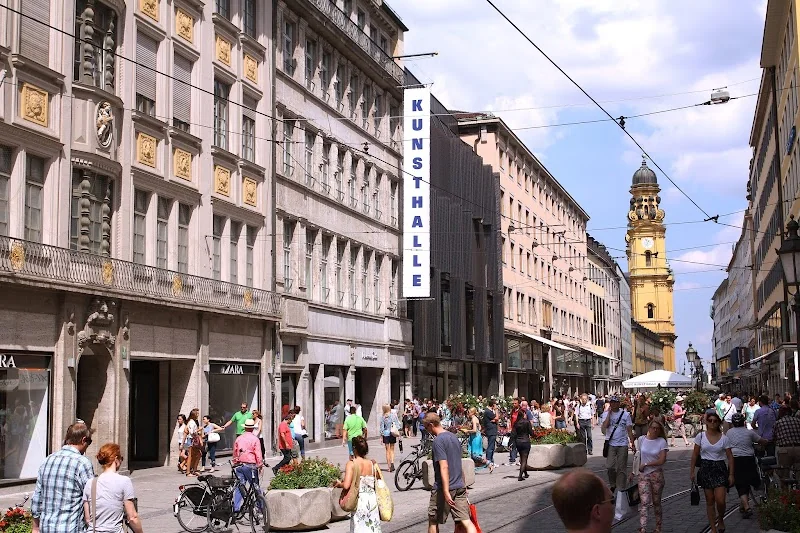
The directions are also clear and urban. The address is Theatinerstraße 8 in 80333 Munich, right in the middle of the Five Courtyards. The Kunsthalle can be reached by subway via Odeonsplatz or Marienplatz, and by S-Bahn via all lines to Marienplatz. Tram lines 19 and 21 stop at Theatinerstraße, and bus 100 goes to Odeonsplatz. For drivers, the underground garage in front of the opera at Max-Joseph-Platz 4 and the parking garage at Salvatorplatz 1 are recommended. There are also designated parking spaces for people with disabilities at Prannerstraße 7 and Salvatorplatz 2. Tour buses park at the Central Bus Station Munich in Arnulfstraße 21; the stopping point is Alfons-Goppel-Straße behind the National Theater. Those looking for a barrier-free route will also benefit from the elevators: In the ticket hall, a lift leads to the first floor, and another lift takes visitors to the exhibition level after ticket control. Thus, the Kunsthalle is not only centrally located but also practically accessible. ([kunsthalle-muc.de](https://www.kunsthalle-muc.de/informationen/))
Program, Tours, and Audio Tour
The program of the Kunsthalle Munich goes far beyond mere exhibition visits and is an important reason why many users search for kunsthalle munich program. Regular formats include Afterwork KH: On every third Wednesday of the month, the exhibition can be visited longer in the evening, often combined with music and other accompanying offerings. The Kunsthalle also offers special tours, including after-work tours aimed at visitors who want to use the evening culturally. Additionally, there are public tours in cooperation with the MVHS as well as offerings for private groups. This is particularly interesting for people who want to not only see an exhibition but also explore it in a shared context. For families and young visitors, there are additional formats such as accompanying booklets, children's tours during the holidays, and workshops in the children's art house. This keeps the venue exciting for repeated visits, as the program changes and complements depending on the target group. ([kunsthalle-muc.de](https://www.kunsthalle-muc.de/haar/))
Another advantage is the free audio tour. For the exhibition HAIR – POWER – DESIRE, the Kunsthalle provides an audio guide in German and English, which can be accessed both from home and in the exhibition with one's own mobile device. Visitors are advised to bring their own headphones, as loan devices are not provided. This is very practical for modern museum use, as it allows for an individual deepening of the visit without being tied to fixed times. Those also paying attention to kunsthalle munich photos or digital insights will find many image series and installation views on the official pages that visually prepare for or complement the exhibition afterward. Especially with a theme like hair, which ranges from historical paintings to contemporary photography, these visual previews work particularly well. The venue thus combines analog exhibition, digital mediation, and service offerings into a complete package that appeals to both spontaneous visitors and planning culture fans. ([kunsthalle-muc.de](https://www.kunsthalle-muc.de/haar/))
Digital by Nature and Miguel Chevalier
Even though the current main exhibition on-site is titled HAIR – POWER – DESIRE, the search interest in digital by nature and miguel chevalier is quite relevant for the Kunsthalle Munich. The Kunsthalle presented Digital by Nature. The Art of Miguel Chevalier, the largest solo exhibition of the artist in Europe to date. The exhibition ran from September 12, 2025, to March 1, 2026, and then continued its tour: On Tour from October 3, 2026, to April 4, 2027, at the Museum de Fundatie in Zwolle. Chevalier has been working with the computer as an artistic medium since the 1980s and continuously utilizes new technologies, including artificial intelligence. At the same time, his work maintains a dialogue with art and cultural history. This is very fitting for the Kunsthalle Munich, as the venue itself repeatedly mediates between historical themes and contemporary perspectives. The exhibition demonstrates that digital art does not only function on screens but can also have a strong, sensory impact in physical space. ([kunsthalle-muc.de](https://www.kunsthalle-muc.de/en/chevalier/))
For visitor communication, it is also interesting that the Kunsthalle offers a free audio tour for the Miguel Chevalier exhibition and publishes accompanying publications. This shows that digital art is treated not as a marginal topic but as a full-fledged exhibition area. The official pages of the Kunsthalle also make it clear that the venue regularly works with contemporary and interdisciplinary formats and does not only showcase historical themes. This explains the ongoing search interest in terms like kunsthalle munich miguel chevalier or kunsthalle munich digital by nature: Even if the exhibition on-site has now concluded, it remains present in public perception because it was one of the larger and more visible projects of the venue. Therefore, anyone wanting to understand the profile of the Kunsthalle should not only pay attention to the current exhibition but also consider such digital major exhibitions. They show how broad the spectrum of this exhibition house truly is. ([kunsthalle-muc.de](https://www.kunsthalle-muc.de/en/chevalier/))
History, Architecture, and Facilities
The history of the Kunsthalle Munich begins with the Hypo Cultural Foundation, which was established in 1983 by the then Hypotheken- und Wechselbank on the occasion of the 150th anniversary of the company. Two years later, on June 14, 1985, the Kunsthalle opened for the public for the first time. In 2001, the venue moved to its current premises in the area of the Five Courtyards, designed and realized by the Swiss architectural firm Herzog & de Meuron. This historical development is important because it explains why the Kunsthalle is so well integrated into Munich's city center today: it is not an isolated museum building but part of a vibrant urban ensemble. Approximately 1,200 square meters of exhibition space and modern museum technology create flexible opportunities for large, thematically changing special exhibitions. Since January 2013, Dr. Roger Diederen has been leading the Kunsthalle as director and continues to shape the program. This connects institutional continuity with curatorial flexibility. ([kunsthalle-muc.de](https://www.kunsthalle-muc.de/ueber-uns/))
The facilities also include many practical elements that make the stay more pleasant. The shop in the Five Courtyards, under the Hanging Gardens, offers a selection of products; however, shopping there on Sundays and public holidays is only possible with an exhibition ticket. The café-restaurant Theatiner 8 complements the visit with urban-Bavarian cuisine, café service, and a seasonal terrace. There are ample seating options in the exhibition and foyer, and the Kunsthalle points out that larger bags and backpacks are not allowed in the exhibition rooms. Elevators and designated parking spaces are available for people with mobility impairments. Wi-Fi, cloakroom, and additional service information are also described on the official pages. Those searching for kunsthalle munich photos will also find numerous images, installation views, and impressions on the pages that make the character of the venue visible. Overall, the Kunsthalle presents itself as a well-organized, central, and service-oriented cultural venue that works well for both quick visits and longer art afternoons. ([kunsthalle-muc.de](https://www.kunsthalle-muc.de/informationen/))
Sources:
Show moreShow less
Kunsthalle Munich | Exhibition & Tickets
The Kunsthalle Munich is one of the most renowned exhibition venues in Germany, attracting around 350,000 visitors annually. Located in the heart of Munich's city center, it hosts three major exhibitions each year, focusing on various themes from painting, sculpture, graphics, photography, media art, crafts, design, and fashion. Since 2001, the venue has been situated in the area of the Five Courtyards; it was originally opened in 1985. With around 1,200 square meters of exhibition space, modern museum technology, and a clear visitor guidance system, the Kunsthalle presents significant themes in an understandable, sensory, and well-organized manner. Those searching for kunsthalle munich exhibition, kunsthalle munich current, kunsthalle munich tickets, or kunsthalle munich program will find a venue that combines strong content with a very central location. Queries about photos, parking, or free admission can also be answered quickly, as the Kunsthalle offers extensive information for visitors, tours, and orientation. ([kunsthalle-muc.de](https://www.kunsthalle-muc.de/ueber-uns/))
Current Exhibition: HAIR – POWER – DESIRE
The currently displayed main exhibition is titled HAIR – POWER – DESIRE and runs from March 20 to October 4, 2026. The exhibition addresses a theme that seems ordinary at first glance but actually delves deep into cultural history, identity, and power dynamics. Hair can express beauty and desire, conformity or rebellion, status or belonging. The Kunsthalle Munich presents this theme across cultures and time: Approximately 200 exhibits from antiquity to the present illustrate how diverse head and body hair can be interpreted in art, society, and self-representation. The exhibition features paintings, sculptures, photographs, video works, jewelry, furniture, design objects, and couture creations from significant international collections such as the Prado, the Louvre, and the Rijksmuseum. This creates not just a mere stylistic comparison, but a historical panorama of a motif that has shaped identity, role models, and political symbols over millennia. The exhibition is particularly relevant for anyone searching for kunsthalle munich hair or kunsthalle munich hair power desire, expecting a content-rich yet accessible cultural history. ([kunsthalle-muc.de](https://www.kunsthalle-muc.de/haar/))
In its narrative, the exhibition makes visible that hair is much more than a fashionable detail. It can demonstrate power, for example, when hairstyles mark social hierarchies or when hair is interpreted as a sign of dignity, loss of dignity, norm, or resistance. It can also serve as a stage for self-determination when individuals consciously alter their appearance, thereby expressing gender, belonging, or attitude. The Kunsthalle utilizes this complexity for a sensory journey through three millennia of art and cultural history. The interplay between well-known image motifs and surprising contemporary positions is particularly strong: From historical representations to iconic artworks to current pieces, the perspective is continually realigned. Therefore, visitors to the exhibition experience not just a theme, but a shift in perspective between biography, body, fashion, politics, and pop culture. The fact that the exhibition will be shown in a modified form from November 14, 2026, to April 18, 2027, at the Augustinermuseum Freiburg further underscores its curatorial relevance and reach. ([kunsthalle-muc.de](https://www.kunsthalle-muc.de/haar/))
Tickets, Admission Prices, and Free Admission
The Kunsthalle Munich follows a clear and well-structured pricing logic for tickets, which is easy to plan for families, groups, and individual visitors. For HAIR – POWER – DESIRE, the regular admission fee is 18 euros. Seniors aged 65 and over pay 14 euros, and children and teenagers aged 6 to 17 pay 4 euros. For students, trainees, and unemployed individuals aged 18 to 29, the admission fee is 8 euros. The same applies to individuals with a disability level of 50 to 90. Those with a disability level of 100 receive free admission. Children aged 0 to 5 also have free admission. For school classes, a price of 2 euros per student applies, but only with prior registration. Additionally, there is a family ticket for 36 euros and a small family ticket for 18 euros. This allows the Kunsthalle to cater to various visiting situations from individual visits to family outings while remaining transparent in its pricing. ([kunsthalle-muc.de](https://www.kunsthalle-muc.de/informationen/))
Those searching for kunsthalle munich free admission should know: General free admission is not offered, but several clearly defined free or reduced access options are available. These include the previously mentioned groups such as children aged 0 to 5 years and individuals with a disability level of 100. Additionally, the Kunsthalle refers to free tickets for refugees available through Bellevue di Monaco and the Munich Refugee Council. Tuesdays are particularly attractive, as there is a 50% discount on all admission prices, except on public holidays. Visitors can purchase tickets at the Kunsthalle box office during opening hours; certain discounted tickets can also be booked online, provided valid proof is presented on-site. This is practical for visitors, as it allows for flexible planning according to current schedules. Those who plan early can combine online tickets, travel, and possible tours directly, visiting the exhibition without waiting. ([kunsthalle-muc.de](https://www.kunsthalle-muc.de/informationen/))
Opening Hours, Directions, and Parking
The opening hours of the Kunsthalle Munich are very convenient for a centrally located cultural venue: Daily from 10 AM to 8 PM, including Sundays and public holidays. This makes a visit uncomplicated both during the week and on weekends. Particularly important for those searching for kunsthalle munich opening hours or kunsthalle munich current is the after-work event on every third Wednesday of the month, when the exhibition remains open until 10 PM. For HAIR – POWER – DESIRE, these extended opening hours are scheduled for April 15, May 20, June 17, July 15, and September 16, 2026; August 19 is excluded. Additionally, there are special opening hours for school classes on Wednesdays from 9 to 10 AM, but only with prior registration. This shows that the Kunsthalle is well organized for both spontaneous visits and educational offerings. ([kunsthalle-muc.de](https://www.kunsthalle-muc.de/informationen/))
The directions are also clear and urban. The address is Theatinerstraße 8 in 80333 Munich, right in the middle of the Five Courtyards. The Kunsthalle can be reached by subway via Odeonsplatz or Marienplatz, and by S-Bahn via all lines to Marienplatz. Tram lines 19 and 21 stop at Theatinerstraße, and bus 100 goes to Odeonsplatz. For drivers, the underground garage in front of the opera at Max-Joseph-Platz 4 and the parking garage at Salvatorplatz 1 are recommended. There are also designated parking spaces for people with disabilities at Prannerstraße 7 and Salvatorplatz 2. Tour buses park at the Central Bus Station Munich in Arnulfstraße 21; the stopping point is Alfons-Goppel-Straße behind the National Theater. Those looking for a barrier-free route will also benefit from the elevators: In the ticket hall, a lift leads to the first floor, and another lift takes visitors to the exhibition level after ticket control. Thus, the Kunsthalle is not only centrally located but also practically accessible. ([kunsthalle-muc.de](https://www.kunsthalle-muc.de/informationen/))
Program, Tours, and Audio Tour
The program of the Kunsthalle Munich goes far beyond mere exhibition visits and is an important reason why many users search for kunsthalle munich program. Regular formats include Afterwork KH: On every third Wednesday of the month, the exhibition can be visited longer in the evening, often combined with music and other accompanying offerings. The Kunsthalle also offers special tours, including after-work tours aimed at visitors who want to use the evening culturally. Additionally, there are public tours in cooperation with the MVHS as well as offerings for private groups. This is particularly interesting for people who want to not only see an exhibition but also explore it in a shared context. For families and young visitors, there are additional formats such as accompanying booklets, children's tours during the holidays, and workshops in the children's art house. This keeps the venue exciting for repeated visits, as the program changes and complements depending on the target group. ([kunsthalle-muc.de](https://www.kunsthalle-muc.de/haar/))
Another advantage is the free audio tour. For the exhibition HAIR – POWER – DESIRE, the Kunsthalle provides an audio guide in German and English, which can be accessed both from home and in the exhibition with one's own mobile device. Visitors are advised to bring their own headphones, as loan devices are not provided. This is very practical for modern museum use, as it allows for an individual deepening of the visit without being tied to fixed times. Those also paying attention to kunsthalle munich photos or digital insights will find many image series and installation views on the official pages that visually prepare for or complement the exhibition afterward. Especially with a theme like hair, which ranges from historical paintings to contemporary photography, these visual previews work particularly well. The venue thus combines analog exhibition, digital mediation, and service offerings into a complete package that appeals to both spontaneous visitors and planning culture fans. ([kunsthalle-muc.de](https://www.kunsthalle-muc.de/haar/))
Digital by Nature and Miguel Chevalier
Even though the current main exhibition on-site is titled HAIR – POWER – DESIRE, the search interest in digital by nature and miguel chevalier is quite relevant for the Kunsthalle Munich. The Kunsthalle presented Digital by Nature. The Art of Miguel Chevalier, the largest solo exhibition of the artist in Europe to date. The exhibition ran from September 12, 2025, to March 1, 2026, and then continued its tour: On Tour from October 3, 2026, to April 4, 2027, at the Museum de Fundatie in Zwolle. Chevalier has been working with the computer as an artistic medium since the 1980s and continuously utilizes new technologies, including artificial intelligence. At the same time, his work maintains a dialogue with art and cultural history. This is very fitting for the Kunsthalle Munich, as the venue itself repeatedly mediates between historical themes and contemporary perspectives. The exhibition demonstrates that digital art does not only function on screens but can also have a strong, sensory impact in physical space. ([kunsthalle-muc.de](https://www.kunsthalle-muc.de/en/chevalier/))
For visitor communication, it is also interesting that the Kunsthalle offers a free audio tour for the Miguel Chevalier exhibition and publishes accompanying publications. This shows that digital art is treated not as a marginal topic but as a full-fledged exhibition area. The official pages of the Kunsthalle also make it clear that the venue regularly works with contemporary and interdisciplinary formats and does not only showcase historical themes. This explains the ongoing search interest in terms like kunsthalle munich miguel chevalier or kunsthalle munich digital by nature: Even if the exhibition on-site has now concluded, it remains present in public perception because it was one of the larger and more visible projects of the venue. Therefore, anyone wanting to understand the profile of the Kunsthalle should not only pay attention to the current exhibition but also consider such digital major exhibitions. They show how broad the spectrum of this exhibition house truly is. ([kunsthalle-muc.de](https://www.kunsthalle-muc.de/en/chevalier/))
History, Architecture, and Facilities
The history of the Kunsthalle Munich begins with the Hypo Cultural Foundation, which was established in 1983 by the then Hypotheken- und Wechselbank on the occasion of the 150th anniversary of the company. Two years later, on June 14, 1985, the Kunsthalle opened for the public for the first time. In 2001, the venue moved to its current premises in the area of the Five Courtyards, designed and realized by the Swiss architectural firm Herzog & de Meuron. This historical development is important because it explains why the Kunsthalle is so well integrated into Munich's city center today: it is not an isolated museum building but part of a vibrant urban ensemble. Approximately 1,200 square meters of exhibition space and modern museum technology create flexible opportunities for large, thematically changing special exhibitions. Since January 2013, Dr. Roger Diederen has been leading the Kunsthalle as director and continues to shape the program. This connects institutional continuity with curatorial flexibility. ([kunsthalle-muc.de](https://www.kunsthalle-muc.de/ueber-uns/))
The facilities also include many practical elements that make the stay more pleasant. The shop in the Five Courtyards, under the Hanging Gardens, offers a selection of products; however, shopping there on Sundays and public holidays is only possible with an exhibition ticket. The café-restaurant Theatiner 8 complements the visit with urban-Bavarian cuisine, café service, and a seasonal terrace. There are ample seating options in the exhibition and foyer, and the Kunsthalle points out that larger bags and backpacks are not allowed in the exhibition rooms. Elevators and designated parking spaces are available for people with mobility impairments. Wi-Fi, cloakroom, and additional service information are also described on the official pages. Those searching for kunsthalle munich photos will also find numerous images, installation views, and impressions on the pages that make the character of the venue visible. Overall, the Kunsthalle presents itself as a well-organized, central, and service-oriented cultural venue that works well for both quick visits and longer art afternoons. ([kunsthalle-muc.de](https://www.kunsthalle-muc.de/informationen/))
Sources:
Kunsthalle Munich | Exhibition & Tickets
The Kunsthalle Munich is one of the most renowned exhibition venues in Germany, attracting around 350,000 visitors annually. Located in the heart of Munich's city center, it hosts three major exhibitions each year, focusing on various themes from painting, sculpture, graphics, photography, media art, crafts, design, and fashion. Since 2001, the venue has been situated in the area of the Five Courtyards; it was originally opened in 1985. With around 1,200 square meters of exhibition space, modern museum technology, and a clear visitor guidance system, the Kunsthalle presents significant themes in an understandable, sensory, and well-organized manner. Those searching for kunsthalle munich exhibition, kunsthalle munich current, kunsthalle munich tickets, or kunsthalle munich program will find a venue that combines strong content with a very central location. Queries about photos, parking, or free admission can also be answered quickly, as the Kunsthalle offers extensive information for visitors, tours, and orientation. ([kunsthalle-muc.de](https://www.kunsthalle-muc.de/ueber-uns/))
Current Exhibition: HAIR – POWER – DESIRE
The currently displayed main exhibition is titled HAIR – POWER – DESIRE and runs from March 20 to October 4, 2026. The exhibition addresses a theme that seems ordinary at first glance but actually delves deep into cultural history, identity, and power dynamics. Hair can express beauty and desire, conformity or rebellion, status or belonging. The Kunsthalle Munich presents this theme across cultures and time: Approximately 200 exhibits from antiquity to the present illustrate how diverse head and body hair can be interpreted in art, society, and self-representation. The exhibition features paintings, sculptures, photographs, video works, jewelry, furniture, design objects, and couture creations from significant international collections such as the Prado, the Louvre, and the Rijksmuseum. This creates not just a mere stylistic comparison, but a historical panorama of a motif that has shaped identity, role models, and political symbols over millennia. The exhibition is particularly relevant for anyone searching for kunsthalle munich hair or kunsthalle munich hair power desire, expecting a content-rich yet accessible cultural history. ([kunsthalle-muc.de](https://www.kunsthalle-muc.de/haar/))
In its narrative, the exhibition makes visible that hair is much more than a fashionable detail. It can demonstrate power, for example, when hairstyles mark social hierarchies or when hair is interpreted as a sign of dignity, loss of dignity, norm, or resistance. It can also serve as a stage for self-determination when individuals consciously alter their appearance, thereby expressing gender, belonging, or attitude. The Kunsthalle utilizes this complexity for a sensory journey through three millennia of art and cultural history. The interplay between well-known image motifs and surprising contemporary positions is particularly strong: From historical representations to iconic artworks to current pieces, the perspective is continually realigned. Therefore, visitors to the exhibition experience not just a theme, but a shift in perspective between biography, body, fashion, politics, and pop culture. The fact that the exhibition will be shown in a modified form from November 14, 2026, to April 18, 2027, at the Augustinermuseum Freiburg further underscores its curatorial relevance and reach. ([kunsthalle-muc.de](https://www.kunsthalle-muc.de/haar/))
Tickets, Admission Prices, and Free Admission
The Kunsthalle Munich follows a clear and well-structured pricing logic for tickets, which is easy to plan for families, groups, and individual visitors. For HAIR – POWER – DESIRE, the regular admission fee is 18 euros. Seniors aged 65 and over pay 14 euros, and children and teenagers aged 6 to 17 pay 4 euros. For students, trainees, and unemployed individuals aged 18 to 29, the admission fee is 8 euros. The same applies to individuals with a disability level of 50 to 90. Those with a disability level of 100 receive free admission. Children aged 0 to 5 also have free admission. For school classes, a price of 2 euros per student applies, but only with prior registration. Additionally, there is a family ticket for 36 euros and a small family ticket for 18 euros. This allows the Kunsthalle to cater to various visiting situations from individual visits to family outings while remaining transparent in its pricing. ([kunsthalle-muc.de](https://www.kunsthalle-muc.de/informationen/))
Those searching for kunsthalle munich free admission should know: General free admission is not offered, but several clearly defined free or reduced access options are available. These include the previously mentioned groups such as children aged 0 to 5 years and individuals with a disability level of 100. Additionally, the Kunsthalle refers to free tickets for refugees available through Bellevue di Monaco and the Munich Refugee Council. Tuesdays are particularly attractive, as there is a 50% discount on all admission prices, except on public holidays. Visitors can purchase tickets at the Kunsthalle box office during opening hours; certain discounted tickets can also be booked online, provided valid proof is presented on-site. This is practical for visitors, as it allows for flexible planning according to current schedules. Those who plan early can combine online tickets, travel, and possible tours directly, visiting the exhibition without waiting. ([kunsthalle-muc.de](https://www.kunsthalle-muc.de/informationen/))
Opening Hours, Directions, and Parking
The opening hours of the Kunsthalle Munich are very convenient for a centrally located cultural venue: Daily from 10 AM to 8 PM, including Sundays and public holidays. This makes a visit uncomplicated both during the week and on weekends. Particularly important for those searching for kunsthalle munich opening hours or kunsthalle munich current is the after-work event on every third Wednesday of the month, when the exhibition remains open until 10 PM. For HAIR – POWER – DESIRE, these extended opening hours are scheduled for April 15, May 20, June 17, July 15, and September 16, 2026; August 19 is excluded. Additionally, there are special opening hours for school classes on Wednesdays from 9 to 10 AM, but only with prior registration. This shows that the Kunsthalle is well organized for both spontaneous visits and educational offerings. ([kunsthalle-muc.de](https://www.kunsthalle-muc.de/informationen/))
The directions are also clear and urban. The address is Theatinerstraße 8 in 80333 Munich, right in the middle of the Five Courtyards. The Kunsthalle can be reached by subway via Odeonsplatz or Marienplatz, and by S-Bahn via all lines to Marienplatz. Tram lines 19 and 21 stop at Theatinerstraße, and bus 100 goes to Odeonsplatz. For drivers, the underground garage in front of the opera at Max-Joseph-Platz 4 and the parking garage at Salvatorplatz 1 are recommended. There are also designated parking spaces for people with disabilities at Prannerstraße 7 and Salvatorplatz 2. Tour buses park at the Central Bus Station Munich in Arnulfstraße 21; the stopping point is Alfons-Goppel-Straße behind the National Theater. Those looking for a barrier-free route will also benefit from the elevators: In the ticket hall, a lift leads to the first floor, and another lift takes visitors to the exhibition level after ticket control. Thus, the Kunsthalle is not only centrally located but also practically accessible. ([kunsthalle-muc.de](https://www.kunsthalle-muc.de/informationen/))
Program, Tours, and Audio Tour
The program of the Kunsthalle Munich goes far beyond mere exhibition visits and is an important reason why many users search for kunsthalle munich program. Regular formats include Afterwork KH: On every third Wednesday of the month, the exhibition can be visited longer in the evening, often combined with music and other accompanying offerings. The Kunsthalle also offers special tours, including after-work tours aimed at visitors who want to use the evening culturally. Additionally, there are public tours in cooperation with the MVHS as well as offerings for private groups. This is particularly interesting for people who want to not only see an exhibition but also explore it in a shared context. For families and young visitors, there are additional formats such as accompanying booklets, children's tours during the holidays, and workshops in the children's art house. This keeps the venue exciting for repeated visits, as the program changes and complements depending on the target group. ([kunsthalle-muc.de](https://www.kunsthalle-muc.de/haar/))
Another advantage is the free audio tour. For the exhibition HAIR – POWER – DESIRE, the Kunsthalle provides an audio guide in German and English, which can be accessed both from home and in the exhibition with one's own mobile device. Visitors are advised to bring their own headphones, as loan devices are not provided. This is very practical for modern museum use, as it allows for an individual deepening of the visit without being tied to fixed times. Those also paying attention to kunsthalle munich photos or digital insights will find many image series and installation views on the official pages that visually prepare for or complement the exhibition afterward. Especially with a theme like hair, which ranges from historical paintings to contemporary photography, these visual previews work particularly well. The venue thus combines analog exhibition, digital mediation, and service offerings into a complete package that appeals to both spontaneous visitors and planning culture fans. ([kunsthalle-muc.de](https://www.kunsthalle-muc.de/haar/))
Digital by Nature and Miguel Chevalier
Even though the current main exhibition on-site is titled HAIR – POWER – DESIRE, the search interest in digital by nature and miguel chevalier is quite relevant for the Kunsthalle Munich. The Kunsthalle presented Digital by Nature. The Art of Miguel Chevalier, the largest solo exhibition of the artist in Europe to date. The exhibition ran from September 12, 2025, to March 1, 2026, and then continued its tour: On Tour from October 3, 2026, to April 4, 2027, at the Museum de Fundatie in Zwolle. Chevalier has been working with the computer as an artistic medium since the 1980s and continuously utilizes new technologies, including artificial intelligence. At the same time, his work maintains a dialogue with art and cultural history. This is very fitting for the Kunsthalle Munich, as the venue itself repeatedly mediates between historical themes and contemporary perspectives. The exhibition demonstrates that digital art does not only function on screens but can also have a strong, sensory impact in physical space. ([kunsthalle-muc.de](https://www.kunsthalle-muc.de/en/chevalier/))
For visitor communication, it is also interesting that the Kunsthalle offers a free audio tour for the Miguel Chevalier exhibition and publishes accompanying publications. This shows that digital art is treated not as a marginal topic but as a full-fledged exhibition area. The official pages of the Kunsthalle also make it clear that the venue regularly works with contemporary and interdisciplinary formats and does not only showcase historical themes. This explains the ongoing search interest in terms like kunsthalle munich miguel chevalier or kunsthalle munich digital by nature: Even if the exhibition on-site has now concluded, it remains present in public perception because it was one of the larger and more visible projects of the venue. Therefore, anyone wanting to understand the profile of the Kunsthalle should not only pay attention to the current exhibition but also consider such digital major exhibitions. They show how broad the spectrum of this exhibition house truly is. ([kunsthalle-muc.de](https://www.kunsthalle-muc.de/en/chevalier/))
History, Architecture, and Facilities
The history of the Kunsthalle Munich begins with the Hypo Cultural Foundation, which was established in 1983 by the then Hypotheken- und Wechselbank on the occasion of the 150th anniversary of the company. Two years later, on June 14, 1985, the Kunsthalle opened for the public for the first time. In 2001, the venue moved to its current premises in the area of the Five Courtyards, designed and realized by the Swiss architectural firm Herzog & de Meuron. This historical development is important because it explains why the Kunsthalle is so well integrated into Munich's city center today: it is not an isolated museum building but part of a vibrant urban ensemble. Approximately 1,200 square meters of exhibition space and modern museum technology create flexible opportunities for large, thematically changing special exhibitions. Since January 2013, Dr. Roger Diederen has been leading the Kunsthalle as director and continues to shape the program. This connects institutional continuity with curatorial flexibility. ([kunsthalle-muc.de](https://www.kunsthalle-muc.de/ueber-uns/))
The facilities also include many practical elements that make the stay more pleasant. The shop in the Five Courtyards, under the Hanging Gardens, offers a selection of products; however, shopping there on Sundays and public holidays is only possible with an exhibition ticket. The café-restaurant Theatiner 8 complements the visit with urban-Bavarian cuisine, café service, and a seasonal terrace. There are ample seating options in the exhibition and foyer, and the Kunsthalle points out that larger bags and backpacks are not allowed in the exhibition rooms. Elevators and designated parking spaces are available for people with mobility impairments. Wi-Fi, cloakroom, and additional service information are also described on the official pages. Those searching for kunsthalle munich photos will also find numerous images, installation views, and impressions on the pages that make the character of the venue visible. Overall, the Kunsthalle presents itself as a well-organized, central, and service-oriented cultural venue that works well for both quick visits and longer art afternoons. ([kunsthalle-muc.de](https://www.kunsthalle-muc.de/informationen/))
Sources:
Upcoming Events
No events found
Frequently Asked Questions
Reviews
Iestyn Dallimore
17. November 2025
Interesting exhibition showcasing Miguel Chevalier's digital artwork across a single floor (but a large exhibit). I found the museum itself quite well organised and straightforward albeit a bit expensive, and found the exhibition intriguing and engaging. For the price I paid, I was expecting a bit more than I got - as we were in and out within about half hour (I couldn't see the exhibit lasting more than an hour).
A K
25. January 2026
It’s a decent art gallery, however there are more impressive ones in Munich. We went to a digital art show, and we spent a little over an hour there. It’s immersive and some displays are great, but it did not feel worth the price (18€ per person) and the art was not the type that we were impressed by.
Lauren
6. December 2025
Such a cool museum I’ve visited 2 exhibits that were there and they are so edgy and so cool I really liked it! even though it’s a bit expensive for the size I would say it’s definitely worth it because they have such cool exhibits there!
Kateryna Bielka
29. October 2025
I’ve really enjoyed the exhibition of digital art. Even I had my 6 y o daughter with me, she also was interested in.
robert
7. January 2026
Dazzling digital displays. Some really fascinating. Could use more seating & clearer directions.