
München
Dachauer Str. 90, 80335 München, Deutschland
KUNSTLABOR 2 - Art & Culture Center Munich | Tickets & Directions
KUNSTLABOR 2 in Munich is much more than a classic exhibition venue: The official website describes the project as Munich's largest cultural interim use project, opened on October 16, 2021, in the former health house at Dachauer Straße 90. Spanning 15,000 m², art, culture, changing exhibitions, guided tours, workshops, events, and gastronomy come together to create a place where one does not just look but experiences, tries out, and lingers. This mix makes the location exciting for visitors looking for current events, unique photo opportunities, creative formats, and a central Munich location. KUNSTLABOR 2 is located in Maxvorstadt, a district that benefits from the art area, the old town, and many urban pathways. Those looking for tickets, directions, photos, or programs will find a location that consciously navigates between museum, experiential space, and event address. ([kunstlabor.org](https://kunstlabor.org/))
Tickets, Opening Hours, and Spontaneous Visits at KUNSTLABOR 2
Those wishing to visit KUNSTLABOR 2 will find a clear and straightforward ticketing process. The official ticket page lists both online pre-sale and box office options for visits. Particularly convenient is that spontaneous visits during opening hours are explicitly allowed, making the venue attractive for people who do not want to commit long in advance. The standard admission is 12 euros, reduced tickets are 8 euros, children aged 3 to 17 pay 5 euros, and a family ticket for two adults and three children costs 29 euros. A separate pricing model is provided for guided tours, which already includes admission. This makes the location suitable not only for a quick art visit but also for a planned family day, an outing with friends, or a targeted cultural appointment. The ticket structure is thus easy to understand and versatile enough to appeal to different target groups. ([kunstlabor.org](https://kunstlabor.org/tickets/))
The opening hours are also clearly designed for visitor friendliness. The current page on opening hours states that the exhibition spaces are open on Saturdays and Sundays from 10 AM to 4 PM, with the last admission at 3:15 PM. This is a helpful detail for those who want to plan their visit precisely, for example, if a restaurant visit or a walk through Maxvorstadt is planned before or after the exhibition tour. Additionally, the website points out that guided tours, workshops, and inquiries for school classes are offered individually and must be booked online in advance. Dogs are not allowed in the building, which is important for planning with pets. Overall, the visit is organized in such a way that both spontaneous guests and planning groups receive clear orientation. Especially in a location with changing program points, this transparency is a plus because it makes travel, ticket booking, and the actual timeframe of the stay reliable. ([kunstlabor.org](https://kunstlabor.org/oeffnungszeiten/))
Directions, Parking, and Barrier-Free Access at Dachauer Straße 90
The location of KUNSTLABOR 2 is extremely convenient for visitors to Munich. The directions page states that the venue is located in the former health house at Dachauer Straße 90. Right outside the door is the tram stop Sandstraße with lines 20 and 21. Those coming by subway can reach Stiglmaierplatz on line U1 or U7 in about two minutes on foot; the Theresienstraße station of line U2 is about a six-minute walk away. For those who want to combine their visit with a city walk, it is also important that both the old town and the art area are only a few minutes' walk away. This makes it easy to combine a cultural visit at KUNSTLABOR 2 with other destinations in the city center. This central location makes the venue particularly attractive for anyone wanting to dive directly into the program without a long detour. ([kunstlabor.org](https://kunstlabor.org/en/anfahrt/))
The official website also provides concrete information about parking: Public parking spaces are available along Dachauer Straße and Maßmannstraße. While this is not a classic parking garage directly at the building, it is useful and honest information for a central city location that makes the visit realistically planable. Additionally, the website emphasizes that KUNSTLABOR 2 is barrier-free. For many visitors, this is a crucial factor, as it significantly eases access to art and events. The gastronomic aspect further complements the location description with another orientation anchor: The restaurant AMARi is described as a meeting place in Maxvorstadt between Stiglmaierplatz and Maßmannpark. Together with the good tram and subway connections, this results in a location that is equally suitable for cultural appointments, family outings, workshops, and event visits. Those looking for a location that is central, accessible, and clearly described will find very usable conditions here. ([kunstlabor.org](https://kunstlabor.org/en/anfahrt/))
Exhibitions, Guided Tours, and Workshops for Families, Kids, and Adults
The heart of KUNSTLABOR 2 is the experiential content. The website describes the location as a place with permanent room installations and changing exhibitions. This is complemented by guided tours, workshops, film days, concerts, readings, workshops, performances, and other cultural formats. The current focus is, among other things, on the exhibition SETH's SPIEL(T)RÄUME, which is described on the homepage as an experience for families in Munich and is aimed at children from 3 to 103 years old. This is a deliberately low-threshold approach that does not stage art as purely distanced viewing but as a playful, interactive environment. Especially for families or visitors who like to experience art very directly, this mix of image, space, and movement is exciting. At the same time, the venue shows that it wants to be not only an exhibition space but also a place of experience and education. ([kunstlabor.org](https://kunstlabor.org/))
The workshop and event offerings are also clearly focused on diversity. In the ticket and shop structure, workshops for adults, teenagers, kids, and families are listed, as well as a children's program with creative workshops, scavenger hunts, and children's birthdays. The current event calendar features specific formats such as graffiti workshops for beginners, character design on canvas, and family tours. This shows how strongly KUNSTLABOR 2 focuses on active participation rather than mere observation. Particularly interesting is that the offerings are not only intended for art professionals but explicitly also for beginners, families, and younger target groups. This creates a lively mix of learning, participation, and discovery. So, those looking for a program that goes beyond classic exhibitions and simultaneously offers real creative practice will find a location with a wide thematic range. The combination of exhibition, workshop, guided tour, and current calendar logic is a clear SEO and user advantage because it serves various search intentions under one roof. ([kunstlabor.org](https://kunstlabor.org/tickets/))
The Former Health House and Munich's Cultural Interim Use
The history of KUNSTLABOR 2 is closely tied to the idea of cultural interim use. According to the official concept page, the project is a continuation of a successful interim use project by the Museum of Urban and Contemporary Art, where in 2018/19, the vacant Tengelmann complex was transformed into a walkable work of art with 50 artists. In spring 2019, MUCA then applied for Munich's largest cultural interim use project, the former health house on Dachauer Straße. The city of Munich chose MUCA as a partner in a multi-stage selection process. This development is important because it explains why KUNSTLABOR 2 does not feel like a classic, monolithic museum but rather like a mutable cultural space where different rooms, disciplines, and uses come together. The official opening on October 16, 2021, did not mark the end but the beginning of a place that is consciously designed for change. ([kunstlabor.org](https://kunstlabor.org/kulturelle-zwischennutzung/))
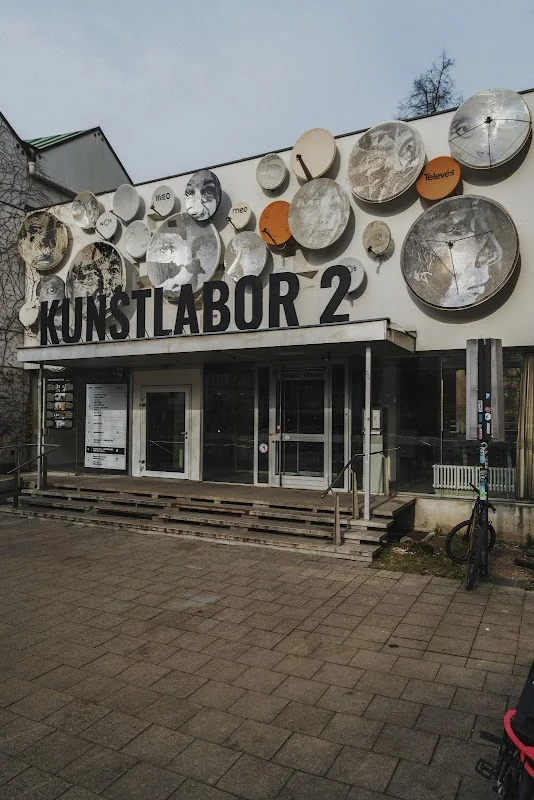
The architectural dimension also makes it clear why the location is so present in the urban space. The website describes KUNSTLABOR 2 as a new center for art and culture that has emerged on the site of the former health house. At the same time, the building, with its various levels, interior spaces, and outdoor areas, is presented as a large cultural space. Particularly striking is the park-like outdoor area, which transforms into a large art and urban garden in summer. Additionally, the changing facade, whose design process visitors can follow repeatedly, adds to the interest. This is a key reason why the location is also appealing for photos and social media content: interior spaces, outdoor areas, and facade design continuously provide new motifs. The house is thus interesting not only because of its program but also because of its visible transformability. This combination of building, art, and constant transformation makes KUNSTLABOR 2 a place with its own character and clear recognizability. ([kunstlabor.org](https://kunstlabor.org/kulturelle-zwischennutzung/))
Gastronomy, Outdoor Terrace, and the Urban Garden in Summer
The experience world of KUNSTLABOR 2 also includes gastronomy. The in-house restaurant AMARi is described on the website as the culinary component of the house. According to the official representation, it offers an excellent lunch menu, coffee and cake, as well as a high-quality bar menu with selected wines, its own aperitif creations, and cocktails. Particularly important for the orientation of the house is also the culinary background of the team: AMARi originally comes from the street food sector and focuses on regional and seasonal products. This fits excellently with the creative identity of the place, as here not just eating takes place, but a modern, urban, and simultaneously high-quality meeting point is created. For visitors, this means: An exhibition or workshop visit can be very easily combined with food, drinks, or a longer stay. The restaurant thus becomes a practical and atmospheric part of the overall visit. ([kunstlabor.org](https://kunstlabor.org/gastronomie/))
The location of the restaurant is also crucial for the atmosphere. The website emphasizes the large outdoor terrace and describes AMARi as a meeting place in Maxvorstadt, centrally located between Stiglmaierplatz and Maßmannpark. Together with the park-like outdoor area of KUNSTLABOR 2 and the seasonal urban garden feel in summer, this creates a place that offers many qualities of stay both inside and outside. This is particularly relevant for visitors looking for photos, impressions, and a special atmosphere: The combination of art, terrace, garden character, and changing facade creates a backdrop that clearly distinguishes itself from many other event and exhibition venues. Those wanting a relaxed cultural stop combined with food, drinks, and a moment to breathe will find a location that seems designed precisely for that. The connection between art and gastronomy is not merely decorative but actively contributes to turning a visit into a longer stay. ([kunstlabor.org](https://kunstlabor.org/gastronomie/))
Event Location, Rooms, and Rentals for Creative Formats
For organizers, KUNSTLABOR 2 is also interesting as an event location because the website lists several specifically named rooms for rent. These include the foyer with 70 m², the pop-up gallery with 120 m², the event room with 180 m², courtyard 1 terrace with 270 m², courtyard 2 graffiti with 270 m², the showroom with 400 m², and the intermediate space with 80 m². This listing shows that the house does not just offer a single large area but various room sizes and atmospheres for different formats. Depending on the occasion, a smaller workshop, a presentation, a networking event, or a larger cultural activation can be planned. For SEO and for visitors, this is a strong signal because the search interest around event location, room rental, and program meets a clear structure here. The variety of spaces also underscores that the location can flexibly respond to different needs. ([kunstlabor.org](https://kunstlabor.org/tickets/))
Additionally, the official website mentions not only event spaces but also studios, offices, and workshops in KUNSTLABOR 2 for rent. This makes it clear that the place does not focus solely on short-term events but also functions as a productive cultural location. In practice, this results in a mix of exhibition, work, encounter, and event operations. This multipurpose use is a core feature of the project and explains why the house feels so lively. Those looking for a location for creative formats will find here not a sterile standard hall but an ensemble of art, gastronomy, outdoor areas, and transformable rooms. For visitors, this means that new occasions arise repeatedly in the calendar and the environment, from guided tours and workshops to concerts, readings, or performances. KUNSTLABOR 2 clearly positions itself as a place where culture is not only presented but continuously produced and experienced. ([kunstlabor.org](https://kunstlabor.org/tickets/))
Sources:
- KUNSTLABOR 2 - Official Website ([kunstlabor.org](https://kunstlabor.org/))
- KUNSTLABOR 2 - Tickets ([kunstlabor.org](https://kunstlabor.org/tickets/))
- KUNSTLABOR 2 - Opening Hours ([kunstlabor.org](https://kunstlabor.org/oeffnungszeiten/))
- KUNSTLABOR 2 - Directions ([kunstlabor.org](https://kunstlabor.org/en/anfahrt/))
- KUNSTLABOR 2 - Gastronomy ([kunstlabor.org](https://kunstlabor.org/gastronomie/))
- KUNSTLABOR 2 - Events ([kunstlabor.org](https://kunstlabor.org/events))
Show moreShow less
KUNSTLABOR 2 - Art & Culture Center Munich | Tickets & Directions
KUNSTLABOR 2 in Munich is much more than a classic exhibition venue: The official website describes the project as Munich's largest cultural interim use project, opened on October 16, 2021, in the former health house at Dachauer Straße 90. Spanning 15,000 m², art, culture, changing exhibitions, guided tours, workshops, events, and gastronomy come together to create a place where one does not just look but experiences, tries out, and lingers. This mix makes the location exciting for visitors looking for current events, unique photo opportunities, creative formats, and a central Munich location. KUNSTLABOR 2 is located in Maxvorstadt, a district that benefits from the art area, the old town, and many urban pathways. Those looking for tickets, directions, photos, or programs will find a location that consciously navigates between museum, experiential space, and event address. ([kunstlabor.org](https://kunstlabor.org/))
Tickets, Opening Hours, and Spontaneous Visits at KUNSTLABOR 2
Those wishing to visit KUNSTLABOR 2 will find a clear and straightforward ticketing process. The official ticket page lists both online pre-sale and box office options for visits. Particularly convenient is that spontaneous visits during opening hours are explicitly allowed, making the venue attractive for people who do not want to commit long in advance. The standard admission is 12 euros, reduced tickets are 8 euros, children aged 3 to 17 pay 5 euros, and a family ticket for two adults and three children costs 29 euros. A separate pricing model is provided for guided tours, which already includes admission. This makes the location suitable not only for a quick art visit but also for a planned family day, an outing with friends, or a targeted cultural appointment. The ticket structure is thus easy to understand and versatile enough to appeal to different target groups. ([kunstlabor.org](https://kunstlabor.org/tickets/))
The opening hours are also clearly designed for visitor friendliness. The current page on opening hours states that the exhibition spaces are open on Saturdays and Sundays from 10 AM to 4 PM, with the last admission at 3:15 PM. This is a helpful detail for those who want to plan their visit precisely, for example, if a restaurant visit or a walk through Maxvorstadt is planned before or after the exhibition tour. Additionally, the website points out that guided tours, workshops, and inquiries for school classes are offered individually and must be booked online in advance. Dogs are not allowed in the building, which is important for planning with pets. Overall, the visit is organized in such a way that both spontaneous guests and planning groups receive clear orientation. Especially in a location with changing program points, this transparency is a plus because it makes travel, ticket booking, and the actual timeframe of the stay reliable. ([kunstlabor.org](https://kunstlabor.org/oeffnungszeiten/))
Directions, Parking, and Barrier-Free Access at Dachauer Straße 90
The location of KUNSTLABOR 2 is extremely convenient for visitors to Munich. The directions page states that the venue is located in the former health house at Dachauer Straße 90. Right outside the door is the tram stop Sandstraße with lines 20 and 21. Those coming by subway can reach Stiglmaierplatz on line U1 or U7 in about two minutes on foot; the Theresienstraße station of line U2 is about a six-minute walk away. For those who want to combine their visit with a city walk, it is also important that both the old town and the art area are only a few minutes' walk away. This makes it easy to combine a cultural visit at KUNSTLABOR 2 with other destinations in the city center. This central location makes the venue particularly attractive for anyone wanting to dive directly into the program without a long detour. ([kunstlabor.org](https://kunstlabor.org/en/anfahrt/))
The official website also provides concrete information about parking: Public parking spaces are available along Dachauer Straße and Maßmannstraße. While this is not a classic parking garage directly at the building, it is useful and honest information for a central city location that makes the visit realistically planable. Additionally, the website emphasizes that KUNSTLABOR 2 is barrier-free. For many visitors, this is a crucial factor, as it significantly eases access to art and events. The gastronomic aspect further complements the location description with another orientation anchor: The restaurant AMARi is described as a meeting place in Maxvorstadt between Stiglmaierplatz and Maßmannpark. Together with the good tram and subway connections, this results in a location that is equally suitable for cultural appointments, family outings, workshops, and event visits. Those looking for a location that is central, accessible, and clearly described will find very usable conditions here. ([kunstlabor.org](https://kunstlabor.org/en/anfahrt/))
Exhibitions, Guided Tours, and Workshops for Families, Kids, and Adults
The heart of KUNSTLABOR 2 is the experiential content. The website describes the location as a place with permanent room installations and changing exhibitions. This is complemented by guided tours, workshops, film days, concerts, readings, workshops, performances, and other cultural formats. The current focus is, among other things, on the exhibition SETH's SPIEL(T)RÄUME, which is described on the homepage as an experience for families in Munich and is aimed at children from 3 to 103 years old. This is a deliberately low-threshold approach that does not stage art as purely distanced viewing but as a playful, interactive environment. Especially for families or visitors who like to experience art very directly, this mix of image, space, and movement is exciting. At the same time, the venue shows that it wants to be not only an exhibition space but also a place of experience and education. ([kunstlabor.org](https://kunstlabor.org/))
The workshop and event offerings are also clearly focused on diversity. In the ticket and shop structure, workshops for adults, teenagers, kids, and families are listed, as well as a children's program with creative workshops, scavenger hunts, and children's birthdays. The current event calendar features specific formats such as graffiti workshops for beginners, character design on canvas, and family tours. This shows how strongly KUNSTLABOR 2 focuses on active participation rather than mere observation. Particularly interesting is that the offerings are not only intended for art professionals but explicitly also for beginners, families, and younger target groups. This creates a lively mix of learning, participation, and discovery. So, those looking for a program that goes beyond classic exhibitions and simultaneously offers real creative practice will find a location with a wide thematic range. The combination of exhibition, workshop, guided tour, and current calendar logic is a clear SEO and user advantage because it serves various search intentions under one roof. ([kunstlabor.org](https://kunstlabor.org/tickets/))
The Former Health House and Munich's Cultural Interim Use
The history of KUNSTLABOR 2 is closely tied to the idea of cultural interim use. According to the official concept page, the project is a continuation of a successful interim use project by the Museum of Urban and Contemporary Art, where in 2018/19, the vacant Tengelmann complex was transformed into a walkable work of art with 50 artists. In spring 2019, MUCA then applied for Munich's largest cultural interim use project, the former health house on Dachauer Straße. The city of Munich chose MUCA as a partner in a multi-stage selection process. This development is important because it explains why KUNSTLABOR 2 does not feel like a classic, monolithic museum but rather like a mutable cultural space where different rooms, disciplines, and uses come together. The official opening on October 16, 2021, did not mark the end but the beginning of a place that is consciously designed for change. ([kunstlabor.org](https://kunstlabor.org/kulturelle-zwischennutzung/))
The architectural dimension also makes it clear why the location is so present in the urban space. The website describes KUNSTLABOR 2 as a new center for art and culture that has emerged on the site of the former health house. At the same time, the building, with its various levels, interior spaces, and outdoor areas, is presented as a large cultural space. Particularly striking is the park-like outdoor area, which transforms into a large art and urban garden in summer. Additionally, the changing facade, whose design process visitors can follow repeatedly, adds to the interest. This is a key reason why the location is also appealing for photos and social media content: interior spaces, outdoor areas, and facade design continuously provide new motifs. The house is thus interesting not only because of its program but also because of its visible transformability. This combination of building, art, and constant transformation makes KUNSTLABOR 2 a place with its own character and clear recognizability. ([kunstlabor.org](https://kunstlabor.org/kulturelle-zwischennutzung/))
Gastronomy, Outdoor Terrace, and the Urban Garden in Summer
The experience world of KUNSTLABOR 2 also includes gastronomy. The in-house restaurant AMARi is described on the website as the culinary component of the house. According to the official representation, it offers an excellent lunch menu, coffee and cake, as well as a high-quality bar menu with selected wines, its own aperitif creations, and cocktails. Particularly important for the orientation of the house is also the culinary background of the team: AMARi originally comes from the street food sector and focuses on regional and seasonal products. This fits excellently with the creative identity of the place, as here not just eating takes place, but a modern, urban, and simultaneously high-quality meeting point is created. For visitors, this means: An exhibition or workshop visit can be very easily combined with food, drinks, or a longer stay. The restaurant thus becomes a practical and atmospheric part of the overall visit. ([kunstlabor.org](https://kunstlabor.org/gastronomie/))
The location of the restaurant is also crucial for the atmosphere. The website emphasizes the large outdoor terrace and describes AMARi as a meeting place in Maxvorstadt, centrally located between Stiglmaierplatz and Maßmannpark. Together with the park-like outdoor area of KUNSTLABOR 2 and the seasonal urban garden feel in summer, this creates a place that offers many qualities of stay both inside and outside. This is particularly relevant for visitors looking for photos, impressions, and a special atmosphere: The combination of art, terrace, garden character, and changing facade creates a backdrop that clearly distinguishes itself from many other event and exhibition venues. Those wanting a relaxed cultural stop combined with food, drinks, and a moment to breathe will find a location that seems designed precisely for that. The connection between art and gastronomy is not merely decorative but actively contributes to turning a visit into a longer stay. ([kunstlabor.org](https://kunstlabor.org/gastronomie/))
Event Location, Rooms, and Rentals for Creative Formats
For organizers, KUNSTLABOR 2 is also interesting as an event location because the website lists several specifically named rooms for rent. These include the foyer with 70 m², the pop-up gallery with 120 m², the event room with 180 m², courtyard 1 terrace with 270 m², courtyard 2 graffiti with 270 m², the showroom with 400 m², and the intermediate space with 80 m². This listing shows that the house does not just offer a single large area but various room sizes and atmospheres for different formats. Depending on the occasion, a smaller workshop, a presentation, a networking event, or a larger cultural activation can be planned. For SEO and for visitors, this is a strong signal because the search interest around event location, room rental, and program meets a clear structure here. The variety of spaces also underscores that the location can flexibly respond to different needs. ([kunstlabor.org](https://kunstlabor.org/tickets/))
Additionally, the official website mentions not only event spaces but also studios, offices, and workshops in KUNSTLABOR 2 for rent. This makes it clear that the place does not focus solely on short-term events but also functions as a productive cultural location. In practice, this results in a mix of exhibition, work, encounter, and event operations. This multipurpose use is a core feature of the project and explains why the house feels so lively. Those looking for a location for creative formats will find here not a sterile standard hall but an ensemble of art, gastronomy, outdoor areas, and transformable rooms. For visitors, this means that new occasions arise repeatedly in the calendar and the environment, from guided tours and workshops to concerts, readings, or performances. KUNSTLABOR 2 clearly positions itself as a place where culture is not only presented but continuously produced and experienced. ([kunstlabor.org](https://kunstlabor.org/tickets/))
Sources:
- KUNSTLABOR 2 - Official Website ([kunstlabor.org](https://kunstlabor.org/))
- KUNSTLABOR 2 - Tickets ([kunstlabor.org](https://kunstlabor.org/tickets/))
- KUNSTLABOR 2 - Opening Hours ([kunstlabor.org](https://kunstlabor.org/oeffnungszeiten/))
- KUNSTLABOR 2 - Directions ([kunstlabor.org](https://kunstlabor.org/en/anfahrt/))
- KUNSTLABOR 2 - Gastronomy ([kunstlabor.org](https://kunstlabor.org/gastronomie/))
- KUNSTLABOR 2 - Events ([kunstlabor.org](https://kunstlabor.org/events))
KUNSTLABOR 2 - Art & Culture Center Munich | Tickets & Directions
KUNSTLABOR 2 in Munich is much more than a classic exhibition venue: The official website describes the project as Munich's largest cultural interim use project, opened on October 16, 2021, in the former health house at Dachauer Straße 90. Spanning 15,000 m², art, culture, changing exhibitions, guided tours, workshops, events, and gastronomy come together to create a place where one does not just look but experiences, tries out, and lingers. This mix makes the location exciting for visitors looking for current events, unique photo opportunities, creative formats, and a central Munich location. KUNSTLABOR 2 is located in Maxvorstadt, a district that benefits from the art area, the old town, and many urban pathways. Those looking for tickets, directions, photos, or programs will find a location that consciously navigates between museum, experiential space, and event address. ([kunstlabor.org](https://kunstlabor.org/))
Tickets, Opening Hours, and Spontaneous Visits at KUNSTLABOR 2
Those wishing to visit KUNSTLABOR 2 will find a clear and straightforward ticketing process. The official ticket page lists both online pre-sale and box office options for visits. Particularly convenient is that spontaneous visits during opening hours are explicitly allowed, making the venue attractive for people who do not want to commit long in advance. The standard admission is 12 euros, reduced tickets are 8 euros, children aged 3 to 17 pay 5 euros, and a family ticket for two adults and three children costs 29 euros. A separate pricing model is provided for guided tours, which already includes admission. This makes the location suitable not only for a quick art visit but also for a planned family day, an outing with friends, or a targeted cultural appointment. The ticket structure is thus easy to understand and versatile enough to appeal to different target groups. ([kunstlabor.org](https://kunstlabor.org/tickets/))
The opening hours are also clearly designed for visitor friendliness. The current page on opening hours states that the exhibition spaces are open on Saturdays and Sundays from 10 AM to 4 PM, with the last admission at 3:15 PM. This is a helpful detail for those who want to plan their visit precisely, for example, if a restaurant visit or a walk through Maxvorstadt is planned before or after the exhibition tour. Additionally, the website points out that guided tours, workshops, and inquiries for school classes are offered individually and must be booked online in advance. Dogs are not allowed in the building, which is important for planning with pets. Overall, the visit is organized in such a way that both spontaneous guests and planning groups receive clear orientation. Especially in a location with changing program points, this transparency is a plus because it makes travel, ticket booking, and the actual timeframe of the stay reliable. ([kunstlabor.org](https://kunstlabor.org/oeffnungszeiten/))
Directions, Parking, and Barrier-Free Access at Dachauer Straße 90
The location of KUNSTLABOR 2 is extremely convenient for visitors to Munich. The directions page states that the venue is located in the former health house at Dachauer Straße 90. Right outside the door is the tram stop Sandstraße with lines 20 and 21. Those coming by subway can reach Stiglmaierplatz on line U1 or U7 in about two minutes on foot; the Theresienstraße station of line U2 is about a six-minute walk away. For those who want to combine their visit with a city walk, it is also important that both the old town and the art area are only a few minutes' walk away. This makes it easy to combine a cultural visit at KUNSTLABOR 2 with other destinations in the city center. This central location makes the venue particularly attractive for anyone wanting to dive directly into the program without a long detour. ([kunstlabor.org](https://kunstlabor.org/en/anfahrt/))
The official website also provides concrete information about parking: Public parking spaces are available along Dachauer Straße and Maßmannstraße. While this is not a classic parking garage directly at the building, it is useful and honest information for a central city location that makes the visit realistically planable. Additionally, the website emphasizes that KUNSTLABOR 2 is barrier-free. For many visitors, this is a crucial factor, as it significantly eases access to art and events. The gastronomic aspect further complements the location description with another orientation anchor: The restaurant AMARi is described as a meeting place in Maxvorstadt between Stiglmaierplatz and Maßmannpark. Together with the good tram and subway connections, this results in a location that is equally suitable for cultural appointments, family outings, workshops, and event visits. Those looking for a location that is central, accessible, and clearly described will find very usable conditions here. ([kunstlabor.org](https://kunstlabor.org/en/anfahrt/))
Exhibitions, Guided Tours, and Workshops for Families, Kids, and Adults
The heart of KUNSTLABOR 2 is the experiential content. The website describes the location as a place with permanent room installations and changing exhibitions. This is complemented by guided tours, workshops, film days, concerts, readings, workshops, performances, and other cultural formats. The current focus is, among other things, on the exhibition SETH's SPIEL(T)RÄUME, which is described on the homepage as an experience for families in Munich and is aimed at children from 3 to 103 years old. This is a deliberately low-threshold approach that does not stage art as purely distanced viewing but as a playful, interactive environment. Especially for families or visitors who like to experience art very directly, this mix of image, space, and movement is exciting. At the same time, the venue shows that it wants to be not only an exhibition space but also a place of experience and education. ([kunstlabor.org](https://kunstlabor.org/))
The workshop and event offerings are also clearly focused on diversity. In the ticket and shop structure, workshops for adults, teenagers, kids, and families are listed, as well as a children's program with creative workshops, scavenger hunts, and children's birthdays. The current event calendar features specific formats such as graffiti workshops for beginners, character design on canvas, and family tours. This shows how strongly KUNSTLABOR 2 focuses on active participation rather than mere observation. Particularly interesting is that the offerings are not only intended for art professionals but explicitly also for beginners, families, and younger target groups. This creates a lively mix of learning, participation, and discovery. So, those looking for a program that goes beyond classic exhibitions and simultaneously offers real creative practice will find a location with a wide thematic range. The combination of exhibition, workshop, guided tour, and current calendar logic is a clear SEO and user advantage because it serves various search intentions under one roof. ([kunstlabor.org](https://kunstlabor.org/tickets/))
The Former Health House and Munich's Cultural Interim Use
The history of KUNSTLABOR 2 is closely tied to the idea of cultural interim use. According to the official concept page, the project is a continuation of a successful interim use project by the Museum of Urban and Contemporary Art, where in 2018/19, the vacant Tengelmann complex was transformed into a walkable work of art with 50 artists. In spring 2019, MUCA then applied for Munich's largest cultural interim use project, the former health house on Dachauer Straße. The city of Munich chose MUCA as a partner in a multi-stage selection process. This development is important because it explains why KUNSTLABOR 2 does not feel like a classic, monolithic museum but rather like a mutable cultural space where different rooms, disciplines, and uses come together. The official opening on October 16, 2021, did not mark the end but the beginning of a place that is consciously designed for change. ([kunstlabor.org](https://kunstlabor.org/kulturelle-zwischennutzung/))
The architectural dimension also makes it clear why the location is so present in the urban space. The website describes KUNSTLABOR 2 as a new center for art and culture that has emerged on the site of the former health house. At the same time, the building, with its various levels, interior spaces, and outdoor areas, is presented as a large cultural space. Particularly striking is the park-like outdoor area, which transforms into a large art and urban garden in summer. Additionally, the changing facade, whose design process visitors can follow repeatedly, adds to the interest. This is a key reason why the location is also appealing for photos and social media content: interior spaces, outdoor areas, and facade design continuously provide new motifs. The house is thus interesting not only because of its program but also because of its visible transformability. This combination of building, art, and constant transformation makes KUNSTLABOR 2 a place with its own character and clear recognizability. ([kunstlabor.org](https://kunstlabor.org/kulturelle-zwischennutzung/))
Gastronomy, Outdoor Terrace, and the Urban Garden in Summer
The experience world of KUNSTLABOR 2 also includes gastronomy. The in-house restaurant AMARi is described on the website as the culinary component of the house. According to the official representation, it offers an excellent lunch menu, coffee and cake, as well as a high-quality bar menu with selected wines, its own aperitif creations, and cocktails. Particularly important for the orientation of the house is also the culinary background of the team: AMARi originally comes from the street food sector and focuses on regional and seasonal products. This fits excellently with the creative identity of the place, as here not just eating takes place, but a modern, urban, and simultaneously high-quality meeting point is created. For visitors, this means: An exhibition or workshop visit can be very easily combined with food, drinks, or a longer stay. The restaurant thus becomes a practical and atmospheric part of the overall visit. ([kunstlabor.org](https://kunstlabor.org/gastronomie/))
The location of the restaurant is also crucial for the atmosphere. The website emphasizes the large outdoor terrace and describes AMARi as a meeting place in Maxvorstadt, centrally located between Stiglmaierplatz and Maßmannpark. Together with the park-like outdoor area of KUNSTLABOR 2 and the seasonal urban garden feel in summer, this creates a place that offers many qualities of stay both inside and outside. This is particularly relevant for visitors looking for photos, impressions, and a special atmosphere: The combination of art, terrace, garden character, and changing facade creates a backdrop that clearly distinguishes itself from many other event and exhibition venues. Those wanting a relaxed cultural stop combined with food, drinks, and a moment to breathe will find a location that seems designed precisely for that. The connection between art and gastronomy is not merely decorative but actively contributes to turning a visit into a longer stay. ([kunstlabor.org](https://kunstlabor.org/gastronomie/))
Event Location, Rooms, and Rentals for Creative Formats
For organizers, KUNSTLABOR 2 is also interesting as an event location because the website lists several specifically named rooms for rent. These include the foyer with 70 m², the pop-up gallery with 120 m², the event room with 180 m², courtyard 1 terrace with 270 m², courtyard 2 graffiti with 270 m², the showroom with 400 m², and the intermediate space with 80 m². This listing shows that the house does not just offer a single large area but various room sizes and atmospheres for different formats. Depending on the occasion, a smaller workshop, a presentation, a networking event, or a larger cultural activation can be planned. For SEO and for visitors, this is a strong signal because the search interest around event location, room rental, and program meets a clear structure here. The variety of spaces also underscores that the location can flexibly respond to different needs. ([kunstlabor.org](https://kunstlabor.org/tickets/))
Additionally, the official website mentions not only event spaces but also studios, offices, and workshops in KUNSTLABOR 2 for rent. This makes it clear that the place does not focus solely on short-term events but also functions as a productive cultural location. In practice, this results in a mix of exhibition, work, encounter, and event operations. This multipurpose use is a core feature of the project and explains why the house feels so lively. Those looking for a location for creative formats will find here not a sterile standard hall but an ensemble of art, gastronomy, outdoor areas, and transformable rooms. For visitors, this means that new occasions arise repeatedly in the calendar and the environment, from guided tours and workshops to concerts, readings, or performances. KUNSTLABOR 2 clearly positions itself as a place where culture is not only presented but continuously produced and experienced. ([kunstlabor.org](https://kunstlabor.org/tickets/))
Sources:
- KUNSTLABOR 2 - Official Website ([kunstlabor.org](https://kunstlabor.org/))
- KUNSTLABOR 2 - Tickets ([kunstlabor.org](https://kunstlabor.org/tickets/))
- KUNSTLABOR 2 - Opening Hours ([kunstlabor.org](https://kunstlabor.org/oeffnungszeiten/))
- KUNSTLABOR 2 - Directions ([kunstlabor.org](https://kunstlabor.org/en/anfahrt/))
- KUNSTLABOR 2 - Gastronomy ([kunstlabor.org](https://kunstlabor.org/gastronomie/))
- KUNSTLABOR 2 - Events ([kunstlabor.org](https://kunstlabor.org/events))
Upcoming Events
No events found
Frequently Asked Questions
Reviews
Alma Cicvaric
17. October 2025
Online it looks vibrant and interactive, but in reality most rooms feel disconnected, dark or oddly aggressive. There are a few cool installations, but the majority lack originality or meaning, leaving both adults and kids a bit lost. The concept of reimagining an old building is great, but the execution just doesn’t deliver. Overall, an interesting idea that sadly feels more chaotic than creative.
Vaituleviciute Migle
22. June 2024
If you have some time, and you are interested in immersive art without the big crowds - you should visit this place. Important to note that you will need to get tickets that costs 12eur per adult. But for us it was well worth it!
Robert Silva
19. May 2024
A Sunday afternoon stroll through a former psychiatric ward turned modern art museum was a perfect way to start our visit to Munich. The very idea of KUNSTLABOR is bold. My overall opinion is that it’s filled with bright spots of awesome in some of the most sombering ways. With themes of immigration, overcrowding, violence against women, and different forms of internal struggle to name a small few, the weight of KUNSTLABOR can be overwhelming to the point I found myself wandering the empty halls overlooking an open courtyard riddled with graffiti tags and the remnants of a chimney that lost its purpose, just to allow myself to breathe before being immersed into the next thought by another artist. Several of the art installations were thought provoking. Some merely showcased a collection of an artist's pieces. The very best ones were both in polarizing ways.
A E
2. April 2023
The idea of turning an old building into an art exhibition is great, giving every artist their own room to create something is worth watching.
X R
20. November 2023
We obviously liked this place, perfect for rainy and gray weather! It's surprising and alarming at the same time, the exposed material destruction of our world and our lives. It's very raw, very violent and so realistic! Bravo to the different artists who express themselves in all freedom and bravo to this initiative. The kids really love the place and it's really interesting to see them discover the place.