
München
Ludwigstraße, 80539 München, Deutschland
Ludwigstraße | History & Access
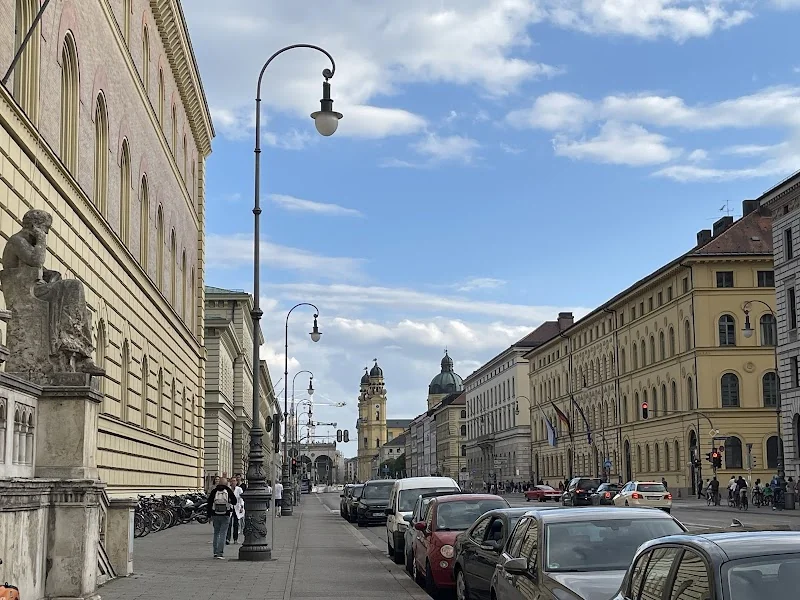
The Ludwigstraße in Munich is not just any traffic area, but a royal boulevard that has significantly influenced the urban space to this day. Between Odeonsplatz and Siegestor, an ensemble emerges that connects architecture, science, religion, and urban history in a compact area. Therefore, when one searches for Ludwigstraße Munich, it usually means much more than just a street: It refers to an urban space with a clear historical signature, strong landmarks, and a special role for walks, events, and representative paths through the Maxvorstadt. Ludwigstraße is one of the four major boulevards in Munich and is part of the city's most significant urban axes. At the same time, it is a place where the transformation of Munich can be particularly well observed: from the royal planned city to the academic location to today's promenade and event address. ([muenchen.travel](https://www.muenchen.travel/pois/stadt-viertel/ludwigstrasse))
How Ludwigstraße was created as a royal boulevard
The history of Ludwigstraße begins with the ambition to expand Munich to the north while creating a representative boulevard. As early as 1808, the Munich magistrate planned an urban expansion, but under Crown Prince and later King Ludwig I, the project became significantly more ambitious. Ludwig I wanted a boulevard about one kilometer long from Odeonsplatz in the south to the present Siegestor in the north. For him, the street was not just a thoroughfare, but a political and cultural program: science and art, Catholic tradition and royal governance should become visible in the urban landscape. In 1816, he commissioned Leo von Klenze with the overall design, and in 1827, Friedrich von Gärtner took over large parts of the execution. The result was a boulevard that consciously oriented itself to Italian models and created a cohesive urban image with its clear arrangement of monumental buildings. Ludwigstraße was also the first street in Munich designed in a complete round arch style and the first to be paved. This combination of technical progress, architectural discipline, and royal design will continues to be its charm to this day. ([muenchen.travel](https://www.muenchen.travel/pois/stadt-viertel/ludwigstrasse))
What is particularly exciting is that Ludwigstraße did not emerge as an isolated project, but as part of a larger urban vision. From the beginning, the boulevard was intended as a representative axis that catered to the needs of a growing residence city while simultaneously reaching far beyond that. In addition to Ludwigstraße, Brienner Straße, Maximilianstraße, and Prinzregentenstraße are also among the great boulevards of Munich. Together, they shape the image of a city that was deliberately equipped with architecture and urban planning under the Wittelsbach dynasty. At Ludwigstraße, this idea is particularly readable because the buildings connect like pearls on a string while remaining part of a total work of art. Therefore, those who walk along here not only feel individual sights but also a staged spatial effect that gives the boulevard its special dignity to this day. The path from the old town to the north is thus also a path through Munich's self-understanding as a city of art, science, and residence. ([muenchen.travel](https://www.muenchen.travel/pois/stadt-viertel/ludwigstrasse))
Which buildings and landmarks shape Ludwigstraße
Ludwigstraße is especially known for its buildings, and therein lies its extraordinary appeal. Among the most important stops is the Feldherrnhalle at the southern end of the ensemble, which Friedrich von Gärtner constructed from 1841 to 1844 after a model from Florence. A few steps further stands the Bavarian State Library, which moved from the Old Court to the new building on Ludwigstraße in 1843. Today, the library is not only a prominent building but also one of the most significant scientific libraries in the country. Also shaping the area is the Ludwigskirche with its two towers and colorful mosaic roof. It was built between 1829 and 1844 and is one of the most famous churches in Munich. The main building of Ludwig Maximilian University marks another central point of the street. The LMU moved into the house designed by Friedrich von Gärtner on Ludwigstraße in 1840, and the area around Professor-Huber- and Geschwister-Scholl-Platz is still closely connected to the academic life of the city. The Siegestor at the northern end monumentally concludes the boulevard. It was built between 1843 and 1850, marks the boundary between Ludwigstraße and Leopoldstraße, and is today one of the most distinctive landmarks in Munich. ([muenchen.travel](https://www.muenchen.travel/pois/stadt-viertel/ludwigstrasse))
It is precisely the sequence of these buildings that makes Ludwigstraße so special. It is not a loose collection of sights but a staged urban space where each building plays a role. In the south, representative buildings with state and cultural references stand, in the middle, the library and church shape the image, and in the north, the academic world around the LMU dominates. The Siegestor closes the axis with a triumphal arch that marks the transition to Leopoldstraße. This creates an urban space that is exciting for both architecture enthusiasts and walkers. Those who explore the street on foot discover not only facades but also different layers of time: classical severity, romantic monumentality, academic representation, and memorial culture lie closely together. Precisely for this reason, Ludwigstraße is excellent for a city walk, where history is not told abstractly but remains spatially tangible. The street is thus both a textbook and an experiential space. ([muenchen.travel](https://www.muenchen.travel/pois/stadt-viertel/ludwigstrasse))
The surroundings of Ludwigstraße also enhance this impression. The Odeonsplatz at the southern beginning is closely linked to the design of the boulevard and forms an architectural unit with Ludwigstraße. Further north, small urban spaces are created by the squares in front of the LMU and the subsequent sightlines, which structure the path and make the monumentality of the boulevard tangible. Therefore, Ludwigstraße is not just an address with individual attractions, but a cohesive ensemble that lives from perspectives, sequences of squares, and facades. For visitors, this is ideal: One can experience the street in stages, orienting oneself to the great landmarks while continuously discovering new details. From the Feldherrnhalle to the State Library to the Siegestor, a route emerges that combines very different functions in a compact area. Those who want to see history, architecture, and urban development together will find one of the densest and most impressive streets in Munich here. ([muenchen.travel](https://www.muenchen.travel/pois/stadt-viertel/ludwigstrasse))
Access by subway, bus, and parking around Ludwigstraße
The most important point of orientation for accessing Ludwigstraße is the subway station Odeonsplatz. According to MVV, the U3 and U6 lines as well as U4 and U5 intersect there on two levels, and it is only a few steps from the station to the southern Ludwigstraße and the pedestrian zone in Theatinerstraße. This makes the location particularly accessible if you want to visit the city center comfortably and without searching for parking. Especially for walks, museum appointments, university visits, or events, the subway is the least stressful option. Those coming from outside can also plan Ludwigstraße well with public transport, as the entire area around Odeonsplatz and Maxvorstadt is closely integrated into the Munich transport network. For visitors who want to orient themselves along the route, it is important: Ludwigstraße is located in the center, and the paths between the subway, boulevard, and adjacent sights are short. This not only facilitates arrival but also the combination with other destinations such as the Residence, the Hofgarten, or the neighboring university district. ([mvv-muenchen.de](https://www.mvv-muenchen.de/plaene-bahnhoefe/bahnhofsinformation/station/odeonsplatz/index.html?utm_source=openai))
However, caution is advised when parking, as the state capital points out that parking spaces in the Munich city center are scarce and usually subject to fees. There are parking garages, underground garages, Park+Ride facilities, parking tickets, mobile parking, and parking permit areas, but finding a parking space directly in heavily frequented city center locations is often tedious. This applies particularly to Ludwigstraße, as it is located in the middle of the historical and tourist core. Therefore, those arriving by car should consider the parking process from the beginning and better plan a parking garage or underground garage in the vicinity instead of hoping for street parking. The city explicitly recommends using public transport for trips to the city center, especially because the parking situation is tense. In practice, this means: For a spontaneous visit to Ludwigstraße, public transport is usually the better choice; for longer stays, a parking garage with a subsequent short walk may be sensible. The combination of central location, monument protection, and high visitor frequency makes access easy if planned consciously, and unnecessarily complicated if one searches for solutions only on-site. ([muenchen.de](https://www.muenchen.de/verkehr/autos/parken-muenchen-infos-fuer-autofahrer?utm_source=openai))
Even during larger events around Odeonsplatz and Ludwigstraße, public transport is the most stable solution. The MVV and MVG guidelines show that the area is regularly integrated into urban transport and event planning. For visitors, this means: Arrive early, choose the subway instead of a car, and understand the walk along Ludwigstraße as part of the experience. Especially because the boulevard is so centrally located, it can be perfectly integrated into an urban day program. Those who get off at Odeonsplatz can easily explore the southern tip of the street, the Feldherrnhalle, and access to adjacent squares on foot. From there, the axis can be walked step by step without being dependent on a vehicle. This is not only practical but also fits the character of the street: Ludwigstraße is a boulevard for arriving, walking, and looking, not just for passing by. ([mvv-muenchen.de](https://www.mvv-muenchen.de/plaene-bahnhoefe/bahnhofsinformation/station/odeonsplatz/index.html?utm_source=openai))
Events, strolling, and great city moments on Ludwigstraße
Ludwigstraße is not only a historical monument but also one of the most important stages for significant Munich city moments. This becomes particularly visible during Corso Leopold and the Zamanand Festival when Leopold- and Ludwigstraße transform into a large pedestrian and experience zone twice a year. Then, the regular traffic area becomes a festival mile with music, culture, information booths, participatory actions, and culinary offerings. The event takes place between Odeonsplatz and Siegestor and makes the boulevard directly experienceable as a public space. For 2026, the official tourism site has scheduled the dates for June 20/21 and September 12/13. Thus, Ludwigstraße shows that it is not only suitable for a quiet view of architecture but also for lively, contemporary urban experiences. The street becomes a place where movement, exchange, and community overlap. This fits well with its size and location: It is wide enough to accommodate crowds and representative enough to serve as a backdrop for a large festival. ([muenchen.travel](https://www.muenchen.travel/pois/maerkte-feste/corso-leopold-zamanand-festival))
Other formats also utilize this urban stage. The official tourism site reports on the New Year's Eve mile, which took place for the first time in 2025 between Siegestor and Odeonsplatz, transforming Ludwigstraße into an approximately 800-meter-long experience mile with light shows, art installations, concerts, and food trucks. Such events clearly demonstrate how adaptable the boulevard is. During the day, it appears monumental and almost museum-like, while during festivals, it is open, audience-friendly, and urban. For visitors, this creates a very different image of the street: not only as a historical axis but as a place where Munich celebrates its present. At the same time, events benefit from the clear geometry and wide sightlines of Ludwigstraße, as stages, booths, and pathways can be organized generously. The mix of historical architecture and modern event usage explains why the street is often at the center of city festivals, cultural actions, and temporary pedestrian zones. ([muenchen.travel](https://www.muenchen.travel/pois/maerkte-feste/silvestermeile-muenchen?utm_source=openai))
Those who visit Ludwigstraße outside of festival times experience a boulevard that has much to offer even in everyday life. The academy around the LMU ensures student life, the places along the street attract walkers, architecture enthusiasts, and tourists, and the transition to the English Garden or towards Leopoldstraße makes the surroundings additionally attractive. The interplay of everyday use and special events is characteristic of Ludwigstraße. It is not a closed museum space but an urban street ensemble used by very different groups. This openness is a key reason why the street is so strongly anchored in the collective memory of Munich. Those who walk along here on a quiet morning experience the boulevard differently than during a large street festival or on a brightly lit New Year's Eve. In both cases, however, the same core remains: Ludwigstraße is a space that represents Munich while remaining open to the city society. ([muenchen.travel](https://www.muenchen.travel/pois/stadt-viertel/ludwigstrasse))
Redesign, climate, and the future of the boulevard
Ludwigstraße stands not only for history but also for the present and future. The city of Munich reported in 2026 that the landscape planning realization competition for the redesign of Ludwigstraße has been decided. The goal is to adapt the boulevard more strongly to climate adaptation, quality of stay, and a contemporary spatial distribution. According to the official announcement, the planned redesign is closely linked to the reconstruction of the blocking level of the subway station Odeonsplatz. A significant reorganization is being discussed for the section between Brienner Straße and Oskar-von-Miller-Ring: The current up to six traffic lanes could be reduced to two lanes in the future, creating space for other uses. This aims to make Ludwigstraße not only functionally better for traffic but also more attractive as an urban space for staying. The city describes the goal as the further development of a listed ensemble while considering sealing, greening, and building quality. ([ru.muenchen.de](https://ru.muenchen.de/2026/83/Neugestaltung-Ludwigstrasse-Realisierungswettbewerb-entschieden-124090))
This process is particularly exciting for Ludwigstraße because it respects the core of the boulevard while also responding to new requirements. Historically, the street has always been an expression of a design will that went beyond mere functionality. Today, it is no longer just about representation but also about climate, shade provision, better quality of stay, and a more balanced use of public space. The city emphasizes that the listed ensemble should be sustainably further developed and that the individual monuments should be strengthened in their impact. This results in an interesting vision for the future: Ludwigstraße remains a historical boulevard but could appear more as an urban promenade, with more greenery, more space for pedestrians, and a less dominant role for car traffic. For visitors, this may mean an even more pleasant urban experience in the long term. For Munich, it is an example of how to handle historical places responsibly without losing their character. ([ru.muenchen.de](https://ru.muenchen.de/2026/83/Neugestaltung-Ludwigstrasse-Realisierungswettbewerb-entschieden-124090))
For this reason, Ludwigstraße is still a place that is much talked about today. It uniquely connects royal planning logic, academic presence, cultural landmarks, and current urban development. Therefore, those who engage with the boulevard discover not only a beautiful path through Munich but also a piece of vibrant urban politics. The historical space is not frozen but is being rethought. This makes Ludwigstraße particularly interesting for visitors: It stands for old Munich and at the same time for the question of what a significant urban space should look like in the 21st century. Between monument protection, traffic, green spaces, and quality of stay, Ludwigstraße remains a place where the past and future meet directly. ([ru.muenchen.de](https://ru.muenchen.de/2026/83/Neugestaltung-Ludwigstrasse-Realisierungswettbewerb-entschieden-124090))
Sources:
- Ludwigstraße Munich - simply Munich
- Corso Leopold and Zamanand Festival - simply Munich
- Siegestor: Triumphal Arch and Peace Memorial in Munich - muenchen.de
- Odeonsplatz - MVV
- Parking - City of Munich
- 1840 - LMU Munich
- Chronicle - Bavarian State Library
- Redesign of Ludwigstraße: Realization competition decided - City Hall Review
Show moreShow less
Ludwigstraße | History & Access
The Ludwigstraße in Munich is not just any traffic area, but a royal boulevard that has significantly influenced the urban space to this day. Between Odeonsplatz and Siegestor, an ensemble emerges that connects architecture, science, religion, and urban history in a compact area. Therefore, when one searches for Ludwigstraße Munich, it usually means much more than just a street: It refers to an urban space with a clear historical signature, strong landmarks, and a special role for walks, events, and representative paths through the Maxvorstadt. Ludwigstraße is one of the four major boulevards in Munich and is part of the city's most significant urban axes. At the same time, it is a place where the transformation of Munich can be particularly well observed: from the royal planned city to the academic location to today's promenade and event address. ([muenchen.travel](https://www.muenchen.travel/pois/stadt-viertel/ludwigstrasse))
How Ludwigstraße was created as a royal boulevard
The history of Ludwigstraße begins with the ambition to expand Munich to the north while creating a representative boulevard. As early as 1808, the Munich magistrate planned an urban expansion, but under Crown Prince and later King Ludwig I, the project became significantly more ambitious. Ludwig I wanted a boulevard about one kilometer long from Odeonsplatz in the south to the present Siegestor in the north. For him, the street was not just a thoroughfare, but a political and cultural program: science and art, Catholic tradition and royal governance should become visible in the urban landscape. In 1816, he commissioned Leo von Klenze with the overall design, and in 1827, Friedrich von Gärtner took over large parts of the execution. The result was a boulevard that consciously oriented itself to Italian models and created a cohesive urban image with its clear arrangement of monumental buildings. Ludwigstraße was also the first street in Munich designed in a complete round arch style and the first to be paved. This combination of technical progress, architectural discipline, and royal design will continues to be its charm to this day. ([muenchen.travel](https://www.muenchen.travel/pois/stadt-viertel/ludwigstrasse))
What is particularly exciting is that Ludwigstraße did not emerge as an isolated project, but as part of a larger urban vision. From the beginning, the boulevard was intended as a representative axis that catered to the needs of a growing residence city while simultaneously reaching far beyond that. In addition to Ludwigstraße, Brienner Straße, Maximilianstraße, and Prinzregentenstraße are also among the great boulevards of Munich. Together, they shape the image of a city that was deliberately equipped with architecture and urban planning under the Wittelsbach dynasty. At Ludwigstraße, this idea is particularly readable because the buildings connect like pearls on a string while remaining part of a total work of art. Therefore, those who walk along here not only feel individual sights but also a staged spatial effect that gives the boulevard its special dignity to this day. The path from the old town to the north is thus also a path through Munich's self-understanding as a city of art, science, and residence. ([muenchen.travel](https://www.muenchen.travel/pois/stadt-viertel/ludwigstrasse))
Which buildings and landmarks shape Ludwigstraße
Ludwigstraße is especially known for its buildings, and therein lies its extraordinary appeal. Among the most important stops is the Feldherrnhalle at the southern end of the ensemble, which Friedrich von Gärtner constructed from 1841 to 1844 after a model from Florence. A few steps further stands the Bavarian State Library, which moved from the Old Court to the new building on Ludwigstraße in 1843. Today, the library is not only a prominent building but also one of the most significant scientific libraries in the country. Also shaping the area is the Ludwigskirche with its two towers and colorful mosaic roof. It was built between 1829 and 1844 and is one of the most famous churches in Munich. The main building of Ludwig Maximilian University marks another central point of the street. The LMU moved into the house designed by Friedrich von Gärtner on Ludwigstraße in 1840, and the area around Professor-Huber- and Geschwister-Scholl-Platz is still closely connected to the academic life of the city. The Siegestor at the northern end monumentally concludes the boulevard. It was built between 1843 and 1850, marks the boundary between Ludwigstraße and Leopoldstraße, and is today one of the most distinctive landmarks in Munich. ([muenchen.travel](https://www.muenchen.travel/pois/stadt-viertel/ludwigstrasse))
It is precisely the sequence of these buildings that makes Ludwigstraße so special. It is not a loose collection of sights but a staged urban space where each building plays a role. In the south, representative buildings with state and cultural references stand, in the middle, the library and church shape the image, and in the north, the academic world around the LMU dominates. The Siegestor closes the axis with a triumphal arch that marks the transition to Leopoldstraße. This creates an urban space that is exciting for both architecture enthusiasts and walkers. Those who explore the street on foot discover not only facades but also different layers of time: classical severity, romantic monumentality, academic representation, and memorial culture lie closely together. Precisely for this reason, Ludwigstraße is excellent for a city walk, where history is not told abstractly but remains spatially tangible. The street is thus both a textbook and an experiential space. ([muenchen.travel](https://www.muenchen.travel/pois/stadt-viertel/ludwigstrasse))
The surroundings of Ludwigstraße also enhance this impression. The Odeonsplatz at the southern beginning is closely linked to the design of the boulevard and forms an architectural unit with Ludwigstraße. Further north, small urban spaces are created by the squares in front of the LMU and the subsequent sightlines, which structure the path and make the monumentality of the boulevard tangible. Therefore, Ludwigstraße is not just an address with individual attractions, but a cohesive ensemble that lives from perspectives, sequences of squares, and facades. For visitors, this is ideal: One can experience the street in stages, orienting oneself to the great landmarks while continuously discovering new details. From the Feldherrnhalle to the State Library to the Siegestor, a route emerges that combines very different functions in a compact area. Those who want to see history, architecture, and urban development together will find one of the densest and most impressive streets in Munich here. ([muenchen.travel](https://www.muenchen.travel/pois/stadt-viertel/ludwigstrasse))
Access by subway, bus, and parking around Ludwigstraße
The most important point of orientation for accessing Ludwigstraße is the subway station Odeonsplatz. According to MVV, the U3 and U6 lines as well as U4 and U5 intersect there on two levels, and it is only a few steps from the station to the southern Ludwigstraße and the pedestrian zone in Theatinerstraße. This makes the location particularly accessible if you want to visit the city center comfortably and without searching for parking. Especially for walks, museum appointments, university visits, or events, the subway is the least stressful option. Those coming from outside can also plan Ludwigstraße well with public transport, as the entire area around Odeonsplatz and Maxvorstadt is closely integrated into the Munich transport network. For visitors who want to orient themselves along the route, it is important: Ludwigstraße is located in the center, and the paths between the subway, boulevard, and adjacent sights are short. This not only facilitates arrival but also the combination with other destinations such as the Residence, the Hofgarten, or the neighboring university district. ([mvv-muenchen.de](https://www.mvv-muenchen.de/plaene-bahnhoefe/bahnhofsinformation/station/odeonsplatz/index.html?utm_source=openai))
However, caution is advised when parking, as the state capital points out that parking spaces in the Munich city center are scarce and usually subject to fees. There are parking garages, underground garages, Park+Ride facilities, parking tickets, mobile parking, and parking permit areas, but finding a parking space directly in heavily frequented city center locations is often tedious. This applies particularly to Ludwigstraße, as it is located in the middle of the historical and tourist core. Therefore, those arriving by car should consider the parking process from the beginning and better plan a parking garage or underground garage in the vicinity instead of hoping for street parking. The city explicitly recommends using public transport for trips to the city center, especially because the parking situation is tense. In practice, this means: For a spontaneous visit to Ludwigstraße, public transport is usually the better choice; for longer stays, a parking garage with a subsequent short walk may be sensible. The combination of central location, monument protection, and high visitor frequency makes access easy if planned consciously, and unnecessarily complicated if one searches for solutions only on-site. ([muenchen.de](https://www.muenchen.de/verkehr/autos/parken-muenchen-infos-fuer-autofahrer?utm_source=openai))
Even during larger events around Odeonsplatz and Ludwigstraße, public transport is the most stable solution. The MVV and MVG guidelines show that the area is regularly integrated into urban transport and event planning. For visitors, this means: Arrive early, choose the subway instead of a car, and understand the walk along Ludwigstraße as part of the experience. Especially because the boulevard is so centrally located, it can be perfectly integrated into an urban day program. Those who get off at Odeonsplatz can easily explore the southern tip of the street, the Feldherrnhalle, and access to adjacent squares on foot. From there, the axis can be walked step by step without being dependent on a vehicle. This is not only practical but also fits the character of the street: Ludwigstraße is a boulevard for arriving, walking, and looking, not just for passing by. ([mvv-muenchen.de](https://www.mvv-muenchen.de/plaene-bahnhoefe/bahnhofsinformation/station/odeonsplatz/index.html?utm_source=openai))
Events, strolling, and great city moments on Ludwigstraße
Ludwigstraße is not only a historical monument but also one of the most important stages for significant Munich city moments. This becomes particularly visible during Corso Leopold and the Zamanand Festival when Leopold- and Ludwigstraße transform into a large pedestrian and experience zone twice a year. Then, the regular traffic area becomes a festival mile with music, culture, information booths, participatory actions, and culinary offerings. The event takes place between Odeonsplatz and Siegestor and makes the boulevard directly experienceable as a public space. For 2026, the official tourism site has scheduled the dates for June 20/21 and September 12/13. Thus, Ludwigstraße shows that it is not only suitable for a quiet view of architecture but also for lively, contemporary urban experiences. The street becomes a place where movement, exchange, and community overlap. This fits well with its size and location: It is wide enough to accommodate crowds and representative enough to serve as a backdrop for a large festival. ([muenchen.travel](https://www.muenchen.travel/pois/maerkte-feste/corso-leopold-zamanand-festival))
Other formats also utilize this urban stage. The official tourism site reports on the New Year's Eve mile, which took place for the first time in 2025 between Siegestor and Odeonsplatz, transforming Ludwigstraße into an approximately 800-meter-long experience mile with light shows, art installations, concerts, and food trucks. Such events clearly demonstrate how adaptable the boulevard is. During the day, it appears monumental and almost museum-like, while during festivals, it is open, audience-friendly, and urban. For visitors, this creates a very different image of the street: not only as a historical axis but as a place where Munich celebrates its present. At the same time, events benefit from the clear geometry and wide sightlines of Ludwigstraße, as stages, booths, and pathways can be organized generously. The mix of historical architecture and modern event usage explains why the street is often at the center of city festivals, cultural actions, and temporary pedestrian zones. ([muenchen.travel](https://www.muenchen.travel/pois/maerkte-feste/silvestermeile-muenchen?utm_source=openai))
Those who visit Ludwigstraße outside of festival times experience a boulevard that has much to offer even in everyday life. The academy around the LMU ensures student life, the places along the street attract walkers, architecture enthusiasts, and tourists, and the transition to the English Garden or towards Leopoldstraße makes the surroundings additionally attractive. The interplay of everyday use and special events is characteristic of Ludwigstraße. It is not a closed museum space but an urban street ensemble used by very different groups. This openness is a key reason why the street is so strongly anchored in the collective memory of Munich. Those who walk along here on a quiet morning experience the boulevard differently than during a large street festival or on a brightly lit New Year's Eve. In both cases, however, the same core remains: Ludwigstraße is a space that represents Munich while remaining open to the city society. ([muenchen.travel](https://www.muenchen.travel/pois/stadt-viertel/ludwigstrasse))
Redesign, climate, and the future of the boulevard
Ludwigstraße stands not only for history but also for the present and future. The city of Munich reported in 2026 that the landscape planning realization competition for the redesign of Ludwigstraße has been decided. The goal is to adapt the boulevard more strongly to climate adaptation, quality of stay, and a contemporary spatial distribution. According to the official announcement, the planned redesign is closely linked to the reconstruction of the blocking level of the subway station Odeonsplatz. A significant reorganization is being discussed for the section between Brienner Straße and Oskar-von-Miller-Ring: The current up to six traffic lanes could be reduced to two lanes in the future, creating space for other uses. This aims to make Ludwigstraße not only functionally better for traffic but also more attractive as an urban space for staying. The city describes the goal as the further development of a listed ensemble while considering sealing, greening, and building quality. ([ru.muenchen.de](https://ru.muenchen.de/2026/83/Neugestaltung-Ludwigstrasse-Realisierungswettbewerb-entschieden-124090))
This process is particularly exciting for Ludwigstraße because it respects the core of the boulevard while also responding to new requirements. Historically, the street has always been an expression of a design will that went beyond mere functionality. Today, it is no longer just about representation but also about climate, shade provision, better quality of stay, and a more balanced use of public space. The city emphasizes that the listed ensemble should be sustainably further developed and that the individual monuments should be strengthened in their impact. This results in an interesting vision for the future: Ludwigstraße remains a historical boulevard but could appear more as an urban promenade, with more greenery, more space for pedestrians, and a less dominant role for car traffic. For visitors, this may mean an even more pleasant urban experience in the long term. For Munich, it is an example of how to handle historical places responsibly without losing their character. ([ru.muenchen.de](https://ru.muenchen.de/2026/83/Neugestaltung-Ludwigstrasse-Realisierungswettbewerb-entschieden-124090))
For this reason, Ludwigstraße is still a place that is much talked about today. It uniquely connects royal planning logic, academic presence, cultural landmarks, and current urban development. Therefore, those who engage with the boulevard discover not only a beautiful path through Munich but also a piece of vibrant urban politics. The historical space is not frozen but is being rethought. This makes Ludwigstraße particularly interesting for visitors: It stands for old Munich and at the same time for the question of what a significant urban space should look like in the 21st century. Between monument protection, traffic, green spaces, and quality of stay, Ludwigstraße remains a place where the past and future meet directly. ([ru.muenchen.de](https://ru.muenchen.de/2026/83/Neugestaltung-Ludwigstrasse-Realisierungswettbewerb-entschieden-124090))
Sources:
- Ludwigstraße Munich - simply Munich
- Corso Leopold and Zamanand Festival - simply Munich
- Siegestor: Triumphal Arch and Peace Memorial in Munich - muenchen.de
- Odeonsplatz - MVV
- Parking - City of Munich
- 1840 - LMU Munich
- Chronicle - Bavarian State Library
- Redesign of Ludwigstraße: Realization competition decided - City Hall Review
Ludwigstraße | History & Access
The Ludwigstraße in Munich is not just any traffic area, but a royal boulevard that has significantly influenced the urban space to this day. Between Odeonsplatz and Siegestor, an ensemble emerges that connects architecture, science, religion, and urban history in a compact area. Therefore, when one searches for Ludwigstraße Munich, it usually means much more than just a street: It refers to an urban space with a clear historical signature, strong landmarks, and a special role for walks, events, and representative paths through the Maxvorstadt. Ludwigstraße is one of the four major boulevards in Munich and is part of the city's most significant urban axes. At the same time, it is a place where the transformation of Munich can be particularly well observed: from the royal planned city to the academic location to today's promenade and event address. ([muenchen.travel](https://www.muenchen.travel/pois/stadt-viertel/ludwigstrasse))
How Ludwigstraße was created as a royal boulevard
The history of Ludwigstraße begins with the ambition to expand Munich to the north while creating a representative boulevard. As early as 1808, the Munich magistrate planned an urban expansion, but under Crown Prince and later King Ludwig I, the project became significantly more ambitious. Ludwig I wanted a boulevard about one kilometer long from Odeonsplatz in the south to the present Siegestor in the north. For him, the street was not just a thoroughfare, but a political and cultural program: science and art, Catholic tradition and royal governance should become visible in the urban landscape. In 1816, he commissioned Leo von Klenze with the overall design, and in 1827, Friedrich von Gärtner took over large parts of the execution. The result was a boulevard that consciously oriented itself to Italian models and created a cohesive urban image with its clear arrangement of monumental buildings. Ludwigstraße was also the first street in Munich designed in a complete round arch style and the first to be paved. This combination of technical progress, architectural discipline, and royal design will continues to be its charm to this day. ([muenchen.travel](https://www.muenchen.travel/pois/stadt-viertel/ludwigstrasse))
What is particularly exciting is that Ludwigstraße did not emerge as an isolated project, but as part of a larger urban vision. From the beginning, the boulevard was intended as a representative axis that catered to the needs of a growing residence city while simultaneously reaching far beyond that. In addition to Ludwigstraße, Brienner Straße, Maximilianstraße, and Prinzregentenstraße are also among the great boulevards of Munich. Together, they shape the image of a city that was deliberately equipped with architecture and urban planning under the Wittelsbach dynasty. At Ludwigstraße, this idea is particularly readable because the buildings connect like pearls on a string while remaining part of a total work of art. Therefore, those who walk along here not only feel individual sights but also a staged spatial effect that gives the boulevard its special dignity to this day. The path from the old town to the north is thus also a path through Munich's self-understanding as a city of art, science, and residence. ([muenchen.travel](https://www.muenchen.travel/pois/stadt-viertel/ludwigstrasse))
Which buildings and landmarks shape Ludwigstraße
Ludwigstraße is especially known for its buildings, and therein lies its extraordinary appeal. Among the most important stops is the Feldherrnhalle at the southern end of the ensemble, which Friedrich von Gärtner constructed from 1841 to 1844 after a model from Florence. A few steps further stands the Bavarian State Library, which moved from the Old Court to the new building on Ludwigstraße in 1843. Today, the library is not only a prominent building but also one of the most significant scientific libraries in the country. Also shaping the area is the Ludwigskirche with its two towers and colorful mosaic roof. It was built between 1829 and 1844 and is one of the most famous churches in Munich. The main building of Ludwig Maximilian University marks another central point of the street. The LMU moved into the house designed by Friedrich von Gärtner on Ludwigstraße in 1840, and the area around Professor-Huber- and Geschwister-Scholl-Platz is still closely connected to the academic life of the city. The Siegestor at the northern end monumentally concludes the boulevard. It was built between 1843 and 1850, marks the boundary between Ludwigstraße and Leopoldstraße, and is today one of the most distinctive landmarks in Munich. ([muenchen.travel](https://www.muenchen.travel/pois/stadt-viertel/ludwigstrasse))
It is precisely the sequence of these buildings that makes Ludwigstraße so special. It is not a loose collection of sights but a staged urban space where each building plays a role. In the south, representative buildings with state and cultural references stand, in the middle, the library and church shape the image, and in the north, the academic world around the LMU dominates. The Siegestor closes the axis with a triumphal arch that marks the transition to Leopoldstraße. This creates an urban space that is exciting for both architecture enthusiasts and walkers. Those who explore the street on foot discover not only facades but also different layers of time: classical severity, romantic monumentality, academic representation, and memorial culture lie closely together. Precisely for this reason, Ludwigstraße is excellent for a city walk, where history is not told abstractly but remains spatially tangible. The street is thus both a textbook and an experiential space. ([muenchen.travel](https://www.muenchen.travel/pois/stadt-viertel/ludwigstrasse))
The surroundings of Ludwigstraße also enhance this impression. The Odeonsplatz at the southern beginning is closely linked to the design of the boulevard and forms an architectural unit with Ludwigstraße. Further north, small urban spaces are created by the squares in front of the LMU and the subsequent sightlines, which structure the path and make the monumentality of the boulevard tangible. Therefore, Ludwigstraße is not just an address with individual attractions, but a cohesive ensemble that lives from perspectives, sequences of squares, and facades. For visitors, this is ideal: One can experience the street in stages, orienting oneself to the great landmarks while continuously discovering new details. From the Feldherrnhalle to the State Library to the Siegestor, a route emerges that combines very different functions in a compact area. Those who want to see history, architecture, and urban development together will find one of the densest and most impressive streets in Munich here. ([muenchen.travel](https://www.muenchen.travel/pois/stadt-viertel/ludwigstrasse))
Access by subway, bus, and parking around Ludwigstraße
The most important point of orientation for accessing Ludwigstraße is the subway station Odeonsplatz. According to MVV, the U3 and U6 lines as well as U4 and U5 intersect there on two levels, and it is only a few steps from the station to the southern Ludwigstraße and the pedestrian zone in Theatinerstraße. This makes the location particularly accessible if you want to visit the city center comfortably and without searching for parking. Especially for walks, museum appointments, university visits, or events, the subway is the least stressful option. Those coming from outside can also plan Ludwigstraße well with public transport, as the entire area around Odeonsplatz and Maxvorstadt is closely integrated into the Munich transport network. For visitors who want to orient themselves along the route, it is important: Ludwigstraße is located in the center, and the paths between the subway, boulevard, and adjacent sights are short. This not only facilitates arrival but also the combination with other destinations such as the Residence, the Hofgarten, or the neighboring university district. ([mvv-muenchen.de](https://www.mvv-muenchen.de/plaene-bahnhoefe/bahnhofsinformation/station/odeonsplatz/index.html?utm_source=openai))
However, caution is advised when parking, as the state capital points out that parking spaces in the Munich city center are scarce and usually subject to fees. There are parking garages, underground garages, Park+Ride facilities, parking tickets, mobile parking, and parking permit areas, but finding a parking space directly in heavily frequented city center locations is often tedious. This applies particularly to Ludwigstraße, as it is located in the middle of the historical and tourist core. Therefore, those arriving by car should consider the parking process from the beginning and better plan a parking garage or underground garage in the vicinity instead of hoping for street parking. The city explicitly recommends using public transport for trips to the city center, especially because the parking situation is tense. In practice, this means: For a spontaneous visit to Ludwigstraße, public transport is usually the better choice; for longer stays, a parking garage with a subsequent short walk may be sensible. The combination of central location, monument protection, and high visitor frequency makes access easy if planned consciously, and unnecessarily complicated if one searches for solutions only on-site. ([muenchen.de](https://www.muenchen.de/verkehr/autos/parken-muenchen-infos-fuer-autofahrer?utm_source=openai))
Even during larger events around Odeonsplatz and Ludwigstraße, public transport is the most stable solution. The MVV and MVG guidelines show that the area is regularly integrated into urban transport and event planning. For visitors, this means: Arrive early, choose the subway instead of a car, and understand the walk along Ludwigstraße as part of the experience. Especially because the boulevard is so centrally located, it can be perfectly integrated into an urban day program. Those who get off at Odeonsplatz can easily explore the southern tip of the street, the Feldherrnhalle, and access to adjacent squares on foot. From there, the axis can be walked step by step without being dependent on a vehicle. This is not only practical but also fits the character of the street: Ludwigstraße is a boulevard for arriving, walking, and looking, not just for passing by. ([mvv-muenchen.de](https://www.mvv-muenchen.de/plaene-bahnhoefe/bahnhofsinformation/station/odeonsplatz/index.html?utm_source=openai))
Events, strolling, and great city moments on Ludwigstraße
Ludwigstraße is not only a historical monument but also one of the most important stages for significant Munich city moments. This becomes particularly visible during Corso Leopold and the Zamanand Festival when Leopold- and Ludwigstraße transform into a large pedestrian and experience zone twice a year. Then, the regular traffic area becomes a festival mile with music, culture, information booths, participatory actions, and culinary offerings. The event takes place between Odeonsplatz and Siegestor and makes the boulevard directly experienceable as a public space. For 2026, the official tourism site has scheduled the dates for June 20/21 and September 12/13. Thus, Ludwigstraße shows that it is not only suitable for a quiet view of architecture but also for lively, contemporary urban experiences. The street becomes a place where movement, exchange, and community overlap. This fits well with its size and location: It is wide enough to accommodate crowds and representative enough to serve as a backdrop for a large festival. ([muenchen.travel](https://www.muenchen.travel/pois/maerkte-feste/corso-leopold-zamanand-festival))
Other formats also utilize this urban stage. The official tourism site reports on the New Year's Eve mile, which took place for the first time in 2025 between Siegestor and Odeonsplatz, transforming Ludwigstraße into an approximately 800-meter-long experience mile with light shows, art installations, concerts, and food trucks. Such events clearly demonstrate how adaptable the boulevard is. During the day, it appears monumental and almost museum-like, while during festivals, it is open, audience-friendly, and urban. For visitors, this creates a very different image of the street: not only as a historical axis but as a place where Munich celebrates its present. At the same time, events benefit from the clear geometry and wide sightlines of Ludwigstraße, as stages, booths, and pathways can be organized generously. The mix of historical architecture and modern event usage explains why the street is often at the center of city festivals, cultural actions, and temporary pedestrian zones. ([muenchen.travel](https://www.muenchen.travel/pois/maerkte-feste/silvestermeile-muenchen?utm_source=openai))
Those who visit Ludwigstraße outside of festival times experience a boulevard that has much to offer even in everyday life. The academy around the LMU ensures student life, the places along the street attract walkers, architecture enthusiasts, and tourists, and the transition to the English Garden or towards Leopoldstraße makes the surroundings additionally attractive. The interplay of everyday use and special events is characteristic of Ludwigstraße. It is not a closed museum space but an urban street ensemble used by very different groups. This openness is a key reason why the street is so strongly anchored in the collective memory of Munich. Those who walk along here on a quiet morning experience the boulevard differently than during a large street festival or on a brightly lit New Year's Eve. In both cases, however, the same core remains: Ludwigstraße is a space that represents Munich while remaining open to the city society. ([muenchen.travel](https://www.muenchen.travel/pois/stadt-viertel/ludwigstrasse))
Redesign, climate, and the future of the boulevard
Ludwigstraße stands not only for history but also for the present and future. The city of Munich reported in 2026 that the landscape planning realization competition for the redesign of Ludwigstraße has been decided. The goal is to adapt the boulevard more strongly to climate adaptation, quality of stay, and a contemporary spatial distribution. According to the official announcement, the planned redesign is closely linked to the reconstruction of the blocking level of the subway station Odeonsplatz. A significant reorganization is being discussed for the section between Brienner Straße and Oskar-von-Miller-Ring: The current up to six traffic lanes could be reduced to two lanes in the future, creating space for other uses. This aims to make Ludwigstraße not only functionally better for traffic but also more attractive as an urban space for staying. The city describes the goal as the further development of a listed ensemble while considering sealing, greening, and building quality. ([ru.muenchen.de](https://ru.muenchen.de/2026/83/Neugestaltung-Ludwigstrasse-Realisierungswettbewerb-entschieden-124090))
This process is particularly exciting for Ludwigstraße because it respects the core of the boulevard while also responding to new requirements. Historically, the street has always been an expression of a design will that went beyond mere functionality. Today, it is no longer just about representation but also about climate, shade provision, better quality of stay, and a more balanced use of public space. The city emphasizes that the listed ensemble should be sustainably further developed and that the individual monuments should be strengthened in their impact. This results in an interesting vision for the future: Ludwigstraße remains a historical boulevard but could appear more as an urban promenade, with more greenery, more space for pedestrians, and a less dominant role for car traffic. For visitors, this may mean an even more pleasant urban experience in the long term. For Munich, it is an example of how to handle historical places responsibly without losing their character. ([ru.muenchen.de](https://ru.muenchen.de/2026/83/Neugestaltung-Ludwigstrasse-Realisierungswettbewerb-entschieden-124090))
For this reason, Ludwigstraße is still a place that is much talked about today. It uniquely connects royal planning logic, academic presence, cultural landmarks, and current urban development. Therefore, those who engage with the boulevard discover not only a beautiful path through Munich but also a piece of vibrant urban politics. The historical space is not frozen but is being rethought. This makes Ludwigstraße particularly interesting for visitors: It stands for old Munich and at the same time for the question of what a significant urban space should look like in the 21st century. Between monument protection, traffic, green spaces, and quality of stay, Ludwigstraße remains a place where the past and future meet directly. ([ru.muenchen.de](https://ru.muenchen.de/2026/83/Neugestaltung-Ludwigstrasse-Realisierungswettbewerb-entschieden-124090))
Sources:
- Ludwigstraße Munich - simply Munich
- Corso Leopold and Zamanand Festival - simply Munich
- Siegestor: Triumphal Arch and Peace Memorial in Munich - muenchen.de
- Odeonsplatz - MVV
- Parking - City of Munich
- 1840 - LMU Munich
- Chronicle - Bavarian State Library
- Redesign of Ludwigstraße: Realization competition decided - City Hall Review
Upcoming Events
No events found
Frequently Asked Questions
Reviews
Samy Mehdid
8. November 2024
One of the prettiest roads in Munich, I also like the vibes.
Jon L Albee
5. February 2026
While not pedestrianized, enthusiasts of grand classical architecture are in for a real treat here. A stroll from Odeonplatz to Universitat and back is well worth the effort for fans of 18th-19th century, grand city planning. Think of Unter den Linden in Berlin on a smaller scale.
César Flores
1. July 2025
Excellent for exploring on foot.
Enzio Harpaintner
17. December 2025
I would only go there if I have to ... just too crowded.
Nicci Colle
9. November 2025
The focal point and especially the birthplace of Sissi, I love it.