
Potsdam
Im Neuen Garten 10, 14469 Potsdam, Deutschland
Marmorpalais | Opening Hours & Tickets
The Marmorpalais in Potsdam is one of the most elegant buildings in the New Garden and is much more than just a pretty castle by the water. Frederick William II had the summer palace clad in Silesian marble built between 1787 and 1793; Carl von Gontard created the first and only Prussian royal palace in the style of early classicism, while Carl Gotthard Langhans significantly shaped the interiors. The location directly on the lake shore between the Holy Lake, Virgin Lake, and Pfingstberg gives the house its special effect: Here, court architecture meets landscape design, calm water surfaces, and wide sight axes. The New Garden itself was laid out in 1787, later revised by Peter Joseph Lenné, and is still experienced today as a generous park landscape. Therefore, those who visit the Marmorpalais do not experience an arbitrary museum visit, but a precisely composed place of Prussian history, which has been a UNESCO World Heritage Site since 1990 and where the idea of a private summer residence can still be read today. This combination of history, beauty, and practical visit planning makes the Marmorpalais a sought-after topic, where opening hours, guided tours, tickets, arrival, and special rooms are particularly important. ([spsg.de](https://www.spsg.de/schloesser-gaerten/objekt/marmorpalais/))
Opening Hours, Tickets, and Guided Tours at the Marmorpalais
For planning a visit, it is especially important that the Marmorpalais can only be visited as part of a guided tour. The Prussian Palaces and Gardens Foundation Berlin-Brandenburg explicitly points out that the tour is conducted in German and that there may be waiting times for organizational reasons. Those who do not speak German can use the free SANSSOUCI app as a multimedia tour; tours are available in several languages, including English, Spanish, French, Italian, Polish, and Russian. This makes the visit well-planned for international guests and reduces the barrier to experiencing a historical interior with much detail. The opening hours are seasonal: In April, the house is open on Saturdays and Sundays from 10:00 AM to 5:30 PM, from May to October from Tuesday to Sunday from 10:00 AM to 5:30 PM; the Marmorpalais is closed on Mondays. The last admission is 30 minutes before closing time, and on public holidays, weekend opening hours usually apply. Ticket prices are listed by the SPSG as €8 for adults and €6 reduced. Additionally, the sanssouci+ ticket and the sanssouci+ family ticket are offered; all variants are sold at the castle ticket offices, visitor centers, and online. This is practical for families or guests who want to combine several Potsdam castles in one day, as it allows for a whole day of visits around the New Garden and other locations in the castle landscape. ([spsg.de](https://www.spsg.de/schloesser-gaerten/objekt/marmorpalais/))
The practical details surrounding the visit are also relevant for seekers: The Marmorpalais is partially wheelchair accessible, the ground floor can be visited with a wheelchair, and there is a lift to the entrance. A wheelchair is available in the castle, while strollers are not allowed in the exhibition rooms for conservation reasons. There are only a limited number of lockers for luggage, and luggage may not be left in the entrance area for safety reasons. This information is important because the Marmorpalais is not a freely accessible event house, but a historical museum castle with clear rules to protect the furnishings. This also explains why questions about tickets, guided tours, and opening hours are often searched together: Admission is relatively inexpensive, but the visit is structured and time-bound. Those who plan early can avoid waiting times, download the app in advance, and combine the tour with a walk in the New Garden. It is particularly advisable to schedule the visit so that there is still time for the South Wing, which is now independently accessible without waiting times and offers a new museum presentation. ([spsg.de](https://www.spsg.de/schloesser-gaerten/objekt/marmorpalais/))
Directions, Parking, and Address at the Holy Lake
The official address is Im Neuen Garten 10, 14469 Potsdam. Using public transport, the SPSG names the stop Potsdam, Birkenstr./Alleestr. as the nearest point; from there it is about 700 meters on foot to the Marmorpalais. Those arriving by car will find paid parking spaces near Schloss Cecilienhof, but the foundation points out that due to construction work, only parking spaces for cars are currently available. This information is crucial for visitors because the park does not have a classic parking garage like a large fair or arena location, but is embedded in a historical park landscape. Therefore, the journey should be understood as part of the experience: One approaches the building through the New Garden, walks along the paths, and experiences step by step how architecture and landscape intertwine. ([spsg.de](https://www.spsg.de/schloesser-gaerten/objekt/marmorpalais/))
The location itself is one of the strongest arguments for a visit. The New Garden lies between the Holy Lake and Virgin Lake below the Pfingstberg and encompasses 102.5 hectares. It was laid out in 1787 on the orders of Frederick William II and later revised by Peter Joseph Lenné between 1816 and 1828 into a more open park landscape. Today, the basic features of this development are still visible. In the same park, there are other well-known destinations such as the Orangery, the Dutch Establishments, the Shingle House, the Gothic Library, and of course Schloss Cecilienhof. The Marmorpalais is therefore not isolated but part of a rich historical ensemble that allows visitors several stops in one day. Those wondering how to best organize their visit should not only note the castle address but also consider the entire park: The New Garden is open daily from 8 AM until dusk, making it easy to combine the castle tour with a walk along the lakeshore. This location information is central for guests searching for Marmorpalais Potsdam, Marmorpalais at the Holy Lake, or Marmorpalais New Garden, as it explains the character of the place in one sentence: a castle by the water, embedded in an expansive historical landscape park. ([potsdam.de](https://www.potsdam.de/de/neuer-garten))
History of the Marmorpalais in the New Garden
The history of the Marmorpalais begins with Frederick William II's desire to create a private retreat by the water. The building was constructed from 1787 to 1793 as a summer residence, and the king associated it not only with representative claims but also with personal preferences for music, art, and a culture of retreat shaped by the Enlightenment. The SPSG describes the Marmorpalais as the first and only Prussian royal palace in the style of early classicism. This classification is particularly important for the search intent Marmorpalais history, as it makes clear that the building is not a random pleasure palace, but a deliberately set sign of the late 18th century. The king was guided by the idea of a more private, musically influenced place; at the same time, the castle was closely linked to the New Garden, which was designed as a landscape park in the English style. The special atmosphere of this ensemble is therefore based on an interplay of architecture, garden art, and a courtly lifestyle that not only observed nature but also staged it. The noble restraint of the house is just as much a part of the history as its wealth of materials and furnishings. ([spsg.de](https://www.spsg.de/schloesser-gaerten/objekt/marmorpalais/))
Throughout its history, the Marmorpalais has changed several times. After the death of Frederick William II, it served repeatedly as a residence for members of the House of Hohenzollern. The internal structures have remained surprisingly well preserved, so the original character of the furnishings is still perceptible today. A deep break marked the year 1945: The castle, along with the park and the neighboring villa district, came under Soviet administration. In 1961, the GDR took over the Marmorpalais and used it as an army museum surrounded by cannons, an airplane, a speedboat, and other war equipment. This use ended in the late 1980s. A comprehensive restoration followed, through which the Marmorpalais, including the side wings, became fully accessible again. The UNESCO history is also important: The palaces and parks of Potsdam and Berlin were added to the World Heritage List in 1990; the New Garden is part of this cultural landscape. Thus, the Marmorpalais today stands not only for a court residence of the 18th century but also for the preservation of a European cultural landscape whose significance extends far beyond Potsdam. ([potsdam.de](https://www.potsdam.de/de/marmorpalais))
Architecture, Floor Plan, and Furnishings of the Early Classicist Castle
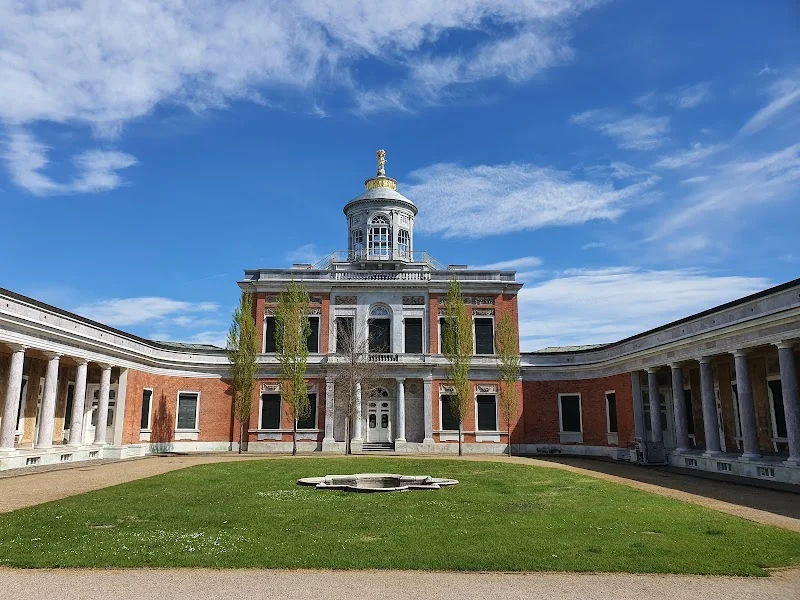
Architecturally, the Marmorpalais thrives on its location on a terraced site directly by the lakeshore and on the contrast between unplastered brick and noble marble. This effect is deliberately set and is one of the most distinctive features of the house. Carl von Gontard designed the exterior appearance, while Carl Gotthard Langhans was responsible for the interior design. The SPSG emphasizes that the interior design is influenced by ancient forms and that numerous marble fireplaces and antique sculptures were specifically acquired in Italy. The spatial relationship with the surroundings was also important: Precious inlays and high-quality wooden floors were created from local woods, so the interiors can be read not as isolated displays of splendor but as a continuation of the landscape idea. Those looking for a floor plan of the Marmorpalais will primarily encounter the guided sequence of rooms in practice: The castle is not a hall building with a classic event seating plan, but a museum castle with a carefully composed sequence of rooms. This sequence particularly shapes the visit and makes the architectural logic of the house understandable. ([spsg.de](https://www.spsg.de/schloesser-gaerten/objekt/marmorpalais/))
Highlights inside include the vestibule entirely made of differently colored marble, the grotto hall located directly by the water, and the impressive concert hall. These rooms are complemented by the king's living quarters, which have been equipped after restoration with inlays, silk upholstery, stuccos, marble fireplaces, paintings, and crafts. The precious English Wedgwood ceramics are also highlighted. These details explain why the Marmorpalais is still considered a key building of early classicism: It combines representative materiality with a more intimate, almost private spatial idea. The South Wing is particularly interesting, as it is now independently accessible without waiting times. There, a new museum presentation in multimedia-designed rooms offers a compact overview of the castle's history. An introductory film, media stations on the role of Frederick William II, and an audio station on Wilhelmine Enke, the later Countess Lichtenau, complement the tour. Thematically, it addresses the French Revolution, the role of women around 1800, and the third partition of Poland as an expression of Prussian power politics. This combination of classical castle architecture and modern mediation makes the Marmorpalais particularly attractive for visitors who want not only to take photos but also to truly understand the historical context. ([spsg.de](https://www.spsg.de/schloesser-gaerten/objekt/marmorpalais/))
Photos, Highlights, and Events at the Marmorpalais
Those searching for Marmorpalais images or Marmorpalais photos are usually looking for the motifs that make the place unmistakable. The castle provides plenty of these motifs: an evening atmosphere with a view over the Holy Lake, the concert hall interior, the Yellow Writing Room, the Grotto Hall, the staircase under the dome, the dressing room, the connecting gallery in the South Wing, and the Kloebersaal are among the official impressions of the SPSG. The external view is particularly strong when the castle appears on its terraced site with the water in front. Together with the Orangery, the green spaces of the New Garden, and the sight axes to the Havelland landscape, a visual language is created that makes the Marmorpalais a very photogenic destination. Unlike pure event locations, here the stage is not the main motif, but the interplay of facade, lakeshore, and historical park landscape. Therefore, it is worthwhile to time the visit so that one can walk through the New Garden in calm light after the tour. ([spsg.de](https://www.spsg.de/schloesser-gaerten/objekt/marmorpalais/))
Also, in terms of events, it becomes clear that the Marmorpalais is not a silent museum object but is actively used. The current SPSG calendar includes both musical formats and family tours at the Marmorpalais. Among other things, a walk opera titled Christoph W. Gluck – Orphée et Eurydice and the tour Johann Ludwig von Fauch for families with children aged 6 and up are mentioned. This confirms the search intent Marmorpalais events and Marmorpalais Potsdam events: It is not about large concert halls with thousands of seats, but about selected cultural and mediation formats in a historical setting. For families, the figure of Johann Ludwig von Fauch is particularly suitable because it makes the tour playful while still conveying historical content. Additionally, the SANSSOUCI app is recommended, which offers tours in several languages for the Marmorpalais and can be conveniently downloaded at home before the visit. Therefore, those visiting the house with an eye on photos, history, and practical orientation should combine three things: first, photograph the external and internal highlights, second, check the current event offerings, and third, use the app for multilingual deepening. This way, a castle visit becomes a complete cultural day in the New Garden, which can be expanded depending on interest with Cecilienhof, the Pfingstberg, or a walk by the Holy Lake. ([spsg.de](https://www.spsg.de/schloesser-gaerten/objekt/marmorpalais/))
Sources:
- SPSG - Marmorpalais ([spsg.de](https://www.spsg.de/schloesser-gaerten/objekt/marmorpalais/))
- State Capital Potsdam - Marmorpalais ([potsdam.de](https://www.potsdam.de/de/marmorpalais))
- State Capital Potsdam - New Garden ([potsdam.de](https://www.potsdam.de/de/neuer-garten))
- UNESCO World Heritage Centre - Palaces and Parks of Potsdam and Berlin ([whc.unesco.org](https://whc.unesco.org/en/list/532/?utm_source=openai))
- SPSG - Events ([spsg.de](https://www.spsg.de/familienprogramm/))
- SPSG - App SANSSOUCI ([spsg.de](https://www.spsg.de/schloesser-gaerten/digitale-angebote/app/?utm_source=openai))
Show moreShow less
Marmorpalais | Opening Hours & Tickets
The Marmorpalais in Potsdam is one of the most elegant buildings in the New Garden and is much more than just a pretty castle by the water. Frederick William II had the summer palace clad in Silesian marble built between 1787 and 1793; Carl von Gontard created the first and only Prussian royal palace in the style of early classicism, while Carl Gotthard Langhans significantly shaped the interiors. The location directly on the lake shore between the Holy Lake, Virgin Lake, and Pfingstberg gives the house its special effect: Here, court architecture meets landscape design, calm water surfaces, and wide sight axes. The New Garden itself was laid out in 1787, later revised by Peter Joseph Lenné, and is still experienced today as a generous park landscape. Therefore, those who visit the Marmorpalais do not experience an arbitrary museum visit, but a precisely composed place of Prussian history, which has been a UNESCO World Heritage Site since 1990 and where the idea of a private summer residence can still be read today. This combination of history, beauty, and practical visit planning makes the Marmorpalais a sought-after topic, where opening hours, guided tours, tickets, arrival, and special rooms are particularly important. ([spsg.de](https://www.spsg.de/schloesser-gaerten/objekt/marmorpalais/))
Opening Hours, Tickets, and Guided Tours at the Marmorpalais
For planning a visit, it is especially important that the Marmorpalais can only be visited as part of a guided tour. The Prussian Palaces and Gardens Foundation Berlin-Brandenburg explicitly points out that the tour is conducted in German and that there may be waiting times for organizational reasons. Those who do not speak German can use the free SANSSOUCI app as a multimedia tour; tours are available in several languages, including English, Spanish, French, Italian, Polish, and Russian. This makes the visit well-planned for international guests and reduces the barrier to experiencing a historical interior with much detail. The opening hours are seasonal: In April, the house is open on Saturdays and Sundays from 10:00 AM to 5:30 PM, from May to October from Tuesday to Sunday from 10:00 AM to 5:30 PM; the Marmorpalais is closed on Mondays. The last admission is 30 minutes before closing time, and on public holidays, weekend opening hours usually apply. Ticket prices are listed by the SPSG as €8 for adults and €6 reduced. Additionally, the sanssouci+ ticket and the sanssouci+ family ticket are offered; all variants are sold at the castle ticket offices, visitor centers, and online. This is practical for families or guests who want to combine several Potsdam castles in one day, as it allows for a whole day of visits around the New Garden and other locations in the castle landscape. ([spsg.de](https://www.spsg.de/schloesser-gaerten/objekt/marmorpalais/))
The practical details surrounding the visit are also relevant for seekers: The Marmorpalais is partially wheelchair accessible, the ground floor can be visited with a wheelchair, and there is a lift to the entrance. A wheelchair is available in the castle, while strollers are not allowed in the exhibition rooms for conservation reasons. There are only a limited number of lockers for luggage, and luggage may not be left in the entrance area for safety reasons. This information is important because the Marmorpalais is not a freely accessible event house, but a historical museum castle with clear rules to protect the furnishings. This also explains why questions about tickets, guided tours, and opening hours are often searched together: Admission is relatively inexpensive, but the visit is structured and time-bound. Those who plan early can avoid waiting times, download the app in advance, and combine the tour with a walk in the New Garden. It is particularly advisable to schedule the visit so that there is still time for the South Wing, which is now independently accessible without waiting times and offers a new museum presentation. ([spsg.de](https://www.spsg.de/schloesser-gaerten/objekt/marmorpalais/))
Directions, Parking, and Address at the Holy Lake
The official address is Im Neuen Garten 10, 14469 Potsdam. Using public transport, the SPSG names the stop Potsdam, Birkenstr./Alleestr. as the nearest point; from there it is about 700 meters on foot to the Marmorpalais. Those arriving by car will find paid parking spaces near Schloss Cecilienhof, but the foundation points out that due to construction work, only parking spaces for cars are currently available. This information is crucial for visitors because the park does not have a classic parking garage like a large fair or arena location, but is embedded in a historical park landscape. Therefore, the journey should be understood as part of the experience: One approaches the building through the New Garden, walks along the paths, and experiences step by step how architecture and landscape intertwine. ([spsg.de](https://www.spsg.de/schloesser-gaerten/objekt/marmorpalais/))
The location itself is one of the strongest arguments for a visit. The New Garden lies between the Holy Lake and Virgin Lake below the Pfingstberg and encompasses 102.5 hectares. It was laid out in 1787 on the orders of Frederick William II and later revised by Peter Joseph Lenné between 1816 and 1828 into a more open park landscape. Today, the basic features of this development are still visible. In the same park, there are other well-known destinations such as the Orangery, the Dutch Establishments, the Shingle House, the Gothic Library, and of course Schloss Cecilienhof. The Marmorpalais is therefore not isolated but part of a rich historical ensemble that allows visitors several stops in one day. Those wondering how to best organize their visit should not only note the castle address but also consider the entire park: The New Garden is open daily from 8 AM until dusk, making it easy to combine the castle tour with a walk along the lakeshore. This location information is central for guests searching for Marmorpalais Potsdam, Marmorpalais at the Holy Lake, or Marmorpalais New Garden, as it explains the character of the place in one sentence: a castle by the water, embedded in an expansive historical landscape park. ([potsdam.de](https://www.potsdam.de/de/neuer-garten))
History of the Marmorpalais in the New Garden
The history of the Marmorpalais begins with Frederick William II's desire to create a private retreat by the water. The building was constructed from 1787 to 1793 as a summer residence, and the king associated it not only with representative claims but also with personal preferences for music, art, and a culture of retreat shaped by the Enlightenment. The SPSG describes the Marmorpalais as the first and only Prussian royal palace in the style of early classicism. This classification is particularly important for the search intent Marmorpalais history, as it makes clear that the building is not a random pleasure palace, but a deliberately set sign of the late 18th century. The king was guided by the idea of a more private, musically influenced place; at the same time, the castle was closely linked to the New Garden, which was designed as a landscape park in the English style. The special atmosphere of this ensemble is therefore based on an interplay of architecture, garden art, and a courtly lifestyle that not only observed nature but also staged it. The noble restraint of the house is just as much a part of the history as its wealth of materials and furnishings. ([spsg.de](https://www.spsg.de/schloesser-gaerten/objekt/marmorpalais/))
Throughout its history, the Marmorpalais has changed several times. After the death of Frederick William II, it served repeatedly as a residence for members of the House of Hohenzollern. The internal structures have remained surprisingly well preserved, so the original character of the furnishings is still perceptible today. A deep break marked the year 1945: The castle, along with the park and the neighboring villa district, came under Soviet administration. In 1961, the GDR took over the Marmorpalais and used it as an army museum surrounded by cannons, an airplane, a speedboat, and other war equipment. This use ended in the late 1980s. A comprehensive restoration followed, through which the Marmorpalais, including the side wings, became fully accessible again. The UNESCO history is also important: The palaces and parks of Potsdam and Berlin were added to the World Heritage List in 1990; the New Garden is part of this cultural landscape. Thus, the Marmorpalais today stands not only for a court residence of the 18th century but also for the preservation of a European cultural landscape whose significance extends far beyond Potsdam. ([potsdam.de](https://www.potsdam.de/de/marmorpalais))
Architecture, Floor Plan, and Furnishings of the Early Classicist Castle
Architecturally, the Marmorpalais thrives on its location on a terraced site directly by the lakeshore and on the contrast between unplastered brick and noble marble. This effect is deliberately set and is one of the most distinctive features of the house. Carl von Gontard designed the exterior appearance, while Carl Gotthard Langhans was responsible for the interior design. The SPSG emphasizes that the interior design is influenced by ancient forms and that numerous marble fireplaces and antique sculptures were specifically acquired in Italy. The spatial relationship with the surroundings was also important: Precious inlays and high-quality wooden floors were created from local woods, so the interiors can be read not as isolated displays of splendor but as a continuation of the landscape idea. Those looking for a floor plan of the Marmorpalais will primarily encounter the guided sequence of rooms in practice: The castle is not a hall building with a classic event seating plan, but a museum castle with a carefully composed sequence of rooms. This sequence particularly shapes the visit and makes the architectural logic of the house understandable. ([spsg.de](https://www.spsg.de/schloesser-gaerten/objekt/marmorpalais/))
Highlights inside include the vestibule entirely made of differently colored marble, the grotto hall located directly by the water, and the impressive concert hall. These rooms are complemented by the king's living quarters, which have been equipped after restoration with inlays, silk upholstery, stuccos, marble fireplaces, paintings, and crafts. The precious English Wedgwood ceramics are also highlighted. These details explain why the Marmorpalais is still considered a key building of early classicism: It combines representative materiality with a more intimate, almost private spatial idea. The South Wing is particularly interesting, as it is now independently accessible without waiting times. There, a new museum presentation in multimedia-designed rooms offers a compact overview of the castle's history. An introductory film, media stations on the role of Frederick William II, and an audio station on Wilhelmine Enke, the later Countess Lichtenau, complement the tour. Thematically, it addresses the French Revolution, the role of women around 1800, and the third partition of Poland as an expression of Prussian power politics. This combination of classical castle architecture and modern mediation makes the Marmorpalais particularly attractive for visitors who want not only to take photos but also to truly understand the historical context. ([spsg.de](https://www.spsg.de/schloesser-gaerten/objekt/marmorpalais/))
Photos, Highlights, and Events at the Marmorpalais
Those searching for Marmorpalais images or Marmorpalais photos are usually looking for the motifs that make the place unmistakable. The castle provides plenty of these motifs: an evening atmosphere with a view over the Holy Lake, the concert hall interior, the Yellow Writing Room, the Grotto Hall, the staircase under the dome, the dressing room, the connecting gallery in the South Wing, and the Kloebersaal are among the official impressions of the SPSG. The external view is particularly strong when the castle appears on its terraced site with the water in front. Together with the Orangery, the green spaces of the New Garden, and the sight axes to the Havelland landscape, a visual language is created that makes the Marmorpalais a very photogenic destination. Unlike pure event locations, here the stage is not the main motif, but the interplay of facade, lakeshore, and historical park landscape. Therefore, it is worthwhile to time the visit so that one can walk through the New Garden in calm light after the tour. ([spsg.de](https://www.spsg.de/schloesser-gaerten/objekt/marmorpalais/))
Also, in terms of events, it becomes clear that the Marmorpalais is not a silent museum object but is actively used. The current SPSG calendar includes both musical formats and family tours at the Marmorpalais. Among other things, a walk opera titled Christoph W. Gluck – Orphée et Eurydice and the tour Johann Ludwig von Fauch for families with children aged 6 and up are mentioned. This confirms the search intent Marmorpalais events and Marmorpalais Potsdam events: It is not about large concert halls with thousands of seats, but about selected cultural and mediation formats in a historical setting. For families, the figure of Johann Ludwig von Fauch is particularly suitable because it makes the tour playful while still conveying historical content. Additionally, the SANSSOUCI app is recommended, which offers tours in several languages for the Marmorpalais and can be conveniently downloaded at home before the visit. Therefore, those visiting the house with an eye on photos, history, and practical orientation should combine three things: first, photograph the external and internal highlights, second, check the current event offerings, and third, use the app for multilingual deepening. This way, a castle visit becomes a complete cultural day in the New Garden, which can be expanded depending on interest with Cecilienhof, the Pfingstberg, or a walk by the Holy Lake. ([spsg.de](https://www.spsg.de/schloesser-gaerten/objekt/marmorpalais/))
Sources:
- SPSG - Marmorpalais ([spsg.de](https://www.spsg.de/schloesser-gaerten/objekt/marmorpalais/))
- State Capital Potsdam - Marmorpalais ([potsdam.de](https://www.potsdam.de/de/marmorpalais))
- State Capital Potsdam - New Garden ([potsdam.de](https://www.potsdam.de/de/neuer-garten))
- UNESCO World Heritage Centre - Palaces and Parks of Potsdam and Berlin ([whc.unesco.org](https://whc.unesco.org/en/list/532/?utm_source=openai))
- SPSG - Events ([spsg.de](https://www.spsg.de/familienprogramm/))
- SPSG - App SANSSOUCI ([spsg.de](https://www.spsg.de/schloesser-gaerten/digitale-angebote/app/?utm_source=openai))
Marmorpalais | Opening Hours & Tickets
The Marmorpalais in Potsdam is one of the most elegant buildings in the New Garden and is much more than just a pretty castle by the water. Frederick William II had the summer palace clad in Silesian marble built between 1787 and 1793; Carl von Gontard created the first and only Prussian royal palace in the style of early classicism, while Carl Gotthard Langhans significantly shaped the interiors. The location directly on the lake shore between the Holy Lake, Virgin Lake, and Pfingstberg gives the house its special effect: Here, court architecture meets landscape design, calm water surfaces, and wide sight axes. The New Garden itself was laid out in 1787, later revised by Peter Joseph Lenné, and is still experienced today as a generous park landscape. Therefore, those who visit the Marmorpalais do not experience an arbitrary museum visit, but a precisely composed place of Prussian history, which has been a UNESCO World Heritage Site since 1990 and where the idea of a private summer residence can still be read today. This combination of history, beauty, and practical visit planning makes the Marmorpalais a sought-after topic, where opening hours, guided tours, tickets, arrival, and special rooms are particularly important. ([spsg.de](https://www.spsg.de/schloesser-gaerten/objekt/marmorpalais/))
Opening Hours, Tickets, and Guided Tours at the Marmorpalais
For planning a visit, it is especially important that the Marmorpalais can only be visited as part of a guided tour. The Prussian Palaces and Gardens Foundation Berlin-Brandenburg explicitly points out that the tour is conducted in German and that there may be waiting times for organizational reasons. Those who do not speak German can use the free SANSSOUCI app as a multimedia tour; tours are available in several languages, including English, Spanish, French, Italian, Polish, and Russian. This makes the visit well-planned for international guests and reduces the barrier to experiencing a historical interior with much detail. The opening hours are seasonal: In April, the house is open on Saturdays and Sundays from 10:00 AM to 5:30 PM, from May to October from Tuesday to Sunday from 10:00 AM to 5:30 PM; the Marmorpalais is closed on Mondays. The last admission is 30 minutes before closing time, and on public holidays, weekend opening hours usually apply. Ticket prices are listed by the SPSG as €8 for adults and €6 reduced. Additionally, the sanssouci+ ticket and the sanssouci+ family ticket are offered; all variants are sold at the castle ticket offices, visitor centers, and online. This is practical for families or guests who want to combine several Potsdam castles in one day, as it allows for a whole day of visits around the New Garden and other locations in the castle landscape. ([spsg.de](https://www.spsg.de/schloesser-gaerten/objekt/marmorpalais/))
The practical details surrounding the visit are also relevant for seekers: The Marmorpalais is partially wheelchair accessible, the ground floor can be visited with a wheelchair, and there is a lift to the entrance. A wheelchair is available in the castle, while strollers are not allowed in the exhibition rooms for conservation reasons. There are only a limited number of lockers for luggage, and luggage may not be left in the entrance area for safety reasons. This information is important because the Marmorpalais is not a freely accessible event house, but a historical museum castle with clear rules to protect the furnishings. This also explains why questions about tickets, guided tours, and opening hours are often searched together: Admission is relatively inexpensive, but the visit is structured and time-bound. Those who plan early can avoid waiting times, download the app in advance, and combine the tour with a walk in the New Garden. It is particularly advisable to schedule the visit so that there is still time for the South Wing, which is now independently accessible without waiting times and offers a new museum presentation. ([spsg.de](https://www.spsg.de/schloesser-gaerten/objekt/marmorpalais/))
Directions, Parking, and Address at the Holy Lake
The official address is Im Neuen Garten 10, 14469 Potsdam. Using public transport, the SPSG names the stop Potsdam, Birkenstr./Alleestr. as the nearest point; from there it is about 700 meters on foot to the Marmorpalais. Those arriving by car will find paid parking spaces near Schloss Cecilienhof, but the foundation points out that due to construction work, only parking spaces for cars are currently available. This information is crucial for visitors because the park does not have a classic parking garage like a large fair or arena location, but is embedded in a historical park landscape. Therefore, the journey should be understood as part of the experience: One approaches the building through the New Garden, walks along the paths, and experiences step by step how architecture and landscape intertwine. ([spsg.de](https://www.spsg.de/schloesser-gaerten/objekt/marmorpalais/))
The location itself is one of the strongest arguments for a visit. The New Garden lies between the Holy Lake and Virgin Lake below the Pfingstberg and encompasses 102.5 hectares. It was laid out in 1787 on the orders of Frederick William II and later revised by Peter Joseph Lenné between 1816 and 1828 into a more open park landscape. Today, the basic features of this development are still visible. In the same park, there are other well-known destinations such as the Orangery, the Dutch Establishments, the Shingle House, the Gothic Library, and of course Schloss Cecilienhof. The Marmorpalais is therefore not isolated but part of a rich historical ensemble that allows visitors several stops in one day. Those wondering how to best organize their visit should not only note the castle address but also consider the entire park: The New Garden is open daily from 8 AM until dusk, making it easy to combine the castle tour with a walk along the lakeshore. This location information is central for guests searching for Marmorpalais Potsdam, Marmorpalais at the Holy Lake, or Marmorpalais New Garden, as it explains the character of the place in one sentence: a castle by the water, embedded in an expansive historical landscape park. ([potsdam.de](https://www.potsdam.de/de/neuer-garten))
History of the Marmorpalais in the New Garden
The history of the Marmorpalais begins with Frederick William II's desire to create a private retreat by the water. The building was constructed from 1787 to 1793 as a summer residence, and the king associated it not only with representative claims but also with personal preferences for music, art, and a culture of retreat shaped by the Enlightenment. The SPSG describes the Marmorpalais as the first and only Prussian royal palace in the style of early classicism. This classification is particularly important for the search intent Marmorpalais history, as it makes clear that the building is not a random pleasure palace, but a deliberately set sign of the late 18th century. The king was guided by the idea of a more private, musically influenced place; at the same time, the castle was closely linked to the New Garden, which was designed as a landscape park in the English style. The special atmosphere of this ensemble is therefore based on an interplay of architecture, garden art, and a courtly lifestyle that not only observed nature but also staged it. The noble restraint of the house is just as much a part of the history as its wealth of materials and furnishings. ([spsg.de](https://www.spsg.de/schloesser-gaerten/objekt/marmorpalais/))
Throughout its history, the Marmorpalais has changed several times. After the death of Frederick William II, it served repeatedly as a residence for members of the House of Hohenzollern. The internal structures have remained surprisingly well preserved, so the original character of the furnishings is still perceptible today. A deep break marked the year 1945: The castle, along with the park and the neighboring villa district, came under Soviet administration. In 1961, the GDR took over the Marmorpalais and used it as an army museum surrounded by cannons, an airplane, a speedboat, and other war equipment. This use ended in the late 1980s. A comprehensive restoration followed, through which the Marmorpalais, including the side wings, became fully accessible again. The UNESCO history is also important: The palaces and parks of Potsdam and Berlin were added to the World Heritage List in 1990; the New Garden is part of this cultural landscape. Thus, the Marmorpalais today stands not only for a court residence of the 18th century but also for the preservation of a European cultural landscape whose significance extends far beyond Potsdam. ([potsdam.de](https://www.potsdam.de/de/marmorpalais))
Architecture, Floor Plan, and Furnishings of the Early Classicist Castle
Architecturally, the Marmorpalais thrives on its location on a terraced site directly by the lakeshore and on the contrast between unplastered brick and noble marble. This effect is deliberately set and is one of the most distinctive features of the house. Carl von Gontard designed the exterior appearance, while Carl Gotthard Langhans was responsible for the interior design. The SPSG emphasizes that the interior design is influenced by ancient forms and that numerous marble fireplaces and antique sculptures were specifically acquired in Italy. The spatial relationship with the surroundings was also important: Precious inlays and high-quality wooden floors were created from local woods, so the interiors can be read not as isolated displays of splendor but as a continuation of the landscape idea. Those looking for a floor plan of the Marmorpalais will primarily encounter the guided sequence of rooms in practice: The castle is not a hall building with a classic event seating plan, but a museum castle with a carefully composed sequence of rooms. This sequence particularly shapes the visit and makes the architectural logic of the house understandable. ([spsg.de](https://www.spsg.de/schloesser-gaerten/objekt/marmorpalais/))
Highlights inside include the vestibule entirely made of differently colored marble, the grotto hall located directly by the water, and the impressive concert hall. These rooms are complemented by the king's living quarters, which have been equipped after restoration with inlays, silk upholstery, stuccos, marble fireplaces, paintings, and crafts. The precious English Wedgwood ceramics are also highlighted. These details explain why the Marmorpalais is still considered a key building of early classicism: It combines representative materiality with a more intimate, almost private spatial idea. The South Wing is particularly interesting, as it is now independently accessible without waiting times. There, a new museum presentation in multimedia-designed rooms offers a compact overview of the castle's history. An introductory film, media stations on the role of Frederick William II, and an audio station on Wilhelmine Enke, the later Countess Lichtenau, complement the tour. Thematically, it addresses the French Revolution, the role of women around 1800, and the third partition of Poland as an expression of Prussian power politics. This combination of classical castle architecture and modern mediation makes the Marmorpalais particularly attractive for visitors who want not only to take photos but also to truly understand the historical context. ([spsg.de](https://www.spsg.de/schloesser-gaerten/objekt/marmorpalais/))
Photos, Highlights, and Events at the Marmorpalais
Those searching for Marmorpalais images or Marmorpalais photos are usually looking for the motifs that make the place unmistakable. The castle provides plenty of these motifs: an evening atmosphere with a view over the Holy Lake, the concert hall interior, the Yellow Writing Room, the Grotto Hall, the staircase under the dome, the dressing room, the connecting gallery in the South Wing, and the Kloebersaal are among the official impressions of the SPSG. The external view is particularly strong when the castle appears on its terraced site with the water in front. Together with the Orangery, the green spaces of the New Garden, and the sight axes to the Havelland landscape, a visual language is created that makes the Marmorpalais a very photogenic destination. Unlike pure event locations, here the stage is not the main motif, but the interplay of facade, lakeshore, and historical park landscape. Therefore, it is worthwhile to time the visit so that one can walk through the New Garden in calm light after the tour. ([spsg.de](https://www.spsg.de/schloesser-gaerten/objekt/marmorpalais/))
Also, in terms of events, it becomes clear that the Marmorpalais is not a silent museum object but is actively used. The current SPSG calendar includes both musical formats and family tours at the Marmorpalais. Among other things, a walk opera titled Christoph W. Gluck – Orphée et Eurydice and the tour Johann Ludwig von Fauch for families with children aged 6 and up are mentioned. This confirms the search intent Marmorpalais events and Marmorpalais Potsdam events: It is not about large concert halls with thousands of seats, but about selected cultural and mediation formats in a historical setting. For families, the figure of Johann Ludwig von Fauch is particularly suitable because it makes the tour playful while still conveying historical content. Additionally, the SANSSOUCI app is recommended, which offers tours in several languages for the Marmorpalais and can be conveniently downloaded at home before the visit. Therefore, those visiting the house with an eye on photos, history, and practical orientation should combine three things: first, photograph the external and internal highlights, second, check the current event offerings, and third, use the app for multilingual deepening. This way, a castle visit becomes a complete cultural day in the New Garden, which can be expanded depending on interest with Cecilienhof, the Pfingstberg, or a walk by the Holy Lake. ([spsg.de](https://www.spsg.de/schloesser-gaerten/objekt/marmorpalais/))
Sources:
- SPSG - Marmorpalais ([spsg.de](https://www.spsg.de/schloesser-gaerten/objekt/marmorpalais/))
- State Capital Potsdam - Marmorpalais ([potsdam.de](https://www.potsdam.de/de/marmorpalais))
- State Capital Potsdam - New Garden ([potsdam.de](https://www.potsdam.de/de/neuer-garten))
- UNESCO World Heritage Centre - Palaces and Parks of Potsdam and Berlin ([whc.unesco.org](https://whc.unesco.org/en/list/532/?utm_source=openai))
- SPSG - Events ([spsg.de](https://www.spsg.de/familienprogramm/))
- SPSG - App SANSSOUCI ([spsg.de](https://www.spsg.de/schloesser-gaerten/digitale-angebote/app/?utm_source=openai))
Upcoming Events
No events found
Frequently Asked Questions
Reviews
Paprika Salami
11. July 2023
The Marble Palace is located by the lake, the scenery is very beautiful, and the lake is very clear. The palace is very refreshing, thanks to the beautiful marble, the color of the whole palace is very beautiful. It is worth walking along the lake when you are free, it is very comfortable. The whole park is also very beautiful, not many people, very suitable for a leisurely walk.
Elizabeth Davies
10. April 2025
The marble palace has never actually been open any time that we’ve been here, and we usually visit Berlin/Potsdam once a year in the summertime. So we walk around the outside and the scenery is absolutely gorgeous, but then it’s in an area that’s spoiled for gorgeous scenery. I gave it a three because there are always annoying caretakers around who try to tell you what you can and can’t do. For example, the palace is right on a swimming lake and I’ve been told off by the caretakers for walking in a swimsuit from the lake entrance one side of the palace to the lake entrance on the other. We’re talking about a distance of about one block. Most recently I was told off today by a random woman who decided that I was speaking too loudly on the phone (outside in the gardens). Incidentally, the “palace” itself is very small and is more of a wedding venue than a place of cultural importance to explore. But it is very pretty!
Ирина Крестова
12. March 2023
One of the most beautiful and exquisite palaces in Brandenburg with ancient precious sculptures and vases. Unfortunately can be visited only with a one-hour excursion in German, which is not enough for such a splendid place and doesn’t always suit foreigners.
Z O L U
10. March 2024
A nice destination place within this park and close to other main attractions in Potsdam.
vincent doblin
17. June 2018
Visit 1hr with guide only. Ticket 7€ Very difficult access from parking (not free) needing 800m walk. Surrounding area very nice.