
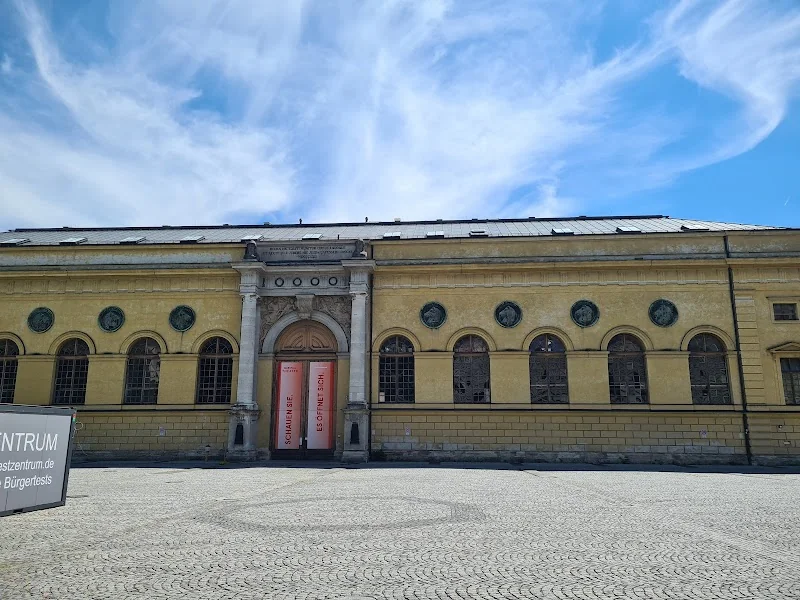
Marstallpl. 4, München-Altstadt-Lehel
Marstallpl. 4, 80539 München, Germany
Marstall Munich | Schedule & Tickets
The Marstall in Munich is one of those venues that you don't just visit, but experience as a theater location. It is located in the heart of the old town, in close proximity to the Residenz, and belongs as a stage to the Residenztheater Munich. With around 146 seats, the Marstall is intentionally small and approachable, giving many performances a special intensity: Here, you don't sit distanced, but close to the production, to the voices, to the movements, and to the atmosphere of the evening. At the same time, the Marstall combines historical substance with a clear contemporary claim. Therefore, those searching for Marstall Munich often mean not just a place, but the connection of program, tickets, access, seating, and the special history of this house. This mixture makes the Marstall one of the most exciting addresses for sophisticated theater in Munich. The official representation of the house emphasizes its role as a venue of the Residenztheater, the location in the city center, and the tradition as a place for new forms and strong artistic signatures. ([residenztheater.de](https://www.residenztheater.de/das-haus))
Current Program and Schedule at Marstall Munich
The schedule of the Marstall clearly shows what this stage stands for: for bold, contemporary, and literarily demanding productions. On the official Marstall page, there is a program that ranges from premieres to world premieres to readings, discussions, and formal experiments. Currently, this includes titles such as Marat/Sade, The Guns of Mrs. Carrar/Strangling Lead, After Midnight, (Not)Mothers!, A Gentle Death, Recitative, Automat Buffet, and Mercury. Even the titles show that the Marstall does not rely on light entertainment, but on material with attitude, friction, and social relevance. This is typical for the stage, which is repeatedly used in the Residenztheater system as a place for contemporary questions and artistic experiments. Therefore, those interested in the Marstall program will find there not just any sequence of evenings, but a clearly profiled selection that intertwines literature, theater history, and current debates. ([residenztheater.de](https://www.residenztheater.de/en/marstall))
Particularly interesting is that the Marstall not only shows classical theater evenings but also formats that are situated between stage, conversation, and research. The official house description points out that the Marstall has developed into a center for contemporary and avant-garde art in recent years. The current selection of the program confirms this: In addition to world premieres and adaptations, there are also projects on the program that work with narrative forms, perspective changes, and performative approaches. For visitors, this means that an evening at the Marstall is often more than just the pure performance of a text. Rather, one experiences a stage that is open to surprises and combines classical city theater with an experimental attitude. Those who want to understand the orientation of the house should also know that the Residenztheater plays in German, but some productions are shown with English surtitles. This makes the Marstall also well accessible for an international audience. ([residenztheater.de](https://www.residenztheater.de/en/marstall))
Tickets, Advance Sales, and Prices for the Marstall
Regarding tickets, the Residenztheater is very clearly organized, which is particularly practical for the Marstall. Tickets can be purchased online, by phone, or at the box office at Marstallplatz 5. The telephone advance sale is possible from Monday to Saturday between 10 AM and 7 PM, and the box office at Marstallplatz is also open from Monday to Saturday between 10 AM and 7 PM. For evening sales: The evening box office opens at the respective venue one hour before the performance starts. So if you want to go to the theater spontaneously, you usually still have a chance at short notice. Important for planning is also that the official advance sale starts on the 1st of each month at 10 AM for the following month; if the 1st falls on a Sunday or holiday, the start is moved to the day before. This structure is especially helpful for in-demand premieres or world premieres at the Marstall, which can be quickly sold out. ([residenztheater.de](https://www.residenztheater.de/en/tickets))
Also, in terms of pricing, the Marstall is transparently integrated into the system of the Residenztheater. On the official page for discounts, a price of 18 euros is mentioned for the Marstall on theater days. Additionally, there are reduced tickets for students, trainees, and volunteers up to 30 years old for 10 euros in advance and at the box office, depending on the seating group and availability. Group bookings for 20 or more people are also possible. Furthermore, it is important for many visitors that the ticket can be used as an MVV ticket: According to the Residenztheater, the travel entitlement is valid on the day of the performance from 3 PM until 6 AM the following day, and for performances before 6 PM, already from three hours before the start. This makes traveling by public transport particularly pleasant and reduces the stress around parking and access. Those who want to prepare well for their visit can not only check the program and dates but also choose the appropriate price and travel option early. ([residenztheater.de](https://www.residenztheater.de/en/tickets/reductions?utm_source=openai))
Access, Parking, and Barrier-Free Access at Marstallplatz
The location of the Marstall is a great advantage for visitors. The official service page states the address for the venue as Marstallplatz 4 in 80539 Munich. At the same time, it describes that there is a barrier at Marstallplatz that can be opened by ringing the bell at the gatekeeper. Those arriving by car can park directly at Marstallplatz. The access to the theater foyer and auditorium is on the ground floor, which makes the visit significantly more comfortable. This is not a given in a central city area and is one of the practical advantages of the house. The location itself is also an argument: The Residenztheater describes its three venues as places in close proximity to the Residenz in the heart of Munich. This confirms the impression of many visitors that the Marstall is not somewhere on the edge, but really in the middle of the city. Those who want to eat or drink something before the theater visit benefit from the short distances to the old town. ([residenztheater.de](https://www.residenztheater.de/service))
Particularly important is the barrier-free aspect of the Marstall. According to the Residenztheater, a wheelchair-accessible toilet is available, and depending on the configured audience tribune, wheelchair seats are available. The service information also specifically points out that there is a wheelchair spectator seat in the Marstall that should be reserved in advance, as this is usually not possible at the evening box office. For people with mobility impairments, it is also helpful that the access to the foyer and auditorium is on the ground floor and that the location of the lending is marked on the barrier-free overview plan of the house. These details show that the Marstall is designed not only artistically but also organizationally for as accessible a use as possible. Therefore, those planning a visit should not only look at the schedule but also contact the visitor service early if needed and consider the desired requirements directly. ([residenztheater.de](https://www.residenztheater.de/service))
Seating Plan, Seats, and Capacity at Marstall
With about 146 seats, the Marstall is one of the smaller venues of the Residenztheater. This is a significant part of its character. The atmosphere is therefore more concentrated, immediate, and often more experimental than in larger houses. The official house description explicitly mentions this capacity and classifies the Marstall as one of three venues of the Residenztheater, alongside the Residenztheater at Max-Joseph-Platz and the Cuvilliés Theater. For visitor planning, this means: The Marstall is not a mass space, but a compact stage where proximity to the ensemble and the production is palpable. For certain productions, the audience tribune may be arranged differently, so the exact seating situation may vary. This is typical for a stage that also accommodates experimental or flexible formats. Therefore, when selecting a seat, one should pay attention not only to the capacity but also to the respective production form. ([residenztheater.de](https://www.residenztheater.de/das-haus))
Even though the Marstall cannot be compared to a large, classical opera house, there are clear service structures for seating planning. A seat is designated for wheelchair users, which should be reserved in advance. Additionally, the house refers to a barrier-free overview plan. This is helpful if you want to orient yourself in advance, for example, during a first visit or if you are traveling with companions. It is also important that the Marstall is part of a larger ensemble and venue structure within the Residenztheater. This means that program selection, ticketing, and access systems are professionally coordinated, even though the space itself remains intentionally small. This combination of intimacy and organizational clarity makes the Marstall attractive for many theater guests: You get a dense, focused audience experience without having to sacrifice comfort and structure. In practice, the Marstall is often a good choice for visitors who want to sit close to the performers and experience the stage action with special intensity. ([residenztheater.de](https://www.residenztheater.de/das-haus))
History and Special Features of the Former Royal Riding School
The history of the Marstall is one of the reasons why this venue has such a special effect. The building was constructed by Leo von Klenze and served the noble society as a royal riding school at the beginning of the 19th century. After the end of the monarchy, riding in the Marstall also ended, and the rooms were initially used as a museum where the public could view the once splendid carriages of the former king. The building was heavily damaged during World War II. After a provisional reconstruction, the state theaters used the premises for years as an assembly hall, wood storage, and for storing decoration pieces. This sequence alone shows how much the Marstall is a place of historical upheavals: from a representative court building to a museum interim station to a pragmatic workshop and storage area. Only later did it develop again into a venue with its own artistic identity. ([residenztheater.de](https://www.residenztheater.de/en/marstall))
In the late 1960s, many artists were looking for alternative performance venues for new, experimental works. In 1971, the potential of the Marstall as a studio and experimental stage was recognized, and a little over a year later, the newly gained venue was ceremoniously opened as part of the cultural program of the Olympic Games with Franz Xaver Kroetz’s Global Interest. Since then, the Marstall has continually reinvented itself. The official texts report on world premieres such as Ingmar Bergman's Scenes from a Marriage, national and international guests, and workshops as well as a props storage in the upper floors, where all stage sets for the Residenztheater are still created today. Under Elisabeth Schweeger, the Marstall was further profiled between 1993 and 2001 as a center for contemporary and avant-garde art. Today, this mixture of history, craftsmanship, contemporary art, and experiment shapes the special character of the place. Therefore, when visiting the Marstall, one not only experiences a performance but also a piece of Munich theater history in condensed form. ([residenztheater.de](https://www.residenztheater.de/en/marstall))
Sources:
Show moreShow less
Marstall Munich | Schedule & Tickets
The Marstall in Munich is one of those venues that you don't just visit, but experience as a theater location. It is located in the heart of the old town, in close proximity to the Residenz, and belongs as a stage to the Residenztheater Munich. With around 146 seats, the Marstall is intentionally small and approachable, giving many performances a special intensity: Here, you don't sit distanced, but close to the production, to the voices, to the movements, and to the atmosphere of the evening. At the same time, the Marstall combines historical substance with a clear contemporary claim. Therefore, those searching for Marstall Munich often mean not just a place, but the connection of program, tickets, access, seating, and the special history of this house. This mixture makes the Marstall one of the most exciting addresses for sophisticated theater in Munich. The official representation of the house emphasizes its role as a venue of the Residenztheater, the location in the city center, and the tradition as a place for new forms and strong artistic signatures. ([residenztheater.de](https://www.residenztheater.de/das-haus))
Current Program and Schedule at Marstall Munich
The schedule of the Marstall clearly shows what this stage stands for: for bold, contemporary, and literarily demanding productions. On the official Marstall page, there is a program that ranges from premieres to world premieres to readings, discussions, and formal experiments. Currently, this includes titles such as Marat/Sade, The Guns of Mrs. Carrar/Strangling Lead, After Midnight, (Not)Mothers!, A Gentle Death, Recitative, Automat Buffet, and Mercury. Even the titles show that the Marstall does not rely on light entertainment, but on material with attitude, friction, and social relevance. This is typical for the stage, which is repeatedly used in the Residenztheater system as a place for contemporary questions and artistic experiments. Therefore, those interested in the Marstall program will find there not just any sequence of evenings, but a clearly profiled selection that intertwines literature, theater history, and current debates. ([residenztheater.de](https://www.residenztheater.de/en/marstall))
Particularly interesting is that the Marstall not only shows classical theater evenings but also formats that are situated between stage, conversation, and research. The official house description points out that the Marstall has developed into a center for contemporary and avant-garde art in recent years. The current selection of the program confirms this: In addition to world premieres and adaptations, there are also projects on the program that work with narrative forms, perspective changes, and performative approaches. For visitors, this means that an evening at the Marstall is often more than just the pure performance of a text. Rather, one experiences a stage that is open to surprises and combines classical city theater with an experimental attitude. Those who want to understand the orientation of the house should also know that the Residenztheater plays in German, but some productions are shown with English surtitles. This makes the Marstall also well accessible for an international audience. ([residenztheater.de](https://www.residenztheater.de/en/marstall))
Tickets, Advance Sales, and Prices for the Marstall
Regarding tickets, the Residenztheater is very clearly organized, which is particularly practical for the Marstall. Tickets can be purchased online, by phone, or at the box office at Marstallplatz 5. The telephone advance sale is possible from Monday to Saturday between 10 AM and 7 PM, and the box office at Marstallplatz is also open from Monday to Saturday between 10 AM and 7 PM. For evening sales: The evening box office opens at the respective venue one hour before the performance starts. So if you want to go to the theater spontaneously, you usually still have a chance at short notice. Important for planning is also that the official advance sale starts on the 1st of each month at 10 AM for the following month; if the 1st falls on a Sunday or holiday, the start is moved to the day before. This structure is especially helpful for in-demand premieres or world premieres at the Marstall, which can be quickly sold out. ([residenztheater.de](https://www.residenztheater.de/en/tickets))
Also, in terms of pricing, the Marstall is transparently integrated into the system of the Residenztheater. On the official page for discounts, a price of 18 euros is mentioned for the Marstall on theater days. Additionally, there are reduced tickets for students, trainees, and volunteers up to 30 years old for 10 euros in advance and at the box office, depending on the seating group and availability. Group bookings for 20 or more people are also possible. Furthermore, it is important for many visitors that the ticket can be used as an MVV ticket: According to the Residenztheater, the travel entitlement is valid on the day of the performance from 3 PM until 6 AM the following day, and for performances before 6 PM, already from three hours before the start. This makes traveling by public transport particularly pleasant and reduces the stress around parking and access. Those who want to prepare well for their visit can not only check the program and dates but also choose the appropriate price and travel option early. ([residenztheater.de](https://www.residenztheater.de/en/tickets/reductions?utm_source=openai))
Access, Parking, and Barrier-Free Access at Marstallplatz
The location of the Marstall is a great advantage for visitors. The official service page states the address for the venue as Marstallplatz 4 in 80539 Munich. At the same time, it describes that there is a barrier at Marstallplatz that can be opened by ringing the bell at the gatekeeper. Those arriving by car can park directly at Marstallplatz. The access to the theater foyer and auditorium is on the ground floor, which makes the visit significantly more comfortable. This is not a given in a central city area and is one of the practical advantages of the house. The location itself is also an argument: The Residenztheater describes its three venues as places in close proximity to the Residenz in the heart of Munich. This confirms the impression of many visitors that the Marstall is not somewhere on the edge, but really in the middle of the city. Those who want to eat or drink something before the theater visit benefit from the short distances to the old town. ([residenztheater.de](https://www.residenztheater.de/service))
Particularly important is the barrier-free aspect of the Marstall. According to the Residenztheater, a wheelchair-accessible toilet is available, and depending on the configured audience tribune, wheelchair seats are available. The service information also specifically points out that there is a wheelchair spectator seat in the Marstall that should be reserved in advance, as this is usually not possible at the evening box office. For people with mobility impairments, it is also helpful that the access to the foyer and auditorium is on the ground floor and that the location of the lending is marked on the barrier-free overview plan of the house. These details show that the Marstall is designed not only artistically but also organizationally for as accessible a use as possible. Therefore, those planning a visit should not only look at the schedule but also contact the visitor service early if needed and consider the desired requirements directly. ([residenztheater.de](https://www.residenztheater.de/service))
Seating Plan, Seats, and Capacity at Marstall
With about 146 seats, the Marstall is one of the smaller venues of the Residenztheater. This is a significant part of its character. The atmosphere is therefore more concentrated, immediate, and often more experimental than in larger houses. The official house description explicitly mentions this capacity and classifies the Marstall as one of three venues of the Residenztheater, alongside the Residenztheater at Max-Joseph-Platz and the Cuvilliés Theater. For visitor planning, this means: The Marstall is not a mass space, but a compact stage where proximity to the ensemble and the production is palpable. For certain productions, the audience tribune may be arranged differently, so the exact seating situation may vary. This is typical for a stage that also accommodates experimental or flexible formats. Therefore, when selecting a seat, one should pay attention not only to the capacity but also to the respective production form. ([residenztheater.de](https://www.residenztheater.de/das-haus))
Even though the Marstall cannot be compared to a large, classical opera house, there are clear service structures for seating planning. A seat is designated for wheelchair users, which should be reserved in advance. Additionally, the house refers to a barrier-free overview plan. This is helpful if you want to orient yourself in advance, for example, during a first visit or if you are traveling with companions. It is also important that the Marstall is part of a larger ensemble and venue structure within the Residenztheater. This means that program selection, ticketing, and access systems are professionally coordinated, even though the space itself remains intentionally small. This combination of intimacy and organizational clarity makes the Marstall attractive for many theater guests: You get a dense, focused audience experience without having to sacrifice comfort and structure. In practice, the Marstall is often a good choice for visitors who want to sit close to the performers and experience the stage action with special intensity. ([residenztheater.de](https://www.residenztheater.de/das-haus))
History and Special Features of the Former Royal Riding School
The history of the Marstall is one of the reasons why this venue has such a special effect. The building was constructed by Leo von Klenze and served the noble society as a royal riding school at the beginning of the 19th century. After the end of the monarchy, riding in the Marstall also ended, and the rooms were initially used as a museum where the public could view the once splendid carriages of the former king. The building was heavily damaged during World War II. After a provisional reconstruction, the state theaters used the premises for years as an assembly hall, wood storage, and for storing decoration pieces. This sequence alone shows how much the Marstall is a place of historical upheavals: from a representative court building to a museum interim station to a pragmatic workshop and storage area. Only later did it develop again into a venue with its own artistic identity. ([residenztheater.de](https://www.residenztheater.de/en/marstall))
In the late 1960s, many artists were looking for alternative performance venues for new, experimental works. In 1971, the potential of the Marstall as a studio and experimental stage was recognized, and a little over a year later, the newly gained venue was ceremoniously opened as part of the cultural program of the Olympic Games with Franz Xaver Kroetz’s Global Interest. Since then, the Marstall has continually reinvented itself. The official texts report on world premieres such as Ingmar Bergman's Scenes from a Marriage, national and international guests, and workshops as well as a props storage in the upper floors, where all stage sets for the Residenztheater are still created today. Under Elisabeth Schweeger, the Marstall was further profiled between 1993 and 2001 as a center for contemporary and avant-garde art. Today, this mixture of history, craftsmanship, contemporary art, and experiment shapes the special character of the place. Therefore, when visiting the Marstall, one not only experiences a performance but also a piece of Munich theater history in condensed form. ([residenztheater.de](https://www.residenztheater.de/en/marstall))
Sources:
Marstall Munich | Schedule & Tickets
The Marstall in Munich is one of those venues that you don't just visit, but experience as a theater location. It is located in the heart of the old town, in close proximity to the Residenz, and belongs as a stage to the Residenztheater Munich. With around 146 seats, the Marstall is intentionally small and approachable, giving many performances a special intensity: Here, you don't sit distanced, but close to the production, to the voices, to the movements, and to the atmosphere of the evening. At the same time, the Marstall combines historical substance with a clear contemporary claim. Therefore, those searching for Marstall Munich often mean not just a place, but the connection of program, tickets, access, seating, and the special history of this house. This mixture makes the Marstall one of the most exciting addresses for sophisticated theater in Munich. The official representation of the house emphasizes its role as a venue of the Residenztheater, the location in the city center, and the tradition as a place for new forms and strong artistic signatures. ([residenztheater.de](https://www.residenztheater.de/das-haus))
Current Program and Schedule at Marstall Munich
The schedule of the Marstall clearly shows what this stage stands for: for bold, contemporary, and literarily demanding productions. On the official Marstall page, there is a program that ranges from premieres to world premieres to readings, discussions, and formal experiments. Currently, this includes titles such as Marat/Sade, The Guns of Mrs. Carrar/Strangling Lead, After Midnight, (Not)Mothers!, A Gentle Death, Recitative, Automat Buffet, and Mercury. Even the titles show that the Marstall does not rely on light entertainment, but on material with attitude, friction, and social relevance. This is typical for the stage, which is repeatedly used in the Residenztheater system as a place for contemporary questions and artistic experiments. Therefore, those interested in the Marstall program will find there not just any sequence of evenings, but a clearly profiled selection that intertwines literature, theater history, and current debates. ([residenztheater.de](https://www.residenztheater.de/en/marstall))
Particularly interesting is that the Marstall not only shows classical theater evenings but also formats that are situated between stage, conversation, and research. The official house description points out that the Marstall has developed into a center for contemporary and avant-garde art in recent years. The current selection of the program confirms this: In addition to world premieres and adaptations, there are also projects on the program that work with narrative forms, perspective changes, and performative approaches. For visitors, this means that an evening at the Marstall is often more than just the pure performance of a text. Rather, one experiences a stage that is open to surprises and combines classical city theater with an experimental attitude. Those who want to understand the orientation of the house should also know that the Residenztheater plays in German, but some productions are shown with English surtitles. This makes the Marstall also well accessible for an international audience. ([residenztheater.de](https://www.residenztheater.de/en/marstall))
Tickets, Advance Sales, and Prices for the Marstall
Regarding tickets, the Residenztheater is very clearly organized, which is particularly practical for the Marstall. Tickets can be purchased online, by phone, or at the box office at Marstallplatz 5. The telephone advance sale is possible from Monday to Saturday between 10 AM and 7 PM, and the box office at Marstallplatz is also open from Monday to Saturday between 10 AM and 7 PM. For evening sales: The evening box office opens at the respective venue one hour before the performance starts. So if you want to go to the theater spontaneously, you usually still have a chance at short notice. Important for planning is also that the official advance sale starts on the 1st of each month at 10 AM for the following month; if the 1st falls on a Sunday or holiday, the start is moved to the day before. This structure is especially helpful for in-demand premieres or world premieres at the Marstall, which can be quickly sold out. ([residenztheater.de](https://www.residenztheater.de/en/tickets))
Also, in terms of pricing, the Marstall is transparently integrated into the system of the Residenztheater. On the official page for discounts, a price of 18 euros is mentioned for the Marstall on theater days. Additionally, there are reduced tickets for students, trainees, and volunteers up to 30 years old for 10 euros in advance and at the box office, depending on the seating group and availability. Group bookings for 20 or more people are also possible. Furthermore, it is important for many visitors that the ticket can be used as an MVV ticket: According to the Residenztheater, the travel entitlement is valid on the day of the performance from 3 PM until 6 AM the following day, and for performances before 6 PM, already from three hours before the start. This makes traveling by public transport particularly pleasant and reduces the stress around parking and access. Those who want to prepare well for their visit can not only check the program and dates but also choose the appropriate price and travel option early. ([residenztheater.de](https://www.residenztheater.de/en/tickets/reductions?utm_source=openai))
Access, Parking, and Barrier-Free Access at Marstallplatz
The location of the Marstall is a great advantage for visitors. The official service page states the address for the venue as Marstallplatz 4 in 80539 Munich. At the same time, it describes that there is a barrier at Marstallplatz that can be opened by ringing the bell at the gatekeeper. Those arriving by car can park directly at Marstallplatz. The access to the theater foyer and auditorium is on the ground floor, which makes the visit significantly more comfortable. This is not a given in a central city area and is one of the practical advantages of the house. The location itself is also an argument: The Residenztheater describes its three venues as places in close proximity to the Residenz in the heart of Munich. This confirms the impression of many visitors that the Marstall is not somewhere on the edge, but really in the middle of the city. Those who want to eat or drink something before the theater visit benefit from the short distances to the old town. ([residenztheater.de](https://www.residenztheater.de/service))
Particularly important is the barrier-free aspect of the Marstall. According to the Residenztheater, a wheelchair-accessible toilet is available, and depending on the configured audience tribune, wheelchair seats are available. The service information also specifically points out that there is a wheelchair spectator seat in the Marstall that should be reserved in advance, as this is usually not possible at the evening box office. For people with mobility impairments, it is also helpful that the access to the foyer and auditorium is on the ground floor and that the location of the lending is marked on the barrier-free overview plan of the house. These details show that the Marstall is designed not only artistically but also organizationally for as accessible a use as possible. Therefore, those planning a visit should not only look at the schedule but also contact the visitor service early if needed and consider the desired requirements directly. ([residenztheater.de](https://www.residenztheater.de/service))
Seating Plan, Seats, and Capacity at Marstall
With about 146 seats, the Marstall is one of the smaller venues of the Residenztheater. This is a significant part of its character. The atmosphere is therefore more concentrated, immediate, and often more experimental than in larger houses. The official house description explicitly mentions this capacity and classifies the Marstall as one of three venues of the Residenztheater, alongside the Residenztheater at Max-Joseph-Platz and the Cuvilliés Theater. For visitor planning, this means: The Marstall is not a mass space, but a compact stage where proximity to the ensemble and the production is palpable. For certain productions, the audience tribune may be arranged differently, so the exact seating situation may vary. This is typical for a stage that also accommodates experimental or flexible formats. Therefore, when selecting a seat, one should pay attention not only to the capacity but also to the respective production form. ([residenztheater.de](https://www.residenztheater.de/das-haus))
Even though the Marstall cannot be compared to a large, classical opera house, there are clear service structures for seating planning. A seat is designated for wheelchair users, which should be reserved in advance. Additionally, the house refers to a barrier-free overview plan. This is helpful if you want to orient yourself in advance, for example, during a first visit or if you are traveling with companions. It is also important that the Marstall is part of a larger ensemble and venue structure within the Residenztheater. This means that program selection, ticketing, and access systems are professionally coordinated, even though the space itself remains intentionally small. This combination of intimacy and organizational clarity makes the Marstall attractive for many theater guests: You get a dense, focused audience experience without having to sacrifice comfort and structure. In practice, the Marstall is often a good choice for visitors who want to sit close to the performers and experience the stage action with special intensity. ([residenztheater.de](https://www.residenztheater.de/das-haus))
History and Special Features of the Former Royal Riding School
The history of the Marstall is one of the reasons why this venue has such a special effect. The building was constructed by Leo von Klenze and served the noble society as a royal riding school at the beginning of the 19th century. After the end of the monarchy, riding in the Marstall also ended, and the rooms were initially used as a museum where the public could view the once splendid carriages of the former king. The building was heavily damaged during World War II. After a provisional reconstruction, the state theaters used the premises for years as an assembly hall, wood storage, and for storing decoration pieces. This sequence alone shows how much the Marstall is a place of historical upheavals: from a representative court building to a museum interim station to a pragmatic workshop and storage area. Only later did it develop again into a venue with its own artistic identity. ([residenztheater.de](https://www.residenztheater.de/en/marstall))
In the late 1960s, many artists were looking for alternative performance venues for new, experimental works. In 1971, the potential of the Marstall as a studio and experimental stage was recognized, and a little over a year later, the newly gained venue was ceremoniously opened as part of the cultural program of the Olympic Games with Franz Xaver Kroetz’s Global Interest. Since then, the Marstall has continually reinvented itself. The official texts report on world premieres such as Ingmar Bergman's Scenes from a Marriage, national and international guests, and workshops as well as a props storage in the upper floors, where all stage sets for the Residenztheater are still created today. Under Elisabeth Schweeger, the Marstall was further profiled between 1993 and 2001 as a center for contemporary and avant-garde art. Today, this mixture of history, craftsmanship, contemporary art, and experiment shapes the special character of the place. Therefore, when visiting the Marstall, one not only experiences a performance but also a piece of Munich theater history in condensed form. ([residenztheater.de](https://www.residenztheater.de/en/marstall))
Sources:
Upcoming Events
No events found
Frequently Asked Questions
Reviews
Nova
4. January 2024
We went to see Yvonne, Prinzessin von Burgund. I didn't really understand, but the actors did a great job and the costumes were great. The theatre itself isn't really my style, since it looked very industrial inside. The staff however were very nice.
Robyn Lee
2. July 2023
A good venue for theatre, music and other live events. Program by Residenz Theatre. There are a few restaurants on walking distance, but I would recommend having a bite and a drink at Viktualen Market instead, about 8 min walk away towards the old Town.
Raffaele Pizzari
4. October 2021
Nice theater in the very city center of Munich.
Robert Wolters
17. February 2019
Enjoyable. Small, simple, but love it.
Eva Martschew
15. January 2023
Tip-top!