
München
Max-Joseph-Platz 2, 80539 München, Deutschland
Max-Joseph-Platz | Events & Redesign
The Max-Joseph-Platz is one of the most well-known urban spaces in Munich because it combines architecture, culture, and urban life in a compact area. When looking for the square, people usually mean not just an address but one of the most impressive backdrops of the old town: the Residence, the National Theatre, the Residence Theatre, and the open square in front of the opera. This is precisely why there are so many inquiries about maps, photos, in front of the opera, redesign, directions, parking, and events around the square. The square is not a closed event venue with fixed seating, but a public space with changing uses that works both in everyday life and during major cultural moments. The official city and tourism presentation emphasizes the historical planning, the recent redesign, and the special role as a stage in the heart of the city center. ([entdecken.muenchen.de](https://entdecken.muenchen.de/en/station/23-22/))
Location, Map, and Orientation at Max-Joseph-Platz in Munich
Those looking for Max-Joseph-Platz on the map will find it in the center of Munich's old town between Residenzstraße, Maximilianstraße, and the immediate vicinity of Marienplatz and Odeonsplatz. For many visitors, this location is the most important reason to head to the square: You stand here right in the city center and at the same time in an area characterized by classicist architecture and representative buildings. The official visitor page of the Bavarian State Opera describes the theatre at Max-Joseph-Platz 2 as located in the heart of the old town and mentions a walking time of about five minutes from Marienplatz. Thus, the square is not only a destination for opera and theatre guests but also a natural reference point for city walks, photos, and short stops. Those coming from the city center find themselves at an intersection of culture, tourism, and public space. The square is also a good anchor point for anyone searching for Max-Joseph-Platz Munich map or Max-Joseph-Platz maps, as the most important sights are immediately in view and the square itself is very easy to read due to its open, clear geometry. Its location also explains why it is often described as in front of the opera: it marks the representative forecourt of a whole cultural ensemble and is thus much more than just a simple traffic area. ([staatsoper.de](https://www.staatsoper.de/besuch?utm_source=openai))
History and Origin of Max-Joseph-Platz
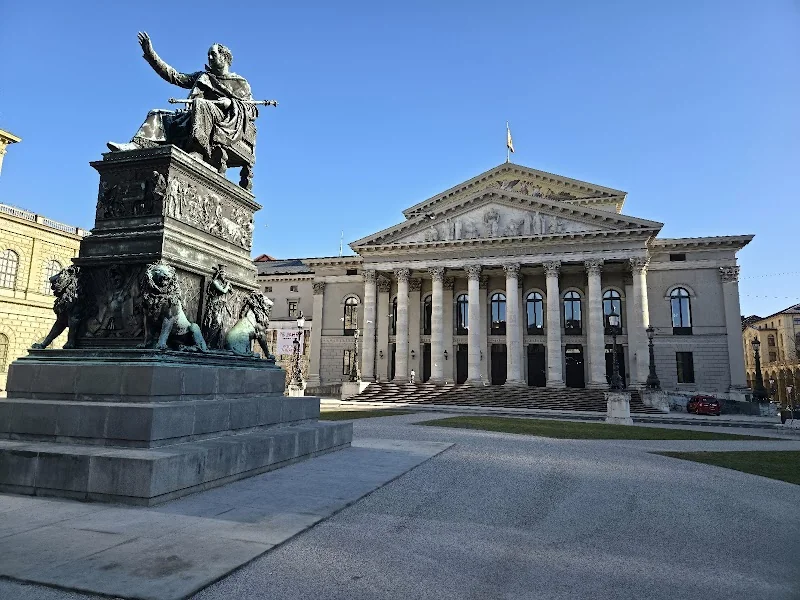
The Max-Joseph-Platz is historically closely linked to the classicist expansion of Munich. According to official city information, it was designed around 1820 by Leo von Klenze and was inspired by the Piazza del Campidoglio in Rome. This origin is important for understanding the square because it explains why it appears so strictly ordered, so representative, and at the same time so open. The layout did not arise by chance but is part of an urban planning idea that aimed to stage royal Munich with monumentality and architectural discipline. The square is named after King Max I. Joseph, and the monument in its center emphasizes this historical connection to this day. The Munich tourism presentation also points out that the monument was originally intended as a tribute to the first Bavarian constitution of 1818. So, anyone asking about the significance of the square automatically lands at Bavarian history, the transition from courtly to bourgeois cityscape, and the question of how architecture makes political representation visible. It is precisely this mixture of memory, power, and public use that makes the square so extraordinary. It is not only a beautiful backdrop for photos but a place where Munich's city history remains readable in stone, bronze, and sight axes. ([entdecken.muenchen.de](https://entdecken.muenchen.de/en/station/23-22/))
Redesign 2025: More Green, More Quality of Stay
A particularly sought-after topic around the square is its redesign. The city of Munich has revised Max-Joseph-Platz in 2025 and noticeably changed the character of the place without destroying its historical effect. According to city documentation, the area has been greened, covered with grass, and equipped with movable furniture and plant containers. At the same time, more generous strolling and lounging areas have been created, and the pathways are oriented towards historical models with a radial structure. As a result, the square feels more open, calmer, and more pleasant to linger in than before. The access to the underground garage has also been reduced, which diminishes the dominant impression of the entrance and emphasizes the public space more strongly. The eight historical lanterns have been visually and technically restored and now illuminate the square with modern LED technology. These measures are more than mere cosmetics: they show that Max-Joseph-Platz is now understood not only as a monument protection object but as a vibrant urban space with quality of stay. Anyone searching for Max-Joseph-Platz Munich redesign or Max Joseph Platz Munich construction is therefore interested in a very current development that has rebalanced the square: less harsh traffic optics, more green, more tranquility, and more space for encounters. This makes it even more attractive for visitors, locals, and cultural audiences. ([entdecken.muenchen.de](https://entdecken.muenchen.de/en/station/23-22/))
Opera, Residence, and Residence Theatre: The Architecture Around the Square
The strongest impact of Max-Joseph-Platz arises from its architectural framing. On one side stands the Residence with the King's Building, on the other the National Theatre and the Residence Theatre; in addition, there are the arcades of Palais Toerring-Jettenbach and historical townhouses. This constellation makes the square one of the densest ensembles in Munich's city center. The National Theatre at Max-Joseph-Platz 2 is the main venue of the Bavarian State Opera and the Bavarian State Ballet. Official information cites around 2,100 seats and standing places, one of the largest opera stages in the world, and a reconstruction after the destruction of World War II. The building is architecturally a masterpiece of European classicism, characterized by Corinthian columns and the monumental temple facade. The Residence Theatre at Max-Joseph-Platz 1, on the other hand, is the main venue of the Bavarian State Theatre, with 881 seats in the main house, supplemented by the Cuvilliés Theatre and the Marstall as additional stages. Together, these houses form a cultural corridor that is typical for Munich: courtly history, Bavarian state culture, and modern repertoire merge here. Anyone searching for Max-Joseph-Platz 1, Max-Joseph-Platz 2, or the facades in front of the opera is actually looking for a very precise urban constellation in which theatre, opera, residence, and square form a single ensemble. ([muenchen.travel](https://www.muenchen.travel/pois/kunst-kultur/nationaltheater))
The cultural use of the buildings around the square is also extraordinary. According to official representation, the Bavarian State Opera performs more than 30 operas and over 20 ballets per season, complemented by concerts and song recitals in a daily changing schedule. This explains why Max-Joseph-Platz is relevant not only for architecture enthusiasts but also for cultural audiences from all over the world. The square is not only a backdrop but part of the visitor experience: in front of the National Theatre, people linger, discuss productions, meet before the performance begins, or use the wide areas for a view of the ensemble. Especially at sunset or in the evening, when the facades are illuminated, it becomes clear how strongly this place is designed for staging. The official city and tourism communication describes the backdrop as unique and highlights the connection between opera, residence, residence theatre, and old townhouses. That is why the square is also so popular for photos: it provides clear lines, monumental perspectives, and a distinctive background that is both classic and urban. Anyone searching for the atmosphere in front of the opera finds here not only a foreground for the theatre but an entire urban framework that makes the significance of the house visible. ([muenchen.travel](https://www.muenchen.travel/pois/kunst-kultur/bayerische-staatsoper))
Events, Photos, and Cultural Use at Max-Joseph-Platz
The Max-Joseph-Platz is not only a beautiful place but also an active event space. The most famous format is “Opera for All,” where a current production of the Bavarian State Opera is broadcast live from the National Theatre onto a large screen. According to official information, this event takes place as part of the opera festival and is usually shown at Max-Joseph-Platz or Marstallplatz. Admission is free, and tickets are not required. This is precisely what makes the square so relevant for many inquiries about Max-Joseph-Platz events: it is a place for cultural participation in public space. The city of Munich also mentions demonstrations, art installations, and formats like Dinner in White as further uses of the square. This makes it clear that the square is not only a historical forecourt for the opera but a flexible urban stage that can function from classical concert evenings to temporary installations. For photos, this is particularly interesting because the atmosphere changes significantly depending on the time of day and use: sometimes representative and calm, then again lively, communal, and eventful. Anyone wanting to photograph the square should pay attention to the monumental axis of the National Theatre, the statue in the middle, the arcades of the neighboring buildings, and the open square in the center. This way, images are created that capture the character of the place better than mere facade shots. ([entdecken.muenchen.de](https://entdecken.muenchen.de/en/station/23-22/))
Directions, Parking, and Visitor Tips in Front of the Opera
For access, Max-Joseph-Platz is particularly well suited for pedestrians, culture visitors, and city walkers. The official visitor page of the Bavarian State Opera mentions the location in the old town and refers to a walking time of about five minutes from Marienplatz. Additionally, various stops for public transport are mentioned, including tram 19 and 21 at the National Theatre, the S-Bahn and U-Bahn at Marienplatz, as well as U-Bahn and bus at Odeonsplatz. Thus, the square is excellently connected to public transport, although the exact stop varies depending on the target building. Those arriving by car usually use the access via the Altstadtring into Maximilianstraße. Directly at the square is the opera garage or underground garage in front of the opera. According to official visitor information, fewer parking spaces are currently available there due to renovation work, and there may be access restrictions. This is particularly important for the search intent Max-Joseph-Platz 4, parking, or Max-Joseph-Platz maps, as drivers should plan their arrival more realistically because of this. At the same time, the State Opera points out that alternative parking options in the city center may also be considered. For bicycles, there are parking spaces behind the National Theatre on Marstallplatz. Overall, the rule is: those who want to experience the square relaxed should come on foot or by public transport. This way, the special effect of the place can be perceived without searching for parking and without time pressure. ([staatsoper.de](https://www.staatsoper.de/besuch?utm_source=openai))
For a practical visit, it is worthwhile to understand Max-Joseph-Platz not only as a destination but also as a starting point. From here, Marienplatz, Odeonsplatz, Maximilianstraße, and the Residence are easily accessible, making the square very well integrated into a city tour. Anyone searching for photos should pay attention to changing light moods: in the morning, the place appears clear and calm, during the day the open design emphasizes the architecture, and in the evening, the effect of the facades comes into its own. After the redesign, staying in the square itself has also become more pleasant, as there is more green and more areas to sit and linger. This makes it particularly attractive for short breaks between sightseeing, opera visits, or shopping. During events like “Opera for All,” the place changes significantly again, as the representative forecourt becomes an open meeting point for a large audience. So, anyone looking for a place that shows the Munich city center in concentrated form finds one of the best addresses in the city here. The mixture of history, culture, current urban design, and good accessibility ensures that Max-Joseph-Platz is not only present on maps and in search results but also leaves a lasting impression on site. ([entdecken.muenchen.de](https://entdecken.muenchen.de/en/station/23-22/))
Sources:
Show moreShow less
Max-Joseph-Platz | Events & Redesign
The Max-Joseph-Platz is one of the most well-known urban spaces in Munich because it combines architecture, culture, and urban life in a compact area. When looking for the square, people usually mean not just an address but one of the most impressive backdrops of the old town: the Residence, the National Theatre, the Residence Theatre, and the open square in front of the opera. This is precisely why there are so many inquiries about maps, photos, in front of the opera, redesign, directions, parking, and events around the square. The square is not a closed event venue with fixed seating, but a public space with changing uses that works both in everyday life and during major cultural moments. The official city and tourism presentation emphasizes the historical planning, the recent redesign, and the special role as a stage in the heart of the city center. ([entdecken.muenchen.de](https://entdecken.muenchen.de/en/station/23-22/))
Location, Map, and Orientation at Max-Joseph-Platz in Munich
Those looking for Max-Joseph-Platz on the map will find it in the center of Munich's old town between Residenzstraße, Maximilianstraße, and the immediate vicinity of Marienplatz and Odeonsplatz. For many visitors, this location is the most important reason to head to the square: You stand here right in the city center and at the same time in an area characterized by classicist architecture and representative buildings. The official visitor page of the Bavarian State Opera describes the theatre at Max-Joseph-Platz 2 as located in the heart of the old town and mentions a walking time of about five minutes from Marienplatz. Thus, the square is not only a destination for opera and theatre guests but also a natural reference point for city walks, photos, and short stops. Those coming from the city center find themselves at an intersection of culture, tourism, and public space. The square is also a good anchor point for anyone searching for Max-Joseph-Platz Munich map or Max-Joseph-Platz maps, as the most important sights are immediately in view and the square itself is very easy to read due to its open, clear geometry. Its location also explains why it is often described as in front of the opera: it marks the representative forecourt of a whole cultural ensemble and is thus much more than just a simple traffic area. ([staatsoper.de](https://www.staatsoper.de/besuch?utm_source=openai))
History and Origin of Max-Joseph-Platz
The Max-Joseph-Platz is historically closely linked to the classicist expansion of Munich. According to official city information, it was designed around 1820 by Leo von Klenze and was inspired by the Piazza del Campidoglio in Rome. This origin is important for understanding the square because it explains why it appears so strictly ordered, so representative, and at the same time so open. The layout did not arise by chance but is part of an urban planning idea that aimed to stage royal Munich with monumentality and architectural discipline. The square is named after King Max I. Joseph, and the monument in its center emphasizes this historical connection to this day. The Munich tourism presentation also points out that the monument was originally intended as a tribute to the first Bavarian constitution of 1818. So, anyone asking about the significance of the square automatically lands at Bavarian history, the transition from courtly to bourgeois cityscape, and the question of how architecture makes political representation visible. It is precisely this mixture of memory, power, and public use that makes the square so extraordinary. It is not only a beautiful backdrop for photos but a place where Munich's city history remains readable in stone, bronze, and sight axes. ([entdecken.muenchen.de](https://entdecken.muenchen.de/en/station/23-22/))
Redesign 2025: More Green, More Quality of Stay
A particularly sought-after topic around the square is its redesign. The city of Munich has revised Max-Joseph-Platz in 2025 and noticeably changed the character of the place without destroying its historical effect. According to city documentation, the area has been greened, covered with grass, and equipped with movable furniture and plant containers. At the same time, more generous strolling and lounging areas have been created, and the pathways are oriented towards historical models with a radial structure. As a result, the square feels more open, calmer, and more pleasant to linger in than before. The access to the underground garage has also been reduced, which diminishes the dominant impression of the entrance and emphasizes the public space more strongly. The eight historical lanterns have been visually and technically restored and now illuminate the square with modern LED technology. These measures are more than mere cosmetics: they show that Max-Joseph-Platz is now understood not only as a monument protection object but as a vibrant urban space with quality of stay. Anyone searching for Max-Joseph-Platz Munich redesign or Max Joseph Platz Munich construction is therefore interested in a very current development that has rebalanced the square: less harsh traffic optics, more green, more tranquility, and more space for encounters. This makes it even more attractive for visitors, locals, and cultural audiences. ([entdecken.muenchen.de](https://entdecken.muenchen.de/en/station/23-22/))
Opera, Residence, and Residence Theatre: The Architecture Around the Square
The strongest impact of Max-Joseph-Platz arises from its architectural framing. On one side stands the Residence with the King's Building, on the other the National Theatre and the Residence Theatre; in addition, there are the arcades of Palais Toerring-Jettenbach and historical townhouses. This constellation makes the square one of the densest ensembles in Munich's city center. The National Theatre at Max-Joseph-Platz 2 is the main venue of the Bavarian State Opera and the Bavarian State Ballet. Official information cites around 2,100 seats and standing places, one of the largest opera stages in the world, and a reconstruction after the destruction of World War II. The building is architecturally a masterpiece of European classicism, characterized by Corinthian columns and the monumental temple facade. The Residence Theatre at Max-Joseph-Platz 1, on the other hand, is the main venue of the Bavarian State Theatre, with 881 seats in the main house, supplemented by the Cuvilliés Theatre and the Marstall as additional stages. Together, these houses form a cultural corridor that is typical for Munich: courtly history, Bavarian state culture, and modern repertoire merge here. Anyone searching for Max-Joseph-Platz 1, Max-Joseph-Platz 2, or the facades in front of the opera is actually looking for a very precise urban constellation in which theatre, opera, residence, and square form a single ensemble. ([muenchen.travel](https://www.muenchen.travel/pois/kunst-kultur/nationaltheater))
The cultural use of the buildings around the square is also extraordinary. According to official representation, the Bavarian State Opera performs more than 30 operas and over 20 ballets per season, complemented by concerts and song recitals in a daily changing schedule. This explains why Max-Joseph-Platz is relevant not only for architecture enthusiasts but also for cultural audiences from all over the world. The square is not only a backdrop but part of the visitor experience: in front of the National Theatre, people linger, discuss productions, meet before the performance begins, or use the wide areas for a view of the ensemble. Especially at sunset or in the evening, when the facades are illuminated, it becomes clear how strongly this place is designed for staging. The official city and tourism communication describes the backdrop as unique and highlights the connection between opera, residence, residence theatre, and old townhouses. That is why the square is also so popular for photos: it provides clear lines, monumental perspectives, and a distinctive background that is both classic and urban. Anyone searching for the atmosphere in front of the opera finds here not only a foreground for the theatre but an entire urban framework that makes the significance of the house visible. ([muenchen.travel](https://www.muenchen.travel/pois/kunst-kultur/bayerische-staatsoper))
Events, Photos, and Cultural Use at Max-Joseph-Platz
The Max-Joseph-Platz is not only a beautiful place but also an active event space. The most famous format is “Opera for All,” where a current production of the Bavarian State Opera is broadcast live from the National Theatre onto a large screen. According to official information, this event takes place as part of the opera festival and is usually shown at Max-Joseph-Platz or Marstallplatz. Admission is free, and tickets are not required. This is precisely what makes the square so relevant for many inquiries about Max-Joseph-Platz events: it is a place for cultural participation in public space. The city of Munich also mentions demonstrations, art installations, and formats like Dinner in White as further uses of the square. This makes it clear that the square is not only a historical forecourt for the opera but a flexible urban stage that can function from classical concert evenings to temporary installations. For photos, this is particularly interesting because the atmosphere changes significantly depending on the time of day and use: sometimes representative and calm, then again lively, communal, and eventful. Anyone wanting to photograph the square should pay attention to the monumental axis of the National Theatre, the statue in the middle, the arcades of the neighboring buildings, and the open square in the center. This way, images are created that capture the character of the place better than mere facade shots. ([entdecken.muenchen.de](https://entdecken.muenchen.de/en/station/23-22/))
Directions, Parking, and Visitor Tips in Front of the Opera
For access, Max-Joseph-Platz is particularly well suited for pedestrians, culture visitors, and city walkers. The official visitor page of the Bavarian State Opera mentions the location in the old town and refers to a walking time of about five minutes from Marienplatz. Additionally, various stops for public transport are mentioned, including tram 19 and 21 at the National Theatre, the S-Bahn and U-Bahn at Marienplatz, as well as U-Bahn and bus at Odeonsplatz. Thus, the square is excellently connected to public transport, although the exact stop varies depending on the target building. Those arriving by car usually use the access via the Altstadtring into Maximilianstraße. Directly at the square is the opera garage or underground garage in front of the opera. According to official visitor information, fewer parking spaces are currently available there due to renovation work, and there may be access restrictions. This is particularly important for the search intent Max-Joseph-Platz 4, parking, or Max-Joseph-Platz maps, as drivers should plan their arrival more realistically because of this. At the same time, the State Opera points out that alternative parking options in the city center may also be considered. For bicycles, there are parking spaces behind the National Theatre on Marstallplatz. Overall, the rule is: those who want to experience the square relaxed should come on foot or by public transport. This way, the special effect of the place can be perceived without searching for parking and without time pressure. ([staatsoper.de](https://www.staatsoper.de/besuch?utm_source=openai))
For a practical visit, it is worthwhile to understand Max-Joseph-Platz not only as a destination but also as a starting point. From here, Marienplatz, Odeonsplatz, Maximilianstraße, and the Residence are easily accessible, making the square very well integrated into a city tour. Anyone searching for photos should pay attention to changing light moods: in the morning, the place appears clear and calm, during the day the open design emphasizes the architecture, and in the evening, the effect of the facades comes into its own. After the redesign, staying in the square itself has also become more pleasant, as there is more green and more areas to sit and linger. This makes it particularly attractive for short breaks between sightseeing, opera visits, or shopping. During events like “Opera for All,” the place changes significantly again, as the representative forecourt becomes an open meeting point for a large audience. So, anyone looking for a place that shows the Munich city center in concentrated form finds one of the best addresses in the city here. The mixture of history, culture, current urban design, and good accessibility ensures that Max-Joseph-Platz is not only present on maps and in search results but also leaves a lasting impression on site. ([entdecken.muenchen.de](https://entdecken.muenchen.de/en/station/23-22/))
Sources:
Max-Joseph-Platz | Events & Redesign
The Max-Joseph-Platz is one of the most well-known urban spaces in Munich because it combines architecture, culture, and urban life in a compact area. When looking for the square, people usually mean not just an address but one of the most impressive backdrops of the old town: the Residence, the National Theatre, the Residence Theatre, and the open square in front of the opera. This is precisely why there are so many inquiries about maps, photos, in front of the opera, redesign, directions, parking, and events around the square. The square is not a closed event venue with fixed seating, but a public space with changing uses that works both in everyday life and during major cultural moments. The official city and tourism presentation emphasizes the historical planning, the recent redesign, and the special role as a stage in the heart of the city center. ([entdecken.muenchen.de](https://entdecken.muenchen.de/en/station/23-22/))
Location, Map, and Orientation at Max-Joseph-Platz in Munich
Those looking for Max-Joseph-Platz on the map will find it in the center of Munich's old town between Residenzstraße, Maximilianstraße, and the immediate vicinity of Marienplatz and Odeonsplatz. For many visitors, this location is the most important reason to head to the square: You stand here right in the city center and at the same time in an area characterized by classicist architecture and representative buildings. The official visitor page of the Bavarian State Opera describes the theatre at Max-Joseph-Platz 2 as located in the heart of the old town and mentions a walking time of about five minutes from Marienplatz. Thus, the square is not only a destination for opera and theatre guests but also a natural reference point for city walks, photos, and short stops. Those coming from the city center find themselves at an intersection of culture, tourism, and public space. The square is also a good anchor point for anyone searching for Max-Joseph-Platz Munich map or Max-Joseph-Platz maps, as the most important sights are immediately in view and the square itself is very easy to read due to its open, clear geometry. Its location also explains why it is often described as in front of the opera: it marks the representative forecourt of a whole cultural ensemble and is thus much more than just a simple traffic area. ([staatsoper.de](https://www.staatsoper.de/besuch?utm_source=openai))
History and Origin of Max-Joseph-Platz
The Max-Joseph-Platz is historically closely linked to the classicist expansion of Munich. According to official city information, it was designed around 1820 by Leo von Klenze and was inspired by the Piazza del Campidoglio in Rome. This origin is important for understanding the square because it explains why it appears so strictly ordered, so representative, and at the same time so open. The layout did not arise by chance but is part of an urban planning idea that aimed to stage royal Munich with monumentality and architectural discipline. The square is named after King Max I. Joseph, and the monument in its center emphasizes this historical connection to this day. The Munich tourism presentation also points out that the monument was originally intended as a tribute to the first Bavarian constitution of 1818. So, anyone asking about the significance of the square automatically lands at Bavarian history, the transition from courtly to bourgeois cityscape, and the question of how architecture makes political representation visible. It is precisely this mixture of memory, power, and public use that makes the square so extraordinary. It is not only a beautiful backdrop for photos but a place where Munich's city history remains readable in stone, bronze, and sight axes. ([entdecken.muenchen.de](https://entdecken.muenchen.de/en/station/23-22/))
Redesign 2025: More Green, More Quality of Stay
A particularly sought-after topic around the square is its redesign. The city of Munich has revised Max-Joseph-Platz in 2025 and noticeably changed the character of the place without destroying its historical effect. According to city documentation, the area has been greened, covered with grass, and equipped with movable furniture and plant containers. At the same time, more generous strolling and lounging areas have been created, and the pathways are oriented towards historical models with a radial structure. As a result, the square feels more open, calmer, and more pleasant to linger in than before. The access to the underground garage has also been reduced, which diminishes the dominant impression of the entrance and emphasizes the public space more strongly. The eight historical lanterns have been visually and technically restored and now illuminate the square with modern LED technology. These measures are more than mere cosmetics: they show that Max-Joseph-Platz is now understood not only as a monument protection object but as a vibrant urban space with quality of stay. Anyone searching for Max-Joseph-Platz Munich redesign or Max Joseph Platz Munich construction is therefore interested in a very current development that has rebalanced the square: less harsh traffic optics, more green, more tranquility, and more space for encounters. This makes it even more attractive for visitors, locals, and cultural audiences. ([entdecken.muenchen.de](https://entdecken.muenchen.de/en/station/23-22/))
Opera, Residence, and Residence Theatre: The Architecture Around the Square
The strongest impact of Max-Joseph-Platz arises from its architectural framing. On one side stands the Residence with the King's Building, on the other the National Theatre and the Residence Theatre; in addition, there are the arcades of Palais Toerring-Jettenbach and historical townhouses. This constellation makes the square one of the densest ensembles in Munich's city center. The National Theatre at Max-Joseph-Platz 2 is the main venue of the Bavarian State Opera and the Bavarian State Ballet. Official information cites around 2,100 seats and standing places, one of the largest opera stages in the world, and a reconstruction after the destruction of World War II. The building is architecturally a masterpiece of European classicism, characterized by Corinthian columns and the monumental temple facade. The Residence Theatre at Max-Joseph-Platz 1, on the other hand, is the main venue of the Bavarian State Theatre, with 881 seats in the main house, supplemented by the Cuvilliés Theatre and the Marstall as additional stages. Together, these houses form a cultural corridor that is typical for Munich: courtly history, Bavarian state culture, and modern repertoire merge here. Anyone searching for Max-Joseph-Platz 1, Max-Joseph-Platz 2, or the facades in front of the opera is actually looking for a very precise urban constellation in which theatre, opera, residence, and square form a single ensemble. ([muenchen.travel](https://www.muenchen.travel/pois/kunst-kultur/nationaltheater))
The cultural use of the buildings around the square is also extraordinary. According to official representation, the Bavarian State Opera performs more than 30 operas and over 20 ballets per season, complemented by concerts and song recitals in a daily changing schedule. This explains why Max-Joseph-Platz is relevant not only for architecture enthusiasts but also for cultural audiences from all over the world. The square is not only a backdrop but part of the visitor experience: in front of the National Theatre, people linger, discuss productions, meet before the performance begins, or use the wide areas for a view of the ensemble. Especially at sunset or in the evening, when the facades are illuminated, it becomes clear how strongly this place is designed for staging. The official city and tourism communication describes the backdrop as unique and highlights the connection between opera, residence, residence theatre, and old townhouses. That is why the square is also so popular for photos: it provides clear lines, monumental perspectives, and a distinctive background that is both classic and urban. Anyone searching for the atmosphere in front of the opera finds here not only a foreground for the theatre but an entire urban framework that makes the significance of the house visible. ([muenchen.travel](https://www.muenchen.travel/pois/kunst-kultur/bayerische-staatsoper))
Events, Photos, and Cultural Use at Max-Joseph-Platz
The Max-Joseph-Platz is not only a beautiful place but also an active event space. The most famous format is “Opera for All,” where a current production of the Bavarian State Opera is broadcast live from the National Theatre onto a large screen. According to official information, this event takes place as part of the opera festival and is usually shown at Max-Joseph-Platz or Marstallplatz. Admission is free, and tickets are not required. This is precisely what makes the square so relevant for many inquiries about Max-Joseph-Platz events: it is a place for cultural participation in public space. The city of Munich also mentions demonstrations, art installations, and formats like Dinner in White as further uses of the square. This makes it clear that the square is not only a historical forecourt for the opera but a flexible urban stage that can function from classical concert evenings to temporary installations. For photos, this is particularly interesting because the atmosphere changes significantly depending on the time of day and use: sometimes representative and calm, then again lively, communal, and eventful. Anyone wanting to photograph the square should pay attention to the monumental axis of the National Theatre, the statue in the middle, the arcades of the neighboring buildings, and the open square in the center. This way, images are created that capture the character of the place better than mere facade shots. ([entdecken.muenchen.de](https://entdecken.muenchen.de/en/station/23-22/))
Directions, Parking, and Visitor Tips in Front of the Opera
For access, Max-Joseph-Platz is particularly well suited for pedestrians, culture visitors, and city walkers. The official visitor page of the Bavarian State Opera mentions the location in the old town and refers to a walking time of about five minutes from Marienplatz. Additionally, various stops for public transport are mentioned, including tram 19 and 21 at the National Theatre, the S-Bahn and U-Bahn at Marienplatz, as well as U-Bahn and bus at Odeonsplatz. Thus, the square is excellently connected to public transport, although the exact stop varies depending on the target building. Those arriving by car usually use the access via the Altstadtring into Maximilianstraße. Directly at the square is the opera garage or underground garage in front of the opera. According to official visitor information, fewer parking spaces are currently available there due to renovation work, and there may be access restrictions. This is particularly important for the search intent Max-Joseph-Platz 4, parking, or Max-Joseph-Platz maps, as drivers should plan their arrival more realistically because of this. At the same time, the State Opera points out that alternative parking options in the city center may also be considered. For bicycles, there are parking spaces behind the National Theatre on Marstallplatz. Overall, the rule is: those who want to experience the square relaxed should come on foot or by public transport. This way, the special effect of the place can be perceived without searching for parking and without time pressure. ([staatsoper.de](https://www.staatsoper.de/besuch?utm_source=openai))
For a practical visit, it is worthwhile to understand Max-Joseph-Platz not only as a destination but also as a starting point. From here, Marienplatz, Odeonsplatz, Maximilianstraße, and the Residence are easily accessible, making the square very well integrated into a city tour. Anyone searching for photos should pay attention to changing light moods: in the morning, the place appears clear and calm, during the day the open design emphasizes the architecture, and in the evening, the effect of the facades comes into its own. After the redesign, staying in the square itself has also become more pleasant, as there is more green and more areas to sit and linger. This makes it particularly attractive for short breaks between sightseeing, opera visits, or shopping. During events like “Opera for All,” the place changes significantly again, as the representative forecourt becomes an open meeting point for a large audience. So, anyone looking for a place that shows the Munich city center in concentrated form finds one of the best addresses in the city here. The mixture of history, culture, current urban design, and good accessibility ensures that Max-Joseph-Platz is not only present on maps and in search results but also leaves a lasting impression on site. ([entdecken.muenchen.de](https://entdecken.muenchen.de/en/station/23-22/))
Sources:
Frequently Asked Questions
Reviews
Dawid Jurkiewicz
12. October 2025
Really nice building. Worth seeing this. I'm actually close to Marienplatz.
Cristiana Umbelino
23. April 2024
Max-Joseph-Platz, a gem in Munich's crown, is a grand square steeped in history and cultural significance. Nestled right next to the Royal Residence and the National Theatre, it's a place where elegance meets artistic spirit. Standing tall in the center is a monument dedicated to King Maximilian I Joseph, the square's namesake. Gaze upon his imposing statue and ponder the reign that ushered in a new era for Bavaria, marked by the adoption of a constitution. The surrounding architecture is equally impressive. The Königsbau, an annex of the Royal Residence, boasts a neoclassical facade that complements the grand National Theatre on the opposite side. Max-Joseph-Platz isn't just a static historical landmark; it's a vibrant space that pulsates with life. It's just lovely!! I do recommend....
berke ayrancioglu
14. January 2024
A large square in central Munich, surrounded by the National Theatre and the Staatsoper. There is a statue in the middle. Other than the theatre and opera, I don't think there is something special for a tourist.
Balkrishna Shroff
17. July 2023
A very famous square right in the middle of the city. It’s named after King Maximilian Joseph, the first king of Bavaria, whose statue is in the center. There are a lot of shops, bars, and restaurants nearby. A great place for pictures and people watching.
Pasan Sensouk
13. July 2023
Beautiful platz, walking around here is enjoyable, and close to many tourist sites. There are many great architectures, beautiful buildings, and the atmosphere is just good.