
München
Maria-Theresia-Straße 23, 81675 München, Deutschland
Monacensia im Hildebrandhaus | Opening Hours & Literary Archive
The Monacensia in the Hildebrandhaus is more than a classic library: The place combines artists' villa, literary archive, research library, and exhibition house into an ensemble that keeps Munich's literary history alive. Visitors to the address at Maria-Theresia-Straße 23 will find a house and a garden that invite exploration, reading, research, and lingering. The Monacensia sees itself as the literary memory of the city and is aimed at everyone who wants to rediscover Munich through books, estates, exhibitions, and conversations. ([muenchner-stadtbibliothek.de](https://www.muenchner-stadtbibliothek.de/monacensia-im-hildebrandhaus))
Opening Hours, Address, and Directions to the Monacensia in the Hildebrandhaus
For practical visits, the times are clearly structured: The library and literary archive open on Tuesdays and Wednesdays from 9:30 AM to 5:30 PM, Thursdays from 12:00 PM to 7:00 PM, and Fridays from 9:30 AM to 5:30 PM; however, the service desk of the library is not staffed on Fridays. Exhibitions are additionally accessible on Mondays from 9:30 AM to 5:30 PM, as well as on Saturdays and Sundays from 11:00 AM to 6:00 PM. Returns are only possible during the library's opening hours. The address is Maria-Theresia-Straße 23, 81675 Munich. Those arriving by public transport can reach the house via tram line 17 to Holbeinstraße or by bus on the museum line 100 to Villa Stuck. The Monacensia can be reached by phone at 089 233 772445. This allows for a seamless connection between research visits, exhibitions, and the reading garden without having to cover long distances in the neighborhood. The city library also points out that there may be short-term changes; therefore, it is worth checking the current location service before visiting. ([muenchner-stadtbibliothek.de](https://www.muenchner-stadtbibliothek.de/monacensia-im-hildebrandhaus))
In everyday life, the Monacensia consciously does not appear as a loud event venue, but as a quiet cultural space on the banks of the Isar. The official self-presentation emphasizes the interplay of reading, personal encounters, and literary research. This mix makes the location interesting for various target groups: Researchers use the archive and catalog, visitors attend exhibitions, and anyone looking for a break finds a place with a lot of atmosphere in the garden, reading areas, and changing programs. The location in Bogenhausen particularly supports this feeling of a protected retreat in the middle of the city. ([muenchner-stadtbibliothek.de](https://www.muenchner-stadtbibliothek.de/monacensia-im-hildebrandhaus))
Parking, Accessibility, and On-Site Services
Regarding parking, the answer is straightforward but important: According to the official city portal, there are no dedicated parking facilities on site. Therefore, the Monacensia refers to parking in the side streets. Those who rely on accessibility should use the separate entrance via Siebertstraße 2; the Monacensia describes itself as largely accessible. However, there are limitations in the literary archive, which is only partially accessible to wheelchair users and therefore recommends personal consultation. Additionally, the Forum Atelier has an inductive hearing system. For visitors with mobility aids, this is a helpful mix of open accessibility and clear indications of areas that require special coordination. ([muenchen.de](https://www.muenchen.de/sehenswuerdigkeiten/museen/monacensia-im-hildebrandhaus?utm_source=openai))
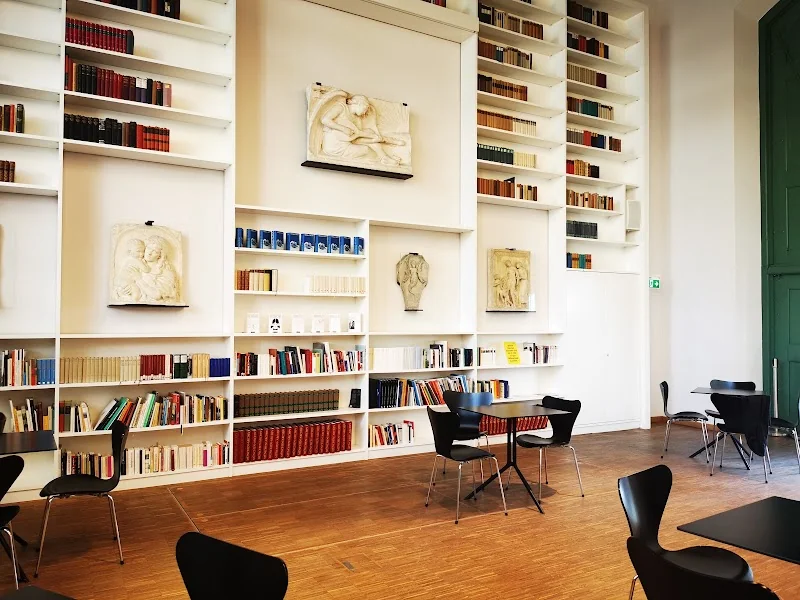
On-site services include open and free Wi-Fi throughout the house, printing, scanning, and copying options with a library card, as well as various work and reading areas in the library, educational space, Forum Atelier, and, in good weather, also in the reading garden. No registration is required for this. Additionally, there is a café in the house with its own opening hours, allowing visits to be planned as a short detour, focused work appointment, or longer cultural stay, depending on needs. Payment options are also conveniently arranged: cash payment is not possible on site. These details may seem unremarkable, but they are crucial for many visitors when research, reading, and stays should function smoothly. ([muenchner-stadtbibliothek.de](https://www.muenchner-stadtbibliothek.de/monacensia-im-hildebrandhaus))
Literary Archive and Monacensia Library: Research, Loans, and Collections
The literary archive is the scientific heart of the Monacensia. It collects the legacy of individuals, networks, and institutions that have shaped literary Munich, and opens its collections to the interested public for research and publications. The archive holdings range from the 19th to the 21st century; individual manuscripts even date back to the late Middle Ages. Established in 1924 as a manuscript collection of the municipal libraries, the archive today houses several hundred estates and other archival materials. Usage is free but requires prior registration. Since essential parts of the material are stored off-site, the house recommends pre-ordering at least three working days before the visit. In the reading room of the literary archive, documents are presented, and there are six workstations available for viewing archival materials. For targeted research, the Monacensia also refers to the catalog of the Munich City Library and the Kalliope portal. ([muenchner-stadtbibliothek.de](https://www.muenchner-stadtbibliothek.de/mon-archiv?utm_source=openai))
The Monacensia Library is also remarkably well-equipped. It is designed as a research library on the topic of Munich and currently includes around 160,000 media, from old Munich prints of the 16th century to current new releases, comics, and newspapers. The collection was founded in 1921 by Hans Ludwig Held and forms the foundation of the Monacensia as the literary memory of the city. The holdings are fully searchable in the online catalog of the Munich City Library. Books and audiovisual media published from 1960 onwards can be borrowed home with a Munich City Library card. The library offers numerous work and reading spaces, making the location attractive not only for archival work but also for longer reading and focused work. ([muenchner-stadtbibliothek.de](https://www.muenchner-stadtbibliothek.de/mon-bibliothek))
The profile becomes particularly vivid in the individual collection areas: The library in the former ladies' studio bundles literature on Munich, architecture, and urban history, neighborhoods, and sports, as well as new Munich publications. Additionally, there is the Mann Family Library with editions of works, letter collections, diaries, and secondary literature, as well as the open-access library of Munich authors, which brings together works, correspondence, and literature on topics such as the bohemian lifestyle around 1900, Munich in the 1920s, and exile. Comics, mangas, caricatures, cartoons, illustrations, and picture books are also included under the term Narrative Images, as long as they have a connection to Munich. The Forum Atelier also exhibits the private library of Peter de Mendelssohn, and on the galleries, translations of Thomas Mann's works connect the former studio with the library. Several estates of Erika, Klaus, and Monika Mann are digitally prepared for free public access, making the Monacensia particularly relevant for research and public use. ([muenchner-stadtbibliothek.de](https://www.muenchner-stadtbibliothek.de/mon-bibliothek))
Maria Theresia 23: History of the Hildebrandhaus from Artists' Villa to Cultural Venue
The history of the house begins in the time of Prince Regent. The property at Maria-Theresia-Straße 23 was built between 1895 and 1898 as a residential and studio building for the sculptor Adolf von Hildebrand. Hildebrand designed the villa himself as an organic unit of spaces for artistic work, family life, and sociability; the construction was carried out by the Munich architect Gabriel von Seidl. In 1898, the family with six children moved into the representative house, which soon became a meeting point for Munich's cultural scene. In the salon and the adjacent dining room, reading, discussion, music-making, and celebration took place. This connection of art and everyday life is still palpable in the character of the house today and explains why the Monacensia understands the place not just as a building but as a cultural-historical biography. ([stadt.muenchen.de](https://stadt.muenchen.de/dam/jcr%3Ac7877ce1-582b-41cc-92f0-0e032e9283b7/Monacensia-Hildebrandhaus.pdf))
The later history of the Hildebrandhaus is significantly shaped by the upheavals of the 20th century. In the 1930s and 1940s, the Nazi era fundamentally changed ownership structures and life paths in the vicinity of the house; the Monacensia shows in its permanent exhibition how much the Hildebrandhaus became a place of persecution, expropriation, and violence. After the war, the villa increasingly fell into disrepair and was threatened with demolition in the 1970s. Only the protest of Munich citizens and the newly created Bavarian monument protection law enabled the rescue of the cultural monument. In 1974, the Free State of Bavaria acquired the property for the state capital Munich, and in 1977 it was handed over to the Munich City Library as the new home of the Monacensia after extensive restoration. Later, a further redesign followed: A southern extension created barrier-free access, a new foyer, an elevator between the basement, ground, and upper floors, as well as improved technical facilities. Historical facades and roofs were restored authentically so that the house retains its character as a former artists' villa while still meeting the demands of a modern cultural and research venue. ([muenchner-stadtbibliothek.de](https://www.muenchner-stadtbibliothek.de/mon-villa))
Exhibitions, Tours, and Events at the Monacensia
Those currently looking for exhibitions will find a long-term program at the Monacensia. The permanent exhibition Maria Theresia 23. Biography of a Munich Villa runs from October 27, 2024, to September 30, 2030, and tells the eventful history of the house from the artists' villa of the time of the Prince Regent through the Nazi era to its rescue and current use. In addition, the Monacensia regularly offers public tours of the house as well as permanent and special exhibitions. For groups and school classes, there are additional formats, available in English and French upon request. The Monacensia works closely with the Munich Adult Education Center, allowing historical insights and educational mediation to complement each other well. This makes the location interesting not only for individual visitors but also for learning and educational groups. ([muenchner-stadtbibliothek.de](https://www.muenchner-stadtbibliothek.de/monacensia-im-hildebrandhaus))
The cultural profile also includes readings, discussions, workshops, and curated tours. Current event announcements include exhibition tours, curator tours, readings, and formats such as SneakPeak archival showcases. The content ranges from literary biographies to exile and stance to questions of anti-Semitism research and the history of the archive. The Monacensia thus not only presents collections but also relates them to the present and debate. This aligns with its own program to make new and rediscovered texts visible and to celebrate various literary forms from poetry and prose to comics, screenplays, theater texts, songs, and experimental formats. Therefore, those who visit the Monacensia experience not just an exhibition but a vibrant cultural place where research, reading culture, and urban history intertwine. ([muenchner-stadtbibliothek.de](https://www.muenchner-stadtbibliothek.de/monacensia-im-hildebrandhaus))
Sources:
Show moreShow less
Monacensia im Hildebrandhaus | Opening Hours & Literary Archive
The Monacensia in the Hildebrandhaus is more than a classic library: The place combines artists' villa, literary archive, research library, and exhibition house into an ensemble that keeps Munich's literary history alive. Visitors to the address at Maria-Theresia-Straße 23 will find a house and a garden that invite exploration, reading, research, and lingering. The Monacensia sees itself as the literary memory of the city and is aimed at everyone who wants to rediscover Munich through books, estates, exhibitions, and conversations. ([muenchner-stadtbibliothek.de](https://www.muenchner-stadtbibliothek.de/monacensia-im-hildebrandhaus))
Opening Hours, Address, and Directions to the Monacensia in the Hildebrandhaus
For practical visits, the times are clearly structured: The library and literary archive open on Tuesdays and Wednesdays from 9:30 AM to 5:30 PM, Thursdays from 12:00 PM to 7:00 PM, and Fridays from 9:30 AM to 5:30 PM; however, the service desk of the library is not staffed on Fridays. Exhibitions are additionally accessible on Mondays from 9:30 AM to 5:30 PM, as well as on Saturdays and Sundays from 11:00 AM to 6:00 PM. Returns are only possible during the library's opening hours. The address is Maria-Theresia-Straße 23, 81675 Munich. Those arriving by public transport can reach the house via tram line 17 to Holbeinstraße or by bus on the museum line 100 to Villa Stuck. The Monacensia can be reached by phone at 089 233 772445. This allows for a seamless connection between research visits, exhibitions, and the reading garden without having to cover long distances in the neighborhood. The city library also points out that there may be short-term changes; therefore, it is worth checking the current location service before visiting. ([muenchner-stadtbibliothek.de](https://www.muenchner-stadtbibliothek.de/monacensia-im-hildebrandhaus))
In everyday life, the Monacensia consciously does not appear as a loud event venue, but as a quiet cultural space on the banks of the Isar. The official self-presentation emphasizes the interplay of reading, personal encounters, and literary research. This mix makes the location interesting for various target groups: Researchers use the archive and catalog, visitors attend exhibitions, and anyone looking for a break finds a place with a lot of atmosphere in the garden, reading areas, and changing programs. The location in Bogenhausen particularly supports this feeling of a protected retreat in the middle of the city. ([muenchner-stadtbibliothek.de](https://www.muenchner-stadtbibliothek.de/monacensia-im-hildebrandhaus))
Parking, Accessibility, and On-Site Services
Regarding parking, the answer is straightforward but important: According to the official city portal, there are no dedicated parking facilities on site. Therefore, the Monacensia refers to parking in the side streets. Those who rely on accessibility should use the separate entrance via Siebertstraße 2; the Monacensia describes itself as largely accessible. However, there are limitations in the literary archive, which is only partially accessible to wheelchair users and therefore recommends personal consultation. Additionally, the Forum Atelier has an inductive hearing system. For visitors with mobility aids, this is a helpful mix of open accessibility and clear indications of areas that require special coordination. ([muenchen.de](https://www.muenchen.de/sehenswuerdigkeiten/museen/monacensia-im-hildebrandhaus?utm_source=openai))
On-site services include open and free Wi-Fi throughout the house, printing, scanning, and copying options with a library card, as well as various work and reading areas in the library, educational space, Forum Atelier, and, in good weather, also in the reading garden. No registration is required for this. Additionally, there is a café in the house with its own opening hours, allowing visits to be planned as a short detour, focused work appointment, or longer cultural stay, depending on needs. Payment options are also conveniently arranged: cash payment is not possible on site. These details may seem unremarkable, but they are crucial for many visitors when research, reading, and stays should function smoothly. ([muenchner-stadtbibliothek.de](https://www.muenchner-stadtbibliothek.de/monacensia-im-hildebrandhaus))
Literary Archive and Monacensia Library: Research, Loans, and Collections
The literary archive is the scientific heart of the Monacensia. It collects the legacy of individuals, networks, and institutions that have shaped literary Munich, and opens its collections to the interested public for research and publications. The archive holdings range from the 19th to the 21st century; individual manuscripts even date back to the late Middle Ages. Established in 1924 as a manuscript collection of the municipal libraries, the archive today houses several hundred estates and other archival materials. Usage is free but requires prior registration. Since essential parts of the material are stored off-site, the house recommends pre-ordering at least three working days before the visit. In the reading room of the literary archive, documents are presented, and there are six workstations available for viewing archival materials. For targeted research, the Monacensia also refers to the catalog of the Munich City Library and the Kalliope portal. ([muenchner-stadtbibliothek.de](https://www.muenchner-stadtbibliothek.de/mon-archiv?utm_source=openai))
The Monacensia Library is also remarkably well-equipped. It is designed as a research library on the topic of Munich and currently includes around 160,000 media, from old Munich prints of the 16th century to current new releases, comics, and newspapers. The collection was founded in 1921 by Hans Ludwig Held and forms the foundation of the Monacensia as the literary memory of the city. The holdings are fully searchable in the online catalog of the Munich City Library. Books and audiovisual media published from 1960 onwards can be borrowed home with a Munich City Library card. The library offers numerous work and reading spaces, making the location attractive not only for archival work but also for longer reading and focused work. ([muenchner-stadtbibliothek.de](https://www.muenchner-stadtbibliothek.de/mon-bibliothek))
The profile becomes particularly vivid in the individual collection areas: The library in the former ladies' studio bundles literature on Munich, architecture, and urban history, neighborhoods, and sports, as well as new Munich publications. Additionally, there is the Mann Family Library with editions of works, letter collections, diaries, and secondary literature, as well as the open-access library of Munich authors, which brings together works, correspondence, and literature on topics such as the bohemian lifestyle around 1900, Munich in the 1920s, and exile. Comics, mangas, caricatures, cartoons, illustrations, and picture books are also included under the term Narrative Images, as long as they have a connection to Munich. The Forum Atelier also exhibits the private library of Peter de Mendelssohn, and on the galleries, translations of Thomas Mann's works connect the former studio with the library. Several estates of Erika, Klaus, and Monika Mann are digitally prepared for free public access, making the Monacensia particularly relevant for research and public use. ([muenchner-stadtbibliothek.de](https://www.muenchner-stadtbibliothek.de/mon-bibliothek))
Maria Theresia 23: History of the Hildebrandhaus from Artists' Villa to Cultural Venue
The history of the house begins in the time of Prince Regent. The property at Maria-Theresia-Straße 23 was built between 1895 and 1898 as a residential and studio building for the sculptor Adolf von Hildebrand. Hildebrand designed the villa himself as an organic unit of spaces for artistic work, family life, and sociability; the construction was carried out by the Munich architect Gabriel von Seidl. In 1898, the family with six children moved into the representative house, which soon became a meeting point for Munich's cultural scene. In the salon and the adjacent dining room, reading, discussion, music-making, and celebration took place. This connection of art and everyday life is still palpable in the character of the house today and explains why the Monacensia understands the place not just as a building but as a cultural-historical biography. ([stadt.muenchen.de](https://stadt.muenchen.de/dam/jcr%3Ac7877ce1-582b-41cc-92f0-0e032e9283b7/Monacensia-Hildebrandhaus.pdf))
The later history of the Hildebrandhaus is significantly shaped by the upheavals of the 20th century. In the 1930s and 1940s, the Nazi era fundamentally changed ownership structures and life paths in the vicinity of the house; the Monacensia shows in its permanent exhibition how much the Hildebrandhaus became a place of persecution, expropriation, and violence. After the war, the villa increasingly fell into disrepair and was threatened with demolition in the 1970s. Only the protest of Munich citizens and the newly created Bavarian monument protection law enabled the rescue of the cultural monument. In 1974, the Free State of Bavaria acquired the property for the state capital Munich, and in 1977 it was handed over to the Munich City Library as the new home of the Monacensia after extensive restoration. Later, a further redesign followed: A southern extension created barrier-free access, a new foyer, an elevator between the basement, ground, and upper floors, as well as improved technical facilities. Historical facades and roofs were restored authentically so that the house retains its character as a former artists' villa while still meeting the demands of a modern cultural and research venue. ([muenchner-stadtbibliothek.de](https://www.muenchner-stadtbibliothek.de/mon-villa))
Exhibitions, Tours, and Events at the Monacensia
Those currently looking for exhibitions will find a long-term program at the Monacensia. The permanent exhibition Maria Theresia 23. Biography of a Munich Villa runs from October 27, 2024, to September 30, 2030, and tells the eventful history of the house from the artists' villa of the time of the Prince Regent through the Nazi era to its rescue and current use. In addition, the Monacensia regularly offers public tours of the house as well as permanent and special exhibitions. For groups and school classes, there are additional formats, available in English and French upon request. The Monacensia works closely with the Munich Adult Education Center, allowing historical insights and educational mediation to complement each other well. This makes the location interesting not only for individual visitors but also for learning and educational groups. ([muenchner-stadtbibliothek.de](https://www.muenchner-stadtbibliothek.de/monacensia-im-hildebrandhaus))
The cultural profile also includes readings, discussions, workshops, and curated tours. Current event announcements include exhibition tours, curator tours, readings, and formats such as SneakPeak archival showcases. The content ranges from literary biographies to exile and stance to questions of anti-Semitism research and the history of the archive. The Monacensia thus not only presents collections but also relates them to the present and debate. This aligns with its own program to make new and rediscovered texts visible and to celebrate various literary forms from poetry and prose to comics, screenplays, theater texts, songs, and experimental formats. Therefore, those who visit the Monacensia experience not just an exhibition but a vibrant cultural place where research, reading culture, and urban history intertwine. ([muenchner-stadtbibliothek.de](https://www.muenchner-stadtbibliothek.de/monacensia-im-hildebrandhaus))
Sources:
Monacensia im Hildebrandhaus | Opening Hours & Literary Archive
The Monacensia in the Hildebrandhaus is more than a classic library: The place combines artists' villa, literary archive, research library, and exhibition house into an ensemble that keeps Munich's literary history alive. Visitors to the address at Maria-Theresia-Straße 23 will find a house and a garden that invite exploration, reading, research, and lingering. The Monacensia sees itself as the literary memory of the city and is aimed at everyone who wants to rediscover Munich through books, estates, exhibitions, and conversations. ([muenchner-stadtbibliothek.de](https://www.muenchner-stadtbibliothek.de/monacensia-im-hildebrandhaus))
Opening Hours, Address, and Directions to the Monacensia in the Hildebrandhaus
For practical visits, the times are clearly structured: The library and literary archive open on Tuesdays and Wednesdays from 9:30 AM to 5:30 PM, Thursdays from 12:00 PM to 7:00 PM, and Fridays from 9:30 AM to 5:30 PM; however, the service desk of the library is not staffed on Fridays. Exhibitions are additionally accessible on Mondays from 9:30 AM to 5:30 PM, as well as on Saturdays and Sundays from 11:00 AM to 6:00 PM. Returns are only possible during the library's opening hours. The address is Maria-Theresia-Straße 23, 81675 Munich. Those arriving by public transport can reach the house via tram line 17 to Holbeinstraße or by bus on the museum line 100 to Villa Stuck. The Monacensia can be reached by phone at 089 233 772445. This allows for a seamless connection between research visits, exhibitions, and the reading garden without having to cover long distances in the neighborhood. The city library also points out that there may be short-term changes; therefore, it is worth checking the current location service before visiting. ([muenchner-stadtbibliothek.de](https://www.muenchner-stadtbibliothek.de/monacensia-im-hildebrandhaus))
In everyday life, the Monacensia consciously does not appear as a loud event venue, but as a quiet cultural space on the banks of the Isar. The official self-presentation emphasizes the interplay of reading, personal encounters, and literary research. This mix makes the location interesting for various target groups: Researchers use the archive and catalog, visitors attend exhibitions, and anyone looking for a break finds a place with a lot of atmosphere in the garden, reading areas, and changing programs. The location in Bogenhausen particularly supports this feeling of a protected retreat in the middle of the city. ([muenchner-stadtbibliothek.de](https://www.muenchner-stadtbibliothek.de/monacensia-im-hildebrandhaus))
Parking, Accessibility, and On-Site Services
Regarding parking, the answer is straightforward but important: According to the official city portal, there are no dedicated parking facilities on site. Therefore, the Monacensia refers to parking in the side streets. Those who rely on accessibility should use the separate entrance via Siebertstraße 2; the Monacensia describes itself as largely accessible. However, there are limitations in the literary archive, which is only partially accessible to wheelchair users and therefore recommends personal consultation. Additionally, the Forum Atelier has an inductive hearing system. For visitors with mobility aids, this is a helpful mix of open accessibility and clear indications of areas that require special coordination. ([muenchen.de](https://www.muenchen.de/sehenswuerdigkeiten/museen/monacensia-im-hildebrandhaus?utm_source=openai))
On-site services include open and free Wi-Fi throughout the house, printing, scanning, and copying options with a library card, as well as various work and reading areas in the library, educational space, Forum Atelier, and, in good weather, also in the reading garden. No registration is required for this. Additionally, there is a café in the house with its own opening hours, allowing visits to be planned as a short detour, focused work appointment, or longer cultural stay, depending on needs. Payment options are also conveniently arranged: cash payment is not possible on site. These details may seem unremarkable, but they are crucial for many visitors when research, reading, and stays should function smoothly. ([muenchner-stadtbibliothek.de](https://www.muenchner-stadtbibliothek.de/monacensia-im-hildebrandhaus))
Literary Archive and Monacensia Library: Research, Loans, and Collections
The literary archive is the scientific heart of the Monacensia. It collects the legacy of individuals, networks, and institutions that have shaped literary Munich, and opens its collections to the interested public for research and publications. The archive holdings range from the 19th to the 21st century; individual manuscripts even date back to the late Middle Ages. Established in 1924 as a manuscript collection of the municipal libraries, the archive today houses several hundred estates and other archival materials. Usage is free but requires prior registration. Since essential parts of the material are stored off-site, the house recommends pre-ordering at least three working days before the visit. In the reading room of the literary archive, documents are presented, and there are six workstations available for viewing archival materials. For targeted research, the Monacensia also refers to the catalog of the Munich City Library and the Kalliope portal. ([muenchner-stadtbibliothek.de](https://www.muenchner-stadtbibliothek.de/mon-archiv?utm_source=openai))
The Monacensia Library is also remarkably well-equipped. It is designed as a research library on the topic of Munich and currently includes around 160,000 media, from old Munich prints of the 16th century to current new releases, comics, and newspapers. The collection was founded in 1921 by Hans Ludwig Held and forms the foundation of the Monacensia as the literary memory of the city. The holdings are fully searchable in the online catalog of the Munich City Library. Books and audiovisual media published from 1960 onwards can be borrowed home with a Munich City Library card. The library offers numerous work and reading spaces, making the location attractive not only for archival work but also for longer reading and focused work. ([muenchner-stadtbibliothek.de](https://www.muenchner-stadtbibliothek.de/mon-bibliothek))
The profile becomes particularly vivid in the individual collection areas: The library in the former ladies' studio bundles literature on Munich, architecture, and urban history, neighborhoods, and sports, as well as new Munich publications. Additionally, there is the Mann Family Library with editions of works, letter collections, diaries, and secondary literature, as well as the open-access library of Munich authors, which brings together works, correspondence, and literature on topics such as the bohemian lifestyle around 1900, Munich in the 1920s, and exile. Comics, mangas, caricatures, cartoons, illustrations, and picture books are also included under the term Narrative Images, as long as they have a connection to Munich. The Forum Atelier also exhibits the private library of Peter de Mendelssohn, and on the galleries, translations of Thomas Mann's works connect the former studio with the library. Several estates of Erika, Klaus, and Monika Mann are digitally prepared for free public access, making the Monacensia particularly relevant for research and public use. ([muenchner-stadtbibliothek.de](https://www.muenchner-stadtbibliothek.de/mon-bibliothek))
Maria Theresia 23: History of the Hildebrandhaus from Artists' Villa to Cultural Venue
The history of the house begins in the time of Prince Regent. The property at Maria-Theresia-Straße 23 was built between 1895 and 1898 as a residential and studio building for the sculptor Adolf von Hildebrand. Hildebrand designed the villa himself as an organic unit of spaces for artistic work, family life, and sociability; the construction was carried out by the Munich architect Gabriel von Seidl. In 1898, the family with six children moved into the representative house, which soon became a meeting point for Munich's cultural scene. In the salon and the adjacent dining room, reading, discussion, music-making, and celebration took place. This connection of art and everyday life is still palpable in the character of the house today and explains why the Monacensia understands the place not just as a building but as a cultural-historical biography. ([stadt.muenchen.de](https://stadt.muenchen.de/dam/jcr%3Ac7877ce1-582b-41cc-92f0-0e032e9283b7/Monacensia-Hildebrandhaus.pdf))
The later history of the Hildebrandhaus is significantly shaped by the upheavals of the 20th century. In the 1930s and 1940s, the Nazi era fundamentally changed ownership structures and life paths in the vicinity of the house; the Monacensia shows in its permanent exhibition how much the Hildebrandhaus became a place of persecution, expropriation, and violence. After the war, the villa increasingly fell into disrepair and was threatened with demolition in the 1970s. Only the protest of Munich citizens and the newly created Bavarian monument protection law enabled the rescue of the cultural monument. In 1974, the Free State of Bavaria acquired the property for the state capital Munich, and in 1977 it was handed over to the Munich City Library as the new home of the Monacensia after extensive restoration. Later, a further redesign followed: A southern extension created barrier-free access, a new foyer, an elevator between the basement, ground, and upper floors, as well as improved technical facilities. Historical facades and roofs were restored authentically so that the house retains its character as a former artists' villa while still meeting the demands of a modern cultural and research venue. ([muenchner-stadtbibliothek.de](https://www.muenchner-stadtbibliothek.de/mon-villa))
Exhibitions, Tours, and Events at the Monacensia
Those currently looking for exhibitions will find a long-term program at the Monacensia. The permanent exhibition Maria Theresia 23. Biography of a Munich Villa runs from October 27, 2024, to September 30, 2030, and tells the eventful history of the house from the artists' villa of the time of the Prince Regent through the Nazi era to its rescue and current use. In addition, the Monacensia regularly offers public tours of the house as well as permanent and special exhibitions. For groups and school classes, there are additional formats, available in English and French upon request. The Monacensia works closely with the Munich Adult Education Center, allowing historical insights and educational mediation to complement each other well. This makes the location interesting not only for individual visitors but also for learning and educational groups. ([muenchner-stadtbibliothek.de](https://www.muenchner-stadtbibliothek.de/monacensia-im-hildebrandhaus))
The cultural profile also includes readings, discussions, workshops, and curated tours. Current event announcements include exhibition tours, curator tours, readings, and formats such as SneakPeak archival showcases. The content ranges from literary biographies to exile and stance to questions of anti-Semitism research and the history of the archive. The Monacensia thus not only presents collections but also relates them to the present and debate. This aligns with its own program to make new and rediscovered texts visible and to celebrate various literary forms from poetry and prose to comics, screenplays, theater texts, songs, and experimental formats. Therefore, those who visit the Monacensia experience not just an exhibition but a vibrant cultural place where research, reading culture, and urban history intertwine. ([muenchner-stadtbibliothek.de](https://www.muenchner-stadtbibliothek.de/monacensia-im-hildebrandhaus))
Sources:
Upcoming Events
No events found
Frequently Asked Questions
Reviews
Era Poudel
27. November 2025
Really nice place with cozy vibe and beautifully captured story of the place
Flying Fish
10. March 2023
Very pleasant rooms with historical documentation on the family Mann. Special exhibition on the first floor. Nice café in the winter garden. Lockers and toilets downstairs. Several study rooms.
Ken Macbeth Knowles
28. July 2022
Used to live nearby & this library/café was a refuge in the leafy Bogenhausen district, when I wanted a bit of peace from either Mitbewohner or a hot summer day. Lots of Munich history, and the books, exhibits & café make this worth a break during an otherwise busy day.
Kerry Pentney
20. April 2024
Calm quiet place to learn, peruse, discuss and contemplate.
Barbra breeze Anderson
7. November 2020
An open space, that's is not only a library but a resource Centre that hosts interesting literature projects, live readings and festivals.