
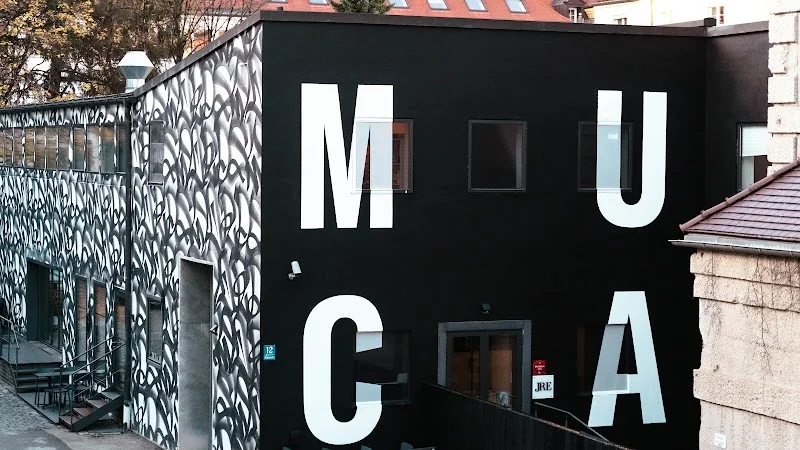
Hotterstraße 12, München-Altstadt-Lehel
Hotterstraße 12, 80331 München, Germany
MUCA - Museum of Urban and Contemporary Art | Tickets & Reviews
The MUCA in Munich is much more than just a museum with an extraordinary facade. Located at Hotterstraße 12, in the heart of the old town and just a few minutes' walk from Marienplatz, Stachus, and Sendlinger Tor, the Museum of Urban and Contemporary Art combines urban imagery, international contemporary art, and a very special place. The building complex originated from a former transformer station and an adjacent air raid shelter, which were transformed into exhibition spaces after renovation. This blend of industrial architecture, historical layering, and contemporary art is what makes the house appealing. Those searching for the muca museum of urban and contemporary art munich usually want to know what makes the MUCA so special, how to get there, what tickets are available, and what impressions visitors can expect on-site. The museum responds with a clear profile: changing exhibitions, a strong collection, iconic outdoor spaces, and a location that makes a visit very straightforward. At the same time, the MUCA is a place where street art, urban art, and contemporary art are presented not as fringe phenomena but as an integral part of the art scene. This creates the special atmosphere that many guests highlight in reviews: compact, intense, independent, and surprisingly diverse.
Especially exciting is that the MUCA does not just rely on individual big names but orchestrates a whole art experience. The collection began in 1998 and now includes over 1,200 objects and works. In the museum and the bunker, visitors encounter positions from Banksy, Shepard Fairey, Keith Haring, Invader, Kusama, Swoon, and other influential artists of urban and contemporary art. At the same time, the house remains adaptable: exhibitions change, formats are expanded, and the outdoor spaces also play an important role. The MUCA Giant Wall is not just a decorative element but an independent art field that is continually reinterpreted. Additionally, there is the idea of embedding urban art into contemporary discourse and not dismissing it as a fleeting scene aesthetic. This makes the MUCA one of the most interesting cultural venues in Munich for anyone searching for muca museum of urban and contemporary art reviews, photos, directions, tickets, or current impressions. Because the museum is manageable yet content-rich, it is suitable for both a short art visit and a deliberately planned cultural morning or afternoon in the city center.
Tickets, Opening Hours, and Admission at MUCA Munich
Anyone planning a visit to the MUCA should first know the practical information, as it makes the decision easy. According to the official website, the main MUCA building along with the bunker is open from Wednesday to Sunday from 10 AM to 6 PM, and on Thursdays even until 8 PM. Tickets can be purchased online in the shop or directly on-site. There is a combo ticket for the main building and the bunker, which costs 15 euros regularly and 10 euros at a reduced rate. Discounts are available for students, trainees, retirees, unemployed individuals, and visitors with a disability rating of 50 percent or more. Children under 12 years have free admission to all exhibitions. This clear pricing structure is practical for guests as it makes planning the museum visit very manageable and also provides good access for families. Therefore, those searching for tickets for the museum of urban and contemporary art muca will find an offer that is quickly understandable online and sets up few barriers. The museum itself also regularly refers to possible updates and events, so checking the website before the visit is advisable if one wants to verify particularly current details.
The MUCA also focuses on easy booking for tours and accompanying offerings. Public tours are regularly offered, and tickets for them must be booked in advance in the shop. Additionally, there are exclusive private tours for companies, friends, or families, as well as special student tours upon request. This indicates that the house is intended not only as an exhibition space but also as a place for learning and mediation. Therefore, those interested in muca museum of urban and contemporary art reviews often experience a museum that is compact in effect but very concentrated in content. Because the offer does not consist of huge crowds and long waits but rather a clearly structured visit, many people perceive the admission as well-invested time. For the day of the visit, personal time planning is still recommended: those who want to see the bunker, the collection, and the outdoor spaces at leisure should not calculate too tightly. The MUCA is not a place to simply check off while passing by. It rewards a conscious visit, where tickets, times, and any additional offers should be briefly checked in advance.
Directions and Parking at MUCA in Munich's Old Town
The location is one of the biggest advantages of the MUCA. The museum is located in the heart of Munich, in close proximity to Marienplatz, Stachus, and Sendlinger Tor. According to the official visitor page, it takes about 6 minutes to walk from Marienplatz, around 8 minutes from Stachus, and about 6 minutes from Sendlinger Tor to the museum. For guests who want to explore the city center anyway, this is ideal: The MUCA can be easily integrated into a city tour through the old town. Those searching for muca museum of urban and contemporary art hotterstraße münchen-altstadt-lehel are usually looking for exactly this mix of culture and urban orientation. The address Hotterstraße 12 is centrally located but not on a noisy main thoroughfare, making the walk to the museum relatively pleasant despite its city center location. Additionally, the surrounding area is rich in other attractions, cafés, and dining options, making it easy to combine a museum visit with a longer stay in the city.
Regarding parking, the museum's message is clear: There are no private parking spaces. Upon request, individual spots can be offered for persons with disabilities, and there is a public parking garage in close proximity. However, the MUCA explicitly recommends arriving by public transport. This recommendation is particularly sensible in Munich, as Marienplatz and Sendlinger Tor are excellently connected. The official website mentions S-Bahn connections via Marienplatz or Stachus as well as tram lines stopping at Sendlinger Tor. Therefore, those searching for muca museum of urban and contemporary art munich or muca museum of urban and contemporary art hotterstraße munich altstadt lehel germany should plan their arrival best directly via public transport. This saves time, avoids the search for parking in the city center, and fits perfectly with the museum's location. For travelers with luggage or for groups, it is also important that large bags, backpacks, and totes must be checked in at the entrance, and large travel luggage should be avoided due to limited space capacity. This keeps the visit to the museum orderly and relaxed. Overall, the location of the MUCA is a real advantage: urban, central, easily accessible, and simultaneously positioned so independently that the museum character is already perceptible upon arrival.
Photos, Reviews, and the Visitor Experience at MUCA
The search queries related to muca museum of urban and contemporary art photos and muca - museum of urban and contemporary art photos clearly show what many visitors want to know in advance: Is the place worth it visually? The short answer is yes. The MUCA is one of those museums that provide strong motifs through architecture, materiality, and facade design. At the same time, the museum allows photos and videos for private use, so personal impressions can be captured. It is important that no flash is used and that tripods, selfie sticks, or other photographic aids are not brought along. Commercial use is not permitted. For social media posts, it is stipulated that the recordings remain non-commercial and that no third parties should be visible in problematic ways. This makes the MUCA attractive for private photo shoots without compromising the quality of the exhibitions. Therefore, anyone looking for a museum that works well in photos and memories will find plenty of motifs here: the art bunker, the wall surfaces, the interior with its urban aesthetics, and the striking external impact of the entire ensemble.
The reviews reflect a similar picture. In the available Google data, the MUCA holds 4.3 stars based on 1,182 reviews. Visitors describe the place as small but unique, praise the thought-provoking collections, and repeatedly highlight the friendliness of the staff. The changing main exhibitions are also very well received because they keep the museum lively and open new perspectives with each visit. Therefore, those searching for muca museum of urban and contemporary art reviews or muca - museum of urban and contemporary art reviews encounter a fairly consistent pattern: The MUCA is not perceived as a huge, overwhelming museum but as a concentrated place with a clear stance. This is appealing to many. There is no sensory overload but a precise entry into street art, urban art, and contemporary positions. This makes the visit particularly suitable for people who not only want to see images but also understand content-related contexts. Many also find the mix of historical building substance, modern presentation, and changing installations very harmonious. Those who appreciate well-planned photos, short distances, and an independent art climate will quickly realize why the MUCA has such a good reputation in Munich.
History, Architecture, and the Emergence from the Transformer Station
The history of the MUCA is a central part of its identity. The museum opened in 2016 as Germany's first museum for urban art. It was founded by the collector couple Stephanie and Christian Utz, who had the idea of not only collecting urban art but also giving it a solid institutional framework. This decision is important because urban art has long been perceived in the gray area between street, scene, and improvised exhibition. The MUCA addresses this directly and translates the energy of this art form into a museum environment without denying its origins. The place itself reinforces this narrative: From a former transformer station and an adjacent air raid shelter from World War II, exhibition spaces were created after renovation. Thus, the museum did not simply move into any building but has consciously reinterpreted a place with history and layering. This connection of past and present strongly shapes the visitor experience.
The spatial dimension is also remarkable. On a total area of around 2,000 square meters, works from urban art, street art, and contemporary art can be displayed on multiple levels. According to its own description, the museum sees itself as a space where urban and contemporary art engage in dialogue. It is not only about well-known names but also about mediation, art discussions, readings, tours, and educational offerings. The permanent exhibition or collection did not arise by chance but is based on works that began in 1998 and have been continuously expanded since then. Over 1,200 objects and works are now part of it. This is a strong foundation for a museum of this orientation. Therefore, anyone interested in muca museum of urban and contemporary art munich receives not only a beautiful facade but also an institution that has grown in content. Especially in a city like Munich, which is often associated with classical art, the MUCA sets a clear accent: Urban art is not a side topic but a serious part of the modern art discourse. This makes the house historically interesting and culturally politically relevant at the same time.
The MUCA Bunker, the Giant Wall, and the Collection of Urban Art
A significant part of the MUCA experience is the bunker. The former air raid shelter directly adjoins the main building and is mostly used by the museum for special exhibitions or unique formats that are particularly impressive in this characteristic architecture. Here, the atmosphere of the MUCA is further intensified: massive walls, historical context, and contemporary art create an intense combination. According to official information, a part of the current Vhils exhibition as well as the world-famous Banksy work Girl Without Balloon were recently displayed there. Until the end of January 2024, the famous diamond skull by Damien Hirst was also exhibited in the bunker. This sequence shows how strongly the MUCA purposefully showcases international positions. Therefore, the bunker is not just an ancillary extension but a central highlight of the museum. Those who only superficially consider the facility quickly miss one of the most important reasons why the house receives so much attention in the scene.
The outdoor spaces also deserve special attention. The MUCA Giant Wall is an independent art format with changing large-scale outdoor projects. Recently, it was designed as a massive spot painting by Damien Hirst, which, according to the official website, can even be seen from the towers of the Frauenkirche with its 1,000 square meters and 540 different color points. This scale makes it clear that the museum does not end at the entrance door. The art concept extends outward, into the urban space, and transforms the facade itself into a communicating medium. Additionally, the MUCA presents changing installations and sculptures on the green space in front of the bunker. Until December 2024, the large Pegasus sculpture by Damien Hirst was displayed there, for example. For visitors, this means that even if one only wanted to take a photo of the building, one already encounters part of the program. Inside and outside interconnect, and this is exactly what makes the MUCA so attractive for muca museum of urban and contemporary art photos, as the architecture itself already functions as an art backdrop. Those who want to experience urban art in its spatial effect are exactly right here.
Guided Tours, MUCA App, and Practical Tips for Your Visit
The MUCA has significantly worked in recent years to make the visit more interactive and accessible. One example is the MUCA App, which is offered for free for Android and Apple. It facilitates orientation in the museum spaces, provides audio guides and visual content, and makes the current Vhils exhibition digitally experienceable. Information about the collection, visit tips, current tours, and news are also included. Particularly interesting is that the app offers a virtual tour with texts, images, videos, and audio elements, and the content is available in German and English. For people with visual impairments, this is a clear advantage as background information and station texts also become acoustically accessible. Therefore, those who like to prepare for their visit can complement this well with digital information. At the same time, on-site tours remain important: public tours are regularly offered but must be booked in advance in the shop. This also applies to the currently available dates. Those needing a group solution can rely on private tours or student tours. The museum thus relies on a mix of classic visits and modern mediation.
Some rules and guidelines on-site are also practically relevant. Dogs are not allowed in the exhibition, bags and backpacks must be checked in, and there is a storage area for strollers or buggies in the entrance area. The museum fundamentally sees itself as family and child-friendly but points out in individual exhibitions that certain content may be less suitable for younger children. Regarding accessibility, the MUCA is transparent: the main building is accessible via a ramp but not fully barrier-free, and the adjacent MUCA bunker is not barrier-free due to structural reasons. Additionally, there is the Mural restaurant in the building, which is a pleasant addition for many visitors when the museum visit is to be combined with a meal or a break. For search queries like muca museum of urban and contemporary art photos, reviews, or tickets, this is important because a good museum visit consists not only of art but also of comfort, orientation, and clean planning. The MUCA provides convincing answers here: clearly accessible, well organized, content-rich, and with a visitor experience that conveys a very harmonious balance between urban lifestyle, serious art, and Munich's city center location. Those who come consciously receive not only exhibitions but a whole cultural venue with a distinctive character.
Sources:
Show moreShow less
MUCA - Museum of Urban and Contemporary Art | Tickets & Reviews
The MUCA in Munich is much more than just a museum with an extraordinary facade. Located at Hotterstraße 12, in the heart of the old town and just a few minutes' walk from Marienplatz, Stachus, and Sendlinger Tor, the Museum of Urban and Contemporary Art combines urban imagery, international contemporary art, and a very special place. The building complex originated from a former transformer station and an adjacent air raid shelter, which were transformed into exhibition spaces after renovation. This blend of industrial architecture, historical layering, and contemporary art is what makes the house appealing. Those searching for the muca museum of urban and contemporary art munich usually want to know what makes the MUCA so special, how to get there, what tickets are available, and what impressions visitors can expect on-site. The museum responds with a clear profile: changing exhibitions, a strong collection, iconic outdoor spaces, and a location that makes a visit very straightforward. At the same time, the MUCA is a place where street art, urban art, and contemporary art are presented not as fringe phenomena but as an integral part of the art scene. This creates the special atmosphere that many guests highlight in reviews: compact, intense, independent, and surprisingly diverse.
Especially exciting is that the MUCA does not just rely on individual big names but orchestrates a whole art experience. The collection began in 1998 and now includes over 1,200 objects and works. In the museum and the bunker, visitors encounter positions from Banksy, Shepard Fairey, Keith Haring, Invader, Kusama, Swoon, and other influential artists of urban and contemporary art. At the same time, the house remains adaptable: exhibitions change, formats are expanded, and the outdoor spaces also play an important role. The MUCA Giant Wall is not just a decorative element but an independent art field that is continually reinterpreted. Additionally, there is the idea of embedding urban art into contemporary discourse and not dismissing it as a fleeting scene aesthetic. This makes the MUCA one of the most interesting cultural venues in Munich for anyone searching for muca museum of urban and contemporary art reviews, photos, directions, tickets, or current impressions. Because the museum is manageable yet content-rich, it is suitable for both a short art visit and a deliberately planned cultural morning or afternoon in the city center.
Tickets, Opening Hours, and Admission at MUCA Munich
Anyone planning a visit to the MUCA should first know the practical information, as it makes the decision easy. According to the official website, the main MUCA building along with the bunker is open from Wednesday to Sunday from 10 AM to 6 PM, and on Thursdays even until 8 PM. Tickets can be purchased online in the shop or directly on-site. There is a combo ticket for the main building and the bunker, which costs 15 euros regularly and 10 euros at a reduced rate. Discounts are available for students, trainees, retirees, unemployed individuals, and visitors with a disability rating of 50 percent or more. Children under 12 years have free admission to all exhibitions. This clear pricing structure is practical for guests as it makes planning the museum visit very manageable and also provides good access for families. Therefore, those searching for tickets for the museum of urban and contemporary art muca will find an offer that is quickly understandable online and sets up few barriers. The museum itself also regularly refers to possible updates and events, so checking the website before the visit is advisable if one wants to verify particularly current details.
The MUCA also focuses on easy booking for tours and accompanying offerings. Public tours are regularly offered, and tickets for them must be booked in advance in the shop. Additionally, there are exclusive private tours for companies, friends, or families, as well as special student tours upon request. This indicates that the house is intended not only as an exhibition space but also as a place for learning and mediation. Therefore, those interested in muca museum of urban and contemporary art reviews often experience a museum that is compact in effect but very concentrated in content. Because the offer does not consist of huge crowds and long waits but rather a clearly structured visit, many people perceive the admission as well-invested time. For the day of the visit, personal time planning is still recommended: those who want to see the bunker, the collection, and the outdoor spaces at leisure should not calculate too tightly. The MUCA is not a place to simply check off while passing by. It rewards a conscious visit, where tickets, times, and any additional offers should be briefly checked in advance.
Directions and Parking at MUCA in Munich's Old Town
The location is one of the biggest advantages of the MUCA. The museum is located in the heart of Munich, in close proximity to Marienplatz, Stachus, and Sendlinger Tor. According to the official visitor page, it takes about 6 minutes to walk from Marienplatz, around 8 minutes from Stachus, and about 6 minutes from Sendlinger Tor to the museum. For guests who want to explore the city center anyway, this is ideal: The MUCA can be easily integrated into a city tour through the old town. Those searching for muca museum of urban and contemporary art hotterstraße münchen-altstadt-lehel are usually looking for exactly this mix of culture and urban orientation. The address Hotterstraße 12 is centrally located but not on a noisy main thoroughfare, making the walk to the museum relatively pleasant despite its city center location. Additionally, the surrounding area is rich in other attractions, cafés, and dining options, making it easy to combine a museum visit with a longer stay in the city.
Regarding parking, the museum's message is clear: There are no private parking spaces. Upon request, individual spots can be offered for persons with disabilities, and there is a public parking garage in close proximity. However, the MUCA explicitly recommends arriving by public transport. This recommendation is particularly sensible in Munich, as Marienplatz and Sendlinger Tor are excellently connected. The official website mentions S-Bahn connections via Marienplatz or Stachus as well as tram lines stopping at Sendlinger Tor. Therefore, those searching for muca museum of urban and contemporary art munich or muca museum of urban and contemporary art hotterstraße munich altstadt lehel germany should plan their arrival best directly via public transport. This saves time, avoids the search for parking in the city center, and fits perfectly with the museum's location. For travelers with luggage or for groups, it is also important that large bags, backpacks, and totes must be checked in at the entrance, and large travel luggage should be avoided due to limited space capacity. This keeps the visit to the museum orderly and relaxed. Overall, the location of the MUCA is a real advantage: urban, central, easily accessible, and simultaneously positioned so independently that the museum character is already perceptible upon arrival.
Photos, Reviews, and the Visitor Experience at MUCA
The search queries related to muca museum of urban and contemporary art photos and muca - museum of urban and contemporary art photos clearly show what many visitors want to know in advance: Is the place worth it visually? The short answer is yes. The MUCA is one of those museums that provide strong motifs through architecture, materiality, and facade design. At the same time, the museum allows photos and videos for private use, so personal impressions can be captured. It is important that no flash is used and that tripods, selfie sticks, or other photographic aids are not brought along. Commercial use is not permitted. For social media posts, it is stipulated that the recordings remain non-commercial and that no third parties should be visible in problematic ways. This makes the MUCA attractive for private photo shoots without compromising the quality of the exhibitions. Therefore, anyone looking for a museum that works well in photos and memories will find plenty of motifs here: the art bunker, the wall surfaces, the interior with its urban aesthetics, and the striking external impact of the entire ensemble.
The reviews reflect a similar picture. In the available Google data, the MUCA holds 4.3 stars based on 1,182 reviews. Visitors describe the place as small but unique, praise the thought-provoking collections, and repeatedly highlight the friendliness of the staff. The changing main exhibitions are also very well received because they keep the museum lively and open new perspectives with each visit. Therefore, those searching for muca museum of urban and contemporary art reviews or muca - museum of urban and contemporary art reviews encounter a fairly consistent pattern: The MUCA is not perceived as a huge, overwhelming museum but as a concentrated place with a clear stance. This is appealing to many. There is no sensory overload but a precise entry into street art, urban art, and contemporary positions. This makes the visit particularly suitable for people who not only want to see images but also understand content-related contexts. Many also find the mix of historical building substance, modern presentation, and changing installations very harmonious. Those who appreciate well-planned photos, short distances, and an independent art climate will quickly realize why the MUCA has such a good reputation in Munich.
History, Architecture, and the Emergence from the Transformer Station
The history of the MUCA is a central part of its identity. The museum opened in 2016 as Germany's first museum for urban art. It was founded by the collector couple Stephanie and Christian Utz, who had the idea of not only collecting urban art but also giving it a solid institutional framework. This decision is important because urban art has long been perceived in the gray area between street, scene, and improvised exhibition. The MUCA addresses this directly and translates the energy of this art form into a museum environment without denying its origins. The place itself reinforces this narrative: From a former transformer station and an adjacent air raid shelter from World War II, exhibition spaces were created after renovation. Thus, the museum did not simply move into any building but has consciously reinterpreted a place with history and layering. This connection of past and present strongly shapes the visitor experience.
The spatial dimension is also remarkable. On a total area of around 2,000 square meters, works from urban art, street art, and contemporary art can be displayed on multiple levels. According to its own description, the museum sees itself as a space where urban and contemporary art engage in dialogue. It is not only about well-known names but also about mediation, art discussions, readings, tours, and educational offerings. The permanent exhibition or collection did not arise by chance but is based on works that began in 1998 and have been continuously expanded since then. Over 1,200 objects and works are now part of it. This is a strong foundation for a museum of this orientation. Therefore, anyone interested in muca museum of urban and contemporary art munich receives not only a beautiful facade but also an institution that has grown in content. Especially in a city like Munich, which is often associated with classical art, the MUCA sets a clear accent: Urban art is not a side topic but a serious part of the modern art discourse. This makes the house historically interesting and culturally politically relevant at the same time.
The MUCA Bunker, the Giant Wall, and the Collection of Urban Art
A significant part of the MUCA experience is the bunker. The former air raid shelter directly adjoins the main building and is mostly used by the museum for special exhibitions or unique formats that are particularly impressive in this characteristic architecture. Here, the atmosphere of the MUCA is further intensified: massive walls, historical context, and contemporary art create an intense combination. According to official information, a part of the current Vhils exhibition as well as the world-famous Banksy work Girl Without Balloon were recently displayed there. Until the end of January 2024, the famous diamond skull by Damien Hirst was also exhibited in the bunker. This sequence shows how strongly the MUCA purposefully showcases international positions. Therefore, the bunker is not just an ancillary extension but a central highlight of the museum. Those who only superficially consider the facility quickly miss one of the most important reasons why the house receives so much attention in the scene.
The outdoor spaces also deserve special attention. The MUCA Giant Wall is an independent art format with changing large-scale outdoor projects. Recently, it was designed as a massive spot painting by Damien Hirst, which, according to the official website, can even be seen from the towers of the Frauenkirche with its 1,000 square meters and 540 different color points. This scale makes it clear that the museum does not end at the entrance door. The art concept extends outward, into the urban space, and transforms the facade itself into a communicating medium. Additionally, the MUCA presents changing installations and sculptures on the green space in front of the bunker. Until December 2024, the large Pegasus sculpture by Damien Hirst was displayed there, for example. For visitors, this means that even if one only wanted to take a photo of the building, one already encounters part of the program. Inside and outside interconnect, and this is exactly what makes the MUCA so attractive for muca museum of urban and contemporary art photos, as the architecture itself already functions as an art backdrop. Those who want to experience urban art in its spatial effect are exactly right here.
Guided Tours, MUCA App, and Practical Tips for Your Visit
The MUCA has significantly worked in recent years to make the visit more interactive and accessible. One example is the MUCA App, which is offered for free for Android and Apple. It facilitates orientation in the museum spaces, provides audio guides and visual content, and makes the current Vhils exhibition digitally experienceable. Information about the collection, visit tips, current tours, and news are also included. Particularly interesting is that the app offers a virtual tour with texts, images, videos, and audio elements, and the content is available in German and English. For people with visual impairments, this is a clear advantage as background information and station texts also become acoustically accessible. Therefore, those who like to prepare for their visit can complement this well with digital information. At the same time, on-site tours remain important: public tours are regularly offered but must be booked in advance in the shop. This also applies to the currently available dates. Those needing a group solution can rely on private tours or student tours. The museum thus relies on a mix of classic visits and modern mediation.
Some rules and guidelines on-site are also practically relevant. Dogs are not allowed in the exhibition, bags and backpacks must be checked in, and there is a storage area for strollers or buggies in the entrance area. The museum fundamentally sees itself as family and child-friendly but points out in individual exhibitions that certain content may be less suitable for younger children. Regarding accessibility, the MUCA is transparent: the main building is accessible via a ramp but not fully barrier-free, and the adjacent MUCA bunker is not barrier-free due to structural reasons. Additionally, there is the Mural restaurant in the building, which is a pleasant addition for many visitors when the museum visit is to be combined with a meal or a break. For search queries like muca museum of urban and contemporary art photos, reviews, or tickets, this is important because a good museum visit consists not only of art but also of comfort, orientation, and clean planning. The MUCA provides convincing answers here: clearly accessible, well organized, content-rich, and with a visitor experience that conveys a very harmonious balance between urban lifestyle, serious art, and Munich's city center location. Those who come consciously receive not only exhibitions but a whole cultural venue with a distinctive character.
Sources:
MUCA - Museum of Urban and Contemporary Art | Tickets & Reviews
The MUCA in Munich is much more than just a museum with an extraordinary facade. Located at Hotterstraße 12, in the heart of the old town and just a few minutes' walk from Marienplatz, Stachus, and Sendlinger Tor, the Museum of Urban and Contemporary Art combines urban imagery, international contemporary art, and a very special place. The building complex originated from a former transformer station and an adjacent air raid shelter, which were transformed into exhibition spaces after renovation. This blend of industrial architecture, historical layering, and contemporary art is what makes the house appealing. Those searching for the muca museum of urban and contemporary art munich usually want to know what makes the MUCA so special, how to get there, what tickets are available, and what impressions visitors can expect on-site. The museum responds with a clear profile: changing exhibitions, a strong collection, iconic outdoor spaces, and a location that makes a visit very straightforward. At the same time, the MUCA is a place where street art, urban art, and contemporary art are presented not as fringe phenomena but as an integral part of the art scene. This creates the special atmosphere that many guests highlight in reviews: compact, intense, independent, and surprisingly diverse.
Especially exciting is that the MUCA does not just rely on individual big names but orchestrates a whole art experience. The collection began in 1998 and now includes over 1,200 objects and works. In the museum and the bunker, visitors encounter positions from Banksy, Shepard Fairey, Keith Haring, Invader, Kusama, Swoon, and other influential artists of urban and contemporary art. At the same time, the house remains adaptable: exhibitions change, formats are expanded, and the outdoor spaces also play an important role. The MUCA Giant Wall is not just a decorative element but an independent art field that is continually reinterpreted. Additionally, there is the idea of embedding urban art into contemporary discourse and not dismissing it as a fleeting scene aesthetic. This makes the MUCA one of the most interesting cultural venues in Munich for anyone searching for muca museum of urban and contemporary art reviews, photos, directions, tickets, or current impressions. Because the museum is manageable yet content-rich, it is suitable for both a short art visit and a deliberately planned cultural morning or afternoon in the city center.
Tickets, Opening Hours, and Admission at MUCA Munich
Anyone planning a visit to the MUCA should first know the practical information, as it makes the decision easy. According to the official website, the main MUCA building along with the bunker is open from Wednesday to Sunday from 10 AM to 6 PM, and on Thursdays even until 8 PM. Tickets can be purchased online in the shop or directly on-site. There is a combo ticket for the main building and the bunker, which costs 15 euros regularly and 10 euros at a reduced rate. Discounts are available for students, trainees, retirees, unemployed individuals, and visitors with a disability rating of 50 percent or more. Children under 12 years have free admission to all exhibitions. This clear pricing structure is practical for guests as it makes planning the museum visit very manageable and also provides good access for families. Therefore, those searching for tickets for the museum of urban and contemporary art muca will find an offer that is quickly understandable online and sets up few barriers. The museum itself also regularly refers to possible updates and events, so checking the website before the visit is advisable if one wants to verify particularly current details.
The MUCA also focuses on easy booking for tours and accompanying offerings. Public tours are regularly offered, and tickets for them must be booked in advance in the shop. Additionally, there are exclusive private tours for companies, friends, or families, as well as special student tours upon request. This indicates that the house is intended not only as an exhibition space but also as a place for learning and mediation. Therefore, those interested in muca museum of urban and contemporary art reviews often experience a museum that is compact in effect but very concentrated in content. Because the offer does not consist of huge crowds and long waits but rather a clearly structured visit, many people perceive the admission as well-invested time. For the day of the visit, personal time planning is still recommended: those who want to see the bunker, the collection, and the outdoor spaces at leisure should not calculate too tightly. The MUCA is not a place to simply check off while passing by. It rewards a conscious visit, where tickets, times, and any additional offers should be briefly checked in advance.
Directions and Parking at MUCA in Munich's Old Town
The location is one of the biggest advantages of the MUCA. The museum is located in the heart of Munich, in close proximity to Marienplatz, Stachus, and Sendlinger Tor. According to the official visitor page, it takes about 6 minutes to walk from Marienplatz, around 8 minutes from Stachus, and about 6 minutes from Sendlinger Tor to the museum. For guests who want to explore the city center anyway, this is ideal: The MUCA can be easily integrated into a city tour through the old town. Those searching for muca museum of urban and contemporary art hotterstraße münchen-altstadt-lehel are usually looking for exactly this mix of culture and urban orientation. The address Hotterstraße 12 is centrally located but not on a noisy main thoroughfare, making the walk to the museum relatively pleasant despite its city center location. Additionally, the surrounding area is rich in other attractions, cafés, and dining options, making it easy to combine a museum visit with a longer stay in the city.
Regarding parking, the museum's message is clear: There are no private parking spaces. Upon request, individual spots can be offered for persons with disabilities, and there is a public parking garage in close proximity. However, the MUCA explicitly recommends arriving by public transport. This recommendation is particularly sensible in Munich, as Marienplatz and Sendlinger Tor are excellently connected. The official website mentions S-Bahn connections via Marienplatz or Stachus as well as tram lines stopping at Sendlinger Tor. Therefore, those searching for muca museum of urban and contemporary art munich or muca museum of urban and contemporary art hotterstraße munich altstadt lehel germany should plan their arrival best directly via public transport. This saves time, avoids the search for parking in the city center, and fits perfectly with the museum's location. For travelers with luggage or for groups, it is also important that large bags, backpacks, and totes must be checked in at the entrance, and large travel luggage should be avoided due to limited space capacity. This keeps the visit to the museum orderly and relaxed. Overall, the location of the MUCA is a real advantage: urban, central, easily accessible, and simultaneously positioned so independently that the museum character is already perceptible upon arrival.
Photos, Reviews, and the Visitor Experience at MUCA
The search queries related to muca museum of urban and contemporary art photos and muca - museum of urban and contemporary art photos clearly show what many visitors want to know in advance: Is the place worth it visually? The short answer is yes. The MUCA is one of those museums that provide strong motifs through architecture, materiality, and facade design. At the same time, the museum allows photos and videos for private use, so personal impressions can be captured. It is important that no flash is used and that tripods, selfie sticks, or other photographic aids are not brought along. Commercial use is not permitted. For social media posts, it is stipulated that the recordings remain non-commercial and that no third parties should be visible in problematic ways. This makes the MUCA attractive for private photo shoots without compromising the quality of the exhibitions. Therefore, anyone looking for a museum that works well in photos and memories will find plenty of motifs here: the art bunker, the wall surfaces, the interior with its urban aesthetics, and the striking external impact of the entire ensemble.
The reviews reflect a similar picture. In the available Google data, the MUCA holds 4.3 stars based on 1,182 reviews. Visitors describe the place as small but unique, praise the thought-provoking collections, and repeatedly highlight the friendliness of the staff. The changing main exhibitions are also very well received because they keep the museum lively and open new perspectives with each visit. Therefore, those searching for muca museum of urban and contemporary art reviews or muca - museum of urban and contemporary art reviews encounter a fairly consistent pattern: The MUCA is not perceived as a huge, overwhelming museum but as a concentrated place with a clear stance. This is appealing to many. There is no sensory overload but a precise entry into street art, urban art, and contemporary positions. This makes the visit particularly suitable for people who not only want to see images but also understand content-related contexts. Many also find the mix of historical building substance, modern presentation, and changing installations very harmonious. Those who appreciate well-planned photos, short distances, and an independent art climate will quickly realize why the MUCA has such a good reputation in Munich.
History, Architecture, and the Emergence from the Transformer Station
The history of the MUCA is a central part of its identity. The museum opened in 2016 as Germany's first museum for urban art. It was founded by the collector couple Stephanie and Christian Utz, who had the idea of not only collecting urban art but also giving it a solid institutional framework. This decision is important because urban art has long been perceived in the gray area between street, scene, and improvised exhibition. The MUCA addresses this directly and translates the energy of this art form into a museum environment without denying its origins. The place itself reinforces this narrative: From a former transformer station and an adjacent air raid shelter from World War II, exhibition spaces were created after renovation. Thus, the museum did not simply move into any building but has consciously reinterpreted a place with history and layering. This connection of past and present strongly shapes the visitor experience.
The spatial dimension is also remarkable. On a total area of around 2,000 square meters, works from urban art, street art, and contemporary art can be displayed on multiple levels. According to its own description, the museum sees itself as a space where urban and contemporary art engage in dialogue. It is not only about well-known names but also about mediation, art discussions, readings, tours, and educational offerings. The permanent exhibition or collection did not arise by chance but is based on works that began in 1998 and have been continuously expanded since then. Over 1,200 objects and works are now part of it. This is a strong foundation for a museum of this orientation. Therefore, anyone interested in muca museum of urban and contemporary art munich receives not only a beautiful facade but also an institution that has grown in content. Especially in a city like Munich, which is often associated with classical art, the MUCA sets a clear accent: Urban art is not a side topic but a serious part of the modern art discourse. This makes the house historically interesting and culturally politically relevant at the same time.
The MUCA Bunker, the Giant Wall, and the Collection of Urban Art
A significant part of the MUCA experience is the bunker. The former air raid shelter directly adjoins the main building and is mostly used by the museum for special exhibitions or unique formats that are particularly impressive in this characteristic architecture. Here, the atmosphere of the MUCA is further intensified: massive walls, historical context, and contemporary art create an intense combination. According to official information, a part of the current Vhils exhibition as well as the world-famous Banksy work Girl Without Balloon were recently displayed there. Until the end of January 2024, the famous diamond skull by Damien Hirst was also exhibited in the bunker. This sequence shows how strongly the MUCA purposefully showcases international positions. Therefore, the bunker is not just an ancillary extension but a central highlight of the museum. Those who only superficially consider the facility quickly miss one of the most important reasons why the house receives so much attention in the scene.
The outdoor spaces also deserve special attention. The MUCA Giant Wall is an independent art format with changing large-scale outdoor projects. Recently, it was designed as a massive spot painting by Damien Hirst, which, according to the official website, can even be seen from the towers of the Frauenkirche with its 1,000 square meters and 540 different color points. This scale makes it clear that the museum does not end at the entrance door. The art concept extends outward, into the urban space, and transforms the facade itself into a communicating medium. Additionally, the MUCA presents changing installations and sculptures on the green space in front of the bunker. Until December 2024, the large Pegasus sculpture by Damien Hirst was displayed there, for example. For visitors, this means that even if one only wanted to take a photo of the building, one already encounters part of the program. Inside and outside interconnect, and this is exactly what makes the MUCA so attractive for muca museum of urban and contemporary art photos, as the architecture itself already functions as an art backdrop. Those who want to experience urban art in its spatial effect are exactly right here.
Guided Tours, MUCA App, and Practical Tips for Your Visit
The MUCA has significantly worked in recent years to make the visit more interactive and accessible. One example is the MUCA App, which is offered for free for Android and Apple. It facilitates orientation in the museum spaces, provides audio guides and visual content, and makes the current Vhils exhibition digitally experienceable. Information about the collection, visit tips, current tours, and news are also included. Particularly interesting is that the app offers a virtual tour with texts, images, videos, and audio elements, and the content is available in German and English. For people with visual impairments, this is a clear advantage as background information and station texts also become acoustically accessible. Therefore, those who like to prepare for their visit can complement this well with digital information. At the same time, on-site tours remain important: public tours are regularly offered but must be booked in advance in the shop. This also applies to the currently available dates. Those needing a group solution can rely on private tours or student tours. The museum thus relies on a mix of classic visits and modern mediation.
Some rules and guidelines on-site are also practically relevant. Dogs are not allowed in the exhibition, bags and backpacks must be checked in, and there is a storage area for strollers or buggies in the entrance area. The museum fundamentally sees itself as family and child-friendly but points out in individual exhibitions that certain content may be less suitable for younger children. Regarding accessibility, the MUCA is transparent: the main building is accessible via a ramp but not fully barrier-free, and the adjacent MUCA bunker is not barrier-free due to structural reasons. Additionally, there is the Mural restaurant in the building, which is a pleasant addition for many visitors when the museum visit is to be combined with a meal or a break. For search queries like muca museum of urban and contemporary art photos, reviews, or tickets, this is important because a good museum visit consists not only of art but also of comfort, orientation, and clean planning. The MUCA provides convincing answers here: clearly accessible, well organized, content-rich, and with a visitor experience that conveys a very harmonious balance between urban lifestyle, serious art, and Munich's city center location. Those who come consciously receive not only exhibitions but a whole cultural venue with a distinctive character.
Sources:
Frequently Asked Questions
Reviews
N Maharaj
4. December 2025
Amazing museum. Small but unique space with thought provoking collection. The staff is very friendly.
Barbara Prothero
8. November 2025
What a fabulous museum - and the Vhils exhibition is incredibly powerful. We love our experience. Very cool - even for old folk like us.
Martin Paulus
31. January 2026
Incredible experience, well worth the visit, always changing main exhibits.
Nina Brendel
19. April 2024
Very cool space, exposition is not too big, just enough for 1-1.5 hours visit. We went on Sunday afternoon, no waiting time, bought the tickets on the spot and enjoyed the exhibition of Damian Hurst. If you enjoy contemporary art, don't miss this exhibition it is on till the end of 2024.
Roger Almengor
3. November 2025
Save your cash and skip this absolute tourist trap! Paying a premium for what turned out to be a fleeting 10-15 minute experience is highway robbery. It's grossly overpriced and completely fails to deliver any real value. You'll be done before you've even had a chance to regret opening your wallet. Massively disappointing.