
München
Lenbachpl. 8, 80333 München, Deutschland
Munich Artists' House | Program & Parking
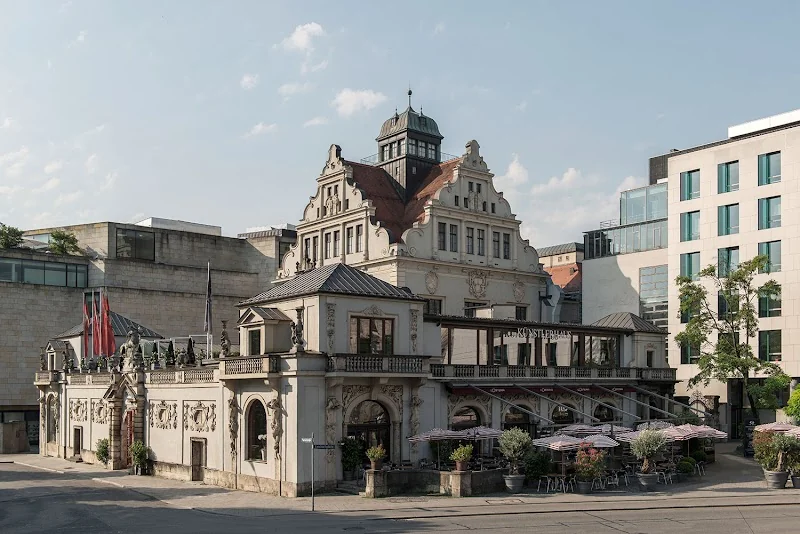
The Munich Artists' House at Lenbachplatz 8 in Munich is much more than just a representative building in a prime city center location. It is a historical monument, a cultural venue, an event address, and a meeting point for people who want to connect art, music, society, and special spaces. Since its opening in 1900, the house has shaped Munich's city and cultural history. Today, it belongs to the Munich Artists' House Foundation and presents itself with a vibrant cultural program, versatile event spaces, and an atmosphere that seamlessly brings together tradition and the present. Those looking for a place with character will find here not only a festive setting but also a house with history, profile, and remarkable adaptability. Its location in the heart of the old town, proximity to Karlsplatz/Stachus, and clear focus on culture and events make the Munich Artists' House one of the most exciting addresses in the city. ([kuenstlerhaus-muc.de](https://www.kuenstlerhaus-muc.de/kontakt/))
Current Cultural Program, Concerts, and Exhibitions
The cultural program of the Munich Artists' House clearly shows what this house stands for today: not for a single genre, but for an open concept of culture that brings together different formats. On the official program page, exhibitions, jazz, cabaret, children's programs, concerts, lithography in Munich, and dance are listed, among others. This is an important indication for visitors who want to get to know the house not only as an event location but also as a place for cultural discoveries. The programs take place in various rooms, such as the festival hall, Miller room, loft, or lithography workshop. This creates a varied impression of the house, which shows a different side with each event. Therefore, those searching for the term Munich Artists' House Program will find here not a rigid scheme, but a calendar with changing formats, ranging from classical concert evenings to exhibition openings and workshop offerings. ([kuenstlerhaus-muc.de](https://www.kuenstlerhaus-muc.de/kulturprogramm/?utm_source=openai))
Particularly interesting is that the Munich Artists' House understands culture not as an addition but as a core task. The foundation emphasizes that the house should provide artists of various genres access to a broad audience and that the legendary motto Nobis et Amicis carries the claim of being a meeting point for artists and society to this day. The homepage also refers to a digital tour, a ticket system, and various in-house offerings. For visitors, this means: The house can be experienced not only through individual events but also as a comprehensive concept of culture, architecture, and use. The connection of program, history, and space is particularly convincing because it takes place in a genuine historical environment and not in an interchangeable multifunctional building. This is precisely why the Munich Artists' House remains equally attractive for events, exhibitions, and concerts. ([kuenstlerhaus-muc.de](https://www.kuenstlerhaus-muc.de/stiftung/))
Festival Hall, Seating, and Room Capacities
The festival hall is the heart of the Munich Artists' House and one of the most impressive rooms in the entire house. According to the official description, it was completely destroyed by fire in 1944, was redesigned in a historical style, and reopened in 1961. Today, it impresses with a ceiling height of nine meters, a large gallery, excellent acoustics, and a spacious stage with a Steinway concert grand piano. Additionally, there are portraits of Franz von Lenbach, the opulent still lifes of Franz Snyders, and the Athena figure with two lions and a coat of arms above the stage. This room combines representation and function in an extraordinary way. It is suitable for cultural events as well as gala evenings, lectures, congresses, or festive private occasions. Therefore, those interested in the keyword Munich Artists' House Festival Hall are looking for a space that not only looks beautiful but is also historically charged and strong both technically and atmospherically. ([kuenstlerhaus-muc.de](https://www.kuenstlerhaus-muc.de/raum/festsaal/))
The capacities also show how flexibly the festival hall can be used. In a round seating arrangement, up to 230 people fit in the parquet, up to 276 with the gallery. In a lecture seating arrangement, there are up to 334 people in the parquet and 404 with the gallery. For conferences, the official site mentions 192 people in the parquet and 210 with the gallery. For standing receptions, the capacity is about 450 people. This makes the festival hall excellent for both concentrated formats and large reception situations. Additionally, other areas in the house can be combined, such as the foyer or adjacent club rooms. This makes the Munich Artists' House particularly interesting for organizers looking for not just a beautiful hall but a versatile overall location. Even in the search context of seating plans, best seats, or seating availability, this room provides very concrete answers, as the types of seating are clearly named and different event ideas can be oriented around them. ([kuenstlerhaus-muc.de](https://www.kuenstlerhaus-muc.de/raum/festsaal/))
Directions, Address, and Parking at Lenbachplatz
The address of the Munich Artists' House is clear and central: Lenbachplatz 8, 80333 Munich. This places the house in one of the most well-known city center locations in Munich, very close to Karlsplatz, i.e., Stachus. For visitors, this location is a real advantage, as the house is easily accessible both on foot from the old town and by public transport. Those arriving by train or bus benefit from the proximity to Karlsplatz/Stachus, one of the most important traffic hubs in the city center. The Stachus passages describe the area as being in the heart of Munich, 200 meters from the main train station and 500 meters from Marienplatz, with direct connections via subway, S-Bahn, and tram. For orientation in the search field Munich Artists' House Address or Lenbachplatz 8, this is an excellent starting point. ([kuenstlerhaus-muc.de](https://www.kuenstlerhaus-muc.de/kontakt/))
There is also a clearly identifiable solution for parking in the immediate vicinity: the underground garage Stachus at Karlsplatz/Stachus. According to the official site, it has 700 parking spaces, is open 24 hours a day, and the entrance is located at Herzog-Wilhelm-Straße 11. For many visitors, this is the most pragmatic option when attending an event, concert, or dinner at the Artists' House. Those wanting to remember the way from the car to the house can orient themselves to the central city location and plan the short walking distance. This is especially helpful for evening appointments when the city center is heavily frequented. The Munich Artists' House itself also emphasizes that it can be accessed barrier-free if needed, except for the lithography workshop. This combination of central location, good public transport connections, clear parking options, and barrier-free access makes the journey overall pleasantly manageable. ([stachuspassagen.de](https://www.stachuspassagen.de/services/anfahrt-parken))
History, Founding Fathers, and Munich Artists' House Foundation
The history of the Munich Artists' House begins in the late 19th century with a very clear ideal: a house for all artists of the city. Among the influential personalities were Franz von Lenbach, Gabriel von Seidl, Fritz August von Kaulbach, Ferdinand von Miller, and Lorenz von Gedon. Particularly, the artist society Allotria, founded in 1873, advanced the idea. In 1893, Prince Regent Luitpold laid the foundation stone, and architect Gabriel von Seidl began to construct the building in the style of the turn of the century. The enclosed document states that the house should be a gathering place for all artists in Munich, a center for joy, advice, and first actions. On March 29, 1900, the Artists' House was ceremonially inaugurated. Within a short time, it developed into a dazzling center of cultural events, where parties, exhibitions, and social events came together. Therefore, those searching for Munich Artists' House history will encounter a house that has never been just architecture but has embodied a social idea from the very beginning. ([kuenstlerhaus-muc.de](https://www.kuenstlerhaus-muc.de/geschichte/))
The following decades were marked by upheavals. World War I, economic hardship, the dissolution and expropriation of the Artists' House Association in 1938, and the devastating air raid on July 14, 1944, during which the house was almost completely destroyed by fire, mark the deepest cuts. After that followed use in the post-war period, difficult restitutions, and a laborious reconstruction that led to the reopening of the festival hall in 1961. The association became active again in 1997, and in December 2001, the Munich Artists' House Foundation was established. Today, the building is owned by this foundation; its chair was taken over by Birgit Gottschalk and Jennifer Ruhland in 2021. The association, in turn, has been under the leadership of Peter Clemente since mid-2024. These dates show that the present of the house is built on a very eventful past. This mixture of loss, reconstruction, and new beginnings gives the place its special depth and explains why it is still perceived as a cultural gem in Munich today. ([kuenstlerhaus-muc.de](https://www.kuenstlerhaus-muc.de/geschichte/))
Foyer, Courtyard, Loft, and Historical Bowling Alley
Besides the festival hall, the Munich Artists' House thrives mainly on its variety of rooms. The event location page lists foyer, festival hall, courtyard, Lenbach room, Seidl room, Miller room, loft, bowling alley, and Allotria. This is a significant advantage for organizers looking for more than a classic hall booking. The foyer serves as an inviting reception area, the courtyard as an open outdoor complement, and the loft offers a bright, flexible solution above the rooftops of the city with three rooms. The house presents itself as an ensemble, not as an individual room. For birthdays, weddings, Christmas parties, conferences, or fashion fairs, this creates a wide range of usage possibilities. The house is also technically prepared, as it refers to conference technology, catering, and film and photo opportunities. Therefore, those searching under the terms event location Munich, room rental, or special location will find here an exceptionally versatile address. The official website makes it clear that both small and large formats can be implemented just as well as social evenings with a stronger staging requirement. ([kuenstlerhaus-muc.de](https://www.kuenstlerhaus-muc.de/eventlocation/))
Particularly charming is the historical bowling alley. It is described on the official room page as a special gem of the vault and is not only worth seeing but also fully playable. The bowling alley is suitable for up to 20 people and is thus ideal for smaller, very personal gatherings with an experiential character. The Allotria area also refers to the long artistic tradition of the house; the room is named after the legendary artist society and is highlighted on the event page together with the adjacent historical bowling alley as a unique ambiance. This makes it clear that the Munich Artists' House not only has representative spaces but also original, almost hidden features that are not found in many other locations. For search queries such as Munich Artists' House bowling alley or Munich Artists' House photos, this is particularly relevant because the rooms are presented very vividly in the 3D tour and on the room pages. Thus, the house remains tangible and individual rather than abstract. ([kuenstlerhaus-muc.de](https://www.kuenstlerhaus-muc.de/raum/kegelbahn/?utm_source=openai))
Restaurant, Tickets, and Visitor Tips
Those visiting the Munich Artists' House will find not only culture and architecture at Lenbachplatz 8 but also gastronomy. In the same building, L'Osteria Munich Artists' House is represented with its own restaurant page; there, a Venetian hall, a large sun terrace, and a view into the kitchen are described, among other things. This is practical for guests who want to eat before or after an event or want to combine an evening at the Artists' House with a relaxed restaurant visit. In connection with the central location at Karlsplatz/Stachus, this creates a very harmonious overall package: art, events, and gastronomy in one place. For planning, this is helpful because one can think spatially about the journey, the table, and the event date. Those informing themselves under the keyword Munich Artists' House Restaurant thus have a real point of contact directly at the house and not just a mere recommendation somewhere nearby. ([losteria.net](https://losteria.net/de-en/restaurants/restaurant/muenchen-kuenstlerhaus/?utm_source=openai))
The house is also well-equipped for ticket purchases and the visit itself. The official website refers to a ticket system, a digital tour, and a clear event structure. For current events, it is worth taking a look at the cultural calendar, as the formats change regularly and range from concerts and exhibitions to workshops and special dates. Those planning a specific occasion should also check the room pages, as the possible seating arrangements and capacities are transparently listed there. For visitors who are getting to know the house for the first time, the combination of history, program, and room offerings is particularly attractive. The Munich Artists' House is not a place that you see just once and check off. It is rather a house that opens up a different perspective with each visit: once as a stage, once as a festival hall, once as a work of art, once as an urban meeting point. This is precisely where its lasting appeal lies. ([kuenstlerhaus-muc.de](https://www.kuenstlerhaus-muc.de/?utm_source=openai))
Sources:
Show moreShow less
Munich Artists' House | Program & Parking
The Munich Artists' House at Lenbachplatz 8 in Munich is much more than just a representative building in a prime city center location. It is a historical monument, a cultural venue, an event address, and a meeting point for people who want to connect art, music, society, and special spaces. Since its opening in 1900, the house has shaped Munich's city and cultural history. Today, it belongs to the Munich Artists' House Foundation and presents itself with a vibrant cultural program, versatile event spaces, and an atmosphere that seamlessly brings together tradition and the present. Those looking for a place with character will find here not only a festive setting but also a house with history, profile, and remarkable adaptability. Its location in the heart of the old town, proximity to Karlsplatz/Stachus, and clear focus on culture and events make the Munich Artists' House one of the most exciting addresses in the city. ([kuenstlerhaus-muc.de](https://www.kuenstlerhaus-muc.de/kontakt/))
Current Cultural Program, Concerts, and Exhibitions
The cultural program of the Munich Artists' House clearly shows what this house stands for today: not for a single genre, but for an open concept of culture that brings together different formats. On the official program page, exhibitions, jazz, cabaret, children's programs, concerts, lithography in Munich, and dance are listed, among others. This is an important indication for visitors who want to get to know the house not only as an event location but also as a place for cultural discoveries. The programs take place in various rooms, such as the festival hall, Miller room, loft, or lithography workshop. This creates a varied impression of the house, which shows a different side with each event. Therefore, those searching for the term Munich Artists' House Program will find here not a rigid scheme, but a calendar with changing formats, ranging from classical concert evenings to exhibition openings and workshop offerings. ([kuenstlerhaus-muc.de](https://www.kuenstlerhaus-muc.de/kulturprogramm/?utm_source=openai))
Particularly interesting is that the Munich Artists' House understands culture not as an addition but as a core task. The foundation emphasizes that the house should provide artists of various genres access to a broad audience and that the legendary motto Nobis et Amicis carries the claim of being a meeting point for artists and society to this day. The homepage also refers to a digital tour, a ticket system, and various in-house offerings. For visitors, this means: The house can be experienced not only through individual events but also as a comprehensive concept of culture, architecture, and use. The connection of program, history, and space is particularly convincing because it takes place in a genuine historical environment and not in an interchangeable multifunctional building. This is precisely why the Munich Artists' House remains equally attractive for events, exhibitions, and concerts. ([kuenstlerhaus-muc.de](https://www.kuenstlerhaus-muc.de/stiftung/))
Festival Hall, Seating, and Room Capacities
The festival hall is the heart of the Munich Artists' House and one of the most impressive rooms in the entire house. According to the official description, it was completely destroyed by fire in 1944, was redesigned in a historical style, and reopened in 1961. Today, it impresses with a ceiling height of nine meters, a large gallery, excellent acoustics, and a spacious stage with a Steinway concert grand piano. Additionally, there are portraits of Franz von Lenbach, the opulent still lifes of Franz Snyders, and the Athena figure with two lions and a coat of arms above the stage. This room combines representation and function in an extraordinary way. It is suitable for cultural events as well as gala evenings, lectures, congresses, or festive private occasions. Therefore, those interested in the keyword Munich Artists' House Festival Hall are looking for a space that not only looks beautiful but is also historically charged and strong both technically and atmospherically. ([kuenstlerhaus-muc.de](https://www.kuenstlerhaus-muc.de/raum/festsaal/))
The capacities also show how flexibly the festival hall can be used. In a round seating arrangement, up to 230 people fit in the parquet, up to 276 with the gallery. In a lecture seating arrangement, there are up to 334 people in the parquet and 404 with the gallery. For conferences, the official site mentions 192 people in the parquet and 210 with the gallery. For standing receptions, the capacity is about 450 people. This makes the festival hall excellent for both concentrated formats and large reception situations. Additionally, other areas in the house can be combined, such as the foyer or adjacent club rooms. This makes the Munich Artists' House particularly interesting for organizers looking for not just a beautiful hall but a versatile overall location. Even in the search context of seating plans, best seats, or seating availability, this room provides very concrete answers, as the types of seating are clearly named and different event ideas can be oriented around them. ([kuenstlerhaus-muc.de](https://www.kuenstlerhaus-muc.de/raum/festsaal/))
Directions, Address, and Parking at Lenbachplatz
The address of the Munich Artists' House is clear and central: Lenbachplatz 8, 80333 Munich. This places the house in one of the most well-known city center locations in Munich, very close to Karlsplatz, i.e., Stachus. For visitors, this location is a real advantage, as the house is easily accessible both on foot from the old town and by public transport. Those arriving by train or bus benefit from the proximity to Karlsplatz/Stachus, one of the most important traffic hubs in the city center. The Stachus passages describe the area as being in the heart of Munich, 200 meters from the main train station and 500 meters from Marienplatz, with direct connections via subway, S-Bahn, and tram. For orientation in the search field Munich Artists' House Address or Lenbachplatz 8, this is an excellent starting point. ([kuenstlerhaus-muc.de](https://www.kuenstlerhaus-muc.de/kontakt/))
There is also a clearly identifiable solution for parking in the immediate vicinity: the underground garage Stachus at Karlsplatz/Stachus. According to the official site, it has 700 parking spaces, is open 24 hours a day, and the entrance is located at Herzog-Wilhelm-Straße 11. For many visitors, this is the most pragmatic option when attending an event, concert, or dinner at the Artists' House. Those wanting to remember the way from the car to the house can orient themselves to the central city location and plan the short walking distance. This is especially helpful for evening appointments when the city center is heavily frequented. The Munich Artists' House itself also emphasizes that it can be accessed barrier-free if needed, except for the lithography workshop. This combination of central location, good public transport connections, clear parking options, and barrier-free access makes the journey overall pleasantly manageable. ([stachuspassagen.de](https://www.stachuspassagen.de/services/anfahrt-parken))
History, Founding Fathers, and Munich Artists' House Foundation
The history of the Munich Artists' House begins in the late 19th century with a very clear ideal: a house for all artists of the city. Among the influential personalities were Franz von Lenbach, Gabriel von Seidl, Fritz August von Kaulbach, Ferdinand von Miller, and Lorenz von Gedon. Particularly, the artist society Allotria, founded in 1873, advanced the idea. In 1893, Prince Regent Luitpold laid the foundation stone, and architect Gabriel von Seidl began to construct the building in the style of the turn of the century. The enclosed document states that the house should be a gathering place for all artists in Munich, a center for joy, advice, and first actions. On March 29, 1900, the Artists' House was ceremonially inaugurated. Within a short time, it developed into a dazzling center of cultural events, where parties, exhibitions, and social events came together. Therefore, those searching for Munich Artists' House history will encounter a house that has never been just architecture but has embodied a social idea from the very beginning. ([kuenstlerhaus-muc.de](https://www.kuenstlerhaus-muc.de/geschichte/))
The following decades were marked by upheavals. World War I, economic hardship, the dissolution and expropriation of the Artists' House Association in 1938, and the devastating air raid on July 14, 1944, during which the house was almost completely destroyed by fire, mark the deepest cuts. After that followed use in the post-war period, difficult restitutions, and a laborious reconstruction that led to the reopening of the festival hall in 1961. The association became active again in 1997, and in December 2001, the Munich Artists' House Foundation was established. Today, the building is owned by this foundation; its chair was taken over by Birgit Gottschalk and Jennifer Ruhland in 2021. The association, in turn, has been under the leadership of Peter Clemente since mid-2024. These dates show that the present of the house is built on a very eventful past. This mixture of loss, reconstruction, and new beginnings gives the place its special depth and explains why it is still perceived as a cultural gem in Munich today. ([kuenstlerhaus-muc.de](https://www.kuenstlerhaus-muc.de/geschichte/))
Foyer, Courtyard, Loft, and Historical Bowling Alley
Besides the festival hall, the Munich Artists' House thrives mainly on its variety of rooms. The event location page lists foyer, festival hall, courtyard, Lenbach room, Seidl room, Miller room, loft, bowling alley, and Allotria. This is a significant advantage for organizers looking for more than a classic hall booking. The foyer serves as an inviting reception area, the courtyard as an open outdoor complement, and the loft offers a bright, flexible solution above the rooftops of the city with three rooms. The house presents itself as an ensemble, not as an individual room. For birthdays, weddings, Christmas parties, conferences, or fashion fairs, this creates a wide range of usage possibilities. The house is also technically prepared, as it refers to conference technology, catering, and film and photo opportunities. Therefore, those searching under the terms event location Munich, room rental, or special location will find here an exceptionally versatile address. The official website makes it clear that both small and large formats can be implemented just as well as social evenings with a stronger staging requirement. ([kuenstlerhaus-muc.de](https://www.kuenstlerhaus-muc.de/eventlocation/))
Particularly charming is the historical bowling alley. It is described on the official room page as a special gem of the vault and is not only worth seeing but also fully playable. The bowling alley is suitable for up to 20 people and is thus ideal for smaller, very personal gatherings with an experiential character. The Allotria area also refers to the long artistic tradition of the house; the room is named after the legendary artist society and is highlighted on the event page together with the adjacent historical bowling alley as a unique ambiance. This makes it clear that the Munich Artists' House not only has representative spaces but also original, almost hidden features that are not found in many other locations. For search queries such as Munich Artists' House bowling alley or Munich Artists' House photos, this is particularly relevant because the rooms are presented very vividly in the 3D tour and on the room pages. Thus, the house remains tangible and individual rather than abstract. ([kuenstlerhaus-muc.de](https://www.kuenstlerhaus-muc.de/raum/kegelbahn/?utm_source=openai))
Restaurant, Tickets, and Visitor Tips
Those visiting the Munich Artists' House will find not only culture and architecture at Lenbachplatz 8 but also gastronomy. In the same building, L'Osteria Munich Artists' House is represented with its own restaurant page; there, a Venetian hall, a large sun terrace, and a view into the kitchen are described, among other things. This is practical for guests who want to eat before or after an event or want to combine an evening at the Artists' House with a relaxed restaurant visit. In connection with the central location at Karlsplatz/Stachus, this creates a very harmonious overall package: art, events, and gastronomy in one place. For planning, this is helpful because one can think spatially about the journey, the table, and the event date. Those informing themselves under the keyword Munich Artists' House Restaurant thus have a real point of contact directly at the house and not just a mere recommendation somewhere nearby. ([losteria.net](https://losteria.net/de-en/restaurants/restaurant/muenchen-kuenstlerhaus/?utm_source=openai))
The house is also well-equipped for ticket purchases and the visit itself. The official website refers to a ticket system, a digital tour, and a clear event structure. For current events, it is worth taking a look at the cultural calendar, as the formats change regularly and range from concerts and exhibitions to workshops and special dates. Those planning a specific occasion should also check the room pages, as the possible seating arrangements and capacities are transparently listed there. For visitors who are getting to know the house for the first time, the combination of history, program, and room offerings is particularly attractive. The Munich Artists' House is not a place that you see just once and check off. It is rather a house that opens up a different perspective with each visit: once as a stage, once as a festival hall, once as a work of art, once as an urban meeting point. This is precisely where its lasting appeal lies. ([kuenstlerhaus-muc.de](https://www.kuenstlerhaus-muc.de/?utm_source=openai))
Sources:
Munich Artists' House | Program & Parking
The Munich Artists' House at Lenbachplatz 8 in Munich is much more than just a representative building in a prime city center location. It is a historical monument, a cultural venue, an event address, and a meeting point for people who want to connect art, music, society, and special spaces. Since its opening in 1900, the house has shaped Munich's city and cultural history. Today, it belongs to the Munich Artists' House Foundation and presents itself with a vibrant cultural program, versatile event spaces, and an atmosphere that seamlessly brings together tradition and the present. Those looking for a place with character will find here not only a festive setting but also a house with history, profile, and remarkable adaptability. Its location in the heart of the old town, proximity to Karlsplatz/Stachus, and clear focus on culture and events make the Munich Artists' House one of the most exciting addresses in the city. ([kuenstlerhaus-muc.de](https://www.kuenstlerhaus-muc.de/kontakt/))
Current Cultural Program, Concerts, and Exhibitions
The cultural program of the Munich Artists' House clearly shows what this house stands for today: not for a single genre, but for an open concept of culture that brings together different formats. On the official program page, exhibitions, jazz, cabaret, children's programs, concerts, lithography in Munich, and dance are listed, among others. This is an important indication for visitors who want to get to know the house not only as an event location but also as a place for cultural discoveries. The programs take place in various rooms, such as the festival hall, Miller room, loft, or lithography workshop. This creates a varied impression of the house, which shows a different side with each event. Therefore, those searching for the term Munich Artists' House Program will find here not a rigid scheme, but a calendar with changing formats, ranging from classical concert evenings to exhibition openings and workshop offerings. ([kuenstlerhaus-muc.de](https://www.kuenstlerhaus-muc.de/kulturprogramm/?utm_source=openai))
Particularly interesting is that the Munich Artists' House understands culture not as an addition but as a core task. The foundation emphasizes that the house should provide artists of various genres access to a broad audience and that the legendary motto Nobis et Amicis carries the claim of being a meeting point for artists and society to this day. The homepage also refers to a digital tour, a ticket system, and various in-house offerings. For visitors, this means: The house can be experienced not only through individual events but also as a comprehensive concept of culture, architecture, and use. The connection of program, history, and space is particularly convincing because it takes place in a genuine historical environment and not in an interchangeable multifunctional building. This is precisely why the Munich Artists' House remains equally attractive for events, exhibitions, and concerts. ([kuenstlerhaus-muc.de](https://www.kuenstlerhaus-muc.de/stiftung/))
Festival Hall, Seating, and Room Capacities
The festival hall is the heart of the Munich Artists' House and one of the most impressive rooms in the entire house. According to the official description, it was completely destroyed by fire in 1944, was redesigned in a historical style, and reopened in 1961. Today, it impresses with a ceiling height of nine meters, a large gallery, excellent acoustics, and a spacious stage with a Steinway concert grand piano. Additionally, there are portraits of Franz von Lenbach, the opulent still lifes of Franz Snyders, and the Athena figure with two lions and a coat of arms above the stage. This room combines representation and function in an extraordinary way. It is suitable for cultural events as well as gala evenings, lectures, congresses, or festive private occasions. Therefore, those interested in the keyword Munich Artists' House Festival Hall are looking for a space that not only looks beautiful but is also historically charged and strong both technically and atmospherically. ([kuenstlerhaus-muc.de](https://www.kuenstlerhaus-muc.de/raum/festsaal/))
The capacities also show how flexibly the festival hall can be used. In a round seating arrangement, up to 230 people fit in the parquet, up to 276 with the gallery. In a lecture seating arrangement, there are up to 334 people in the parquet and 404 with the gallery. For conferences, the official site mentions 192 people in the parquet and 210 with the gallery. For standing receptions, the capacity is about 450 people. This makes the festival hall excellent for both concentrated formats and large reception situations. Additionally, other areas in the house can be combined, such as the foyer or adjacent club rooms. This makes the Munich Artists' House particularly interesting for organizers looking for not just a beautiful hall but a versatile overall location. Even in the search context of seating plans, best seats, or seating availability, this room provides very concrete answers, as the types of seating are clearly named and different event ideas can be oriented around them. ([kuenstlerhaus-muc.de](https://www.kuenstlerhaus-muc.de/raum/festsaal/))
Directions, Address, and Parking at Lenbachplatz
The address of the Munich Artists' House is clear and central: Lenbachplatz 8, 80333 Munich. This places the house in one of the most well-known city center locations in Munich, very close to Karlsplatz, i.e., Stachus. For visitors, this location is a real advantage, as the house is easily accessible both on foot from the old town and by public transport. Those arriving by train or bus benefit from the proximity to Karlsplatz/Stachus, one of the most important traffic hubs in the city center. The Stachus passages describe the area as being in the heart of Munich, 200 meters from the main train station and 500 meters from Marienplatz, with direct connections via subway, S-Bahn, and tram. For orientation in the search field Munich Artists' House Address or Lenbachplatz 8, this is an excellent starting point. ([kuenstlerhaus-muc.de](https://www.kuenstlerhaus-muc.de/kontakt/))
There is also a clearly identifiable solution for parking in the immediate vicinity: the underground garage Stachus at Karlsplatz/Stachus. According to the official site, it has 700 parking spaces, is open 24 hours a day, and the entrance is located at Herzog-Wilhelm-Straße 11. For many visitors, this is the most pragmatic option when attending an event, concert, or dinner at the Artists' House. Those wanting to remember the way from the car to the house can orient themselves to the central city location and plan the short walking distance. This is especially helpful for evening appointments when the city center is heavily frequented. The Munich Artists' House itself also emphasizes that it can be accessed barrier-free if needed, except for the lithography workshop. This combination of central location, good public transport connections, clear parking options, and barrier-free access makes the journey overall pleasantly manageable. ([stachuspassagen.de](https://www.stachuspassagen.de/services/anfahrt-parken))
History, Founding Fathers, and Munich Artists' House Foundation
The history of the Munich Artists' House begins in the late 19th century with a very clear ideal: a house for all artists of the city. Among the influential personalities were Franz von Lenbach, Gabriel von Seidl, Fritz August von Kaulbach, Ferdinand von Miller, and Lorenz von Gedon. Particularly, the artist society Allotria, founded in 1873, advanced the idea. In 1893, Prince Regent Luitpold laid the foundation stone, and architect Gabriel von Seidl began to construct the building in the style of the turn of the century. The enclosed document states that the house should be a gathering place for all artists in Munich, a center for joy, advice, and first actions. On March 29, 1900, the Artists' House was ceremonially inaugurated. Within a short time, it developed into a dazzling center of cultural events, where parties, exhibitions, and social events came together. Therefore, those searching for Munich Artists' House history will encounter a house that has never been just architecture but has embodied a social idea from the very beginning. ([kuenstlerhaus-muc.de](https://www.kuenstlerhaus-muc.de/geschichte/))
The following decades were marked by upheavals. World War I, economic hardship, the dissolution and expropriation of the Artists' House Association in 1938, and the devastating air raid on July 14, 1944, during which the house was almost completely destroyed by fire, mark the deepest cuts. After that followed use in the post-war period, difficult restitutions, and a laborious reconstruction that led to the reopening of the festival hall in 1961. The association became active again in 1997, and in December 2001, the Munich Artists' House Foundation was established. Today, the building is owned by this foundation; its chair was taken over by Birgit Gottschalk and Jennifer Ruhland in 2021. The association, in turn, has been under the leadership of Peter Clemente since mid-2024. These dates show that the present of the house is built on a very eventful past. This mixture of loss, reconstruction, and new beginnings gives the place its special depth and explains why it is still perceived as a cultural gem in Munich today. ([kuenstlerhaus-muc.de](https://www.kuenstlerhaus-muc.de/geschichte/))
Foyer, Courtyard, Loft, and Historical Bowling Alley
Besides the festival hall, the Munich Artists' House thrives mainly on its variety of rooms. The event location page lists foyer, festival hall, courtyard, Lenbach room, Seidl room, Miller room, loft, bowling alley, and Allotria. This is a significant advantage for organizers looking for more than a classic hall booking. The foyer serves as an inviting reception area, the courtyard as an open outdoor complement, and the loft offers a bright, flexible solution above the rooftops of the city with three rooms. The house presents itself as an ensemble, not as an individual room. For birthdays, weddings, Christmas parties, conferences, or fashion fairs, this creates a wide range of usage possibilities. The house is also technically prepared, as it refers to conference technology, catering, and film and photo opportunities. Therefore, those searching under the terms event location Munich, room rental, or special location will find here an exceptionally versatile address. The official website makes it clear that both small and large formats can be implemented just as well as social evenings with a stronger staging requirement. ([kuenstlerhaus-muc.de](https://www.kuenstlerhaus-muc.de/eventlocation/))
Particularly charming is the historical bowling alley. It is described on the official room page as a special gem of the vault and is not only worth seeing but also fully playable. The bowling alley is suitable for up to 20 people and is thus ideal for smaller, very personal gatherings with an experiential character. The Allotria area also refers to the long artistic tradition of the house; the room is named after the legendary artist society and is highlighted on the event page together with the adjacent historical bowling alley as a unique ambiance. This makes it clear that the Munich Artists' House not only has representative spaces but also original, almost hidden features that are not found in many other locations. For search queries such as Munich Artists' House bowling alley or Munich Artists' House photos, this is particularly relevant because the rooms are presented very vividly in the 3D tour and on the room pages. Thus, the house remains tangible and individual rather than abstract. ([kuenstlerhaus-muc.de](https://www.kuenstlerhaus-muc.de/raum/kegelbahn/?utm_source=openai))
Restaurant, Tickets, and Visitor Tips
Those visiting the Munich Artists' House will find not only culture and architecture at Lenbachplatz 8 but also gastronomy. In the same building, L'Osteria Munich Artists' House is represented with its own restaurant page; there, a Venetian hall, a large sun terrace, and a view into the kitchen are described, among other things. This is practical for guests who want to eat before or after an event or want to combine an evening at the Artists' House with a relaxed restaurant visit. In connection with the central location at Karlsplatz/Stachus, this creates a very harmonious overall package: art, events, and gastronomy in one place. For planning, this is helpful because one can think spatially about the journey, the table, and the event date. Those informing themselves under the keyword Munich Artists' House Restaurant thus have a real point of contact directly at the house and not just a mere recommendation somewhere nearby. ([losteria.net](https://losteria.net/de-en/restaurants/restaurant/muenchen-kuenstlerhaus/?utm_source=openai))
The house is also well-equipped for ticket purchases and the visit itself. The official website refers to a ticket system, a digital tour, and a clear event structure. For current events, it is worth taking a look at the cultural calendar, as the formats change regularly and range from concerts and exhibitions to workshops and special dates. Those planning a specific occasion should also check the room pages, as the possible seating arrangements and capacities are transparently listed there. For visitors who are getting to know the house for the first time, the combination of history, program, and room offerings is particularly attractive. The Munich Artists' House is not a place that you see just once and check off. It is rather a house that opens up a different perspective with each visit: once as a stage, once as a festival hall, once as a work of art, once as an urban meeting point. This is precisely where its lasting appeal lies. ([kuenstlerhaus-muc.de](https://www.kuenstlerhaus-muc.de/?utm_source=openai))
Sources:
Upcoming Events
No events found
Frequently Asked Questions
Reviews
Sena Yilmaz
21. February 2026
The historic character of the building has been well preserved. I attended a dance festival there, including both training sessions and a dance ball. The hall is not very large and the stage is also quite modest, but the venue has kept its original atmosphere without losing its historical charm. I think attending an event here can feel like stepping back in time, which makes the experience especially enjoyable.
Abdurrahman Ali
20. February 2026
Very delicious food and nice place
Marchela Lebikyan
25. April 2025
The Künstlerhaus am Lenbachplatz is a beautiful building where we’ve experienced some unforgettable music events. It’s always a pleasure to visit, and its central, well-connected location is a big plus.
Devan Pulliah
2. December 2023
Well organised theatre dating back to 1900...attended a lovely piano concert by a 17 year old who was brilliant...the room is large & comfortable with good view of the stage...the sound was great...costs 2 euros to leave your coat...
Mayur Alaspure
5. October 2022
Perfect hall for VIP events. Hall environment is so elegant and warm. I did one event shoot here and everything was so perfect.