
Rosenheimer Str. 5, München
Rosenheimer Str. 5, 81667 München, Germany
Munch Market Fat Cat | Photos & Gasteig
The Munch Market at FAT CAT Munich is more than just a food spot in the former Gasteig. Those searching for the name usually mean a place where street food, culture, and the unique history of one of Munich's most famous venues come together. That is exactly what makes it appealing: The former concert hall on Rosenheimer Straße is currently being used as FAT CAT to avoid vacancy and create space for art, gastronomy, and events. For visitors, this means an address that is memorable not only for the food but also for its atmosphere, central location, and very distinct character between pop-up, cultural center, and neighborhood spot. The location is still clearly connected to Haidhausen, is easily accessible at Rosenheimer Platz, and has quickly developed into one of the most exciting temporary cultural venues in Munich. ([fatcat-muc.de](https://fatcat-muc.de/))
Especially for search queries like Munch Market Fat Cat Photos, Fat Cat Gasteig, or Fat Cat Munich, many people are looking for a first impression: How does the place look today, what is there, and how does it differ from the classic Gasteig? The answer is simple yet remarkable. FAT CAT is not a closed restaurant project but a whole building complex with different uses. Almost 200 office spaces have been converted into studios and rehearsal rooms, break gastronomy has turned into bars, and lecture rooms have become stages. In the large halls, concerts, theater, ballet, comedy, fairs, and much more take place. Therefore, the Munch Market should not be understood in isolation, but as part of a larger cultural and experiential venue that is constantly evolving. That is exactly why the location works so well for everyone looking for unique city motifs, vibrant interiors, and an urban meeting point. ([fatcat-muc.de](https://fatcat-muc.de/))
Fat Cat Munich in the former Gasteig: What the place is today
The current FAT CAT stands in direct tradition of the Gasteig, which has been used as a large cultural center of the city of Munich since 1985. The official Gasteig website describes the building as home to many municipal institutions and refers to its size of 90,000 square meters. This spatial dimension is crucial to understand why the place is so attractive for interim use: Here, there is not just a hall or a corridor, but a complete building with a lot of potential for provisional, creative, and urban uses. In February 2023, Gasteig München GmbH signed a contract with the non-profit FAT CAT gGmbH, and in May 2023, the first tenants moved into their spaces, and since then, the former cultural complex has become a vibrant mix of workplaces, stages, and gastronomy. ([gasteig.de](https://www.gasteig.de/der-neue-gasteig/))
The FAT CAT website clearly states its ambition: to avoid vacancy, enable creative diversity, and provide spaces for artists from music, dance, theater, film, as well as visual and performing arts. This is not just a marketing formula but the central idea behind the house. More than 100 artists, dance schools, comedy clubs, and gastronomy establishments now call it home, and over 50 events take place monthly. This is exceptionally high for a temporarily used cultural venue. Visitors thus experience not a static place but a house that simultaneously serves as a workspace, event venue, and meeting point. So, anyone visiting the Munch Market enters an environment where gastronomy functions not just as an addition but as part of a larger cultural movement. ([fatcat-muc.de](https://fatcat-muc.de/ueber-uns/))
The future of the house is already clearly outlined. According to Gasteig and FAT CAT, the interim use ends in late September 2026; the remediation is expected to begin in early 2027. Operations in the Philharmonie will end earlier because the organ will be dismantled later. This is important for visitors as it explains the current dynamics: FAT CAT is today a temporary place, and that is why much feels particularly direct, lively, and somewhat unique. The Munch Market benefits from this situation because nothing feels arbitrary here. The food is set in a house with history, and this history is palpable everywhere. ([gasteig.de](https://www.gasteig.de/der-neue-gasteig/))
The combination of old substance and new use is also evident in the events and tenants. Since December 2023, the Philharmonie has resumed operations with ballet, concerts, and exhibitions, while other halls host theater, comedy, dance, and experimental formats. This mix is what gives the place its charm, as it attracts an audience that comes not only for a specific program but for the overall feeling. For SEO intentions around Fat Cat Munich Gasteig or Fat Cat former Gasteig, this is the crucial information: It is not just a mere event space but an urban cultural center with a strong connection to Munich's city history. ([fatcat-muc.de](https://fatcat-muc.de/ueber-uns/))
Munch Market: Street food, burgers, ramen, and new gastronomy concepts
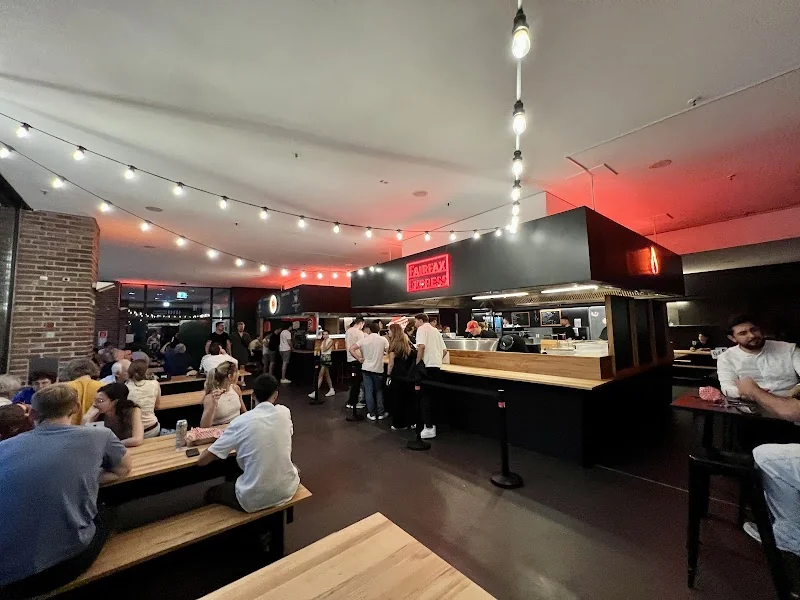
The Munch Market became known in early January 2024 as a small street food area in FAT CAT. IN Munich described it shortly after the opening as a new destination for street food fans, then featuring two stalls, burgers, beer, and ramen. The character of the space was particularly important from the start: not a classic food court with endless rows, but a compact, rather intimate area on the ground floor of the former concert hall. The editorial team noted that two cooking islands for burgers and ramen face each other and that in the middle of the space is a bar for wine, lemonade, and beer. This blend of food, community, and very direct spatial impact continues to define the place today. Those looking for photos are essentially searching for this interplay of provisional charm and clear culinary direction. ([in-muenchen.de](https://www.in-muenchen.de/essen-und-trinken/gastro/klein-aber-fein-der-munch-market.html))
This is particularly tangible in the example of Fairfax Express. The official website of the provider lists the location as Munich Munch Market Gasteig at Rosenheimer Straße 5 in Munich, states opening hours from Tuesday to Saturday in the evening, and also points out that only card payments are accepted and no reservations are possible. This is practically important for visitors as it answers the most pressing everyday questions: How do you pay, and can you reserve a table? The Munch Market functions more like a spontaneous urban eating place than a classic reservation restaurant. This directness is what makes it appealing, but it can lead to wait times, especially during peak hours in the evening or on weekends. ([fairfax-express.de](https://fairfax-express.de/))
Culinarily, the place has also evolved. IN Munich reported in June 2025 about Taqueria con Salsa as a newcomer in the Munch Market. There, homemade corn tortillas, Mexican-inspired fillings, and a very authentic orientation were emphasized. This shows that the Munch Market is not a frozen concept but a place where food ideas can change and complement each other. Especially for those searching for Munch Market Munich or Fat Cat Munich, this is good news: Here, there is not only a fixed name but a growing urban gastronomy format. The development from ramen to burgers to Mexican cuisine shows how open the house is to different tastes and target groups. ([in-muenchen.de](https://www.in-muenchen.de/essen-und-trinken/gastro/neueroeffnungen.html))
The spatial atmosphere is also important. Early reports highlighted the rather small layout and the communal seating areas. There are separate areas for each concept, but also tables that can be used communally. This is pleasant for many guests because one does not have to choose between culinary worlds but can eat within a compact, lively setting. That is why the Munch Market is often described as charming but consciously not oversized. The place thrives on the mix of uncomplicated food, urban use, and the feeling that something is emerging here that does not aim for maximum size from the outset but for a clear identity. ([in-muenchen.de](https://www.in-muenchen.de/essen-und-trinken/gastro/klein-aber-fein-der-munch-market.html))
From an SEO perspective, terms like Munch Market Fat Cat, street food Munich, burgers at Fat Cat, ramen in the former Gasteig, and new gastronomy concepts are particularly relevant. The search intention is not only informative but also visual: people want to see how the place looks and at the same time know if the trip is worth it. The Munch Market answers this very well. It is not just a side aspect of FAT CAT but one of the reasons why the building functions again as a real attraction. The interplay of food, culture, and the special house makes it interesting for visitors and content seekers alike. ([in-muenchen.de](https://www.in-muenchen.de/essen-und-trinken/gastro/klein-aber-fein-der-munch-market.html))
Directions, Rosenheimer Platz, and parking at FAT CAT
Those visiting FAT CAT or the Munch Market have the location clearly on their side. The visitor address is at Rosenheimer Straße 5 in 81667 Munich, right in the middle of Haidhausen and in close proximity to Rosenheimer Platz. The official directions page explicitly mentions the S-Bahn lines S1 to S8 stopping at Rosenheimer Platz, as well as tram line 25 at the same junction. Additionally, the walking distance from Rosenheimer Platz is about three minutes. For guests, this means: The house is very well accessible by public transport, and the walk from the station or stop to the entrance is short and uncomplicated. ([fatcat-muc.de](https://fatcat-muc.de/kontakt-anfahrt/))
There is also a clear answer regarding parking. Directly on-site is the parking garage Gasteig or Fat Cat at Rosenheimer Straße 5 with 271 parking spaces available. This is particularly relevant for evening events, family visits, or guests traveling from afar. Especially since the place is not just a food spot but also a cultural center with many events, the garage offers a practical and planable solution. Those who inform themselves in advance save time later and avoid the risk of searching for a free spot in the surrounding streets. For search queries like Fat Cat parking or Munch Market Fat Cat parking, this information is therefore central. ([fatcat-muc.de](https://fatcat-muc.de/kontakt-anfahrt/))
Additionally, cycling is recommended. The FAT CAT website points out parking options around the house and explicitly states that the walking distance from Rosenheimer Platz is very short. This is a real advantage in an inner-city district like Haidhausen. The building is located in an urban environment where public transport, cycling, and walking can be well combined. Those arriving spontaneously can thus flexibly decide whether they want to go directly to eat, a concert, or an exhibition. The location is therefore not only practical but also typically Munich: central, dense, lively, and very well connected. ([fatcat-muc.de](https://fatcat-muc.de/kontakt-anfahrt/))
For people with limited mobility, information about accessibility is also important. FAT CAT explains on the contact page that all venues and event spaces are accessible and that there are several elevators in the building. In a large building with many levels and different uses, this is a crucial quality statement. It shows that the place is not only temporarily lively but also practically thought out. Those who want to use events, food offerings, or individual rooms can rely on the fact that access has been fundamentally considered. ([fatcat-muc.de](https://fatcat-muc.de/kontakt-anfahrt/))
In summary, the journey is a real plus point of the location. A central S-Bahn junction, a tram stop, a dedicated parking garage, bike parking, and barrier-free access make the place well usable for various target groups. This is also relevant from an SEO perspective because many people search for these questions before deciding to visit. In the case of Munch Market Fat Cat, directions and parking are not a side topic but part of the utility value of the location. Those coming from outside quickly get the feeling that the visit is not complicated but planable. ([fatcat-muc.de](https://fatcat-muc.de/kontakt-anfahrt/))
Rooms, halls, and capacities at FAT CAT
A key reason why FAT CAT works so well is the variety of rooms. On the official venue overview, the house lists the small concert hall with 194 seats, the black box with 249 seats, the Carl-Orff hall with 600 seats, and the Philharmonie with 2300 seats. Additionally, there are seminar rooms for 20 to 70 people as well as the Fat Cat Lab as another multipurpose room. For visitors, this means that the house is not only gastronomically but also content-wise extremely well equipped. Whether reading, comedy, concert, conference, or experimental format: there is a suitable room in the building for many occasions. ([fatcat-muc.de](https://fatcat-muc.de/venues/))
Especially the larger halls shape the external image. The Carl-Orff hall is particularly suitable for theater performances, concerts, dance, and readings, according to FAT CAT. The black box is used for theater, comedy, parties, concerts, and readings. The Philharmonie is primarily intended for concerts; the venue page also states that from 2025 it will only be used for a maximum of 200 people or spectators without a foyer. This detail shows very well how the interim use interacts with the spatial possibilities of the building. The house is large but not usable in its full original form everywhere. This mix of formerly large cultural infrastructure and new, adapted use gives it a special character. ([fatcat-muc.de](https://fatcat-muc.de/venues/))
That these rooms are now truly lively is confirmed by the FAT CAT's self-presentation. It mentions more than 50 events per month, offerings for theater, concerts, ballet, raves, comedy, conferences, and fairs, as well as a growing community of over 200 tenants. It also states that the small concert hall, the black box, and the Carl-Orff hall have gradually been equipped with lighting and sound technology. For those searching for Fat Cat program or Fat Cat tickets, this is the exciting point: There is not just a single event type but a house that simultaneously serves as a concert venue, performance space, and platform for different scenes. ([fatcat-muc.de](https://fatcat-muc.de/))
The Philharmonie is a special case because it leaves the greatest historical and spatial impression. The official Gasteig and FAT CAT communication makes it clear that this hall was once Munich's grand concert hall and is still used within the interim use. At the same time, the dismantling is already underway as part of the renovation planning. For visitors, this is both a hint at the transience of the moment and also at the high cultural value of the building. Therefore, those attending an event in this house experience not only a program but also a piece of city history. ([gasteig.de](https://www.gasteig.de/der-neue-gasteig/))
For practical use, it is also interesting that FAT CAT openly discusses its limitations. On several venue pages, it is pointed out that this is an interim use and not all technical possibilities of the former Gasteig are available. This is not a disadvantage but rather an honest classification. It explains why some things appear more conscious, concentrated, and sometimes a bit improvised than in a fully developed large operation. For visitors, organizers, and seekers, this transparency is helpful as it makes expectations realistic. Those coming here do not experience an anonymous large house but a place in transition. That is what makes the rooms, halls, and events so special. ([fatcat-muc.de](https://fatcat-muc.de/venues/))
Photos, atmosphere, and why the place feels so special
When searching for photos, it is usually not just about images but about atmosphere. And this is exactly where FAT CAT delivers strong motifs. The building is on one hand a former cultural house with a great history, and on the other hand, a current interim use with bars, rehearsal rooms, stages, and food concepts. The official pages show rooms, hall views, and venue photos, while editorial contributions describe the Munch Market as a small but clearly designed street food place. Those who visualize this do not get a generic food court image but a mix of urban architecture, cultural venue, and spontaneous gastronomy character. This blend ensures that the place stands out both photographically and emotionally. ([fatcat-muc.de](https://fatcat-muc.de/venues/))
Particularly, reports about the Munch Market emphasize the compact layout and lively use. There are cooking islands, communal seating areas, and a bar in the space. This is exciting for photos because different levels of use overlap: eating, waiting, arriving, meeting, and moving on. Such places function visually better than pure functional spaces because they tell stories. Additionally, the Munch Market is located on the ground floor of the former concert hall, thus taking place in a very distinctive architectural environment. The effect is: modern use, but historically charged. This is exactly what many seek when searching for Fat Cat photos or Munch Market photos. ([in-muenchen.de](https://www.in-muenchen.de/essen-und-trinken/gastro/klein-aber-fein-der-munch-market.html))
The program also reinforces this impression. At FAT CAT, not only classic cultural formats take place but also comedy, raves, theater, ballet, and fairs. Therefore, the place is never tailored to a single audience but to many groups simultaneously. This complexity is one reason why the house has become a cultural hotspot in recent years. For visual perception, this means: One does not just see a hall but a system of rooms, uses, and scenes. Those visiting the place inevitably perceive a piece of a city in transition. This makes the photographic motifs unmistakable. ([fatcat-muc.de](https://fatcat-muc.de/ueber-uns/))
Practical tips for a visit can also be directly derived from the facts. Those who want to be on the safe side should take the S-Bahn to Rosenheimer Platz, use the short distance or the parking garage, and plan for some waiting time at popular food offerings. For individual providers like Fairfax Express, card payment is required, and reservations are not accepted. This is especially important for groups wanting to eat together. So, those coming with the thought of beautiful photos or a relaxed food visit should consciously plan for the urban, sometimes slightly improvised character of the place. Then, the visit will not be a service experience like in a standard restaurant but a very distinctive Munich cultural moment. ([fatcat-muc.de](https://fatcat-muc.de/kontakt-anfahrt/))
And this is precisely where the future of this place lies until the end of the interim use in autumn 2026. The Munch Market and the entire FAT CAT are part of a transition that keeps the house lively while preparations for renovation are underway. This gives the place a rare mix of presence and farewell, of use and change. Those taking photos today or searching for content document not just a current hotspot but also a chapter of Munich's urban development. That is why Munch Market Fat Cat is so interesting: It is a food spot, cultural venue, and time marker at the same time. ([gasteig.de](https://www.gasteig.de/der-neue-gasteig/))
Sources:
- FAT CAT Munich - Official Website
- FAT CAT Munich - Contact & Directions
- FAT CAT Munich - About Us
- FAT CAT Munich - Venues
- FAT CAT Munich - Blackbox
- FAT CAT Munich - Carl-Orff Hall
- Gasteig Munich - The New Gasteig
- IN Munich - Small but Fine: The Munch Market
- IN Munich - New Restaurants, Bars, and Cafés in Munich
- Fairfax Express - Official Website
Show moreShow less
Munch Market Fat Cat | Photos & Gasteig
The Munch Market at FAT CAT Munich is more than just a food spot in the former Gasteig. Those searching for the name usually mean a place where street food, culture, and the unique history of one of Munich's most famous venues come together. That is exactly what makes it appealing: The former concert hall on Rosenheimer Straße is currently being used as FAT CAT to avoid vacancy and create space for art, gastronomy, and events. For visitors, this means an address that is memorable not only for the food but also for its atmosphere, central location, and very distinct character between pop-up, cultural center, and neighborhood spot. The location is still clearly connected to Haidhausen, is easily accessible at Rosenheimer Platz, and has quickly developed into one of the most exciting temporary cultural venues in Munich. ([fatcat-muc.de](https://fatcat-muc.de/))
Especially for search queries like Munch Market Fat Cat Photos, Fat Cat Gasteig, or Fat Cat Munich, many people are looking for a first impression: How does the place look today, what is there, and how does it differ from the classic Gasteig? The answer is simple yet remarkable. FAT CAT is not a closed restaurant project but a whole building complex with different uses. Almost 200 office spaces have been converted into studios and rehearsal rooms, break gastronomy has turned into bars, and lecture rooms have become stages. In the large halls, concerts, theater, ballet, comedy, fairs, and much more take place. Therefore, the Munch Market should not be understood in isolation, but as part of a larger cultural and experiential venue that is constantly evolving. That is exactly why the location works so well for everyone looking for unique city motifs, vibrant interiors, and an urban meeting point. ([fatcat-muc.de](https://fatcat-muc.de/))
Fat Cat Munich in the former Gasteig: What the place is today
The current FAT CAT stands in direct tradition of the Gasteig, which has been used as a large cultural center of the city of Munich since 1985. The official Gasteig website describes the building as home to many municipal institutions and refers to its size of 90,000 square meters. This spatial dimension is crucial to understand why the place is so attractive for interim use: Here, there is not just a hall or a corridor, but a complete building with a lot of potential for provisional, creative, and urban uses. In February 2023, Gasteig München GmbH signed a contract with the non-profit FAT CAT gGmbH, and in May 2023, the first tenants moved into their spaces, and since then, the former cultural complex has become a vibrant mix of workplaces, stages, and gastronomy. ([gasteig.de](https://www.gasteig.de/der-neue-gasteig/))
The FAT CAT website clearly states its ambition: to avoid vacancy, enable creative diversity, and provide spaces for artists from music, dance, theater, film, as well as visual and performing arts. This is not just a marketing formula but the central idea behind the house. More than 100 artists, dance schools, comedy clubs, and gastronomy establishments now call it home, and over 50 events take place monthly. This is exceptionally high for a temporarily used cultural venue. Visitors thus experience not a static place but a house that simultaneously serves as a workspace, event venue, and meeting point. So, anyone visiting the Munch Market enters an environment where gastronomy functions not just as an addition but as part of a larger cultural movement. ([fatcat-muc.de](https://fatcat-muc.de/ueber-uns/))
The future of the house is already clearly outlined. According to Gasteig and FAT CAT, the interim use ends in late September 2026; the remediation is expected to begin in early 2027. Operations in the Philharmonie will end earlier because the organ will be dismantled later. This is important for visitors as it explains the current dynamics: FAT CAT is today a temporary place, and that is why much feels particularly direct, lively, and somewhat unique. The Munch Market benefits from this situation because nothing feels arbitrary here. The food is set in a house with history, and this history is palpable everywhere. ([gasteig.de](https://www.gasteig.de/der-neue-gasteig/))
The combination of old substance and new use is also evident in the events and tenants. Since December 2023, the Philharmonie has resumed operations with ballet, concerts, and exhibitions, while other halls host theater, comedy, dance, and experimental formats. This mix is what gives the place its charm, as it attracts an audience that comes not only for a specific program but for the overall feeling. For SEO intentions around Fat Cat Munich Gasteig or Fat Cat former Gasteig, this is the crucial information: It is not just a mere event space but an urban cultural center with a strong connection to Munich's city history. ([fatcat-muc.de](https://fatcat-muc.de/ueber-uns/))
Munch Market: Street food, burgers, ramen, and new gastronomy concepts
The Munch Market became known in early January 2024 as a small street food area in FAT CAT. IN Munich described it shortly after the opening as a new destination for street food fans, then featuring two stalls, burgers, beer, and ramen. The character of the space was particularly important from the start: not a classic food court with endless rows, but a compact, rather intimate area on the ground floor of the former concert hall. The editorial team noted that two cooking islands for burgers and ramen face each other and that in the middle of the space is a bar for wine, lemonade, and beer. This blend of food, community, and very direct spatial impact continues to define the place today. Those looking for photos are essentially searching for this interplay of provisional charm and clear culinary direction. ([in-muenchen.de](https://www.in-muenchen.de/essen-und-trinken/gastro/klein-aber-fein-der-munch-market.html))
This is particularly tangible in the example of Fairfax Express. The official website of the provider lists the location as Munich Munch Market Gasteig at Rosenheimer Straße 5 in Munich, states opening hours from Tuesday to Saturday in the evening, and also points out that only card payments are accepted and no reservations are possible. This is practically important for visitors as it answers the most pressing everyday questions: How do you pay, and can you reserve a table? The Munch Market functions more like a spontaneous urban eating place than a classic reservation restaurant. This directness is what makes it appealing, but it can lead to wait times, especially during peak hours in the evening or on weekends. ([fairfax-express.de](https://fairfax-express.de/))
Culinarily, the place has also evolved. IN Munich reported in June 2025 about Taqueria con Salsa as a newcomer in the Munch Market. There, homemade corn tortillas, Mexican-inspired fillings, and a very authentic orientation were emphasized. This shows that the Munch Market is not a frozen concept but a place where food ideas can change and complement each other. Especially for those searching for Munch Market Munich or Fat Cat Munich, this is good news: Here, there is not only a fixed name but a growing urban gastronomy format. The development from ramen to burgers to Mexican cuisine shows how open the house is to different tastes and target groups. ([in-muenchen.de](https://www.in-muenchen.de/essen-und-trinken/gastro/neueroeffnungen.html))
The spatial atmosphere is also important. Early reports highlighted the rather small layout and the communal seating areas. There are separate areas for each concept, but also tables that can be used communally. This is pleasant for many guests because one does not have to choose between culinary worlds but can eat within a compact, lively setting. That is why the Munch Market is often described as charming but consciously not oversized. The place thrives on the mix of uncomplicated food, urban use, and the feeling that something is emerging here that does not aim for maximum size from the outset but for a clear identity. ([in-muenchen.de](https://www.in-muenchen.de/essen-und-trinken/gastro/klein-aber-fein-der-munch-market.html))
From an SEO perspective, terms like Munch Market Fat Cat, street food Munich, burgers at Fat Cat, ramen in the former Gasteig, and new gastronomy concepts are particularly relevant. The search intention is not only informative but also visual: people want to see how the place looks and at the same time know if the trip is worth it. The Munch Market answers this very well. It is not just a side aspect of FAT CAT but one of the reasons why the building functions again as a real attraction. The interplay of food, culture, and the special house makes it interesting for visitors and content seekers alike. ([in-muenchen.de](https://www.in-muenchen.de/essen-und-trinken/gastro/klein-aber-fein-der-munch-market.html))
Directions, Rosenheimer Platz, and parking at FAT CAT
Those visiting FAT CAT or the Munch Market have the location clearly on their side. The visitor address is at Rosenheimer Straße 5 in 81667 Munich, right in the middle of Haidhausen and in close proximity to Rosenheimer Platz. The official directions page explicitly mentions the S-Bahn lines S1 to S8 stopping at Rosenheimer Platz, as well as tram line 25 at the same junction. Additionally, the walking distance from Rosenheimer Platz is about three minutes. For guests, this means: The house is very well accessible by public transport, and the walk from the station or stop to the entrance is short and uncomplicated. ([fatcat-muc.de](https://fatcat-muc.de/kontakt-anfahrt/))
There is also a clear answer regarding parking. Directly on-site is the parking garage Gasteig or Fat Cat at Rosenheimer Straße 5 with 271 parking spaces available. This is particularly relevant for evening events, family visits, or guests traveling from afar. Especially since the place is not just a food spot but also a cultural center with many events, the garage offers a practical and planable solution. Those who inform themselves in advance save time later and avoid the risk of searching for a free spot in the surrounding streets. For search queries like Fat Cat parking or Munch Market Fat Cat parking, this information is therefore central. ([fatcat-muc.de](https://fatcat-muc.de/kontakt-anfahrt/))
Additionally, cycling is recommended. The FAT CAT website points out parking options around the house and explicitly states that the walking distance from Rosenheimer Platz is very short. This is a real advantage in an inner-city district like Haidhausen. The building is located in an urban environment where public transport, cycling, and walking can be well combined. Those arriving spontaneously can thus flexibly decide whether they want to go directly to eat, a concert, or an exhibition. The location is therefore not only practical but also typically Munich: central, dense, lively, and very well connected. ([fatcat-muc.de](https://fatcat-muc.de/kontakt-anfahrt/))
For people with limited mobility, information about accessibility is also important. FAT CAT explains on the contact page that all venues and event spaces are accessible and that there are several elevators in the building. In a large building with many levels and different uses, this is a crucial quality statement. It shows that the place is not only temporarily lively but also practically thought out. Those who want to use events, food offerings, or individual rooms can rely on the fact that access has been fundamentally considered. ([fatcat-muc.de](https://fatcat-muc.de/kontakt-anfahrt/))
In summary, the journey is a real plus point of the location. A central S-Bahn junction, a tram stop, a dedicated parking garage, bike parking, and barrier-free access make the place well usable for various target groups. This is also relevant from an SEO perspective because many people search for these questions before deciding to visit. In the case of Munch Market Fat Cat, directions and parking are not a side topic but part of the utility value of the location. Those coming from outside quickly get the feeling that the visit is not complicated but planable. ([fatcat-muc.de](https://fatcat-muc.de/kontakt-anfahrt/))
Rooms, halls, and capacities at FAT CAT
A key reason why FAT CAT works so well is the variety of rooms. On the official venue overview, the house lists the small concert hall with 194 seats, the black box with 249 seats, the Carl-Orff hall with 600 seats, and the Philharmonie with 2300 seats. Additionally, there are seminar rooms for 20 to 70 people as well as the Fat Cat Lab as another multipurpose room. For visitors, this means that the house is not only gastronomically but also content-wise extremely well equipped. Whether reading, comedy, concert, conference, or experimental format: there is a suitable room in the building for many occasions. ([fatcat-muc.de](https://fatcat-muc.de/venues/))
Especially the larger halls shape the external image. The Carl-Orff hall is particularly suitable for theater performances, concerts, dance, and readings, according to FAT CAT. The black box is used for theater, comedy, parties, concerts, and readings. The Philharmonie is primarily intended for concerts; the venue page also states that from 2025 it will only be used for a maximum of 200 people or spectators without a foyer. This detail shows very well how the interim use interacts with the spatial possibilities of the building. The house is large but not usable in its full original form everywhere. This mix of formerly large cultural infrastructure and new, adapted use gives it a special character. ([fatcat-muc.de](https://fatcat-muc.de/venues/))
That these rooms are now truly lively is confirmed by the FAT CAT's self-presentation. It mentions more than 50 events per month, offerings for theater, concerts, ballet, raves, comedy, conferences, and fairs, as well as a growing community of over 200 tenants. It also states that the small concert hall, the black box, and the Carl-Orff hall have gradually been equipped with lighting and sound technology. For those searching for Fat Cat program or Fat Cat tickets, this is the exciting point: There is not just a single event type but a house that simultaneously serves as a concert venue, performance space, and platform for different scenes. ([fatcat-muc.de](https://fatcat-muc.de/))
The Philharmonie is a special case because it leaves the greatest historical and spatial impression. The official Gasteig and FAT CAT communication makes it clear that this hall was once Munich's grand concert hall and is still used within the interim use. At the same time, the dismantling is already underway as part of the renovation planning. For visitors, this is both a hint at the transience of the moment and also at the high cultural value of the building. Therefore, those attending an event in this house experience not only a program but also a piece of city history. ([gasteig.de](https://www.gasteig.de/der-neue-gasteig/))
For practical use, it is also interesting that FAT CAT openly discusses its limitations. On several venue pages, it is pointed out that this is an interim use and not all technical possibilities of the former Gasteig are available. This is not a disadvantage but rather an honest classification. It explains why some things appear more conscious, concentrated, and sometimes a bit improvised than in a fully developed large operation. For visitors, organizers, and seekers, this transparency is helpful as it makes expectations realistic. Those coming here do not experience an anonymous large house but a place in transition. That is what makes the rooms, halls, and events so special. ([fatcat-muc.de](https://fatcat-muc.de/venues/))
Photos, atmosphere, and why the place feels so special
When searching for photos, it is usually not just about images but about atmosphere. And this is exactly where FAT CAT delivers strong motifs. The building is on one hand a former cultural house with a great history, and on the other hand, a current interim use with bars, rehearsal rooms, stages, and food concepts. The official pages show rooms, hall views, and venue photos, while editorial contributions describe the Munch Market as a small but clearly designed street food place. Those who visualize this do not get a generic food court image but a mix of urban architecture, cultural venue, and spontaneous gastronomy character. This blend ensures that the place stands out both photographically and emotionally. ([fatcat-muc.de](https://fatcat-muc.de/venues/))
Particularly, reports about the Munch Market emphasize the compact layout and lively use. There are cooking islands, communal seating areas, and a bar in the space. This is exciting for photos because different levels of use overlap: eating, waiting, arriving, meeting, and moving on. Such places function visually better than pure functional spaces because they tell stories. Additionally, the Munch Market is located on the ground floor of the former concert hall, thus taking place in a very distinctive architectural environment. The effect is: modern use, but historically charged. This is exactly what many seek when searching for Fat Cat photos or Munch Market photos. ([in-muenchen.de](https://www.in-muenchen.de/essen-und-trinken/gastro/klein-aber-fein-der-munch-market.html))
The program also reinforces this impression. At FAT CAT, not only classic cultural formats take place but also comedy, raves, theater, ballet, and fairs. Therefore, the place is never tailored to a single audience but to many groups simultaneously. This complexity is one reason why the house has become a cultural hotspot in recent years. For visual perception, this means: One does not just see a hall but a system of rooms, uses, and scenes. Those visiting the place inevitably perceive a piece of a city in transition. This makes the photographic motifs unmistakable. ([fatcat-muc.de](https://fatcat-muc.de/ueber-uns/))
Practical tips for a visit can also be directly derived from the facts. Those who want to be on the safe side should take the S-Bahn to Rosenheimer Platz, use the short distance or the parking garage, and plan for some waiting time at popular food offerings. For individual providers like Fairfax Express, card payment is required, and reservations are not accepted. This is especially important for groups wanting to eat together. So, those coming with the thought of beautiful photos or a relaxed food visit should consciously plan for the urban, sometimes slightly improvised character of the place. Then, the visit will not be a service experience like in a standard restaurant but a very distinctive Munich cultural moment. ([fatcat-muc.de](https://fatcat-muc.de/kontakt-anfahrt/))
And this is precisely where the future of this place lies until the end of the interim use in autumn 2026. The Munch Market and the entire FAT CAT are part of a transition that keeps the house lively while preparations for renovation are underway. This gives the place a rare mix of presence and farewell, of use and change. Those taking photos today or searching for content document not just a current hotspot but also a chapter of Munich's urban development. That is why Munch Market Fat Cat is so interesting: It is a food spot, cultural venue, and time marker at the same time. ([gasteig.de](https://www.gasteig.de/der-neue-gasteig/))
Sources:
- FAT CAT Munich - Official Website
- FAT CAT Munich - Contact & Directions
- FAT CAT Munich - About Us
- FAT CAT Munich - Venues
- FAT CAT Munich - Blackbox
- FAT CAT Munich - Carl-Orff Hall
- Gasteig Munich - The New Gasteig
- IN Munich - Small but Fine: The Munch Market
- IN Munich - New Restaurants, Bars, and Cafés in Munich
- Fairfax Express - Official Website
Munch Market Fat Cat | Photos & Gasteig
The Munch Market at FAT CAT Munich is more than just a food spot in the former Gasteig. Those searching for the name usually mean a place where street food, culture, and the unique history of one of Munich's most famous venues come together. That is exactly what makes it appealing: The former concert hall on Rosenheimer Straße is currently being used as FAT CAT to avoid vacancy and create space for art, gastronomy, and events. For visitors, this means an address that is memorable not only for the food but also for its atmosphere, central location, and very distinct character between pop-up, cultural center, and neighborhood spot. The location is still clearly connected to Haidhausen, is easily accessible at Rosenheimer Platz, and has quickly developed into one of the most exciting temporary cultural venues in Munich. ([fatcat-muc.de](https://fatcat-muc.de/))
Especially for search queries like Munch Market Fat Cat Photos, Fat Cat Gasteig, or Fat Cat Munich, many people are looking for a first impression: How does the place look today, what is there, and how does it differ from the classic Gasteig? The answer is simple yet remarkable. FAT CAT is not a closed restaurant project but a whole building complex with different uses. Almost 200 office spaces have been converted into studios and rehearsal rooms, break gastronomy has turned into bars, and lecture rooms have become stages. In the large halls, concerts, theater, ballet, comedy, fairs, and much more take place. Therefore, the Munch Market should not be understood in isolation, but as part of a larger cultural and experiential venue that is constantly evolving. That is exactly why the location works so well for everyone looking for unique city motifs, vibrant interiors, and an urban meeting point. ([fatcat-muc.de](https://fatcat-muc.de/))
Fat Cat Munich in the former Gasteig: What the place is today
The current FAT CAT stands in direct tradition of the Gasteig, which has been used as a large cultural center of the city of Munich since 1985. The official Gasteig website describes the building as home to many municipal institutions and refers to its size of 90,000 square meters. This spatial dimension is crucial to understand why the place is so attractive for interim use: Here, there is not just a hall or a corridor, but a complete building with a lot of potential for provisional, creative, and urban uses. In February 2023, Gasteig München GmbH signed a contract with the non-profit FAT CAT gGmbH, and in May 2023, the first tenants moved into their spaces, and since then, the former cultural complex has become a vibrant mix of workplaces, stages, and gastronomy. ([gasteig.de](https://www.gasteig.de/der-neue-gasteig/))
The FAT CAT website clearly states its ambition: to avoid vacancy, enable creative diversity, and provide spaces for artists from music, dance, theater, film, as well as visual and performing arts. This is not just a marketing formula but the central idea behind the house. More than 100 artists, dance schools, comedy clubs, and gastronomy establishments now call it home, and over 50 events take place monthly. This is exceptionally high for a temporarily used cultural venue. Visitors thus experience not a static place but a house that simultaneously serves as a workspace, event venue, and meeting point. So, anyone visiting the Munch Market enters an environment where gastronomy functions not just as an addition but as part of a larger cultural movement. ([fatcat-muc.de](https://fatcat-muc.de/ueber-uns/))
The future of the house is already clearly outlined. According to Gasteig and FAT CAT, the interim use ends in late September 2026; the remediation is expected to begin in early 2027. Operations in the Philharmonie will end earlier because the organ will be dismantled later. This is important for visitors as it explains the current dynamics: FAT CAT is today a temporary place, and that is why much feels particularly direct, lively, and somewhat unique. The Munch Market benefits from this situation because nothing feels arbitrary here. The food is set in a house with history, and this history is palpable everywhere. ([gasteig.de](https://www.gasteig.de/der-neue-gasteig/))
The combination of old substance and new use is also evident in the events and tenants. Since December 2023, the Philharmonie has resumed operations with ballet, concerts, and exhibitions, while other halls host theater, comedy, dance, and experimental formats. This mix is what gives the place its charm, as it attracts an audience that comes not only for a specific program but for the overall feeling. For SEO intentions around Fat Cat Munich Gasteig or Fat Cat former Gasteig, this is the crucial information: It is not just a mere event space but an urban cultural center with a strong connection to Munich's city history. ([fatcat-muc.de](https://fatcat-muc.de/ueber-uns/))
Munch Market: Street food, burgers, ramen, and new gastronomy concepts
The Munch Market became known in early January 2024 as a small street food area in FAT CAT. IN Munich described it shortly after the opening as a new destination for street food fans, then featuring two stalls, burgers, beer, and ramen. The character of the space was particularly important from the start: not a classic food court with endless rows, but a compact, rather intimate area on the ground floor of the former concert hall. The editorial team noted that two cooking islands for burgers and ramen face each other and that in the middle of the space is a bar for wine, lemonade, and beer. This blend of food, community, and very direct spatial impact continues to define the place today. Those looking for photos are essentially searching for this interplay of provisional charm and clear culinary direction. ([in-muenchen.de](https://www.in-muenchen.de/essen-und-trinken/gastro/klein-aber-fein-der-munch-market.html))
This is particularly tangible in the example of Fairfax Express. The official website of the provider lists the location as Munich Munch Market Gasteig at Rosenheimer Straße 5 in Munich, states opening hours from Tuesday to Saturday in the evening, and also points out that only card payments are accepted and no reservations are possible. This is practically important for visitors as it answers the most pressing everyday questions: How do you pay, and can you reserve a table? The Munch Market functions more like a spontaneous urban eating place than a classic reservation restaurant. This directness is what makes it appealing, but it can lead to wait times, especially during peak hours in the evening or on weekends. ([fairfax-express.de](https://fairfax-express.de/))
Culinarily, the place has also evolved. IN Munich reported in June 2025 about Taqueria con Salsa as a newcomer in the Munch Market. There, homemade corn tortillas, Mexican-inspired fillings, and a very authentic orientation were emphasized. This shows that the Munch Market is not a frozen concept but a place where food ideas can change and complement each other. Especially for those searching for Munch Market Munich or Fat Cat Munich, this is good news: Here, there is not only a fixed name but a growing urban gastronomy format. The development from ramen to burgers to Mexican cuisine shows how open the house is to different tastes and target groups. ([in-muenchen.de](https://www.in-muenchen.de/essen-und-trinken/gastro/neueroeffnungen.html))
The spatial atmosphere is also important. Early reports highlighted the rather small layout and the communal seating areas. There are separate areas for each concept, but also tables that can be used communally. This is pleasant for many guests because one does not have to choose between culinary worlds but can eat within a compact, lively setting. That is why the Munch Market is often described as charming but consciously not oversized. The place thrives on the mix of uncomplicated food, urban use, and the feeling that something is emerging here that does not aim for maximum size from the outset but for a clear identity. ([in-muenchen.de](https://www.in-muenchen.de/essen-und-trinken/gastro/klein-aber-fein-der-munch-market.html))
From an SEO perspective, terms like Munch Market Fat Cat, street food Munich, burgers at Fat Cat, ramen in the former Gasteig, and new gastronomy concepts are particularly relevant. The search intention is not only informative but also visual: people want to see how the place looks and at the same time know if the trip is worth it. The Munch Market answers this very well. It is not just a side aspect of FAT CAT but one of the reasons why the building functions again as a real attraction. The interplay of food, culture, and the special house makes it interesting for visitors and content seekers alike. ([in-muenchen.de](https://www.in-muenchen.de/essen-und-trinken/gastro/klein-aber-fein-der-munch-market.html))
Directions, Rosenheimer Platz, and parking at FAT CAT
Those visiting FAT CAT or the Munch Market have the location clearly on their side. The visitor address is at Rosenheimer Straße 5 in 81667 Munich, right in the middle of Haidhausen and in close proximity to Rosenheimer Platz. The official directions page explicitly mentions the S-Bahn lines S1 to S8 stopping at Rosenheimer Platz, as well as tram line 25 at the same junction. Additionally, the walking distance from Rosenheimer Platz is about three minutes. For guests, this means: The house is very well accessible by public transport, and the walk from the station or stop to the entrance is short and uncomplicated. ([fatcat-muc.de](https://fatcat-muc.de/kontakt-anfahrt/))
There is also a clear answer regarding parking. Directly on-site is the parking garage Gasteig or Fat Cat at Rosenheimer Straße 5 with 271 parking spaces available. This is particularly relevant for evening events, family visits, or guests traveling from afar. Especially since the place is not just a food spot but also a cultural center with many events, the garage offers a practical and planable solution. Those who inform themselves in advance save time later and avoid the risk of searching for a free spot in the surrounding streets. For search queries like Fat Cat parking or Munch Market Fat Cat parking, this information is therefore central. ([fatcat-muc.de](https://fatcat-muc.de/kontakt-anfahrt/))
Additionally, cycling is recommended. The FAT CAT website points out parking options around the house and explicitly states that the walking distance from Rosenheimer Platz is very short. This is a real advantage in an inner-city district like Haidhausen. The building is located in an urban environment where public transport, cycling, and walking can be well combined. Those arriving spontaneously can thus flexibly decide whether they want to go directly to eat, a concert, or an exhibition. The location is therefore not only practical but also typically Munich: central, dense, lively, and very well connected. ([fatcat-muc.de](https://fatcat-muc.de/kontakt-anfahrt/))
For people with limited mobility, information about accessibility is also important. FAT CAT explains on the contact page that all venues and event spaces are accessible and that there are several elevators in the building. In a large building with many levels and different uses, this is a crucial quality statement. It shows that the place is not only temporarily lively but also practically thought out. Those who want to use events, food offerings, or individual rooms can rely on the fact that access has been fundamentally considered. ([fatcat-muc.de](https://fatcat-muc.de/kontakt-anfahrt/))
In summary, the journey is a real plus point of the location. A central S-Bahn junction, a tram stop, a dedicated parking garage, bike parking, and barrier-free access make the place well usable for various target groups. This is also relevant from an SEO perspective because many people search for these questions before deciding to visit. In the case of Munch Market Fat Cat, directions and parking are not a side topic but part of the utility value of the location. Those coming from outside quickly get the feeling that the visit is not complicated but planable. ([fatcat-muc.de](https://fatcat-muc.de/kontakt-anfahrt/))
Rooms, halls, and capacities at FAT CAT
A key reason why FAT CAT works so well is the variety of rooms. On the official venue overview, the house lists the small concert hall with 194 seats, the black box with 249 seats, the Carl-Orff hall with 600 seats, and the Philharmonie with 2300 seats. Additionally, there are seminar rooms for 20 to 70 people as well as the Fat Cat Lab as another multipurpose room. For visitors, this means that the house is not only gastronomically but also content-wise extremely well equipped. Whether reading, comedy, concert, conference, or experimental format: there is a suitable room in the building for many occasions. ([fatcat-muc.de](https://fatcat-muc.de/venues/))
Especially the larger halls shape the external image. The Carl-Orff hall is particularly suitable for theater performances, concerts, dance, and readings, according to FAT CAT. The black box is used for theater, comedy, parties, concerts, and readings. The Philharmonie is primarily intended for concerts; the venue page also states that from 2025 it will only be used for a maximum of 200 people or spectators without a foyer. This detail shows very well how the interim use interacts with the spatial possibilities of the building. The house is large but not usable in its full original form everywhere. This mix of formerly large cultural infrastructure and new, adapted use gives it a special character. ([fatcat-muc.de](https://fatcat-muc.de/venues/))
That these rooms are now truly lively is confirmed by the FAT CAT's self-presentation. It mentions more than 50 events per month, offerings for theater, concerts, ballet, raves, comedy, conferences, and fairs, as well as a growing community of over 200 tenants. It also states that the small concert hall, the black box, and the Carl-Orff hall have gradually been equipped with lighting and sound technology. For those searching for Fat Cat program or Fat Cat tickets, this is the exciting point: There is not just a single event type but a house that simultaneously serves as a concert venue, performance space, and platform for different scenes. ([fatcat-muc.de](https://fatcat-muc.de/))
The Philharmonie is a special case because it leaves the greatest historical and spatial impression. The official Gasteig and FAT CAT communication makes it clear that this hall was once Munich's grand concert hall and is still used within the interim use. At the same time, the dismantling is already underway as part of the renovation planning. For visitors, this is both a hint at the transience of the moment and also at the high cultural value of the building. Therefore, those attending an event in this house experience not only a program but also a piece of city history. ([gasteig.de](https://www.gasteig.de/der-neue-gasteig/))
For practical use, it is also interesting that FAT CAT openly discusses its limitations. On several venue pages, it is pointed out that this is an interim use and not all technical possibilities of the former Gasteig are available. This is not a disadvantage but rather an honest classification. It explains why some things appear more conscious, concentrated, and sometimes a bit improvised than in a fully developed large operation. For visitors, organizers, and seekers, this transparency is helpful as it makes expectations realistic. Those coming here do not experience an anonymous large house but a place in transition. That is what makes the rooms, halls, and events so special. ([fatcat-muc.de](https://fatcat-muc.de/venues/))
Photos, atmosphere, and why the place feels so special
When searching for photos, it is usually not just about images but about atmosphere. And this is exactly where FAT CAT delivers strong motifs. The building is on one hand a former cultural house with a great history, and on the other hand, a current interim use with bars, rehearsal rooms, stages, and food concepts. The official pages show rooms, hall views, and venue photos, while editorial contributions describe the Munch Market as a small but clearly designed street food place. Those who visualize this do not get a generic food court image but a mix of urban architecture, cultural venue, and spontaneous gastronomy character. This blend ensures that the place stands out both photographically and emotionally. ([fatcat-muc.de](https://fatcat-muc.de/venues/))
Particularly, reports about the Munch Market emphasize the compact layout and lively use. There are cooking islands, communal seating areas, and a bar in the space. This is exciting for photos because different levels of use overlap: eating, waiting, arriving, meeting, and moving on. Such places function visually better than pure functional spaces because they tell stories. Additionally, the Munch Market is located on the ground floor of the former concert hall, thus taking place in a very distinctive architectural environment. The effect is: modern use, but historically charged. This is exactly what many seek when searching for Fat Cat photos or Munch Market photos. ([in-muenchen.de](https://www.in-muenchen.de/essen-und-trinken/gastro/klein-aber-fein-der-munch-market.html))
The program also reinforces this impression. At FAT CAT, not only classic cultural formats take place but also comedy, raves, theater, ballet, and fairs. Therefore, the place is never tailored to a single audience but to many groups simultaneously. This complexity is one reason why the house has become a cultural hotspot in recent years. For visual perception, this means: One does not just see a hall but a system of rooms, uses, and scenes. Those visiting the place inevitably perceive a piece of a city in transition. This makes the photographic motifs unmistakable. ([fatcat-muc.de](https://fatcat-muc.de/ueber-uns/))
Practical tips for a visit can also be directly derived from the facts. Those who want to be on the safe side should take the S-Bahn to Rosenheimer Platz, use the short distance or the parking garage, and plan for some waiting time at popular food offerings. For individual providers like Fairfax Express, card payment is required, and reservations are not accepted. This is especially important for groups wanting to eat together. So, those coming with the thought of beautiful photos or a relaxed food visit should consciously plan for the urban, sometimes slightly improvised character of the place. Then, the visit will not be a service experience like in a standard restaurant but a very distinctive Munich cultural moment. ([fatcat-muc.de](https://fatcat-muc.de/kontakt-anfahrt/))
And this is precisely where the future of this place lies until the end of the interim use in autumn 2026. The Munch Market and the entire FAT CAT are part of a transition that keeps the house lively while preparations for renovation are underway. This gives the place a rare mix of presence and farewell, of use and change. Those taking photos today or searching for content document not just a current hotspot but also a chapter of Munich's urban development. That is why Munch Market Fat Cat is so interesting: It is a food spot, cultural venue, and time marker at the same time. ([gasteig.de](https://www.gasteig.de/der-neue-gasteig/))
Sources:
- FAT CAT Munich - Official Website
- FAT CAT Munich - Contact & Directions
- FAT CAT Munich - About Us
- FAT CAT Munich - Venues
- FAT CAT Munich - Blackbox
- FAT CAT Munich - Carl-Orff Hall
- Gasteig Munich - The New Gasteig
- IN Munich - Small but Fine: The Munch Market
- IN Munich - New Restaurants, Bars, and Cafés in Munich
- Fairfax Express - Official Website
Upcoming Events
No events found
Frequently Asked Questions
Reviews
Philip Czipczer
7. February 2025
A recent discovery for delicious smash burgers in Munich. Tasty beef, sweet brioche, they also grate the brioche, I guess for a better flavor absorbing and texture. The fries are good and tasty - the parmesan/garlic/pesto ones are really good. Give it a try and enjoy.
Janik Hickmann
29. August 2025
The smash burger was awesome! Eating inside was really loud and badly ventilated.
Michael Hirschner
18. January 2024
F… amazing
lea engelbrecht
11. June 2024
Our recommendation: arrive sharp at 6:00 PM, then you'll avoid waiting in line. We came here to try Fairfax's burgers and were not disappointed. We had the basic smash burger and the bacon smash. Both were absolutely spot on. As a side dish, we had the tater tots, which were reminiscent of dumpling-like croquettes, and the garlic parmesan fries. We were completely impressed with these, too; the only downside was that the fries were unfortunately very greasy due to the garlic pesto. Unfortunately, our seat was rather semi-comfortable; we were sitting right by the door, and the draft was very unpleasant. Nevertheless, we would definitely recommend this place. We will definitely try the ramen too! Today we went to Munch Market for the second time to try the ramen. Unfortunately, it was extremely expensive and not as much as you might have expected for €20. The owner rather rudely informed us that we weren't allowed to eat burgers in the ramen area. This was legitimate, since they are two different restaurants. However, I think it's pointless for a family to eat at two tables when the majority eat ramen and only one person would prefer a burger. However, since we had already asked the waiter at the entrance if it was okay for us to eat ramen and burgers there, we thought it wouldn't cause any problems. The rude and rude way we were confronted made us feel rather unwanted and uncomfortable. Unfortunately, we probably won't be eating ramen again.
Stefanie Huber
2. July 2025
Good burgers and KFC in one of the coolest spots in Munich 👍 There may be waiting times to get a seat after work.