
München
Theresienstraße 35a, 80333 München, Deutschland
Museum Brandhorst | Exhibitions & Opening Hours
The Museum Brandhorst is one of the most prominent places for contemporary art in Munich, combining museum visits, architecture, and urban experience in a very dense way. Upon entering the building in the Kunstareal, one quickly realizes that not only individual works are displayed here, but a complete art experience is created: The collection ranges from the 1930s to the present, includes over 2,000 works, and makes strong statements with Cy Twombly, Andy Warhol, and many other positions. At the same time, the museum, due to its location in close proximity to the Alte and Neue Pinakothek as well as the Pinakothek der Moderne, is part of a cultural center that shapes Munich internationally. The building was opened to the public in 2009 and has since become a central part of the Bavarian State Painting Collections. Thus, Museum Brandhorst connects collection, research, mediation, and exhibition operations in a place that is equally exciting for art audiences, families, architecture enthusiasts, and spontaneous visitors. ([museum-brandhorst.de](https://www.museum-brandhorst.de/museum-brandhorst/))
It is precisely the mix of clear orientation and high content density that makes the search for terms like Museum Brandhorst Munich, opening hours, exhibition, admission, address, café, shop, architect, façade, children, or directions so understandable. The museum is not only a destination because of its artworks but also due to its unique building form, its changing special exhibitions, and its diverse program with guided tours, workshops, and discussions. Those planning a visit will find a place here that conveys art at a high level while also answering very practical visitor questions clearly: When is it open, what is the admission fee, how do I get there, what is available to eat on-site, and what offers are there for families? This blend of emotion and information makes Museum Brandhorst a location that is particularly in demand online. ([museum-brandhorst.de](https://www.museum-brandhorst.de/museum-brandhorst/))
Opening Hours, Admission, and Online Tickets
In the most important search queries regarding Museum Brandhorst, opening hours and admission are at the top. The museum is open daily except Mondays from 10:00 AM to 6:00 PM, and on Thursdays even until 8:00 PM. These times are particularly practical for planning, as they allow for both a classic day visit and a longer evening visit. Those wishing to explore the museum landscape in Munich on a weekend or a free afternoon can easily combine their visit to Brandhorst with the surrounding buildings in the Kunstareal. For holidays, the museum points out special opening hours; on certain holidays, regular times apply until 6:00 PM. This keeps the museum a reliable destination for art visits during many holiday situations. ([museum-brandhorst.de](https://www.museum-brandhorst.de/en/info-tickets/))
The admission prices at Museum Brandhorst are also very clear: The regular price is 7 euros, reduced admission costs 5 euros, and on Sundays, it is only 1 euro. Particularly attractive for families and young visitors is that children and teenagers up to 18 years have free admission. Additionally, online tickets are valid on the booked day during regular opening hours but do not guarantee priority entry. This is a useful note for anyone expecting longer wait times and wanting to better time their visit. For frequent visitors, there are also combination and annual tickets that allow access to other buildings of the Bavarian State Painting Collections. So, for those who want to dive into Munich's museum world not just once but repeatedly, a flexible ticket model can be found here. ([museum-brandhorst.de](https://www.museum-brandhorst.de/info-tickets/?utm_source=openai))
For the search intent Museum Brandhorst admission, it is also important that the museum is more than just a pure exhibition space. The ticket not only opens access to ongoing presentations but also to mediation formats, the café, and parts of the experience area in the foyer. This transforms the classic museum visit into a whole day component. Especially in conjunction with the changing special exhibitions, it is worth taking a look at the calendar, as the offerings change throughout the year and continually provide new reasons for a visit. Those planning last minute benefit from the fact that the museum communicates its opening hours and admission prices very transparently. This is a significant advantage for high click and booking rates on the website. ([museum-brandhorst.de](https://www.museum-brandhorst.de/en/info-tickets/))
Exhibitions, Program, and Collection
The actual strength of Museum Brandhorst lies in its collection and its clever exhibition program. The museum houses over 2,000 works by international artists and spans the arc from the 1930s to the present. The collection is particularly strong in the areas of modern and contemporary art. The presence of Cy Twombly has been established as a permanent exhibition since the museum's opening, while the collection also includes outstanding groups of works by Andy Warhol, Keith Haring, Roni Horn, Jacqueline Humphries, Arthur Jafa, Alex Katz, Mike Kelley, Louise Lawler, Cady Noland, Pope.L, Seth Price, and Kara Walker. This creates not a narrow canon but an open picture of artistic developments over several decades. The museum explicitly sees itself as a place of encounter with contemporary art and as a platform for research, exchange, and societal debates. ([museum-brandhorst.de](https://www.museum-brandhorst.de/sammlung/))
The current exhibition program features several strong titles that also reappear in search demand. These include Long Story Short. An Art History from the Brandhorst Collection from the 1960s to the Present, Confrontations. Pairings from the Collection, and Carrying. Additionally, the museum presents Spot On Kate Newby: anything, anything as another concentrated position. The permanent exhibition on Cy Twombly remains a central anchor point of the museum. This mix of a large collection, thematic contrasts, and independent solo exhibitions makes Brandhorst attractive for repeated visits. Those who only know the museum once often experience only a snippet; those who return discover new interpretations, fresh arrangements, and changed reference systems. ([museum-brandhorst.de](https://www.museum-brandhorst.de/en/))
The mediation program is also deliberately broad. The museum focuses on guided tours, workshops, artist talks, and family-oriented formats. The Factory is considered a pioneering project in cultural education and reaches several thousand children, teenagers, families, and educational institutions both on-site and digitally each year. This is more than just a supporting program: it is part of the museum's self-understanding to not only show art but also to make it accessible. For search terms like Museum Brandhorst exhibition, Long Story Short, Carrying, or program, it is therefore important that visitors find not only a fixed tour but a lively, constantly changing offering here. The museum positions itself as an open place where collection history, current artistic positions, and public mediation mutually reinforce each other. ([museum-brandhorst.de](https://www.museum-brandhorst.de/en/museum-brandhorst/))
Address, Directions, and Accessible Visit
Those searching for Museum Brandhorst address or directions receive very clear information. The museum is located at Theresienstraße 35a in 80333 Munich, at the corner of Türkenstraße. This location in the Munich Kunstareal is conveniently accessible and culturally excellently embedded. By tram, you can reach the stop Pinakotheken via lines 27 and 28. By subway, important points include Königsplatz, Theresienstraße, Odeonsplatz, and Universität, depending on the line U2, U3, U4, U5, or U6. Several bus lines also serve the area, including 154, 100, 68, and 58. Thus, those visiting the museum without a car can plan their route very flexibly. This is a significant advantage, especially in the dense Munich city center, as the visit can be easily combined with other stops in the Kunstareal. ([museum-brandhorst.de](https://www.museum-brandhorst.de/en/info-tickets/))
Accessibility has also been well considered at Museum Brandhorst. The building describes itself as barrier-free and provides lightweight buggies and wheelchairs upon request. Two elevators provide access to all exhibition levels, and an additional elevator connects the entrance area with the cloakroom level. For visitors with mobility impairments, there are two disabled parking spaces directly in front of the main entrance. Accessible restrooms are located in several places within the building. Assistance dogs are also allowed, provided they are appropriately marked. This specific information is particularly valuable for keyword searches related to parking, accessibility, wheelchair, or directions, as it reduces uncertainties before the visit. The museum clearly demonstrates that it focuses on accessibility not only in content but also in organization. ([museum-brandhorst.de](https://www.museum-brandhorst.de/en/info-tickets/))
Additionally, practical information about the cloakroom and lockers is important. Bags up to DIN A4, meaning no larger than 30 x 20 x 10 centimeters, may be taken into the museum. Larger bags and backpacks should be left at the cloakroom or stored in lockers. The lockers are located in the basement of the foyer, and the deposit is 1 or 2 euros. This is helpful for a relaxed museum visit, as one can walk through the exhibition without cumbersome luggage. Especially in a location with such a pronounced architectural presence and much movement within the building, good visitor organization is part of the overall experience. Thus, those starting the search for Museum Brandhorst directions, parking, or address receive not only the way but also a very user-friendly visitor infrastructure. ([museum-brandhorst.de](https://www.museum-brandhorst.de/en/info-tickets/))
Architecture, Façade, and Sustainability
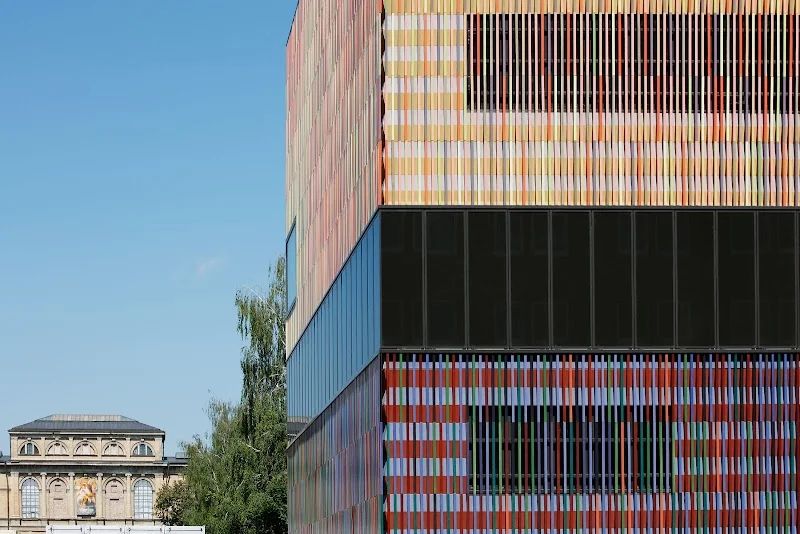
The architecture is one of the most famous features of Museum Brandhorst. The building was designed by the Berlin office Sauerbruch Hutton and opened in 2009. Particularly well-known is the colorful façade made of 36,000 ceramic rods in 23 different colors, which makes the building unmistakable from afar. The colorfulness is not merely decorative but reflects the urban surroundings and translates them into an independent architectural language. For the search terms Museum Brandhorst architect and façade, this is crucial: The building itself is a landmark that visibly fulfills its function as an art museum. At the same time, it is located at the northeastern corner of the Kunstareal, connecting the cultural environment with the vibrant Maxvorstadt and university district. This gives the building a strong mediating role in urban space. ([museum-brandhorst.de](https://www.museum-brandhorst.de/architektur/))
However, the architecture is not only aesthetically pleasing but also technically remarkable. The museum uses walls and floors to regulate room temperature, a form of building component activation. This achieves a high temperature consistency, which is important for the protection of sensitive artworks. Additionally, there is a lighting concept that prefers daylight and distributes it through special light ceilings. The façade also contributes to sustainability by dampening sound and reducing traffic noise. The combination of climate and lighting technology, energy efficiency, and museum protection makes the building a special example of contemporary museum architecture. In the architectural communication of the museum, this is even described as a holistic ecological concept that was ahead of its time. For visitors, this is particularly interesting because this technology is hardly visible in operation but strongly shapes the spatial experience. ([museum-brandhorst.de](https://www.museum-brandhorst.de/architektur/))
Inside, the museum also works architecturally in a consciously understated manner. White walls, wooden floors, and spacious, well-proportioned rooms create a calm stage for the art. Thus, not only the façade but also the interior appears as a precisely set contrast: striking outside, concentrated inside. This tension is one of the reasons why Museum Brandhorst is a strong destination not only for art lovers but also for architecture fans. Those searching for Museum Brandhorst façade or architect expect an iconic shell; those on-site discover in addition a functionally and atmospherically well-thought-out museum building that does not overshadow but supports the collection and exhibition. This architectural quality also explains why the building is perceived in many cities and media as one of the most striking museum buildings in Germany. ([museum-brandhorst.de](https://www.museum-brandhorst.de/architektur/))
Café, Bookshop, and Breaks in the Museum
Museum Brandhorst is not only a place of seeing but also of lingering. The café is located in the foyer on Theresienstraße and is open during regular museum hours. It offers cakes, drinks, and a changing lunch menu daily. The opening hours are Tuesday to Sunday from 10:00 AM to 6:00 PM, Thursdays until 8:00 PM. Particularly noteworthy is the interior: The artist duo GuytonWalker designed a more than 50-meter-long curtain with digitally altered zebra motifs in 2017, which can transform the restaurant area into an art space. This means that the café is not perceived merely as a service area but as part of the artistic overall experience. For search queries related to café or food in the museum, this is the relevant information: Here, the break itself becomes a cultural moment. ([museum-brandhorst.de](https://www.museum-brandhorst.de/cafe/))
There is also a current development regarding the bookshop that is interesting for visitors and for keyword searches related to shop or poster. The Walther-König bookshop in Museum Brandhorst closed its doors on April 26, 2026. Since May 5, the space is being rethought; this summer, an open space for encounters and exchanges is set to emerge before a new shop opens in the fall. This is particularly fitting for a museum with a strong publication and mediation profile, as books, catalogs, and materials here are not just merchandise but part of the discourse on art. Therefore, those searching for posters, publications, or shop should be aware of the current transitional phase and check the official website before their visit. This change is particularly exciting for culture-interested visitors as it shows that the museum shop is understood as a curated place and not as a static sales area. ([museum-brandhorst.de](https://www.museum-brandhorst.de/en/book-shop/))
For practical museum life, it is also important that the café and the shop are located close to the entrance area and thus well integrated into the flow of visits. Those who first visit an exhibition can relax in the café afterward or dive deeper into content in the book area. This interlinking is an important part of the brand effect of the house. It makes Museum Brandhorst attractive to visitors who want to spend an entire afternoon or several hours in the Kunstareal. Thus, the search query Museum Brandhorst café is not just a question of catering but of quality of stay. And this is consciously set high here: art, communication, and breaks are closely linked at Brandhorst. ([museum-brandhorst.de](https://www.museum-brandhorst.de/cafe/))
Children, Families, and Tours
Museum Brandhorst is exceptionally family-friendly and has a clearly structured offering for this purpose. Children and teenagers up to 18 years receive free admission. Additionally, there is a free activity brochure for individual tours, so-called kangaroo tours for families with babies, as well as workshops and tours designed for joint exploration. These formats are not an addition but an essential part of the house, as they make access to contemporary art playful, low-threshold, and at the same time content-wise serious. For search terms like Museum Brandhorst children or Museum Brandhorst families, this is a central advantage: The visit can be planned easily and is also attractive for younger target groups. ([museum-brandhorst.de](https://www.museum-brandhorst.de/en/children-families/))
The Factory plays a special role in this. It is considered a pioneering project in cultural education and annually delights several thousand children and teenagers with their families and educational institutions, both on-site and digitally. The museum focuses on workshops, family tours, and dialogical formats that open the view of art rather than narrowing it. For parents, this is practical because they find a museum that not only offers the classic tour but actively encourages participation and understanding. For children, it is a place where art does not feel like a compulsory program but as a discovery. This also strengthens the relevance of keywords like children, families, tour, or workshop, as these offerings are firmly anchored in the structure of the museum and are regularly updated. ([museum-brandhorst.de](https://www.museum-brandhorst.de/en/museum-brandhorst/))
Particularly successful is the way family offerings, collection, and special exhibitions complement each other here. Those coming with children can experience current themes like Long Story Short or Carrying in a suitable format and then continue to see how broadly the museum is positioned in content in the café or in the collection presentation. This creates a museum visit that works for both adults and children without neglecting either side. Museum Brandhorst thus creates a balance between serious artistic claims and genuine accessibility. This is exactly what makes the place in the Munich Kunstareal so attractive: It is not only spectacular to look at but also well usable in everyday life, well explained, and well organized. Families receive a clear, diverse, and modern access to art that goes far beyond a single appointment. ([museum-brandhorst.de](https://www.museum-brandhorst.de/en/children-families/))
Sources:
Show moreShow less
Museum Brandhorst | Exhibitions & Opening Hours
The Museum Brandhorst is one of the most prominent places for contemporary art in Munich, combining museum visits, architecture, and urban experience in a very dense way. Upon entering the building in the Kunstareal, one quickly realizes that not only individual works are displayed here, but a complete art experience is created: The collection ranges from the 1930s to the present, includes over 2,000 works, and makes strong statements with Cy Twombly, Andy Warhol, and many other positions. At the same time, the museum, due to its location in close proximity to the Alte and Neue Pinakothek as well as the Pinakothek der Moderne, is part of a cultural center that shapes Munich internationally. The building was opened to the public in 2009 and has since become a central part of the Bavarian State Painting Collections. Thus, Museum Brandhorst connects collection, research, mediation, and exhibition operations in a place that is equally exciting for art audiences, families, architecture enthusiasts, and spontaneous visitors. ([museum-brandhorst.de](https://www.museum-brandhorst.de/museum-brandhorst/))
It is precisely the mix of clear orientation and high content density that makes the search for terms like Museum Brandhorst Munich, opening hours, exhibition, admission, address, café, shop, architect, façade, children, or directions so understandable. The museum is not only a destination because of its artworks but also due to its unique building form, its changing special exhibitions, and its diverse program with guided tours, workshops, and discussions. Those planning a visit will find a place here that conveys art at a high level while also answering very practical visitor questions clearly: When is it open, what is the admission fee, how do I get there, what is available to eat on-site, and what offers are there for families? This blend of emotion and information makes Museum Brandhorst a location that is particularly in demand online. ([museum-brandhorst.de](https://www.museum-brandhorst.de/museum-brandhorst/))
Opening Hours, Admission, and Online Tickets
In the most important search queries regarding Museum Brandhorst, opening hours and admission are at the top. The museum is open daily except Mondays from 10:00 AM to 6:00 PM, and on Thursdays even until 8:00 PM. These times are particularly practical for planning, as they allow for both a classic day visit and a longer evening visit. Those wishing to explore the museum landscape in Munich on a weekend or a free afternoon can easily combine their visit to Brandhorst with the surrounding buildings in the Kunstareal. For holidays, the museum points out special opening hours; on certain holidays, regular times apply until 6:00 PM. This keeps the museum a reliable destination for art visits during many holiday situations. ([museum-brandhorst.de](https://www.museum-brandhorst.de/en/info-tickets/))
The admission prices at Museum Brandhorst are also very clear: The regular price is 7 euros, reduced admission costs 5 euros, and on Sundays, it is only 1 euro. Particularly attractive for families and young visitors is that children and teenagers up to 18 years have free admission. Additionally, online tickets are valid on the booked day during regular opening hours but do not guarantee priority entry. This is a useful note for anyone expecting longer wait times and wanting to better time their visit. For frequent visitors, there are also combination and annual tickets that allow access to other buildings of the Bavarian State Painting Collections. So, for those who want to dive into Munich's museum world not just once but repeatedly, a flexible ticket model can be found here. ([museum-brandhorst.de](https://www.museum-brandhorst.de/info-tickets/?utm_source=openai))
For the search intent Museum Brandhorst admission, it is also important that the museum is more than just a pure exhibition space. The ticket not only opens access to ongoing presentations but also to mediation formats, the café, and parts of the experience area in the foyer. This transforms the classic museum visit into a whole day component. Especially in conjunction with the changing special exhibitions, it is worth taking a look at the calendar, as the offerings change throughout the year and continually provide new reasons for a visit. Those planning last minute benefit from the fact that the museum communicates its opening hours and admission prices very transparently. This is a significant advantage for high click and booking rates on the website. ([museum-brandhorst.de](https://www.museum-brandhorst.de/en/info-tickets/))
Exhibitions, Program, and Collection
The actual strength of Museum Brandhorst lies in its collection and its clever exhibition program. The museum houses over 2,000 works by international artists and spans the arc from the 1930s to the present. The collection is particularly strong in the areas of modern and contemporary art. The presence of Cy Twombly has been established as a permanent exhibition since the museum's opening, while the collection also includes outstanding groups of works by Andy Warhol, Keith Haring, Roni Horn, Jacqueline Humphries, Arthur Jafa, Alex Katz, Mike Kelley, Louise Lawler, Cady Noland, Pope.L, Seth Price, and Kara Walker. This creates not a narrow canon but an open picture of artistic developments over several decades. The museum explicitly sees itself as a place of encounter with contemporary art and as a platform for research, exchange, and societal debates. ([museum-brandhorst.de](https://www.museum-brandhorst.de/sammlung/))
The current exhibition program features several strong titles that also reappear in search demand. These include Long Story Short. An Art History from the Brandhorst Collection from the 1960s to the Present, Confrontations. Pairings from the Collection, and Carrying. Additionally, the museum presents Spot On Kate Newby: anything, anything as another concentrated position. The permanent exhibition on Cy Twombly remains a central anchor point of the museum. This mix of a large collection, thematic contrasts, and independent solo exhibitions makes Brandhorst attractive for repeated visits. Those who only know the museum once often experience only a snippet; those who return discover new interpretations, fresh arrangements, and changed reference systems. ([museum-brandhorst.de](https://www.museum-brandhorst.de/en/))
The mediation program is also deliberately broad. The museum focuses on guided tours, workshops, artist talks, and family-oriented formats. The Factory is considered a pioneering project in cultural education and reaches several thousand children, teenagers, families, and educational institutions both on-site and digitally each year. This is more than just a supporting program: it is part of the museum's self-understanding to not only show art but also to make it accessible. For search terms like Museum Brandhorst exhibition, Long Story Short, Carrying, or program, it is therefore important that visitors find not only a fixed tour but a lively, constantly changing offering here. The museum positions itself as an open place where collection history, current artistic positions, and public mediation mutually reinforce each other. ([museum-brandhorst.de](https://www.museum-brandhorst.de/en/museum-brandhorst/))
Address, Directions, and Accessible Visit
Those searching for Museum Brandhorst address or directions receive very clear information. The museum is located at Theresienstraße 35a in 80333 Munich, at the corner of Türkenstraße. This location in the Munich Kunstareal is conveniently accessible and culturally excellently embedded. By tram, you can reach the stop Pinakotheken via lines 27 and 28. By subway, important points include Königsplatz, Theresienstraße, Odeonsplatz, and Universität, depending on the line U2, U3, U4, U5, or U6. Several bus lines also serve the area, including 154, 100, 68, and 58. Thus, those visiting the museum without a car can plan their route very flexibly. This is a significant advantage, especially in the dense Munich city center, as the visit can be easily combined with other stops in the Kunstareal. ([museum-brandhorst.de](https://www.museum-brandhorst.de/en/info-tickets/))
Accessibility has also been well considered at Museum Brandhorst. The building describes itself as barrier-free and provides lightweight buggies and wheelchairs upon request. Two elevators provide access to all exhibition levels, and an additional elevator connects the entrance area with the cloakroom level. For visitors with mobility impairments, there are two disabled parking spaces directly in front of the main entrance. Accessible restrooms are located in several places within the building. Assistance dogs are also allowed, provided they are appropriately marked. This specific information is particularly valuable for keyword searches related to parking, accessibility, wheelchair, or directions, as it reduces uncertainties before the visit. The museum clearly demonstrates that it focuses on accessibility not only in content but also in organization. ([museum-brandhorst.de](https://www.museum-brandhorst.de/en/info-tickets/))
Additionally, practical information about the cloakroom and lockers is important. Bags up to DIN A4, meaning no larger than 30 x 20 x 10 centimeters, may be taken into the museum. Larger bags and backpacks should be left at the cloakroom or stored in lockers. The lockers are located in the basement of the foyer, and the deposit is 1 or 2 euros. This is helpful for a relaxed museum visit, as one can walk through the exhibition without cumbersome luggage. Especially in a location with such a pronounced architectural presence and much movement within the building, good visitor organization is part of the overall experience. Thus, those starting the search for Museum Brandhorst directions, parking, or address receive not only the way but also a very user-friendly visitor infrastructure. ([museum-brandhorst.de](https://www.museum-brandhorst.de/en/info-tickets/))
Architecture, Façade, and Sustainability
The architecture is one of the most famous features of Museum Brandhorst. The building was designed by the Berlin office Sauerbruch Hutton and opened in 2009. Particularly well-known is the colorful façade made of 36,000 ceramic rods in 23 different colors, which makes the building unmistakable from afar. The colorfulness is not merely decorative but reflects the urban surroundings and translates them into an independent architectural language. For the search terms Museum Brandhorst architect and façade, this is crucial: The building itself is a landmark that visibly fulfills its function as an art museum. At the same time, it is located at the northeastern corner of the Kunstareal, connecting the cultural environment with the vibrant Maxvorstadt and university district. This gives the building a strong mediating role in urban space. ([museum-brandhorst.de](https://www.museum-brandhorst.de/architektur/))
However, the architecture is not only aesthetically pleasing but also technically remarkable. The museum uses walls and floors to regulate room temperature, a form of building component activation. This achieves a high temperature consistency, which is important for the protection of sensitive artworks. Additionally, there is a lighting concept that prefers daylight and distributes it through special light ceilings. The façade also contributes to sustainability by dampening sound and reducing traffic noise. The combination of climate and lighting technology, energy efficiency, and museum protection makes the building a special example of contemporary museum architecture. In the architectural communication of the museum, this is even described as a holistic ecological concept that was ahead of its time. For visitors, this is particularly interesting because this technology is hardly visible in operation but strongly shapes the spatial experience. ([museum-brandhorst.de](https://www.museum-brandhorst.de/architektur/))
Inside, the museum also works architecturally in a consciously understated manner. White walls, wooden floors, and spacious, well-proportioned rooms create a calm stage for the art. Thus, not only the façade but also the interior appears as a precisely set contrast: striking outside, concentrated inside. This tension is one of the reasons why Museum Brandhorst is a strong destination not only for art lovers but also for architecture fans. Those searching for Museum Brandhorst façade or architect expect an iconic shell; those on-site discover in addition a functionally and atmospherically well-thought-out museum building that does not overshadow but supports the collection and exhibition. This architectural quality also explains why the building is perceived in many cities and media as one of the most striking museum buildings in Germany. ([museum-brandhorst.de](https://www.museum-brandhorst.de/architektur/))
Café, Bookshop, and Breaks in the Museum
Museum Brandhorst is not only a place of seeing but also of lingering. The café is located in the foyer on Theresienstraße and is open during regular museum hours. It offers cakes, drinks, and a changing lunch menu daily. The opening hours are Tuesday to Sunday from 10:00 AM to 6:00 PM, Thursdays until 8:00 PM. Particularly noteworthy is the interior: The artist duo GuytonWalker designed a more than 50-meter-long curtain with digitally altered zebra motifs in 2017, which can transform the restaurant area into an art space. This means that the café is not perceived merely as a service area but as part of the artistic overall experience. For search queries related to café or food in the museum, this is the relevant information: Here, the break itself becomes a cultural moment. ([museum-brandhorst.de](https://www.museum-brandhorst.de/cafe/))
There is also a current development regarding the bookshop that is interesting for visitors and for keyword searches related to shop or poster. The Walther-König bookshop in Museum Brandhorst closed its doors on April 26, 2026. Since May 5, the space is being rethought; this summer, an open space for encounters and exchanges is set to emerge before a new shop opens in the fall. This is particularly fitting for a museum with a strong publication and mediation profile, as books, catalogs, and materials here are not just merchandise but part of the discourse on art. Therefore, those searching for posters, publications, or shop should be aware of the current transitional phase and check the official website before their visit. This change is particularly exciting for culture-interested visitors as it shows that the museum shop is understood as a curated place and not as a static sales area. ([museum-brandhorst.de](https://www.museum-brandhorst.de/en/book-shop/))
For practical museum life, it is also important that the café and the shop are located close to the entrance area and thus well integrated into the flow of visits. Those who first visit an exhibition can relax in the café afterward or dive deeper into content in the book area. This interlinking is an important part of the brand effect of the house. It makes Museum Brandhorst attractive to visitors who want to spend an entire afternoon or several hours in the Kunstareal. Thus, the search query Museum Brandhorst café is not just a question of catering but of quality of stay. And this is consciously set high here: art, communication, and breaks are closely linked at Brandhorst. ([museum-brandhorst.de](https://www.museum-brandhorst.de/cafe/))
Children, Families, and Tours
Museum Brandhorst is exceptionally family-friendly and has a clearly structured offering for this purpose. Children and teenagers up to 18 years receive free admission. Additionally, there is a free activity brochure for individual tours, so-called kangaroo tours for families with babies, as well as workshops and tours designed for joint exploration. These formats are not an addition but an essential part of the house, as they make access to contemporary art playful, low-threshold, and at the same time content-wise serious. For search terms like Museum Brandhorst children or Museum Brandhorst families, this is a central advantage: The visit can be planned easily and is also attractive for younger target groups. ([museum-brandhorst.de](https://www.museum-brandhorst.de/en/children-families/))
The Factory plays a special role in this. It is considered a pioneering project in cultural education and annually delights several thousand children and teenagers with their families and educational institutions, both on-site and digitally. The museum focuses on workshops, family tours, and dialogical formats that open the view of art rather than narrowing it. For parents, this is practical because they find a museum that not only offers the classic tour but actively encourages participation and understanding. For children, it is a place where art does not feel like a compulsory program but as a discovery. This also strengthens the relevance of keywords like children, families, tour, or workshop, as these offerings are firmly anchored in the structure of the museum and are regularly updated. ([museum-brandhorst.de](https://www.museum-brandhorst.de/en/museum-brandhorst/))
Particularly successful is the way family offerings, collection, and special exhibitions complement each other here. Those coming with children can experience current themes like Long Story Short or Carrying in a suitable format and then continue to see how broadly the museum is positioned in content in the café or in the collection presentation. This creates a museum visit that works for both adults and children without neglecting either side. Museum Brandhorst thus creates a balance between serious artistic claims and genuine accessibility. This is exactly what makes the place in the Munich Kunstareal so attractive: It is not only spectacular to look at but also well usable in everyday life, well explained, and well organized. Families receive a clear, diverse, and modern access to art that goes far beyond a single appointment. ([museum-brandhorst.de](https://www.museum-brandhorst.de/en/children-families/))
Sources:
Museum Brandhorst | Exhibitions & Opening Hours
The Museum Brandhorst is one of the most prominent places for contemporary art in Munich, combining museum visits, architecture, and urban experience in a very dense way. Upon entering the building in the Kunstareal, one quickly realizes that not only individual works are displayed here, but a complete art experience is created: The collection ranges from the 1930s to the present, includes over 2,000 works, and makes strong statements with Cy Twombly, Andy Warhol, and many other positions. At the same time, the museum, due to its location in close proximity to the Alte and Neue Pinakothek as well as the Pinakothek der Moderne, is part of a cultural center that shapes Munich internationally. The building was opened to the public in 2009 and has since become a central part of the Bavarian State Painting Collections. Thus, Museum Brandhorst connects collection, research, mediation, and exhibition operations in a place that is equally exciting for art audiences, families, architecture enthusiasts, and spontaneous visitors. ([museum-brandhorst.de](https://www.museum-brandhorst.de/museum-brandhorst/))
It is precisely the mix of clear orientation and high content density that makes the search for terms like Museum Brandhorst Munich, opening hours, exhibition, admission, address, café, shop, architect, façade, children, or directions so understandable. The museum is not only a destination because of its artworks but also due to its unique building form, its changing special exhibitions, and its diverse program with guided tours, workshops, and discussions. Those planning a visit will find a place here that conveys art at a high level while also answering very practical visitor questions clearly: When is it open, what is the admission fee, how do I get there, what is available to eat on-site, and what offers are there for families? This blend of emotion and information makes Museum Brandhorst a location that is particularly in demand online. ([museum-brandhorst.de](https://www.museum-brandhorst.de/museum-brandhorst/))
Opening Hours, Admission, and Online Tickets
In the most important search queries regarding Museum Brandhorst, opening hours and admission are at the top. The museum is open daily except Mondays from 10:00 AM to 6:00 PM, and on Thursdays even until 8:00 PM. These times are particularly practical for planning, as they allow for both a classic day visit and a longer evening visit. Those wishing to explore the museum landscape in Munich on a weekend or a free afternoon can easily combine their visit to Brandhorst with the surrounding buildings in the Kunstareal. For holidays, the museum points out special opening hours; on certain holidays, regular times apply until 6:00 PM. This keeps the museum a reliable destination for art visits during many holiday situations. ([museum-brandhorst.de](https://www.museum-brandhorst.de/en/info-tickets/))
The admission prices at Museum Brandhorst are also very clear: The regular price is 7 euros, reduced admission costs 5 euros, and on Sundays, it is only 1 euro. Particularly attractive for families and young visitors is that children and teenagers up to 18 years have free admission. Additionally, online tickets are valid on the booked day during regular opening hours but do not guarantee priority entry. This is a useful note for anyone expecting longer wait times and wanting to better time their visit. For frequent visitors, there are also combination and annual tickets that allow access to other buildings of the Bavarian State Painting Collections. So, for those who want to dive into Munich's museum world not just once but repeatedly, a flexible ticket model can be found here. ([museum-brandhorst.de](https://www.museum-brandhorst.de/info-tickets/?utm_source=openai))
For the search intent Museum Brandhorst admission, it is also important that the museum is more than just a pure exhibition space. The ticket not only opens access to ongoing presentations but also to mediation formats, the café, and parts of the experience area in the foyer. This transforms the classic museum visit into a whole day component. Especially in conjunction with the changing special exhibitions, it is worth taking a look at the calendar, as the offerings change throughout the year and continually provide new reasons for a visit. Those planning last minute benefit from the fact that the museum communicates its opening hours and admission prices very transparently. This is a significant advantage for high click and booking rates on the website. ([museum-brandhorst.de](https://www.museum-brandhorst.de/en/info-tickets/))
Exhibitions, Program, and Collection
The actual strength of Museum Brandhorst lies in its collection and its clever exhibition program. The museum houses over 2,000 works by international artists and spans the arc from the 1930s to the present. The collection is particularly strong in the areas of modern and contemporary art. The presence of Cy Twombly has been established as a permanent exhibition since the museum's opening, while the collection also includes outstanding groups of works by Andy Warhol, Keith Haring, Roni Horn, Jacqueline Humphries, Arthur Jafa, Alex Katz, Mike Kelley, Louise Lawler, Cady Noland, Pope.L, Seth Price, and Kara Walker. This creates not a narrow canon but an open picture of artistic developments over several decades. The museum explicitly sees itself as a place of encounter with contemporary art and as a platform for research, exchange, and societal debates. ([museum-brandhorst.de](https://www.museum-brandhorst.de/sammlung/))
The current exhibition program features several strong titles that also reappear in search demand. These include Long Story Short. An Art History from the Brandhorst Collection from the 1960s to the Present, Confrontations. Pairings from the Collection, and Carrying. Additionally, the museum presents Spot On Kate Newby: anything, anything as another concentrated position. The permanent exhibition on Cy Twombly remains a central anchor point of the museum. This mix of a large collection, thematic contrasts, and independent solo exhibitions makes Brandhorst attractive for repeated visits. Those who only know the museum once often experience only a snippet; those who return discover new interpretations, fresh arrangements, and changed reference systems. ([museum-brandhorst.de](https://www.museum-brandhorst.de/en/))
The mediation program is also deliberately broad. The museum focuses on guided tours, workshops, artist talks, and family-oriented formats. The Factory is considered a pioneering project in cultural education and reaches several thousand children, teenagers, families, and educational institutions both on-site and digitally each year. This is more than just a supporting program: it is part of the museum's self-understanding to not only show art but also to make it accessible. For search terms like Museum Brandhorst exhibition, Long Story Short, Carrying, or program, it is therefore important that visitors find not only a fixed tour but a lively, constantly changing offering here. The museum positions itself as an open place where collection history, current artistic positions, and public mediation mutually reinforce each other. ([museum-brandhorst.de](https://www.museum-brandhorst.de/en/museum-brandhorst/))
Address, Directions, and Accessible Visit
Those searching for Museum Brandhorst address or directions receive very clear information. The museum is located at Theresienstraße 35a in 80333 Munich, at the corner of Türkenstraße. This location in the Munich Kunstareal is conveniently accessible and culturally excellently embedded. By tram, you can reach the stop Pinakotheken via lines 27 and 28. By subway, important points include Königsplatz, Theresienstraße, Odeonsplatz, and Universität, depending on the line U2, U3, U4, U5, or U6. Several bus lines also serve the area, including 154, 100, 68, and 58. Thus, those visiting the museum without a car can plan their route very flexibly. This is a significant advantage, especially in the dense Munich city center, as the visit can be easily combined with other stops in the Kunstareal. ([museum-brandhorst.de](https://www.museum-brandhorst.de/en/info-tickets/))
Accessibility has also been well considered at Museum Brandhorst. The building describes itself as barrier-free and provides lightweight buggies and wheelchairs upon request. Two elevators provide access to all exhibition levels, and an additional elevator connects the entrance area with the cloakroom level. For visitors with mobility impairments, there are two disabled parking spaces directly in front of the main entrance. Accessible restrooms are located in several places within the building. Assistance dogs are also allowed, provided they are appropriately marked. This specific information is particularly valuable for keyword searches related to parking, accessibility, wheelchair, or directions, as it reduces uncertainties before the visit. The museum clearly demonstrates that it focuses on accessibility not only in content but also in organization. ([museum-brandhorst.de](https://www.museum-brandhorst.de/en/info-tickets/))
Additionally, practical information about the cloakroom and lockers is important. Bags up to DIN A4, meaning no larger than 30 x 20 x 10 centimeters, may be taken into the museum. Larger bags and backpacks should be left at the cloakroom or stored in lockers. The lockers are located in the basement of the foyer, and the deposit is 1 or 2 euros. This is helpful for a relaxed museum visit, as one can walk through the exhibition without cumbersome luggage. Especially in a location with such a pronounced architectural presence and much movement within the building, good visitor organization is part of the overall experience. Thus, those starting the search for Museum Brandhorst directions, parking, or address receive not only the way but also a very user-friendly visitor infrastructure. ([museum-brandhorst.de](https://www.museum-brandhorst.de/en/info-tickets/))
Architecture, Façade, and Sustainability
The architecture is one of the most famous features of Museum Brandhorst. The building was designed by the Berlin office Sauerbruch Hutton and opened in 2009. Particularly well-known is the colorful façade made of 36,000 ceramic rods in 23 different colors, which makes the building unmistakable from afar. The colorfulness is not merely decorative but reflects the urban surroundings and translates them into an independent architectural language. For the search terms Museum Brandhorst architect and façade, this is crucial: The building itself is a landmark that visibly fulfills its function as an art museum. At the same time, it is located at the northeastern corner of the Kunstareal, connecting the cultural environment with the vibrant Maxvorstadt and university district. This gives the building a strong mediating role in urban space. ([museum-brandhorst.de](https://www.museum-brandhorst.de/architektur/))
However, the architecture is not only aesthetically pleasing but also technically remarkable. The museum uses walls and floors to regulate room temperature, a form of building component activation. This achieves a high temperature consistency, which is important for the protection of sensitive artworks. Additionally, there is a lighting concept that prefers daylight and distributes it through special light ceilings. The façade also contributes to sustainability by dampening sound and reducing traffic noise. The combination of climate and lighting technology, energy efficiency, and museum protection makes the building a special example of contemporary museum architecture. In the architectural communication of the museum, this is even described as a holistic ecological concept that was ahead of its time. For visitors, this is particularly interesting because this technology is hardly visible in operation but strongly shapes the spatial experience. ([museum-brandhorst.de](https://www.museum-brandhorst.de/architektur/))
Inside, the museum also works architecturally in a consciously understated manner. White walls, wooden floors, and spacious, well-proportioned rooms create a calm stage for the art. Thus, not only the façade but also the interior appears as a precisely set contrast: striking outside, concentrated inside. This tension is one of the reasons why Museum Brandhorst is a strong destination not only for art lovers but also for architecture fans. Those searching for Museum Brandhorst façade or architect expect an iconic shell; those on-site discover in addition a functionally and atmospherically well-thought-out museum building that does not overshadow but supports the collection and exhibition. This architectural quality also explains why the building is perceived in many cities and media as one of the most striking museum buildings in Germany. ([museum-brandhorst.de](https://www.museum-brandhorst.de/architektur/))
Café, Bookshop, and Breaks in the Museum
Museum Brandhorst is not only a place of seeing but also of lingering. The café is located in the foyer on Theresienstraße and is open during regular museum hours. It offers cakes, drinks, and a changing lunch menu daily. The opening hours are Tuesday to Sunday from 10:00 AM to 6:00 PM, Thursdays until 8:00 PM. Particularly noteworthy is the interior: The artist duo GuytonWalker designed a more than 50-meter-long curtain with digitally altered zebra motifs in 2017, which can transform the restaurant area into an art space. This means that the café is not perceived merely as a service area but as part of the artistic overall experience. For search queries related to café or food in the museum, this is the relevant information: Here, the break itself becomes a cultural moment. ([museum-brandhorst.de](https://www.museum-brandhorst.de/cafe/))
There is also a current development regarding the bookshop that is interesting for visitors and for keyword searches related to shop or poster. The Walther-König bookshop in Museum Brandhorst closed its doors on April 26, 2026. Since May 5, the space is being rethought; this summer, an open space for encounters and exchanges is set to emerge before a new shop opens in the fall. This is particularly fitting for a museum with a strong publication and mediation profile, as books, catalogs, and materials here are not just merchandise but part of the discourse on art. Therefore, those searching for posters, publications, or shop should be aware of the current transitional phase and check the official website before their visit. This change is particularly exciting for culture-interested visitors as it shows that the museum shop is understood as a curated place and not as a static sales area. ([museum-brandhorst.de](https://www.museum-brandhorst.de/en/book-shop/))
For practical museum life, it is also important that the café and the shop are located close to the entrance area and thus well integrated into the flow of visits. Those who first visit an exhibition can relax in the café afterward or dive deeper into content in the book area. This interlinking is an important part of the brand effect of the house. It makes Museum Brandhorst attractive to visitors who want to spend an entire afternoon or several hours in the Kunstareal. Thus, the search query Museum Brandhorst café is not just a question of catering but of quality of stay. And this is consciously set high here: art, communication, and breaks are closely linked at Brandhorst. ([museum-brandhorst.de](https://www.museum-brandhorst.de/cafe/))
Children, Families, and Tours
Museum Brandhorst is exceptionally family-friendly and has a clearly structured offering for this purpose. Children and teenagers up to 18 years receive free admission. Additionally, there is a free activity brochure for individual tours, so-called kangaroo tours for families with babies, as well as workshops and tours designed for joint exploration. These formats are not an addition but an essential part of the house, as they make access to contemporary art playful, low-threshold, and at the same time content-wise serious. For search terms like Museum Brandhorst children or Museum Brandhorst families, this is a central advantage: The visit can be planned easily and is also attractive for younger target groups. ([museum-brandhorst.de](https://www.museum-brandhorst.de/en/children-families/))
The Factory plays a special role in this. It is considered a pioneering project in cultural education and annually delights several thousand children and teenagers with their families and educational institutions, both on-site and digitally. The museum focuses on workshops, family tours, and dialogical formats that open the view of art rather than narrowing it. For parents, this is practical because they find a museum that not only offers the classic tour but actively encourages participation and understanding. For children, it is a place where art does not feel like a compulsory program but as a discovery. This also strengthens the relevance of keywords like children, families, tour, or workshop, as these offerings are firmly anchored in the structure of the museum and are regularly updated. ([museum-brandhorst.de](https://www.museum-brandhorst.de/en/museum-brandhorst/))
Particularly successful is the way family offerings, collection, and special exhibitions complement each other here. Those coming with children can experience current themes like Long Story Short or Carrying in a suitable format and then continue to see how broadly the museum is positioned in content in the café or in the collection presentation. This creates a museum visit that works for both adults and children without neglecting either side. Museum Brandhorst thus creates a balance between serious artistic claims and genuine accessibility. This is exactly what makes the place in the Munich Kunstareal so attractive: It is not only spectacular to look at but also well usable in everyday life, well explained, and well organized. Families receive a clear, diverse, and modern access to art that goes far beyond a single appointment. ([museum-brandhorst.de](https://www.museum-brandhorst.de/en/children-families/))
Sources:
Frequently Asked Questions
Reviews
Nils Paellmann
19. September 2025
Phenomenal museum with fantastic collection. The highlight are clearly the two Cy Twombly rooms, Untitled (Roses) and the Lepanto series. The permanent collection also contains great artworks by Andy Warhol. Nice museum building by Sauerbruch Hutton. Great museum bookstore.
Robin B.
28. October 2025
It’s a small gallery, but it’s super well-curated, and you’ll find some really great pieces there, like Warhol!
Nanita
26. July 2025
The Museum Brandhorst is centrally located in Munich, easily accessible by public transportation (there’s a bus stop across the street). The open space showcases varied works of art on three floors. Currently on display are works of art by Cy Twombly and Robert Rauschenberg as part of the five friends exhibit, and even Andy Warhol. It’s possible to visit the museum within a couple of hours. What’s more, ticket prices are discounted on Sundays. There’s also a cafe inside and gift shop. Highly recommend.
A B
12. October 2025
Fortunately we bought 1 euro Sunday tickets, cause the experience was totally forgettable. The museum looks huge from outside, but it has a couple of halls with like 5 giants paintings in each. Nothing really interesting, unfortunately. I love contemporary art, but enjoying my visit to Alte Pinakothek far more.
Hanna Stelmakh
25. August 2024
I had a nice time at this museum, though I expected a bit more from it. The exterior is quite striking—colorful and textured, which makes it interesting to look at. Inside, the museum is spacious, with exhibitions spread out across three floors, each featuring its own unique display. I enjoyed exploring all the exhibits. While it was a good one-time experience, I’m not sure if I’d return.