
München
Prinzregentenstraße 60, 81675 München, Deutschland
Museum Villa Stuck | Opening Hours & Tickets
The Museum Villa Stuck in Munich is much more than a classic art museum: it is a historic artist's house, an exhibition space for art from the 19th to the 21st century, and a vibrant place for culture, encounters, and architecture. Those looking for the museum are usually interested not only in opening hours and tickets but also in the reopening, access, photos, the café, and what is offered today after the extensive technical renovation. This is where the special strength of the house lies: it combines the original preserved villa of Franz von Stuck with current exhibitions, a restored garden, barrier-free access, and a program that brings together historical spaces and contemporary art. The villa was built in 1897/98 according to the artist's own designs and was later supplemented by studio buildings and garden design; since 1992, it has belonged to the city of Munich as a museum and is part of the city's cultural identity. ([villastuck.de](https://www.villastuck.de/besuch))
Opening Hours, Tickets, and Admission Prices at Museum Villa Stuck
For planning the visit, the opening hours are particularly important, as the Museum Villa Stuck offers fixed daytime hours and additional evening openings. The house is open from Tuesday to Sunday and on public holidays from 11 am to 6 pm. On Wednesdays, it stays open longer, until 8 pm, and on the first Friday of the month even until 10 pm. These times are not only attractive for spontaneous visits but also for those who want to combine their tour with an evening program or an exhibition visit after work. Those who want to buy tickets can find the reference to the ticket shop on the official visit page; regular admission for the entire house costs 9 euros, reduced 5 euros. Admission is free for children and young people up to 18 years, making the museum very interesting for families. Additionally, there is an annual pass for 25 euros, reduced 15 euros. Discounts apply, among others, to students, trainees over 18 years, recipients of unemployment benefits, pensioners, and people with disabilities. Various museum and art associations are also mentioned. So, anyone specifically looking for Museum Villa Stuck tickets or opening hours can plan their visit well in advance and take advantage of the longer evening openings depending on the time window. ([villastuck.de](https://www.villastuck.de/besuch))
The ticket model supports both one-time museum visits and recurring exhibition visits. Particularly practical is that the house not only shows historical rooms but also offers changing special exhibitions and educational formats. This makes a return visit worthwhile even if one already knows the villa. The website also informs about current events such as tours, Friday Late, and offers for children, young people, and adults, which connects ticket purchases with a concrete program. Those who want to experience a special evening format rather than just the classic tour should keep an eye on the first Friday of the month. The Wednesday opening until 8 pm is also helpful for those who prefer less crowding. Thus, the Museum Villa Stuck is interesting for visitors with different time budgets: from a short, targeted art visit to a longer cultural evening with an exhibition tour and museum café. ([villastuck.de](https://www.villastuck.de/besuch))
Reopening, Historical Rooms, and Current Exhibitions
A central search topic around the Museum Villa Stuck is the reopening. The official status of the house confirms that the extensive technical renovation has been completed. The building technology and facades have been renewed; furthermore, building sculptures have been restored, the historical rooms have been newly furnished, a barrier-free access has been created via Ismaninger Straße, the artist's garden has been fully restored and replanted, and the museum foyer has been redesigned. With the Stuckkantine, a new museum gastronomy has also been added, and a lecture room has been established in the basement. For visitors, this means not only a fresh appearance but also more comfort, better orientation, and an overall significantly modernized visitor experience, without losing the historical character of the villa. The historical rooms were presented on May 14, 2026, with new hanging and a new ambiance; restored and newly staged rooms such as the former dining room, the boudoir, and the smoking room are the focus. ([villastuck.de](https://www.villastuck.de/kalender/detail/mission-completed-1174?utm_source=openai))
Particularly exciting is that the reopening marks not only a structural but also a content-related new beginning. The historical rooms display rarely or never shown works from the early work of Franz von Stuck and make his thematic world between myth, symbolism, and expressive imagery newly experienceable. In the music room situation, reconstructed cinnabar red silk curtains based on historical templates have been reintroduced, which makes the spatial effect and color dramaturgy of the artist comprehensible. Four exhibitions will also be presented at the reopening: No Single View by Ilit Azoulay, Field by Philipp Messner, Ten Lives by Delschad Numan Khorschid and Jan-Hendrik Pelz, and Ladies' Portrait à la japonaise by Franz von Stuck. Thus, the house not only covers its own collection but also connects historical art with contemporary art and invites multiple perspectives on the artist's house. For all those looking for Museum Villa Stuck reopening or Museum Villa Stuck exhibitions, this is a strong signal: the house is once again fully accessible and has visibly expanded its role as a cultural hotspot in Munich. ([villastuck.de](https://www.villastuck.de/kalender/detail/mission-completed-1174?utm_source=openai))
The keyword term VS Interim Quarter Museum Villa Stuck also receives a clear classification in this context. During the renovation period, the museum was temporarily present in VS at Goethestraße 54. There, the team realized exhibitions, events, and educational offerings in a significantly smaller house; admission was generally free. With the return to Prinzregentenstraße, however, the interim quarter was a transitional solution during the renovation phase, not the current location of the museum. So, anyone wishing to visit the actual Museum Villa Stuck today should again go to the historic villa at Prinzregentenstraße 60. This is important for the search intent because many users only know the old interim name and thus have to reassign the correct place, the correct opening hours, and the current program. ([villastuck.de](https://www.villastuck.de/programm/detail/vs?utm_source=openai))
Directions, Parking, and Barrier-Free Access at Prinzregentenstraße
For practical planning of the visit, directions are a central topic. The official visit page lists public transport connections including bus 100, the so-called museum line, as well as tram 17 with the stop Friedensengel/Villa Stuck. Additionally, U4 at the stop Prinzregentenplatz and U5 at Max-Weber-Platz are mentioned. Those coming from the city center or from the Ostbahnhof thus have several good options to reach the museum without a car. Especially in a heavily frequented museum area, this public transport connection is a clear advantage as it makes the way to the house simple and planable. For visitors specifically looking for directions to Museum Villa Stuck, these stops are the most reliable points of reference. ([villastuck.de](https://www.villastuck.de/besuch))
Regarding parking, the official page provides only a few but important pieces of information. Two public disabled parking spaces are mentioned at the corner of Prinzregentenstraße/Ismaninger Straße. Furthermore, the museum refers to a new access from Ismaninger Straße. This is relevant because the barrier-free entrance and parts of the museum visit have significantly improved as a result. The historical collections remain intact, while the access has been modernized. Therefore, anyone looking to park at Museum Villa Stuck should not rely on a classic large visitor parking lot but rather prefer to arrive by bus, tram, or subway and only plan the available disabled parking spaces in case of specific needs. This clear, concise information is particularly important for guests who want to time their visit precisely and avoid detours on-site. ([villastuck.de](https://www.villastuck.de/besuch))
Barrier-free access is another plus point of the house. According to the official description, the Museum Villa Stuck is accessible via the new access from Ismaninger Straße and is largely barrier-free inside the house. Guiding strips in the outdoor area lead to the entrances, door openers are available at the relevant entrances, and inside, further strips lead to the ticket office, elevator, and barrier-free restroom. The elevators are equipped with voice announcements and a two-sense emergency call, the ticket and information desk is equipped with an inductive hearing system, and a walker as well as folding chairs can be borrowed. There are also tours for deaf people and people with dementia. Only two rooms on the ground floor of the historical rooms, the former dining room and the smoking room, are not accessible via the elevator. For people with disabilities, there is reduced admission, and accompanying persons receive free admission. These are concrete, practical pieces of information that significantly facilitate the visit and precisely correspond to the search interest for Museum Villa Stuck barrier-free. ([villastuck.de](https://www.villastuck.de/besuch))
The Artist's House of Franz von Stuck: Architecture, Studio, and Garden
The historical significance of the villa is the core of the museum. Franz von Stuck built the house in 1897/98 as a 34-year-old painter, graphic artist, and sculptor according to his own designs on the Isaranhöhe. The villa combined private living spaces, representative salons, and an artist's studio and was perceived by contemporaries as a modern, idiosyncratic sensation. Its fundamental idea is the total work of art: life, architecture, art, music, and theater interconnect. This very idea makes the museum so unmistakable to this day. The artist combined different historical styles such as antiquity, Byzantium, the Orient, and High Renaissance with the modern developments of the late 19th century. This resulted in a house that functions not only as a residence but also as a consciously composed art space. Among the preserved masterpieces of spatial art are the vestibule, the reception salon, the music salon, the staircase, and the studio. ([villastuck.de](https://www.villastuck.de/kuenstlerhaus))
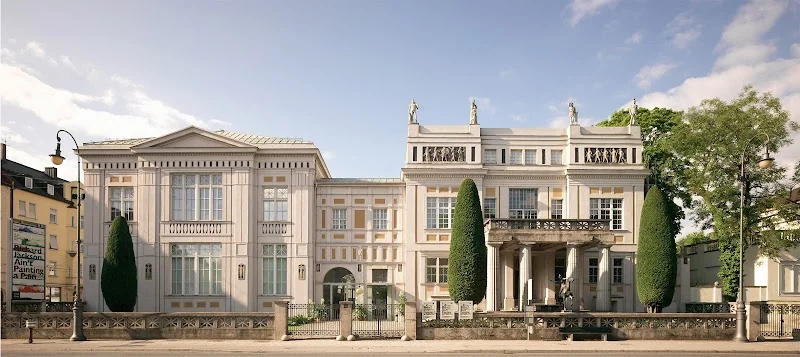
The building is also architecturally remarkable. The historical villa presents itself as a three-story, monolithic-looking structure with four tower-like corner projections, a bronze entrance portal, a Doric portico, and clear cubature. Later, Stuck added a decoration of rectangular fields to the initially strictly white building, which was executed in various versions. On the attic, life-size copies of ancient sculptures stand, including Heracles, Pudicitia, Amazon, and Ares Borghese; in addition, there is a galvanoplastic Capitoline wolf on the pergola side balustrade. These elements are not mere adornments but part of the artistic overall idea. They show how consistently Stuck worked on the connection between antiquity and modernity. In 1914/15, the villa was expanded with an impressive studio building that included a large painter's studio on the upper floor, a sculptor's studio on the ground floor, and a servant's wing with a garage. At the back lies the artist's garden, whose Pompeian models are connected with artworks from the 19th century. So, for those interested in Museum Villa Stuck history, this is not just a building but a completely composed art system. ([villastuck.de](https://www.villastuck.de/kuenstlerhaus))
The historical significance also includes the later history of the house. After severe war damage, Hans Joachim and Amélie Ziersch acquired the villa in 1965 and supported its restoration. In 1992, the artist villa along with its inventory was donated to the state capital Munich; since then, it has been a museum of the city. Particularly impressive remains that the furniture designed by Stuck was awarded a gold medal at the Paris World Exhibition in 1900. This recognition demonstrates how early the house and its interior were perceived as an internationally significant total work of art. Today, the museum showcases exactly this quality: not as a static monument but as a living place where architecture, collection, exhibition, and mediation interact. For all those searching for the special character of the villa, it is precisely this combination of original substance, museum history, and current curation that is the real charm. ([villastuck.de](https://www.villastuck.de/besuch))
Photos, House Rules, and the Visitor Experience at Villa Stuck
Those looking for Museum Villa Stuck photos are usually interested in the most beautiful motifs in the house. Here, the villa offers a lot: the historically preserved entrance area, the vestibule, the elegant salons, the artistically staged staircases, the studios, and the garden create strong photographic moments. The official presentation of the artist's house explicitly names rooms such as vestibule, reception salon, boudoir, dining room, smoking room, music salon, staircase, old studio, new studio, and artist's garden. These rooms make the museum a place where interior design, art, and atmosphere come together directly. For many visitors, photos are therefore an important part of the experience. At the same time, the house remains a museum with clear rules: artworks may not be touched, and photography is only allowed under certain conditions. ([villastuck.de](https://www.villastuck.de/kuenstlerhaus))
The house rules are very specific in this regard. Private photos with mobile phones and digital compact cameras are allowed, but flash, tripods, and selfie sticks are prohibited. Furthermore, the personal rights of other visitors must be respected. This is important because Villa Stuck functions not only as a photo motif but also as a protected cultural space. It is also stipulated that eating and drinking are not allowed in the exhibition and event spaces of the museum building. However, consumption is allowed in the museum café, in the garden, and in front of the JUGENDZimmer. For practical visits, this means: those planning a longer tour can consciously take breaks in the designated areas and do not have to choose between art and comfort. Especially during special exhibitions, guided tours, or an intensive tour through the historical rooms, this structure is very pleasant. It creates order and simultaneously protects the sensitive rooms and objects. ([villastuck.de](https://www.villastuck.de/besuch))
The visitor experience at the Museum Villa Stuck also thrives on the mix of contemplation and variety. The historical architecture sets strong accents, while the current program continually opens new perspectives. Those visiting the villa for the first time should plan enough time to discover not only the rooms but also details such as furniture, wall design, sight lines, and transitions. It is precisely in these details that the quality of the house lies. Additionally, the museum has been upgraded not only visually but also infrastructurally after the renovation. The barrier-free access, better wayfinding, and the new foyer situation significantly ease orientation. For visitors who enjoy photographing but do not want to disturb the museum atmosphere, the house is therefore very well positioned: it allows private recordings but sets clear boundaries to protect the art. So, anyone specifically looking for photos, rules, and a good visitor flow will find a successful balance of openness and care at Villa Stuck. ([villastuck.de](https://www.villastuck.de/besuch))
Stuckkantine, Program, and the Interim Quarter VS
Another search focus is the Café Museum Villa Stuck. Since May 15, 2026, the Stuckkantine has been part of the house as a new museum gastronomy. According to the official announcement, the team from the training restaurant Roecklplatz brings a socially oriented, culinarily creative concept to the villa. Regional ingredients, seasonal products, vegetarian and vegan dishes, creative lunch dishes, fine wines, and homemade lemonades are mentioned. The Stuckkantine is thus more than a classic museum café: it is a place for lunch breaks, coffee breaks, a drink after the tour, and also for events such as openings, readings, or summer parties in the garden. For many visitors, this is an important added value because the museum visit does not end abruptly but can conclude pleasantly. Those searching online for café museum villa stuck will now find an official, newly launched address within the museum. ([villastuck.de](https://www.villastuck.de/besuch?utm_source=openai))
Content-wise, the Stuckkantine also fits the new orientation of the house: it connects enjoyment with social responsibility and integrates into the newly designed foyer and visitor landscape. Together with the restored garden and expanded recreational opportunities, it makes the stay significantly more comfortable. This is important not only for art lovers but also for families, groups, course participants, and guests who want to consciously slow down a museum day. That the canteen is located in a historically charged house underscores the special character of the villa: here, not just consumption takes place, but a cultural-historical place is experienced. The house thus remains true to its idea of the total work of art while expanding it with a contemporary form of hospitality. ([villastuck.de](https://www.villastuck.de/besuch?utm_source=openai))
The keyword term VS interim quarter museum villa stuck can also be clearly classified. During the renovation phase, the museum was present in VS at Goethestraße 54 since May 2024. This interim quarter was significantly smaller than the historical villa, featuring a main building with three floors, a small courtyard, and a barrier-free rear building. Admission was generally free there, and the opening hours were Tuesday to Sunday from 12 pm to 8 pm. Today, VS is primarily relevant as a transitional solution during the renovation period; the actual Museum Villa Stuck is back at Prinzregentenstraße 60 after the reopening. For search queries related to VS, this distinction is important as it explains the transition from the interim phase to the current museum operation and avoids confusion regarding address, opening hours, and program. ([villastuck.de](https://www.villastuck.de/programm/detail/vs?utm_source=openai))
Sources:
Show moreShow less
Museum Villa Stuck | Opening Hours & Tickets
The Museum Villa Stuck in Munich is much more than a classic art museum: it is a historic artist's house, an exhibition space for art from the 19th to the 21st century, and a vibrant place for culture, encounters, and architecture. Those looking for the museum are usually interested not only in opening hours and tickets but also in the reopening, access, photos, the café, and what is offered today after the extensive technical renovation. This is where the special strength of the house lies: it combines the original preserved villa of Franz von Stuck with current exhibitions, a restored garden, barrier-free access, and a program that brings together historical spaces and contemporary art. The villa was built in 1897/98 according to the artist's own designs and was later supplemented by studio buildings and garden design; since 1992, it has belonged to the city of Munich as a museum and is part of the city's cultural identity. ([villastuck.de](https://www.villastuck.de/besuch))
Opening Hours, Tickets, and Admission Prices at Museum Villa Stuck
For planning the visit, the opening hours are particularly important, as the Museum Villa Stuck offers fixed daytime hours and additional evening openings. The house is open from Tuesday to Sunday and on public holidays from 11 am to 6 pm. On Wednesdays, it stays open longer, until 8 pm, and on the first Friday of the month even until 10 pm. These times are not only attractive for spontaneous visits but also for those who want to combine their tour with an evening program or an exhibition visit after work. Those who want to buy tickets can find the reference to the ticket shop on the official visit page; regular admission for the entire house costs 9 euros, reduced 5 euros. Admission is free for children and young people up to 18 years, making the museum very interesting for families. Additionally, there is an annual pass for 25 euros, reduced 15 euros. Discounts apply, among others, to students, trainees over 18 years, recipients of unemployment benefits, pensioners, and people with disabilities. Various museum and art associations are also mentioned. So, anyone specifically looking for Museum Villa Stuck tickets or opening hours can plan their visit well in advance and take advantage of the longer evening openings depending on the time window. ([villastuck.de](https://www.villastuck.de/besuch))
The ticket model supports both one-time museum visits and recurring exhibition visits. Particularly practical is that the house not only shows historical rooms but also offers changing special exhibitions and educational formats. This makes a return visit worthwhile even if one already knows the villa. The website also informs about current events such as tours, Friday Late, and offers for children, young people, and adults, which connects ticket purchases with a concrete program. Those who want to experience a special evening format rather than just the classic tour should keep an eye on the first Friday of the month. The Wednesday opening until 8 pm is also helpful for those who prefer less crowding. Thus, the Museum Villa Stuck is interesting for visitors with different time budgets: from a short, targeted art visit to a longer cultural evening with an exhibition tour and museum café. ([villastuck.de](https://www.villastuck.de/besuch))
Reopening, Historical Rooms, and Current Exhibitions
A central search topic around the Museum Villa Stuck is the reopening. The official status of the house confirms that the extensive technical renovation has been completed. The building technology and facades have been renewed; furthermore, building sculptures have been restored, the historical rooms have been newly furnished, a barrier-free access has been created via Ismaninger Straße, the artist's garden has been fully restored and replanted, and the museum foyer has been redesigned. With the Stuckkantine, a new museum gastronomy has also been added, and a lecture room has been established in the basement. For visitors, this means not only a fresh appearance but also more comfort, better orientation, and an overall significantly modernized visitor experience, without losing the historical character of the villa. The historical rooms were presented on May 14, 2026, with new hanging and a new ambiance; restored and newly staged rooms such as the former dining room, the boudoir, and the smoking room are the focus. ([villastuck.de](https://www.villastuck.de/kalender/detail/mission-completed-1174?utm_source=openai))
Particularly exciting is that the reopening marks not only a structural but also a content-related new beginning. The historical rooms display rarely or never shown works from the early work of Franz von Stuck and make his thematic world between myth, symbolism, and expressive imagery newly experienceable. In the music room situation, reconstructed cinnabar red silk curtains based on historical templates have been reintroduced, which makes the spatial effect and color dramaturgy of the artist comprehensible. Four exhibitions will also be presented at the reopening: No Single View by Ilit Azoulay, Field by Philipp Messner, Ten Lives by Delschad Numan Khorschid and Jan-Hendrik Pelz, and Ladies' Portrait à la japonaise by Franz von Stuck. Thus, the house not only covers its own collection but also connects historical art with contemporary art and invites multiple perspectives on the artist's house. For all those looking for Museum Villa Stuck reopening or Museum Villa Stuck exhibitions, this is a strong signal: the house is once again fully accessible and has visibly expanded its role as a cultural hotspot in Munich. ([villastuck.de](https://www.villastuck.de/kalender/detail/mission-completed-1174?utm_source=openai))
The keyword term VS Interim Quarter Museum Villa Stuck also receives a clear classification in this context. During the renovation period, the museum was temporarily present in VS at Goethestraße 54. There, the team realized exhibitions, events, and educational offerings in a significantly smaller house; admission was generally free. With the return to Prinzregentenstraße, however, the interim quarter was a transitional solution during the renovation phase, not the current location of the museum. So, anyone wishing to visit the actual Museum Villa Stuck today should again go to the historic villa at Prinzregentenstraße 60. This is important for the search intent because many users only know the old interim name and thus have to reassign the correct place, the correct opening hours, and the current program. ([villastuck.de](https://www.villastuck.de/programm/detail/vs?utm_source=openai))
Directions, Parking, and Barrier-Free Access at Prinzregentenstraße
For practical planning of the visit, directions are a central topic. The official visit page lists public transport connections including bus 100, the so-called museum line, as well as tram 17 with the stop Friedensengel/Villa Stuck. Additionally, U4 at the stop Prinzregentenplatz and U5 at Max-Weber-Platz are mentioned. Those coming from the city center or from the Ostbahnhof thus have several good options to reach the museum without a car. Especially in a heavily frequented museum area, this public transport connection is a clear advantage as it makes the way to the house simple and planable. For visitors specifically looking for directions to Museum Villa Stuck, these stops are the most reliable points of reference. ([villastuck.de](https://www.villastuck.de/besuch))
Regarding parking, the official page provides only a few but important pieces of information. Two public disabled parking spaces are mentioned at the corner of Prinzregentenstraße/Ismaninger Straße. Furthermore, the museum refers to a new access from Ismaninger Straße. This is relevant because the barrier-free entrance and parts of the museum visit have significantly improved as a result. The historical collections remain intact, while the access has been modernized. Therefore, anyone looking to park at Museum Villa Stuck should not rely on a classic large visitor parking lot but rather prefer to arrive by bus, tram, or subway and only plan the available disabled parking spaces in case of specific needs. This clear, concise information is particularly important for guests who want to time their visit precisely and avoid detours on-site. ([villastuck.de](https://www.villastuck.de/besuch))
Barrier-free access is another plus point of the house. According to the official description, the Museum Villa Stuck is accessible via the new access from Ismaninger Straße and is largely barrier-free inside the house. Guiding strips in the outdoor area lead to the entrances, door openers are available at the relevant entrances, and inside, further strips lead to the ticket office, elevator, and barrier-free restroom. The elevators are equipped with voice announcements and a two-sense emergency call, the ticket and information desk is equipped with an inductive hearing system, and a walker as well as folding chairs can be borrowed. There are also tours for deaf people and people with dementia. Only two rooms on the ground floor of the historical rooms, the former dining room and the smoking room, are not accessible via the elevator. For people with disabilities, there is reduced admission, and accompanying persons receive free admission. These are concrete, practical pieces of information that significantly facilitate the visit and precisely correspond to the search interest for Museum Villa Stuck barrier-free. ([villastuck.de](https://www.villastuck.de/besuch))
The Artist's House of Franz von Stuck: Architecture, Studio, and Garden
The historical significance of the villa is the core of the museum. Franz von Stuck built the house in 1897/98 as a 34-year-old painter, graphic artist, and sculptor according to his own designs on the Isaranhöhe. The villa combined private living spaces, representative salons, and an artist's studio and was perceived by contemporaries as a modern, idiosyncratic sensation. Its fundamental idea is the total work of art: life, architecture, art, music, and theater interconnect. This very idea makes the museum so unmistakable to this day. The artist combined different historical styles such as antiquity, Byzantium, the Orient, and High Renaissance with the modern developments of the late 19th century. This resulted in a house that functions not only as a residence but also as a consciously composed art space. Among the preserved masterpieces of spatial art are the vestibule, the reception salon, the music salon, the staircase, and the studio. ([villastuck.de](https://www.villastuck.de/kuenstlerhaus))
The building is also architecturally remarkable. The historical villa presents itself as a three-story, monolithic-looking structure with four tower-like corner projections, a bronze entrance portal, a Doric portico, and clear cubature. Later, Stuck added a decoration of rectangular fields to the initially strictly white building, which was executed in various versions. On the attic, life-size copies of ancient sculptures stand, including Heracles, Pudicitia, Amazon, and Ares Borghese; in addition, there is a galvanoplastic Capitoline wolf on the pergola side balustrade. These elements are not mere adornments but part of the artistic overall idea. They show how consistently Stuck worked on the connection between antiquity and modernity. In 1914/15, the villa was expanded with an impressive studio building that included a large painter's studio on the upper floor, a sculptor's studio on the ground floor, and a servant's wing with a garage. At the back lies the artist's garden, whose Pompeian models are connected with artworks from the 19th century. So, for those interested in Museum Villa Stuck history, this is not just a building but a completely composed art system. ([villastuck.de](https://www.villastuck.de/kuenstlerhaus))
The historical significance also includes the later history of the house. After severe war damage, Hans Joachim and Amélie Ziersch acquired the villa in 1965 and supported its restoration. In 1992, the artist villa along with its inventory was donated to the state capital Munich; since then, it has been a museum of the city. Particularly impressive remains that the furniture designed by Stuck was awarded a gold medal at the Paris World Exhibition in 1900. This recognition demonstrates how early the house and its interior were perceived as an internationally significant total work of art. Today, the museum showcases exactly this quality: not as a static monument but as a living place where architecture, collection, exhibition, and mediation interact. For all those searching for the special character of the villa, it is precisely this combination of original substance, museum history, and current curation that is the real charm. ([villastuck.de](https://www.villastuck.de/besuch))
Photos, House Rules, and the Visitor Experience at Villa Stuck
Those looking for Museum Villa Stuck photos are usually interested in the most beautiful motifs in the house. Here, the villa offers a lot: the historically preserved entrance area, the vestibule, the elegant salons, the artistically staged staircases, the studios, and the garden create strong photographic moments. The official presentation of the artist's house explicitly names rooms such as vestibule, reception salon, boudoir, dining room, smoking room, music salon, staircase, old studio, new studio, and artist's garden. These rooms make the museum a place where interior design, art, and atmosphere come together directly. For many visitors, photos are therefore an important part of the experience. At the same time, the house remains a museum with clear rules: artworks may not be touched, and photography is only allowed under certain conditions. ([villastuck.de](https://www.villastuck.de/kuenstlerhaus))
The house rules are very specific in this regard. Private photos with mobile phones and digital compact cameras are allowed, but flash, tripods, and selfie sticks are prohibited. Furthermore, the personal rights of other visitors must be respected. This is important because Villa Stuck functions not only as a photo motif but also as a protected cultural space. It is also stipulated that eating and drinking are not allowed in the exhibition and event spaces of the museum building. However, consumption is allowed in the museum café, in the garden, and in front of the JUGENDZimmer. For practical visits, this means: those planning a longer tour can consciously take breaks in the designated areas and do not have to choose between art and comfort. Especially during special exhibitions, guided tours, or an intensive tour through the historical rooms, this structure is very pleasant. It creates order and simultaneously protects the sensitive rooms and objects. ([villastuck.de](https://www.villastuck.de/besuch))
The visitor experience at the Museum Villa Stuck also thrives on the mix of contemplation and variety. The historical architecture sets strong accents, while the current program continually opens new perspectives. Those visiting the villa for the first time should plan enough time to discover not only the rooms but also details such as furniture, wall design, sight lines, and transitions. It is precisely in these details that the quality of the house lies. Additionally, the museum has been upgraded not only visually but also infrastructurally after the renovation. The barrier-free access, better wayfinding, and the new foyer situation significantly ease orientation. For visitors who enjoy photographing but do not want to disturb the museum atmosphere, the house is therefore very well positioned: it allows private recordings but sets clear boundaries to protect the art. So, anyone specifically looking for photos, rules, and a good visitor flow will find a successful balance of openness and care at Villa Stuck. ([villastuck.de](https://www.villastuck.de/besuch))
Stuckkantine, Program, and the Interim Quarter VS
Another search focus is the Café Museum Villa Stuck. Since May 15, 2026, the Stuckkantine has been part of the house as a new museum gastronomy. According to the official announcement, the team from the training restaurant Roecklplatz brings a socially oriented, culinarily creative concept to the villa. Regional ingredients, seasonal products, vegetarian and vegan dishes, creative lunch dishes, fine wines, and homemade lemonades are mentioned. The Stuckkantine is thus more than a classic museum café: it is a place for lunch breaks, coffee breaks, a drink after the tour, and also for events such as openings, readings, or summer parties in the garden. For many visitors, this is an important added value because the museum visit does not end abruptly but can conclude pleasantly. Those searching online for café museum villa stuck will now find an official, newly launched address within the museum. ([villastuck.de](https://www.villastuck.de/besuch?utm_source=openai))
Content-wise, the Stuckkantine also fits the new orientation of the house: it connects enjoyment with social responsibility and integrates into the newly designed foyer and visitor landscape. Together with the restored garden and expanded recreational opportunities, it makes the stay significantly more comfortable. This is important not only for art lovers but also for families, groups, course participants, and guests who want to consciously slow down a museum day. That the canteen is located in a historically charged house underscores the special character of the villa: here, not just consumption takes place, but a cultural-historical place is experienced. The house thus remains true to its idea of the total work of art while expanding it with a contemporary form of hospitality. ([villastuck.de](https://www.villastuck.de/besuch?utm_source=openai))
The keyword term VS interim quarter museum villa stuck can also be clearly classified. During the renovation phase, the museum was present in VS at Goethestraße 54 since May 2024. This interim quarter was significantly smaller than the historical villa, featuring a main building with three floors, a small courtyard, and a barrier-free rear building. Admission was generally free there, and the opening hours were Tuesday to Sunday from 12 pm to 8 pm. Today, VS is primarily relevant as a transitional solution during the renovation period; the actual Museum Villa Stuck is back at Prinzregentenstraße 60 after the reopening. For search queries related to VS, this distinction is important as it explains the transition from the interim phase to the current museum operation and avoids confusion regarding address, opening hours, and program. ([villastuck.de](https://www.villastuck.de/programm/detail/vs?utm_source=openai))
Sources:
Museum Villa Stuck | Opening Hours & Tickets
The Museum Villa Stuck in Munich is much more than a classic art museum: it is a historic artist's house, an exhibition space for art from the 19th to the 21st century, and a vibrant place for culture, encounters, and architecture. Those looking for the museum are usually interested not only in opening hours and tickets but also in the reopening, access, photos, the café, and what is offered today after the extensive technical renovation. This is where the special strength of the house lies: it combines the original preserved villa of Franz von Stuck with current exhibitions, a restored garden, barrier-free access, and a program that brings together historical spaces and contemporary art. The villa was built in 1897/98 according to the artist's own designs and was later supplemented by studio buildings and garden design; since 1992, it has belonged to the city of Munich as a museum and is part of the city's cultural identity. ([villastuck.de](https://www.villastuck.de/besuch))
Opening Hours, Tickets, and Admission Prices at Museum Villa Stuck
For planning the visit, the opening hours are particularly important, as the Museum Villa Stuck offers fixed daytime hours and additional evening openings. The house is open from Tuesday to Sunday and on public holidays from 11 am to 6 pm. On Wednesdays, it stays open longer, until 8 pm, and on the first Friday of the month even until 10 pm. These times are not only attractive for spontaneous visits but also for those who want to combine their tour with an evening program or an exhibition visit after work. Those who want to buy tickets can find the reference to the ticket shop on the official visit page; regular admission for the entire house costs 9 euros, reduced 5 euros. Admission is free for children and young people up to 18 years, making the museum very interesting for families. Additionally, there is an annual pass for 25 euros, reduced 15 euros. Discounts apply, among others, to students, trainees over 18 years, recipients of unemployment benefits, pensioners, and people with disabilities. Various museum and art associations are also mentioned. So, anyone specifically looking for Museum Villa Stuck tickets or opening hours can plan their visit well in advance and take advantage of the longer evening openings depending on the time window. ([villastuck.de](https://www.villastuck.de/besuch))
The ticket model supports both one-time museum visits and recurring exhibition visits. Particularly practical is that the house not only shows historical rooms but also offers changing special exhibitions and educational formats. This makes a return visit worthwhile even if one already knows the villa. The website also informs about current events such as tours, Friday Late, and offers for children, young people, and adults, which connects ticket purchases with a concrete program. Those who want to experience a special evening format rather than just the classic tour should keep an eye on the first Friday of the month. The Wednesday opening until 8 pm is also helpful for those who prefer less crowding. Thus, the Museum Villa Stuck is interesting for visitors with different time budgets: from a short, targeted art visit to a longer cultural evening with an exhibition tour and museum café. ([villastuck.de](https://www.villastuck.de/besuch))
Reopening, Historical Rooms, and Current Exhibitions
A central search topic around the Museum Villa Stuck is the reopening. The official status of the house confirms that the extensive technical renovation has been completed. The building technology and facades have been renewed; furthermore, building sculptures have been restored, the historical rooms have been newly furnished, a barrier-free access has been created via Ismaninger Straße, the artist's garden has been fully restored and replanted, and the museum foyer has been redesigned. With the Stuckkantine, a new museum gastronomy has also been added, and a lecture room has been established in the basement. For visitors, this means not only a fresh appearance but also more comfort, better orientation, and an overall significantly modernized visitor experience, without losing the historical character of the villa. The historical rooms were presented on May 14, 2026, with new hanging and a new ambiance; restored and newly staged rooms such as the former dining room, the boudoir, and the smoking room are the focus. ([villastuck.de](https://www.villastuck.de/kalender/detail/mission-completed-1174?utm_source=openai))
Particularly exciting is that the reopening marks not only a structural but also a content-related new beginning. The historical rooms display rarely or never shown works from the early work of Franz von Stuck and make his thematic world between myth, symbolism, and expressive imagery newly experienceable. In the music room situation, reconstructed cinnabar red silk curtains based on historical templates have been reintroduced, which makes the spatial effect and color dramaturgy of the artist comprehensible. Four exhibitions will also be presented at the reopening: No Single View by Ilit Azoulay, Field by Philipp Messner, Ten Lives by Delschad Numan Khorschid and Jan-Hendrik Pelz, and Ladies' Portrait à la japonaise by Franz von Stuck. Thus, the house not only covers its own collection but also connects historical art with contemporary art and invites multiple perspectives on the artist's house. For all those looking for Museum Villa Stuck reopening or Museum Villa Stuck exhibitions, this is a strong signal: the house is once again fully accessible and has visibly expanded its role as a cultural hotspot in Munich. ([villastuck.de](https://www.villastuck.de/kalender/detail/mission-completed-1174?utm_source=openai))
The keyword term VS Interim Quarter Museum Villa Stuck also receives a clear classification in this context. During the renovation period, the museum was temporarily present in VS at Goethestraße 54. There, the team realized exhibitions, events, and educational offerings in a significantly smaller house; admission was generally free. With the return to Prinzregentenstraße, however, the interim quarter was a transitional solution during the renovation phase, not the current location of the museum. So, anyone wishing to visit the actual Museum Villa Stuck today should again go to the historic villa at Prinzregentenstraße 60. This is important for the search intent because many users only know the old interim name and thus have to reassign the correct place, the correct opening hours, and the current program. ([villastuck.de](https://www.villastuck.de/programm/detail/vs?utm_source=openai))
Directions, Parking, and Barrier-Free Access at Prinzregentenstraße
For practical planning of the visit, directions are a central topic. The official visit page lists public transport connections including bus 100, the so-called museum line, as well as tram 17 with the stop Friedensengel/Villa Stuck. Additionally, U4 at the stop Prinzregentenplatz and U5 at Max-Weber-Platz are mentioned. Those coming from the city center or from the Ostbahnhof thus have several good options to reach the museum without a car. Especially in a heavily frequented museum area, this public transport connection is a clear advantage as it makes the way to the house simple and planable. For visitors specifically looking for directions to Museum Villa Stuck, these stops are the most reliable points of reference. ([villastuck.de](https://www.villastuck.de/besuch))
Regarding parking, the official page provides only a few but important pieces of information. Two public disabled parking spaces are mentioned at the corner of Prinzregentenstraße/Ismaninger Straße. Furthermore, the museum refers to a new access from Ismaninger Straße. This is relevant because the barrier-free entrance and parts of the museum visit have significantly improved as a result. The historical collections remain intact, while the access has been modernized. Therefore, anyone looking to park at Museum Villa Stuck should not rely on a classic large visitor parking lot but rather prefer to arrive by bus, tram, or subway and only plan the available disabled parking spaces in case of specific needs. This clear, concise information is particularly important for guests who want to time their visit precisely and avoid detours on-site. ([villastuck.de](https://www.villastuck.de/besuch))
Barrier-free access is another plus point of the house. According to the official description, the Museum Villa Stuck is accessible via the new access from Ismaninger Straße and is largely barrier-free inside the house. Guiding strips in the outdoor area lead to the entrances, door openers are available at the relevant entrances, and inside, further strips lead to the ticket office, elevator, and barrier-free restroom. The elevators are equipped with voice announcements and a two-sense emergency call, the ticket and information desk is equipped with an inductive hearing system, and a walker as well as folding chairs can be borrowed. There are also tours for deaf people and people with dementia. Only two rooms on the ground floor of the historical rooms, the former dining room and the smoking room, are not accessible via the elevator. For people with disabilities, there is reduced admission, and accompanying persons receive free admission. These are concrete, practical pieces of information that significantly facilitate the visit and precisely correspond to the search interest for Museum Villa Stuck barrier-free. ([villastuck.de](https://www.villastuck.de/besuch))
The Artist's House of Franz von Stuck: Architecture, Studio, and Garden
The historical significance of the villa is the core of the museum. Franz von Stuck built the house in 1897/98 as a 34-year-old painter, graphic artist, and sculptor according to his own designs on the Isaranhöhe. The villa combined private living spaces, representative salons, and an artist's studio and was perceived by contemporaries as a modern, idiosyncratic sensation. Its fundamental idea is the total work of art: life, architecture, art, music, and theater interconnect. This very idea makes the museum so unmistakable to this day. The artist combined different historical styles such as antiquity, Byzantium, the Orient, and High Renaissance with the modern developments of the late 19th century. This resulted in a house that functions not only as a residence but also as a consciously composed art space. Among the preserved masterpieces of spatial art are the vestibule, the reception salon, the music salon, the staircase, and the studio. ([villastuck.de](https://www.villastuck.de/kuenstlerhaus))
The building is also architecturally remarkable. The historical villa presents itself as a three-story, monolithic-looking structure with four tower-like corner projections, a bronze entrance portal, a Doric portico, and clear cubature. Later, Stuck added a decoration of rectangular fields to the initially strictly white building, which was executed in various versions. On the attic, life-size copies of ancient sculptures stand, including Heracles, Pudicitia, Amazon, and Ares Borghese; in addition, there is a galvanoplastic Capitoline wolf on the pergola side balustrade. These elements are not mere adornments but part of the artistic overall idea. They show how consistently Stuck worked on the connection between antiquity and modernity. In 1914/15, the villa was expanded with an impressive studio building that included a large painter's studio on the upper floor, a sculptor's studio on the ground floor, and a servant's wing with a garage. At the back lies the artist's garden, whose Pompeian models are connected with artworks from the 19th century. So, for those interested in Museum Villa Stuck history, this is not just a building but a completely composed art system. ([villastuck.de](https://www.villastuck.de/kuenstlerhaus))
The historical significance also includes the later history of the house. After severe war damage, Hans Joachim and Amélie Ziersch acquired the villa in 1965 and supported its restoration. In 1992, the artist villa along with its inventory was donated to the state capital Munich; since then, it has been a museum of the city. Particularly impressive remains that the furniture designed by Stuck was awarded a gold medal at the Paris World Exhibition in 1900. This recognition demonstrates how early the house and its interior were perceived as an internationally significant total work of art. Today, the museum showcases exactly this quality: not as a static monument but as a living place where architecture, collection, exhibition, and mediation interact. For all those searching for the special character of the villa, it is precisely this combination of original substance, museum history, and current curation that is the real charm. ([villastuck.de](https://www.villastuck.de/besuch))
Photos, House Rules, and the Visitor Experience at Villa Stuck
Those looking for Museum Villa Stuck photos are usually interested in the most beautiful motifs in the house. Here, the villa offers a lot: the historically preserved entrance area, the vestibule, the elegant salons, the artistically staged staircases, the studios, and the garden create strong photographic moments. The official presentation of the artist's house explicitly names rooms such as vestibule, reception salon, boudoir, dining room, smoking room, music salon, staircase, old studio, new studio, and artist's garden. These rooms make the museum a place where interior design, art, and atmosphere come together directly. For many visitors, photos are therefore an important part of the experience. At the same time, the house remains a museum with clear rules: artworks may not be touched, and photography is only allowed under certain conditions. ([villastuck.de](https://www.villastuck.de/kuenstlerhaus))
The house rules are very specific in this regard. Private photos with mobile phones and digital compact cameras are allowed, but flash, tripods, and selfie sticks are prohibited. Furthermore, the personal rights of other visitors must be respected. This is important because Villa Stuck functions not only as a photo motif but also as a protected cultural space. It is also stipulated that eating and drinking are not allowed in the exhibition and event spaces of the museum building. However, consumption is allowed in the museum café, in the garden, and in front of the JUGENDZimmer. For practical visits, this means: those planning a longer tour can consciously take breaks in the designated areas and do not have to choose between art and comfort. Especially during special exhibitions, guided tours, or an intensive tour through the historical rooms, this structure is very pleasant. It creates order and simultaneously protects the sensitive rooms and objects. ([villastuck.de](https://www.villastuck.de/besuch))
The visitor experience at the Museum Villa Stuck also thrives on the mix of contemplation and variety. The historical architecture sets strong accents, while the current program continually opens new perspectives. Those visiting the villa for the first time should plan enough time to discover not only the rooms but also details such as furniture, wall design, sight lines, and transitions. It is precisely in these details that the quality of the house lies. Additionally, the museum has been upgraded not only visually but also infrastructurally after the renovation. The barrier-free access, better wayfinding, and the new foyer situation significantly ease orientation. For visitors who enjoy photographing but do not want to disturb the museum atmosphere, the house is therefore very well positioned: it allows private recordings but sets clear boundaries to protect the art. So, anyone specifically looking for photos, rules, and a good visitor flow will find a successful balance of openness and care at Villa Stuck. ([villastuck.de](https://www.villastuck.de/besuch))
Stuckkantine, Program, and the Interim Quarter VS
Another search focus is the Café Museum Villa Stuck. Since May 15, 2026, the Stuckkantine has been part of the house as a new museum gastronomy. According to the official announcement, the team from the training restaurant Roecklplatz brings a socially oriented, culinarily creative concept to the villa. Regional ingredients, seasonal products, vegetarian and vegan dishes, creative lunch dishes, fine wines, and homemade lemonades are mentioned. The Stuckkantine is thus more than a classic museum café: it is a place for lunch breaks, coffee breaks, a drink after the tour, and also for events such as openings, readings, or summer parties in the garden. For many visitors, this is an important added value because the museum visit does not end abruptly but can conclude pleasantly. Those searching online for café museum villa stuck will now find an official, newly launched address within the museum. ([villastuck.de](https://www.villastuck.de/besuch?utm_source=openai))
Content-wise, the Stuckkantine also fits the new orientation of the house: it connects enjoyment with social responsibility and integrates into the newly designed foyer and visitor landscape. Together with the restored garden and expanded recreational opportunities, it makes the stay significantly more comfortable. This is important not only for art lovers but also for families, groups, course participants, and guests who want to consciously slow down a museum day. That the canteen is located in a historically charged house underscores the special character of the villa: here, not just consumption takes place, but a cultural-historical place is experienced. The house thus remains true to its idea of the total work of art while expanding it with a contemporary form of hospitality. ([villastuck.de](https://www.villastuck.de/besuch?utm_source=openai))
The keyword term VS interim quarter museum villa stuck can also be clearly classified. During the renovation phase, the museum was present in VS at Goethestraße 54 since May 2024. This interim quarter was significantly smaller than the historical villa, featuring a main building with three floors, a small courtyard, and a barrier-free rear building. Admission was generally free there, and the opening hours were Tuesday to Sunday from 12 pm to 8 pm. Today, VS is primarily relevant as a transitional solution during the renovation period; the actual Museum Villa Stuck is back at Prinzregentenstraße 60 after the reopening. For search queries related to VS, this distinction is important as it explains the transition from the interim phase to the current museum operation and avoids confusion regarding address, opening hours, and program. ([villastuck.de](https://www.villastuck.de/programm/detail/vs?utm_source=openai))
Sources:
Upcoming Events
No events found
Frequently Asked Questions
Reviews
Jerry Kokesh
25. February 2026
What an interesting place, second visit. The special exhibitions are always interesting. The renovations make it a must-visit in Munich, a small peek at life of the privileged 100+ years ago.
Csaba Csaki
8. November 2025
Outstanding art nouveau villa. Imagine as if a mansion was decorated in the style of Klimt - that's exactly how this villa looks. It's the former residence of another art nouveau painter Stück, and you can see about 15 of his paintings, which are beautiful, along with the original frames. A true hidden gem that was closed for many years and just recently reopened. It's not very big, so about half an hour is enough for a good visit.
david antoun
26. December 2025
Built at the end of the 19th century by Franz von Stuck. The first floor has two historical collections in Greek design rooms. The 2nd floor is a big sleeping room with hanging carpets and the other rooms are new and changing exhibitions. Worth a visit on a wintery afternoon.
Alex Jilitsky
2. November 2025
The villa itself is very interesting in terms of its interior design (what's left of it). It strongly contrasts with the contemporary art exhibitions on site, but can be enjoyable if you like both worlds. 4 rather than 5 stars because I found the price (9 EUR) a bit high in comparison with other similar-sized places.
Mika Cimolini
20. November 2025
Very beautiful historic villa. Also interesting contemporary art is exhibited there.