
Max-Mannheimer-Platz 1, München-Maxvorstadt
Max-Mannheimer-Platz 1, 80333 München, Germany
NS Documentation Center Munich | Opening Hours & Admission
The NS Documentation Center Munich is a place of learning and remembrance that treats history not as a closed chapter but as a mandate for the present and future. Those who enter the building at Max-Mannheimer-Platz experience not only an exhibition but also a historical site where the origins, rise, and consequences of National Socialism in Munich become comprehensible. The center sees itself as an open house of information, discussion, and mediation. It combines historical research with public conversations, art, digital offerings, educational programs, and a clear stance against exclusion, hatred, and violence. Particularly because Munich plays such a special role in the history of National Socialism as the founding site of the NSDAP, this house has a dual mandate: to remember and to explain. It shows how the dictatorship became entrenched in the city and simultaneously asks what this history means for our democratic coexistence today. The location on the site of the former Brown House makes this claim immediately visible, as the past is conveyed at an authentic site and not just told abstractly. ([nsdoku.de](https://www.nsdoku.de/ueber-uns/das-nsdoku))
Opening Hours, Admission, and Tickets
The most important questions for visiting the NS Documentation Center Munich are quickly answered: Admission is free, tickets do not need to be purchased in advance, and a reservation for regular individual visits is not necessary. The house is open from Tuesday to Sunday from 10:00 AM to 7:00 PM; it remains open on holidays, even if a holiday falls on a Monday. This makes the center well-suited for weekend visits, spontaneous cultural appointments, and day trips. The offer is particularly attractive for people who want to experience a well-founded historical exhibition without long lead times. Groups of more than 20 people should register in advance to ensure the visit is well organized. The house generally recommends the later afternoon for groups, as there are usually fewer visitors on-site then. There are also helpful offerings for families and younger guests: A free media guide is aimed at teenagers aged 14 and older, and a family version is intended for children aged 10 and up. This way, different age groups can explore the exhibition at a pace and on a content level that suits them. Especially in a house that deals with war, violence, exclusion, and remembrance culture, this differentiation is particularly valuable. It makes the visit accessible without reducing the content's depth. ([nsdoku.de](https://www.nsdoku.de/besuch/allgemeine-infos))
Directions, Address, and Parking
The address of the NS Documentation Center Munich is Max-Mannheimer-Platz 1, 80333 Munich. The house is located in the Maxvorstadt, in close proximity to Königsplatz, and is very well accessible by public transport. By subway, take lines U2 and U8 to the Königsplatz stop; there, use exit B with stairs or exit C with an elevator. If you are traveling by tram, get off at the Karolinenplatz stop, where lines 27 and 28 stop. Several bus lines also lead nearby: Line 100, known as the museum line, as well as lines 58 and 68 stop at Königsplatz or at the Pinakotheken. For the S-Bahn, Hauptbahnhof or Karlsplatz/Stachus are suitable; from there, it is about a 10-minute walk. This location makes the visit particularly uncomplicated not only for Munich residents but also for guests from other districts and travelers. However, there is a clear recommendation regarding parking: The NS Documentation Center does not have its own visitor or bus parking spaces. Public parking in the vicinity is subject to fees, and the house explicitly advises arriving by public transport. Tour buses can only stop at Königsplatz briefly for boarding and alighting. These notes are important because the center is located in a densely frequented cultural and museum district, where mobility by train, tram, or bus is usually less stressful than arriving by car. ([nsdoku.de](https://www.nsdoku.de/besuch/allgemeine-infos))
Guided Tours and Walks
Those who want to experience the NS Documentation Center Munich more intensively will find a very well-developed offering of guided tours. Particularly relevant for inquiries about tours and walks are the free public tours: Every Sunday at 11:00 AM and 2:00 PM, the house conducts tours through the exhibition Munich and National Socialism, and additionally, a free tour through the current temporary exhibition starts on Sundays at 3:00 PM. Regular public tours in English are also offered; on the English website, a Sunday appointment at 1:00 PM is indicated for this. This is especially practical for international visitors who want to explore Munich on their own while still seeking a professionally informed access to the history of the place. For groups, there are also bookable tours, seminars, and workshops. The standard tour lasts 90 minutes and costs 90 euros per group; school classes and students participate free of charge. This tour content covers the emergence of National Socialism, the seizure of power, and the handling of history after 1945. In addition, the center's web-based app makes the exhibition and 118 locations in Munich and the surrounding area digitally accessible. It can be used on one's own smartphone or tablet and complements the on-site visit with audio, video, and background material. This creates a visit concept that ranges from a short tour to in-depth digital research. ([nsdoku.de](https://www.nsdoku.de/besuch/allgemeine-infos))
Architecture and Historical Site
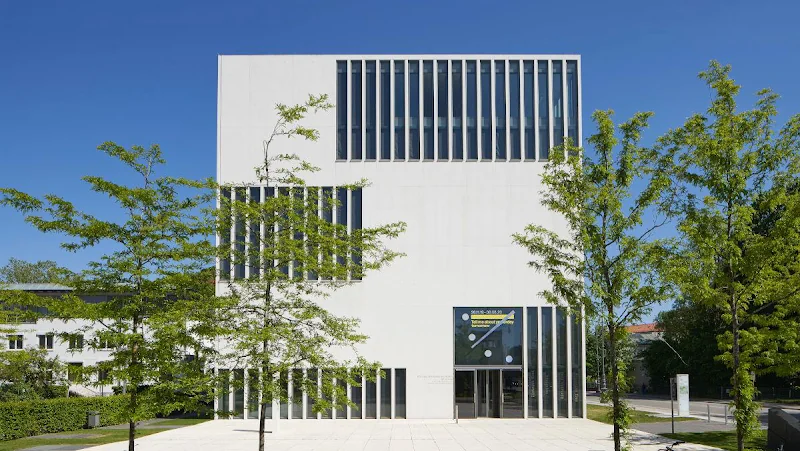
The architecture of the NS Documentation Center is inextricably linked to the history of the site. Before the current building was constructed here, there was a Neoclassical palace from 1828, designed and built by Johann Baptist Métivier. Later, the building became Palais Barlow before being purchased by the NSDAP in 1930 and converted into the party headquarters according to plans by Paul Ludwig Troost. From 1931 until its destruction in 1945, the so-called Brown House was located here, the central power site of the NSDAP in Munich. After the war and after long debates about how to deal with the site, the Munich City Council decided in 2001/2002 to establish an NS Documentation Center. The 2009 architectural competition was won by the Berlin office Georg Scheel Wetzel, which developed a cubic new building with white exposed concrete and distinctive louvered windows. The architecture deliberately sets a contrast to the surroundings and simultaneously makes the break with history visible. The cube marks the site of the perpetrators without gesturing toward the old Brown House. The facades appear bright and closed, punctuated by darker window areas, and the outdoor spaces were designed to make the historical burden of the site visible rather than conceal it. The foundation stone was laid on March 9, 2012, and the opening followed on May 1, 2015. Today, the square in front of the house is called Max-Mannheimer-Platz, named after the Holocaust survivor and co-initiator of the center. Thus, the building combines architectural restraint with historical clarity and makes the site itself part of the narrative. ([nsdoku.de](https://www.nsdoku.de/historischer-ort/braunes-haus))
Exhibition Munich and National Socialism
The central exhibition of the house is titled Munich and National Socialism and is based on a historical arc that spans from the end of World War I to the present. It addresses the emergence and rise phase of the NSDAP in Munich, the functioning of the NS state, the living conditions in the city during the dictatorship, and the difficult handling of this past after 1945. Covering around 1000 square meters, the exhibition conveys well-founded historical knowledge, works with photographs, documents, texts, film projections, and media stations, and shows how National Socialism became entrenched in everyday life, politics, and the cityscape. Particularly important is the change of perspective: not only the power elites but also the societal conditions, exclusion, persecution, and the approval of many people become visible. The house also emphasizes that Munich, as the founding site of the NSDAP, played a special role in the terror system of the dictatorship. This places the city's history not in a local context but in larger contexts. The exhibition is bilingual in German and English, which facilitates access for visitors from both domestic and international backgrounds. In addition to the permanent themes, changing artistic interventions and special exhibitions show how historical research and contemporary issues engage in dialogue. This connection is characteristic of the NS Documentation Center: it is not only about remembering the past but also about the question of how memory, democracy, and responsibility are interconnected today. ([nsdoku.de](https://www.nsdoku.de/muenchen-und-der-nationalsozialismus?utm_source=openai))
Accessibility, Library, and Café
The NS Documentation Center Munich is not only content-wise open but also practically oriented towards different needs. The exhibition and all public areas are accessible for people with mobility impairments and wheelchair users. Additionally, there are tours in German sign language and in simple language, making the visit particularly inclusive. The house provides open Wi-Fi for visitors, and the media guide can be borrowed free of charge or used on one's own smartphone. It is designed in various languages and for different target groups. For in-depth research, the learning forum offers interactive media tables and research terminals; the library contains a large selection of publications on the NS era, post-history, and related topics. The English website mentions two interactive media tables and 22 research terminals, and the library also has around 3000 books available in the open access section. For those needing a break after the tour, the CafeBar Max offers a convenient option directly in the house: from Tuesday to Sunday between 10:00 AM and 7:00 PM, there is coffee, cake, homemade iced tea, croissants, sandwiches, and changing dishes. Publications can also be purchased there. This makes the visit not only content-wise pleasant but also organizationally convenient, as research, breaks, and conversations can take place in one location. This mix of café, library, and learning forum is a real added value, especially for longer stays, educational visits, and independent deepening. ([nsdoku.de](https://www.nsdoku.de/besuch/allgemeine-infos))
Group Visits, Family Offers, and Practical Tips
For groups, families, and anyone looking to plan their visit well, the NS Documentation Center Munich provides many useful pieces of information. Groups of 20 or more people should register in advance, and a fixed schedule, a duration of 90 minutes, and clear conditions are available for the standard tour. This is especially helpful for school classes, student groups, educational trips, and club outings. The house also points out that it is not an archive and does not conduct private family history research; instead, there are research tips and references to suitable archives and institutions. Those who possess historical objects, documents, or photographs related to the NS era can contact the center and submit the materials with a brief description and images. There are also clear rules regarding the use of the house: photography is only allowed in the exhibitions for private use; for commercial recordings or reporting, written permission is required. Rooms in the NS Documentation Center are not rented out; events are therefore not freely bookable event spaces but part of the own curatorial program or cooperative formats. For families, it is particularly important that the visit does not have to be overwhelming: with the media guide for teenagers aged 14 and older and the family version for children aged 10 and older, the tour can be adapted to the respective age. This transforms a potentially heavy topic into a well-structured learning visit that meaningfully connects content, historical responsibility, and modern mediation. Therefore, those who find the house under the search terms tickets, tours, address, parking, or architecture receive far more on-site than just a pure exhibition space: a carefully curated, barrier-free, and historically precise offering in the center of Munich. ([nsdoku.de](https://www.nsdoku.de/kontakt))
Sources:
Show moreShow less
NS Documentation Center Munich | Opening Hours & Admission
The NS Documentation Center Munich is a place of learning and remembrance that treats history not as a closed chapter but as a mandate for the present and future. Those who enter the building at Max-Mannheimer-Platz experience not only an exhibition but also a historical site where the origins, rise, and consequences of National Socialism in Munich become comprehensible. The center sees itself as an open house of information, discussion, and mediation. It combines historical research with public conversations, art, digital offerings, educational programs, and a clear stance against exclusion, hatred, and violence. Particularly because Munich plays such a special role in the history of National Socialism as the founding site of the NSDAP, this house has a dual mandate: to remember and to explain. It shows how the dictatorship became entrenched in the city and simultaneously asks what this history means for our democratic coexistence today. The location on the site of the former Brown House makes this claim immediately visible, as the past is conveyed at an authentic site and not just told abstractly. ([nsdoku.de](https://www.nsdoku.de/ueber-uns/das-nsdoku))
Opening Hours, Admission, and Tickets
The most important questions for visiting the NS Documentation Center Munich are quickly answered: Admission is free, tickets do not need to be purchased in advance, and a reservation for regular individual visits is not necessary. The house is open from Tuesday to Sunday from 10:00 AM to 7:00 PM; it remains open on holidays, even if a holiday falls on a Monday. This makes the center well-suited for weekend visits, spontaneous cultural appointments, and day trips. The offer is particularly attractive for people who want to experience a well-founded historical exhibition without long lead times. Groups of more than 20 people should register in advance to ensure the visit is well organized. The house generally recommends the later afternoon for groups, as there are usually fewer visitors on-site then. There are also helpful offerings for families and younger guests: A free media guide is aimed at teenagers aged 14 and older, and a family version is intended for children aged 10 and up. This way, different age groups can explore the exhibition at a pace and on a content level that suits them. Especially in a house that deals with war, violence, exclusion, and remembrance culture, this differentiation is particularly valuable. It makes the visit accessible without reducing the content's depth. ([nsdoku.de](https://www.nsdoku.de/besuch/allgemeine-infos))
Directions, Address, and Parking
The address of the NS Documentation Center Munich is Max-Mannheimer-Platz 1, 80333 Munich. The house is located in the Maxvorstadt, in close proximity to Königsplatz, and is very well accessible by public transport. By subway, take lines U2 and U8 to the Königsplatz stop; there, use exit B with stairs or exit C with an elevator. If you are traveling by tram, get off at the Karolinenplatz stop, where lines 27 and 28 stop. Several bus lines also lead nearby: Line 100, known as the museum line, as well as lines 58 and 68 stop at Königsplatz or at the Pinakotheken. For the S-Bahn, Hauptbahnhof or Karlsplatz/Stachus are suitable; from there, it is about a 10-minute walk. This location makes the visit particularly uncomplicated not only for Munich residents but also for guests from other districts and travelers. However, there is a clear recommendation regarding parking: The NS Documentation Center does not have its own visitor or bus parking spaces. Public parking in the vicinity is subject to fees, and the house explicitly advises arriving by public transport. Tour buses can only stop at Königsplatz briefly for boarding and alighting. These notes are important because the center is located in a densely frequented cultural and museum district, where mobility by train, tram, or bus is usually less stressful than arriving by car. ([nsdoku.de](https://www.nsdoku.de/besuch/allgemeine-infos))
Guided Tours and Walks
Those who want to experience the NS Documentation Center Munich more intensively will find a very well-developed offering of guided tours. Particularly relevant for inquiries about tours and walks are the free public tours: Every Sunday at 11:00 AM and 2:00 PM, the house conducts tours through the exhibition Munich and National Socialism, and additionally, a free tour through the current temporary exhibition starts on Sundays at 3:00 PM. Regular public tours in English are also offered; on the English website, a Sunday appointment at 1:00 PM is indicated for this. This is especially practical for international visitors who want to explore Munich on their own while still seeking a professionally informed access to the history of the place. For groups, there are also bookable tours, seminars, and workshops. The standard tour lasts 90 minutes and costs 90 euros per group; school classes and students participate free of charge. This tour content covers the emergence of National Socialism, the seizure of power, and the handling of history after 1945. In addition, the center's web-based app makes the exhibition and 118 locations in Munich and the surrounding area digitally accessible. It can be used on one's own smartphone or tablet and complements the on-site visit with audio, video, and background material. This creates a visit concept that ranges from a short tour to in-depth digital research. ([nsdoku.de](https://www.nsdoku.de/besuch/allgemeine-infos))
Architecture and Historical Site
The architecture of the NS Documentation Center is inextricably linked to the history of the site. Before the current building was constructed here, there was a Neoclassical palace from 1828, designed and built by Johann Baptist Métivier. Later, the building became Palais Barlow before being purchased by the NSDAP in 1930 and converted into the party headquarters according to plans by Paul Ludwig Troost. From 1931 until its destruction in 1945, the so-called Brown House was located here, the central power site of the NSDAP in Munich. After the war and after long debates about how to deal with the site, the Munich City Council decided in 2001/2002 to establish an NS Documentation Center. The 2009 architectural competition was won by the Berlin office Georg Scheel Wetzel, which developed a cubic new building with white exposed concrete and distinctive louvered windows. The architecture deliberately sets a contrast to the surroundings and simultaneously makes the break with history visible. The cube marks the site of the perpetrators without gesturing toward the old Brown House. The facades appear bright and closed, punctuated by darker window areas, and the outdoor spaces were designed to make the historical burden of the site visible rather than conceal it. The foundation stone was laid on March 9, 2012, and the opening followed on May 1, 2015. Today, the square in front of the house is called Max-Mannheimer-Platz, named after the Holocaust survivor and co-initiator of the center. Thus, the building combines architectural restraint with historical clarity and makes the site itself part of the narrative. ([nsdoku.de](https://www.nsdoku.de/historischer-ort/braunes-haus))
Exhibition Munich and National Socialism
The central exhibition of the house is titled Munich and National Socialism and is based on a historical arc that spans from the end of World War I to the present. It addresses the emergence and rise phase of the NSDAP in Munich, the functioning of the NS state, the living conditions in the city during the dictatorship, and the difficult handling of this past after 1945. Covering around 1000 square meters, the exhibition conveys well-founded historical knowledge, works with photographs, documents, texts, film projections, and media stations, and shows how National Socialism became entrenched in everyday life, politics, and the cityscape. Particularly important is the change of perspective: not only the power elites but also the societal conditions, exclusion, persecution, and the approval of many people become visible. The house also emphasizes that Munich, as the founding site of the NSDAP, played a special role in the terror system of the dictatorship. This places the city's history not in a local context but in larger contexts. The exhibition is bilingual in German and English, which facilitates access for visitors from both domestic and international backgrounds. In addition to the permanent themes, changing artistic interventions and special exhibitions show how historical research and contemporary issues engage in dialogue. This connection is characteristic of the NS Documentation Center: it is not only about remembering the past but also about the question of how memory, democracy, and responsibility are interconnected today. ([nsdoku.de](https://www.nsdoku.de/muenchen-und-der-nationalsozialismus?utm_source=openai))
Accessibility, Library, and Café
The NS Documentation Center Munich is not only content-wise open but also practically oriented towards different needs. The exhibition and all public areas are accessible for people with mobility impairments and wheelchair users. Additionally, there are tours in German sign language and in simple language, making the visit particularly inclusive. The house provides open Wi-Fi for visitors, and the media guide can be borrowed free of charge or used on one's own smartphone. It is designed in various languages and for different target groups. For in-depth research, the learning forum offers interactive media tables and research terminals; the library contains a large selection of publications on the NS era, post-history, and related topics. The English website mentions two interactive media tables and 22 research terminals, and the library also has around 3000 books available in the open access section. For those needing a break after the tour, the CafeBar Max offers a convenient option directly in the house: from Tuesday to Sunday between 10:00 AM and 7:00 PM, there is coffee, cake, homemade iced tea, croissants, sandwiches, and changing dishes. Publications can also be purchased there. This makes the visit not only content-wise pleasant but also organizationally convenient, as research, breaks, and conversations can take place in one location. This mix of café, library, and learning forum is a real added value, especially for longer stays, educational visits, and independent deepening. ([nsdoku.de](https://www.nsdoku.de/besuch/allgemeine-infos))
Group Visits, Family Offers, and Practical Tips
For groups, families, and anyone looking to plan their visit well, the NS Documentation Center Munich provides many useful pieces of information. Groups of 20 or more people should register in advance, and a fixed schedule, a duration of 90 minutes, and clear conditions are available for the standard tour. This is especially helpful for school classes, student groups, educational trips, and club outings. The house also points out that it is not an archive and does not conduct private family history research; instead, there are research tips and references to suitable archives and institutions. Those who possess historical objects, documents, or photographs related to the NS era can contact the center and submit the materials with a brief description and images. There are also clear rules regarding the use of the house: photography is only allowed in the exhibitions for private use; for commercial recordings or reporting, written permission is required. Rooms in the NS Documentation Center are not rented out; events are therefore not freely bookable event spaces but part of the own curatorial program or cooperative formats. For families, it is particularly important that the visit does not have to be overwhelming: with the media guide for teenagers aged 14 and older and the family version for children aged 10 and older, the tour can be adapted to the respective age. This transforms a potentially heavy topic into a well-structured learning visit that meaningfully connects content, historical responsibility, and modern mediation. Therefore, those who find the house under the search terms tickets, tours, address, parking, or architecture receive far more on-site than just a pure exhibition space: a carefully curated, barrier-free, and historically precise offering in the center of Munich. ([nsdoku.de](https://www.nsdoku.de/kontakt))
Sources:
NS Documentation Center Munich | Opening Hours & Admission
The NS Documentation Center Munich is a place of learning and remembrance that treats history not as a closed chapter but as a mandate for the present and future. Those who enter the building at Max-Mannheimer-Platz experience not only an exhibition but also a historical site where the origins, rise, and consequences of National Socialism in Munich become comprehensible. The center sees itself as an open house of information, discussion, and mediation. It combines historical research with public conversations, art, digital offerings, educational programs, and a clear stance against exclusion, hatred, and violence. Particularly because Munich plays such a special role in the history of National Socialism as the founding site of the NSDAP, this house has a dual mandate: to remember and to explain. It shows how the dictatorship became entrenched in the city and simultaneously asks what this history means for our democratic coexistence today. The location on the site of the former Brown House makes this claim immediately visible, as the past is conveyed at an authentic site and not just told abstractly. ([nsdoku.de](https://www.nsdoku.de/ueber-uns/das-nsdoku))
Opening Hours, Admission, and Tickets
The most important questions for visiting the NS Documentation Center Munich are quickly answered: Admission is free, tickets do not need to be purchased in advance, and a reservation for regular individual visits is not necessary. The house is open from Tuesday to Sunday from 10:00 AM to 7:00 PM; it remains open on holidays, even if a holiday falls on a Monday. This makes the center well-suited for weekend visits, spontaneous cultural appointments, and day trips. The offer is particularly attractive for people who want to experience a well-founded historical exhibition without long lead times. Groups of more than 20 people should register in advance to ensure the visit is well organized. The house generally recommends the later afternoon for groups, as there are usually fewer visitors on-site then. There are also helpful offerings for families and younger guests: A free media guide is aimed at teenagers aged 14 and older, and a family version is intended for children aged 10 and up. This way, different age groups can explore the exhibition at a pace and on a content level that suits them. Especially in a house that deals with war, violence, exclusion, and remembrance culture, this differentiation is particularly valuable. It makes the visit accessible without reducing the content's depth. ([nsdoku.de](https://www.nsdoku.de/besuch/allgemeine-infos))
Directions, Address, and Parking
The address of the NS Documentation Center Munich is Max-Mannheimer-Platz 1, 80333 Munich. The house is located in the Maxvorstadt, in close proximity to Königsplatz, and is very well accessible by public transport. By subway, take lines U2 and U8 to the Königsplatz stop; there, use exit B with stairs or exit C with an elevator. If you are traveling by tram, get off at the Karolinenplatz stop, where lines 27 and 28 stop. Several bus lines also lead nearby: Line 100, known as the museum line, as well as lines 58 and 68 stop at Königsplatz or at the Pinakotheken. For the S-Bahn, Hauptbahnhof or Karlsplatz/Stachus are suitable; from there, it is about a 10-minute walk. This location makes the visit particularly uncomplicated not only for Munich residents but also for guests from other districts and travelers. However, there is a clear recommendation regarding parking: The NS Documentation Center does not have its own visitor or bus parking spaces. Public parking in the vicinity is subject to fees, and the house explicitly advises arriving by public transport. Tour buses can only stop at Königsplatz briefly for boarding and alighting. These notes are important because the center is located in a densely frequented cultural and museum district, where mobility by train, tram, or bus is usually less stressful than arriving by car. ([nsdoku.de](https://www.nsdoku.de/besuch/allgemeine-infos))
Guided Tours and Walks
Those who want to experience the NS Documentation Center Munich more intensively will find a very well-developed offering of guided tours. Particularly relevant for inquiries about tours and walks are the free public tours: Every Sunday at 11:00 AM and 2:00 PM, the house conducts tours through the exhibition Munich and National Socialism, and additionally, a free tour through the current temporary exhibition starts on Sundays at 3:00 PM. Regular public tours in English are also offered; on the English website, a Sunday appointment at 1:00 PM is indicated for this. This is especially practical for international visitors who want to explore Munich on their own while still seeking a professionally informed access to the history of the place. For groups, there are also bookable tours, seminars, and workshops. The standard tour lasts 90 minutes and costs 90 euros per group; school classes and students participate free of charge. This tour content covers the emergence of National Socialism, the seizure of power, and the handling of history after 1945. In addition, the center's web-based app makes the exhibition and 118 locations in Munich and the surrounding area digitally accessible. It can be used on one's own smartphone or tablet and complements the on-site visit with audio, video, and background material. This creates a visit concept that ranges from a short tour to in-depth digital research. ([nsdoku.de](https://www.nsdoku.de/besuch/allgemeine-infos))
Architecture and Historical Site
The architecture of the NS Documentation Center is inextricably linked to the history of the site. Before the current building was constructed here, there was a Neoclassical palace from 1828, designed and built by Johann Baptist Métivier. Later, the building became Palais Barlow before being purchased by the NSDAP in 1930 and converted into the party headquarters according to plans by Paul Ludwig Troost. From 1931 until its destruction in 1945, the so-called Brown House was located here, the central power site of the NSDAP in Munich. After the war and after long debates about how to deal with the site, the Munich City Council decided in 2001/2002 to establish an NS Documentation Center. The 2009 architectural competition was won by the Berlin office Georg Scheel Wetzel, which developed a cubic new building with white exposed concrete and distinctive louvered windows. The architecture deliberately sets a contrast to the surroundings and simultaneously makes the break with history visible. The cube marks the site of the perpetrators without gesturing toward the old Brown House. The facades appear bright and closed, punctuated by darker window areas, and the outdoor spaces were designed to make the historical burden of the site visible rather than conceal it. The foundation stone was laid on March 9, 2012, and the opening followed on May 1, 2015. Today, the square in front of the house is called Max-Mannheimer-Platz, named after the Holocaust survivor and co-initiator of the center. Thus, the building combines architectural restraint with historical clarity and makes the site itself part of the narrative. ([nsdoku.de](https://www.nsdoku.de/historischer-ort/braunes-haus))
Exhibition Munich and National Socialism
The central exhibition of the house is titled Munich and National Socialism and is based on a historical arc that spans from the end of World War I to the present. It addresses the emergence and rise phase of the NSDAP in Munich, the functioning of the NS state, the living conditions in the city during the dictatorship, and the difficult handling of this past after 1945. Covering around 1000 square meters, the exhibition conveys well-founded historical knowledge, works with photographs, documents, texts, film projections, and media stations, and shows how National Socialism became entrenched in everyday life, politics, and the cityscape. Particularly important is the change of perspective: not only the power elites but also the societal conditions, exclusion, persecution, and the approval of many people become visible. The house also emphasizes that Munich, as the founding site of the NSDAP, played a special role in the terror system of the dictatorship. This places the city's history not in a local context but in larger contexts. The exhibition is bilingual in German and English, which facilitates access for visitors from both domestic and international backgrounds. In addition to the permanent themes, changing artistic interventions and special exhibitions show how historical research and contemporary issues engage in dialogue. This connection is characteristic of the NS Documentation Center: it is not only about remembering the past but also about the question of how memory, democracy, and responsibility are interconnected today. ([nsdoku.de](https://www.nsdoku.de/muenchen-und-der-nationalsozialismus?utm_source=openai))
Accessibility, Library, and Café
The NS Documentation Center Munich is not only content-wise open but also practically oriented towards different needs. The exhibition and all public areas are accessible for people with mobility impairments and wheelchair users. Additionally, there are tours in German sign language and in simple language, making the visit particularly inclusive. The house provides open Wi-Fi for visitors, and the media guide can be borrowed free of charge or used on one's own smartphone. It is designed in various languages and for different target groups. For in-depth research, the learning forum offers interactive media tables and research terminals; the library contains a large selection of publications on the NS era, post-history, and related topics. The English website mentions two interactive media tables and 22 research terminals, and the library also has around 3000 books available in the open access section. For those needing a break after the tour, the CafeBar Max offers a convenient option directly in the house: from Tuesday to Sunday between 10:00 AM and 7:00 PM, there is coffee, cake, homemade iced tea, croissants, sandwiches, and changing dishes. Publications can also be purchased there. This makes the visit not only content-wise pleasant but also organizationally convenient, as research, breaks, and conversations can take place in one location. This mix of café, library, and learning forum is a real added value, especially for longer stays, educational visits, and independent deepening. ([nsdoku.de](https://www.nsdoku.de/besuch/allgemeine-infos))
Group Visits, Family Offers, and Practical Tips
For groups, families, and anyone looking to plan their visit well, the NS Documentation Center Munich provides many useful pieces of information. Groups of 20 or more people should register in advance, and a fixed schedule, a duration of 90 minutes, and clear conditions are available for the standard tour. This is especially helpful for school classes, student groups, educational trips, and club outings. The house also points out that it is not an archive and does not conduct private family history research; instead, there are research tips and references to suitable archives and institutions. Those who possess historical objects, documents, or photographs related to the NS era can contact the center and submit the materials with a brief description and images. There are also clear rules regarding the use of the house: photography is only allowed in the exhibitions for private use; for commercial recordings or reporting, written permission is required. Rooms in the NS Documentation Center are not rented out; events are therefore not freely bookable event spaces but part of the own curatorial program or cooperative formats. For families, it is particularly important that the visit does not have to be overwhelming: with the media guide for teenagers aged 14 and older and the family version for children aged 10 and older, the tour can be adapted to the respective age. This transforms a potentially heavy topic into a well-structured learning visit that meaningfully connects content, historical responsibility, and modern mediation. Therefore, those who find the house under the search terms tickets, tours, address, parking, or architecture receive far more on-site than just a pure exhibition space: a carefully curated, barrier-free, and historically precise offering in the center of Munich. ([nsdoku.de](https://www.nsdoku.de/kontakt))
Sources:
Upcoming Events
No events found
Frequently Asked Questions
Reviews
Jenson Connor
13. February 2026
Absolutely speechless. Incredibly preserved objects from the Nazi era. A really moving combination of modern and historic war exhibitions. The information was vast, thorough, and broken up into key time frames which allowed you to literally walk through time. We would advise starting from the top floor and working your way down in order to view the exhibitions chronologically. Entry is free.
Hotimir Licen
17. November 2025
NS-Dokumentationszentrum in Munich offers a powerful and informative exhibition about the rise of Nazism in the city where it began. Modern, well-organized, and free to enter, it provides deep historical insight through interactive displays and authentic stories. A must-visit for understanding Munich’s past and Europe’s history.
Nireas
30. November 2025
A vastly informative experience, exploring different aspects of NS history from its birth to its demise. History learners and lovers will find much to take in, might be a big too much for those who know little to nothing of the topic.
Lana Koshkareva (Lana)
16. November 2025
Free of charge. ♿ for wheelchair. Free Audio guide available. Amazing Expo. Strongly recommended.
Sarah Systemic
22. February 2026
Very interesting museum. Lots of information to read, translated mostly into English too. Lots of photos and videos. Move at your own pace throughout. Lockers provided for bags which was good. Very friendly and helpful staff too.