
München
Luisenstraße 37A, 80333 München, Deutschland
Reactor Hall Venue of the University of Music | Concerts & Tickets
The Reactor Hall at the University of Music and Performing Arts Munich is one of those places where university operations, stage practice, and city history converge in a compact space. Located at Luisenstraße 37a, there are two venues of HMTM: the Reactor Hall on the ground floor and the Carl-Orff-Auditorium on the first floor. This is practical for visitors because many formats are concentrated at a central location in the Munich art area. For students, it is a space where rehearsals, exams, premieres, and public performances come together directly. At the same time, the place feels much less arbitrary than a normal multipurpose hall due to its past and architectural character. ([kultur-barrierefrei-muenchen.de](https://www.kultur-barrierefrei-muenchen.de/hochschule-fuer-musik-und-theater-standort-luisenstrasse/))
The most common search intentions around this place clearly revolve around programs, tickets, photos, images, directions, and parking. That is exactly why it is worth looking at the current usage: On the HMTM pages, music theater productions, symphony concerts, big band evenings, premieres, and competitions regularly appear there. The Reactor Hall is thus not a static hall, but a versatile university and guest performance venue with changing lineups, different productions, and a very own atmosphere. So, those looking for the Reactor Hall are not just looking for a space, but usually for a current experience that mediates between artistic education, public performance, and urban cultural events. ([hmtm.de](https://hmtm.de/kuenstlerische-gesangs-und-theaterausbildung/musiktheater-im-reaktor/))
Current Program, Tickets, and Typical Events
Those looking for the current program will find primarily three major lines at HMTM: opera and music theater productions, symphony concerts, as well as ensemble and subject-specific formats. The series “Music Theater in the Reactor” brings a large opera project with singing students to the Reactor Hall every year; in 2026, “The Emperor of Atlantis or The Refusal of Death” is announced, while “Don Giovanni” was on the program in 2025. Additionally, the symphony concerts of the Munich School Music Orchestra will return to the Reactor Hall in 2026 with a program. This creates a calendar that makes the breadth of the university visible and simultaneously shows that the Reactor Hall functions for very different artistic demands. ([hmtm.de](https://hmtm.de/kuenstlerische-gesangs-und-theaterausbildung/musiktheater-im-reaktor/))
Big band formats are also firmly part of the venue's profile. HMTM announces concerts of the Teachers’ Finest Big Band and other big band evenings of school music in the Reactor Hall. Additionally, the space appears in series like “Silent Film in the Reactor Hall,” where live music and film come together. It is important for ticket interested parties: Some events are subject to a fee, and advance sales are explicitly recommended, while other dates are freely accessible and only require wristbands or reservations at the entrance. This creates a program that oscillates between university exams, public concerts, and professionally curated productions. This mixture explains why search queries often specifically ask for programs, dates, and tickets for individual evenings. ([hmtm.de](https://hmtm.de/events/konzert-der-teachers-finest-bigband/?utm_source=openai))
Photos, Images, and the Special Stage Character
The Reactor Hall is a place that is not only visited but also gladly photographed. The architecture dates back to the 1950s, and the space was converted into a multifunctional hall with a foyer and cloakrooms after being taken over by HMTM in 1999. This mix of industrial origins and today's stage function makes the hall particularly interesting for photos and images: Many productions are documented with visual material on the HMTM pages, and the Theater Academy also presents the space as its own venue with a clearly recognizable stage situation. This is helpful for visitors because it allows them to gain an impression of the spatial effect, proximity to the action, and visual atmosphere even before the event. ([bwki.de](https://www.bwki.de/de/projekte/musterseite-3))
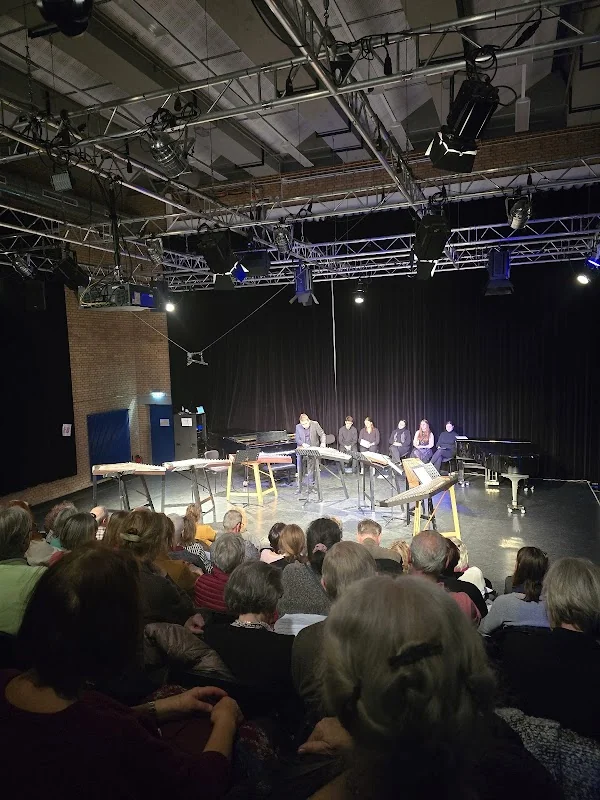
Particularly striking is the contrast between the austere building structure and the very different productions that take place there. A music theater evening feels different in this space than a symphony concert or a big band set because the hall creates proximity and brings the audience close to the action. This is precisely the impression that many visitors also seek in images: raw architecture, concentrated light, visible stage, clear lines, and a space that does not hide technology but integrates it into the artistic impression. So, those looking for photos or images of the Reactor Hall are usually not just looking for a view of the location but a feeling for the atmosphere of this house. This impression is further enhanced by the regular photo and video documentation of HMTM, making the Reactor Hall recognizable online as well as on-site. ([hmtm.de](https://hmtm.de/kuenstlerische-gesangs-und-theaterausbildung/musiktheater-im-reaktor/))
Seating, Hall Plan, and Equipment
For the classification of the space, the numbers are important: The Theater Academy describes the Reactor Hall as a venue with a capacity of up to 199 seats. The barrier-free Munich site lists 180 seats plus two wheelchair spaces. This discrepancy does not speak against the space but shows that the actual seating arrangement can vary depending on the production and usage form. In practice, this means: The Reactor Hall is not a huge multipurpose building but rather a compact hall with a manageable number of seats, thus creating an intimate proximity to the audience. This density is an advantage, especially for concerts, opera productions, and exam formats, as it keeps the distance between the stage and the audience small and gives the action more immediacy. ([theaterakademie.de](https://www.theaterakademie.de/spielstaetten/reaktorhalle))
According to the Theater Academy, the equipment includes a foyer and cloakrooms; HMTM also uses the hall for audio, video, and media technology. This fits the use as a concert, theater, and experimental stage: a production here needs not only seating but also flexible technical solutions. The barrier-free profile also mentions that the seats are folding chairs with cushions and backrests and that the space has four emergency exits. This is particularly helpful for visitors looking for a seating plan, best seats, or seating comfort: The hall is designed for changing formats, not for a rigid fixed-row model like a classic opera house. This is what makes it appealing, as each production can utilize the proximity, sightlines, and the effect of the space a little differently. ([bwki.de](https://www.bwki.de/de/projekte/musterseite-3))
Directions, Parking, and Location on Luisenstraße
The Reactor Hall is located at Luisenstraße 37a in Munich-Maxvorstadt, thus very centrally in the vicinity of the art area, universities, and museums. For public transport, the local directory lists nearby stops: Technical University at about 96 meters, Königsplatz at about 285 meters, Pinakotheken at about 459 meters, and Munich Central Station at about 932 meters. Additionally, HMTM mentions a connection from Arcisstraße to Luisenstraße in about five minutes on foot through the park at the Glyptothek for the route between its locations. This shows that the Reactor Hall is not isolated but closely networked with the cultural and academic center of the city. ([mux.de](https://www.mux.de/Reaktorhalle))
For those arriving by car, the local directory lists the nearest parking options as the underground garage Hotel Ibis City (P23) at 567 meters and the parking lot at Theresienwiese at 1.6 kilometers. At the same time, it is important for people with disabilities that the barrier-free Munich site only lists disabled parking at the Arcisstraße location, not at Luisenstraße. This suggests planning the trip to the Reactor Hall primarily as an inner-city journey with public transport or short walks and only considering the car with some advance planning. For many guests, this is the better solution because it allows for a more relaxed combination of arrival, entry, and return, enabling them to focus on the actual event experience. ([mux.de](https://www.mux.de/Reaktorhalle))
Barrier-Free Access, Wheelchair Spaces, and Visitor Service
The Reactor Hall is considered a barrier-free accessible event venue. The barrier-free Munich information mentions barrier-free access, an elevator, two wheelchair spaces, and a wheelchair-accessible toilet. Additionally, the Theater Academy points out that wheelchair spaces should be reserved and that the entry staff will assist with questions. For visitors with limitations, this is an important foundation because it creates a reliable, well-planned visiting situation. It is also particularly helpful that the Luisenstraße location is described as a university building with two event rooms and that the Reactor Hall is located on the ground floor, which makes orientation easier. ([kultur-barrierefrei-muenchen.de](https://www.kultur-barrierefrei-muenchen.de/hochschule-fuer-musik-und-theater-standort-luisenstrasse/))
For people with hearing or visual impairments, the profile also contains useful information. The barrier-free site mentions that subtitles or surtitles are used at selected events and that a mobile induction loop is available at some dates. It is also described that staff will help open the heavy doors at events. This creates real added value in practice: The hall is not an anonymous event block but a place with personal service and clear responsibilities. Those attending a free event should reserve wheelchair spaces by phone in advance; for ticket purchases, registration is recommended directly at the time of purchase. Thus, the Reactor Hall is not only architecturally but also organizationally adjusted to different needs. ([kultur-barrierefrei-muenchen.de](https://www.kultur-barrierefrei-muenchen.de/hochschule-fuer-musik-und-theater-standort-luisenstrasse/))
History and Use of the Reactor Hall
The historical development of the Reactor Hall is almost as exciting as its current program. According to building and architectural sources, HMTM took over an institute building from the 1950s of the Technical University of Munich in 1999, which previously housed the Institute for Technical Physics. The so-called Reactor Hall originally housed a proton accelerator and was later converted into a multifunctional hall with a foyer, cloakrooms, and modern stage technology. This transforms a once technical-scientific space into a cultural place with a completely different effect. The Reactor Hall is therefore not just an address but an example of how city history can be transformed into new use without completely losing its origins. ([bwki.de](https://www.bwki.de/de/projekte/musterseite-3))
Today, the Reactor Hall is firmly integrated into the HMTM ecosystem. In addition to the university, it is also used by the Bavarian Theater Academy, the Bavarian State Opera, and private organizers; at the same time, it appears in university series such as “Music Theater in the Reactor,” in the Munich School Music Orchestra, at big band concerts, and in film projects with live music. This versatility explains why search queries so often target terms like HMTM, Luisenstraße, program, tickets, photos, and images: The Reactor Hall is not a singular hall for a single purpose but a lively venue where the art university, the city, and the audience regularly meet. Those coming here usually experience not only an event but also a piece of lived university culture in the heart of Munich. ([bwki.de](https://www.bwki.de/de/projekte/musterseite-3))
Sources:
Show moreShow less
Reactor Hall Venue of the University of Music | Concerts & Tickets
The Reactor Hall at the University of Music and Performing Arts Munich is one of those places where university operations, stage practice, and city history converge in a compact space. Located at Luisenstraße 37a, there are two venues of HMTM: the Reactor Hall on the ground floor and the Carl-Orff-Auditorium on the first floor. This is practical for visitors because many formats are concentrated at a central location in the Munich art area. For students, it is a space where rehearsals, exams, premieres, and public performances come together directly. At the same time, the place feels much less arbitrary than a normal multipurpose hall due to its past and architectural character. ([kultur-barrierefrei-muenchen.de](https://www.kultur-barrierefrei-muenchen.de/hochschule-fuer-musik-und-theater-standort-luisenstrasse/))
The most common search intentions around this place clearly revolve around programs, tickets, photos, images, directions, and parking. That is exactly why it is worth looking at the current usage: On the HMTM pages, music theater productions, symphony concerts, big band evenings, premieres, and competitions regularly appear there. The Reactor Hall is thus not a static hall, but a versatile university and guest performance venue with changing lineups, different productions, and a very own atmosphere. So, those looking for the Reactor Hall are not just looking for a space, but usually for a current experience that mediates between artistic education, public performance, and urban cultural events. ([hmtm.de](https://hmtm.de/kuenstlerische-gesangs-und-theaterausbildung/musiktheater-im-reaktor/))
Current Program, Tickets, and Typical Events
Those looking for the current program will find primarily three major lines at HMTM: opera and music theater productions, symphony concerts, as well as ensemble and subject-specific formats. The series “Music Theater in the Reactor” brings a large opera project with singing students to the Reactor Hall every year; in 2026, “The Emperor of Atlantis or The Refusal of Death” is announced, while “Don Giovanni” was on the program in 2025. Additionally, the symphony concerts of the Munich School Music Orchestra will return to the Reactor Hall in 2026 with a program. This creates a calendar that makes the breadth of the university visible and simultaneously shows that the Reactor Hall functions for very different artistic demands. ([hmtm.de](https://hmtm.de/kuenstlerische-gesangs-und-theaterausbildung/musiktheater-im-reaktor/))
Big band formats are also firmly part of the venue's profile. HMTM announces concerts of the Teachers’ Finest Big Band and other big band evenings of school music in the Reactor Hall. Additionally, the space appears in series like “Silent Film in the Reactor Hall,” where live music and film come together. It is important for ticket interested parties: Some events are subject to a fee, and advance sales are explicitly recommended, while other dates are freely accessible and only require wristbands or reservations at the entrance. This creates a program that oscillates between university exams, public concerts, and professionally curated productions. This mixture explains why search queries often specifically ask for programs, dates, and tickets for individual evenings. ([hmtm.de](https://hmtm.de/events/konzert-der-teachers-finest-bigband/?utm_source=openai))
Photos, Images, and the Special Stage Character
The Reactor Hall is a place that is not only visited but also gladly photographed. The architecture dates back to the 1950s, and the space was converted into a multifunctional hall with a foyer and cloakrooms after being taken over by HMTM in 1999. This mix of industrial origins and today's stage function makes the hall particularly interesting for photos and images: Many productions are documented with visual material on the HMTM pages, and the Theater Academy also presents the space as its own venue with a clearly recognizable stage situation. This is helpful for visitors because it allows them to gain an impression of the spatial effect, proximity to the action, and visual atmosphere even before the event. ([bwki.de](https://www.bwki.de/de/projekte/musterseite-3))
Particularly striking is the contrast between the austere building structure and the very different productions that take place there. A music theater evening feels different in this space than a symphony concert or a big band set because the hall creates proximity and brings the audience close to the action. This is precisely the impression that many visitors also seek in images: raw architecture, concentrated light, visible stage, clear lines, and a space that does not hide technology but integrates it into the artistic impression. So, those looking for photos or images of the Reactor Hall are usually not just looking for a view of the location but a feeling for the atmosphere of this house. This impression is further enhanced by the regular photo and video documentation of HMTM, making the Reactor Hall recognizable online as well as on-site. ([hmtm.de](https://hmtm.de/kuenstlerische-gesangs-und-theaterausbildung/musiktheater-im-reaktor/))
Seating, Hall Plan, and Equipment
For the classification of the space, the numbers are important: The Theater Academy describes the Reactor Hall as a venue with a capacity of up to 199 seats. The barrier-free Munich site lists 180 seats plus two wheelchair spaces. This discrepancy does not speak against the space but shows that the actual seating arrangement can vary depending on the production and usage form. In practice, this means: The Reactor Hall is not a huge multipurpose building but rather a compact hall with a manageable number of seats, thus creating an intimate proximity to the audience. This density is an advantage, especially for concerts, opera productions, and exam formats, as it keeps the distance between the stage and the audience small and gives the action more immediacy. ([theaterakademie.de](https://www.theaterakademie.de/spielstaetten/reaktorhalle))
According to the Theater Academy, the equipment includes a foyer and cloakrooms; HMTM also uses the hall for audio, video, and media technology. This fits the use as a concert, theater, and experimental stage: a production here needs not only seating but also flexible technical solutions. The barrier-free profile also mentions that the seats are folding chairs with cushions and backrests and that the space has four emergency exits. This is particularly helpful for visitors looking for a seating plan, best seats, or seating comfort: The hall is designed for changing formats, not for a rigid fixed-row model like a classic opera house. This is what makes it appealing, as each production can utilize the proximity, sightlines, and the effect of the space a little differently. ([bwki.de](https://www.bwki.de/de/projekte/musterseite-3))
Directions, Parking, and Location on Luisenstraße
The Reactor Hall is located at Luisenstraße 37a in Munich-Maxvorstadt, thus very centrally in the vicinity of the art area, universities, and museums. For public transport, the local directory lists nearby stops: Technical University at about 96 meters, Königsplatz at about 285 meters, Pinakotheken at about 459 meters, and Munich Central Station at about 932 meters. Additionally, HMTM mentions a connection from Arcisstraße to Luisenstraße in about five minutes on foot through the park at the Glyptothek for the route between its locations. This shows that the Reactor Hall is not isolated but closely networked with the cultural and academic center of the city. ([mux.de](https://www.mux.de/Reaktorhalle))
For those arriving by car, the local directory lists the nearest parking options as the underground garage Hotel Ibis City (P23) at 567 meters and the parking lot at Theresienwiese at 1.6 kilometers. At the same time, it is important for people with disabilities that the barrier-free Munich site only lists disabled parking at the Arcisstraße location, not at Luisenstraße. This suggests planning the trip to the Reactor Hall primarily as an inner-city journey with public transport or short walks and only considering the car with some advance planning. For many guests, this is the better solution because it allows for a more relaxed combination of arrival, entry, and return, enabling them to focus on the actual event experience. ([mux.de](https://www.mux.de/Reaktorhalle))
Barrier-Free Access, Wheelchair Spaces, and Visitor Service
The Reactor Hall is considered a barrier-free accessible event venue. The barrier-free Munich information mentions barrier-free access, an elevator, two wheelchair spaces, and a wheelchair-accessible toilet. Additionally, the Theater Academy points out that wheelchair spaces should be reserved and that the entry staff will assist with questions. For visitors with limitations, this is an important foundation because it creates a reliable, well-planned visiting situation. It is also particularly helpful that the Luisenstraße location is described as a university building with two event rooms and that the Reactor Hall is located on the ground floor, which makes orientation easier. ([kultur-barrierefrei-muenchen.de](https://www.kultur-barrierefrei-muenchen.de/hochschule-fuer-musik-und-theater-standort-luisenstrasse/))
For people with hearing or visual impairments, the profile also contains useful information. The barrier-free site mentions that subtitles or surtitles are used at selected events and that a mobile induction loop is available at some dates. It is also described that staff will help open the heavy doors at events. This creates real added value in practice: The hall is not an anonymous event block but a place with personal service and clear responsibilities. Those attending a free event should reserve wheelchair spaces by phone in advance; for ticket purchases, registration is recommended directly at the time of purchase. Thus, the Reactor Hall is not only architecturally but also organizationally adjusted to different needs. ([kultur-barrierefrei-muenchen.de](https://www.kultur-barrierefrei-muenchen.de/hochschule-fuer-musik-und-theater-standort-luisenstrasse/))
History and Use of the Reactor Hall
The historical development of the Reactor Hall is almost as exciting as its current program. According to building and architectural sources, HMTM took over an institute building from the 1950s of the Technical University of Munich in 1999, which previously housed the Institute for Technical Physics. The so-called Reactor Hall originally housed a proton accelerator and was later converted into a multifunctional hall with a foyer, cloakrooms, and modern stage technology. This transforms a once technical-scientific space into a cultural place with a completely different effect. The Reactor Hall is therefore not just an address but an example of how city history can be transformed into new use without completely losing its origins. ([bwki.de](https://www.bwki.de/de/projekte/musterseite-3))
Today, the Reactor Hall is firmly integrated into the HMTM ecosystem. In addition to the university, it is also used by the Bavarian Theater Academy, the Bavarian State Opera, and private organizers; at the same time, it appears in university series such as “Music Theater in the Reactor,” in the Munich School Music Orchestra, at big band concerts, and in film projects with live music. This versatility explains why search queries so often target terms like HMTM, Luisenstraße, program, tickets, photos, and images: The Reactor Hall is not a singular hall for a single purpose but a lively venue where the art university, the city, and the audience regularly meet. Those coming here usually experience not only an event but also a piece of lived university culture in the heart of Munich. ([bwki.de](https://www.bwki.de/de/projekte/musterseite-3))
Sources:
Reactor Hall Venue of the University of Music | Concerts & Tickets
The Reactor Hall at the University of Music and Performing Arts Munich is one of those places where university operations, stage practice, and city history converge in a compact space. Located at Luisenstraße 37a, there are two venues of HMTM: the Reactor Hall on the ground floor and the Carl-Orff-Auditorium on the first floor. This is practical for visitors because many formats are concentrated at a central location in the Munich art area. For students, it is a space where rehearsals, exams, premieres, and public performances come together directly. At the same time, the place feels much less arbitrary than a normal multipurpose hall due to its past and architectural character. ([kultur-barrierefrei-muenchen.de](https://www.kultur-barrierefrei-muenchen.de/hochschule-fuer-musik-und-theater-standort-luisenstrasse/))
The most common search intentions around this place clearly revolve around programs, tickets, photos, images, directions, and parking. That is exactly why it is worth looking at the current usage: On the HMTM pages, music theater productions, symphony concerts, big band evenings, premieres, and competitions regularly appear there. The Reactor Hall is thus not a static hall, but a versatile university and guest performance venue with changing lineups, different productions, and a very own atmosphere. So, those looking for the Reactor Hall are not just looking for a space, but usually for a current experience that mediates between artistic education, public performance, and urban cultural events. ([hmtm.de](https://hmtm.de/kuenstlerische-gesangs-und-theaterausbildung/musiktheater-im-reaktor/))
Current Program, Tickets, and Typical Events
Those looking for the current program will find primarily three major lines at HMTM: opera and music theater productions, symphony concerts, as well as ensemble and subject-specific formats. The series “Music Theater in the Reactor” brings a large opera project with singing students to the Reactor Hall every year; in 2026, “The Emperor of Atlantis or The Refusal of Death” is announced, while “Don Giovanni” was on the program in 2025. Additionally, the symphony concerts of the Munich School Music Orchestra will return to the Reactor Hall in 2026 with a program. This creates a calendar that makes the breadth of the university visible and simultaneously shows that the Reactor Hall functions for very different artistic demands. ([hmtm.de](https://hmtm.de/kuenstlerische-gesangs-und-theaterausbildung/musiktheater-im-reaktor/))
Big band formats are also firmly part of the venue's profile. HMTM announces concerts of the Teachers’ Finest Big Band and other big band evenings of school music in the Reactor Hall. Additionally, the space appears in series like “Silent Film in the Reactor Hall,” where live music and film come together. It is important for ticket interested parties: Some events are subject to a fee, and advance sales are explicitly recommended, while other dates are freely accessible and only require wristbands or reservations at the entrance. This creates a program that oscillates between university exams, public concerts, and professionally curated productions. This mixture explains why search queries often specifically ask for programs, dates, and tickets for individual evenings. ([hmtm.de](https://hmtm.de/events/konzert-der-teachers-finest-bigband/?utm_source=openai))
Photos, Images, and the Special Stage Character
The Reactor Hall is a place that is not only visited but also gladly photographed. The architecture dates back to the 1950s, and the space was converted into a multifunctional hall with a foyer and cloakrooms after being taken over by HMTM in 1999. This mix of industrial origins and today's stage function makes the hall particularly interesting for photos and images: Many productions are documented with visual material on the HMTM pages, and the Theater Academy also presents the space as its own venue with a clearly recognizable stage situation. This is helpful for visitors because it allows them to gain an impression of the spatial effect, proximity to the action, and visual atmosphere even before the event. ([bwki.de](https://www.bwki.de/de/projekte/musterseite-3))
Particularly striking is the contrast between the austere building structure and the very different productions that take place there. A music theater evening feels different in this space than a symphony concert or a big band set because the hall creates proximity and brings the audience close to the action. This is precisely the impression that many visitors also seek in images: raw architecture, concentrated light, visible stage, clear lines, and a space that does not hide technology but integrates it into the artistic impression. So, those looking for photos or images of the Reactor Hall are usually not just looking for a view of the location but a feeling for the atmosphere of this house. This impression is further enhanced by the regular photo and video documentation of HMTM, making the Reactor Hall recognizable online as well as on-site. ([hmtm.de](https://hmtm.de/kuenstlerische-gesangs-und-theaterausbildung/musiktheater-im-reaktor/))
Seating, Hall Plan, and Equipment
For the classification of the space, the numbers are important: The Theater Academy describes the Reactor Hall as a venue with a capacity of up to 199 seats. The barrier-free Munich site lists 180 seats plus two wheelchair spaces. This discrepancy does not speak against the space but shows that the actual seating arrangement can vary depending on the production and usage form. In practice, this means: The Reactor Hall is not a huge multipurpose building but rather a compact hall with a manageable number of seats, thus creating an intimate proximity to the audience. This density is an advantage, especially for concerts, opera productions, and exam formats, as it keeps the distance between the stage and the audience small and gives the action more immediacy. ([theaterakademie.de](https://www.theaterakademie.de/spielstaetten/reaktorhalle))
According to the Theater Academy, the equipment includes a foyer and cloakrooms; HMTM also uses the hall for audio, video, and media technology. This fits the use as a concert, theater, and experimental stage: a production here needs not only seating but also flexible technical solutions. The barrier-free profile also mentions that the seats are folding chairs with cushions and backrests and that the space has four emergency exits. This is particularly helpful for visitors looking for a seating plan, best seats, or seating comfort: The hall is designed for changing formats, not for a rigid fixed-row model like a classic opera house. This is what makes it appealing, as each production can utilize the proximity, sightlines, and the effect of the space a little differently. ([bwki.de](https://www.bwki.de/de/projekte/musterseite-3))
Directions, Parking, and Location on Luisenstraße
The Reactor Hall is located at Luisenstraße 37a in Munich-Maxvorstadt, thus very centrally in the vicinity of the art area, universities, and museums. For public transport, the local directory lists nearby stops: Technical University at about 96 meters, Königsplatz at about 285 meters, Pinakotheken at about 459 meters, and Munich Central Station at about 932 meters. Additionally, HMTM mentions a connection from Arcisstraße to Luisenstraße in about five minutes on foot through the park at the Glyptothek for the route between its locations. This shows that the Reactor Hall is not isolated but closely networked with the cultural and academic center of the city. ([mux.de](https://www.mux.de/Reaktorhalle))
For those arriving by car, the local directory lists the nearest parking options as the underground garage Hotel Ibis City (P23) at 567 meters and the parking lot at Theresienwiese at 1.6 kilometers. At the same time, it is important for people with disabilities that the barrier-free Munich site only lists disabled parking at the Arcisstraße location, not at Luisenstraße. This suggests planning the trip to the Reactor Hall primarily as an inner-city journey with public transport or short walks and only considering the car with some advance planning. For many guests, this is the better solution because it allows for a more relaxed combination of arrival, entry, and return, enabling them to focus on the actual event experience. ([mux.de](https://www.mux.de/Reaktorhalle))
Barrier-Free Access, Wheelchair Spaces, and Visitor Service
The Reactor Hall is considered a barrier-free accessible event venue. The barrier-free Munich information mentions barrier-free access, an elevator, two wheelchair spaces, and a wheelchair-accessible toilet. Additionally, the Theater Academy points out that wheelchair spaces should be reserved and that the entry staff will assist with questions. For visitors with limitations, this is an important foundation because it creates a reliable, well-planned visiting situation. It is also particularly helpful that the Luisenstraße location is described as a university building with two event rooms and that the Reactor Hall is located on the ground floor, which makes orientation easier. ([kultur-barrierefrei-muenchen.de](https://www.kultur-barrierefrei-muenchen.de/hochschule-fuer-musik-und-theater-standort-luisenstrasse/))
For people with hearing or visual impairments, the profile also contains useful information. The barrier-free site mentions that subtitles or surtitles are used at selected events and that a mobile induction loop is available at some dates. It is also described that staff will help open the heavy doors at events. This creates real added value in practice: The hall is not an anonymous event block but a place with personal service and clear responsibilities. Those attending a free event should reserve wheelchair spaces by phone in advance; for ticket purchases, registration is recommended directly at the time of purchase. Thus, the Reactor Hall is not only architecturally but also organizationally adjusted to different needs. ([kultur-barrierefrei-muenchen.de](https://www.kultur-barrierefrei-muenchen.de/hochschule-fuer-musik-und-theater-standort-luisenstrasse/))
History and Use of the Reactor Hall
The historical development of the Reactor Hall is almost as exciting as its current program. According to building and architectural sources, HMTM took over an institute building from the 1950s of the Technical University of Munich in 1999, which previously housed the Institute for Technical Physics. The so-called Reactor Hall originally housed a proton accelerator and was later converted into a multifunctional hall with a foyer, cloakrooms, and modern stage technology. This transforms a once technical-scientific space into a cultural place with a completely different effect. The Reactor Hall is therefore not just an address but an example of how city history can be transformed into new use without completely losing its origins. ([bwki.de](https://www.bwki.de/de/projekte/musterseite-3))
Today, the Reactor Hall is firmly integrated into the HMTM ecosystem. In addition to the university, it is also used by the Bavarian Theater Academy, the Bavarian State Opera, and private organizers; at the same time, it appears in university series such as “Music Theater in the Reactor,” in the Munich School Music Orchestra, at big band concerts, and in film projects with live music. This versatility explains why search queries so often target terms like HMTM, Luisenstraße, program, tickets, photos, and images: The Reactor Hall is not a singular hall for a single purpose but a lively venue where the art university, the city, and the audience regularly meet. Those coming here usually experience not only an event but also a piece of lived university culture in the heart of Munich. ([bwki.de](https://www.bwki.de/de/projekte/musterseite-3))
Sources:
Upcoming Events
No events found
Frequently Asked Questions
Reviews
Kevin Bachmann
9. November 2024
Cool location
히비스코 식물성콜라겐 이너뷰티
14. November 2025
A unique experience in Munich ~~
Gaby Ottowski
9. January 2019
Pretty cool concert hall, especially considering that the reactor hall was actually planned in the early days of nuclear research in Germany in the 1950s for the former Institute for Technical Physics right in the city. You can see the 70 cm thick concrete walls at the entrance, which were originally surrounded by a 2 cm thick lead lining to protect against the nuclear radiation of the research reactor. This idea gives it a special atmosphere, spooky ;-) But if you don't know that, it's just a technically well-equipped concert hall with good acoustics. Special tip: A drum concert from the University of Music, an absolute highlight here!
Da H
27. November 2025
Great concerts from HMTM in the REKTORHALLE again and again: free seating, good acoustics.
Dilruba A
17. February 2023
The hall is a bit small. So if you're invited to a concert, my tip is: sit at the back. That way you get a nice bird's eye view and you won't be blasted as much as everyone else ;)