
München
Residenzstraße 1, 80333 München, Deutschland
Residence Munich | Opening Hours & Tickets
The Residence Munich is much more than a single castle or a classic museum. It is a grown ensemble of courtyards, ceremonial rooms, collections, theaters, and event venues, making it one of the largest museum complexes in Bavaria. Its core dates back to the Neuveste built in 1385, from which the residence and seat of government of the Wittelsbach family developed over centuries. Therefore, those visiting the Residence move through a place where Munich's political, cultural, and architectural history overlaps in several layers. Since 1920, the Residence has been accessible to the public as a museum; today, the Residence Museum, Treasury, Cuvilliés Theater, Hercules Hall, and other areas create an exceptionally versatile visitor experience. ([residenz-muenchen.de](https://www.residenz-muenchen.de/deutsch/residenz/bau.htm))
For SEO and for the visit itself, the same questions are primarily at the center of attention at the Residence Munich: opening hours, tickets, admission, entrance, plan, parking, sightseeing, and events. These topics also shape the official visitor information. Those who plan their visit to the Residence wisely can divide the tour according to time budget and interest: from a quick museum visit with the treasury to an in-depth historical tour to an evening concert or theater performance in Hercules Hall or the Cuvilliés Theater. Due to its central location in Munich's old town, clear signage in the building, and the free audio guide, orientation is relatively easy, even though the complex itself is very large. ([residenz-muenchen.de](https://www.residenz-muenchen.de/deutsch/tourist/oeffnung.htm))
Opening Hours, Tickets, and Admission Prices of the Residence Munich
The most important information for the first visit can be summarized quickly: The Residence Munich is open daily but closed on January 1, on Shrove Tuesday, and on December 24, 25, and 31. The Residence Museum and the Treasury are open daily from March 28 to October 19 from 9 AM to 6 PM, and from October 20 to March 27 from 10 AM to 5 PM. The last admission is one hour before closing, at 5 PM in summer and at 4 PM in the winter season. These clear time windows are particularly helpful for planning the visit because the tour through the museum and treasury can be enjoyed more calmly if you do not arrive too close to closing time. ([residenz-muenchen.de](https://www.residenz-muenchen.de/deutsch/tourist/oeffnung.htm))
The admission prices are also transparently displayed. For the treasury, the regular price in 2026 is 10 euros and 9 euros reduced. Those who wish to visit the Residence Museum and the treasury together can use the combination ticket for 15 euros regular and 13 euros reduced. The total ticket for the Residence, including the Residence Museum, Treasury, and Cuvilliés Theater, costs 20 euros regular and 16 euros reduced. Particularly family-friendly: Children and young people up to the age of 18 receive free admission. Tickets are also available online in the ticket shop, which makes access easier, especially on weekends or during holiday periods. ([schloss.bayern.de](https://www.schloss.bayern.de/deutsch/schloss/objekte/mu_schk.htm))
For visitors who want to experience not just individual rooms but the entire history of the Residence, the total ticket is usually the most sensible choice. Because the Residence is not a compact place that can be crossed in ten minutes, but a multi-layered work of spatial art with different time levels, collections, and access points. The free audio guide meaningfully complements the tour and is available in nine languages: German, English, French, Italian, Spanish, Russian, Arabic, Chinese, and Japanese. This is particularly practical for international guests and for anyone who wants to discover architecture, furnishings, and historical contexts at their own pace without a fixed tour. ([residenz-muenchen.de](https://www.residenz-muenchen.de/deutsch/tourist/oeffnung.htm))
Important for the search for the term Residence Munich tour: There are no regular tours at the Residence. Visitors explore the objects independently, but private guides are allowed. Additionally, the official visitor information refers to group regulations: registrations or reservations are not required, but the maximum group size is 25 people. This is useful information for travel groups, school classes, and private visits with a larger circle, as it facilitates planning on-site. Those coming as a group should divide the size accordingly and organize the visit calmly. ([residenz-muenchen.de](https://www.residenz-muenchen.de/deutsch/tourist/oeffnung.htm))
For SEO planning, these topics are the main search intentions: opening hours, tickets, admission, tours, and sightseeing. They show that the Residence Munich is perceived not only as a sight but also as a practical visitor location. Visitors want to know when they can come, what they have to pay, whether they need a tour, and how to best utilize their time in the building. From these questions, the content strategy for this text also arises: first the hard facts about times and tickets, then the paths and entrances, followed by the historical highlights and finally the venues for concerts and events. ([residenz-muenchen.de](https://www.residenz-muenchen.de/deutsch/tourist/oeffnung.htm))
Entrance, Access, and Parking at the Residence Munich
The Residence Munich is centrally located in the old town and is very well integrated into the Munich public transport network. The official overview plan and visitor information mention the U-Bahn and S-Bahn to Marienplatz or Odeonsplatz, the bus to Odeonsplatz, and the tram to Nationaltheater as public transport connections. As a parking option, the underground garage at Max-Joseph-Platz is indicated. For visitors arriving by car, this is the most important official reference, as it directly shows where parking in the city center is most realistic. At the same time, the location of the Residence makes it clear that arriving by public transport is usually the most convenient solution. This is a practical conclusion, but it is clearly supported by the official access information. ([schloss.bayern.de](https://www.schloss.bayern.de/deutsch/schloss/objekte/mu_schk.htm))
The question of the entrance is also clearly understandable on the official plans. For the Residence Museum and Treasury, the site plan shows the entrance area around Hercules Hall and Max-Joseph Hall, where the ticket office, museum shop, and access to the main tours are located. This is useful because the Residence does not function like a single front building but consists of various wings, courtyards, and transitions. The Cuvilliés Theater is entered via a different route: the official visitor text indicates the entrance in the passage between the Fountain Courtyard and the Pharmacy Courtyard. Therefore, those visiting the building for the first time should not just look for a central main door but should orient themselves according to the respective functional areas. ([schloesser.bayern.de](https://www.schloesser.bayern.de/deutsch/service/infomat/screen-pdf/mu-residenz_dt.pdf))
The overview plan also helps to understand the spatial logic of the Residence. It marks not only the entrances but also the most important courtyards and areas, such as the Fountain Courtyard, Pharmacy Courtyard, Grotto Courtyard, Chapel Courtyard, and Court Garden. Especially in a large complex with several buildings, collections, and transitions, this is important: those who know the plan do not just move from room to room but understand the structure of the entire complex. This is particularly true for visitors searching for Residence Munich plan or Residence Munich entrance. The official graphic also makes it visible that the Residence is not just a museum but a spatially multi-layered cultural site where visitor flows, event spaces, and museum tours overlap. ([schloesser.bayern.de](https://www.schloesser.bayern.de/deutsch/service/infomat/screen-pdf/mu-residenz_dt.pdf))
In everyday life, the combination of public transport and a short walk through the old town is recommended. Marienplatz and Odeonsplatz are located directly near the Residence, making the visit very well combined with a stroll through the historic center. If arriving by car, it is advisable to plan the underground garage at Max-Joseph-Platz early and to understand the stay more as a city center visit than just a drive. The Residence is not an isolated destination on the outskirts but a central part of Munich's center. That is why the search terms access, parking, entrance, and plan work particularly well together here. ([schloss.bayern.de](https://www.schloss.bayern.de/deutsch/schloss/objekte/mu_schk.htm))
Residence Museum and History of the Wittelsbach Family
The Residence Museum is the historical core of today's visitor residence. Since 1920, the Munich Residence has been accessible to the public as a museum, and the complex still documents the claims of its builders from the House of Wittelsbach. These rulers initially governed as dukes, later as electors, and from 1806 to 1918 as kings in Bavaria. The official museum page describes the Residence as a stone testimony to this self-understanding. From the Renaissance through Baroque and Rococo to Classicism and Historicism, different eras can be directly read in the building and rooms. Thus, the Residence is not just a collection of beautiful halls but a chronologically readable cultural monument. ([residenz-muenchen.de](https://www.residenz-muenchen.de/deutsch/residenz/))
The origin lies in the Neuveste built in 1385, which is considered the core of today's Residence. From there, the complex grew over centuries into a facility with several courtyards and wings. The official construction history clearly traces the expansion phases: from the medieval core through Renaissance and Baroque renovations to the classicist and historical additions of the 18th and 19th centuries. It is particularly important that many rooms that can be visited today are not isolated museum reconstructions but have directly emerged from historical use. This makes the Residence so credible and impressive: architecture and furnishings together tell the story of the House of Wittelsbach. ([residenz-muenchen.de](https://www.residenz-muenchen.de/deutsch/residenz/bau.htm))
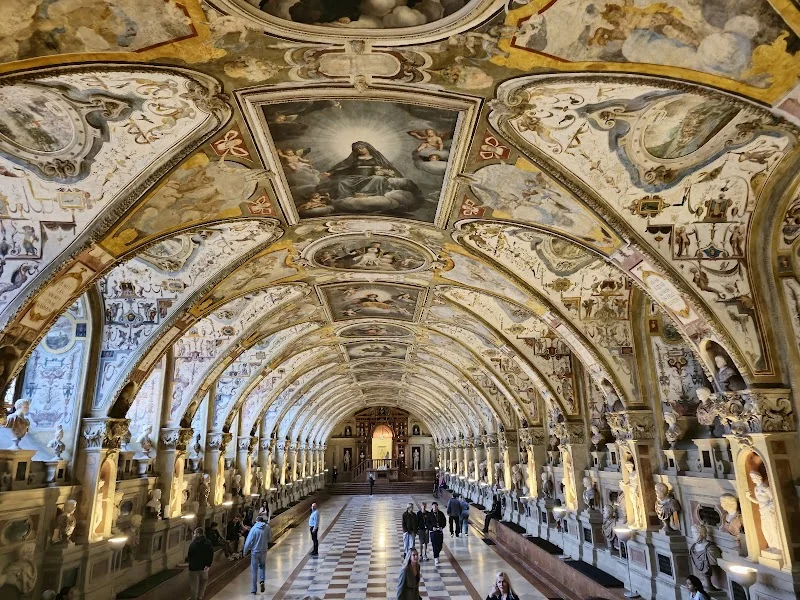
An outstanding example is the Antiquarium, the oldest preserved room of the Munich Residence. With a length of 66 meters, it is one of the largest and most magnificent Renaissance halls north of the Alps. Duke Albrecht V. had it built between 1568 and 1571 for his collection of ancient sculptures. Later, Wilhelm V. and Maximilian I. converted the room into a banquet hall. The decoration visible today, with grotesques, paintings, 102 views of cities, markets, castles, and palaces, as well as sculptures and busts, makes the room one of the key locations of the Residence. Those searching for Residence Munich museum or Residence Munich visit will find one of the strongest arguments for a visit here. ([residenz-muenchen.de](https://www.residenz-muenchen.de/deutsch/museum/antiquar.htm))
The official overview plan of the museum also clarifies how extensive the tour actually is. It leads through the vestibule entrance area, the garden halls, the gallery of ancestors, and the porcelain cabinet to the Grotto Courtyard and further to the Antiquarium, the Octagon, the Nibelungen Halls, the porcelain collection of the 18th and 19th centuries, the court chapel, and the paraments chambers. This enumeration shows that the Residence Museum offers a dense succession of rooms and collection areas. Therefore, anyone wanting to understand the history of the Residence should not only aim for individual highlights but read the tour as a coherent narrative. The variety of collections makes the Residence Munich an ideal destination for culturally and historically interested visitors. ([schloesser.bayern.de](https://www.schloesser.bayern.de/deutsch/service/infomat/screen-pdf/mu-residenz_dt.pdf))
For keyword analysis, this topic is also central. Search queries like Residence Munich museum, visit, plan, and photos show that users not only want practical information but also an idea of what to expect inside. Here, the Residence Museum impresses with spatial art, original layers, and clearly identifiable highlights. The connection of architectural history, court culture, and collection presentation explains why the Residence is considered one of the most significant castle museums in Europe today. ([residenz-muenchen.de](https://www.residenz-muenchen.de/deutsch/residenz/))
Treasury of the Residence Munich and its Treasures
The treasury is one of the most fascinating parts of the Residence Munich because it directly showcases the material splendor of the House of Wittelsbach. The official description speaks of secular and sacred treasures, including liturgical objects, reliquaries, and precious goldsmith works. As early as the early 17th century, there was a collection of such objects in the Munich Residence, acquired by Wilhelm V. and Maximilian I. for the court chapels. During the time of secularization, this collection was expanded with medieval goldsmith works from former monastery property. Thus, a collection emerged that combines dynastic representation, piety, and artisanal excellence. ([schloss.bayern.de](https://www.schloss.bayern.de/deutsch/schloss/objekte/mu_schk.htm))
For visitors, it is particularly exciting that the treasury does not appear abstract or museum-like cold but conveys a very concrete idea of court culture. Here, one encounters goldsmith art from the Middle Ages to Classicism, orders and insignia, jewelry, tableware, ecclesiastical art, as well as masterpieces made of ivory, rock crystal, and precious stones. This is exactly the kind of substance that makes search terms like Residence Munich treasury or Residence Munich admission so attractive: people are not only looking for ticket prices but primarily for access to unique objects and their history. The treasury delivers both. ([schloss.bayern.de](https://www.schloss.bayern.de/deutsch/service/infomat/screen-pdf/mu_residenz_dt.pdf))
The official tour and accompanying room descriptions also show that the treasury is not to be seen in isolation from the rest of the visit. It is part of a larger route through the Residence and adds the dimension of the house's possessions and representation culture to the Residence Museum. Where architecture and interior design speak in the museum, the treasury showcases the small, particularly precious objects that have been collected, worn, donated, or preserved over centuries. For many guests, this combination of large rooms and small treasures is the charm of the entire visit. ([schloss.bayern.de](https://www.schloss.bayern.de/deutsch/schloss/objekte/mu_schk.htm))
Also practical here is the free audio guide, which is available at the entrance for the Residence Museum and Treasury. It is available in nine languages and significantly facilitates the understanding of the exhibited objects. Those who take their time can experience the treasury as a concentrated counterpoint to the spacious museum: less room volume, but an enormous density of goldsmith art, relics, and symbols of power. This mixture makes the area equally interesting for art history enthusiasts, cultural travelers, and families. Those searching for Residence Munich photos will primarily look for iconic individual pieces and glamorous details in the treasury. ([residenz-muenchen.de](https://www.residenz-muenchen.de/deutsch/tourist/oeffnung.htm))
From an SEO perspective, the treasury is also a strong thematic anchor because it bundles several search intentions: admission, museum, visit, opening hours, and special highlights. This is important for the content strategy because users expect not just a building but an ensemble of collections here. The Residence Munich thus becomes a location that functions historically, museum-wise, and as a collection. This triple function distinguishes it from many other sights in Munich. ([schloss.bayern.de](https://www.schloss.bayern.de/deutsch/schloss/objekte/mu_schk.htm))
Cuvilliés Theater, Hercules Hall, and Events
When it comes to Residence Munich concerts or Residence Munich events, three places are particularly important: the Cuvilliés Theater, Hercules Hall, and the Allerheiligen-Hofkirche. The Cuvilliés Theater is an outstanding example of court theater architecture from the Rococo period. It was built from 1751 to 1755 on the orders of Elector Max III. Joseph according to a design by François Cuvilliés the Elder as the new opera house of the court. Here, lavish productions took place, including the first performance of Mozart's Idomeneo in 1781. For theater and music lovers, this is an important background because the space is not only beautiful but also historically charged. ([residenz-muenchen.de](https://www.residenz-muenchen.de/englisch/cuv/index.htm))
The history of the Cuvilliés Theater is also an example of dealing with loss and reconstruction. The building was destroyed in 1944; however, the wooden, colorfully painted tiers of the auditorium were stored in 1943 and survived the war. In 1956, they were handed over to the Bavarian Palace Administration, which reassembled them in a new building near the Pharmacy Courtyard by 1958. Today, the theater is accessed from the Fountain Courtyard. The official description emphasizes the exuberant decoration in the rocaille style and the European rank of this total work of art. Therefore, those searching for Residence Munich theater will find here not just any playhouse but one of the most famous historical theater spaces in Germany. ([residenz-muenchen.de](https://www.residenz-muenchen.de/deutsch/cuv/index.htm?utm_source=openai))
Hercules Hall complements this picture with modern event use. According to the official room page, it is suitable for concerts, festive events, lectures, and conferences. The maximum occupancy is 1,450 people, including 1,270 seats in row seating and 180 standing places. With an area of 964 square meters, foyer, cloakrooms, artist dressing rooms, soloist rooms, and technical equipment, the hall is one of the most important event venues of the Residence. For public events, it is also noted: catering only in the foyer, no events with candles. These are useful facts for organizers but also for visitors interested in the specific use of the building. ([schloesser.bayern.de](https://www.schloesser.bayern.de/deutsch/raeume/objekte/mu_r_herk.htm))
The Allerheiligen-Hofkirche shows yet another facet of the Residence as a cultural site. King Ludwig I. had it built between 1826 and 1837 according to plans by Leo von Klenze, inspired by his impressions in Palermo. It was the first church building in Bavaria after the secularization of 1803. The space, largely destroyed in World War II, was reopened to the public in 2003 and adapted as a concert and event hall. This expands the Residence's spectrum from museum location to theater to concert hall. For visitors, this means: depending on interest, a stay here can look very different, from a quiet museum tour to an evening cultural event. ([residenz-muenchen.de](https://www.residenz-muenchen.de/deutsch/ahkirche/index.htm))
This variety of events also explains why search queries like Residence Munich Hercules Hall, Residence Munich concerts, and Residence Munich events are so important. The Residence is not just a monument but a vibrant cultural site. Its rooms are not only shown but also used. This makes the place particularly attractive for cultural audiences who want to experience architecture and performing arts at the same time. Therefore, anyone planning a concert evening should check the respective schedule and access information for the chosen hall and possibly combine the visit with a museum tour. ([schloesser.bayern.de](https://www.schloesser.bayern.de/deutsch/raeume/objekte/mu_r_herk.htm))
Visit, Audio Guide, and Practical Tips for the Visit
The best way to experience the Residence Munich is usually through a self-guided tour with some preparation. The official visitor information makes it clear that there are no regular tours, but visitors can independently walk through the objects. At the same time, private guides are allowed, and a free audio guide is available for the Residence Museum and Treasury. This is particularly practical because the Residence consists of many units, and understanding the historical contexts is significantly better with explanations. Those planning the tour should therefore not only look at the clock but also at their own attention: the mixture of rooms, collections, and transitions is very rich. ([residenz-muenchen.de](https://www.residenz-muenchen.de/deutsch/tourist/oeffnung.htm))
A good visit begins with the overview plan. It shows not only the entrances but also the logical order of the most important stations. These include the vestibule, garden halls, gallery of ancestors, porcelain cabinet, grotto courtyard, antiquarium, Nibelungen halls, porcelain collections, court chapel, and paraments chambers. Those who know this structure can plan the tour much more purposefully. This is helpful for families, culture enthusiasts, and photographers because it allows one to decide whether to focus on just one area or combine several. Especially in such a large house, it is sensible to concentrate on the most important stations in advance rather than taking everything in passingly. ([schloesser.bayern.de](https://www.schloesser.bayern.de/deutsch/service/infomat/screen-pdf/mu-residenz_dt.pdf))
The official data also suggests that a visit should be planned generously in terms of time. This is a factual recommendation, not a marketing phrase: the Residence is a complex of museum, treasury, theater, and event venues, not just a single hall. Those who want to see everything calmly should plan enough time for the tour, for breaks, and for transitions between areas. The combination of the Residence Museum and Treasury is particularly interesting because it shows the life and representation of the House of Wittelsbach from two perspectives. Anyone wanting to see the Cuvilliés Theater or an event in Hercules Hall should extend the day accordingly. ([residenz-muenchen.de](https://www.residenz-muenchen.de/deutsch/residenz/))
For specific visitor questions, some simple rules of thumb help: Admission is free for those under 18, tickets are available online, the last admission is one hour before closing, and access is very good by U-Bahn and S-Bahn. Parking is described with the underground garage at Max-Joseph-Platz, but especially due to the central city location, public transport is often the more pleasant choice. Those coming as a group do not need to make a reservation but should observe the maximum size of 25 people. These points are small but crucial for a smooth visit. ([schloss.bayern.de](https://www.schloss.bayern.de/deutsch/schloss/objekte/mu_schk.htm))
In summary, the Residence Munich is a place where search intention and experience align unusually well. Those searching for opening hours, tickets, entrance, parking, treasury, theater, or concerts not only find answers but a coherent cultural offering. That is why the Residence is so strong in local search: it combines historical authority, practical visitor information, and emotional experiences at a single, very central location. ([residenz-muenchen.de](https://www.residenz-muenchen.de/deutsch/tourist/oeffnung.htm))
Sources:
- Bavarian Palace Administration - Residence Munich | Visitor Information | Opening Hours
([residenz-muenchen.de](https://www.residenz-muenchen.de/deutsch/tourist/oeffnung.htm))- Bavarian Palace Administration - Residence Museum | Overview
([residenz-muenchen.de](https://www.residenz-muenchen.de/deutsch/museum/))- Bavarian Palace Administration - Treasury of the Residence Munich
([schloss.bayern.de](https://www.schloss.bayern.de/deutsch/schloss/objekte/mu_schk.htm))- Bavarian Palace Administration - Cuvilliés Theater
([residenz-muenchen.de](https://www.residenz-muenchen.de/englisch/cuv/index.htm))- Bavarian Palace Administration - Hercules Hall
([schloesser.bayern.de](https://www.schloesser.bayern.de/deutsch/raeume/objekte/mu_r_herk.htm))- Bavarian Palace Administration - Residence Munich | Construction History
([residenz-muenchen.de](https://www.residenz-muenchen.de/deutsch/residenz/bau.htm))- Bavarian Palace Administration - Allerheiligen-Hofkirche
([residenz-muenchen.de](https://www.residenz-muenchen.de/deutsch/ahkirche/index.htm))
Show moreShow less
Residence Munich | Opening Hours & Tickets
The Residence Munich is much more than a single castle or a classic museum. It is a grown ensemble of courtyards, ceremonial rooms, collections, theaters, and event venues, making it one of the largest museum complexes in Bavaria. Its core dates back to the Neuveste built in 1385, from which the residence and seat of government of the Wittelsbach family developed over centuries. Therefore, those visiting the Residence move through a place where Munich's political, cultural, and architectural history overlaps in several layers. Since 1920, the Residence has been accessible to the public as a museum; today, the Residence Museum, Treasury, Cuvilliés Theater, Hercules Hall, and other areas create an exceptionally versatile visitor experience. ([residenz-muenchen.de](https://www.residenz-muenchen.de/deutsch/residenz/bau.htm))
For SEO and for the visit itself, the same questions are primarily at the center of attention at the Residence Munich: opening hours, tickets, admission, entrance, plan, parking, sightseeing, and events. These topics also shape the official visitor information. Those who plan their visit to the Residence wisely can divide the tour according to time budget and interest: from a quick museum visit with the treasury to an in-depth historical tour to an evening concert or theater performance in Hercules Hall or the Cuvilliés Theater. Due to its central location in Munich's old town, clear signage in the building, and the free audio guide, orientation is relatively easy, even though the complex itself is very large. ([residenz-muenchen.de](https://www.residenz-muenchen.de/deutsch/tourist/oeffnung.htm))
Opening Hours, Tickets, and Admission Prices of the Residence Munich
The most important information for the first visit can be summarized quickly: The Residence Munich is open daily but closed on January 1, on Shrove Tuesday, and on December 24, 25, and 31. The Residence Museum and the Treasury are open daily from March 28 to October 19 from 9 AM to 6 PM, and from October 20 to March 27 from 10 AM to 5 PM. The last admission is one hour before closing, at 5 PM in summer and at 4 PM in the winter season. These clear time windows are particularly helpful for planning the visit because the tour through the museum and treasury can be enjoyed more calmly if you do not arrive too close to closing time. ([residenz-muenchen.de](https://www.residenz-muenchen.de/deutsch/tourist/oeffnung.htm))
The admission prices are also transparently displayed. For the treasury, the regular price in 2026 is 10 euros and 9 euros reduced. Those who wish to visit the Residence Museum and the treasury together can use the combination ticket for 15 euros regular and 13 euros reduced. The total ticket for the Residence, including the Residence Museum, Treasury, and Cuvilliés Theater, costs 20 euros regular and 16 euros reduced. Particularly family-friendly: Children and young people up to the age of 18 receive free admission. Tickets are also available online in the ticket shop, which makes access easier, especially on weekends or during holiday periods. ([schloss.bayern.de](https://www.schloss.bayern.de/deutsch/schloss/objekte/mu_schk.htm))
For visitors who want to experience not just individual rooms but the entire history of the Residence, the total ticket is usually the most sensible choice. Because the Residence is not a compact place that can be crossed in ten minutes, but a multi-layered work of spatial art with different time levels, collections, and access points. The free audio guide meaningfully complements the tour and is available in nine languages: German, English, French, Italian, Spanish, Russian, Arabic, Chinese, and Japanese. This is particularly practical for international guests and for anyone who wants to discover architecture, furnishings, and historical contexts at their own pace without a fixed tour. ([residenz-muenchen.de](https://www.residenz-muenchen.de/deutsch/tourist/oeffnung.htm))
Important for the search for the term Residence Munich tour: There are no regular tours at the Residence. Visitors explore the objects independently, but private guides are allowed. Additionally, the official visitor information refers to group regulations: registrations or reservations are not required, but the maximum group size is 25 people. This is useful information for travel groups, school classes, and private visits with a larger circle, as it facilitates planning on-site. Those coming as a group should divide the size accordingly and organize the visit calmly. ([residenz-muenchen.de](https://www.residenz-muenchen.de/deutsch/tourist/oeffnung.htm))
For SEO planning, these topics are the main search intentions: opening hours, tickets, admission, tours, and sightseeing. They show that the Residence Munich is perceived not only as a sight but also as a practical visitor location. Visitors want to know when they can come, what they have to pay, whether they need a tour, and how to best utilize their time in the building. From these questions, the content strategy for this text also arises: first the hard facts about times and tickets, then the paths and entrances, followed by the historical highlights and finally the venues for concerts and events. ([residenz-muenchen.de](https://www.residenz-muenchen.de/deutsch/tourist/oeffnung.htm))
Entrance, Access, and Parking at the Residence Munich
The Residence Munich is centrally located in the old town and is very well integrated into the Munich public transport network. The official overview plan and visitor information mention the U-Bahn and S-Bahn to Marienplatz or Odeonsplatz, the bus to Odeonsplatz, and the tram to Nationaltheater as public transport connections. As a parking option, the underground garage at Max-Joseph-Platz is indicated. For visitors arriving by car, this is the most important official reference, as it directly shows where parking in the city center is most realistic. At the same time, the location of the Residence makes it clear that arriving by public transport is usually the most convenient solution. This is a practical conclusion, but it is clearly supported by the official access information. ([schloss.bayern.de](https://www.schloss.bayern.de/deutsch/schloss/objekte/mu_schk.htm))
The question of the entrance is also clearly understandable on the official plans. For the Residence Museum and Treasury, the site plan shows the entrance area around Hercules Hall and Max-Joseph Hall, where the ticket office, museum shop, and access to the main tours are located. This is useful because the Residence does not function like a single front building but consists of various wings, courtyards, and transitions. The Cuvilliés Theater is entered via a different route: the official visitor text indicates the entrance in the passage between the Fountain Courtyard and the Pharmacy Courtyard. Therefore, those visiting the building for the first time should not just look for a central main door but should orient themselves according to the respective functional areas. ([schloesser.bayern.de](https://www.schloesser.bayern.de/deutsch/service/infomat/screen-pdf/mu-residenz_dt.pdf))
The overview plan also helps to understand the spatial logic of the Residence. It marks not only the entrances but also the most important courtyards and areas, such as the Fountain Courtyard, Pharmacy Courtyard, Grotto Courtyard, Chapel Courtyard, and Court Garden. Especially in a large complex with several buildings, collections, and transitions, this is important: those who know the plan do not just move from room to room but understand the structure of the entire complex. This is particularly true for visitors searching for Residence Munich plan or Residence Munich entrance. The official graphic also makes it visible that the Residence is not just a museum but a spatially multi-layered cultural site where visitor flows, event spaces, and museum tours overlap. ([schloesser.bayern.de](https://www.schloesser.bayern.de/deutsch/service/infomat/screen-pdf/mu-residenz_dt.pdf))
In everyday life, the combination of public transport and a short walk through the old town is recommended. Marienplatz and Odeonsplatz are located directly near the Residence, making the visit very well combined with a stroll through the historic center. If arriving by car, it is advisable to plan the underground garage at Max-Joseph-Platz early and to understand the stay more as a city center visit than just a drive. The Residence is not an isolated destination on the outskirts but a central part of Munich's center. That is why the search terms access, parking, entrance, and plan work particularly well together here. ([schloss.bayern.de](https://www.schloss.bayern.de/deutsch/schloss/objekte/mu_schk.htm))
Residence Museum and History of the Wittelsbach Family
The Residence Museum is the historical core of today's visitor residence. Since 1920, the Munich Residence has been accessible to the public as a museum, and the complex still documents the claims of its builders from the House of Wittelsbach. These rulers initially governed as dukes, later as electors, and from 1806 to 1918 as kings in Bavaria. The official museum page describes the Residence as a stone testimony to this self-understanding. From the Renaissance through Baroque and Rococo to Classicism and Historicism, different eras can be directly read in the building and rooms. Thus, the Residence is not just a collection of beautiful halls but a chronologically readable cultural monument. ([residenz-muenchen.de](https://www.residenz-muenchen.de/deutsch/residenz/))
The origin lies in the Neuveste built in 1385, which is considered the core of today's Residence. From there, the complex grew over centuries into a facility with several courtyards and wings. The official construction history clearly traces the expansion phases: from the medieval core through Renaissance and Baroque renovations to the classicist and historical additions of the 18th and 19th centuries. It is particularly important that many rooms that can be visited today are not isolated museum reconstructions but have directly emerged from historical use. This makes the Residence so credible and impressive: architecture and furnishings together tell the story of the House of Wittelsbach. ([residenz-muenchen.de](https://www.residenz-muenchen.de/deutsch/residenz/bau.htm))
An outstanding example is the Antiquarium, the oldest preserved room of the Munich Residence. With a length of 66 meters, it is one of the largest and most magnificent Renaissance halls north of the Alps. Duke Albrecht V. had it built between 1568 and 1571 for his collection of ancient sculptures. Later, Wilhelm V. and Maximilian I. converted the room into a banquet hall. The decoration visible today, with grotesques, paintings, 102 views of cities, markets, castles, and palaces, as well as sculptures and busts, makes the room one of the key locations of the Residence. Those searching for Residence Munich museum or Residence Munich visit will find one of the strongest arguments for a visit here. ([residenz-muenchen.de](https://www.residenz-muenchen.de/deutsch/museum/antiquar.htm))
The official overview plan of the museum also clarifies how extensive the tour actually is. It leads through the vestibule entrance area, the garden halls, the gallery of ancestors, and the porcelain cabinet to the Grotto Courtyard and further to the Antiquarium, the Octagon, the Nibelungen Halls, the porcelain collection of the 18th and 19th centuries, the court chapel, and the paraments chambers. This enumeration shows that the Residence Museum offers a dense succession of rooms and collection areas. Therefore, anyone wanting to understand the history of the Residence should not only aim for individual highlights but read the tour as a coherent narrative. The variety of collections makes the Residence Munich an ideal destination for culturally and historically interested visitors. ([schloesser.bayern.de](https://www.schloesser.bayern.de/deutsch/service/infomat/screen-pdf/mu-residenz_dt.pdf))
For keyword analysis, this topic is also central. Search queries like Residence Munich museum, visit, plan, and photos show that users not only want practical information but also an idea of what to expect inside. Here, the Residence Museum impresses with spatial art, original layers, and clearly identifiable highlights. The connection of architectural history, court culture, and collection presentation explains why the Residence is considered one of the most significant castle museums in Europe today. ([residenz-muenchen.de](https://www.residenz-muenchen.de/deutsch/residenz/))
Treasury of the Residence Munich and its Treasures
The treasury is one of the most fascinating parts of the Residence Munich because it directly showcases the material splendor of the House of Wittelsbach. The official description speaks of secular and sacred treasures, including liturgical objects, reliquaries, and precious goldsmith works. As early as the early 17th century, there was a collection of such objects in the Munich Residence, acquired by Wilhelm V. and Maximilian I. for the court chapels. During the time of secularization, this collection was expanded with medieval goldsmith works from former monastery property. Thus, a collection emerged that combines dynastic representation, piety, and artisanal excellence. ([schloss.bayern.de](https://www.schloss.bayern.de/deutsch/schloss/objekte/mu_schk.htm))
For visitors, it is particularly exciting that the treasury does not appear abstract or museum-like cold but conveys a very concrete idea of court culture. Here, one encounters goldsmith art from the Middle Ages to Classicism, orders and insignia, jewelry, tableware, ecclesiastical art, as well as masterpieces made of ivory, rock crystal, and precious stones. This is exactly the kind of substance that makes search terms like Residence Munich treasury or Residence Munich admission so attractive: people are not only looking for ticket prices but primarily for access to unique objects and their history. The treasury delivers both. ([schloss.bayern.de](https://www.schloss.bayern.de/deutsch/service/infomat/screen-pdf/mu_residenz_dt.pdf))
The official tour and accompanying room descriptions also show that the treasury is not to be seen in isolation from the rest of the visit. It is part of a larger route through the Residence and adds the dimension of the house's possessions and representation culture to the Residence Museum. Where architecture and interior design speak in the museum, the treasury showcases the small, particularly precious objects that have been collected, worn, donated, or preserved over centuries. For many guests, this combination of large rooms and small treasures is the charm of the entire visit. ([schloss.bayern.de](https://www.schloss.bayern.de/deutsch/schloss/objekte/mu_schk.htm))
Also practical here is the free audio guide, which is available at the entrance for the Residence Museum and Treasury. It is available in nine languages and significantly facilitates the understanding of the exhibited objects. Those who take their time can experience the treasury as a concentrated counterpoint to the spacious museum: less room volume, but an enormous density of goldsmith art, relics, and symbols of power. This mixture makes the area equally interesting for art history enthusiasts, cultural travelers, and families. Those searching for Residence Munich photos will primarily look for iconic individual pieces and glamorous details in the treasury. ([residenz-muenchen.de](https://www.residenz-muenchen.de/deutsch/tourist/oeffnung.htm))
From an SEO perspective, the treasury is also a strong thematic anchor because it bundles several search intentions: admission, museum, visit, opening hours, and special highlights. This is important for the content strategy because users expect not just a building but an ensemble of collections here. The Residence Munich thus becomes a location that functions historically, museum-wise, and as a collection. This triple function distinguishes it from many other sights in Munich. ([schloss.bayern.de](https://www.schloss.bayern.de/deutsch/schloss/objekte/mu_schk.htm))
Cuvilliés Theater, Hercules Hall, and Events
When it comes to Residence Munich concerts or Residence Munich events, three places are particularly important: the Cuvilliés Theater, Hercules Hall, and the Allerheiligen-Hofkirche. The Cuvilliés Theater is an outstanding example of court theater architecture from the Rococo period. It was built from 1751 to 1755 on the orders of Elector Max III. Joseph according to a design by François Cuvilliés the Elder as the new opera house of the court. Here, lavish productions took place, including the first performance of Mozart's Idomeneo in 1781. For theater and music lovers, this is an important background because the space is not only beautiful but also historically charged. ([residenz-muenchen.de](https://www.residenz-muenchen.de/englisch/cuv/index.htm))
The history of the Cuvilliés Theater is also an example of dealing with loss and reconstruction. The building was destroyed in 1944; however, the wooden, colorfully painted tiers of the auditorium were stored in 1943 and survived the war. In 1956, they were handed over to the Bavarian Palace Administration, which reassembled them in a new building near the Pharmacy Courtyard by 1958. Today, the theater is accessed from the Fountain Courtyard. The official description emphasizes the exuberant decoration in the rocaille style and the European rank of this total work of art. Therefore, those searching for Residence Munich theater will find here not just any playhouse but one of the most famous historical theater spaces in Germany. ([residenz-muenchen.de](https://www.residenz-muenchen.de/deutsch/cuv/index.htm?utm_source=openai))
Hercules Hall complements this picture with modern event use. According to the official room page, it is suitable for concerts, festive events, lectures, and conferences. The maximum occupancy is 1,450 people, including 1,270 seats in row seating and 180 standing places. With an area of 964 square meters, foyer, cloakrooms, artist dressing rooms, soloist rooms, and technical equipment, the hall is one of the most important event venues of the Residence. For public events, it is also noted: catering only in the foyer, no events with candles. These are useful facts for organizers but also for visitors interested in the specific use of the building. ([schloesser.bayern.de](https://www.schloesser.bayern.de/deutsch/raeume/objekte/mu_r_herk.htm))
The Allerheiligen-Hofkirche shows yet another facet of the Residence as a cultural site. King Ludwig I. had it built between 1826 and 1837 according to plans by Leo von Klenze, inspired by his impressions in Palermo. It was the first church building in Bavaria after the secularization of 1803. The space, largely destroyed in World War II, was reopened to the public in 2003 and adapted as a concert and event hall. This expands the Residence's spectrum from museum location to theater to concert hall. For visitors, this means: depending on interest, a stay here can look very different, from a quiet museum tour to an evening cultural event. ([residenz-muenchen.de](https://www.residenz-muenchen.de/deutsch/ahkirche/index.htm))
This variety of events also explains why search queries like Residence Munich Hercules Hall, Residence Munich concerts, and Residence Munich events are so important. The Residence is not just a monument but a vibrant cultural site. Its rooms are not only shown but also used. This makes the place particularly attractive for cultural audiences who want to experience architecture and performing arts at the same time. Therefore, anyone planning a concert evening should check the respective schedule and access information for the chosen hall and possibly combine the visit with a museum tour. ([schloesser.bayern.de](https://www.schloesser.bayern.de/deutsch/raeume/objekte/mu_r_herk.htm))
Visit, Audio Guide, and Practical Tips for the Visit
The best way to experience the Residence Munich is usually through a self-guided tour with some preparation. The official visitor information makes it clear that there are no regular tours, but visitors can independently walk through the objects. At the same time, private guides are allowed, and a free audio guide is available for the Residence Museum and Treasury. This is particularly practical because the Residence consists of many units, and understanding the historical contexts is significantly better with explanations. Those planning the tour should therefore not only look at the clock but also at their own attention: the mixture of rooms, collections, and transitions is very rich. ([residenz-muenchen.de](https://www.residenz-muenchen.de/deutsch/tourist/oeffnung.htm))
A good visit begins with the overview plan. It shows not only the entrances but also the logical order of the most important stations. These include the vestibule, garden halls, gallery of ancestors, porcelain cabinet, grotto courtyard, antiquarium, Nibelungen halls, porcelain collections, court chapel, and paraments chambers. Those who know this structure can plan the tour much more purposefully. This is helpful for families, culture enthusiasts, and photographers because it allows one to decide whether to focus on just one area or combine several. Especially in such a large house, it is sensible to concentrate on the most important stations in advance rather than taking everything in passingly. ([schloesser.bayern.de](https://www.schloesser.bayern.de/deutsch/service/infomat/screen-pdf/mu-residenz_dt.pdf))
The official data also suggests that a visit should be planned generously in terms of time. This is a factual recommendation, not a marketing phrase: the Residence is a complex of museum, treasury, theater, and event venues, not just a single hall. Those who want to see everything calmly should plan enough time for the tour, for breaks, and for transitions between areas. The combination of the Residence Museum and Treasury is particularly interesting because it shows the life and representation of the House of Wittelsbach from two perspectives. Anyone wanting to see the Cuvilliés Theater or an event in Hercules Hall should extend the day accordingly. ([residenz-muenchen.de](https://www.residenz-muenchen.de/deutsch/residenz/))
For specific visitor questions, some simple rules of thumb help: Admission is free for those under 18, tickets are available online, the last admission is one hour before closing, and access is very good by U-Bahn and S-Bahn. Parking is described with the underground garage at Max-Joseph-Platz, but especially due to the central city location, public transport is often the more pleasant choice. Those coming as a group do not need to make a reservation but should observe the maximum size of 25 people. These points are small but crucial for a smooth visit. ([schloss.bayern.de](https://www.schloss.bayern.de/deutsch/schloss/objekte/mu_schk.htm))
In summary, the Residence Munich is a place where search intention and experience align unusually well. Those searching for opening hours, tickets, entrance, parking, treasury, theater, or concerts not only find answers but a coherent cultural offering. That is why the Residence is so strong in local search: it combines historical authority, practical visitor information, and emotional experiences at a single, very central location. ([residenz-muenchen.de](https://www.residenz-muenchen.de/deutsch/tourist/oeffnung.htm))
Sources:
- Bavarian Palace Administration - Residence Munich | Visitor Information | Opening Hours ([residenz-muenchen.de](https://www.residenz-muenchen.de/deutsch/tourist/oeffnung.htm))
- Bavarian Palace Administration - Residence Museum | Overview ([residenz-muenchen.de](https://www.residenz-muenchen.de/deutsch/museum/))
- Bavarian Palace Administration - Treasury of the Residence Munich ([schloss.bayern.de](https://www.schloss.bayern.de/deutsch/schloss/objekte/mu_schk.htm))
- Bavarian Palace Administration - Cuvilliés Theater ([residenz-muenchen.de](https://www.residenz-muenchen.de/englisch/cuv/index.htm))
- Bavarian Palace Administration - Hercules Hall ([schloesser.bayern.de](https://www.schloesser.bayern.de/deutsch/raeume/objekte/mu_r_herk.htm))
- Bavarian Palace Administration - Residence Munich | Construction History ([residenz-muenchen.de](https://www.residenz-muenchen.de/deutsch/residenz/bau.htm))
- Bavarian Palace Administration - Allerheiligen-Hofkirche ([residenz-muenchen.de](https://www.residenz-muenchen.de/deutsch/ahkirche/index.htm))
Residence Munich | Opening Hours & Tickets
The Residence Munich is much more than a single castle or a classic museum. It is a grown ensemble of courtyards, ceremonial rooms, collections, theaters, and event venues, making it one of the largest museum complexes in Bavaria. Its core dates back to the Neuveste built in 1385, from which the residence and seat of government of the Wittelsbach family developed over centuries. Therefore, those visiting the Residence move through a place where Munich's political, cultural, and architectural history overlaps in several layers. Since 1920, the Residence has been accessible to the public as a museum; today, the Residence Museum, Treasury, Cuvilliés Theater, Hercules Hall, and other areas create an exceptionally versatile visitor experience. ([residenz-muenchen.de](https://www.residenz-muenchen.de/deutsch/residenz/bau.htm))
For SEO and for the visit itself, the same questions are primarily at the center of attention at the Residence Munich: opening hours, tickets, admission, entrance, plan, parking, sightseeing, and events. These topics also shape the official visitor information. Those who plan their visit to the Residence wisely can divide the tour according to time budget and interest: from a quick museum visit with the treasury to an in-depth historical tour to an evening concert or theater performance in Hercules Hall or the Cuvilliés Theater. Due to its central location in Munich's old town, clear signage in the building, and the free audio guide, orientation is relatively easy, even though the complex itself is very large. ([residenz-muenchen.de](https://www.residenz-muenchen.de/deutsch/tourist/oeffnung.htm))
Opening Hours, Tickets, and Admission Prices of the Residence Munich
The most important information for the first visit can be summarized quickly: The Residence Munich is open daily but closed on January 1, on Shrove Tuesday, and on December 24, 25, and 31. The Residence Museum and the Treasury are open daily from March 28 to October 19 from 9 AM to 6 PM, and from October 20 to March 27 from 10 AM to 5 PM. The last admission is one hour before closing, at 5 PM in summer and at 4 PM in the winter season. These clear time windows are particularly helpful for planning the visit because the tour through the museum and treasury can be enjoyed more calmly if you do not arrive too close to closing time. ([residenz-muenchen.de](https://www.residenz-muenchen.de/deutsch/tourist/oeffnung.htm))
The admission prices are also transparently displayed. For the treasury, the regular price in 2026 is 10 euros and 9 euros reduced. Those who wish to visit the Residence Museum and the treasury together can use the combination ticket for 15 euros regular and 13 euros reduced. The total ticket for the Residence, including the Residence Museum, Treasury, and Cuvilliés Theater, costs 20 euros regular and 16 euros reduced. Particularly family-friendly: Children and young people up to the age of 18 receive free admission. Tickets are also available online in the ticket shop, which makes access easier, especially on weekends or during holiday periods. ([schloss.bayern.de](https://www.schloss.bayern.de/deutsch/schloss/objekte/mu_schk.htm))
For visitors who want to experience not just individual rooms but the entire history of the Residence, the total ticket is usually the most sensible choice. Because the Residence is not a compact place that can be crossed in ten minutes, but a multi-layered work of spatial art with different time levels, collections, and access points. The free audio guide meaningfully complements the tour and is available in nine languages: German, English, French, Italian, Spanish, Russian, Arabic, Chinese, and Japanese. This is particularly practical for international guests and for anyone who wants to discover architecture, furnishings, and historical contexts at their own pace without a fixed tour. ([residenz-muenchen.de](https://www.residenz-muenchen.de/deutsch/tourist/oeffnung.htm))
Important for the search for the term Residence Munich tour: There are no regular tours at the Residence. Visitors explore the objects independently, but private guides are allowed. Additionally, the official visitor information refers to group regulations: registrations or reservations are not required, but the maximum group size is 25 people. This is useful information for travel groups, school classes, and private visits with a larger circle, as it facilitates planning on-site. Those coming as a group should divide the size accordingly and organize the visit calmly. ([residenz-muenchen.de](https://www.residenz-muenchen.de/deutsch/tourist/oeffnung.htm))
For SEO planning, these topics are the main search intentions: opening hours, tickets, admission, tours, and sightseeing. They show that the Residence Munich is perceived not only as a sight but also as a practical visitor location. Visitors want to know when they can come, what they have to pay, whether they need a tour, and how to best utilize their time in the building. From these questions, the content strategy for this text also arises: first the hard facts about times and tickets, then the paths and entrances, followed by the historical highlights and finally the venues for concerts and events. ([residenz-muenchen.de](https://www.residenz-muenchen.de/deutsch/tourist/oeffnung.htm))
Entrance, Access, and Parking at the Residence Munich
The Residence Munich is centrally located in the old town and is very well integrated into the Munich public transport network. The official overview plan and visitor information mention the U-Bahn and S-Bahn to Marienplatz or Odeonsplatz, the bus to Odeonsplatz, and the tram to Nationaltheater as public transport connections. As a parking option, the underground garage at Max-Joseph-Platz is indicated. For visitors arriving by car, this is the most important official reference, as it directly shows where parking in the city center is most realistic. At the same time, the location of the Residence makes it clear that arriving by public transport is usually the most convenient solution. This is a practical conclusion, but it is clearly supported by the official access information. ([schloss.bayern.de](https://www.schloss.bayern.de/deutsch/schloss/objekte/mu_schk.htm))
The question of the entrance is also clearly understandable on the official plans. For the Residence Museum and Treasury, the site plan shows the entrance area around Hercules Hall and Max-Joseph Hall, where the ticket office, museum shop, and access to the main tours are located. This is useful because the Residence does not function like a single front building but consists of various wings, courtyards, and transitions. The Cuvilliés Theater is entered via a different route: the official visitor text indicates the entrance in the passage between the Fountain Courtyard and the Pharmacy Courtyard. Therefore, those visiting the building for the first time should not just look for a central main door but should orient themselves according to the respective functional areas. ([schloesser.bayern.de](https://www.schloesser.bayern.de/deutsch/service/infomat/screen-pdf/mu-residenz_dt.pdf))
The overview plan also helps to understand the spatial logic of the Residence. It marks not only the entrances but also the most important courtyards and areas, such as the Fountain Courtyard, Pharmacy Courtyard, Grotto Courtyard, Chapel Courtyard, and Court Garden. Especially in a large complex with several buildings, collections, and transitions, this is important: those who know the plan do not just move from room to room but understand the structure of the entire complex. This is particularly true for visitors searching for Residence Munich plan or Residence Munich entrance. The official graphic also makes it visible that the Residence is not just a museum but a spatially multi-layered cultural site where visitor flows, event spaces, and museum tours overlap. ([schloesser.bayern.de](https://www.schloesser.bayern.de/deutsch/service/infomat/screen-pdf/mu-residenz_dt.pdf))
In everyday life, the combination of public transport and a short walk through the old town is recommended. Marienplatz and Odeonsplatz are located directly near the Residence, making the visit very well combined with a stroll through the historic center. If arriving by car, it is advisable to plan the underground garage at Max-Joseph-Platz early and to understand the stay more as a city center visit than just a drive. The Residence is not an isolated destination on the outskirts but a central part of Munich's center. That is why the search terms access, parking, entrance, and plan work particularly well together here. ([schloss.bayern.de](https://www.schloss.bayern.de/deutsch/schloss/objekte/mu_schk.htm))
Residence Museum and History of the Wittelsbach Family
The Residence Museum is the historical core of today's visitor residence. Since 1920, the Munich Residence has been accessible to the public as a museum, and the complex still documents the claims of its builders from the House of Wittelsbach. These rulers initially governed as dukes, later as electors, and from 1806 to 1918 as kings in Bavaria. The official museum page describes the Residence as a stone testimony to this self-understanding. From the Renaissance through Baroque and Rococo to Classicism and Historicism, different eras can be directly read in the building and rooms. Thus, the Residence is not just a collection of beautiful halls but a chronologically readable cultural monument. ([residenz-muenchen.de](https://www.residenz-muenchen.de/deutsch/residenz/))
The origin lies in the Neuveste built in 1385, which is considered the core of today's Residence. From there, the complex grew over centuries into a facility with several courtyards and wings. The official construction history clearly traces the expansion phases: from the medieval core through Renaissance and Baroque renovations to the classicist and historical additions of the 18th and 19th centuries. It is particularly important that many rooms that can be visited today are not isolated museum reconstructions but have directly emerged from historical use. This makes the Residence so credible and impressive: architecture and furnishings together tell the story of the House of Wittelsbach. ([residenz-muenchen.de](https://www.residenz-muenchen.de/deutsch/residenz/bau.htm))
An outstanding example is the Antiquarium, the oldest preserved room of the Munich Residence. With a length of 66 meters, it is one of the largest and most magnificent Renaissance halls north of the Alps. Duke Albrecht V. had it built between 1568 and 1571 for his collection of ancient sculptures. Later, Wilhelm V. and Maximilian I. converted the room into a banquet hall. The decoration visible today, with grotesques, paintings, 102 views of cities, markets, castles, and palaces, as well as sculptures and busts, makes the room one of the key locations of the Residence. Those searching for Residence Munich museum or Residence Munich visit will find one of the strongest arguments for a visit here. ([residenz-muenchen.de](https://www.residenz-muenchen.de/deutsch/museum/antiquar.htm))
The official overview plan of the museum also clarifies how extensive the tour actually is. It leads through the vestibule entrance area, the garden halls, the gallery of ancestors, and the porcelain cabinet to the Grotto Courtyard and further to the Antiquarium, the Octagon, the Nibelungen Halls, the porcelain collection of the 18th and 19th centuries, the court chapel, and the paraments chambers. This enumeration shows that the Residence Museum offers a dense succession of rooms and collection areas. Therefore, anyone wanting to understand the history of the Residence should not only aim for individual highlights but read the tour as a coherent narrative. The variety of collections makes the Residence Munich an ideal destination for culturally and historically interested visitors. ([schloesser.bayern.de](https://www.schloesser.bayern.de/deutsch/service/infomat/screen-pdf/mu-residenz_dt.pdf))
For keyword analysis, this topic is also central. Search queries like Residence Munich museum, visit, plan, and photos show that users not only want practical information but also an idea of what to expect inside. Here, the Residence Museum impresses with spatial art, original layers, and clearly identifiable highlights. The connection of architectural history, court culture, and collection presentation explains why the Residence is considered one of the most significant castle museums in Europe today. ([residenz-muenchen.de](https://www.residenz-muenchen.de/deutsch/residenz/))
Treasury of the Residence Munich and its Treasures
The treasury is one of the most fascinating parts of the Residence Munich because it directly showcases the material splendor of the House of Wittelsbach. The official description speaks of secular and sacred treasures, including liturgical objects, reliquaries, and precious goldsmith works. As early as the early 17th century, there was a collection of such objects in the Munich Residence, acquired by Wilhelm V. and Maximilian I. for the court chapels. During the time of secularization, this collection was expanded with medieval goldsmith works from former monastery property. Thus, a collection emerged that combines dynastic representation, piety, and artisanal excellence. ([schloss.bayern.de](https://www.schloss.bayern.de/deutsch/schloss/objekte/mu_schk.htm))
For visitors, it is particularly exciting that the treasury does not appear abstract or museum-like cold but conveys a very concrete idea of court culture. Here, one encounters goldsmith art from the Middle Ages to Classicism, orders and insignia, jewelry, tableware, ecclesiastical art, as well as masterpieces made of ivory, rock crystal, and precious stones. This is exactly the kind of substance that makes search terms like Residence Munich treasury or Residence Munich admission so attractive: people are not only looking for ticket prices but primarily for access to unique objects and their history. The treasury delivers both. ([schloss.bayern.de](https://www.schloss.bayern.de/deutsch/service/infomat/screen-pdf/mu_residenz_dt.pdf))
The official tour and accompanying room descriptions also show that the treasury is not to be seen in isolation from the rest of the visit. It is part of a larger route through the Residence and adds the dimension of the house's possessions and representation culture to the Residence Museum. Where architecture and interior design speak in the museum, the treasury showcases the small, particularly precious objects that have been collected, worn, donated, or preserved over centuries. For many guests, this combination of large rooms and small treasures is the charm of the entire visit. ([schloss.bayern.de](https://www.schloss.bayern.de/deutsch/schloss/objekte/mu_schk.htm))
Also practical here is the free audio guide, which is available at the entrance for the Residence Museum and Treasury. It is available in nine languages and significantly facilitates the understanding of the exhibited objects. Those who take their time can experience the treasury as a concentrated counterpoint to the spacious museum: less room volume, but an enormous density of goldsmith art, relics, and symbols of power. This mixture makes the area equally interesting for art history enthusiasts, cultural travelers, and families. Those searching for Residence Munich photos will primarily look for iconic individual pieces and glamorous details in the treasury. ([residenz-muenchen.de](https://www.residenz-muenchen.de/deutsch/tourist/oeffnung.htm))
From an SEO perspective, the treasury is also a strong thematic anchor because it bundles several search intentions: admission, museum, visit, opening hours, and special highlights. This is important for the content strategy because users expect not just a building but an ensemble of collections here. The Residence Munich thus becomes a location that functions historically, museum-wise, and as a collection. This triple function distinguishes it from many other sights in Munich. ([schloss.bayern.de](https://www.schloss.bayern.de/deutsch/schloss/objekte/mu_schk.htm))
Cuvilliés Theater, Hercules Hall, and Events
When it comes to Residence Munich concerts or Residence Munich events, three places are particularly important: the Cuvilliés Theater, Hercules Hall, and the Allerheiligen-Hofkirche. The Cuvilliés Theater is an outstanding example of court theater architecture from the Rococo period. It was built from 1751 to 1755 on the orders of Elector Max III. Joseph according to a design by François Cuvilliés the Elder as the new opera house of the court. Here, lavish productions took place, including the first performance of Mozart's Idomeneo in 1781. For theater and music lovers, this is an important background because the space is not only beautiful but also historically charged. ([residenz-muenchen.de](https://www.residenz-muenchen.de/englisch/cuv/index.htm))
The history of the Cuvilliés Theater is also an example of dealing with loss and reconstruction. The building was destroyed in 1944; however, the wooden, colorfully painted tiers of the auditorium were stored in 1943 and survived the war. In 1956, they were handed over to the Bavarian Palace Administration, which reassembled them in a new building near the Pharmacy Courtyard by 1958. Today, the theater is accessed from the Fountain Courtyard. The official description emphasizes the exuberant decoration in the rocaille style and the European rank of this total work of art. Therefore, those searching for Residence Munich theater will find here not just any playhouse but one of the most famous historical theater spaces in Germany. ([residenz-muenchen.de](https://www.residenz-muenchen.de/deutsch/cuv/index.htm?utm_source=openai))
Hercules Hall complements this picture with modern event use. According to the official room page, it is suitable for concerts, festive events, lectures, and conferences. The maximum occupancy is 1,450 people, including 1,270 seats in row seating and 180 standing places. With an area of 964 square meters, foyer, cloakrooms, artist dressing rooms, soloist rooms, and technical equipment, the hall is one of the most important event venues of the Residence. For public events, it is also noted: catering only in the foyer, no events with candles. These are useful facts for organizers but also for visitors interested in the specific use of the building. ([schloesser.bayern.de](https://www.schloesser.bayern.de/deutsch/raeume/objekte/mu_r_herk.htm))
The Allerheiligen-Hofkirche shows yet another facet of the Residence as a cultural site. King Ludwig I. had it built between 1826 and 1837 according to plans by Leo von Klenze, inspired by his impressions in Palermo. It was the first church building in Bavaria after the secularization of 1803. The space, largely destroyed in World War II, was reopened to the public in 2003 and adapted as a concert and event hall. This expands the Residence's spectrum from museum location to theater to concert hall. For visitors, this means: depending on interest, a stay here can look very different, from a quiet museum tour to an evening cultural event. ([residenz-muenchen.de](https://www.residenz-muenchen.de/deutsch/ahkirche/index.htm))
This variety of events also explains why search queries like Residence Munich Hercules Hall, Residence Munich concerts, and Residence Munich events are so important. The Residence is not just a monument but a vibrant cultural site. Its rooms are not only shown but also used. This makes the place particularly attractive for cultural audiences who want to experience architecture and performing arts at the same time. Therefore, anyone planning a concert evening should check the respective schedule and access information for the chosen hall and possibly combine the visit with a museum tour. ([schloesser.bayern.de](https://www.schloesser.bayern.de/deutsch/raeume/objekte/mu_r_herk.htm))
Visit, Audio Guide, and Practical Tips for the Visit
The best way to experience the Residence Munich is usually through a self-guided tour with some preparation. The official visitor information makes it clear that there are no regular tours, but visitors can independently walk through the objects. At the same time, private guides are allowed, and a free audio guide is available for the Residence Museum and Treasury. This is particularly practical because the Residence consists of many units, and understanding the historical contexts is significantly better with explanations. Those planning the tour should therefore not only look at the clock but also at their own attention: the mixture of rooms, collections, and transitions is very rich. ([residenz-muenchen.de](https://www.residenz-muenchen.de/deutsch/tourist/oeffnung.htm))
A good visit begins with the overview plan. It shows not only the entrances but also the logical order of the most important stations. These include the vestibule, garden halls, gallery of ancestors, porcelain cabinet, grotto courtyard, antiquarium, Nibelungen halls, porcelain collections, court chapel, and paraments chambers. Those who know this structure can plan the tour much more purposefully. This is helpful for families, culture enthusiasts, and photographers because it allows one to decide whether to focus on just one area or combine several. Especially in such a large house, it is sensible to concentrate on the most important stations in advance rather than taking everything in passingly. ([schloesser.bayern.de](https://www.schloesser.bayern.de/deutsch/service/infomat/screen-pdf/mu-residenz_dt.pdf))
The official data also suggests that a visit should be planned generously in terms of time. This is a factual recommendation, not a marketing phrase: the Residence is a complex of museum, treasury, theater, and event venues, not just a single hall. Those who want to see everything calmly should plan enough time for the tour, for breaks, and for transitions between areas. The combination of the Residence Museum and Treasury is particularly interesting because it shows the life and representation of the House of Wittelsbach from two perspectives. Anyone wanting to see the Cuvilliés Theater or an event in Hercules Hall should extend the day accordingly. ([residenz-muenchen.de](https://www.residenz-muenchen.de/deutsch/residenz/))
For specific visitor questions, some simple rules of thumb help: Admission is free for those under 18, tickets are available online, the last admission is one hour before closing, and access is very good by U-Bahn and S-Bahn. Parking is described with the underground garage at Max-Joseph-Platz, but especially due to the central city location, public transport is often the more pleasant choice. Those coming as a group do not need to make a reservation but should observe the maximum size of 25 people. These points are small but crucial for a smooth visit. ([schloss.bayern.de](https://www.schloss.bayern.de/deutsch/schloss/objekte/mu_schk.htm))
In summary, the Residence Munich is a place where search intention and experience align unusually well. Those searching for opening hours, tickets, entrance, parking, treasury, theater, or concerts not only find answers but a coherent cultural offering. That is why the Residence is so strong in local search: it combines historical authority, practical visitor information, and emotional experiences at a single, very central location. ([residenz-muenchen.de](https://www.residenz-muenchen.de/deutsch/tourist/oeffnung.htm))
Sources:
- Bavarian Palace Administration - Residence Munich | Visitor Information | Opening Hours ([residenz-muenchen.de](https://www.residenz-muenchen.de/deutsch/tourist/oeffnung.htm))
- Bavarian Palace Administration - Residence Museum | Overview ([residenz-muenchen.de](https://www.residenz-muenchen.de/deutsch/museum/))
- Bavarian Palace Administration - Treasury of the Residence Munich ([schloss.bayern.de](https://www.schloss.bayern.de/deutsch/schloss/objekte/mu_schk.htm))
- Bavarian Palace Administration - Cuvilliés Theater ([residenz-muenchen.de](https://www.residenz-muenchen.de/englisch/cuv/index.htm))
- Bavarian Palace Administration - Hercules Hall ([schloesser.bayern.de](https://www.schloesser.bayern.de/deutsch/raeume/objekte/mu_r_herk.htm))
- Bavarian Palace Administration - Residence Munich | Construction History ([residenz-muenchen.de](https://www.residenz-muenchen.de/deutsch/residenz/bau.htm))
- Bavarian Palace Administration - Allerheiligen-Hofkirche ([residenz-muenchen.de](https://www.residenz-muenchen.de/deutsch/ahkirche/index.htm))
Frequently Asked Questions
Reviews
Mayya W
7. March 2026
Even if you aren't a 'museum person,' the sheer craftsmanship in the Residenz Treasury is staggering. The collection spans over a millennium, housing everything from the prayer book of Emperor Charles the Bald (9th century) to the crown jewels of the Bavarian Kings. The Statue of St. George and the Dragon is the undisputed centerpiece—encrusted with more gems than seems physically possible. The theatre is amazing yet smaller in size than anticipated. Pro-tips for your visit: The Ticket: Buy the 'Residence Combined' ticket (Palace + Treasury + Cuvilliés Theatre) for the best value. The Vibe: It’s much quieter than the main Palace tour. You can really take your time with the jewelry. Audio Guide: Included and essential. It provides the political context behind the wealth. If you appreciate fine art, goldsmithing, or royal history, this is impressive.
KLOVAN
27. February 2026
It is a well organized museum with tons of materials to watch, but there was no context and no explanation. Absolutely I suggest to everyone to take a guide or it is really difficult to understand it. I found it really boring with small interactive material! Even the listening pad was badly made and long with small emphasis and too much information. I hope this museum will modernize itself and put more interaction ways to approach us.
Laura Hall
6. January 2026
This is one of the places you must go if you go to Munich. It is a beautiful palace and huge. Bigger than Buckingham. We waited a small amount of time and took a quick pace through the museum and it was very worth it. Our teenagers enjoyed it. Visually amazing and historical significance.
Nhung Đỗ
20. January 2026
The Munich Residence is incredibly beautiful and magnificent, extremely vast, and filled with an impressive royal atmosphere. From the exhibition areas with grand rooms, paintings, statues, and luxurious chandeliers to the sections displaying historical artifacts, everything makes a strong impression with its splendor. You should spend 3-4 hours in here if you want to see clearly and slowly everything. It’s located in an area that was a bit hard to find (at least for me). The staff are very friendly and speak English well. The exhibition areas and the theater are not in the same section, but everything is absolutely wonderful.
Anand
15. December 2025
This is a wonderful structure that was ruled by a dynasty for over 700 years. The building carries Baroque to Neoclassical elements which were added over time by newer rulers. The interior is magnificent and has over 130 rooms. If you really wanted to spend time here and look into the details then it will take a while to get around. If you just wanted to stroll and enjoy the rooms I would recommend keeping 1hr to 1.5hrs for a quick walk around. They have some beautiful halls (ornate rooms) and a war-damaged chapel inside (restored). They also carry some interesting statues. I would highly recommend visiting here.