
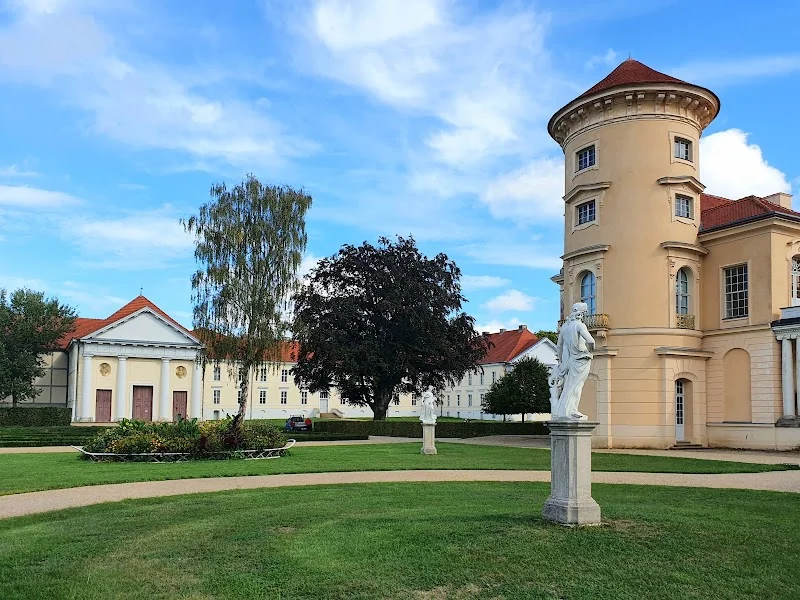
Schloß Rheinsberg 2, Rheinsberg
Schloß Rheinsberg 2, 16831 Rheinsberg, Germany
Rheinsberg Palace | History & Interior
Rheinsberg Palace is much more than a beautiful building by the water. Those searching for rheinsberg palace photos, rheinsberg palace interior, rheinsberg palace history, or rheinsberg park are actually looking for a place where architecture, garden art, literature, and music have been closely intertwined since the 18th century. The palace is picturesque by Lake Grienerick and combines historical rooms, an expansive pleasure garden, and a vibrant cultural program into an excursion that feels equally calm, impressive, and diverse. This mix is precisely what makes Rheinsberg so interesting for day visitors, cultural travelers, and families: one can stroll in the park, explore the interiors, gaze over the water, and simultaneously experience a historical ensemble that is still maintained and used today. The official description emphasizes the character of the Muses' Court of the place, its special location by the lake, and the connection of nature, architecture, and art. ([spsg.de](https://www.spsg.de/schloesser-gaerten/objekt/schloss-rheinsberg))
Visitors experience a museum palace here with original room decorations from the Friderician era and early classical versions from the time of Prince Heinrich. At the same time, the historical Muses' Court continues to live on through special tours, lectures, concerts, and collaborations with the music culture of Rheinsberg and the Kurt Tucholsky Literature Museum. The place is thus not only a destination for history enthusiasts but also for anyone seeking a special atmosphere that is rarely preserved so completely in classical castles. This page organizes the most common search topics around history, interiors, park, access, parking, tickets, and events, and explains why Rheinsberg Palace continues to captivate so many visitors today. ([spsg.de](https://www.spsg.de/schloesser-gaerten/objekt/schloss-rheinsberg))
History of Rheinsberg Palace
The history of Rheinsberg Palace begins in its formative phase with Crown Prince Friedrich, later known as Frederick the Great. From 1736 to 1740, Rheinsberg was his refuge, a place where he had time, space, and leisure to develop ideas for architecture, court life, and garden design. The Foundation of Prussian Palaces and Gardens describes these years as the happiest time of the Crown Prince. Particularly important for historical understanding is that Friedrich expanded the simple Renaissance castle into a three-wing complex with distinctive towers and had the main axes of the pleasure garden laid out. Therefore, anyone interested in schloss rheinsberg history today encounters not only a pretty castle but also an early laboratory phase of Prussian building and garden art, which later found its most famous continuation in Sanssouci. This is where the historical uniqueness of Rheinsberg lies: the ensemble is not merely preserved but is readable as a developmental step of an entire stylistic idea. ([spsg.de](https://www.spsg.de/schloesser-gaerten/objekt/lustgarten-rheinsberg/))
After Friedrich ascended the throne, he gifted the palace and garden to his younger brother Heinrich of Prussia. Under Heinrich, Rheinsberg developed into a Muses' Court, enlarging the estate over the course of half a century to over 300 hectares. He had, among other things, the fieldstone grotto, the hedge theater, the earth terraces beyond Lake Grienerick, the obelisk, and the perspective avenue created. At the same time, the palace became a place of festival, theater, and music culture, thus becoming a center that radiated far beyond its region. This dual history is essential: Friedrich provided the form, Heinrich created a cultural cosmos from it. Even later, the impact remained strong. Adolph Menzel, Theodor Fontane, and the young Kurt Tucholsky contributed to anchoring the myth of the inspiring Muses' Court in literary and cultural history. Rheinsberg is therefore not only a monument of the 18th century but a place whose significance has condensed over several epochs. ([spsg.de](https://www.spsg.de/schloesser-gaerten/objekt/lustgarten-rheinsberg/))
The fact that Rheinsberg still has such a strong impact today is also due to the quality of its restoration and communication. The SPSG emphasizes that the original room decorations from the Friderician era around 1740 and the early classical room versions created under Prince Heinrich around 1786 have been recovered in recent years. This recovery is not just a restoration detail for visitors but the core of the experience: one sees a palace that has not simply been decorated but whose historical layers have been made readable again. Paintings and artisanal objects complement the architecture and make the living culture, the feeling of life, and the collecting passion of the then residents comprehensible. Therefore, those searching for rheinsberg palace reviews often encounter precisely this impression: a historical place with substance, not just a pure photo motif. The combination of authentic history, careful maintenance, and cultural use explains why Rheinsberg has been perceived for decades as one of the most important Prussian memorial sites in Brandenburg. ([spsg.de](https://www.spsg.de/schloesser-gaerten/objekt/schloss-rheinsberg))
Interiors, Mirror Hall, and Grand Tour
Those interested in rheinsberg palace interior will be rewarded at Rheinsberg Palace with a series of rooms that make the character of the house very tangible. The SPSG shows in the impressions, among other things, the Mirror Hall, the Long Chamber, the Shell Hall, the Picture Gallery, the Arched Chamber, and the apartment of Prince Ferdinand. Even this sequence of rooms makes it clear that the palace cannot be reduced to a single representative room but connects different living and staging forms. The renewed wall designs from the time of Friedrich and Heinrich reveal how courtly order and personal collecting culture complemented each other. Particularly the Mirror Hall, the artistically framed wall surfaces, and the historically furnished rooms create an atmosphere that is not museum-cold but remarkably lively. Visitors thus get an impression of how light, perspective, color, and spatial feeling were worked with in the 18th century. These interiors are therefore as popular for photos as they are for cultural-historical classifications. ([spsg.de](https://www.spsg.de/schloesser-gaerten/objekt/schloss-rheinsberg))
The regular visitor route is called Grand Tour Rheinsberg. It connects the palace with the Kurt Tucholsky Literature Museum; in the summer season, the summer apartment of Prince Heinrich is additionally included. This is important for planning because the ticket logic operates seasonally. In winter, the single ticket includes the Grand Tour Rheinsberg and the Literature Museum; in summer, the Grand Tour, the summer apartment, and the Literature Museum. Family tickets are also available in winter and summer formats. Those who prefer to go digital can use the SANSSOUCI app as a multimedia tour; for Rheinsberg Palace, German, English, and Polish are available, and there are also contents for children aged 6 to 9 years. The family rally with the palace backpack offers another way to discover rooms and grounds playfully. The palace is thus not only a place to look at but also a place where the communication consciously addresses different visitor needs. ([spsg.de](https://www.spsg.de/schloesser-gaerten/objekt/schloss-rheinsberg))
Realistic visit planning also includes practical tips that often only become important on-site. For conservation reasons, strollers are not allowed in the exhibition rooms. Luggage cannot be left in the entrance area, but small pieces of luggage can be stored in limited numbers in lockers. This may initially sound trivial, but it is relevant for visitors with daypacks, camera equipment, or family luggage. Equally helpful is the note that the last admission occurs 30 minutes before closing time. Therefore, those who want to approach the visit relaxed should not arrive just before the end but plan enough time for the interiors. The rooms themselves invite slow walking because each room shows different details: decorative frames, wall paintings, furnishings, and perspectives over the lake. For this reason, it is worthwhile to understand the palace and museum not as a short photo stop but as a coherent tour. ([spsg.de](https://www.spsg.de/schloesser-gaerten/objekt/schloss-rheinsberg))
Palace Park and Pleasure Garden by Lake Grienerick
The palace park, officially the Pleasure Garden Rheinsberg, is for many visitors the actual heart of the place. Friedrich had the main axis laid out with the garden portal and a long cross axis, later Heinrich expanded the area with the fieldstone grotto, hedge theater, earth terraces, obelisk, and perspective avenue. This resulted in a garden artwork that still appears today as a composition of lawns, paths, sight axes, and water references. The location by Lake Grienerick enhances this impression because the palace, lake, and park form an ensemble that constantly reflects each other. Therefore, those searching for rheinsberg park find not only a green area but a historically composed landscape space that was deliberately conceived as a pleasure garden in the 18th century. For walks, this is particularly pleasant because one can switch between open areas, shady spots, and wide views. The connection of architecture and nature here is not just a marketing slogan but the actual content of the place. ([spsg.de](https://www.spsg.de/schloesser-gaerten/objekt/lustgarten-rheinsberg/))
The Pleasure Garden is now freely accessible and open daily from 8 a.m. until dusk. This makes it one of the most uncomplicated excursion destinations in Rheinsberg, as the park can also be visited independently of the palace opening hours. At the same time, the garden is a garden monument and is under special protection. This protective function is important because Rheinsberg was not designed as an arbitrary city park but as a cultural-historical facility whose form, vegetation, and sight axes are to be deliberately preserved. The SPSG therefore points to a park regulation and emphasizes that the place must be protected as a space for culture and recreation. Additionally, special tours, lectures, and concerts take place throughout the year in the palace and park. Thus, the Pleasure Garden remains not just a backdrop but a vibrant part of the overall ensemble. Those interested in quiet moments should also utilize the shore and sight relationships: the view from the palace over the lake and back to the ensemble is one of the strongest images of the place. ([spsg.de](https://www.spsg.de/schloesser-gaerten/objekt/lustgarten-rheinsberg/))
The special quality of the park is also evident in that it connects historical staging with current use. The facility was created from the beginning as a place for strolling, marveling, and representing, and that is still palpable today. Even those who come for just an hour experience a very concentrated interplay of garden art, water, sculpture, and architecture in the Pleasure Garden. This also explains why many visitors take their photos right here: the paths, the garden portal, the obelisk, and the view of the palace provide classic image motifs without appearing artificial. At the same time, one should not read the park only as a photo backdrop but as a historical monument that derives its character from the entirety of the facility. For a longer stay, it is worthwhile to plan the park together with the palace and literature museum because then the temporal and content connection of the Muses' Court becomes particularly clear. Those who view the place this way quickly understand why Rheinsberg is considered inspiring across generations. ([spsg.de](https://www.spsg.de/schloesser-gaerten/objekt/lustgarten-rheinsberg/))
Access, Parking, and Barrier-Free Access
Regarding rheinsberg access and rheinsberg parking, the official information is pleasantly clear. The SPSG names Rheinsberg, Schloss as the stop for public transport and also refers to a visitor parking lot near the palace. For guests with mobility impairments, the Brandenburg tourism site additionally mentions a designated disabled parking space next to the tourist information with a maximum parking duration of 60 minutes; in the urban area, there are further designated disabled parking spaces, for example, in Seestraße. Therefore, those arriving without a car can start their visit directly at the palace, and those driving will find parking options in close proximity. This combination of good connections and short distances makes the place attractive for day trips. However, during peak visitor times, it is still advisable to arrive early, as parking spaces in the center of historical places are naturally limited. The main thing is: the palace and the town center are so close together that one can organize the visit very compactly. ([spsg.de](https://www.spsg.de/schloesser-gaerten/objekt/schloss-rheinsberg))
Accessibility should be viewed in a differentiated manner, and this differentiation is important for good planning. The Pleasure Garden is wheelchair accessible, the palace itself is conditionally wheelchair accessible. The tourist details mention step-free paths in the outdoor area, access via elevator, and an outside entrance door with more than 150 centimeters in width. Inside, door widths of 90 centimeters are noted; at the same time, there are several thresholds in the historical building, some of which are sloped but still noticeable. For groups with wheelchairs, it is also noted that only one guest in a wheelchair can be transported at a time and that time should be planned for the ride to the first floor. Assistance dogs are welcome. For conservation reasons, strollers are not allowed in the exhibition rooms. This information shows that the place takes accessibility seriously without concealing historical building substance. Those who plan in advance can approach the visit much more relaxed. ([spsg.de](https://www.spsg.de/schloesser-gaerten/objekt/lustgarten-rheinsberg/))
For practical route selection, it is also helpful that visitors do not have to shuttle between the palace and park but can experience both elements in a compact walking route. The paths in the palace surroundings consist partly of water-bound surfaces, wooden planks, and in the courtyard of rough cobblestones. This mixture is historically plausible but requires some attention depending on mobility. For this reason, a realistic time buffer is worthwhile: those who want to take photos, enjoy the park, and visit the interiors relaxed should not only plan the pure visiting time but also paths, breaks, and potential waiting times. This is especially true for families, guests with strollers, and visitors who rely on elevators or assistance. Rheinsberg is thus not complicated, but it is a historical place whose authentic structure should be considered in planning. This honesty makes the preparation ultimately more pleasant. ([reiseland-brandenburg.de](https://www.reiseland-brandenburg.de/poi/ruppiner-seenland/galerien-und-ateliers/ausstellung-im-kurt-tucholsky-literaturmuseum/))
Tickets, Opening Hours, and Visit Planning
The opening hours of Rheinsberg Palace are clearly regulated seasonally. From April to October, the palace is closed on Mondays and open from Tuesday to Sunday from 10:00 a.m. to 5:30 p.m.; the last admission is 30 minutes before closing time. From November to March, a visit is only possible with a guided tour, and these tours are conducted in German, with information available in other languages. The price structure is also transparent: the single ticket costs 10 euros in winter, reduced 7 euros; in summer 14 euros, reduced 10 euros. Family tickets are available according to the seasonal formats. For visitors, this means primarily one thing: one should not spontaneously assume year-round consistent opening hours but consciously incorporate the season into planning. Those who consider this experience the palace without stress and can enjoy the tour much better. ([spsg.de](https://www.spsg.de/schloesser-gaerten/objekt/schloss-rheinsberg))
Particularly useful is the distinction between palace, museum, and park. The Pleasure Garden is freely accessible and open year-round, while the interiors require tickets and the offerings vary by season. The Grand Tour includes the palace, the summer apartment of Prince Heinrich, and the Kurt Tucholsky Literature Museum in summer; in winter, the tour includes the palace and the literature museum. Family tickets apply to two adults and up to four children. This is for many visitors the best basis to structure a day in Rheinsberg meaningfully: in the morning the interiors, then the park, and finally perhaps a detour to the literature museum or a longer walk by the lake. Therefore, those searching for schloss rheinsberg tickets should not only look at the price but also at the seasonal package. This combination logic makes the visit efficient and varied at the same time. ([spsg.de](https://www.spsg.de/schloesser-gaerten/objekt/schloss-rheinsberg))
Digital and family-friendly offerings are also part of visit planning. The SANSSOUCI app serves as a multimedia companion through the palaces and parks of the SPSG, and several language versions are available for Rheinsberg Palace. The palace backpack rally offers a playful way for families and younger visitors to explore. Such offerings are important because they not only explain the historical place but also make it actively experienceable. At the same time, one should not underestimate the practical tips: luggage cannot be left in the entrance area, and only limited lockers are available for small pieces of luggage. Therefore, those coming with a lot of equipment should plan more minimally. This way, a visit remains rich in content and organizationally relaxed. Especially at a place like Rheinsberg, good preparation pays off because then one not only sees something but can truly absorb the atmosphere of the ensemble. ([spsg.de](https://www.spsg.de/schloesser-gaerten/objekt/schloss-rheinsberg))
Events, Concerts, and Cultural Life
Rheinsberg Palace is still a cultural venue with a real program. The SPSG explicitly describes the former Muses' Court as a lively connection between the palace, music culture of Rheinsberg, and the Kurt Tucholsky Literature Museum. In addition to the museum use, there are special tours, lectures, and concerts throughout the year. Additionally, the historical palace courtyard, which has already been the scene of gallant festivities in the past, can now be used as an event location. This continuity is a large part of Rheinsberg's charm: the palace does not just stand still as a monument but continues to function as a place of exchange, performance, and communication. Therefore, those searching for kammeroper schloss rheinsberg or events in Rheinsberg land at a place where history and present actually intertwine. ([spsg.de](https://www.spsg.de/schloesser-gaerten/objekt/schloss-rheinsberg))
The cultural identity of the place is also supported by literary and musical references. Theodor Fontane, Kurt Tucholsky, and the tradition of the Muses' Court have made Rheinsberg known far beyond Brandenburg. At the same time, the current program shows that the use has not become museum-like and stagnant. The annual availability of special tours, the thematic formats around Heinrich of Prussia, and the musical use of the ensemble make clear why visitors are still inspired by the place today. This is particularly important for search queries like rheinsberg palace photos or rheinsberg palace reviews: the images and impressions arise here not from mere decoration but from a genuine cultural density. Therefore, those visiting the place experience not only beautiful interiors or a beautiful park but an ensemble that has historically grown and continues to be maintained, enlivened, and communicated as cultural heritage in the 21st century. ([spsg.de](https://www.spsg.de/schloesser-gaerten/objekt/schloss-rheinsberg))
In the end, Rheinsberg shows exactly what many visitors are looking for without always naming it in advance: a place with a clear history, strong ambiance, and well-readable visitor paths. One can see the palace in its historical core, understand the park as a garden artwork, plan tickets seasonally, and experience the events as a lively continuation of the Muses' Court. Those who build the day this way not only take beautiful photos with them but also a comprehensible impression of why Rheinsberg has fascinated since the days of Friedrich. The palace is thus an ideal destination for cultural travelers, couples, families, and anyone who wants to not only look at historical places but experience them in the interplay of space, landscape, and program. ([spsg.de](https://www.spsg.de/schloesser-gaerten/objekt/schloss-rheinsberg))
Sources:
Show moreShow less
Rheinsberg Palace | History & Interior
Rheinsberg Palace is much more than a beautiful building by the water. Those searching for rheinsberg palace photos, rheinsberg palace interior, rheinsberg palace history, or rheinsberg park are actually looking for a place where architecture, garden art, literature, and music have been closely intertwined since the 18th century. The palace is picturesque by Lake Grienerick and combines historical rooms, an expansive pleasure garden, and a vibrant cultural program into an excursion that feels equally calm, impressive, and diverse. This mix is precisely what makes Rheinsberg so interesting for day visitors, cultural travelers, and families: one can stroll in the park, explore the interiors, gaze over the water, and simultaneously experience a historical ensemble that is still maintained and used today. The official description emphasizes the character of the Muses' Court of the place, its special location by the lake, and the connection of nature, architecture, and art. ([spsg.de](https://www.spsg.de/schloesser-gaerten/objekt/schloss-rheinsberg))
Visitors experience a museum palace here with original room decorations from the Friderician era and early classical versions from the time of Prince Heinrich. At the same time, the historical Muses' Court continues to live on through special tours, lectures, concerts, and collaborations with the music culture of Rheinsberg and the Kurt Tucholsky Literature Museum. The place is thus not only a destination for history enthusiasts but also for anyone seeking a special atmosphere that is rarely preserved so completely in classical castles. This page organizes the most common search topics around history, interiors, park, access, parking, tickets, and events, and explains why Rheinsberg Palace continues to captivate so many visitors today. ([spsg.de](https://www.spsg.de/schloesser-gaerten/objekt/schloss-rheinsberg))
History of Rheinsberg Palace
The history of Rheinsberg Palace begins in its formative phase with Crown Prince Friedrich, later known as Frederick the Great. From 1736 to 1740, Rheinsberg was his refuge, a place where he had time, space, and leisure to develop ideas for architecture, court life, and garden design. The Foundation of Prussian Palaces and Gardens describes these years as the happiest time of the Crown Prince. Particularly important for historical understanding is that Friedrich expanded the simple Renaissance castle into a three-wing complex with distinctive towers and had the main axes of the pleasure garden laid out. Therefore, anyone interested in schloss rheinsberg history today encounters not only a pretty castle but also an early laboratory phase of Prussian building and garden art, which later found its most famous continuation in Sanssouci. This is where the historical uniqueness of Rheinsberg lies: the ensemble is not merely preserved but is readable as a developmental step of an entire stylistic idea. ([spsg.de](https://www.spsg.de/schloesser-gaerten/objekt/lustgarten-rheinsberg/))
After Friedrich ascended the throne, he gifted the palace and garden to his younger brother Heinrich of Prussia. Under Heinrich, Rheinsberg developed into a Muses' Court, enlarging the estate over the course of half a century to over 300 hectares. He had, among other things, the fieldstone grotto, the hedge theater, the earth terraces beyond Lake Grienerick, the obelisk, and the perspective avenue created. At the same time, the palace became a place of festival, theater, and music culture, thus becoming a center that radiated far beyond its region. This dual history is essential: Friedrich provided the form, Heinrich created a cultural cosmos from it. Even later, the impact remained strong. Adolph Menzel, Theodor Fontane, and the young Kurt Tucholsky contributed to anchoring the myth of the inspiring Muses' Court in literary and cultural history. Rheinsberg is therefore not only a monument of the 18th century but a place whose significance has condensed over several epochs. ([spsg.de](https://www.spsg.de/schloesser-gaerten/objekt/lustgarten-rheinsberg/))
The fact that Rheinsberg still has such a strong impact today is also due to the quality of its restoration and communication. The SPSG emphasizes that the original room decorations from the Friderician era around 1740 and the early classical room versions created under Prince Heinrich around 1786 have been recovered in recent years. This recovery is not just a restoration detail for visitors but the core of the experience: one sees a palace that has not simply been decorated but whose historical layers have been made readable again. Paintings and artisanal objects complement the architecture and make the living culture, the feeling of life, and the collecting passion of the then residents comprehensible. Therefore, those searching for rheinsberg palace reviews often encounter precisely this impression: a historical place with substance, not just a pure photo motif. The combination of authentic history, careful maintenance, and cultural use explains why Rheinsberg has been perceived for decades as one of the most important Prussian memorial sites in Brandenburg. ([spsg.de](https://www.spsg.de/schloesser-gaerten/objekt/schloss-rheinsberg))
Interiors, Mirror Hall, and Grand Tour
Those interested in rheinsberg palace interior will be rewarded at Rheinsberg Palace with a series of rooms that make the character of the house very tangible. The SPSG shows in the impressions, among other things, the Mirror Hall, the Long Chamber, the Shell Hall, the Picture Gallery, the Arched Chamber, and the apartment of Prince Ferdinand. Even this sequence of rooms makes it clear that the palace cannot be reduced to a single representative room but connects different living and staging forms. The renewed wall designs from the time of Friedrich and Heinrich reveal how courtly order and personal collecting culture complemented each other. Particularly the Mirror Hall, the artistically framed wall surfaces, and the historically furnished rooms create an atmosphere that is not museum-cold but remarkably lively. Visitors thus get an impression of how light, perspective, color, and spatial feeling were worked with in the 18th century. These interiors are therefore as popular for photos as they are for cultural-historical classifications. ([spsg.de](https://www.spsg.de/schloesser-gaerten/objekt/schloss-rheinsberg))
The regular visitor route is called Grand Tour Rheinsberg. It connects the palace with the Kurt Tucholsky Literature Museum; in the summer season, the summer apartment of Prince Heinrich is additionally included. This is important for planning because the ticket logic operates seasonally. In winter, the single ticket includes the Grand Tour Rheinsberg and the Literature Museum; in summer, the Grand Tour, the summer apartment, and the Literature Museum. Family tickets are also available in winter and summer formats. Those who prefer to go digital can use the SANSSOUCI app as a multimedia tour; for Rheinsberg Palace, German, English, and Polish are available, and there are also contents for children aged 6 to 9 years. The family rally with the palace backpack offers another way to discover rooms and grounds playfully. The palace is thus not only a place to look at but also a place where the communication consciously addresses different visitor needs. ([spsg.de](https://www.spsg.de/schloesser-gaerten/objekt/schloss-rheinsberg))
Realistic visit planning also includes practical tips that often only become important on-site. For conservation reasons, strollers are not allowed in the exhibition rooms. Luggage cannot be left in the entrance area, but small pieces of luggage can be stored in limited numbers in lockers. This may initially sound trivial, but it is relevant for visitors with daypacks, camera equipment, or family luggage. Equally helpful is the note that the last admission occurs 30 minutes before closing time. Therefore, those who want to approach the visit relaxed should not arrive just before the end but plan enough time for the interiors. The rooms themselves invite slow walking because each room shows different details: decorative frames, wall paintings, furnishings, and perspectives over the lake. For this reason, it is worthwhile to understand the palace and museum not as a short photo stop but as a coherent tour. ([spsg.de](https://www.spsg.de/schloesser-gaerten/objekt/schloss-rheinsberg))
Palace Park and Pleasure Garden by Lake Grienerick
The palace park, officially the Pleasure Garden Rheinsberg, is for many visitors the actual heart of the place. Friedrich had the main axis laid out with the garden portal and a long cross axis, later Heinrich expanded the area with the fieldstone grotto, hedge theater, earth terraces, obelisk, and perspective avenue. This resulted in a garden artwork that still appears today as a composition of lawns, paths, sight axes, and water references. The location by Lake Grienerick enhances this impression because the palace, lake, and park form an ensemble that constantly reflects each other. Therefore, those searching for rheinsberg park find not only a green area but a historically composed landscape space that was deliberately conceived as a pleasure garden in the 18th century. For walks, this is particularly pleasant because one can switch between open areas, shady spots, and wide views. The connection of architecture and nature here is not just a marketing slogan but the actual content of the place. ([spsg.de](https://www.spsg.de/schloesser-gaerten/objekt/lustgarten-rheinsberg/))
The Pleasure Garden is now freely accessible and open daily from 8 a.m. until dusk. This makes it one of the most uncomplicated excursion destinations in Rheinsberg, as the park can also be visited independently of the palace opening hours. At the same time, the garden is a garden monument and is under special protection. This protective function is important because Rheinsberg was not designed as an arbitrary city park but as a cultural-historical facility whose form, vegetation, and sight axes are to be deliberately preserved. The SPSG therefore points to a park regulation and emphasizes that the place must be protected as a space for culture and recreation. Additionally, special tours, lectures, and concerts take place throughout the year in the palace and park. Thus, the Pleasure Garden remains not just a backdrop but a vibrant part of the overall ensemble. Those interested in quiet moments should also utilize the shore and sight relationships: the view from the palace over the lake and back to the ensemble is one of the strongest images of the place. ([spsg.de](https://www.spsg.de/schloesser-gaerten/objekt/lustgarten-rheinsberg/))
The special quality of the park is also evident in that it connects historical staging with current use. The facility was created from the beginning as a place for strolling, marveling, and representing, and that is still palpable today. Even those who come for just an hour experience a very concentrated interplay of garden art, water, sculpture, and architecture in the Pleasure Garden. This also explains why many visitors take their photos right here: the paths, the garden portal, the obelisk, and the view of the palace provide classic image motifs without appearing artificial. At the same time, one should not read the park only as a photo backdrop but as a historical monument that derives its character from the entirety of the facility. For a longer stay, it is worthwhile to plan the park together with the palace and literature museum because then the temporal and content connection of the Muses' Court becomes particularly clear. Those who view the place this way quickly understand why Rheinsberg is considered inspiring across generations. ([spsg.de](https://www.spsg.de/schloesser-gaerten/objekt/lustgarten-rheinsberg/))
Access, Parking, and Barrier-Free Access
Regarding rheinsberg access and rheinsberg parking, the official information is pleasantly clear. The SPSG names Rheinsberg, Schloss as the stop for public transport and also refers to a visitor parking lot near the palace. For guests with mobility impairments, the Brandenburg tourism site additionally mentions a designated disabled parking space next to the tourist information with a maximum parking duration of 60 minutes; in the urban area, there are further designated disabled parking spaces, for example, in Seestraße. Therefore, those arriving without a car can start their visit directly at the palace, and those driving will find parking options in close proximity. This combination of good connections and short distances makes the place attractive for day trips. However, during peak visitor times, it is still advisable to arrive early, as parking spaces in the center of historical places are naturally limited. The main thing is: the palace and the town center are so close together that one can organize the visit very compactly. ([spsg.de](https://www.spsg.de/schloesser-gaerten/objekt/schloss-rheinsberg))
Accessibility should be viewed in a differentiated manner, and this differentiation is important for good planning. The Pleasure Garden is wheelchair accessible, the palace itself is conditionally wheelchair accessible. The tourist details mention step-free paths in the outdoor area, access via elevator, and an outside entrance door with more than 150 centimeters in width. Inside, door widths of 90 centimeters are noted; at the same time, there are several thresholds in the historical building, some of which are sloped but still noticeable. For groups with wheelchairs, it is also noted that only one guest in a wheelchair can be transported at a time and that time should be planned for the ride to the first floor. Assistance dogs are welcome. For conservation reasons, strollers are not allowed in the exhibition rooms. This information shows that the place takes accessibility seriously without concealing historical building substance. Those who plan in advance can approach the visit much more relaxed. ([spsg.de](https://www.spsg.de/schloesser-gaerten/objekt/lustgarten-rheinsberg/))
For practical route selection, it is also helpful that visitors do not have to shuttle between the palace and park but can experience both elements in a compact walking route. The paths in the palace surroundings consist partly of water-bound surfaces, wooden planks, and in the courtyard of rough cobblestones. This mixture is historically plausible but requires some attention depending on mobility. For this reason, a realistic time buffer is worthwhile: those who want to take photos, enjoy the park, and visit the interiors relaxed should not only plan the pure visiting time but also paths, breaks, and potential waiting times. This is especially true for families, guests with strollers, and visitors who rely on elevators or assistance. Rheinsberg is thus not complicated, but it is a historical place whose authentic structure should be considered in planning. This honesty makes the preparation ultimately more pleasant. ([reiseland-brandenburg.de](https://www.reiseland-brandenburg.de/poi/ruppiner-seenland/galerien-und-ateliers/ausstellung-im-kurt-tucholsky-literaturmuseum/))
Tickets, Opening Hours, and Visit Planning
The opening hours of Rheinsberg Palace are clearly regulated seasonally. From April to October, the palace is closed on Mondays and open from Tuesday to Sunday from 10:00 a.m. to 5:30 p.m.; the last admission is 30 minutes before closing time. From November to March, a visit is only possible with a guided tour, and these tours are conducted in German, with information available in other languages. The price structure is also transparent: the single ticket costs 10 euros in winter, reduced 7 euros; in summer 14 euros, reduced 10 euros. Family tickets are available according to the seasonal formats. For visitors, this means primarily one thing: one should not spontaneously assume year-round consistent opening hours but consciously incorporate the season into planning. Those who consider this experience the palace without stress and can enjoy the tour much better. ([spsg.de](https://www.spsg.de/schloesser-gaerten/objekt/schloss-rheinsberg))
Particularly useful is the distinction between palace, museum, and park. The Pleasure Garden is freely accessible and open year-round, while the interiors require tickets and the offerings vary by season. The Grand Tour includes the palace, the summer apartment of Prince Heinrich, and the Kurt Tucholsky Literature Museum in summer; in winter, the tour includes the palace and the literature museum. Family tickets apply to two adults and up to four children. This is for many visitors the best basis to structure a day in Rheinsberg meaningfully: in the morning the interiors, then the park, and finally perhaps a detour to the literature museum or a longer walk by the lake. Therefore, those searching for schloss rheinsberg tickets should not only look at the price but also at the seasonal package. This combination logic makes the visit efficient and varied at the same time. ([spsg.de](https://www.spsg.de/schloesser-gaerten/objekt/schloss-rheinsberg))
Digital and family-friendly offerings are also part of visit planning. The SANSSOUCI app serves as a multimedia companion through the palaces and parks of the SPSG, and several language versions are available for Rheinsberg Palace. The palace backpack rally offers a playful way for families and younger visitors to explore. Such offerings are important because they not only explain the historical place but also make it actively experienceable. At the same time, one should not underestimate the practical tips: luggage cannot be left in the entrance area, and only limited lockers are available for small pieces of luggage. Therefore, those coming with a lot of equipment should plan more minimally. This way, a visit remains rich in content and organizationally relaxed. Especially at a place like Rheinsberg, good preparation pays off because then one not only sees something but can truly absorb the atmosphere of the ensemble. ([spsg.de](https://www.spsg.de/schloesser-gaerten/objekt/schloss-rheinsberg))
Events, Concerts, and Cultural Life
Rheinsberg Palace is still a cultural venue with a real program. The SPSG explicitly describes the former Muses' Court as a lively connection between the palace, music culture of Rheinsberg, and the Kurt Tucholsky Literature Museum. In addition to the museum use, there are special tours, lectures, and concerts throughout the year. Additionally, the historical palace courtyard, which has already been the scene of gallant festivities in the past, can now be used as an event location. This continuity is a large part of Rheinsberg's charm: the palace does not just stand still as a monument but continues to function as a place of exchange, performance, and communication. Therefore, those searching for kammeroper schloss rheinsberg or events in Rheinsberg land at a place where history and present actually intertwine. ([spsg.de](https://www.spsg.de/schloesser-gaerten/objekt/schloss-rheinsberg))
The cultural identity of the place is also supported by literary and musical references. Theodor Fontane, Kurt Tucholsky, and the tradition of the Muses' Court have made Rheinsberg known far beyond Brandenburg. At the same time, the current program shows that the use has not become museum-like and stagnant. The annual availability of special tours, the thematic formats around Heinrich of Prussia, and the musical use of the ensemble make clear why visitors are still inspired by the place today. This is particularly important for search queries like rheinsberg palace photos or rheinsberg palace reviews: the images and impressions arise here not from mere decoration but from a genuine cultural density. Therefore, those visiting the place experience not only beautiful interiors or a beautiful park but an ensemble that has historically grown and continues to be maintained, enlivened, and communicated as cultural heritage in the 21st century. ([spsg.de](https://www.spsg.de/schloesser-gaerten/objekt/schloss-rheinsberg))
In the end, Rheinsberg shows exactly what many visitors are looking for without always naming it in advance: a place with a clear history, strong ambiance, and well-readable visitor paths. One can see the palace in its historical core, understand the park as a garden artwork, plan tickets seasonally, and experience the events as a lively continuation of the Muses' Court. Those who build the day this way not only take beautiful photos with them but also a comprehensible impression of why Rheinsberg has fascinated since the days of Friedrich. The palace is thus an ideal destination for cultural travelers, couples, families, and anyone who wants to not only look at historical places but experience them in the interplay of space, landscape, and program. ([spsg.de](https://www.spsg.de/schloesser-gaerten/objekt/schloss-rheinsberg))
Sources:
Rheinsberg Palace | History & Interior
Rheinsberg Palace is much more than a beautiful building by the water. Those searching for rheinsberg palace photos, rheinsberg palace interior, rheinsberg palace history, or rheinsberg park are actually looking for a place where architecture, garden art, literature, and music have been closely intertwined since the 18th century. The palace is picturesque by Lake Grienerick and combines historical rooms, an expansive pleasure garden, and a vibrant cultural program into an excursion that feels equally calm, impressive, and diverse. This mix is precisely what makes Rheinsberg so interesting for day visitors, cultural travelers, and families: one can stroll in the park, explore the interiors, gaze over the water, and simultaneously experience a historical ensemble that is still maintained and used today. The official description emphasizes the character of the Muses' Court of the place, its special location by the lake, and the connection of nature, architecture, and art. ([spsg.de](https://www.spsg.de/schloesser-gaerten/objekt/schloss-rheinsberg))
Visitors experience a museum palace here with original room decorations from the Friderician era and early classical versions from the time of Prince Heinrich. At the same time, the historical Muses' Court continues to live on through special tours, lectures, concerts, and collaborations with the music culture of Rheinsberg and the Kurt Tucholsky Literature Museum. The place is thus not only a destination for history enthusiasts but also for anyone seeking a special atmosphere that is rarely preserved so completely in classical castles. This page organizes the most common search topics around history, interiors, park, access, parking, tickets, and events, and explains why Rheinsberg Palace continues to captivate so many visitors today. ([spsg.de](https://www.spsg.de/schloesser-gaerten/objekt/schloss-rheinsberg))
History of Rheinsberg Palace
The history of Rheinsberg Palace begins in its formative phase with Crown Prince Friedrich, later known as Frederick the Great. From 1736 to 1740, Rheinsberg was his refuge, a place where he had time, space, and leisure to develop ideas for architecture, court life, and garden design. The Foundation of Prussian Palaces and Gardens describes these years as the happiest time of the Crown Prince. Particularly important for historical understanding is that Friedrich expanded the simple Renaissance castle into a three-wing complex with distinctive towers and had the main axes of the pleasure garden laid out. Therefore, anyone interested in schloss rheinsberg history today encounters not only a pretty castle but also an early laboratory phase of Prussian building and garden art, which later found its most famous continuation in Sanssouci. This is where the historical uniqueness of Rheinsberg lies: the ensemble is not merely preserved but is readable as a developmental step of an entire stylistic idea. ([spsg.de](https://www.spsg.de/schloesser-gaerten/objekt/lustgarten-rheinsberg/))
After Friedrich ascended the throne, he gifted the palace and garden to his younger brother Heinrich of Prussia. Under Heinrich, Rheinsberg developed into a Muses' Court, enlarging the estate over the course of half a century to over 300 hectares. He had, among other things, the fieldstone grotto, the hedge theater, the earth terraces beyond Lake Grienerick, the obelisk, and the perspective avenue created. At the same time, the palace became a place of festival, theater, and music culture, thus becoming a center that radiated far beyond its region. This dual history is essential: Friedrich provided the form, Heinrich created a cultural cosmos from it. Even later, the impact remained strong. Adolph Menzel, Theodor Fontane, and the young Kurt Tucholsky contributed to anchoring the myth of the inspiring Muses' Court in literary and cultural history. Rheinsberg is therefore not only a monument of the 18th century but a place whose significance has condensed over several epochs. ([spsg.de](https://www.spsg.de/schloesser-gaerten/objekt/lustgarten-rheinsberg/))
The fact that Rheinsberg still has such a strong impact today is also due to the quality of its restoration and communication. The SPSG emphasizes that the original room decorations from the Friderician era around 1740 and the early classical room versions created under Prince Heinrich around 1786 have been recovered in recent years. This recovery is not just a restoration detail for visitors but the core of the experience: one sees a palace that has not simply been decorated but whose historical layers have been made readable again. Paintings and artisanal objects complement the architecture and make the living culture, the feeling of life, and the collecting passion of the then residents comprehensible. Therefore, those searching for rheinsberg palace reviews often encounter precisely this impression: a historical place with substance, not just a pure photo motif. The combination of authentic history, careful maintenance, and cultural use explains why Rheinsberg has been perceived for decades as one of the most important Prussian memorial sites in Brandenburg. ([spsg.de](https://www.spsg.de/schloesser-gaerten/objekt/schloss-rheinsberg))
Interiors, Mirror Hall, and Grand Tour
Those interested in rheinsberg palace interior will be rewarded at Rheinsberg Palace with a series of rooms that make the character of the house very tangible. The SPSG shows in the impressions, among other things, the Mirror Hall, the Long Chamber, the Shell Hall, the Picture Gallery, the Arched Chamber, and the apartment of Prince Ferdinand. Even this sequence of rooms makes it clear that the palace cannot be reduced to a single representative room but connects different living and staging forms. The renewed wall designs from the time of Friedrich and Heinrich reveal how courtly order and personal collecting culture complemented each other. Particularly the Mirror Hall, the artistically framed wall surfaces, and the historically furnished rooms create an atmosphere that is not museum-cold but remarkably lively. Visitors thus get an impression of how light, perspective, color, and spatial feeling were worked with in the 18th century. These interiors are therefore as popular for photos as they are for cultural-historical classifications. ([spsg.de](https://www.spsg.de/schloesser-gaerten/objekt/schloss-rheinsberg))
The regular visitor route is called Grand Tour Rheinsberg. It connects the palace with the Kurt Tucholsky Literature Museum; in the summer season, the summer apartment of Prince Heinrich is additionally included. This is important for planning because the ticket logic operates seasonally. In winter, the single ticket includes the Grand Tour Rheinsberg and the Literature Museum; in summer, the Grand Tour, the summer apartment, and the Literature Museum. Family tickets are also available in winter and summer formats. Those who prefer to go digital can use the SANSSOUCI app as a multimedia tour; for Rheinsberg Palace, German, English, and Polish are available, and there are also contents for children aged 6 to 9 years. The family rally with the palace backpack offers another way to discover rooms and grounds playfully. The palace is thus not only a place to look at but also a place where the communication consciously addresses different visitor needs. ([spsg.de](https://www.spsg.de/schloesser-gaerten/objekt/schloss-rheinsberg))
Realistic visit planning also includes practical tips that often only become important on-site. For conservation reasons, strollers are not allowed in the exhibition rooms. Luggage cannot be left in the entrance area, but small pieces of luggage can be stored in limited numbers in lockers. This may initially sound trivial, but it is relevant for visitors with daypacks, camera equipment, or family luggage. Equally helpful is the note that the last admission occurs 30 minutes before closing time. Therefore, those who want to approach the visit relaxed should not arrive just before the end but plan enough time for the interiors. The rooms themselves invite slow walking because each room shows different details: decorative frames, wall paintings, furnishings, and perspectives over the lake. For this reason, it is worthwhile to understand the palace and museum not as a short photo stop but as a coherent tour. ([spsg.de](https://www.spsg.de/schloesser-gaerten/objekt/schloss-rheinsberg))
Palace Park and Pleasure Garden by Lake Grienerick
The palace park, officially the Pleasure Garden Rheinsberg, is for many visitors the actual heart of the place. Friedrich had the main axis laid out with the garden portal and a long cross axis, later Heinrich expanded the area with the fieldstone grotto, hedge theater, earth terraces, obelisk, and perspective avenue. This resulted in a garden artwork that still appears today as a composition of lawns, paths, sight axes, and water references. The location by Lake Grienerick enhances this impression because the palace, lake, and park form an ensemble that constantly reflects each other. Therefore, those searching for rheinsberg park find not only a green area but a historically composed landscape space that was deliberately conceived as a pleasure garden in the 18th century. For walks, this is particularly pleasant because one can switch between open areas, shady spots, and wide views. The connection of architecture and nature here is not just a marketing slogan but the actual content of the place. ([spsg.de](https://www.spsg.de/schloesser-gaerten/objekt/lustgarten-rheinsberg/))
The Pleasure Garden is now freely accessible and open daily from 8 a.m. until dusk. This makes it one of the most uncomplicated excursion destinations in Rheinsberg, as the park can also be visited independently of the palace opening hours. At the same time, the garden is a garden monument and is under special protection. This protective function is important because Rheinsberg was not designed as an arbitrary city park but as a cultural-historical facility whose form, vegetation, and sight axes are to be deliberately preserved. The SPSG therefore points to a park regulation and emphasizes that the place must be protected as a space for culture and recreation. Additionally, special tours, lectures, and concerts take place throughout the year in the palace and park. Thus, the Pleasure Garden remains not just a backdrop but a vibrant part of the overall ensemble. Those interested in quiet moments should also utilize the shore and sight relationships: the view from the palace over the lake and back to the ensemble is one of the strongest images of the place. ([spsg.de](https://www.spsg.de/schloesser-gaerten/objekt/lustgarten-rheinsberg/))
The special quality of the park is also evident in that it connects historical staging with current use. The facility was created from the beginning as a place for strolling, marveling, and representing, and that is still palpable today. Even those who come for just an hour experience a very concentrated interplay of garden art, water, sculpture, and architecture in the Pleasure Garden. This also explains why many visitors take their photos right here: the paths, the garden portal, the obelisk, and the view of the palace provide classic image motifs without appearing artificial. At the same time, one should not read the park only as a photo backdrop but as a historical monument that derives its character from the entirety of the facility. For a longer stay, it is worthwhile to plan the park together with the palace and literature museum because then the temporal and content connection of the Muses' Court becomes particularly clear. Those who view the place this way quickly understand why Rheinsberg is considered inspiring across generations. ([spsg.de](https://www.spsg.de/schloesser-gaerten/objekt/lustgarten-rheinsberg/))
Access, Parking, and Barrier-Free Access
Regarding rheinsberg access and rheinsberg parking, the official information is pleasantly clear. The SPSG names Rheinsberg, Schloss as the stop for public transport and also refers to a visitor parking lot near the palace. For guests with mobility impairments, the Brandenburg tourism site additionally mentions a designated disabled parking space next to the tourist information with a maximum parking duration of 60 minutes; in the urban area, there are further designated disabled parking spaces, for example, in Seestraße. Therefore, those arriving without a car can start their visit directly at the palace, and those driving will find parking options in close proximity. This combination of good connections and short distances makes the place attractive for day trips. However, during peak visitor times, it is still advisable to arrive early, as parking spaces in the center of historical places are naturally limited. The main thing is: the palace and the town center are so close together that one can organize the visit very compactly. ([spsg.de](https://www.spsg.de/schloesser-gaerten/objekt/schloss-rheinsberg))
Accessibility should be viewed in a differentiated manner, and this differentiation is important for good planning. The Pleasure Garden is wheelchair accessible, the palace itself is conditionally wheelchair accessible. The tourist details mention step-free paths in the outdoor area, access via elevator, and an outside entrance door with more than 150 centimeters in width. Inside, door widths of 90 centimeters are noted; at the same time, there are several thresholds in the historical building, some of which are sloped but still noticeable. For groups with wheelchairs, it is also noted that only one guest in a wheelchair can be transported at a time and that time should be planned for the ride to the first floor. Assistance dogs are welcome. For conservation reasons, strollers are not allowed in the exhibition rooms. This information shows that the place takes accessibility seriously without concealing historical building substance. Those who plan in advance can approach the visit much more relaxed. ([spsg.de](https://www.spsg.de/schloesser-gaerten/objekt/lustgarten-rheinsberg/))
For practical route selection, it is also helpful that visitors do not have to shuttle between the palace and park but can experience both elements in a compact walking route. The paths in the palace surroundings consist partly of water-bound surfaces, wooden planks, and in the courtyard of rough cobblestones. This mixture is historically plausible but requires some attention depending on mobility. For this reason, a realistic time buffer is worthwhile: those who want to take photos, enjoy the park, and visit the interiors relaxed should not only plan the pure visiting time but also paths, breaks, and potential waiting times. This is especially true for families, guests with strollers, and visitors who rely on elevators or assistance. Rheinsberg is thus not complicated, but it is a historical place whose authentic structure should be considered in planning. This honesty makes the preparation ultimately more pleasant. ([reiseland-brandenburg.de](https://www.reiseland-brandenburg.de/poi/ruppiner-seenland/galerien-und-ateliers/ausstellung-im-kurt-tucholsky-literaturmuseum/))
Tickets, Opening Hours, and Visit Planning
The opening hours of Rheinsberg Palace are clearly regulated seasonally. From April to October, the palace is closed on Mondays and open from Tuesday to Sunday from 10:00 a.m. to 5:30 p.m.; the last admission is 30 minutes before closing time. From November to March, a visit is only possible with a guided tour, and these tours are conducted in German, with information available in other languages. The price structure is also transparent: the single ticket costs 10 euros in winter, reduced 7 euros; in summer 14 euros, reduced 10 euros. Family tickets are available according to the seasonal formats. For visitors, this means primarily one thing: one should not spontaneously assume year-round consistent opening hours but consciously incorporate the season into planning. Those who consider this experience the palace without stress and can enjoy the tour much better. ([spsg.de](https://www.spsg.de/schloesser-gaerten/objekt/schloss-rheinsberg))
Particularly useful is the distinction between palace, museum, and park. The Pleasure Garden is freely accessible and open year-round, while the interiors require tickets and the offerings vary by season. The Grand Tour includes the palace, the summer apartment of Prince Heinrich, and the Kurt Tucholsky Literature Museum in summer; in winter, the tour includes the palace and the literature museum. Family tickets apply to two adults and up to four children. This is for many visitors the best basis to structure a day in Rheinsberg meaningfully: in the morning the interiors, then the park, and finally perhaps a detour to the literature museum or a longer walk by the lake. Therefore, those searching for schloss rheinsberg tickets should not only look at the price but also at the seasonal package. This combination logic makes the visit efficient and varied at the same time. ([spsg.de](https://www.spsg.de/schloesser-gaerten/objekt/schloss-rheinsberg))
Digital and family-friendly offerings are also part of visit planning. The SANSSOUCI app serves as a multimedia companion through the palaces and parks of the SPSG, and several language versions are available for Rheinsberg Palace. The palace backpack rally offers a playful way for families and younger visitors to explore. Such offerings are important because they not only explain the historical place but also make it actively experienceable. At the same time, one should not underestimate the practical tips: luggage cannot be left in the entrance area, and only limited lockers are available for small pieces of luggage. Therefore, those coming with a lot of equipment should plan more minimally. This way, a visit remains rich in content and organizationally relaxed. Especially at a place like Rheinsberg, good preparation pays off because then one not only sees something but can truly absorb the atmosphere of the ensemble. ([spsg.de](https://www.spsg.de/schloesser-gaerten/objekt/schloss-rheinsberg))
Events, Concerts, and Cultural Life
Rheinsberg Palace is still a cultural venue with a real program. The SPSG explicitly describes the former Muses' Court as a lively connection between the palace, music culture of Rheinsberg, and the Kurt Tucholsky Literature Museum. In addition to the museum use, there are special tours, lectures, and concerts throughout the year. Additionally, the historical palace courtyard, which has already been the scene of gallant festivities in the past, can now be used as an event location. This continuity is a large part of Rheinsberg's charm: the palace does not just stand still as a monument but continues to function as a place of exchange, performance, and communication. Therefore, those searching for kammeroper schloss rheinsberg or events in Rheinsberg land at a place where history and present actually intertwine. ([spsg.de](https://www.spsg.de/schloesser-gaerten/objekt/schloss-rheinsberg))
The cultural identity of the place is also supported by literary and musical references. Theodor Fontane, Kurt Tucholsky, and the tradition of the Muses' Court have made Rheinsberg known far beyond Brandenburg. At the same time, the current program shows that the use has not become museum-like and stagnant. The annual availability of special tours, the thematic formats around Heinrich of Prussia, and the musical use of the ensemble make clear why visitors are still inspired by the place today. This is particularly important for search queries like rheinsberg palace photos or rheinsberg palace reviews: the images and impressions arise here not from mere decoration but from a genuine cultural density. Therefore, those visiting the place experience not only beautiful interiors or a beautiful park but an ensemble that has historically grown and continues to be maintained, enlivened, and communicated as cultural heritage in the 21st century. ([spsg.de](https://www.spsg.de/schloesser-gaerten/objekt/schloss-rheinsberg))
In the end, Rheinsberg shows exactly what many visitors are looking for without always naming it in advance: a place with a clear history, strong ambiance, and well-readable visitor paths. One can see the palace in its historical core, understand the park as a garden artwork, plan tickets seasonally, and experience the events as a lively continuation of the Muses' Court. Those who build the day this way not only take beautiful photos with them but also a comprehensible impression of why Rheinsberg has fascinated since the days of Friedrich. The palace is thus an ideal destination for cultural travelers, couples, families, and anyone who wants to not only look at historical places but experience them in the interplay of space, landscape, and program. ([spsg.de](https://www.spsg.de/schloesser-gaerten/objekt/schloss-rheinsberg))
Sources:
Upcoming Events
No events found
Frequently Asked Questions
Reviews
TH3 TR/\V1R
20. November 2025
Beautiful small Prussian palace at the lake. There's a museum inside and a huge park connected to the forest which is inviting for a great walk in nature.
OE. Kjærsland
5. September 2025
Definitely worth a visit if you are interested in history, art and architecture. Very beautiful and big gardens. No problem using a couple of hours here. Amazing architecture. Many rooms to walk through.
Mysterix
1. October 2025
Loved our visit today, what a beautiful castle and the whole town ❤️ Bumped into a very cute cat in the park by the castle 😻
Ariful Haque
27. May 2025
A must visit place for anyone living in Berlin and Brandenburg. It is a very beautiful, nice and quiet place just 1hr driving away from Berlin. The lake in front of the castle and the park make it 100% worth to visit.
Shannon
7. May 2023
Beautiful gardens to walk around, dog friendly, and if you'd like to go inside I believe they offer tours. We did not do a tour, instead we went all around the grounds which seem to be very well kept. Parking nearby was easy to find as well.