
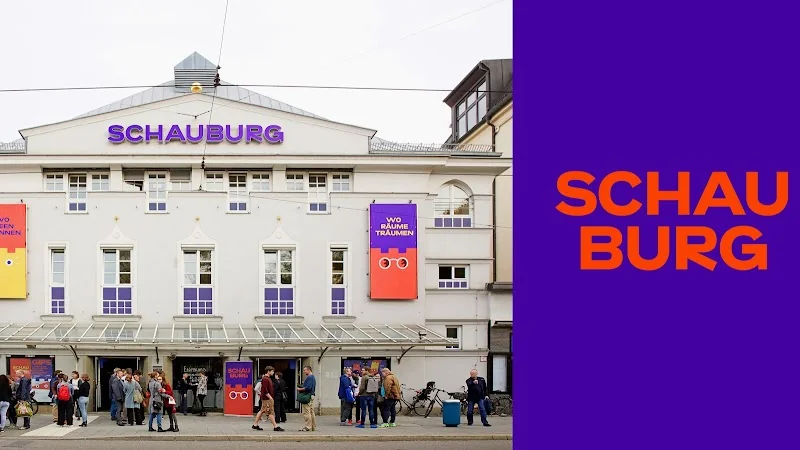
München
Franz-Joseph-Straße 47, 80801 München-Schwabing-West, Deutschland
Schauburg Munich | Program & Tickets
The Schauburg Munich is the theater for young audiences of the state capital Munich and has been one of the largest and most renowned theaters of its kind in Germany since its move to Elisabethplatz in 1977. The house sees itself as an open theater for young and young-at-heart people, performing for babies from 3 months to adulthood and combining acting, dance, musical theater, puppet theater, and digital mediation into a versatile overall experience. Therefore, those looking for the Schauburg Munich find not only a performance venue with a clear address but also a cultural house with several stages, a well-developed LAB area, its own café, an active ensemble, and a schedule that brings together classic works, new themes, and participatory formats. This mix is already clearly visible on the current website: In addition to the ongoing program featuring plays like Meze Brotzeit, Happy Peppy or Pech? The Glückstück, DRUNTER & DRÜBER, and Tisch der Generationen, there are guides for first-time visitors and for daycare and school groups, information on tickets and prices, as well as insights into the media library and the artistic profile of the house. Thus, the Schauburg is not just a cultural address in Schwabing but a vibrant stage for families, educational support, exchange, and discovery. ([schauburg.net](https://www.schauburg.net/de/theater/leitbild))
Program, Schedule, and Tickets at Schauburg Munich
The most important search impulse around Schauburg Munich is clearly the program. This is where the house shows its strength, as the schedule is not aimed at just one age group but grows with the audience. The homepage currently highlights various formats and plays, including discussion and encounter formats, productions for different age groups, and information about advance sales for new months. At the same time, Schauburg makes it clear that the media library and the schedule are closely linked and that the plays are often marked with age indications. This is particularly helpful for parents, teachers, and anyone who wants to plan a visit well. For well-known titles like Die kleine Hexe, Die Kuh Rosmarie, or DRUNTER & DRÜBER, the website also lists current age groups and practical information. Regarding tickets, Schauburg operates with a clear, understandable pricing structure: In the Große Burg, tickets for viewers under 18 years cost 7 euros, for adults 16 euros, and for students up to 30 years and apprentices 9 euros; in the Kleine Burg and Schauburg Labor, prices are 6 euros for under 18s and 10 euros for adults. Certain performances can be booked online, payment can be made there with credit card, instant transfer, PayPal, or direct debit, and tickets can be used by post or as print@home. Reserved tickets must be paid for on time; otherwise, the reservation expires. Additionally, there is a well-organized ticket counter with opening hours that align with performance times. So, those looking for Schauburg Munich tickets do not encounter a complicated system but a clear, family-friendly, and practical process. ([schauburg.net](https://www.schauburg.net/))
Address, Contact, and Directions to Elisabethplatz and Ramersdorf
Finding Schauburg Munich is straightforward because the house communicates its locations very clearly. The main address is Franz-Joseph-Straße 47, 80801 Munich, directly at Elisabethplatz in Schwabing-West. Additionally, the Schauburg Labor is part of the house's structure and is located at Rosenheimer Straße 192 with an entrance on Wageneggerstraße in Ramersdorf. For both locations, Schauburg provides precise routes using public transport: To Schauburg at Elisabethplatz, trams 27 and 28 go to Elisabethplatz, U2 and U8 to Josephsplatz, and U3 and U6 to Giselastraße. To reach Schauburg Labor, one can take U2 and U7 to Karl-Preis-Platz, exit D, as well as bus lines 55, 145, 59, and X200 with stops at Karl-Preis-Platz or in Ramersdorf. This makes the journey very well planned for families, school classes, and guests from other districts of Munich. The contact options are also clearly laid out on the official site: The ticket phone, the theater box office, general contact via email, as well as specific contacts for schools & daycare and for the LAB are easily found. The day and evening box offices open one hour before the start of performances, and the current opening hours of the theater box office are listed on the homepage. Therefore, anyone looking for an address for Schauburg Munich, directions to Schauburg Munich, or direct contact options finds a reliable and complete service base here. Even though the website does not advertise a classic parking garage, the public transport connections via tram, subway, and bus are described so well that the visit can be planned without detours. ([schauburg.net](https://www.schauburg.net/de/service/kontakt))
Große Burg, Kleine Burg, Schaubox, and Schauburg Labor
Schauburg is not a house with only one stage but a system of different rooms that are intentionally conceived differently. At Elisabethplatz, there are the Große Burg, Kleine Burg, and Schaubox. The Große Burg can be played depending on the production with a ramp and seating rows, with the audience from three sides around the performance area, or entirely without seating. This versatility is part of the artistic concept because the production and the space are not thought of separately. In the Kleine Burg, an intimate setting is created where audiences can experience theater very directly and closely. The Schaubox, on the other hand, is the LAB space in the attic, a place for untamed creativity and for formats where young people are to become active. In the Schauburg Labor in Ramersdorf, this openness continues, but in a different spatial logic: There are two stage spaces, a large performance space on the ground floor for up to 100 spectators and a room on the first floor for up to 50 people. Workshops and LABs also take place in the rooms of the Labor, and there is additionally a café that offers freshly prepared food and drinks and is explicitly open without requiring an order. Schauburg describes this place as a connection of community, enjoyment, and theater. For visitors, it is important that there are no numbered seats in the venues Große Burg, Kleine Burg, and Schauburg Labor, and free seating applies. Exactly this mix of versatility, closeness, and openness makes the house interesting for many inquiries regarding seating plans, seats, space, equipment, and Schauburg Labor. Those looking for a special theater location in Munich will find here not a rigid hall but a house that works with spatial concepts and thinks each production anew spatially. ([schauburg.net](https://www.schauburg.net/de/theater/leitbild))
Theater for Children, Schools, and Daycares
The Schauburg Munich is particularly in demand because it consistently works for young audiences without appearing too detailed or pedagogically narrow. The house states very clearly that the audience can grow up with the theater: The ensemble already performs for the very youngest from 3 months and expands the offerings age-appropriately into adulthood. This breadth is reflected on the current website in a media library with productions for 5 months+, 18 months+, 2+, 3+, 6+, 7+, 13+, and even 15+ to 19 years. Examples like Viva Wasser, La Le Luffft, DRUNTER & DRÜBER, Socken, Mond und Sterne, Glück im Doppelpack, Die kleine Hexe, Ein deutsches Mädchen, and Erik*a make it clear that Schauburg also prepares topics such as friendship, family, identity, diversity, conflict, anger, or societal issues in an age-appropriate manner. This is particularly practical for schools and daycares, as the house also offers mobile productions for classrooms and kindergartens, thus reaching children and young people in theater-remote districts. The website provides specific information, contacts, and guides for this purpose, making visits, bookings, and preparations well organized. Additionally, Schauburg uses very different forms in its productions: classic acting, music, dance, puppetry, and digital mediation. That is why it is suitable not only for a simple family outing but also for educational contexts, project work, and conversation opportunities. So, those looking for Schauburg Munich children, family-friendly theater in Munich, or a suitable location for school visits find a house that cannot be reduced to one age group but covers a very broad spectrum and takes the perception of young people seriously. Schauburg is thus not only a stage but also a learning, experience, and meeting space. ([schauburg.net](https://www.schauburg.net/de/theater/leitbild))
History of Schauburg: From Cinema to Children's and Youth Theater
The history of Schauburg Munich is an important part of its current identity, as it explains why this house possesses so much adaptability. The building at Elisabethplatz was initially constructed as a cinema under the name Schauburg in 1926. After World War II, it briefly served as an operetta theater before being converted in 1967 by brothers Anusch and Temur Samy into the legendary disco Blow Up. According to the archive, the light show with 250 spotlights that reacted to the rhythm of the music was unique for its time; up to 2,000 people could dance in the hall, and international names like Pink Floyd, Yes, Jimi Hendrix, or Sammy Davis Jr. performed there. At the same time, a separate children's and youth theater developed from the Munich fairy tale stage of the Jobsts. Sigfrid Jobst founded the theater in 1953 together with Annemarie Jobst-Grashey because he wanted to reintroduce young people to literature, spirit, and aesthetics after the war years. In 1959/60, the theater found a permanent venue on Reitmorstraße, in 1969 the city of Munich took over the theater, and in 1977 it reopened at Elisabethplatz as a youth theater in a new form. The archive text also describes the political and cultural tensions surrounding the house, the name change back to Schauburg, and the renovation after asbestos findings in the 1990s. Since 1993, the house has been experienced again as a municipal children's and youth theater at Elisabethplatz. The current website connects to this history and names Schauburg as one of the largest and most renowned theaters for young audiences in Germany. So, anyone looking for Schauburg Munich history discovers a house that has led several lives from cinema to disco to theater and is precisely why it is so open to the present, experimentation, and young perspectives. ([schauburgarchiv.online](https://www.schauburgarchiv.online/content/geschichte.html))
LAB, Residency Program, Jobs, and Photos
An essential part of today's Schauburg is the LAB, the area where not only plays are performed but also researched, experimented, and co-created together. Schauburg describes the LAB as a space within the house where children, young people, and adults come together to discover, negotiate, and translate topics into artistic forms. The focus is on participation, encounter, and collaborative work with stage, light, music, objects, and materials. At the same time, the Schauburg Labor in Ramersdorf is a new place for this working method: Many LABs, community formats, workshops, and meetings take place here, as well as the café as a social space. The residency program shows how seriously Schauburg takes the research character of this work: For the 2026/2027 seasons, three research residencies for professional freelance artists, collectives, or ensembles are being advertised, applications are possible for up to six people, and the work is to be created in close proximity to the target group in Schauburg Labor. The application deadline for the second residency is May 31, 2026, and the working phase is scheduled between February 6 and April 9, 2027. The topic of jobs is also visible on the website: The career page lists current job offers, including a lighting technician, and refers to service and admission areas as well as training paths in event technology. The team page also lists numerous areas such as management, dramaturgy, box office, LAB, community building, school & daycare, press, and ensemble. Those looking for photos will find material from productions, the ensemble, Andrea Gronemeyer, and both houses, namely Schauburg at Elisabethplatz and Schauburg Labor in Ramersdorf in the press area. This combination of participation, research, residency, team, and image material makes Schauburg particularly relevant for inquiries about LAB, residency, jobs, staff, and photos. ([schauburg.net](https://www.schauburg.net/de/residenzprogramm-labor))
Sources:
Show moreShow less
Schauburg Munich | Program & Tickets
The Schauburg Munich is the theater for young audiences of the state capital Munich and has been one of the largest and most renowned theaters of its kind in Germany since its move to Elisabethplatz in 1977. The house sees itself as an open theater for young and young-at-heart people, performing for babies from 3 months to adulthood and combining acting, dance, musical theater, puppet theater, and digital mediation into a versatile overall experience. Therefore, those looking for the Schauburg Munich find not only a performance venue with a clear address but also a cultural house with several stages, a well-developed LAB area, its own café, an active ensemble, and a schedule that brings together classic works, new themes, and participatory formats. This mix is already clearly visible on the current website: In addition to the ongoing program featuring plays like Meze Brotzeit, Happy Peppy or Pech? The Glückstück, DRUNTER & DRÜBER, and Tisch der Generationen, there are guides for first-time visitors and for daycare and school groups, information on tickets and prices, as well as insights into the media library and the artistic profile of the house. Thus, the Schauburg is not just a cultural address in Schwabing but a vibrant stage for families, educational support, exchange, and discovery. ([schauburg.net](https://www.schauburg.net/de/theater/leitbild))
Program, Schedule, and Tickets at Schauburg Munich
The most important search impulse around Schauburg Munich is clearly the program. This is where the house shows its strength, as the schedule is not aimed at just one age group but grows with the audience. The homepage currently highlights various formats and plays, including discussion and encounter formats, productions for different age groups, and information about advance sales for new months. At the same time, Schauburg makes it clear that the media library and the schedule are closely linked and that the plays are often marked with age indications. This is particularly helpful for parents, teachers, and anyone who wants to plan a visit well. For well-known titles like Die kleine Hexe, Die Kuh Rosmarie, or DRUNTER & DRÜBER, the website also lists current age groups and practical information. Regarding tickets, Schauburg operates with a clear, understandable pricing structure: In the Große Burg, tickets for viewers under 18 years cost 7 euros, for adults 16 euros, and for students up to 30 years and apprentices 9 euros; in the Kleine Burg and Schauburg Labor, prices are 6 euros for under 18s and 10 euros for adults. Certain performances can be booked online, payment can be made there with credit card, instant transfer, PayPal, or direct debit, and tickets can be used by post or as print@home. Reserved tickets must be paid for on time; otherwise, the reservation expires. Additionally, there is a well-organized ticket counter with opening hours that align with performance times. So, those looking for Schauburg Munich tickets do not encounter a complicated system but a clear, family-friendly, and practical process. ([schauburg.net](https://www.schauburg.net/))
Address, Contact, and Directions to Elisabethplatz and Ramersdorf
Finding Schauburg Munich is straightforward because the house communicates its locations very clearly. The main address is Franz-Joseph-Straße 47, 80801 Munich, directly at Elisabethplatz in Schwabing-West. Additionally, the Schauburg Labor is part of the house's structure and is located at Rosenheimer Straße 192 with an entrance on Wageneggerstraße in Ramersdorf. For both locations, Schauburg provides precise routes using public transport: To Schauburg at Elisabethplatz, trams 27 and 28 go to Elisabethplatz, U2 and U8 to Josephsplatz, and U3 and U6 to Giselastraße. To reach Schauburg Labor, one can take U2 and U7 to Karl-Preis-Platz, exit D, as well as bus lines 55, 145, 59, and X200 with stops at Karl-Preis-Platz or in Ramersdorf. This makes the journey very well planned for families, school classes, and guests from other districts of Munich. The contact options are also clearly laid out on the official site: The ticket phone, the theater box office, general contact via email, as well as specific contacts for schools & daycare and for the LAB are easily found. The day and evening box offices open one hour before the start of performances, and the current opening hours of the theater box office are listed on the homepage. Therefore, anyone looking for an address for Schauburg Munich, directions to Schauburg Munich, or direct contact options finds a reliable and complete service base here. Even though the website does not advertise a classic parking garage, the public transport connections via tram, subway, and bus are described so well that the visit can be planned without detours. ([schauburg.net](https://www.schauburg.net/de/service/kontakt))
Große Burg, Kleine Burg, Schaubox, and Schauburg Labor
Schauburg is not a house with only one stage but a system of different rooms that are intentionally conceived differently. At Elisabethplatz, there are the Große Burg, Kleine Burg, and Schaubox. The Große Burg can be played depending on the production with a ramp and seating rows, with the audience from three sides around the performance area, or entirely without seating. This versatility is part of the artistic concept because the production and the space are not thought of separately. In the Kleine Burg, an intimate setting is created where audiences can experience theater very directly and closely. The Schaubox, on the other hand, is the LAB space in the attic, a place for untamed creativity and for formats where young people are to become active. In the Schauburg Labor in Ramersdorf, this openness continues, but in a different spatial logic: There are two stage spaces, a large performance space on the ground floor for up to 100 spectators and a room on the first floor for up to 50 people. Workshops and LABs also take place in the rooms of the Labor, and there is additionally a café that offers freshly prepared food and drinks and is explicitly open without requiring an order. Schauburg describes this place as a connection of community, enjoyment, and theater. For visitors, it is important that there are no numbered seats in the venues Große Burg, Kleine Burg, and Schauburg Labor, and free seating applies. Exactly this mix of versatility, closeness, and openness makes the house interesting for many inquiries regarding seating plans, seats, space, equipment, and Schauburg Labor. Those looking for a special theater location in Munich will find here not a rigid hall but a house that works with spatial concepts and thinks each production anew spatially. ([schauburg.net](https://www.schauburg.net/de/theater/leitbild))
Theater for Children, Schools, and Daycares
The Schauburg Munich is particularly in demand because it consistently works for young audiences without appearing too detailed or pedagogically narrow. The house states very clearly that the audience can grow up with the theater: The ensemble already performs for the very youngest from 3 months and expands the offerings age-appropriately into adulthood. This breadth is reflected on the current website in a media library with productions for 5 months+, 18 months+, 2+, 3+, 6+, 7+, 13+, and even 15+ to 19 years. Examples like Viva Wasser, La Le Luffft, DRUNTER & DRÜBER, Socken, Mond und Sterne, Glück im Doppelpack, Die kleine Hexe, Ein deutsches Mädchen, and Erik*a make it clear that Schauburg also prepares topics such as friendship, family, identity, diversity, conflict, anger, or societal issues in an age-appropriate manner. This is particularly practical for schools and daycares, as the house also offers mobile productions for classrooms and kindergartens, thus reaching children and young people in theater-remote districts. The website provides specific information, contacts, and guides for this purpose, making visits, bookings, and preparations well organized. Additionally, Schauburg uses very different forms in its productions: classic acting, music, dance, puppetry, and digital mediation. That is why it is suitable not only for a simple family outing but also for educational contexts, project work, and conversation opportunities. So, those looking for Schauburg Munich children, family-friendly theater in Munich, or a suitable location for school visits find a house that cannot be reduced to one age group but covers a very broad spectrum and takes the perception of young people seriously. Schauburg is thus not only a stage but also a learning, experience, and meeting space. ([schauburg.net](https://www.schauburg.net/de/theater/leitbild))
History of Schauburg: From Cinema to Children's and Youth Theater
The history of Schauburg Munich is an important part of its current identity, as it explains why this house possesses so much adaptability. The building at Elisabethplatz was initially constructed as a cinema under the name Schauburg in 1926. After World War II, it briefly served as an operetta theater before being converted in 1967 by brothers Anusch and Temur Samy into the legendary disco Blow Up. According to the archive, the light show with 250 spotlights that reacted to the rhythm of the music was unique for its time; up to 2,000 people could dance in the hall, and international names like Pink Floyd, Yes, Jimi Hendrix, or Sammy Davis Jr. performed there. At the same time, a separate children's and youth theater developed from the Munich fairy tale stage of the Jobsts. Sigfrid Jobst founded the theater in 1953 together with Annemarie Jobst-Grashey because he wanted to reintroduce young people to literature, spirit, and aesthetics after the war years. In 1959/60, the theater found a permanent venue on Reitmorstraße, in 1969 the city of Munich took over the theater, and in 1977 it reopened at Elisabethplatz as a youth theater in a new form. The archive text also describes the political and cultural tensions surrounding the house, the name change back to Schauburg, and the renovation after asbestos findings in the 1990s. Since 1993, the house has been experienced again as a municipal children's and youth theater at Elisabethplatz. The current website connects to this history and names Schauburg as one of the largest and most renowned theaters for young audiences in Germany. So, anyone looking for Schauburg Munich history discovers a house that has led several lives from cinema to disco to theater and is precisely why it is so open to the present, experimentation, and young perspectives. ([schauburgarchiv.online](https://www.schauburgarchiv.online/content/geschichte.html))
LAB, Residency Program, Jobs, and Photos
An essential part of today's Schauburg is the LAB, the area where not only plays are performed but also researched, experimented, and co-created together. Schauburg describes the LAB as a space within the house where children, young people, and adults come together to discover, negotiate, and translate topics into artistic forms. The focus is on participation, encounter, and collaborative work with stage, light, music, objects, and materials. At the same time, the Schauburg Labor in Ramersdorf is a new place for this working method: Many LABs, community formats, workshops, and meetings take place here, as well as the café as a social space. The residency program shows how seriously Schauburg takes the research character of this work: For the 2026/2027 seasons, three research residencies for professional freelance artists, collectives, or ensembles are being advertised, applications are possible for up to six people, and the work is to be created in close proximity to the target group in Schauburg Labor. The application deadline for the second residency is May 31, 2026, and the working phase is scheduled between February 6 and April 9, 2027. The topic of jobs is also visible on the website: The career page lists current job offers, including a lighting technician, and refers to service and admission areas as well as training paths in event technology. The team page also lists numerous areas such as management, dramaturgy, box office, LAB, community building, school & daycare, press, and ensemble. Those looking for photos will find material from productions, the ensemble, Andrea Gronemeyer, and both houses, namely Schauburg at Elisabethplatz and Schauburg Labor in Ramersdorf in the press area. This combination of participation, research, residency, team, and image material makes Schauburg particularly relevant for inquiries about LAB, residency, jobs, staff, and photos. ([schauburg.net](https://www.schauburg.net/de/residenzprogramm-labor))
Sources:
Schauburg Munich | Program & Tickets
The Schauburg Munich is the theater for young audiences of the state capital Munich and has been one of the largest and most renowned theaters of its kind in Germany since its move to Elisabethplatz in 1977. The house sees itself as an open theater for young and young-at-heart people, performing for babies from 3 months to adulthood and combining acting, dance, musical theater, puppet theater, and digital mediation into a versatile overall experience. Therefore, those looking for the Schauburg Munich find not only a performance venue with a clear address but also a cultural house with several stages, a well-developed LAB area, its own café, an active ensemble, and a schedule that brings together classic works, new themes, and participatory formats. This mix is already clearly visible on the current website: In addition to the ongoing program featuring plays like Meze Brotzeit, Happy Peppy or Pech? The Glückstück, DRUNTER & DRÜBER, and Tisch der Generationen, there are guides for first-time visitors and for daycare and school groups, information on tickets and prices, as well as insights into the media library and the artistic profile of the house. Thus, the Schauburg is not just a cultural address in Schwabing but a vibrant stage for families, educational support, exchange, and discovery. ([schauburg.net](https://www.schauburg.net/de/theater/leitbild))
Program, Schedule, and Tickets at Schauburg Munich
The most important search impulse around Schauburg Munich is clearly the program. This is where the house shows its strength, as the schedule is not aimed at just one age group but grows with the audience. The homepage currently highlights various formats and plays, including discussion and encounter formats, productions for different age groups, and information about advance sales for new months. At the same time, Schauburg makes it clear that the media library and the schedule are closely linked and that the plays are often marked with age indications. This is particularly helpful for parents, teachers, and anyone who wants to plan a visit well. For well-known titles like Die kleine Hexe, Die Kuh Rosmarie, or DRUNTER & DRÜBER, the website also lists current age groups and practical information. Regarding tickets, Schauburg operates with a clear, understandable pricing structure: In the Große Burg, tickets for viewers under 18 years cost 7 euros, for adults 16 euros, and for students up to 30 years and apprentices 9 euros; in the Kleine Burg and Schauburg Labor, prices are 6 euros for under 18s and 10 euros for adults. Certain performances can be booked online, payment can be made there with credit card, instant transfer, PayPal, or direct debit, and tickets can be used by post or as print@home. Reserved tickets must be paid for on time; otherwise, the reservation expires. Additionally, there is a well-organized ticket counter with opening hours that align with performance times. So, those looking for Schauburg Munich tickets do not encounter a complicated system but a clear, family-friendly, and practical process. ([schauburg.net](https://www.schauburg.net/))
Address, Contact, and Directions to Elisabethplatz and Ramersdorf
Finding Schauburg Munich is straightforward because the house communicates its locations very clearly. The main address is Franz-Joseph-Straße 47, 80801 Munich, directly at Elisabethplatz in Schwabing-West. Additionally, the Schauburg Labor is part of the house's structure and is located at Rosenheimer Straße 192 with an entrance on Wageneggerstraße in Ramersdorf. For both locations, Schauburg provides precise routes using public transport: To Schauburg at Elisabethplatz, trams 27 and 28 go to Elisabethplatz, U2 and U8 to Josephsplatz, and U3 and U6 to Giselastraße. To reach Schauburg Labor, one can take U2 and U7 to Karl-Preis-Platz, exit D, as well as bus lines 55, 145, 59, and X200 with stops at Karl-Preis-Platz or in Ramersdorf. This makes the journey very well planned for families, school classes, and guests from other districts of Munich. The contact options are also clearly laid out on the official site: The ticket phone, the theater box office, general contact via email, as well as specific contacts for schools & daycare and for the LAB are easily found. The day and evening box offices open one hour before the start of performances, and the current opening hours of the theater box office are listed on the homepage. Therefore, anyone looking for an address for Schauburg Munich, directions to Schauburg Munich, or direct contact options finds a reliable and complete service base here. Even though the website does not advertise a classic parking garage, the public transport connections via tram, subway, and bus are described so well that the visit can be planned without detours. ([schauburg.net](https://www.schauburg.net/de/service/kontakt))
Große Burg, Kleine Burg, Schaubox, and Schauburg Labor
Schauburg is not a house with only one stage but a system of different rooms that are intentionally conceived differently. At Elisabethplatz, there are the Große Burg, Kleine Burg, and Schaubox. The Große Burg can be played depending on the production with a ramp and seating rows, with the audience from three sides around the performance area, or entirely without seating. This versatility is part of the artistic concept because the production and the space are not thought of separately. In the Kleine Burg, an intimate setting is created where audiences can experience theater very directly and closely. The Schaubox, on the other hand, is the LAB space in the attic, a place for untamed creativity and for formats where young people are to become active. In the Schauburg Labor in Ramersdorf, this openness continues, but in a different spatial logic: There are two stage spaces, a large performance space on the ground floor for up to 100 spectators and a room on the first floor for up to 50 people. Workshops and LABs also take place in the rooms of the Labor, and there is additionally a café that offers freshly prepared food and drinks and is explicitly open without requiring an order. Schauburg describes this place as a connection of community, enjoyment, and theater. For visitors, it is important that there are no numbered seats in the venues Große Burg, Kleine Burg, and Schauburg Labor, and free seating applies. Exactly this mix of versatility, closeness, and openness makes the house interesting for many inquiries regarding seating plans, seats, space, equipment, and Schauburg Labor. Those looking for a special theater location in Munich will find here not a rigid hall but a house that works with spatial concepts and thinks each production anew spatially. ([schauburg.net](https://www.schauburg.net/de/theater/leitbild))
Theater for Children, Schools, and Daycares
The Schauburg Munich is particularly in demand because it consistently works for young audiences without appearing too detailed or pedagogically narrow. The house states very clearly that the audience can grow up with the theater: The ensemble already performs for the very youngest from 3 months and expands the offerings age-appropriately into adulthood. This breadth is reflected on the current website in a media library with productions for 5 months+, 18 months+, 2+, 3+, 6+, 7+, 13+, and even 15+ to 19 years. Examples like Viva Wasser, La Le Luffft, DRUNTER & DRÜBER, Socken, Mond und Sterne, Glück im Doppelpack, Die kleine Hexe, Ein deutsches Mädchen, and Erik*a make it clear that Schauburg also prepares topics such as friendship, family, identity, diversity, conflict, anger, or societal issues in an age-appropriate manner. This is particularly practical for schools and daycares, as the house also offers mobile productions for classrooms and kindergartens, thus reaching children and young people in theater-remote districts. The website provides specific information, contacts, and guides for this purpose, making visits, bookings, and preparations well organized. Additionally, Schauburg uses very different forms in its productions: classic acting, music, dance, puppetry, and digital mediation. That is why it is suitable not only for a simple family outing but also for educational contexts, project work, and conversation opportunities. So, those looking for Schauburg Munich children, family-friendly theater in Munich, or a suitable location for school visits find a house that cannot be reduced to one age group but covers a very broad spectrum and takes the perception of young people seriously. Schauburg is thus not only a stage but also a learning, experience, and meeting space. ([schauburg.net](https://www.schauburg.net/de/theater/leitbild))
History of Schauburg: From Cinema to Children's and Youth Theater
The history of Schauburg Munich is an important part of its current identity, as it explains why this house possesses so much adaptability. The building at Elisabethplatz was initially constructed as a cinema under the name Schauburg in 1926. After World War II, it briefly served as an operetta theater before being converted in 1967 by brothers Anusch and Temur Samy into the legendary disco Blow Up. According to the archive, the light show with 250 spotlights that reacted to the rhythm of the music was unique for its time; up to 2,000 people could dance in the hall, and international names like Pink Floyd, Yes, Jimi Hendrix, or Sammy Davis Jr. performed there. At the same time, a separate children's and youth theater developed from the Munich fairy tale stage of the Jobsts. Sigfrid Jobst founded the theater in 1953 together with Annemarie Jobst-Grashey because he wanted to reintroduce young people to literature, spirit, and aesthetics after the war years. In 1959/60, the theater found a permanent venue on Reitmorstraße, in 1969 the city of Munich took over the theater, and in 1977 it reopened at Elisabethplatz as a youth theater in a new form. The archive text also describes the political and cultural tensions surrounding the house, the name change back to Schauburg, and the renovation after asbestos findings in the 1990s. Since 1993, the house has been experienced again as a municipal children's and youth theater at Elisabethplatz. The current website connects to this history and names Schauburg as one of the largest and most renowned theaters for young audiences in Germany. So, anyone looking for Schauburg Munich history discovers a house that has led several lives from cinema to disco to theater and is precisely why it is so open to the present, experimentation, and young perspectives. ([schauburgarchiv.online](https://www.schauburgarchiv.online/content/geschichte.html))
LAB, Residency Program, Jobs, and Photos
An essential part of today's Schauburg is the LAB, the area where not only plays are performed but also researched, experimented, and co-created together. Schauburg describes the LAB as a space within the house where children, young people, and adults come together to discover, negotiate, and translate topics into artistic forms. The focus is on participation, encounter, and collaborative work with stage, light, music, objects, and materials. At the same time, the Schauburg Labor in Ramersdorf is a new place for this working method: Many LABs, community formats, workshops, and meetings take place here, as well as the café as a social space. The residency program shows how seriously Schauburg takes the research character of this work: For the 2026/2027 seasons, three research residencies for professional freelance artists, collectives, or ensembles are being advertised, applications are possible for up to six people, and the work is to be created in close proximity to the target group in Schauburg Labor. The application deadline for the second residency is May 31, 2026, and the working phase is scheduled between February 6 and April 9, 2027. The topic of jobs is also visible on the website: The career page lists current job offers, including a lighting technician, and refers to service and admission areas as well as training paths in event technology. The team page also lists numerous areas such as management, dramaturgy, box office, LAB, community building, school & daycare, press, and ensemble. Those looking for photos will find material from productions, the ensemble, Andrea Gronemeyer, and both houses, namely Schauburg at Elisabethplatz and Schauburg Labor in Ramersdorf in the press area. This combination of participation, research, residency, team, and image material makes Schauburg particularly relevant for inquiries about LAB, residency, jobs, staff, and photos. ([schauburg.net](https://www.schauburg.net/de/residenzprogramm-labor))
Sources:
Frequently Asked Questions
Reviews
No reviews found