
Schwangau
Neuschwansteinstraße 20, 87645 Schwangau, Deutschland
Neuschwanstein Castle | Tickets & Opening Hours 2026
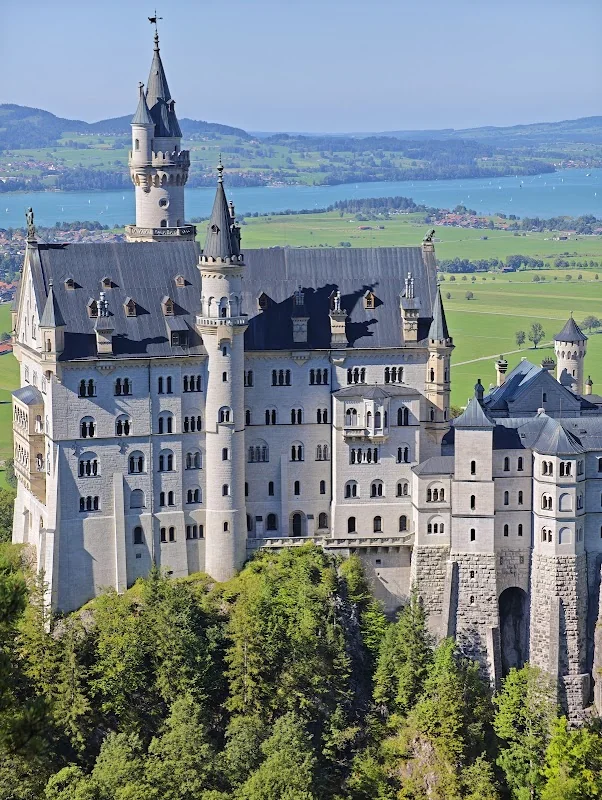
Neuschwanstein Castle is one of the most famous attractions in Germany and is located above Hohenschwangau near Schwangau in the Allgäu region. Those planning a visit quickly realize: This castle is not a place for spontaneous disorientation, but for good preparation. The tour is time-bound, the paths are partly steep, the tickets are popular, and the view is fantastic. That is exactly why it is worth clarifying the most important questions in advance: When is it open, where do you buy tickets, how do you get there, and what can you expect inside? The official visitor information from the Bavarian Palace Administration makes it clear that the castle can only be visited as part of a guided tour, which lasts about 30 minutes, and access is no longer possible in case of late arrival. At the same time, Neuschwanstein has been a UNESCO World Heritage Site as part of the palaces of King Ludwig II since 2025. ([neuschwanstein.de](https://www.neuschwanstein.de/deutsch/tourist/oeffnung.htm?utm_source=openai))
Tickets and Opening Hours for Neuschwanstein Castle
For many visitors, the Neuschwanstein visit begins with the ticket question, and this is where the official process is particularly important. Tickets are available in the online ticket shop or directly at the Ticket Center Hohenschwangau; on-site, remaining tickets are only sold for the same day and only subject to availability. The prices for 2026 are 21 euros regular and 20 euros reduced, children and teenagers up to 18 years receive free admission. Those who book or reserve online pay an additional service fee of 2.50 euros per ticket. This is relevant because demand is high, and tickets can quickly become scarce, especially during holiday periods. The official recommendation is therefore to secure tickets early. Combinations with other facilities are also offered by the Bavarian Palace Administration, but for Neuschwanstein, the most important thing is: book in time, pay close attention to the time, and do not assume that there will still be enough tickets available on-site. ([neuschwanstein.de](https://www.neuschwanstein.de/deutsch/tourist/eintritt.htm?utm_source=openai))
The opening hours are seasonal and should be checked before each visit. The Ticket Center sells tickets in summer from March 28 to October 15 from 8 AM to 4 PM, and in winter from October 16 to March 27 from 8 AM to 3:30 PM. The castle itself is open in the peak season from 9 AM to 6 PM and in the winter season from 10 AM to 4 PM. It is only closed on January 1 and December 24, 25, and 31. The tours start punctually, and the ticket is tied to a specific time, so one should plan enough time for the way up and for possible security checks. Those who arrive late lose their participation in the tour, even if the ticket has already been paid for. This strict time logic makes Neuschwanstein a well-organized but not flexible destination. ([neuschwanstein.de](https://www.neuschwanstein.de/deutsch/tourist/oeffnung.htm?utm_source=openai))
Part of the visit organization is also that the castle can only be visited with a guide, and the tours last about 30 minutes. German and English-speaking visitors are accompanied by staff from the Bavarian Palace Administration; for other languages, audio guide tours are available in French, Spanish, Italian, Russian, Japanese, Chinese, Polish, Portuguese, Greek, Dutch, Korean, Arabic, Hebrew, and other languages. The house rules are also important: bulky items, strollers, and backpacks are not allowed inside the castle, so it is better to leave luggage in the car or bus. Those who want a smooth arrival should therefore pay attention not only to the time but also to their own equipment. The lighter the visit is organized, the more relaxed the experience inside the castle will be. ([neuschwanstein.de](https://www.neuschwanstein.de/deutsch/tourist/oeffnung.htm?utm_source=openai))
Access, Parking, and the Way from the Ticket Center
Neuschwanstein is located near Schwangau and Füssen in the Allgäu, but the actual starting point for the castle visit is Hohenschwangau. The official visitor information makes it clear that arriving by private car directly to the castle is not allowed. Instead, one must use the paid parking lots P1 to P4 in the valley, from where the Ticket Center, shuttle bus, carriage stations, and footpaths are accessible. Bicycles are also not allowed to simply ride on Neuschwanstein Street; there are separate rules and a designated bike path. For orientation, the visitor area of Hohenschwangau provides a local map that marks paths, stops, and viewpoints. Those arriving by train or bus travel to Füssen and take the regional bus to Hohenschwangau from there. The location is therefore very well developed for tourists but deliberately concentrated on a visitor center in the valley so that the actual castle area above remains unburdened. ([neuschwanstein.de](https://www.neuschwanstein.de/deutsch/tourist/anfahrt.htm?utm_source=openai))
When parking, the official prices and rules are clear. For cars, the operators charge 12 euros for six hours, each additional hour costs 1 euro, with a maximum of 16 euros. Buses pay 35 euros per day, motorcycles 5 euros per day, and motorhomes may only park on P2, costing 16 euros for six hours, with each additional hour costing 2 euros, up to a maximum of 20 euros. These details are important because the stay in Hohenschwangau is not just a short photo stop but often lasts several hours. Those who arrive early have more time for ticket collection, the way up, and possibly a look at the surroundings before the booked tour begins. Especially during holiday periods, a generous time buffer is recommended, as parking spaces and paths can also be heavily utilized. ([hohenschwangau.de](https://www.hohenschwangau.de/index.php?id=473&utm_source=openai))
The path from the Ticket Center to the castle is clearly marked but physically demanding. The distance is about 1.5 kilometers long, continuously ascending, and partly quite steep. Therefore, depending on fitness, either the footpath, the shuttle bus connection, or the horse-drawn carriage is advisable. The buses and carriages do not run on a fixed schedule but as needed; this means that especially during holiday periods, waiting times should be expected. For visitors with limited mobility, the official information recommends the horse-drawn carriage, while the bus ends at the stop Jugend above the castle, and from there, there is still a steep descent. This mix of valley, ascent, and view makes the charm of the place but also requires some planning. Those who underestimate the ascent risk stress instead of anticipation. ([neuschwanstein.de](https://www.neuschwanstein.de/englisch/tourist/mobility.htm?utm_source=openai))
It is also practical that the operators check daily whether the shuttle bus and carriages are in operation and which viewpoints are currently accessible. This is as important for visit planning as the ticket purchase itself because weather, occupancy, and seasonal conditions can noticeably change the reality on-site. Those who rely on maps, route guidance, and current information avoid unnecessary detours and arrive at the castle much more relaxed. That is why one should look at the local map not only on-site but also before departure. Neuschwanstein is indeed a fairy-tale castle, but the journey works best in a very pragmatic way: park, orient, plan a time buffer, and then consciously enjoy the ascent. ([hohenschwangau.de](https://www.hohenschwangau.de/en?utm_source=openai))
Interior, Tour, and the 14 Rooms
Inside Neuschwanstein Castle, it is not about a classic museum experience with freely accessible halls, but about a strictly guided tour through the king's rooms. The official tour includes 14 rooms on the third and fourth floors of the palace. The second floor remains unfinished and today serves as an area for the shop, cafeteria, and multimedia room. Following the original route, one starts in the lower hall and then moves step by step through the royal living and representation rooms. It is particularly interesting that the castle, despite its fairy-tale exterior, was not intended as an exhibition space with free movement but as an idealized living and representation world of Ludwig II. The tour therefore does not show arbitrary interiors but a carefully staged sequence of rooms that reflect the king's thoughts. This makes Neuschwanstein unique: one does not just visit a building but a very personal imagery. ([neuschwanstein.de](https://www.neuschwanstein.de/englisch/palace/tour.htm?utm_source=openai))
Among the most famous rooms are the throne room and the singers' hall. The throne room is inspired by Byzantine churches, particularly the All Saints' Chapel in Munich, and was intended to serve Ludwig II. as an expression of a special king idea. A throne was originally planned for the apse, but it was never built. The singers' hall, on the other hand, was one of the king's favorite rooms and combines motifs from Wartburg with fabrics from the Parzival and Grail world. Both rooms were never used for state grand events but are places of thought and remembrance that take up the medieval and romantic idea of rule, art, and religion. This mix of sacred space, knightly ideal, and theatrical effect makes the interior visit so impressive. Those who only think of beautiful walls underestimate the symbolism of the building. ([neuschwanstein.de](https://www.neuschwanstein.de/englisch/palace/thron.htm?utm_source=openai))
The other rooms also consistently tell the same story. The bedroom, dining room, study, dressing room, salon, and grotto with winter garden are not just decorative but part of a strictly composed path. The wall paintings feature legendary motifs from the Germanic and Nordic world, especially Lohengrin, Parzival, and Gudrun's saga. The tour ends on the second floor, where the shop, cafeteria, and multimedia area are located today; afterwards, the historic kitchen on the ground floor can be visited. This sequence is particularly appealing to visitors because it makes the contrast between the highly staged royal floor and the practical functional world of the house visible. Neuschwanstein is thus not only beautiful but also very consciously built: above dream, below operation, in between a precisely planned tour. ([neuschwanstein.de](https://www.neuschwanstein.de/englisch/palace/tour.htm?utm_source=openai))
Important for practice: The tour starts punctually, and the admission ticket is only valid for the booked time. Those who arrive late cannot simply wait and take a later group. Furthermore, the administration requests that no large bags, strollers, or similar items be brought along. This is less a bureaucratic barrier than part of the protection concept and the narrow paths in the castle. Especially because the interior is so particularly preserved and at the same time so heavily visited, the process needs fixed rules. This is sometimes stricter than expected for visitors, but it ensures that the experience remains orderly and calm. Those who accept this do not experience the interiors as hectic but as a concentrated view of Ludwig's idea of beauty, power, and retreat. ([neuschwanstein.de](https://www.neuschwanstein.de/deutsch/tourist/oeffnung.htm?utm_source=openai))
History, Marienbrücke, and the Best View
The history of Neuschwanstein Castle begins with Ludwig II, who became King of Bavaria in 1864 and wanted to create his own counter-world. The official representation describes the castle as a reaction to the political reality of his time and as an expression of his desire to live in an idealized medieval world. The foundation stone was laid in 1869, and even the planning made it clear that this was not about a normal residential castle but about an artistically staged total work of art. Ludwig oriented himself to Wartburg, the medieval knight idea, and Richard Wagner's operatic world. Many main motifs of the castle are therefore not chosen randomly but follow a clear imagery. Neuschwanstein is thus less a historical residence than a personal statement of the king about art, origin, longing, and power. This is exactly what makes the historical narrative so strong to this day. ([neuschwanstein.de](https://www.neuschwanstein.de/englisch/idea/index.htm?utm_source=openai))
The fact that the castle was never completed is also part of its fascination. Ludwig II died in 1886, and only seven weeks later, Neuschwanstein was opened to the public. This unusually early museum fate contributed to the fact that the building was not further used in its original form but was perceived early on as a monument and visitor destination. Today, Neuschwanstein, together with Linderhof, Herrenchiemsee, and the King's House on Schachen, belongs to the UNESCO World Heritage Site of the Palaces of King Ludwig II of Bavaria. The World Heritage presentation particularly emphasizes that these facilities were created in the era of historicism and eclecticism, are richly equipped, and are considered works of art of their time. For visitors, this is more than an award: it explains why every detail seems so consciously composed and why the castle still has an extraordinary cultural radiance. ([neuschwanstein.de](https://www.neuschwanstein.de/englisch/palace/index.htm?utm_source=openai))
The history also includes the surroundings, especially the Marienbrücke. The bridge was built in the 1840s on the initiative of Maximilian II as a gift to his mountain-loving wife Marie and spans high above the Pöllatschlucht. The view from there has always been considered one of the most beautiful of Neuschwanstein Castle, the mountains, and the valley. Those who want to photograph the castle or simply experience it from a slightly higher perspective should know this viewpoint. Official visitor information also recommends checking daily which shuttle buses, carriages, and viewpoints are in operation, as accessibility may vary depending on the season and operation. Thus, the classic castle visit becomes a small day trip with a map, viewpoints, and movement in the fresh air. Those who take their time experience not only the building but also the landscape from which its myth has emerged. ([neuschwanstein.de](https://www.neuschwanstein.de/englisch/idea/index.htm?utm_source=openai))
For the best visit strategy, the rule is: first secure ticket and time slot, then plan arrival and parking, then realistically assess the way to the castle, and finally decide on-site whether to prefer the Marienbrücke, the viewpoint Jugend, or the direct way to the castle. Especially in good weather, visitor traffic is high, which is why arriving early and having enough buffer is worth its weight in gold. Those traveling with children, older companions, or limited fitness should consciously choose the combination of bus, carriage, and short walks and not improvise on-site. Neuschwanstein is not a place for haste but for a clever dramaturgy of the day. The better one understands the process, the more beautiful the impression: first the valley, then the ascent, then the castle, and finally the view back over the entire landscape. ([hohenschwangau.de](https://www.hohenschwangau.de/en/visitor-information-2-2?utm_source=openai))
Sources:
- Neuschwanstein Castle - Opening hours and guided tours
- Neuschwanstein Castle - Admission charges
- Hohenschwangau Tickets - Ticket prices 2026
- Neuschwanstein Castle - How to get there
- Neuschwanstein Castle - Tour of the castle
- Neuschwanstein Castle - Idea and History
- UNESCO World Heritage Centre - The Palaces of King Ludwig II of Bavaria
Show moreShow less
Neuschwanstein Castle | Tickets & Opening Hours 2026
Neuschwanstein Castle is one of the most famous attractions in Germany and is located above Hohenschwangau near Schwangau in the Allgäu region. Those planning a visit quickly realize: This castle is not a place for spontaneous disorientation, but for good preparation. The tour is time-bound, the paths are partly steep, the tickets are popular, and the view is fantastic. That is exactly why it is worth clarifying the most important questions in advance: When is it open, where do you buy tickets, how do you get there, and what can you expect inside? The official visitor information from the Bavarian Palace Administration makes it clear that the castle can only be visited as part of a guided tour, which lasts about 30 minutes, and access is no longer possible in case of late arrival. At the same time, Neuschwanstein has been a UNESCO World Heritage Site as part of the palaces of King Ludwig II since 2025. ([neuschwanstein.de](https://www.neuschwanstein.de/deutsch/tourist/oeffnung.htm?utm_source=openai))
Tickets and Opening Hours for Neuschwanstein Castle
For many visitors, the Neuschwanstein visit begins with the ticket question, and this is where the official process is particularly important. Tickets are available in the online ticket shop or directly at the Ticket Center Hohenschwangau; on-site, remaining tickets are only sold for the same day and only subject to availability. The prices for 2026 are 21 euros regular and 20 euros reduced, children and teenagers up to 18 years receive free admission. Those who book or reserve online pay an additional service fee of 2.50 euros per ticket. This is relevant because demand is high, and tickets can quickly become scarce, especially during holiday periods. The official recommendation is therefore to secure tickets early. Combinations with other facilities are also offered by the Bavarian Palace Administration, but for Neuschwanstein, the most important thing is: book in time, pay close attention to the time, and do not assume that there will still be enough tickets available on-site. ([neuschwanstein.de](https://www.neuschwanstein.de/deutsch/tourist/eintritt.htm?utm_source=openai))
The opening hours are seasonal and should be checked before each visit. The Ticket Center sells tickets in summer from March 28 to October 15 from 8 AM to 4 PM, and in winter from October 16 to March 27 from 8 AM to 3:30 PM. The castle itself is open in the peak season from 9 AM to 6 PM and in the winter season from 10 AM to 4 PM. It is only closed on January 1 and December 24, 25, and 31. The tours start punctually, and the ticket is tied to a specific time, so one should plan enough time for the way up and for possible security checks. Those who arrive late lose their participation in the tour, even if the ticket has already been paid for. This strict time logic makes Neuschwanstein a well-organized but not flexible destination. ([neuschwanstein.de](https://www.neuschwanstein.de/deutsch/tourist/oeffnung.htm?utm_source=openai))
Part of the visit organization is also that the castle can only be visited with a guide, and the tours last about 30 minutes. German and English-speaking visitors are accompanied by staff from the Bavarian Palace Administration; for other languages, audio guide tours are available in French, Spanish, Italian, Russian, Japanese, Chinese, Polish, Portuguese, Greek, Dutch, Korean, Arabic, Hebrew, and other languages. The house rules are also important: bulky items, strollers, and backpacks are not allowed inside the castle, so it is better to leave luggage in the car or bus. Those who want a smooth arrival should therefore pay attention not only to the time but also to their own equipment. The lighter the visit is organized, the more relaxed the experience inside the castle will be. ([neuschwanstein.de](https://www.neuschwanstein.de/deutsch/tourist/oeffnung.htm?utm_source=openai))
Access, Parking, and the Way from the Ticket Center
Neuschwanstein is located near Schwangau and Füssen in the Allgäu, but the actual starting point for the castle visit is Hohenschwangau. The official visitor information makes it clear that arriving by private car directly to the castle is not allowed. Instead, one must use the paid parking lots P1 to P4 in the valley, from where the Ticket Center, shuttle bus, carriage stations, and footpaths are accessible. Bicycles are also not allowed to simply ride on Neuschwanstein Street; there are separate rules and a designated bike path. For orientation, the visitor area of Hohenschwangau provides a local map that marks paths, stops, and viewpoints. Those arriving by train or bus travel to Füssen and take the regional bus to Hohenschwangau from there. The location is therefore very well developed for tourists but deliberately concentrated on a visitor center in the valley so that the actual castle area above remains unburdened. ([neuschwanstein.de](https://www.neuschwanstein.de/deutsch/tourist/anfahrt.htm?utm_source=openai))
When parking, the official prices and rules are clear. For cars, the operators charge 12 euros for six hours, each additional hour costs 1 euro, with a maximum of 16 euros. Buses pay 35 euros per day, motorcycles 5 euros per day, and motorhomes may only park on P2, costing 16 euros for six hours, with each additional hour costing 2 euros, up to a maximum of 20 euros. These details are important because the stay in Hohenschwangau is not just a short photo stop but often lasts several hours. Those who arrive early have more time for ticket collection, the way up, and possibly a look at the surroundings before the booked tour begins. Especially during holiday periods, a generous time buffer is recommended, as parking spaces and paths can also be heavily utilized. ([hohenschwangau.de](https://www.hohenschwangau.de/index.php?id=473&utm_source=openai))
The path from the Ticket Center to the castle is clearly marked but physically demanding. The distance is about 1.5 kilometers long, continuously ascending, and partly quite steep. Therefore, depending on fitness, either the footpath, the shuttle bus connection, or the horse-drawn carriage is advisable. The buses and carriages do not run on a fixed schedule but as needed; this means that especially during holiday periods, waiting times should be expected. For visitors with limited mobility, the official information recommends the horse-drawn carriage, while the bus ends at the stop Jugend above the castle, and from there, there is still a steep descent. This mix of valley, ascent, and view makes the charm of the place but also requires some planning. Those who underestimate the ascent risk stress instead of anticipation. ([neuschwanstein.de](https://www.neuschwanstein.de/englisch/tourist/mobility.htm?utm_source=openai))
It is also practical that the operators check daily whether the shuttle bus and carriages are in operation and which viewpoints are currently accessible. This is as important for visit planning as the ticket purchase itself because weather, occupancy, and seasonal conditions can noticeably change the reality on-site. Those who rely on maps, route guidance, and current information avoid unnecessary detours and arrive at the castle much more relaxed. That is why one should look at the local map not only on-site but also before departure. Neuschwanstein is indeed a fairy-tale castle, but the journey works best in a very pragmatic way: park, orient, plan a time buffer, and then consciously enjoy the ascent. ([hohenschwangau.de](https://www.hohenschwangau.de/en?utm_source=openai))
Interior, Tour, and the 14 Rooms
Inside Neuschwanstein Castle, it is not about a classic museum experience with freely accessible halls, but about a strictly guided tour through the king's rooms. The official tour includes 14 rooms on the third and fourth floors of the palace. The second floor remains unfinished and today serves as an area for the shop, cafeteria, and multimedia room. Following the original route, one starts in the lower hall and then moves step by step through the royal living and representation rooms. It is particularly interesting that the castle, despite its fairy-tale exterior, was not intended as an exhibition space with free movement but as an idealized living and representation world of Ludwig II. The tour therefore does not show arbitrary interiors but a carefully staged sequence of rooms that reflect the king's thoughts. This makes Neuschwanstein unique: one does not just visit a building but a very personal imagery. ([neuschwanstein.de](https://www.neuschwanstein.de/englisch/palace/tour.htm?utm_source=openai))
Among the most famous rooms are the throne room and the singers' hall. The throne room is inspired by Byzantine churches, particularly the All Saints' Chapel in Munich, and was intended to serve Ludwig II. as an expression of a special king idea. A throne was originally planned for the apse, but it was never built. The singers' hall, on the other hand, was one of the king's favorite rooms and combines motifs from Wartburg with fabrics from the Parzival and Grail world. Both rooms were never used for state grand events but are places of thought and remembrance that take up the medieval and romantic idea of rule, art, and religion. This mix of sacred space, knightly ideal, and theatrical effect makes the interior visit so impressive. Those who only think of beautiful walls underestimate the symbolism of the building. ([neuschwanstein.de](https://www.neuschwanstein.de/englisch/palace/thron.htm?utm_source=openai))
The other rooms also consistently tell the same story. The bedroom, dining room, study, dressing room, salon, and grotto with winter garden are not just decorative but part of a strictly composed path. The wall paintings feature legendary motifs from the Germanic and Nordic world, especially Lohengrin, Parzival, and Gudrun's saga. The tour ends on the second floor, where the shop, cafeteria, and multimedia area are located today; afterwards, the historic kitchen on the ground floor can be visited. This sequence is particularly appealing to visitors because it makes the contrast between the highly staged royal floor and the practical functional world of the house visible. Neuschwanstein is thus not only beautiful but also very consciously built: above dream, below operation, in between a precisely planned tour. ([neuschwanstein.de](https://www.neuschwanstein.de/englisch/palace/tour.htm?utm_source=openai))
Important for practice: The tour starts punctually, and the admission ticket is only valid for the booked time. Those who arrive late cannot simply wait and take a later group. Furthermore, the administration requests that no large bags, strollers, or similar items be brought along. This is less a bureaucratic barrier than part of the protection concept and the narrow paths in the castle. Especially because the interior is so particularly preserved and at the same time so heavily visited, the process needs fixed rules. This is sometimes stricter than expected for visitors, but it ensures that the experience remains orderly and calm. Those who accept this do not experience the interiors as hectic but as a concentrated view of Ludwig's idea of beauty, power, and retreat. ([neuschwanstein.de](https://www.neuschwanstein.de/deutsch/tourist/oeffnung.htm?utm_source=openai))
History, Marienbrücke, and the Best View
The history of Neuschwanstein Castle begins with Ludwig II, who became King of Bavaria in 1864 and wanted to create his own counter-world. The official representation describes the castle as a reaction to the political reality of his time and as an expression of his desire to live in an idealized medieval world. The foundation stone was laid in 1869, and even the planning made it clear that this was not about a normal residential castle but about an artistically staged total work of art. Ludwig oriented himself to Wartburg, the medieval knight idea, and Richard Wagner's operatic world. Many main motifs of the castle are therefore not chosen randomly but follow a clear imagery. Neuschwanstein is thus less a historical residence than a personal statement of the king about art, origin, longing, and power. This is exactly what makes the historical narrative so strong to this day. ([neuschwanstein.de](https://www.neuschwanstein.de/englisch/idea/index.htm?utm_source=openai))
The fact that the castle was never completed is also part of its fascination. Ludwig II died in 1886, and only seven weeks later, Neuschwanstein was opened to the public. This unusually early museum fate contributed to the fact that the building was not further used in its original form but was perceived early on as a monument and visitor destination. Today, Neuschwanstein, together with Linderhof, Herrenchiemsee, and the King's House on Schachen, belongs to the UNESCO World Heritage Site of the Palaces of King Ludwig II of Bavaria. The World Heritage presentation particularly emphasizes that these facilities were created in the era of historicism and eclecticism, are richly equipped, and are considered works of art of their time. For visitors, this is more than an award: it explains why every detail seems so consciously composed and why the castle still has an extraordinary cultural radiance. ([neuschwanstein.de](https://www.neuschwanstein.de/englisch/palace/index.htm?utm_source=openai))
The history also includes the surroundings, especially the Marienbrücke. The bridge was built in the 1840s on the initiative of Maximilian II as a gift to his mountain-loving wife Marie and spans high above the Pöllatschlucht. The view from there has always been considered one of the most beautiful of Neuschwanstein Castle, the mountains, and the valley. Those who want to photograph the castle or simply experience it from a slightly higher perspective should know this viewpoint. Official visitor information also recommends checking daily which shuttle buses, carriages, and viewpoints are in operation, as accessibility may vary depending on the season and operation. Thus, the classic castle visit becomes a small day trip with a map, viewpoints, and movement in the fresh air. Those who take their time experience not only the building but also the landscape from which its myth has emerged. ([neuschwanstein.de](https://www.neuschwanstein.de/englisch/idea/index.htm?utm_source=openai))
For the best visit strategy, the rule is: first secure ticket and time slot, then plan arrival and parking, then realistically assess the way to the castle, and finally decide on-site whether to prefer the Marienbrücke, the viewpoint Jugend, or the direct way to the castle. Especially in good weather, visitor traffic is high, which is why arriving early and having enough buffer is worth its weight in gold. Those traveling with children, older companions, or limited fitness should consciously choose the combination of bus, carriage, and short walks and not improvise on-site. Neuschwanstein is not a place for haste but for a clever dramaturgy of the day. The better one understands the process, the more beautiful the impression: first the valley, then the ascent, then the castle, and finally the view back over the entire landscape. ([hohenschwangau.de](https://www.hohenschwangau.de/en/visitor-information-2-2?utm_source=openai))
Sources:
- Neuschwanstein Castle - Opening hours and guided tours
- Neuschwanstein Castle - Admission charges
- Hohenschwangau Tickets - Ticket prices 2026
- Neuschwanstein Castle - How to get there
- Neuschwanstein Castle - Tour of the castle
- Neuschwanstein Castle - Idea and History
- UNESCO World Heritage Centre - The Palaces of King Ludwig II of Bavaria
Neuschwanstein Castle | Tickets & Opening Hours 2026
Neuschwanstein Castle is one of the most famous attractions in Germany and is located above Hohenschwangau near Schwangau in the Allgäu region. Those planning a visit quickly realize: This castle is not a place for spontaneous disorientation, but for good preparation. The tour is time-bound, the paths are partly steep, the tickets are popular, and the view is fantastic. That is exactly why it is worth clarifying the most important questions in advance: When is it open, where do you buy tickets, how do you get there, and what can you expect inside? The official visitor information from the Bavarian Palace Administration makes it clear that the castle can only be visited as part of a guided tour, which lasts about 30 minutes, and access is no longer possible in case of late arrival. At the same time, Neuschwanstein has been a UNESCO World Heritage Site as part of the palaces of King Ludwig II since 2025. ([neuschwanstein.de](https://www.neuschwanstein.de/deutsch/tourist/oeffnung.htm?utm_source=openai))
Tickets and Opening Hours for Neuschwanstein Castle
For many visitors, the Neuschwanstein visit begins with the ticket question, and this is where the official process is particularly important. Tickets are available in the online ticket shop or directly at the Ticket Center Hohenschwangau; on-site, remaining tickets are only sold for the same day and only subject to availability. The prices for 2026 are 21 euros regular and 20 euros reduced, children and teenagers up to 18 years receive free admission. Those who book or reserve online pay an additional service fee of 2.50 euros per ticket. This is relevant because demand is high, and tickets can quickly become scarce, especially during holiday periods. The official recommendation is therefore to secure tickets early. Combinations with other facilities are also offered by the Bavarian Palace Administration, but for Neuschwanstein, the most important thing is: book in time, pay close attention to the time, and do not assume that there will still be enough tickets available on-site. ([neuschwanstein.de](https://www.neuschwanstein.de/deutsch/tourist/eintritt.htm?utm_source=openai))
The opening hours are seasonal and should be checked before each visit. The Ticket Center sells tickets in summer from March 28 to October 15 from 8 AM to 4 PM, and in winter from October 16 to March 27 from 8 AM to 3:30 PM. The castle itself is open in the peak season from 9 AM to 6 PM and in the winter season from 10 AM to 4 PM. It is only closed on January 1 and December 24, 25, and 31. The tours start punctually, and the ticket is tied to a specific time, so one should plan enough time for the way up and for possible security checks. Those who arrive late lose their participation in the tour, even if the ticket has already been paid for. This strict time logic makes Neuschwanstein a well-organized but not flexible destination. ([neuschwanstein.de](https://www.neuschwanstein.de/deutsch/tourist/oeffnung.htm?utm_source=openai))
Part of the visit organization is also that the castle can only be visited with a guide, and the tours last about 30 minutes. German and English-speaking visitors are accompanied by staff from the Bavarian Palace Administration; for other languages, audio guide tours are available in French, Spanish, Italian, Russian, Japanese, Chinese, Polish, Portuguese, Greek, Dutch, Korean, Arabic, Hebrew, and other languages. The house rules are also important: bulky items, strollers, and backpacks are not allowed inside the castle, so it is better to leave luggage in the car or bus. Those who want a smooth arrival should therefore pay attention not only to the time but also to their own equipment. The lighter the visit is organized, the more relaxed the experience inside the castle will be. ([neuschwanstein.de](https://www.neuschwanstein.de/deutsch/tourist/oeffnung.htm?utm_source=openai))
Access, Parking, and the Way from the Ticket Center
Neuschwanstein is located near Schwangau and Füssen in the Allgäu, but the actual starting point for the castle visit is Hohenschwangau. The official visitor information makes it clear that arriving by private car directly to the castle is not allowed. Instead, one must use the paid parking lots P1 to P4 in the valley, from where the Ticket Center, shuttle bus, carriage stations, and footpaths are accessible. Bicycles are also not allowed to simply ride on Neuschwanstein Street; there are separate rules and a designated bike path. For orientation, the visitor area of Hohenschwangau provides a local map that marks paths, stops, and viewpoints. Those arriving by train or bus travel to Füssen and take the regional bus to Hohenschwangau from there. The location is therefore very well developed for tourists but deliberately concentrated on a visitor center in the valley so that the actual castle area above remains unburdened. ([neuschwanstein.de](https://www.neuschwanstein.de/deutsch/tourist/anfahrt.htm?utm_source=openai))
When parking, the official prices and rules are clear. For cars, the operators charge 12 euros for six hours, each additional hour costs 1 euro, with a maximum of 16 euros. Buses pay 35 euros per day, motorcycles 5 euros per day, and motorhomes may only park on P2, costing 16 euros for six hours, with each additional hour costing 2 euros, up to a maximum of 20 euros. These details are important because the stay in Hohenschwangau is not just a short photo stop but often lasts several hours. Those who arrive early have more time for ticket collection, the way up, and possibly a look at the surroundings before the booked tour begins. Especially during holiday periods, a generous time buffer is recommended, as parking spaces and paths can also be heavily utilized. ([hohenschwangau.de](https://www.hohenschwangau.de/index.php?id=473&utm_source=openai))
The path from the Ticket Center to the castle is clearly marked but physically demanding. The distance is about 1.5 kilometers long, continuously ascending, and partly quite steep. Therefore, depending on fitness, either the footpath, the shuttle bus connection, or the horse-drawn carriage is advisable. The buses and carriages do not run on a fixed schedule but as needed; this means that especially during holiday periods, waiting times should be expected. For visitors with limited mobility, the official information recommends the horse-drawn carriage, while the bus ends at the stop Jugend above the castle, and from there, there is still a steep descent. This mix of valley, ascent, and view makes the charm of the place but also requires some planning. Those who underestimate the ascent risk stress instead of anticipation. ([neuschwanstein.de](https://www.neuschwanstein.de/englisch/tourist/mobility.htm?utm_source=openai))
It is also practical that the operators check daily whether the shuttle bus and carriages are in operation and which viewpoints are currently accessible. This is as important for visit planning as the ticket purchase itself because weather, occupancy, and seasonal conditions can noticeably change the reality on-site. Those who rely on maps, route guidance, and current information avoid unnecessary detours and arrive at the castle much more relaxed. That is why one should look at the local map not only on-site but also before departure. Neuschwanstein is indeed a fairy-tale castle, but the journey works best in a very pragmatic way: park, orient, plan a time buffer, and then consciously enjoy the ascent. ([hohenschwangau.de](https://www.hohenschwangau.de/en?utm_source=openai))
Interior, Tour, and the 14 Rooms
Inside Neuschwanstein Castle, it is not about a classic museum experience with freely accessible halls, but about a strictly guided tour through the king's rooms. The official tour includes 14 rooms on the third and fourth floors of the palace. The second floor remains unfinished and today serves as an area for the shop, cafeteria, and multimedia room. Following the original route, one starts in the lower hall and then moves step by step through the royal living and representation rooms. It is particularly interesting that the castle, despite its fairy-tale exterior, was not intended as an exhibition space with free movement but as an idealized living and representation world of Ludwig II. The tour therefore does not show arbitrary interiors but a carefully staged sequence of rooms that reflect the king's thoughts. This makes Neuschwanstein unique: one does not just visit a building but a very personal imagery. ([neuschwanstein.de](https://www.neuschwanstein.de/englisch/palace/tour.htm?utm_source=openai))
Among the most famous rooms are the throne room and the singers' hall. The throne room is inspired by Byzantine churches, particularly the All Saints' Chapel in Munich, and was intended to serve Ludwig II. as an expression of a special king idea. A throne was originally planned for the apse, but it was never built. The singers' hall, on the other hand, was one of the king's favorite rooms and combines motifs from Wartburg with fabrics from the Parzival and Grail world. Both rooms were never used for state grand events but are places of thought and remembrance that take up the medieval and romantic idea of rule, art, and religion. This mix of sacred space, knightly ideal, and theatrical effect makes the interior visit so impressive. Those who only think of beautiful walls underestimate the symbolism of the building. ([neuschwanstein.de](https://www.neuschwanstein.de/englisch/palace/thron.htm?utm_source=openai))
The other rooms also consistently tell the same story. The bedroom, dining room, study, dressing room, salon, and grotto with winter garden are not just decorative but part of a strictly composed path. The wall paintings feature legendary motifs from the Germanic and Nordic world, especially Lohengrin, Parzival, and Gudrun's saga. The tour ends on the second floor, where the shop, cafeteria, and multimedia area are located today; afterwards, the historic kitchen on the ground floor can be visited. This sequence is particularly appealing to visitors because it makes the contrast between the highly staged royal floor and the practical functional world of the house visible. Neuschwanstein is thus not only beautiful but also very consciously built: above dream, below operation, in between a precisely planned tour. ([neuschwanstein.de](https://www.neuschwanstein.de/englisch/palace/tour.htm?utm_source=openai))
Important for practice: The tour starts punctually, and the admission ticket is only valid for the booked time. Those who arrive late cannot simply wait and take a later group. Furthermore, the administration requests that no large bags, strollers, or similar items be brought along. This is less a bureaucratic barrier than part of the protection concept and the narrow paths in the castle. Especially because the interior is so particularly preserved and at the same time so heavily visited, the process needs fixed rules. This is sometimes stricter than expected for visitors, but it ensures that the experience remains orderly and calm. Those who accept this do not experience the interiors as hectic but as a concentrated view of Ludwig's idea of beauty, power, and retreat. ([neuschwanstein.de](https://www.neuschwanstein.de/deutsch/tourist/oeffnung.htm?utm_source=openai))
History, Marienbrücke, and the Best View
The history of Neuschwanstein Castle begins with Ludwig II, who became King of Bavaria in 1864 and wanted to create his own counter-world. The official representation describes the castle as a reaction to the political reality of his time and as an expression of his desire to live in an idealized medieval world. The foundation stone was laid in 1869, and even the planning made it clear that this was not about a normal residential castle but about an artistically staged total work of art. Ludwig oriented himself to Wartburg, the medieval knight idea, and Richard Wagner's operatic world. Many main motifs of the castle are therefore not chosen randomly but follow a clear imagery. Neuschwanstein is thus less a historical residence than a personal statement of the king about art, origin, longing, and power. This is exactly what makes the historical narrative so strong to this day. ([neuschwanstein.de](https://www.neuschwanstein.de/englisch/idea/index.htm?utm_source=openai))
The fact that the castle was never completed is also part of its fascination. Ludwig II died in 1886, and only seven weeks later, Neuschwanstein was opened to the public. This unusually early museum fate contributed to the fact that the building was not further used in its original form but was perceived early on as a monument and visitor destination. Today, Neuschwanstein, together with Linderhof, Herrenchiemsee, and the King's House on Schachen, belongs to the UNESCO World Heritage Site of the Palaces of King Ludwig II of Bavaria. The World Heritage presentation particularly emphasizes that these facilities were created in the era of historicism and eclecticism, are richly equipped, and are considered works of art of their time. For visitors, this is more than an award: it explains why every detail seems so consciously composed and why the castle still has an extraordinary cultural radiance. ([neuschwanstein.de](https://www.neuschwanstein.de/englisch/palace/index.htm?utm_source=openai))
The history also includes the surroundings, especially the Marienbrücke. The bridge was built in the 1840s on the initiative of Maximilian II as a gift to his mountain-loving wife Marie and spans high above the Pöllatschlucht. The view from there has always been considered one of the most beautiful of Neuschwanstein Castle, the mountains, and the valley. Those who want to photograph the castle or simply experience it from a slightly higher perspective should know this viewpoint. Official visitor information also recommends checking daily which shuttle buses, carriages, and viewpoints are in operation, as accessibility may vary depending on the season and operation. Thus, the classic castle visit becomes a small day trip with a map, viewpoints, and movement in the fresh air. Those who take their time experience not only the building but also the landscape from which its myth has emerged. ([neuschwanstein.de](https://www.neuschwanstein.de/englisch/idea/index.htm?utm_source=openai))
For the best visit strategy, the rule is: first secure ticket and time slot, then plan arrival and parking, then realistically assess the way to the castle, and finally decide on-site whether to prefer the Marienbrücke, the viewpoint Jugend, or the direct way to the castle. Especially in good weather, visitor traffic is high, which is why arriving early and having enough buffer is worth its weight in gold. Those traveling with children, older companions, or limited fitness should consciously choose the combination of bus, carriage, and short walks and not improvise on-site. Neuschwanstein is not a place for haste but for a clever dramaturgy of the day. The better one understands the process, the more beautiful the impression: first the valley, then the ascent, then the castle, and finally the view back over the entire landscape. ([hohenschwangau.de](https://www.hohenschwangau.de/en/visitor-information-2-2?utm_source=openai))
Sources:
- Neuschwanstein Castle - Opening hours and guided tours
- Neuschwanstein Castle - Admission charges
- Hohenschwangau Tickets - Ticket prices 2026
- Neuschwanstein Castle - How to get there
- Neuschwanstein Castle - Tour of the castle
- Neuschwanstein Castle - Idea and History
- UNESCO World Heritage Centre - The Palaces of King Ludwig II of Bavaria
Upcoming Events
No events found
Frequently Asked Questions
Reviews
SusDuck
4. February 2026
I went here on my birthday with my family and when I say it was great it really was. When arriving you can take the bus, a horse carriage, or even walk, but we were in a rush so we took the bus. Also, the walking takes quite a bit of time, so only do it if you have extra time. When we got to the top, you have to walk on the large path and on your way to the castle, there is a viewpoint, and it was the most amazing view I’ve seen. When you get to the castle, you are met with this magnificent beautiful castle and you must wait for your tour. You are not allowed backpacks unless small ones and no taking pictures inside. You walk with your group through the amazing castle. 9/10 would go again.
PalmD WindyC
3. March 2026
Must See!! Incredible views. Recommend to make online reservations. Even by bus, it is quite the hike. In the castle, you will climb all the stairs up the turret. Must see the bridge first then head to castle.
Owais Madani Ashrafi
24. December 2025
Very good experience – truly magical! Visiting Neuschwanstein Castle during winter was an absolutely amazing experience. The views, the snow-covered mountains, and the overall atmosphere felt straight out of a fairytale. To reach the castle, we first started with hiking through the snowy mountain paths. We managed to go halfway, but due to heavy snow, the route was blocked, so we had to return. From there, we took a horse cart, which was a beautiful experience in itself. The horses were very well maintained and calm. The cart costs €8 per person, and around 8 people are allowed per cart. The horse cart takes you close to the top, but from there you still need to walk around 300 metres uphill. After that final walk, we finally reached the spot—and it was totally worth it. Visiting in winter made everything even more special. The snow, the silence, and the stunning views made this one of the most memorable places we’ve visited in Germany. Highly recommended!
Anand
28. November 2025
This was such a wonderful experience, especially for little girls who grew up loving princess movies. The castle view from the outside is beautiful. Their inside tour is also short and sweet as most of the castle is unfinished from the inside. The view from the castle is gorgeous. Their tours are held often which makes it convenient. I highly recommend taking a side trip to see this castle.
Subir Das
4. February 2026
This is one of the most picturesque castles in the world amid the beautiful mountains of Bavaria. Having visited this place earlier in 2014, we revisited the place in end October 2025 and we continued to be mesmerized by the sheer beauty of the structure, its intensely artful interiors, and the majestic location of the place in the Bavarian Alps. The views of the surroundings from the castle windows are like viewing a fairy tale. The best views of the castle are from Marienbrücke, a small pedestrian bridge located about 600 meters following a pathway down from the back side of the castle. It is a small trek and weather permitting, it is worth all the efforts to reach there. The views of the castle from the bridge are nothing short of out of this world. To reach the place, one needs to take the train to Fussen. The train journey from Munich by itself is very fascinating with spectacular views on the journey to Fussen. After getting down from the train, we then take a bus from Fussen station to Hohenschwangau located at the bottom of the mountain on which the castle is located. You buy the entry tickets here and either take another bus or a horse carriage up the mountain. They take you to a point from where you need to walk up to the castle. Once inside the castle, you have to wait in a holding area till your tour group is announced. After your number is announced you join a group with a dedicated guide who takes you through the open areas of the castle in your chosen language. The history of the castle is quite intriguing and interesting and the guide does full justice to it. Cafes are available at the bottom of the mountain, the entry gate to the castle, and one inside the castle which can be accessed at the end of the tour. As toilets are scarce in the castle area, it is better to use the toilets located before the entry gate. Otherwise, you will have to wait till the end of the castle visit and use the toilets located near the cafe at the end of the tour. All in all a very fascinating re-visit!!!