
Kirchberg 7B, Schäftlarn-Hohenschäftlarn
Kirchberg 7B, 82069 Schäftlarn, Germany
St. Georg Hohenschäftlarn | Baroque Church & Georgiritt
St. Georg Hohenschäftlarn is a place where local history, ecclesiastical tradition, and vibrant community life meet in a small space. The church belongs to the parish association of Schäftlarn and is considered one of the oldest branch churches of the former monastery parish according to the Archdiocese. A documented mention from 778 shows how deep the roots of this place run. The current building was constructed in the first half of the 18th century under Johann Georg Ettenhofer and continues to shape the image of Hohenschäftlarn today. Those interested in church, culture, and local identity will find here not only a sacred building but a historical anchor point that has held significance over many generations. This is particularly evident in the interplay of architecture, monastic tradition, and current ecclesiastical events such as Georgiritt and parish festivals. This very mix makes St. Georg a location that is not only historically intriguing but also remains present in the daily life of the community. ([www2.erzbistum-muenchen.de](https://www2.erzbistum-muenchen.de/pfarrei/pv-schaeftlarn/cont/79655))
History and Origin of St. Georg Hohenschäftlarn
The history of St. Georg begins long before the current church building. The parish association of Schäftlarn describes the church as one of the oldest branch churches of the former monastery parish of Schäftlarn and refers to a document from the year 778 that attests to a donation to the Bishop of Freising, Arbeo. Thus, St. Georg stands not only for a single sacred building but for a piece of early medieval continuity in the region. The community of Schäftlarn also emphasizes in its historical presentation that the clustering of three churches in the current municipal area indicates a dense settlement and that the ancient church of St. Georg in Hohenschäftlarn was last rebuilt in 1729/30. This is important for visitors because the place does not see itself as an isolated sight but as part of a much older settlement and faith landscape. Therefore, those who come here encounter not just a church building but a historical site that has been reinterpreted repeatedly over more than a millennium. ([www2.erzbistum-muenchen.de](https://www2.erzbistum-muenchen.de/pfarrei/pv-schaeftlarn/cont/79655))
The current building dates back to the years 1729 to 1732 and was constructed under the direction of the Munich master mason Johann Georg Ettenhofer. The official description of the parish association makes it clear that the older predecessor building was in a condition that made a new construction urgently necessary. This information is not only interesting for historians but also explains why St. Georg today possesses such a clear baroque character: The new construction of the 18th century marked a complete artistic fresh start without erasing the long prehistory of the place. The community of Schäftlarn summarizes this concisely in its chronicle and refers to the last new construction phase of 1729/30. Together, this presents a picture of continuity and renewal at the same time. This is precisely what makes the church so attractive for SEO and content purposes, as inquiries about history, year of construction, architect, and origin can be answered here with verifiable facts. ([www2.erzbistum-muenchen.de](https://www2.erzbistum-muenchen.de/pfarrei/pv-schaeftlarn/cont/79655))
A particularly impressive historical trace is the grave of Abbot Hermann Joseph Frey. The parish association writes that he was buried in St. Georg in 1751 because the monastery church was itself under construction at that time, and his epitaph still hangs on the wall of the choir. This makes the church a place where the fate of the monastery of Schäftlarn can be read very concretely. Anyone who wants to understand the history of the house should also consider this connection: St. Georg was not only a branch church but at times an important alternative location within the monastic structure. The community later developed into an expositura, a parish curacy, and finally in 1957 into an independent parish. Thus, St. Georg connects old monastic tradition with modern parish independence. For visitors, this creates a multifaceted image that goes far beyond an ordinary village church and marks the place as a living document of regional history. ([www2.erzbistum-muenchen.de](https://www2.erzbistum-muenchen.de/pfarrei/pv-schaeftlarn/cont/79655))
Architecture, Furnishings, and Listed Character
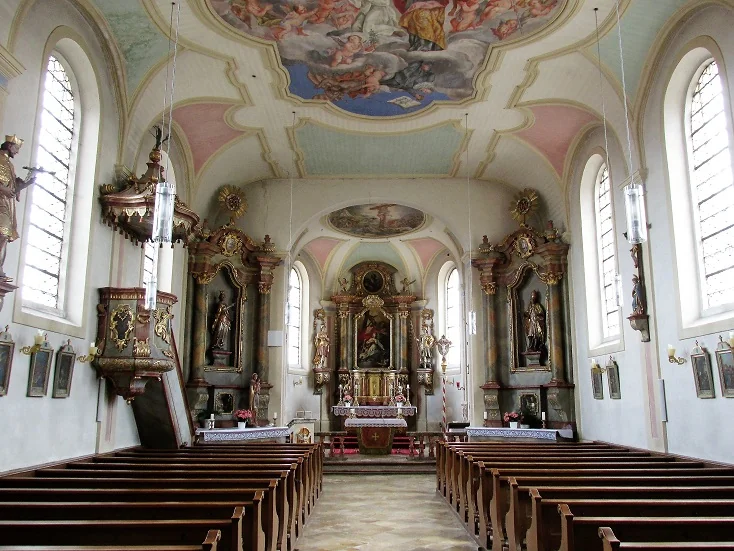
St. Georg is primarily a church of the 18th century, and this shapes its architectural impression. The new construction phase under Johann Georg Ettenhofer gives the building that calm, clear, and baroque effect that is typical for many churches of this time. On the side of the onion tower project, St. Georg is described as a building from the early 1730s and is listed in the monument register, which further underscores the cultural-historical significance of the building. Even without excessive embellishment, it is clear: Here stands a sacred building that is not arbitrary but counts among the defining historical structures in the area. For users searching for architecture, monument protection, or baroque church art, St. Georg thus provides exactly the combination of age, authenticity, and regional integration that makes such places so interesting. The church is not a museum but a monument with a lived function, and that is precisely what makes its charm. ([zwiebeltuerme-oberbayern.de](https://zwiebeltuerme-oberbayern.de/st-georg-schaeftlarn/))
The interior is also visibly documented on the official page of the parish association. There are references to the ceiling fresco, the fresco in the altar area, the depiction of Saint George, as well as the epitaphs and figures that shape the space. Particularly striking is the reference to the monastery of Schäftlarn: The figures of the monastery patrons Dionysius and Juliana show the close connection between church and monastery, and these patrons can also be found in the monastery church. This means for visitors: Those who enter St. Georg do not only see a local church but a spiritual network that extends beyond the immediate area. The pictorial furnishings make it clear that theology, memory, and local identity were thought together here. For content and SEO, this is important because inquiries about the interior, furnishings, altar area, or frescoes can be answered with real, verifiable facts. ([www2.erzbistum-muenchen.de](https://www2.erzbistum-muenchen.de/pfarrei/pv-schaeftlarn/cont/79655))
The preservation and care are also part of the monument character. The parish side informs that work on the church's roof structure began in early 2022, and services could still take place. This shows that St. Georg is not only historically valuable but also actively maintained. A listed building thrives on such care, as old churches especially need regular measures to retain their function in community life. For visitors, this is a positive signal: The place is not left to itself but remains in use and care. Thus, St. Georg connects what many good cultural sites are characterized by: historical substance, visible traces of time, and ongoing use that does not empty the space but fills it with meaning. This aspect should not be missing in a content text because it shows the church as a real, present building and not just as a memory of a bygone era. ([www2.erzbistum-muenchen.de](https://www2.erzbistum-muenchen.de/pfarrei/pv-schaeftlarn/cont/79655))
Services, Georgiritt, and Parish Life
St. Georg is not only historically interesting but also an active place of church life. The current schedule page of the parish association shows a dense succession of services, liturgical celebrations, and devotions. For April 2026, among other things, the Good Friday liturgy, the Easter vigil with food blessing, the festive service for Easter, the Fatima rosary, the patronage with Georgiritt and parish festival, as well as silent adoration and a procession to Baierbrunn are listed. This is particularly valuable for SEO research because it covers exactly those search intentions that often arise around church locations: When is the patronage? Is there a Georgiritt? Are services held regularly? The answer is clearly yes, and the official page documents it in a form that is easy for visitors to understand. Especially for a church like St. Georg, the lively calendar events are an essential part of its profile. ([www2.erzbistum-muenchen.de](https://www2.erzbistum-muenchen.de/pfarrei/pv-schaeftlarn/cont/79655))
The Georgiritt is a central keyword in this context. The official parish page mentions it directly in connection with the patronage and parish festival. For many users, this is more than just a date, as a Georgiritt traditionally stands for lived religious culture, customs, and regional connection in Bavaria. Although the exact procedures may vary from year to year, it is clear that St. Georg holds a fixed place in the local festival calendar. For the content strategy, this means: The church can be searched not only for its past but also for its current events. This makes the text connectable to search terms like service, patronage, Georgiritt, parish festival, and event calendar. Thus, the church lives not only from its architecture but from its function throughout the year and in the daily life of the community. Those seeking a place with genuine church practice will find here a very good example of how tradition and present intertwine. ([www2.erzbistum-muenchen.de](https://www2.erzbistum-muenchen.de/pfarrei/pv-schaeftlarn/cont/79655))
It is also noteworthy that the parish page presents St. Georg as a place of continuity, where planned services could take place despite construction work on the roof structure. This speaks for a strong anchoring in community life and good organization on site. The church is thus important not only for special holidays but also for regular liturgical processes. This is precisely what distinguishes St. Georg from purely tourist attractions. This point should definitely be included in an SEO description because it describes the actual use and directly addresses inquiries about services, masses, parish community, or church events. For visitors, this creates a realistic picture: St. Georg is a historical place with an active present, where faith, customs, and regional identity are not separated but made visible together. ([www2.erzbistum-muenchen.de](https://www2.erzbistum-muenchen.de/pfarrei/pv-schaeftlarn/cont/79655))
Access, S-Bahn, and Regional Accessibility
According to the community, Schäftlarn is well connected in terms of transport, and this is also important for visiting St. Georg. The official transport page mentions the A95 highway with exit No. 5 Schäftlarn, the federal highway B11, the S-Bahn line S7 between Munich Ostbahnhof and Wolfratshausen, as well as the train stations Ebenhausen and Hohenschäftlarn. Additionally, bus line 961 runs from Hohenschäftlarn via Neufahrn and Starnberg to Ammerland. For users searching for directions, public transport, or route descriptions, this is a very useful foundation. The church is thus located in an area that is easily accessible by both car and public transport. This is important for visitors planning a short detour, but also for those coming specifically for services, festivals, or a cultural walk. Especially for a church in the outskirts of Munich, this combination of regional location and good accessibility is a strong argument. ([schaeftlarn.de](https://www.schaeftlarn.de/verkehrsanbindung/))
Regarding parking, the official finding is rather reserved, but this is useful as it does not create false expectations. The transport page of the community does not specify any dedicated church parking. Instead, the general connection of Schäftlarn is emphasized, including S-Bahn, bus, and car via the main axes of the region. Those arriving by car should therefore orient themselves to the area and local conditions; those who prefer to travel simply should best use the train station Hohenschäftlarn or Ebenhausen and plan the short onward journey from there. For content optimization, this means: An FAQ on the topic of parking should be honestly formulated and indicate that the community does not provide separate parking information for the church. This makes the page trustworthy and simultaneously fulfills the search intent around access, parking, and accessibility. ([schaeftlarn.de](https://www.schaeftlarn.de/verkehrsanbindung/))
The good accessibility also fits the role of St. Georg as a place for regular appointments and special occasions. For example, those coming for the patronage or a service benefit from the fact that Schäftlarn is accessible in several ways. The community also provides a local map, and the transport page refers to further information sources of public transport. For visitors with limited time, this is particularly helpful as they can easily plan their arrival. In a search engine description, a clear benefit can be formulated from this: St. Georg is not remote but well connected via A95, S7, and bus 961. This practicality makes the church interesting for target groups that come not only out of spiritual interest but also from cultural or tourist motives. The journey is thus part of the experience, and the official transport situation supports this accessibility very clearly. ([schaeftlarn.de](https://www.schaeftlarn.de/verkehrsanbindung/))
Why a Visit is Worthwhile
A visit to St. Georg Hohenschäftlarn is especially worthwhile for people who understand churches not just as buildings but as repositories of history. The community of Schäftlarn describes that the three churches in the current municipal area indicate a dense settlement, and St. Georg takes on a special role in this. As one of the oldest ecclesiastical places in the Schäftlarn area, the church tells of early medieval beginnings, monastic influence, and later parish independence. Those engaged with local history will find here a rare concentration of information at a single location. This is interesting for cultural travelers as well as for people from the region who want to better understand the roots of their place. The combination of documented early history, the new construction of the 18th century, and vibrant community life makes the church a credible and versatile content topic. ([schaeftlarn.de](https://www.schaeftlarn.de/geschichte/))
Additionally, the close connection to the monastery of Schäftlarn remains visible in the furnishings and memory. The parish association refers to the figures of the monastery patrons Dionysius and Juliana, as well as to the epitaph of Abbot Hermann Frey. These are not random details but concrete signs of a long relationship between church and monastery. This is particularly valuable in SEO texts as it makes the place unique. Many churches share the same name, but few connect such an early mention, a clear construction history, monastic entanglement, and an active present community life. Therefore, those visiting St. Georg receive not just a quiet church space but a place with a narrative. And it is precisely this narrative that transforms a simple location into a strong venue that works excellently in content, navigation, and local search engine optimization. ([www2.erzbistum-muenchen.de](https://www2.erzbistum-muenchen.de/pfarrei/pv-schaeftlarn/cont/79655))
In the end, St. Georg Hohenschäftlarn can be described as a place that elegantly connects the past and the present. The historical core dates back to early documented history, the baroque new construction shapes the appearance, and the current parish calendar shows that the place is still needed. For visitors, this means clear orientation: Those seeking history, church art, regional spirituality, and genuine local events are in the right place. For search engines, this means a strong thematic focus on history, parish church, Georgiritt, service, access, and monastery reference. This very connection of facts and utility makes the place so well describable. St. Georg is not an arbitrary sight but a church with substance, function, and clear regional identity. Anyone wanting to understand Hohenschäftlarn cannot overlook St. Georg. ([schaeftlarn.de](https://www.schaeftlarn.de/geschichte/))
Sources:
- Archdiocese of Munich and Freising – St. Georg Hohenschäftlarn ([www2.erzbistum-muenchen.de](https://www2.erzbistum-muenchen.de/pfarrei/pv-schaeftlarn/cont/79655))
- Community Schäftlarn – History ([schaeftlarn.de](https://www.schaeftlarn.de/geschichte/))
- Community Schäftlarn – Transport Connection ([schaeftlarn.de](https://www.schaeftlarn.de/verkehrsanbindung/))
- Parish Association Schäftlarn – Parish Church Hohenschäftlarn St. Georg ([erzbistum-muenchen.de](https://www.erzbistum-muenchen.de/pfarrei/pv-schaeftlarn/--/pfarrverband-schaeftlarn/pfarrkirche-hohenschaeftlarn-st-georg/2004518/20250720.gottesdienst?utm_source=openai))
Show moreShow less
St. Georg Hohenschäftlarn | Baroque Church & Georgiritt
St. Georg Hohenschäftlarn is a place where local history, ecclesiastical tradition, and vibrant community life meet in a small space. The church belongs to the parish association of Schäftlarn and is considered one of the oldest branch churches of the former monastery parish according to the Archdiocese. A documented mention from 778 shows how deep the roots of this place run. The current building was constructed in the first half of the 18th century under Johann Georg Ettenhofer and continues to shape the image of Hohenschäftlarn today. Those interested in church, culture, and local identity will find here not only a sacred building but a historical anchor point that has held significance over many generations. This is particularly evident in the interplay of architecture, monastic tradition, and current ecclesiastical events such as Georgiritt and parish festivals. This very mix makes St. Georg a location that is not only historically intriguing but also remains present in the daily life of the community. ([www2.erzbistum-muenchen.de](https://www2.erzbistum-muenchen.de/pfarrei/pv-schaeftlarn/cont/79655))
History and Origin of St. Georg Hohenschäftlarn
The history of St. Georg begins long before the current church building. The parish association of Schäftlarn describes the church as one of the oldest branch churches of the former monastery parish of Schäftlarn and refers to a document from the year 778 that attests to a donation to the Bishop of Freising, Arbeo. Thus, St. Georg stands not only for a single sacred building but for a piece of early medieval continuity in the region. The community of Schäftlarn also emphasizes in its historical presentation that the clustering of three churches in the current municipal area indicates a dense settlement and that the ancient church of St. Georg in Hohenschäftlarn was last rebuilt in 1729/30. This is important for visitors because the place does not see itself as an isolated sight but as part of a much older settlement and faith landscape. Therefore, those who come here encounter not just a church building but a historical site that has been reinterpreted repeatedly over more than a millennium. ([www2.erzbistum-muenchen.de](https://www2.erzbistum-muenchen.de/pfarrei/pv-schaeftlarn/cont/79655))
The current building dates back to the years 1729 to 1732 and was constructed under the direction of the Munich master mason Johann Georg Ettenhofer. The official description of the parish association makes it clear that the older predecessor building was in a condition that made a new construction urgently necessary. This information is not only interesting for historians but also explains why St. Georg today possesses such a clear baroque character: The new construction of the 18th century marked a complete artistic fresh start without erasing the long prehistory of the place. The community of Schäftlarn summarizes this concisely in its chronicle and refers to the last new construction phase of 1729/30. Together, this presents a picture of continuity and renewal at the same time. This is precisely what makes the church so attractive for SEO and content purposes, as inquiries about history, year of construction, architect, and origin can be answered here with verifiable facts. ([www2.erzbistum-muenchen.de](https://www2.erzbistum-muenchen.de/pfarrei/pv-schaeftlarn/cont/79655))
A particularly impressive historical trace is the grave of Abbot Hermann Joseph Frey. The parish association writes that he was buried in St. Georg in 1751 because the monastery church was itself under construction at that time, and his epitaph still hangs on the wall of the choir. This makes the church a place where the fate of the monastery of Schäftlarn can be read very concretely. Anyone who wants to understand the history of the house should also consider this connection: St. Georg was not only a branch church but at times an important alternative location within the monastic structure. The community later developed into an expositura, a parish curacy, and finally in 1957 into an independent parish. Thus, St. Georg connects old monastic tradition with modern parish independence. For visitors, this creates a multifaceted image that goes far beyond an ordinary village church and marks the place as a living document of regional history. ([www2.erzbistum-muenchen.de](https://www2.erzbistum-muenchen.de/pfarrei/pv-schaeftlarn/cont/79655))
Architecture, Furnishings, and Listed Character
St. Georg is primarily a church of the 18th century, and this shapes its architectural impression. The new construction phase under Johann Georg Ettenhofer gives the building that calm, clear, and baroque effect that is typical for many churches of this time. On the side of the onion tower project, St. Georg is described as a building from the early 1730s and is listed in the monument register, which further underscores the cultural-historical significance of the building. Even without excessive embellishment, it is clear: Here stands a sacred building that is not arbitrary but counts among the defining historical structures in the area. For users searching for architecture, monument protection, or baroque church art, St. Georg thus provides exactly the combination of age, authenticity, and regional integration that makes such places so interesting. The church is not a museum but a monument with a lived function, and that is precisely what makes its charm. ([zwiebeltuerme-oberbayern.de](https://zwiebeltuerme-oberbayern.de/st-georg-schaeftlarn/))
The interior is also visibly documented on the official page of the parish association. There are references to the ceiling fresco, the fresco in the altar area, the depiction of Saint George, as well as the epitaphs and figures that shape the space. Particularly striking is the reference to the monastery of Schäftlarn: The figures of the monastery patrons Dionysius and Juliana show the close connection between church and monastery, and these patrons can also be found in the monastery church. This means for visitors: Those who enter St. Georg do not only see a local church but a spiritual network that extends beyond the immediate area. The pictorial furnishings make it clear that theology, memory, and local identity were thought together here. For content and SEO, this is important because inquiries about the interior, furnishings, altar area, or frescoes can be answered with real, verifiable facts. ([www2.erzbistum-muenchen.de](https://www2.erzbistum-muenchen.de/pfarrei/pv-schaeftlarn/cont/79655))
The preservation and care are also part of the monument character. The parish side informs that work on the church's roof structure began in early 2022, and services could still take place. This shows that St. Georg is not only historically valuable but also actively maintained. A listed building thrives on such care, as old churches especially need regular measures to retain their function in community life. For visitors, this is a positive signal: The place is not left to itself but remains in use and care. Thus, St. Georg connects what many good cultural sites are characterized by: historical substance, visible traces of time, and ongoing use that does not empty the space but fills it with meaning. This aspect should not be missing in a content text because it shows the church as a real, present building and not just as a memory of a bygone era. ([www2.erzbistum-muenchen.de](https://www2.erzbistum-muenchen.de/pfarrei/pv-schaeftlarn/cont/79655))
Services, Georgiritt, and Parish Life
St. Georg is not only historically interesting but also an active place of church life. The current schedule page of the parish association shows a dense succession of services, liturgical celebrations, and devotions. For April 2026, among other things, the Good Friday liturgy, the Easter vigil with food blessing, the festive service for Easter, the Fatima rosary, the patronage with Georgiritt and parish festival, as well as silent adoration and a procession to Baierbrunn are listed. This is particularly valuable for SEO research because it covers exactly those search intentions that often arise around church locations: When is the patronage? Is there a Georgiritt? Are services held regularly? The answer is clearly yes, and the official page documents it in a form that is easy for visitors to understand. Especially for a church like St. Georg, the lively calendar events are an essential part of its profile. ([www2.erzbistum-muenchen.de](https://www2.erzbistum-muenchen.de/pfarrei/pv-schaeftlarn/cont/79655))
The Georgiritt is a central keyword in this context. The official parish page mentions it directly in connection with the patronage and parish festival. For many users, this is more than just a date, as a Georgiritt traditionally stands for lived religious culture, customs, and regional connection in Bavaria. Although the exact procedures may vary from year to year, it is clear that St. Georg holds a fixed place in the local festival calendar. For the content strategy, this means: The church can be searched not only for its past but also for its current events. This makes the text connectable to search terms like service, patronage, Georgiritt, parish festival, and event calendar. Thus, the church lives not only from its architecture but from its function throughout the year and in the daily life of the community. Those seeking a place with genuine church practice will find here a very good example of how tradition and present intertwine. ([www2.erzbistum-muenchen.de](https://www2.erzbistum-muenchen.de/pfarrei/pv-schaeftlarn/cont/79655))
It is also noteworthy that the parish page presents St. Georg as a place of continuity, where planned services could take place despite construction work on the roof structure. This speaks for a strong anchoring in community life and good organization on site. The church is thus important not only for special holidays but also for regular liturgical processes. This is precisely what distinguishes St. Georg from purely tourist attractions. This point should definitely be included in an SEO description because it describes the actual use and directly addresses inquiries about services, masses, parish community, or church events. For visitors, this creates a realistic picture: St. Georg is a historical place with an active present, where faith, customs, and regional identity are not separated but made visible together. ([www2.erzbistum-muenchen.de](https://www2.erzbistum-muenchen.de/pfarrei/pv-schaeftlarn/cont/79655))
Access, S-Bahn, and Regional Accessibility
According to the community, Schäftlarn is well connected in terms of transport, and this is also important for visiting St. Georg. The official transport page mentions the A95 highway with exit No. 5 Schäftlarn, the federal highway B11, the S-Bahn line S7 between Munich Ostbahnhof and Wolfratshausen, as well as the train stations Ebenhausen and Hohenschäftlarn. Additionally, bus line 961 runs from Hohenschäftlarn via Neufahrn and Starnberg to Ammerland. For users searching for directions, public transport, or route descriptions, this is a very useful foundation. The church is thus located in an area that is easily accessible by both car and public transport. This is important for visitors planning a short detour, but also for those coming specifically for services, festivals, or a cultural walk. Especially for a church in the outskirts of Munich, this combination of regional location and good accessibility is a strong argument. ([schaeftlarn.de](https://www.schaeftlarn.de/verkehrsanbindung/))
Regarding parking, the official finding is rather reserved, but this is useful as it does not create false expectations. The transport page of the community does not specify any dedicated church parking. Instead, the general connection of Schäftlarn is emphasized, including S-Bahn, bus, and car via the main axes of the region. Those arriving by car should therefore orient themselves to the area and local conditions; those who prefer to travel simply should best use the train station Hohenschäftlarn or Ebenhausen and plan the short onward journey from there. For content optimization, this means: An FAQ on the topic of parking should be honestly formulated and indicate that the community does not provide separate parking information for the church. This makes the page trustworthy and simultaneously fulfills the search intent around access, parking, and accessibility. ([schaeftlarn.de](https://www.schaeftlarn.de/verkehrsanbindung/))
The good accessibility also fits the role of St. Georg as a place for regular appointments and special occasions. For example, those coming for the patronage or a service benefit from the fact that Schäftlarn is accessible in several ways. The community also provides a local map, and the transport page refers to further information sources of public transport. For visitors with limited time, this is particularly helpful as they can easily plan their arrival. In a search engine description, a clear benefit can be formulated from this: St. Georg is not remote but well connected via A95, S7, and bus 961. This practicality makes the church interesting for target groups that come not only out of spiritual interest but also from cultural or tourist motives. The journey is thus part of the experience, and the official transport situation supports this accessibility very clearly. ([schaeftlarn.de](https://www.schaeftlarn.de/verkehrsanbindung/))
Why a Visit is Worthwhile
A visit to St. Georg Hohenschäftlarn is especially worthwhile for people who understand churches not just as buildings but as repositories of history. The community of Schäftlarn describes that the three churches in the current municipal area indicate a dense settlement, and St. Georg takes on a special role in this. As one of the oldest ecclesiastical places in the Schäftlarn area, the church tells of early medieval beginnings, monastic influence, and later parish independence. Those engaged with local history will find here a rare concentration of information at a single location. This is interesting for cultural travelers as well as for people from the region who want to better understand the roots of their place. The combination of documented early history, the new construction of the 18th century, and vibrant community life makes the church a credible and versatile content topic. ([schaeftlarn.de](https://www.schaeftlarn.de/geschichte/))
Additionally, the close connection to the monastery of Schäftlarn remains visible in the furnishings and memory. The parish association refers to the figures of the monastery patrons Dionysius and Juliana, as well as to the epitaph of Abbot Hermann Frey. These are not random details but concrete signs of a long relationship between church and monastery. This is particularly valuable in SEO texts as it makes the place unique. Many churches share the same name, but few connect such an early mention, a clear construction history, monastic entanglement, and an active present community life. Therefore, those visiting St. Georg receive not just a quiet church space but a place with a narrative. And it is precisely this narrative that transforms a simple location into a strong venue that works excellently in content, navigation, and local search engine optimization. ([www2.erzbistum-muenchen.de](https://www2.erzbistum-muenchen.de/pfarrei/pv-schaeftlarn/cont/79655))
In the end, St. Georg Hohenschäftlarn can be described as a place that elegantly connects the past and the present. The historical core dates back to early documented history, the baroque new construction shapes the appearance, and the current parish calendar shows that the place is still needed. For visitors, this means clear orientation: Those seeking history, church art, regional spirituality, and genuine local events are in the right place. For search engines, this means a strong thematic focus on history, parish church, Georgiritt, service, access, and monastery reference. This very connection of facts and utility makes the place so well describable. St. Georg is not an arbitrary sight but a church with substance, function, and clear regional identity. Anyone wanting to understand Hohenschäftlarn cannot overlook St. Georg. ([schaeftlarn.de](https://www.schaeftlarn.de/geschichte/))
Sources:
- Archdiocese of Munich and Freising – St. Georg Hohenschäftlarn ([www2.erzbistum-muenchen.de](https://www2.erzbistum-muenchen.de/pfarrei/pv-schaeftlarn/cont/79655))
- Community Schäftlarn – History ([schaeftlarn.de](https://www.schaeftlarn.de/geschichte/))
- Community Schäftlarn – Transport Connection ([schaeftlarn.de](https://www.schaeftlarn.de/verkehrsanbindung/))
- Parish Association Schäftlarn – Parish Church Hohenschäftlarn St. Georg ([erzbistum-muenchen.de](https://www.erzbistum-muenchen.de/pfarrei/pv-schaeftlarn/--/pfarrverband-schaeftlarn/pfarrkirche-hohenschaeftlarn-st-georg/2004518/20250720.gottesdienst?utm_source=openai))
St. Georg Hohenschäftlarn | Baroque Church & Georgiritt
St. Georg Hohenschäftlarn is a place where local history, ecclesiastical tradition, and vibrant community life meet in a small space. The church belongs to the parish association of Schäftlarn and is considered one of the oldest branch churches of the former monastery parish according to the Archdiocese. A documented mention from 778 shows how deep the roots of this place run. The current building was constructed in the first half of the 18th century under Johann Georg Ettenhofer and continues to shape the image of Hohenschäftlarn today. Those interested in church, culture, and local identity will find here not only a sacred building but a historical anchor point that has held significance over many generations. This is particularly evident in the interplay of architecture, monastic tradition, and current ecclesiastical events such as Georgiritt and parish festivals. This very mix makes St. Georg a location that is not only historically intriguing but also remains present in the daily life of the community. ([www2.erzbistum-muenchen.de](https://www2.erzbistum-muenchen.de/pfarrei/pv-schaeftlarn/cont/79655))
History and Origin of St. Georg Hohenschäftlarn
The history of St. Georg begins long before the current church building. The parish association of Schäftlarn describes the church as one of the oldest branch churches of the former monastery parish of Schäftlarn and refers to a document from the year 778 that attests to a donation to the Bishop of Freising, Arbeo. Thus, St. Georg stands not only for a single sacred building but for a piece of early medieval continuity in the region. The community of Schäftlarn also emphasizes in its historical presentation that the clustering of three churches in the current municipal area indicates a dense settlement and that the ancient church of St. Georg in Hohenschäftlarn was last rebuilt in 1729/30. This is important for visitors because the place does not see itself as an isolated sight but as part of a much older settlement and faith landscape. Therefore, those who come here encounter not just a church building but a historical site that has been reinterpreted repeatedly over more than a millennium. ([www2.erzbistum-muenchen.de](https://www2.erzbistum-muenchen.de/pfarrei/pv-schaeftlarn/cont/79655))
The current building dates back to the years 1729 to 1732 and was constructed under the direction of the Munich master mason Johann Georg Ettenhofer. The official description of the parish association makes it clear that the older predecessor building was in a condition that made a new construction urgently necessary. This information is not only interesting for historians but also explains why St. Georg today possesses such a clear baroque character: The new construction of the 18th century marked a complete artistic fresh start without erasing the long prehistory of the place. The community of Schäftlarn summarizes this concisely in its chronicle and refers to the last new construction phase of 1729/30. Together, this presents a picture of continuity and renewal at the same time. This is precisely what makes the church so attractive for SEO and content purposes, as inquiries about history, year of construction, architect, and origin can be answered here with verifiable facts. ([www2.erzbistum-muenchen.de](https://www2.erzbistum-muenchen.de/pfarrei/pv-schaeftlarn/cont/79655))
A particularly impressive historical trace is the grave of Abbot Hermann Joseph Frey. The parish association writes that he was buried in St. Georg in 1751 because the monastery church was itself under construction at that time, and his epitaph still hangs on the wall of the choir. This makes the church a place where the fate of the monastery of Schäftlarn can be read very concretely. Anyone who wants to understand the history of the house should also consider this connection: St. Georg was not only a branch church but at times an important alternative location within the monastic structure. The community later developed into an expositura, a parish curacy, and finally in 1957 into an independent parish. Thus, St. Georg connects old monastic tradition with modern parish independence. For visitors, this creates a multifaceted image that goes far beyond an ordinary village church and marks the place as a living document of regional history. ([www2.erzbistum-muenchen.de](https://www2.erzbistum-muenchen.de/pfarrei/pv-schaeftlarn/cont/79655))
Architecture, Furnishings, and Listed Character
St. Georg is primarily a church of the 18th century, and this shapes its architectural impression. The new construction phase under Johann Georg Ettenhofer gives the building that calm, clear, and baroque effect that is typical for many churches of this time. On the side of the onion tower project, St. Georg is described as a building from the early 1730s and is listed in the monument register, which further underscores the cultural-historical significance of the building. Even without excessive embellishment, it is clear: Here stands a sacred building that is not arbitrary but counts among the defining historical structures in the area. For users searching for architecture, monument protection, or baroque church art, St. Georg thus provides exactly the combination of age, authenticity, and regional integration that makes such places so interesting. The church is not a museum but a monument with a lived function, and that is precisely what makes its charm. ([zwiebeltuerme-oberbayern.de](https://zwiebeltuerme-oberbayern.de/st-georg-schaeftlarn/))
The interior is also visibly documented on the official page of the parish association. There are references to the ceiling fresco, the fresco in the altar area, the depiction of Saint George, as well as the epitaphs and figures that shape the space. Particularly striking is the reference to the monastery of Schäftlarn: The figures of the monastery patrons Dionysius and Juliana show the close connection between church and monastery, and these patrons can also be found in the monastery church. This means for visitors: Those who enter St. Georg do not only see a local church but a spiritual network that extends beyond the immediate area. The pictorial furnishings make it clear that theology, memory, and local identity were thought together here. For content and SEO, this is important because inquiries about the interior, furnishings, altar area, or frescoes can be answered with real, verifiable facts. ([www2.erzbistum-muenchen.de](https://www2.erzbistum-muenchen.de/pfarrei/pv-schaeftlarn/cont/79655))
The preservation and care are also part of the monument character. The parish side informs that work on the church's roof structure began in early 2022, and services could still take place. This shows that St. Georg is not only historically valuable but also actively maintained. A listed building thrives on such care, as old churches especially need regular measures to retain their function in community life. For visitors, this is a positive signal: The place is not left to itself but remains in use and care. Thus, St. Georg connects what many good cultural sites are characterized by: historical substance, visible traces of time, and ongoing use that does not empty the space but fills it with meaning. This aspect should not be missing in a content text because it shows the church as a real, present building and not just as a memory of a bygone era. ([www2.erzbistum-muenchen.de](https://www2.erzbistum-muenchen.de/pfarrei/pv-schaeftlarn/cont/79655))
Services, Georgiritt, and Parish Life
St. Georg is not only historically interesting but also an active place of church life. The current schedule page of the parish association shows a dense succession of services, liturgical celebrations, and devotions. For April 2026, among other things, the Good Friday liturgy, the Easter vigil with food blessing, the festive service for Easter, the Fatima rosary, the patronage with Georgiritt and parish festival, as well as silent adoration and a procession to Baierbrunn are listed. This is particularly valuable for SEO research because it covers exactly those search intentions that often arise around church locations: When is the patronage? Is there a Georgiritt? Are services held regularly? The answer is clearly yes, and the official page documents it in a form that is easy for visitors to understand. Especially for a church like St. Georg, the lively calendar events are an essential part of its profile. ([www2.erzbistum-muenchen.de](https://www2.erzbistum-muenchen.de/pfarrei/pv-schaeftlarn/cont/79655))
The Georgiritt is a central keyword in this context. The official parish page mentions it directly in connection with the patronage and parish festival. For many users, this is more than just a date, as a Georgiritt traditionally stands for lived religious culture, customs, and regional connection in Bavaria. Although the exact procedures may vary from year to year, it is clear that St. Georg holds a fixed place in the local festival calendar. For the content strategy, this means: The church can be searched not only for its past but also for its current events. This makes the text connectable to search terms like service, patronage, Georgiritt, parish festival, and event calendar. Thus, the church lives not only from its architecture but from its function throughout the year and in the daily life of the community. Those seeking a place with genuine church practice will find here a very good example of how tradition and present intertwine. ([www2.erzbistum-muenchen.de](https://www2.erzbistum-muenchen.de/pfarrei/pv-schaeftlarn/cont/79655))
It is also noteworthy that the parish page presents St. Georg as a place of continuity, where planned services could take place despite construction work on the roof structure. This speaks for a strong anchoring in community life and good organization on site. The church is thus important not only for special holidays but also for regular liturgical processes. This is precisely what distinguishes St. Georg from purely tourist attractions. This point should definitely be included in an SEO description because it describes the actual use and directly addresses inquiries about services, masses, parish community, or church events. For visitors, this creates a realistic picture: St. Georg is a historical place with an active present, where faith, customs, and regional identity are not separated but made visible together. ([www2.erzbistum-muenchen.de](https://www2.erzbistum-muenchen.de/pfarrei/pv-schaeftlarn/cont/79655))
Access, S-Bahn, and Regional Accessibility
According to the community, Schäftlarn is well connected in terms of transport, and this is also important for visiting St. Georg. The official transport page mentions the A95 highway with exit No. 5 Schäftlarn, the federal highway B11, the S-Bahn line S7 between Munich Ostbahnhof and Wolfratshausen, as well as the train stations Ebenhausen and Hohenschäftlarn. Additionally, bus line 961 runs from Hohenschäftlarn via Neufahrn and Starnberg to Ammerland. For users searching for directions, public transport, or route descriptions, this is a very useful foundation. The church is thus located in an area that is easily accessible by both car and public transport. This is important for visitors planning a short detour, but also for those coming specifically for services, festivals, or a cultural walk. Especially for a church in the outskirts of Munich, this combination of regional location and good accessibility is a strong argument. ([schaeftlarn.de](https://www.schaeftlarn.de/verkehrsanbindung/))
Regarding parking, the official finding is rather reserved, but this is useful as it does not create false expectations. The transport page of the community does not specify any dedicated church parking. Instead, the general connection of Schäftlarn is emphasized, including S-Bahn, bus, and car via the main axes of the region. Those arriving by car should therefore orient themselves to the area and local conditions; those who prefer to travel simply should best use the train station Hohenschäftlarn or Ebenhausen and plan the short onward journey from there. For content optimization, this means: An FAQ on the topic of parking should be honestly formulated and indicate that the community does not provide separate parking information for the church. This makes the page trustworthy and simultaneously fulfills the search intent around access, parking, and accessibility. ([schaeftlarn.de](https://www.schaeftlarn.de/verkehrsanbindung/))
The good accessibility also fits the role of St. Georg as a place for regular appointments and special occasions. For example, those coming for the patronage or a service benefit from the fact that Schäftlarn is accessible in several ways. The community also provides a local map, and the transport page refers to further information sources of public transport. For visitors with limited time, this is particularly helpful as they can easily plan their arrival. In a search engine description, a clear benefit can be formulated from this: St. Georg is not remote but well connected via A95, S7, and bus 961. This practicality makes the church interesting for target groups that come not only out of spiritual interest but also from cultural or tourist motives. The journey is thus part of the experience, and the official transport situation supports this accessibility very clearly. ([schaeftlarn.de](https://www.schaeftlarn.de/verkehrsanbindung/))
Why a Visit is Worthwhile
A visit to St. Georg Hohenschäftlarn is especially worthwhile for people who understand churches not just as buildings but as repositories of history. The community of Schäftlarn describes that the three churches in the current municipal area indicate a dense settlement, and St. Georg takes on a special role in this. As one of the oldest ecclesiastical places in the Schäftlarn area, the church tells of early medieval beginnings, monastic influence, and later parish independence. Those engaged with local history will find here a rare concentration of information at a single location. This is interesting for cultural travelers as well as for people from the region who want to better understand the roots of their place. The combination of documented early history, the new construction of the 18th century, and vibrant community life makes the church a credible and versatile content topic. ([schaeftlarn.de](https://www.schaeftlarn.de/geschichte/))
Additionally, the close connection to the monastery of Schäftlarn remains visible in the furnishings and memory. The parish association refers to the figures of the monastery patrons Dionysius and Juliana, as well as to the epitaph of Abbot Hermann Frey. These are not random details but concrete signs of a long relationship between church and monastery. This is particularly valuable in SEO texts as it makes the place unique. Many churches share the same name, but few connect such an early mention, a clear construction history, monastic entanglement, and an active present community life. Therefore, those visiting St. Georg receive not just a quiet church space but a place with a narrative. And it is precisely this narrative that transforms a simple location into a strong venue that works excellently in content, navigation, and local search engine optimization. ([www2.erzbistum-muenchen.de](https://www2.erzbistum-muenchen.de/pfarrei/pv-schaeftlarn/cont/79655))
In the end, St. Georg Hohenschäftlarn can be described as a place that elegantly connects the past and the present. The historical core dates back to early documented history, the baroque new construction shapes the appearance, and the current parish calendar shows that the place is still needed. For visitors, this means clear orientation: Those seeking history, church art, regional spirituality, and genuine local events are in the right place. For search engines, this means a strong thematic focus on history, parish church, Georgiritt, service, access, and monastery reference. This very connection of facts and utility makes the place so well describable. St. Georg is not an arbitrary sight but a church with substance, function, and clear regional identity. Anyone wanting to understand Hohenschäftlarn cannot overlook St. Georg. ([schaeftlarn.de](https://www.schaeftlarn.de/geschichte/))
Sources:
- Archdiocese of Munich and Freising – St. Georg Hohenschäftlarn ([www2.erzbistum-muenchen.de](https://www2.erzbistum-muenchen.de/pfarrei/pv-schaeftlarn/cont/79655))
- Community Schäftlarn – History ([schaeftlarn.de](https://www.schaeftlarn.de/geschichte/))
- Community Schäftlarn – Transport Connection ([schaeftlarn.de](https://www.schaeftlarn.de/verkehrsanbindung/))
- Parish Association Schäftlarn – Parish Church Hohenschäftlarn St. Georg ([erzbistum-muenchen.de](https://www.erzbistum-muenchen.de/pfarrei/pv-schaeftlarn/--/pfarrverband-schaeftlarn/pfarrkirche-hohenschaeftlarn-st-georg/2004518/20250720.gottesdienst?utm_source=openai))
Upcoming Events
No events found
Frequently Asked Questions
Reviews
Michi Wagner
6. April 2019
A very beautiful Baroque church and one of the cemeteries with an incredibly beautiful view. On clear days and when the Föhn wind is blowing, you can see almost the entire mountain range. Benches invite you to linger.
Hu Mo
7. January 2021
Situated on a hill, the church and its cemetery offer beautiful panoramic views. The interior of the church is also worth seeing.
Gerlinde Gerum
25. June 2019
The church is situated on a hill with a wonderful view of the mountains. Unfortunately, it is currently closed due to damage.
Christo Paul
13. October 2025
Peter Bruckmaier
5. October 2020
Beautiful church.