
München
Sankt-Jakobs-Platz, 80331 München, Deutschland
St. Jakob am Anger | Services & History
St. Jakob am Anger is much more than a church address at St. Jakob Square. The place connects Munich's city history, monastic continuity, pilgrimage tradition, and an exceptionally clear church space into an ensemble that immediately stands out in the old town while also appearing remarkably quiet. Those who visit St. Jakob am Anger experience not only a Catholic church but a historically grown center that stands on the oldest monastic traces of the city. The current monastery and institute church belongs to the complex of the Poor School Sisters of Our Lady and is located at the southern edge of the square, directly in an environment that today is characterized by culture, religion, and public urban space. For visitors, this place is therefore equally a space for prayer, history, and architecture. The square in front of the church, the Jewish Center across the street, and the old town surrounding it make St. Jakob am Anger one of the most distinctive places in Munich, where the past and present visibly touch. ([hdbg.eu](https://hdbg.eu/kloster/index.php/detail/geschichte?id=KS0250))
Services and Spiritual Significance of St. Jakob am Anger
Those searching for St. Jakob am Anger often first think of the services. This fits with this church, as it is not only a monument but a living place of faith. The Munich city website explicitly reports that many masses take place here and that the church is accessible until late afternoon. This mixture of openness and quiet liturgy shapes the character of the house: It is a place where one can briefly enter during the day, mentally take a candle with them, let the space affect them, or consciously participate in a celebration. That St. Jakob am Anger continues to be used today as a place of Eucharist and church encounter is also shown by the Munich Archdiocese, which locates events and services here. For many people, the church thus serves as a counterpoint to the hectic center around Marienplatz and Sendlinger Tor: One enters a space that does not want to be loud but allows for contemplation. Especially in the heart of the city, this spiritual presence is a strong signal. It makes the church relevant for believers, pilgrims, and those interested in culture alike. ([muenchen.de](https://www.muenchen.de/sehenswuerdigkeiten/kirchen-und-kloester/kloster-und-institutskirche-st-jakob-am-anger?utm_source=openai))
The spiritual significance extends far beyond the normal parish routine. St. Jakob am Anger is closely connected to the Camino de Santiago: The tradition of sending pilgrims on their way to Santiago de Compostela in summer was revived in 1989 and refers to an even older pilgrimage function of the place. Already in the Middle Ages, the Anger was, according to church tradition, a location where travelers, believers, and urban life intertwined. Today, this origin can still be felt in the symbolic power of the name, in the patronage of Saint James, and in the special atmosphere between the monastery, church, and square. Therefore, those attending a mass here experience not only a liturgical celebration but also a piece of Munich's sense of tradition. The church stands for continuity in a city that has continually reinvented itself. This is precisely what makes its services so interesting: They take place in a space that, although newly built after the war, has a spiritual history that reaches back much further than the current architecture. ([muenchen.de](https://www.muenchen.de/sehenswuerdigkeiten/kirchen-und-kloester/kloster-und-institutskirche-st-jakob-am-anger?utm_source=openai))
History of St. Jakob am Anger: From Franciscan Monastery to Anger Monastery
The history of St. Jakob am Anger begins early in the 13th century and is among the oldest chapters of Munich's history. The House of Bavarian History describes the first Franciscans at the Anger for the year 1221 in the order's tradition; for 1257, written evidence of the permanent settlement and the church of St. Jakob of the Minor Brothers exists. The location was then outside the city wall in a poor suburb and was typical for a mendicant order that sought proximity to the people. In 1284, the Franciscans relocated their convent north at the request of Duke Ludwig the Strict, and the older monastery at the Anger was taken over by Poor Clares, that is, nuns of the Franciscan order. This made the place a monastic center that remained closely intertwined with the city's history for centuries. The name St. Jakob is not a coincidence: it refers to pilgrims, long-distance paths, and the early religious imprint of the area. At the same time, the Anger was already in the Middle Ages not an isolated place but a space where monastic life, trade, and public life coexisted. This dual role is still palpable today. ([hdbg.eu](https://hdbg.eu/kloster/index.php/detail/geschichte?id=KS0250))
The following centuries brought renovations, crises, and new beginnings. In 1329, a great city fire destroyed parts of the surroundings, but the church and monastery complex remained intact at its core. In 1404, the old St. Jakob church collapsed, after which the nuns built a new one within a few years. In the late Middle Ages, the convent grew into a significant spiritual and economic place, and the Wittelsbach family also strongly supported the monastery. Since 1310, the Anger has been the site of the Jacobidult, from which the still-known Auer Dult developed. With secularization came the deepest cut: in 1803, the convent was dissolved, the nuns relocated, and the complex later used for other purposes. It was not until 1843 that Maria Theresia Gerhardinger, the founder of the Poor School Sisters of Our Lady, took over the convent building and the church; in 1855, the order was able to purchase the area. After the severe bombing destruction in 1944, the current complex was newly built in 1955/56 or from 1955 to 1957 according to plans by Friedrich Haindl. Thus, a medieval place became a post-war building with deep historical roots. ([hdbg.eu](https://hdbg.eu/kloster/index.php/detail/geschichte?id=KS0250))
Architecture and Artworks in the Monastery and Institute Church
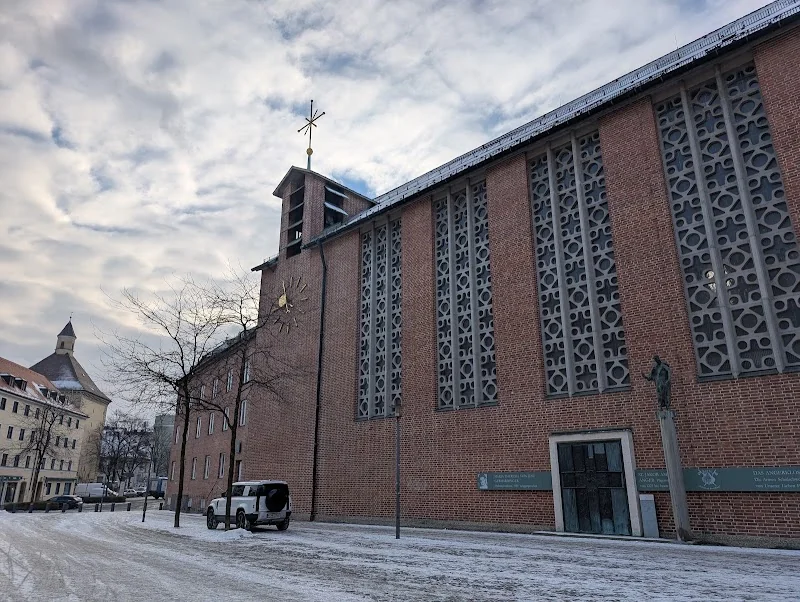
Architecturally, St. Jakob am Anger thrives on the conscious contrast between external simplicity and internal impact. The current church was rebuilt after the war destruction as part of a spacious quadrangular building, and it is precisely this post-war architecture that defines its character: no baroque excess, no monumental staging, but a bright, clear, and spacious form language. The Munich city website emphasizes that the building was severely damaged during the air raids in 1944 and was rebuilt between 1955 and 1957. That St. Jakob am Anger now appears as a brick building fits its position at St. Jakob Square: the façade appears sober but not cold, and it creates a beautiful transition between the old town and the monastic world with the open urban space. Especially those interested in church architecture of the post-war period will find here an exciting example of how a sacred place can continue to live without historical reconstruction. The church does not stand for past splendor but for continuity through renewal. This makes it unique in Munich and particularly worthwhile for architecture enthusiasts. ([muenchen.de](https://www.muenchen.de/sehenswuerdigkeiten/kirchen-und-kloester/kloster-und-institutskirche-st-jakob-am-anger?utm_source=openai))
Inside, this idea continues. The space is kept white, high, and deliberately quiet so that individual artworks can have an even stronger impact. Above the altar hangs an unusual crucifixion depiction by Josef Henselmann, which gives the space a concentrated, modern center. Additionally, there is a medieval sculpture of Saint James by Erasmus Grasser, which makes the historical reference of the house visible in a special way. The colorful frescoes on the flat ceiling by Bill Nagel also play an important role, as they give depth and warmth to the bright space without overloading it. Among the spiritually and historically most important points is also the grave of Maria Theresia Gerhardinger, the founder of the Poor School Sisters. This makes the church a memorial site of the congregation. Those who observe the space attentively quickly understand why St. Jakob am Anger is not simply a city church: the interior connects liturgy, memory, and art into a quiet, very unique overall appearance. This mixture makes the church interesting for visitors, photographers, and believers alike. ([muenchen.de](https://www.muenchen.de/sehenswuerdigkeiten/kirchen-und-kloester/kloster-und-institutskirche-st-jakob-am-anger?utm_source=openai))
St. Jakob Square, Photos, and the Unique Cityscape
St. Jakob am Anger is also very photogenic because its surroundings create a strong image. St. Jakob Square was significantly changed after World War II and redesigned between 2006 and 2007. The area covers about 1.1 hectares and today forms an urban ensemble of church, Jewish Center, and Munich City Museum. The city of Munich describes the square as a place of encounter, which has become a cultural focal point again after decades as a parking lot and wasteland. For photos, this contrast is particularly interesting: the rather closed, historically significant church with its brick façade meets the modern, open square design with granite paving and clear lines. The square thus visually tells the same story as the church itself: the old remains recognizable, the new is not hidden. Those wanting to take beautiful pictures of St. Jakob am Anger should therefore not only capture the church from the front but also seek the connection to the square and neighboring buildings. The result is images that are not only architecturally beautiful but also showcase Munich as a city of layers and contrasts. ([entdecken.muenchen.de](https://entdecken.muenchen.de/en/station/23-12/?utm_source=openai))
Particularly impressive is the proximity to the Jewish Center with the Ohel Jakob synagogue. Its position opposite the church makes the place a cultural and religious key space in the city. The city of Munich emphasizes that the buildings give the square its unmistakable face and special significance. For visitors, this means: even a short stay provides strong motifs. The quiet monastery church, the open pavement, the modern travertine and granite surfaces of the surroundings, the view over the square, and the proximity to the city museum create numerous perspectives. Those searching for photos will find current exterior views, square scenes, and close-ups on the city pages that clearly show why St. Jakob Square is not just a transit place. The square is now family-friendly, lively, and historically charged. This is precisely why it is worthwhile to consciously perceive not only the church but also the surroundings when visiting St. Jakob am Anger. It is a place where photography, urban space, and memory almost automatically come together. ([entdecken.muenchen.de](https://entdecken.muenchen.de/en/station/23-12/?utm_source=openai))
Access, Parking, and Practical Tips for Visitors
Practically, St. Jakob am Anger is very centrally located. The address at St. Jakob Square 1, 80331 Munich, brings visitors right into the old town, just a few minutes' walk from central urban axes. For orientation, it is important that the square is now a well-developed urban space that can be easily reached both on foot and by public transport. The nearby surroundings are linked on the city pages with Marienplatz and Sendlinger Tor; practical parking options in the area include the underground garage Oberanger and the parking garage Schrannenhalle. Those who do not search directly in the parking area of the square will find sensible alternatives in the neighborhood. This is particularly practical for visitors who want to combine a visit to the church, Jewish Center, city museum, or a walk through the old town. That the Munich city website describes the church as accessible until late afternoon makes spontaneous visits additionally uncomplicated. St. Jakob am Anger is thus not a hard-to-reach insider tip but an inner-city place that remains surprisingly quiet despite its central location. ([muenchen.de](https://www.muenchen.de/sehenswuerdigkeiten/kirchen-und-kloester/kloster-und-institutskirche-st-jakob-am-anger?utm_source=openai))
Practical planning also includes looking at the religious and cultural function of the place. In summer, many pilgrims set out from here towards Santiago de Compostela; this tradition was revived in 1989 and connects to a very old story. So, if you are looking for a church with a connection to the Camino de Santiago, you are in the right place. The place is suitable for short visits between appointments as well as for consciously planned stays with more time. One can use the church as a spiritual stop, view the artworks, photograph the square, or simply let the special mixture of monastery, urban space, and history affect them. That such a dense cultural environment has developed around St. Jakob am Anger is no coincidence: the historical development of the Anger, the post-war redesign, and the current religious neighborhood interlink. For visitors, this is a clear advantage, as a church visit can quickly turn into a whole old town tour. Those who want to understand Munich through its places will find here a very compact but extremely informative entry point. ([muenchen.de](https://www.muenchen.de/sehenswuerdigkeiten/kirchen-und-kloester/kloster-und-institutskirche-st-jakob-am-anger?utm_source=openai))
Pilgrimage Tradition, Monastic Life, and Educational Mission at the Anger
St. Jakob am Anger would not be fully described if one only considered the church and the square. The place is also closely connected to the monastic life of the Poor School Sisters, who have shaped the area since the 19th century. Today, sisters live and work here, and the complex remains a place of education, support, and spiritual practice to this day. The House of Bavarian History describes that the school of the Anger monastery became a significant educational institution in the 19th and 20th centuries, and the congregation made a substantial contribution to Bavarian education. Although today's structures are different from those of the past, the basic idea remains: St. Jakob am Anger is not just a monument but a working place with a social and religious mission. For visitors, this explains the special atmosphere. It is not merely museum architecture but a house that has shaped people over generations. The presence of the order and the connection to Maria Theresia Gerhardinger additionally make the place an important memorial space within the Catholic history of Munich. ([hdbg.eu](https://hdbg.eu/kloster/index.php/detail/geschichte?id=KS0855))
Those who think about the pilgrimage tradition, the school history, and the current urban location together quickly understand why St. Jakob am Anger is so frequently sought after. Many users are interested in the church name, others in services, and still others in photos, address, or the Camino de Santiago. These search motives reflect the profile of the place: it is religious, historical, visually, and practically relevant at the same time. The immediate proximity to other significant institutions enhances the profile. St. Jakob Square is now one of the densest cultural places in Munich, and the church remains a quiet focal point within it. Thus, those who pause here do not experience an isolated sacred space but a piece of living urban history. The visit is therefore worthwhile on multiple levels: as a spiritual break, as a glimpse into Munich's monastic past, as a photographic motif, and as a starting point for further discoveries in the old town. St. Jakob am Anger is a place where the logic of the city and the logic of faith do not contradict but explain each other. This is exactly what makes it so interesting for Munich residents, visitors to Munich, and pilgrims alike. ([entdecken.muenchen.de](https://entdecken.muenchen.de/en/station/23-12/?utm_source=openai))
Sources:
Show moreShow less
St. Jakob am Anger | Services & History
St. Jakob am Anger is much more than a church address at St. Jakob Square. The place connects Munich's city history, monastic continuity, pilgrimage tradition, and an exceptionally clear church space into an ensemble that immediately stands out in the old town while also appearing remarkably quiet. Those who visit St. Jakob am Anger experience not only a Catholic church but a historically grown center that stands on the oldest monastic traces of the city. The current monastery and institute church belongs to the complex of the Poor School Sisters of Our Lady and is located at the southern edge of the square, directly in an environment that today is characterized by culture, religion, and public urban space. For visitors, this place is therefore equally a space for prayer, history, and architecture. The square in front of the church, the Jewish Center across the street, and the old town surrounding it make St. Jakob am Anger one of the most distinctive places in Munich, where the past and present visibly touch. ([hdbg.eu](https://hdbg.eu/kloster/index.php/detail/geschichte?id=KS0250))
Services and Spiritual Significance of St. Jakob am Anger
Those searching for St. Jakob am Anger often first think of the services. This fits with this church, as it is not only a monument but a living place of faith. The Munich city website explicitly reports that many masses take place here and that the church is accessible until late afternoon. This mixture of openness and quiet liturgy shapes the character of the house: It is a place where one can briefly enter during the day, mentally take a candle with them, let the space affect them, or consciously participate in a celebration. That St. Jakob am Anger continues to be used today as a place of Eucharist and church encounter is also shown by the Munich Archdiocese, which locates events and services here. For many people, the church thus serves as a counterpoint to the hectic center around Marienplatz and Sendlinger Tor: One enters a space that does not want to be loud but allows for contemplation. Especially in the heart of the city, this spiritual presence is a strong signal. It makes the church relevant for believers, pilgrims, and those interested in culture alike. ([muenchen.de](https://www.muenchen.de/sehenswuerdigkeiten/kirchen-und-kloester/kloster-und-institutskirche-st-jakob-am-anger?utm_source=openai))
The spiritual significance extends far beyond the normal parish routine. St. Jakob am Anger is closely connected to the Camino de Santiago: The tradition of sending pilgrims on their way to Santiago de Compostela in summer was revived in 1989 and refers to an even older pilgrimage function of the place. Already in the Middle Ages, the Anger was, according to church tradition, a location where travelers, believers, and urban life intertwined. Today, this origin can still be felt in the symbolic power of the name, in the patronage of Saint James, and in the special atmosphere between the monastery, church, and square. Therefore, those attending a mass here experience not only a liturgical celebration but also a piece of Munich's sense of tradition. The church stands for continuity in a city that has continually reinvented itself. This is precisely what makes its services so interesting: They take place in a space that, although newly built after the war, has a spiritual history that reaches back much further than the current architecture. ([muenchen.de](https://www.muenchen.de/sehenswuerdigkeiten/kirchen-und-kloester/kloster-und-institutskirche-st-jakob-am-anger?utm_source=openai))
History of St. Jakob am Anger: From Franciscan Monastery to Anger Monastery
The history of St. Jakob am Anger begins early in the 13th century and is among the oldest chapters of Munich's history. The House of Bavarian History describes the first Franciscans at the Anger for the year 1221 in the order's tradition; for 1257, written evidence of the permanent settlement and the church of St. Jakob of the Minor Brothers exists. The location was then outside the city wall in a poor suburb and was typical for a mendicant order that sought proximity to the people. In 1284, the Franciscans relocated their convent north at the request of Duke Ludwig the Strict, and the older monastery at the Anger was taken over by Poor Clares, that is, nuns of the Franciscan order. This made the place a monastic center that remained closely intertwined with the city's history for centuries. The name St. Jakob is not a coincidence: it refers to pilgrims, long-distance paths, and the early religious imprint of the area. At the same time, the Anger was already in the Middle Ages not an isolated place but a space where monastic life, trade, and public life coexisted. This dual role is still palpable today. ([hdbg.eu](https://hdbg.eu/kloster/index.php/detail/geschichte?id=KS0250))
The following centuries brought renovations, crises, and new beginnings. In 1329, a great city fire destroyed parts of the surroundings, but the church and monastery complex remained intact at its core. In 1404, the old St. Jakob church collapsed, after which the nuns built a new one within a few years. In the late Middle Ages, the convent grew into a significant spiritual and economic place, and the Wittelsbach family also strongly supported the monastery. Since 1310, the Anger has been the site of the Jacobidult, from which the still-known Auer Dult developed. With secularization came the deepest cut: in 1803, the convent was dissolved, the nuns relocated, and the complex later used for other purposes. It was not until 1843 that Maria Theresia Gerhardinger, the founder of the Poor School Sisters of Our Lady, took over the convent building and the church; in 1855, the order was able to purchase the area. After the severe bombing destruction in 1944, the current complex was newly built in 1955/56 or from 1955 to 1957 according to plans by Friedrich Haindl. Thus, a medieval place became a post-war building with deep historical roots. ([hdbg.eu](https://hdbg.eu/kloster/index.php/detail/geschichte?id=KS0250))
Architecture and Artworks in the Monastery and Institute Church
Architecturally, St. Jakob am Anger thrives on the conscious contrast between external simplicity and internal impact. The current church was rebuilt after the war destruction as part of a spacious quadrangular building, and it is precisely this post-war architecture that defines its character: no baroque excess, no monumental staging, but a bright, clear, and spacious form language. The Munich city website emphasizes that the building was severely damaged during the air raids in 1944 and was rebuilt between 1955 and 1957. That St. Jakob am Anger now appears as a brick building fits its position at St. Jakob Square: the façade appears sober but not cold, and it creates a beautiful transition between the old town and the monastic world with the open urban space. Especially those interested in church architecture of the post-war period will find here an exciting example of how a sacred place can continue to live without historical reconstruction. The church does not stand for past splendor but for continuity through renewal. This makes it unique in Munich and particularly worthwhile for architecture enthusiasts. ([muenchen.de](https://www.muenchen.de/sehenswuerdigkeiten/kirchen-und-kloester/kloster-und-institutskirche-st-jakob-am-anger?utm_source=openai))
Inside, this idea continues. The space is kept white, high, and deliberately quiet so that individual artworks can have an even stronger impact. Above the altar hangs an unusual crucifixion depiction by Josef Henselmann, which gives the space a concentrated, modern center. Additionally, there is a medieval sculpture of Saint James by Erasmus Grasser, which makes the historical reference of the house visible in a special way. The colorful frescoes on the flat ceiling by Bill Nagel also play an important role, as they give depth and warmth to the bright space without overloading it. Among the spiritually and historically most important points is also the grave of Maria Theresia Gerhardinger, the founder of the Poor School Sisters. This makes the church a memorial site of the congregation. Those who observe the space attentively quickly understand why St. Jakob am Anger is not simply a city church: the interior connects liturgy, memory, and art into a quiet, very unique overall appearance. This mixture makes the church interesting for visitors, photographers, and believers alike. ([muenchen.de](https://www.muenchen.de/sehenswuerdigkeiten/kirchen-und-kloester/kloster-und-institutskirche-st-jakob-am-anger?utm_source=openai))
St. Jakob Square, Photos, and the Unique Cityscape
St. Jakob am Anger is also very photogenic because its surroundings create a strong image. St. Jakob Square was significantly changed after World War II and redesigned between 2006 and 2007. The area covers about 1.1 hectares and today forms an urban ensemble of church, Jewish Center, and Munich City Museum. The city of Munich describes the square as a place of encounter, which has become a cultural focal point again after decades as a parking lot and wasteland. For photos, this contrast is particularly interesting: the rather closed, historically significant church with its brick façade meets the modern, open square design with granite paving and clear lines. The square thus visually tells the same story as the church itself: the old remains recognizable, the new is not hidden. Those wanting to take beautiful pictures of St. Jakob am Anger should therefore not only capture the church from the front but also seek the connection to the square and neighboring buildings. The result is images that are not only architecturally beautiful but also showcase Munich as a city of layers and contrasts. ([entdecken.muenchen.de](https://entdecken.muenchen.de/en/station/23-12/?utm_source=openai))
Particularly impressive is the proximity to the Jewish Center with the Ohel Jakob synagogue. Its position opposite the church makes the place a cultural and religious key space in the city. The city of Munich emphasizes that the buildings give the square its unmistakable face and special significance. For visitors, this means: even a short stay provides strong motifs. The quiet monastery church, the open pavement, the modern travertine and granite surfaces of the surroundings, the view over the square, and the proximity to the city museum create numerous perspectives. Those searching for photos will find current exterior views, square scenes, and close-ups on the city pages that clearly show why St. Jakob Square is not just a transit place. The square is now family-friendly, lively, and historically charged. This is precisely why it is worthwhile to consciously perceive not only the church but also the surroundings when visiting St. Jakob am Anger. It is a place where photography, urban space, and memory almost automatically come together. ([entdecken.muenchen.de](https://entdecken.muenchen.de/en/station/23-12/?utm_source=openai))
Access, Parking, and Practical Tips for Visitors
Practically, St. Jakob am Anger is very centrally located. The address at St. Jakob Square 1, 80331 Munich, brings visitors right into the old town, just a few minutes' walk from central urban axes. For orientation, it is important that the square is now a well-developed urban space that can be easily reached both on foot and by public transport. The nearby surroundings are linked on the city pages with Marienplatz and Sendlinger Tor; practical parking options in the area include the underground garage Oberanger and the parking garage Schrannenhalle. Those who do not search directly in the parking area of the square will find sensible alternatives in the neighborhood. This is particularly practical for visitors who want to combine a visit to the church, Jewish Center, city museum, or a walk through the old town. That the Munich city website describes the church as accessible until late afternoon makes spontaneous visits additionally uncomplicated. St. Jakob am Anger is thus not a hard-to-reach insider tip but an inner-city place that remains surprisingly quiet despite its central location. ([muenchen.de](https://www.muenchen.de/sehenswuerdigkeiten/kirchen-und-kloester/kloster-und-institutskirche-st-jakob-am-anger?utm_source=openai))
Practical planning also includes looking at the religious and cultural function of the place. In summer, many pilgrims set out from here towards Santiago de Compostela; this tradition was revived in 1989 and connects to a very old story. So, if you are looking for a church with a connection to the Camino de Santiago, you are in the right place. The place is suitable for short visits between appointments as well as for consciously planned stays with more time. One can use the church as a spiritual stop, view the artworks, photograph the square, or simply let the special mixture of monastery, urban space, and history affect them. That such a dense cultural environment has developed around St. Jakob am Anger is no coincidence: the historical development of the Anger, the post-war redesign, and the current religious neighborhood interlink. For visitors, this is a clear advantage, as a church visit can quickly turn into a whole old town tour. Those who want to understand Munich through its places will find here a very compact but extremely informative entry point. ([muenchen.de](https://www.muenchen.de/sehenswuerdigkeiten/kirchen-und-kloester/kloster-und-institutskirche-st-jakob-am-anger?utm_source=openai))
Pilgrimage Tradition, Monastic Life, and Educational Mission at the Anger
St. Jakob am Anger would not be fully described if one only considered the church and the square. The place is also closely connected to the monastic life of the Poor School Sisters, who have shaped the area since the 19th century. Today, sisters live and work here, and the complex remains a place of education, support, and spiritual practice to this day. The House of Bavarian History describes that the school of the Anger monastery became a significant educational institution in the 19th and 20th centuries, and the congregation made a substantial contribution to Bavarian education. Although today's structures are different from those of the past, the basic idea remains: St. Jakob am Anger is not just a monument but a working place with a social and religious mission. For visitors, this explains the special atmosphere. It is not merely museum architecture but a house that has shaped people over generations. The presence of the order and the connection to Maria Theresia Gerhardinger additionally make the place an important memorial space within the Catholic history of Munich. ([hdbg.eu](https://hdbg.eu/kloster/index.php/detail/geschichte?id=KS0855))
Those who think about the pilgrimage tradition, the school history, and the current urban location together quickly understand why St. Jakob am Anger is so frequently sought after. Many users are interested in the church name, others in services, and still others in photos, address, or the Camino de Santiago. These search motives reflect the profile of the place: it is religious, historical, visually, and practically relevant at the same time. The immediate proximity to other significant institutions enhances the profile. St. Jakob Square is now one of the densest cultural places in Munich, and the church remains a quiet focal point within it. Thus, those who pause here do not experience an isolated sacred space but a piece of living urban history. The visit is therefore worthwhile on multiple levels: as a spiritual break, as a glimpse into Munich's monastic past, as a photographic motif, and as a starting point for further discoveries in the old town. St. Jakob am Anger is a place where the logic of the city and the logic of faith do not contradict but explain each other. This is exactly what makes it so interesting for Munich residents, visitors to Munich, and pilgrims alike. ([entdecken.muenchen.de](https://entdecken.muenchen.de/en/station/23-12/?utm_source=openai))
Sources:
St. Jakob am Anger | Services & History
St. Jakob am Anger is much more than a church address at St. Jakob Square. The place connects Munich's city history, monastic continuity, pilgrimage tradition, and an exceptionally clear church space into an ensemble that immediately stands out in the old town while also appearing remarkably quiet. Those who visit St. Jakob am Anger experience not only a Catholic church but a historically grown center that stands on the oldest monastic traces of the city. The current monastery and institute church belongs to the complex of the Poor School Sisters of Our Lady and is located at the southern edge of the square, directly in an environment that today is characterized by culture, religion, and public urban space. For visitors, this place is therefore equally a space for prayer, history, and architecture. The square in front of the church, the Jewish Center across the street, and the old town surrounding it make St. Jakob am Anger one of the most distinctive places in Munich, where the past and present visibly touch. ([hdbg.eu](https://hdbg.eu/kloster/index.php/detail/geschichte?id=KS0250))
Services and Spiritual Significance of St. Jakob am Anger
Those searching for St. Jakob am Anger often first think of the services. This fits with this church, as it is not only a monument but a living place of faith. The Munich city website explicitly reports that many masses take place here and that the church is accessible until late afternoon. This mixture of openness and quiet liturgy shapes the character of the house: It is a place where one can briefly enter during the day, mentally take a candle with them, let the space affect them, or consciously participate in a celebration. That St. Jakob am Anger continues to be used today as a place of Eucharist and church encounter is also shown by the Munich Archdiocese, which locates events and services here. For many people, the church thus serves as a counterpoint to the hectic center around Marienplatz and Sendlinger Tor: One enters a space that does not want to be loud but allows for contemplation. Especially in the heart of the city, this spiritual presence is a strong signal. It makes the church relevant for believers, pilgrims, and those interested in culture alike. ([muenchen.de](https://www.muenchen.de/sehenswuerdigkeiten/kirchen-und-kloester/kloster-und-institutskirche-st-jakob-am-anger?utm_source=openai))
The spiritual significance extends far beyond the normal parish routine. St. Jakob am Anger is closely connected to the Camino de Santiago: The tradition of sending pilgrims on their way to Santiago de Compostela in summer was revived in 1989 and refers to an even older pilgrimage function of the place. Already in the Middle Ages, the Anger was, according to church tradition, a location where travelers, believers, and urban life intertwined. Today, this origin can still be felt in the symbolic power of the name, in the patronage of Saint James, and in the special atmosphere between the monastery, church, and square. Therefore, those attending a mass here experience not only a liturgical celebration but also a piece of Munich's sense of tradition. The church stands for continuity in a city that has continually reinvented itself. This is precisely what makes its services so interesting: They take place in a space that, although newly built after the war, has a spiritual history that reaches back much further than the current architecture. ([muenchen.de](https://www.muenchen.de/sehenswuerdigkeiten/kirchen-und-kloester/kloster-und-institutskirche-st-jakob-am-anger?utm_source=openai))
History of St. Jakob am Anger: From Franciscan Monastery to Anger Monastery
The history of St. Jakob am Anger begins early in the 13th century and is among the oldest chapters of Munich's history. The House of Bavarian History describes the first Franciscans at the Anger for the year 1221 in the order's tradition; for 1257, written evidence of the permanent settlement and the church of St. Jakob of the Minor Brothers exists. The location was then outside the city wall in a poor suburb and was typical for a mendicant order that sought proximity to the people. In 1284, the Franciscans relocated their convent north at the request of Duke Ludwig the Strict, and the older monastery at the Anger was taken over by Poor Clares, that is, nuns of the Franciscan order. This made the place a monastic center that remained closely intertwined with the city's history for centuries. The name St. Jakob is not a coincidence: it refers to pilgrims, long-distance paths, and the early religious imprint of the area. At the same time, the Anger was already in the Middle Ages not an isolated place but a space where monastic life, trade, and public life coexisted. This dual role is still palpable today. ([hdbg.eu](https://hdbg.eu/kloster/index.php/detail/geschichte?id=KS0250))
The following centuries brought renovations, crises, and new beginnings. In 1329, a great city fire destroyed parts of the surroundings, but the church and monastery complex remained intact at its core. In 1404, the old St. Jakob church collapsed, after which the nuns built a new one within a few years. In the late Middle Ages, the convent grew into a significant spiritual and economic place, and the Wittelsbach family also strongly supported the monastery. Since 1310, the Anger has been the site of the Jacobidult, from which the still-known Auer Dult developed. With secularization came the deepest cut: in 1803, the convent was dissolved, the nuns relocated, and the complex later used for other purposes. It was not until 1843 that Maria Theresia Gerhardinger, the founder of the Poor School Sisters of Our Lady, took over the convent building and the church; in 1855, the order was able to purchase the area. After the severe bombing destruction in 1944, the current complex was newly built in 1955/56 or from 1955 to 1957 according to plans by Friedrich Haindl. Thus, a medieval place became a post-war building with deep historical roots. ([hdbg.eu](https://hdbg.eu/kloster/index.php/detail/geschichte?id=KS0250))
Architecture and Artworks in the Monastery and Institute Church
Architecturally, St. Jakob am Anger thrives on the conscious contrast between external simplicity and internal impact. The current church was rebuilt after the war destruction as part of a spacious quadrangular building, and it is precisely this post-war architecture that defines its character: no baroque excess, no monumental staging, but a bright, clear, and spacious form language. The Munich city website emphasizes that the building was severely damaged during the air raids in 1944 and was rebuilt between 1955 and 1957. That St. Jakob am Anger now appears as a brick building fits its position at St. Jakob Square: the façade appears sober but not cold, and it creates a beautiful transition between the old town and the monastic world with the open urban space. Especially those interested in church architecture of the post-war period will find here an exciting example of how a sacred place can continue to live without historical reconstruction. The church does not stand for past splendor but for continuity through renewal. This makes it unique in Munich and particularly worthwhile for architecture enthusiasts. ([muenchen.de](https://www.muenchen.de/sehenswuerdigkeiten/kirchen-und-kloester/kloster-und-institutskirche-st-jakob-am-anger?utm_source=openai))
Inside, this idea continues. The space is kept white, high, and deliberately quiet so that individual artworks can have an even stronger impact. Above the altar hangs an unusual crucifixion depiction by Josef Henselmann, which gives the space a concentrated, modern center. Additionally, there is a medieval sculpture of Saint James by Erasmus Grasser, which makes the historical reference of the house visible in a special way. The colorful frescoes on the flat ceiling by Bill Nagel also play an important role, as they give depth and warmth to the bright space without overloading it. Among the spiritually and historically most important points is also the grave of Maria Theresia Gerhardinger, the founder of the Poor School Sisters. This makes the church a memorial site of the congregation. Those who observe the space attentively quickly understand why St. Jakob am Anger is not simply a city church: the interior connects liturgy, memory, and art into a quiet, very unique overall appearance. This mixture makes the church interesting for visitors, photographers, and believers alike. ([muenchen.de](https://www.muenchen.de/sehenswuerdigkeiten/kirchen-und-kloester/kloster-und-institutskirche-st-jakob-am-anger?utm_source=openai))
St. Jakob Square, Photos, and the Unique Cityscape
St. Jakob am Anger is also very photogenic because its surroundings create a strong image. St. Jakob Square was significantly changed after World War II and redesigned between 2006 and 2007. The area covers about 1.1 hectares and today forms an urban ensemble of church, Jewish Center, and Munich City Museum. The city of Munich describes the square as a place of encounter, which has become a cultural focal point again after decades as a parking lot and wasteland. For photos, this contrast is particularly interesting: the rather closed, historically significant church with its brick façade meets the modern, open square design with granite paving and clear lines. The square thus visually tells the same story as the church itself: the old remains recognizable, the new is not hidden. Those wanting to take beautiful pictures of St. Jakob am Anger should therefore not only capture the church from the front but also seek the connection to the square and neighboring buildings. The result is images that are not only architecturally beautiful but also showcase Munich as a city of layers and contrasts. ([entdecken.muenchen.de](https://entdecken.muenchen.de/en/station/23-12/?utm_source=openai))
Particularly impressive is the proximity to the Jewish Center with the Ohel Jakob synagogue. Its position opposite the church makes the place a cultural and religious key space in the city. The city of Munich emphasizes that the buildings give the square its unmistakable face and special significance. For visitors, this means: even a short stay provides strong motifs. The quiet monastery church, the open pavement, the modern travertine and granite surfaces of the surroundings, the view over the square, and the proximity to the city museum create numerous perspectives. Those searching for photos will find current exterior views, square scenes, and close-ups on the city pages that clearly show why St. Jakob Square is not just a transit place. The square is now family-friendly, lively, and historically charged. This is precisely why it is worthwhile to consciously perceive not only the church but also the surroundings when visiting St. Jakob am Anger. It is a place where photography, urban space, and memory almost automatically come together. ([entdecken.muenchen.de](https://entdecken.muenchen.de/en/station/23-12/?utm_source=openai))
Access, Parking, and Practical Tips for Visitors
Practically, St. Jakob am Anger is very centrally located. The address at St. Jakob Square 1, 80331 Munich, brings visitors right into the old town, just a few minutes' walk from central urban axes. For orientation, it is important that the square is now a well-developed urban space that can be easily reached both on foot and by public transport. The nearby surroundings are linked on the city pages with Marienplatz and Sendlinger Tor; practical parking options in the area include the underground garage Oberanger and the parking garage Schrannenhalle. Those who do not search directly in the parking area of the square will find sensible alternatives in the neighborhood. This is particularly practical for visitors who want to combine a visit to the church, Jewish Center, city museum, or a walk through the old town. That the Munich city website describes the church as accessible until late afternoon makes spontaneous visits additionally uncomplicated. St. Jakob am Anger is thus not a hard-to-reach insider tip but an inner-city place that remains surprisingly quiet despite its central location. ([muenchen.de](https://www.muenchen.de/sehenswuerdigkeiten/kirchen-und-kloester/kloster-und-institutskirche-st-jakob-am-anger?utm_source=openai))
Practical planning also includes looking at the religious and cultural function of the place. In summer, many pilgrims set out from here towards Santiago de Compostela; this tradition was revived in 1989 and connects to a very old story. So, if you are looking for a church with a connection to the Camino de Santiago, you are in the right place. The place is suitable for short visits between appointments as well as for consciously planned stays with more time. One can use the church as a spiritual stop, view the artworks, photograph the square, or simply let the special mixture of monastery, urban space, and history affect them. That such a dense cultural environment has developed around St. Jakob am Anger is no coincidence: the historical development of the Anger, the post-war redesign, and the current religious neighborhood interlink. For visitors, this is a clear advantage, as a church visit can quickly turn into a whole old town tour. Those who want to understand Munich through its places will find here a very compact but extremely informative entry point. ([muenchen.de](https://www.muenchen.de/sehenswuerdigkeiten/kirchen-und-kloester/kloster-und-institutskirche-st-jakob-am-anger?utm_source=openai))
Pilgrimage Tradition, Monastic Life, and Educational Mission at the Anger
St. Jakob am Anger would not be fully described if one only considered the church and the square. The place is also closely connected to the monastic life of the Poor School Sisters, who have shaped the area since the 19th century. Today, sisters live and work here, and the complex remains a place of education, support, and spiritual practice to this day. The House of Bavarian History describes that the school of the Anger monastery became a significant educational institution in the 19th and 20th centuries, and the congregation made a substantial contribution to Bavarian education. Although today's structures are different from those of the past, the basic idea remains: St. Jakob am Anger is not just a monument but a working place with a social and religious mission. For visitors, this explains the special atmosphere. It is not merely museum architecture but a house that has shaped people over generations. The presence of the order and the connection to Maria Theresia Gerhardinger additionally make the place an important memorial space within the Catholic history of Munich. ([hdbg.eu](https://hdbg.eu/kloster/index.php/detail/geschichte?id=KS0855))
Those who think about the pilgrimage tradition, the school history, and the current urban location together quickly understand why St. Jakob am Anger is so frequently sought after. Many users are interested in the church name, others in services, and still others in photos, address, or the Camino de Santiago. These search motives reflect the profile of the place: it is religious, historical, visually, and practically relevant at the same time. The immediate proximity to other significant institutions enhances the profile. St. Jakob Square is now one of the densest cultural places in Munich, and the church remains a quiet focal point within it. Thus, those who pause here do not experience an isolated sacred space but a piece of living urban history. The visit is therefore worthwhile on multiple levels: as a spiritual break, as a glimpse into Munich's monastic past, as a photographic motif, and as a starting point for further discoveries in the old town. St. Jakob am Anger is a place where the logic of the city and the logic of faith do not contradict but explain each other. This is exactly what makes it so interesting for Munich residents, visitors to Munich, and pilgrims alike. ([entdecken.muenchen.de](https://entdecken.muenchen.de/en/station/23-12/?utm_source=openai))
Sources:
Frequently Asked Questions
Reviews
No reviews found