
Baierbrunn
Forstenrieder Weg 13, 82065 Baierbrunn, Deutschland
St. Peter and Paul | Church & Photos
St. Peter and Paul in Baierbrunn is the parish church at Forstenrieder Weg 13 and belongs to the parish association of Schäftlarn. The location is in the district of Munich, and the church is today one of the most important religious reference points in Baierbrunn. Those looking for photos, the exact address, the history, or practical information will find here a church with a clear identity, a manageable size, and a remarkable mix of post-war architecture, artistic details, and lived parish practice. Particularly defining is that the church was built on an elevated site between Baierbrunn and Buchenhain and is still perceived today as the parish church of the place. ([erzbistum-muenchen.de](https://www.erzbistum-muenchen.de/pfarrei/pv-schaeftlarn/cont/79627))
Photos and First Impression of St. Peter and Paul in Baierbrunn
The first impression of St. Peter and Paul is that of a bright, clearly structured parish church that does not appear overloaded but convinces with calmness and clarity. On the official website of the parish association, historical images of the church from around 1963 can be seen, as well as photos of the cross and patron figures in the church space. These image motifs are particularly interesting for many visitors because they show how the character of the church is composed of architecture and furnishings. The church does not appear as a monumental prestige building but as a precisely planned place for worship, devotion, and community life. This restraint makes it particularly grateful for photos: lines, light, and individual artworks stand out clearly without overwhelming the space. ([erzbistum-muenchen.de](https://www.erzbistum-muenchen.de/pfarrei/pv-schaeftlarn/cont/79627))
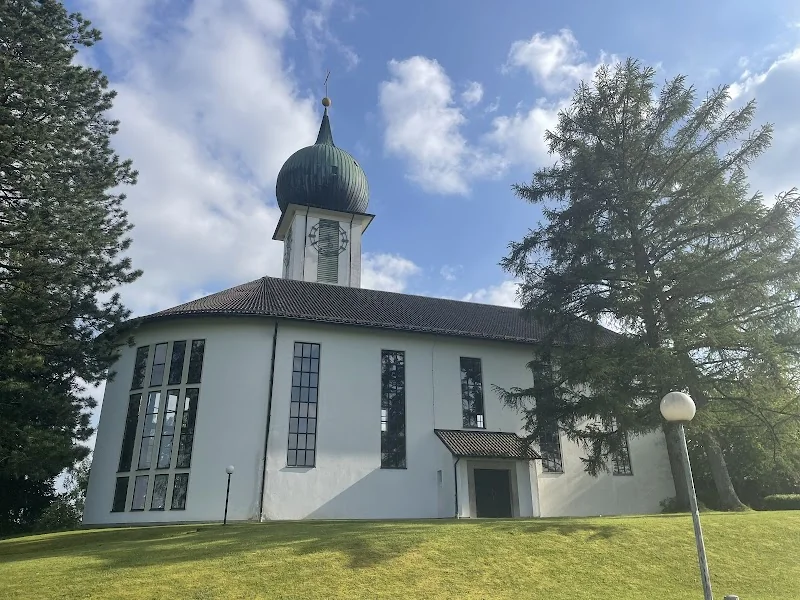
Even from the outside, St. Peter and Paul has a strong recognizability. The architectural page regarding the onion domes in Upper Bavaria describes the building from 1960 and names Hans Hammer as the builder. It also highlights the onion dome with its green copper sheet surface, which sits in the southern nave of the church. This detail ensures that the church stands out in the local landscape, even as it consciously integrates into the surroundings. Therefore, those searching for photos of St. Peter and Paul will not only find classic church images but also very typical Upper Bavarian elements: the distinctive tower, the clear roofline, and the quiet location on an elevated spot in the village. For SEO and real visitors, this visual language is important because it makes the church easily identifiable while also conveying its special atmosphere. ([zwiebeltuerme-oberbayern.de](https://zwiebeltuerme-oberbayern.de/st-peter-und-paul-kirche-baierbrunn/))
History and Construction Decision of the Parish Church
The history of the current parish church is closely linked to the development of Baierbrunn after World War II. According to the official parish page, the population of the village increased significantly after 1945, especially in Buchenhain, where construction took place, and the church in the center soon became too small. In the 1950s, various building sites for a new church were examined. The decision was made in 1957 when Cardinal Joseph Wendel decreed that the new building should be constructed on the highest elevation between Baierbrunn and Buchenhain. This decision explains the location effect of the church to this day: it is not randomly placed somewhere but deliberately positioned to visibly organize and spiritually mark the village. This connection of local development, pastoral necessity, and topography is central to the history of the church. ([erzbistum-muenchen.de](https://www.erzbistum-muenchen.de/pfarrei/pv-schaeftlarn/cont/79627))
The construction itself was realized according to the plans of the Baierbrunn architect Hans Hammer. The parish page states 300 seats, which shows that the building was designed for an active and growing community without being unnecessarily large. The architectural page dates the year of construction to 1960, so St. Peter and Paul clearly belongs to the era of post-war church modernity. This is interesting for visitors because the church does not bring a baroque or medieval layering but a consciously reduced, functional, and at the same time representative design language. This temporal placement makes the church exciting for architecture enthusiasts: it is an example of how liturgical practice, urban planning, and design clarity were connected in the early 1960s. The church space was therefore not planned as a historicizing backdrop but as a living space for a modern community. ([erzbistum-muenchen.de](https://www.erzbistum-muenchen.de/pfarrei/pv-schaeftlarn/cont/79627))
Address, Location, and Directions to Forstenrieder Weg 13
The sought address is Forstenrieder Weg 13, 82065 Baierbrunn. Right there is not only the parish church but also the parish office of St. Peter and Paul. This is important for orientation because search queries like church, parish office, services, or photos ultimately lead to the same place. In local directories, the address is also listed this way, and the proximity to Forstenrieder Weg is a clear anchor point for any approach. Therefore, those coming from Baierbrunn or the surrounding areas should best orient themselves to this specific street. The parish page itself also points to other churches in Baierbrunn, making it clear that St. Peter and Paul is the central parish church within the village. ([erzbistum-muenchen.de](https://www.erzbistum-muenchen.de/pfarrei/pv-schaeftlarn/cont/79621?utm_source=openai))
For practical access, it can be said from the publicly available data that local city maps and street directories indicate parking spaces in the vicinity of Forstenrieder Weg. This is not an indication of a large parking garage or a separate event access but a useful reference point for orientation on-site. Therefore, those arriving by car will find it best to navigate using the street address and check the current situation in Baierbrunn for their specific visit. For SEO, this point is relevant because many search queries are made not only for the church itself but also for directions to it. The best content is therefore always that which combines the name of the church, the exact address, and a reliable local description without claiming more than the sources actually provide. ([meinestadt.de](https://www.meinestadt.de/baierbrunn/stadtplan/strasse/forstenrieder%2Bweg?utm_source=openai))
Seating and Church Space with Clear Spatial Effect
A key fact for the classification of St. Peter and Paul is the number of 300 seats. This makes the church large enough for a lively parish community but small enough to retain the character of a manageable local center. The official page also describes a light-filled apse. This note is important because it describes the spatial effect more precisely than mere numbers could: the light is part of the experience, not just a side effect. The patron figures Peter and Paul found their place in this apse in 1980. They were crafted from wood by the sculptor Wolfgang Hirtreiter from Gröbenzell and were finished by Karl Fornika, a church painter from Landshut. This makes it clear that the furnishings are not interchangeable but possess their own artistic quality. ([erzbistum-muenchen.de](https://www.erzbistum-muenchen.de/pfarrei/pv-schaeftlarn/cont/79627))
As early as 1975, the cross was placed in the church; it was designed from bronze sheet by the sculptor Peter Moser from Pullach. Together with the later added patron figures, a church space emerges that has grown historically but is still clearly readable. This is important for visitors because they do not just see a space with benches but a sequence of design decisions that shape the place. St. Peter and Paul is thus not only a worship space but also a documented space of community development. Such details are significant for the search for seating plans, furnishings, or spatial character. Those wondering whether the church appears more open, festive, simple, or visually striking receive a reliable answer here: it is bright, clear, and carefully designed in the details. ([erzbistum-muenchen.de](https://www.erzbistum-muenchen.de/pfarrei/pv-schaeftlarn/cont/79627))
Architecture, Tower, and External Effect of the Church
The external effect of St. Peter and Paul is primarily determined by its clear architecture and the distinctive tower. The page about the onion domes names the southern nave as the position of the tower and describes the onion dome with a round cross-section and green copper sheet surface. Such information is particularly valuable for an SEO text because it makes the recognizability of the church tangible. The tower is not simply decorative embellishment but a visible sign of the church in the village. In a community like Baierbrunn, where the local landscape is shaped by residential areas, paths, and the location between settlement cores, such a tower creates a clear landmark. Therefore, those searching for the church can orient themselves well by the vertical form of the onion tower. ([zwiebeltuerme-oberbayern.de](https://zwiebeltuerme-oberbayern.de/st-peter-und-paul-kirche-baierbrunn/))
The architectural page also notes that the church is not included in the monument list. This is also useful information as it places the construction history in a factual context. This is not about a centuries-old monument but about a building from the post-war period that arose from its purpose. For this reason, St. Peter and Paul appeals to different target groups: people looking for a place for worship, people wanting to take photos, and people interested in the development of church architecture in the second half of the 20th century. The combination of functional floor plan, bright interior, tower with onion dome, and local embedding makes the church distinctive without pushing itself into the foreground. ([zwiebeltuerme-oberbayern.de](https://zwiebeltuerme-oberbayern.de/st-peter-und-paul-kirche-baierbrunn/))
Hungarian Cross, Artworks, and Special Interior Furnishings
Among the special features of St. Peter and Paul is the so-called Hungarian Cross. The official parish page calls it a special gem; its own page on the Hungarian Cross describes it as a monument of religious tolerance and a silent testimony to the coexistence of religions. This classification is enormously important for the church's effect because it enriches the space not only aesthetically but also historically and spiritually. The cross has a narrative that extends far beyond Baierbrunn: it has been connected in its history with Hungary, the Ottoman period, Munich Capuchins, and finally the church in Baierbrunn. For visitors, this means that they see not only a local artwork here but an object with a dense cultural memory. ([erzbistum-muenchen.de](https://www.erzbistum-muenchen.de/pfarrei/pv-schaeftlarn/cont/79627))
The Hungarian Cross page elaborates further on the tradition: it describes the depiction of the crucified with Mary and John, names possible places of origin in the 17th century, refers to the siege of Buda in 1686, and states that the cross was likely captured by Bavarian soldiers and brought to Munich. How it came from the Munich Capuchins to Baierbrunn remains unknown according to the source. This mixture of legend, history, and open tradition creates the charm of the object. Together with the patron figures Peter and Paul installed in 1980 and the bronze sheet cross designed in 1975, an interior space emerges where art, liturgy, and memory closely intertwine. Therefore, those visiting the church experience not only a worship space but a small ensemble of signs that continues to shape the community to this day. ([erzbistum-muenchen.de](https://www.erzbistum-muenchen.de/pfarrei/pv-schaeftlarn/cont/81680))
Services, Events, and Parish Office in Baierbrunn
The current use of St. Peter and Paul is clearly oriented towards the life of the parish community. The official page of the parish association refers to services, events, and contacts, and the information on dates is published on the parish page as well as in the service order and on the notice boards of the parish offices. This is crucial for search queries regarding programs, events, or service times because it shows where reliable information can be found. The church is thus not a silent museum but an actively used place of faith and community work. Therefore, those visiting the location encounter a real parish life with masses, devotions, and other appointments that vary depending on time and occasion. ([erzbistum-muenchen.de](https://www.erzbistum-muenchen.de/pfarrei/pv-schaeftlarn/cont/79627))
The parish office is also located at the same address: Forstenrieder Weg 13, 82065 Baierbrunn. The official contact details include phone, fax, email, and opening hours on Wednesdays from 4 to 6 PM and Thursdays from 8:30 AM to 12 PM. This information is particularly helpful for anyone looking for a baptism, wedding, confession, conversation, or general information about the parish church. Furthermore, the parish association of Schäftlarn makes it clear that St. Peter and Paul does not stand alone but forms a network together with St. Georg in Hohenschäftlarn, St. Benedikt in Ebenhausen, and Heilig Kreuz in Icking. Thus, a single church becomes a comprehensible part of a larger pastoral structure that supports everyday life on-site. This embedding gives St. Peter and Paul its significance: as a place that has grown historically, remains architecturally clear, and is religiously anchored in the here and now. ([erzbistum-muenchen.de](https://www.erzbistum-muenchen.de/pfarrei/pv-schaeftlarn/cont/79621?utm_source=openai))
Photos, Search, and Orientation for Visitors
Those searching for St. Peter and Paul Baierbrunn are usually looking not just for a name but for a concrete image, an address, or an occasion. Therefore, the topics of photos, church, construction history, and access are particularly important for this location. The existing sources provide a good mix for this: historical images from the parish page, technical and architectural details from the onion domes page, the detailed explanation of the Hungarian Cross, and the clear contact details of the parish office. For practical use, this means: the church is easy to name, well described in content, and can be accurately located with real facts. This is the foundation for good local SEO content. Instead of relying on general phrases, one can work with reliable information that truly characterizes the church in Baierbrunn. ([erzbistum-muenchen.de](https://www.erzbistum-muenchen.de/pfarrei/pv-schaeftlarn/cont/79627))
In terms of content, St. Peter and Paul impresses with the combination of post-war construction, bright apse, patron figures, Hungarian Cross, and distinctive onion tower. This is a rarely clear profile for a local church and at the same time a strong reason why visitors ask for photos or the exact location. Those choosing the place for a quiet visit, a church event, or research on local history will find in Baierbrunn a church that remains manageable yet offers many layers. This is where its charm lies: it is neither too large nor too small, neither too historicizing nor too sober, but a parish church with character and a recognizable face. ([erzbistum-muenchen.de](https://www.erzbistum-muenchen.de/pfarrei/pv-schaeftlarn/cont/79627))
Sources:
Show moreShow less
St. Peter and Paul | Church & Photos
St. Peter and Paul in Baierbrunn is the parish church at Forstenrieder Weg 13 and belongs to the parish association of Schäftlarn. The location is in the district of Munich, and the church is today one of the most important religious reference points in Baierbrunn. Those looking for photos, the exact address, the history, or practical information will find here a church with a clear identity, a manageable size, and a remarkable mix of post-war architecture, artistic details, and lived parish practice. Particularly defining is that the church was built on an elevated site between Baierbrunn and Buchenhain and is still perceived today as the parish church of the place. ([erzbistum-muenchen.de](https://www.erzbistum-muenchen.de/pfarrei/pv-schaeftlarn/cont/79627))
Photos and First Impression of St. Peter and Paul in Baierbrunn
The first impression of St. Peter and Paul is that of a bright, clearly structured parish church that does not appear overloaded but convinces with calmness and clarity. On the official website of the parish association, historical images of the church from around 1963 can be seen, as well as photos of the cross and patron figures in the church space. These image motifs are particularly interesting for many visitors because they show how the character of the church is composed of architecture and furnishings. The church does not appear as a monumental prestige building but as a precisely planned place for worship, devotion, and community life. This restraint makes it particularly grateful for photos: lines, light, and individual artworks stand out clearly without overwhelming the space. ([erzbistum-muenchen.de](https://www.erzbistum-muenchen.de/pfarrei/pv-schaeftlarn/cont/79627))
Even from the outside, St. Peter and Paul has a strong recognizability. The architectural page regarding the onion domes in Upper Bavaria describes the building from 1960 and names Hans Hammer as the builder. It also highlights the onion dome with its green copper sheet surface, which sits in the southern nave of the church. This detail ensures that the church stands out in the local landscape, even as it consciously integrates into the surroundings. Therefore, those searching for photos of St. Peter and Paul will not only find classic church images but also very typical Upper Bavarian elements: the distinctive tower, the clear roofline, and the quiet location on an elevated spot in the village. For SEO and real visitors, this visual language is important because it makes the church easily identifiable while also conveying its special atmosphere. ([zwiebeltuerme-oberbayern.de](https://zwiebeltuerme-oberbayern.de/st-peter-und-paul-kirche-baierbrunn/))
History and Construction Decision of the Parish Church
The history of the current parish church is closely linked to the development of Baierbrunn after World War II. According to the official parish page, the population of the village increased significantly after 1945, especially in Buchenhain, where construction took place, and the church in the center soon became too small. In the 1950s, various building sites for a new church were examined. The decision was made in 1957 when Cardinal Joseph Wendel decreed that the new building should be constructed on the highest elevation between Baierbrunn and Buchenhain. This decision explains the location effect of the church to this day: it is not randomly placed somewhere but deliberately positioned to visibly organize and spiritually mark the village. This connection of local development, pastoral necessity, and topography is central to the history of the church. ([erzbistum-muenchen.de](https://www.erzbistum-muenchen.de/pfarrei/pv-schaeftlarn/cont/79627))
The construction itself was realized according to the plans of the Baierbrunn architect Hans Hammer. The parish page states 300 seats, which shows that the building was designed for an active and growing community without being unnecessarily large. The architectural page dates the year of construction to 1960, so St. Peter and Paul clearly belongs to the era of post-war church modernity. This is interesting for visitors because the church does not bring a baroque or medieval layering but a consciously reduced, functional, and at the same time representative design language. This temporal placement makes the church exciting for architecture enthusiasts: it is an example of how liturgical practice, urban planning, and design clarity were connected in the early 1960s. The church space was therefore not planned as a historicizing backdrop but as a living space for a modern community. ([erzbistum-muenchen.de](https://www.erzbistum-muenchen.de/pfarrei/pv-schaeftlarn/cont/79627))
Address, Location, and Directions to Forstenrieder Weg 13
The sought address is Forstenrieder Weg 13, 82065 Baierbrunn. Right there is not only the parish church but also the parish office of St. Peter and Paul. This is important for orientation because search queries like church, parish office, services, or photos ultimately lead to the same place. In local directories, the address is also listed this way, and the proximity to Forstenrieder Weg is a clear anchor point for any approach. Therefore, those coming from Baierbrunn or the surrounding areas should best orient themselves to this specific street. The parish page itself also points to other churches in Baierbrunn, making it clear that St. Peter and Paul is the central parish church within the village. ([erzbistum-muenchen.de](https://www.erzbistum-muenchen.de/pfarrei/pv-schaeftlarn/cont/79621?utm_source=openai))
For practical access, it can be said from the publicly available data that local city maps and street directories indicate parking spaces in the vicinity of Forstenrieder Weg. This is not an indication of a large parking garage or a separate event access but a useful reference point for orientation on-site. Therefore, those arriving by car will find it best to navigate using the street address and check the current situation in Baierbrunn for their specific visit. For SEO, this point is relevant because many search queries are made not only for the church itself but also for directions to it. The best content is therefore always that which combines the name of the church, the exact address, and a reliable local description without claiming more than the sources actually provide. ([meinestadt.de](https://www.meinestadt.de/baierbrunn/stadtplan/strasse/forstenrieder%2Bweg?utm_source=openai))
Seating and Church Space with Clear Spatial Effect
A key fact for the classification of St. Peter and Paul is the number of 300 seats. This makes the church large enough for a lively parish community but small enough to retain the character of a manageable local center. The official page also describes a light-filled apse. This note is important because it describes the spatial effect more precisely than mere numbers could: the light is part of the experience, not just a side effect. The patron figures Peter and Paul found their place in this apse in 1980. They were crafted from wood by the sculptor Wolfgang Hirtreiter from Gröbenzell and were finished by Karl Fornika, a church painter from Landshut. This makes it clear that the furnishings are not interchangeable but possess their own artistic quality. ([erzbistum-muenchen.de](https://www.erzbistum-muenchen.de/pfarrei/pv-schaeftlarn/cont/79627))
As early as 1975, the cross was placed in the church; it was designed from bronze sheet by the sculptor Peter Moser from Pullach. Together with the later added patron figures, a church space emerges that has grown historically but is still clearly readable. This is important for visitors because they do not just see a space with benches but a sequence of design decisions that shape the place. St. Peter and Paul is thus not only a worship space but also a documented space of community development. Such details are significant for the search for seating plans, furnishings, or spatial character. Those wondering whether the church appears more open, festive, simple, or visually striking receive a reliable answer here: it is bright, clear, and carefully designed in the details. ([erzbistum-muenchen.de](https://www.erzbistum-muenchen.de/pfarrei/pv-schaeftlarn/cont/79627))
Architecture, Tower, and External Effect of the Church
The external effect of St. Peter and Paul is primarily determined by its clear architecture and the distinctive tower. The page about the onion domes names the southern nave as the position of the tower and describes the onion dome with a round cross-section and green copper sheet surface. Such information is particularly valuable for an SEO text because it makes the recognizability of the church tangible. The tower is not simply decorative embellishment but a visible sign of the church in the village. In a community like Baierbrunn, where the local landscape is shaped by residential areas, paths, and the location between settlement cores, such a tower creates a clear landmark. Therefore, those searching for the church can orient themselves well by the vertical form of the onion tower. ([zwiebeltuerme-oberbayern.de](https://zwiebeltuerme-oberbayern.de/st-peter-und-paul-kirche-baierbrunn/))
The architectural page also notes that the church is not included in the monument list. This is also useful information as it places the construction history in a factual context. This is not about a centuries-old monument but about a building from the post-war period that arose from its purpose. For this reason, St. Peter and Paul appeals to different target groups: people looking for a place for worship, people wanting to take photos, and people interested in the development of church architecture in the second half of the 20th century. The combination of functional floor plan, bright interior, tower with onion dome, and local embedding makes the church distinctive without pushing itself into the foreground. ([zwiebeltuerme-oberbayern.de](https://zwiebeltuerme-oberbayern.de/st-peter-und-paul-kirche-baierbrunn/))
Hungarian Cross, Artworks, and Special Interior Furnishings
Among the special features of St. Peter and Paul is the so-called Hungarian Cross. The official parish page calls it a special gem; its own page on the Hungarian Cross describes it as a monument of religious tolerance and a silent testimony to the coexistence of religions. This classification is enormously important for the church's effect because it enriches the space not only aesthetically but also historically and spiritually. The cross has a narrative that extends far beyond Baierbrunn: it has been connected in its history with Hungary, the Ottoman period, Munich Capuchins, and finally the church in Baierbrunn. For visitors, this means that they see not only a local artwork here but an object with a dense cultural memory. ([erzbistum-muenchen.de](https://www.erzbistum-muenchen.de/pfarrei/pv-schaeftlarn/cont/79627))
The Hungarian Cross page elaborates further on the tradition: it describes the depiction of the crucified with Mary and John, names possible places of origin in the 17th century, refers to the siege of Buda in 1686, and states that the cross was likely captured by Bavarian soldiers and brought to Munich. How it came from the Munich Capuchins to Baierbrunn remains unknown according to the source. This mixture of legend, history, and open tradition creates the charm of the object. Together with the patron figures Peter and Paul installed in 1980 and the bronze sheet cross designed in 1975, an interior space emerges where art, liturgy, and memory closely intertwine. Therefore, those visiting the church experience not only a worship space but a small ensemble of signs that continues to shape the community to this day. ([erzbistum-muenchen.de](https://www.erzbistum-muenchen.de/pfarrei/pv-schaeftlarn/cont/81680))
Services, Events, and Parish Office in Baierbrunn
The current use of St. Peter and Paul is clearly oriented towards the life of the parish community. The official page of the parish association refers to services, events, and contacts, and the information on dates is published on the parish page as well as in the service order and on the notice boards of the parish offices. This is crucial for search queries regarding programs, events, or service times because it shows where reliable information can be found. The church is thus not a silent museum but an actively used place of faith and community work. Therefore, those visiting the location encounter a real parish life with masses, devotions, and other appointments that vary depending on time and occasion. ([erzbistum-muenchen.de](https://www.erzbistum-muenchen.de/pfarrei/pv-schaeftlarn/cont/79627))
The parish office is also located at the same address: Forstenrieder Weg 13, 82065 Baierbrunn. The official contact details include phone, fax, email, and opening hours on Wednesdays from 4 to 6 PM and Thursdays from 8:30 AM to 12 PM. This information is particularly helpful for anyone looking for a baptism, wedding, confession, conversation, or general information about the parish church. Furthermore, the parish association of Schäftlarn makes it clear that St. Peter and Paul does not stand alone but forms a network together with St. Georg in Hohenschäftlarn, St. Benedikt in Ebenhausen, and Heilig Kreuz in Icking. Thus, a single church becomes a comprehensible part of a larger pastoral structure that supports everyday life on-site. This embedding gives St. Peter and Paul its significance: as a place that has grown historically, remains architecturally clear, and is religiously anchored in the here and now. ([erzbistum-muenchen.de](https://www.erzbistum-muenchen.de/pfarrei/pv-schaeftlarn/cont/79621?utm_source=openai))
Photos, Search, and Orientation for Visitors
Those searching for St. Peter and Paul Baierbrunn are usually looking not just for a name but for a concrete image, an address, or an occasion. Therefore, the topics of photos, church, construction history, and access are particularly important for this location. The existing sources provide a good mix for this: historical images from the parish page, technical and architectural details from the onion domes page, the detailed explanation of the Hungarian Cross, and the clear contact details of the parish office. For practical use, this means: the church is easy to name, well described in content, and can be accurately located with real facts. This is the foundation for good local SEO content. Instead of relying on general phrases, one can work with reliable information that truly characterizes the church in Baierbrunn. ([erzbistum-muenchen.de](https://www.erzbistum-muenchen.de/pfarrei/pv-schaeftlarn/cont/79627))
In terms of content, St. Peter and Paul impresses with the combination of post-war construction, bright apse, patron figures, Hungarian Cross, and distinctive onion tower. This is a rarely clear profile for a local church and at the same time a strong reason why visitors ask for photos or the exact location. Those choosing the place for a quiet visit, a church event, or research on local history will find in Baierbrunn a church that remains manageable yet offers many layers. This is where its charm lies: it is neither too large nor too small, neither too historicizing nor too sober, but a parish church with character and a recognizable face. ([erzbistum-muenchen.de](https://www.erzbistum-muenchen.de/pfarrei/pv-schaeftlarn/cont/79627))
Sources:
St. Peter and Paul | Church & Photos
St. Peter and Paul in Baierbrunn is the parish church at Forstenrieder Weg 13 and belongs to the parish association of Schäftlarn. The location is in the district of Munich, and the church is today one of the most important religious reference points in Baierbrunn. Those looking for photos, the exact address, the history, or practical information will find here a church with a clear identity, a manageable size, and a remarkable mix of post-war architecture, artistic details, and lived parish practice. Particularly defining is that the church was built on an elevated site between Baierbrunn and Buchenhain and is still perceived today as the parish church of the place. ([erzbistum-muenchen.de](https://www.erzbistum-muenchen.de/pfarrei/pv-schaeftlarn/cont/79627))
Photos and First Impression of St. Peter and Paul in Baierbrunn
The first impression of St. Peter and Paul is that of a bright, clearly structured parish church that does not appear overloaded but convinces with calmness and clarity. On the official website of the parish association, historical images of the church from around 1963 can be seen, as well as photos of the cross and patron figures in the church space. These image motifs are particularly interesting for many visitors because they show how the character of the church is composed of architecture and furnishings. The church does not appear as a monumental prestige building but as a precisely planned place for worship, devotion, and community life. This restraint makes it particularly grateful for photos: lines, light, and individual artworks stand out clearly without overwhelming the space. ([erzbistum-muenchen.de](https://www.erzbistum-muenchen.de/pfarrei/pv-schaeftlarn/cont/79627))
Even from the outside, St. Peter and Paul has a strong recognizability. The architectural page regarding the onion domes in Upper Bavaria describes the building from 1960 and names Hans Hammer as the builder. It also highlights the onion dome with its green copper sheet surface, which sits in the southern nave of the church. This detail ensures that the church stands out in the local landscape, even as it consciously integrates into the surroundings. Therefore, those searching for photos of St. Peter and Paul will not only find classic church images but also very typical Upper Bavarian elements: the distinctive tower, the clear roofline, and the quiet location on an elevated spot in the village. For SEO and real visitors, this visual language is important because it makes the church easily identifiable while also conveying its special atmosphere. ([zwiebeltuerme-oberbayern.de](https://zwiebeltuerme-oberbayern.de/st-peter-und-paul-kirche-baierbrunn/))
History and Construction Decision of the Parish Church
The history of the current parish church is closely linked to the development of Baierbrunn after World War II. According to the official parish page, the population of the village increased significantly after 1945, especially in Buchenhain, where construction took place, and the church in the center soon became too small. In the 1950s, various building sites for a new church were examined. The decision was made in 1957 when Cardinal Joseph Wendel decreed that the new building should be constructed on the highest elevation between Baierbrunn and Buchenhain. This decision explains the location effect of the church to this day: it is not randomly placed somewhere but deliberately positioned to visibly organize and spiritually mark the village. This connection of local development, pastoral necessity, and topography is central to the history of the church. ([erzbistum-muenchen.de](https://www.erzbistum-muenchen.de/pfarrei/pv-schaeftlarn/cont/79627))
The construction itself was realized according to the plans of the Baierbrunn architect Hans Hammer. The parish page states 300 seats, which shows that the building was designed for an active and growing community without being unnecessarily large. The architectural page dates the year of construction to 1960, so St. Peter and Paul clearly belongs to the era of post-war church modernity. This is interesting for visitors because the church does not bring a baroque or medieval layering but a consciously reduced, functional, and at the same time representative design language. This temporal placement makes the church exciting for architecture enthusiasts: it is an example of how liturgical practice, urban planning, and design clarity were connected in the early 1960s. The church space was therefore not planned as a historicizing backdrop but as a living space for a modern community. ([erzbistum-muenchen.de](https://www.erzbistum-muenchen.de/pfarrei/pv-schaeftlarn/cont/79627))
Address, Location, and Directions to Forstenrieder Weg 13
The sought address is Forstenrieder Weg 13, 82065 Baierbrunn. Right there is not only the parish church but also the parish office of St. Peter and Paul. This is important for orientation because search queries like church, parish office, services, or photos ultimately lead to the same place. In local directories, the address is also listed this way, and the proximity to Forstenrieder Weg is a clear anchor point for any approach. Therefore, those coming from Baierbrunn or the surrounding areas should best orient themselves to this specific street. The parish page itself also points to other churches in Baierbrunn, making it clear that St. Peter and Paul is the central parish church within the village. ([erzbistum-muenchen.de](https://www.erzbistum-muenchen.de/pfarrei/pv-schaeftlarn/cont/79621?utm_source=openai))
For practical access, it can be said from the publicly available data that local city maps and street directories indicate parking spaces in the vicinity of Forstenrieder Weg. This is not an indication of a large parking garage or a separate event access but a useful reference point for orientation on-site. Therefore, those arriving by car will find it best to navigate using the street address and check the current situation in Baierbrunn for their specific visit. For SEO, this point is relevant because many search queries are made not only for the church itself but also for directions to it. The best content is therefore always that which combines the name of the church, the exact address, and a reliable local description without claiming more than the sources actually provide. ([meinestadt.de](https://www.meinestadt.de/baierbrunn/stadtplan/strasse/forstenrieder%2Bweg?utm_source=openai))
Seating and Church Space with Clear Spatial Effect
A key fact for the classification of St. Peter and Paul is the number of 300 seats. This makes the church large enough for a lively parish community but small enough to retain the character of a manageable local center. The official page also describes a light-filled apse. This note is important because it describes the spatial effect more precisely than mere numbers could: the light is part of the experience, not just a side effect. The patron figures Peter and Paul found their place in this apse in 1980. They were crafted from wood by the sculptor Wolfgang Hirtreiter from Gröbenzell and were finished by Karl Fornika, a church painter from Landshut. This makes it clear that the furnishings are not interchangeable but possess their own artistic quality. ([erzbistum-muenchen.de](https://www.erzbistum-muenchen.de/pfarrei/pv-schaeftlarn/cont/79627))
As early as 1975, the cross was placed in the church; it was designed from bronze sheet by the sculptor Peter Moser from Pullach. Together with the later added patron figures, a church space emerges that has grown historically but is still clearly readable. This is important for visitors because they do not just see a space with benches but a sequence of design decisions that shape the place. St. Peter and Paul is thus not only a worship space but also a documented space of community development. Such details are significant for the search for seating plans, furnishings, or spatial character. Those wondering whether the church appears more open, festive, simple, or visually striking receive a reliable answer here: it is bright, clear, and carefully designed in the details. ([erzbistum-muenchen.de](https://www.erzbistum-muenchen.de/pfarrei/pv-schaeftlarn/cont/79627))
Architecture, Tower, and External Effect of the Church
The external effect of St. Peter and Paul is primarily determined by its clear architecture and the distinctive tower. The page about the onion domes names the southern nave as the position of the tower and describes the onion dome with a round cross-section and green copper sheet surface. Such information is particularly valuable for an SEO text because it makes the recognizability of the church tangible. The tower is not simply decorative embellishment but a visible sign of the church in the village. In a community like Baierbrunn, where the local landscape is shaped by residential areas, paths, and the location between settlement cores, such a tower creates a clear landmark. Therefore, those searching for the church can orient themselves well by the vertical form of the onion tower. ([zwiebeltuerme-oberbayern.de](https://zwiebeltuerme-oberbayern.de/st-peter-und-paul-kirche-baierbrunn/))
The architectural page also notes that the church is not included in the monument list. This is also useful information as it places the construction history in a factual context. This is not about a centuries-old monument but about a building from the post-war period that arose from its purpose. For this reason, St. Peter and Paul appeals to different target groups: people looking for a place for worship, people wanting to take photos, and people interested in the development of church architecture in the second half of the 20th century. The combination of functional floor plan, bright interior, tower with onion dome, and local embedding makes the church distinctive without pushing itself into the foreground. ([zwiebeltuerme-oberbayern.de](https://zwiebeltuerme-oberbayern.de/st-peter-und-paul-kirche-baierbrunn/))
Hungarian Cross, Artworks, and Special Interior Furnishings
Among the special features of St. Peter and Paul is the so-called Hungarian Cross. The official parish page calls it a special gem; its own page on the Hungarian Cross describes it as a monument of religious tolerance and a silent testimony to the coexistence of religions. This classification is enormously important for the church's effect because it enriches the space not only aesthetically but also historically and spiritually. The cross has a narrative that extends far beyond Baierbrunn: it has been connected in its history with Hungary, the Ottoman period, Munich Capuchins, and finally the church in Baierbrunn. For visitors, this means that they see not only a local artwork here but an object with a dense cultural memory. ([erzbistum-muenchen.de](https://www.erzbistum-muenchen.de/pfarrei/pv-schaeftlarn/cont/79627))
The Hungarian Cross page elaborates further on the tradition: it describes the depiction of the crucified with Mary and John, names possible places of origin in the 17th century, refers to the siege of Buda in 1686, and states that the cross was likely captured by Bavarian soldiers and brought to Munich. How it came from the Munich Capuchins to Baierbrunn remains unknown according to the source. This mixture of legend, history, and open tradition creates the charm of the object. Together with the patron figures Peter and Paul installed in 1980 and the bronze sheet cross designed in 1975, an interior space emerges where art, liturgy, and memory closely intertwine. Therefore, those visiting the church experience not only a worship space but a small ensemble of signs that continues to shape the community to this day. ([erzbistum-muenchen.de](https://www.erzbistum-muenchen.de/pfarrei/pv-schaeftlarn/cont/81680))
Services, Events, and Parish Office in Baierbrunn
The current use of St. Peter and Paul is clearly oriented towards the life of the parish community. The official page of the parish association refers to services, events, and contacts, and the information on dates is published on the parish page as well as in the service order and on the notice boards of the parish offices. This is crucial for search queries regarding programs, events, or service times because it shows where reliable information can be found. The church is thus not a silent museum but an actively used place of faith and community work. Therefore, those visiting the location encounter a real parish life with masses, devotions, and other appointments that vary depending on time and occasion. ([erzbistum-muenchen.de](https://www.erzbistum-muenchen.de/pfarrei/pv-schaeftlarn/cont/79627))
The parish office is also located at the same address: Forstenrieder Weg 13, 82065 Baierbrunn. The official contact details include phone, fax, email, and opening hours on Wednesdays from 4 to 6 PM and Thursdays from 8:30 AM to 12 PM. This information is particularly helpful for anyone looking for a baptism, wedding, confession, conversation, or general information about the parish church. Furthermore, the parish association of Schäftlarn makes it clear that St. Peter and Paul does not stand alone but forms a network together with St. Georg in Hohenschäftlarn, St. Benedikt in Ebenhausen, and Heilig Kreuz in Icking. Thus, a single church becomes a comprehensible part of a larger pastoral structure that supports everyday life on-site. This embedding gives St. Peter and Paul its significance: as a place that has grown historically, remains architecturally clear, and is religiously anchored in the here and now. ([erzbistum-muenchen.de](https://www.erzbistum-muenchen.de/pfarrei/pv-schaeftlarn/cont/79621?utm_source=openai))
Photos, Search, and Orientation for Visitors
Those searching for St. Peter and Paul Baierbrunn are usually looking not just for a name but for a concrete image, an address, or an occasion. Therefore, the topics of photos, church, construction history, and access are particularly important for this location. The existing sources provide a good mix for this: historical images from the parish page, technical and architectural details from the onion domes page, the detailed explanation of the Hungarian Cross, and the clear contact details of the parish office. For practical use, this means: the church is easy to name, well described in content, and can be accurately located with real facts. This is the foundation for good local SEO content. Instead of relying on general phrases, one can work with reliable information that truly characterizes the church in Baierbrunn. ([erzbistum-muenchen.de](https://www.erzbistum-muenchen.de/pfarrei/pv-schaeftlarn/cont/79627))
In terms of content, St. Peter and Paul impresses with the combination of post-war construction, bright apse, patron figures, Hungarian Cross, and distinctive onion tower. This is a rarely clear profile for a local church and at the same time a strong reason why visitors ask for photos or the exact location. Those choosing the place for a quiet visit, a church event, or research on local history will find in Baierbrunn a church that remains manageable yet offers many layers. This is where its charm lies: it is neither too large nor too small, neither too historicizing nor too sober, but a parish church with character and a recognizable face. ([erzbistum-muenchen.de](https://www.erzbistum-muenchen.de/pfarrei/pv-schaeftlarn/cont/79627))
Sources:
Frequently Asked Questions
Reviews
No reviews found