
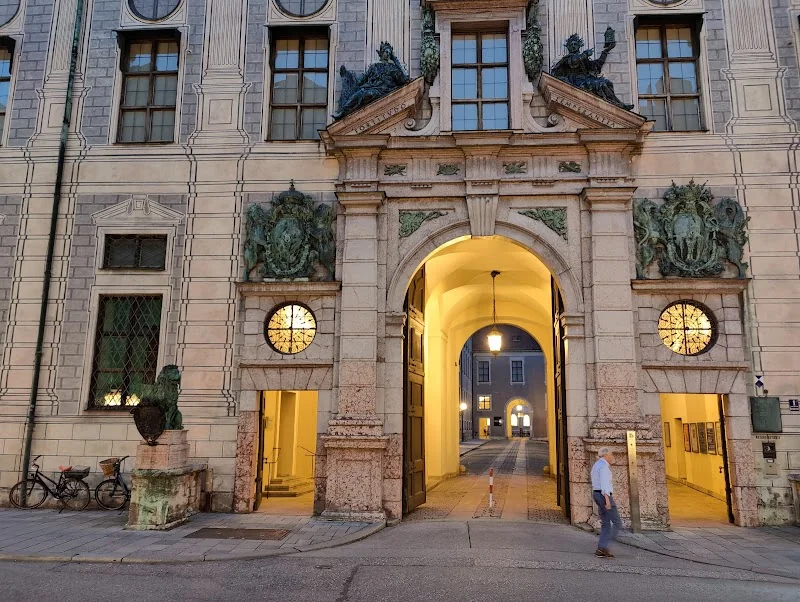
Residenzstraße 1, München
Residenzstraße 1, 80333 München, Germany
State Coin Collection Munich | Admission & Library
The State Coin Collection Munich is a place that appears calm and factual at first glance, but unfolds an astonishing range of history, art, and knowledge upon a second look. Located in the residence in the heart of Munich, the museum showcases not only coins and medals but also gems, pre-monetary forms of money, historical coin cabinets, and objects that open the view to economy, power, imagery, and everyday culture in Europe and beyond. The official website describes the collection as a public museum, research institute, and library, making it a place for visitors, science, and collection care alike. This very mix makes the State Coin Collection equally exciting for culture enthusiasts, families, school classes, and researchers. Those looking for admission, opening hours, library, photos, or current exhibitions will find a museum that clearly presents itself as a scientifically grounded yet accessible treasure house, consciously embedding its content in the historical framework of the residence. ([staatliche-muenzsammlung.de](https://www.staatliche-muenzsammlung.de/de/unser-haus))
Admission, Opening Hours, and Directions to the State Coin Collection
For planning a visit, practical information is particularly important, and here the State Coin Collection provides clear details. The museum is open from Tuesday to Sunday from 10:00 AM to 5:00 PM; it is closed on Mondays. Additionally, the website specifies concrete exceptions: Easter Monday, Whit Monday, and the second Christmas holiday are open. The admission fee is deliberately set low: Regular admission costs 3.00 euros, reduced 2.00 euros, and only 1.00 euro on Sundays. Children and teenagers under 18 enter for free. This pricing structure makes the house attractive not only for individual visitors but also for spontaneous cultural trips on weekends. Those wishing to visit the coin collection should also consider its location in the residence: The official address is Residenzstraße 1, entrance Kapellenhof, 80333 Munich. The website recommends the subway lines U3, U4, U5, and U6 to Odeonsplatz as well as bus lines 100 and 153 to Odeonsplatz; additionally, a walking route from Marienplatz of about ten minutes is mentioned. This makes the journey very central and excellently planable with public transport. ([staatliche-muenzsammlung.de](https://www.staatliche-muenzsammlung.de/de/unser-haus))
Especially helpful is the clear directions via the Lion Portal into the Kapellenhof of the residence. This wording shows that the State Coin Collection is not to be perceived as an isolated single building but as part of a significant historical ensemble in the heart of Munich's old town. This is a real advantage for visitors planning their route between Marienplatz, Odeonsplatz, and the residence: The museum is located right in the cultural center, without complicated access or long paths. The official website also positions the house as a year-round destination, making it interesting for city travelers as well as for Munich residents seeking a quiet museum visit in the city center. Those traveling in groups benefit from the clear opening hours and favorable rates, especially on Sundays. The house is also very well positioned for inquiries regarding admission, opening hours, and directions, as the most important answers are immediately visible on the website. ([staatliche-muenzsammlung.de](https://www.staatliche-muenzsammlung.de/de/unser-haus))
History of the State Coin Collection in the Residence
The history of the State Coin Collection reaches deep into Bavarian and European cultural history. According to the official collection history, the museum traces back to Duke Albrecht V, who ruled between 1550 and 1579. Thus, the collection is the oldest documented of its kind in Bavaria. Albrecht V founded an art chamber where he collected not only exotic and precious objects but primarily ancient coins. By 1598, less than fifty years after its founding, this art chamber encompassed more than 7,000 coins. This shows how early a systematic view of money, power, art, and science developed in Munich. However, the collection was not only characterized by growth but also by losses: In 1632, the residence was plundered by the Swedes during the Thirty Years' War. Nevertheless, the collection quickly regained great significance thanks to purchases, treasure finds, and further holdings of the Bavarian ruling houses. In the following centuries, the collections of the Palatine Wittelsbach, the monasteries, and the principality of Regensburg were added. ([staatliche-muenzsammlung.de](https://www.staatliche-muenzsammlung.de/de/sammlung))
The institutional development is also remarkable. In 1807, the coin cabinet was separated from the court and placed under the Bavarian Academy of Sciences. From then on, interested parties could visit the library and collection upon request, further strengthening the scientific character of the house. After World War II, the collection was made accessible to the general public as a museum in the residence in 1963. This opening marks the transition from courtly and academic collection logic to a modern museum operation. Today, the State Coin Collection thus connects several epochs in a single house: Renaissance, courtly collecting culture, academic research, and public museum experience. Those reading the history of the house quickly understand why the collection not only displays coins but also preserves the development of money and power as cultural memory. This is a decisive added value for visitors seeking historical depth compared to a purely decorative exhibition space. ([staatliche-muenzsammlung.de](https://www.staatliche-muenzsammlung.de/de/sammlung))
The Collection: Coins, Medals, Gems, and Historical Coin Cabinets
The centerpiece of the State Coin Collection is its extraordinary breadth of holdings. The website mentions more than 300,000 objects stored in the collection. The organization follows the systems of numismatics and the respective genres, spread across more than 60 cabinets with special shelves. This number alone shows that this is not a small special exhibition but one of the largest collections of its kind worldwide. The content covers an impressive spectrum: from ancient coins to medieval and modern mintings, as well as medals, cut stones, pre-monetary money, and historical coin cabinets. Particularly exciting for history enthusiasts are the Bavarian finds from Celtic, Roman, and medieval times, as well as the holdings related to ancient Sicily, German princes and bishops, and the archbishops of Salzburg. The collection thus not only showcases the history of money but also political, regional, and iconographic developments over many centuries. ([staatliche-muenzsammlung.de](https://www.staatliche-muenzsammlung.de/de/sammlung))
Among the highlights are the so-called treasures from the Wittelsbach family treasury, gold and richly set medals featuring the portraits of the ruling family. Also noteworthy are the historical coin cabinets: The house describes its collection of around 70 historical coin furniture as particularly extensive, and the black and gold lacquer cabinets from Japan, which were converted into coin furniture at the Munich court, are even considered the largest collection of this kind worldwide. Furthermore, the collection of cut stones is among the most significant in Germany. The collection makes it very clear that coins are not isolated metal objects but carriers of art, power, technology, trade, and memory. The pre-monetary forms of money are also impressive, as the house preserves currencies from around the world, from shells and feathers to cocoa beans. This shift in perspective from classical coins to very early forms of money gives the museum its depth and explains why it remains exciting for different target groups. ([staatliche-muenzsammlung.de](https://www.staatliche-muenzsammlung.de/de/sammlung))
Library, Research, and Publications
A often underestimated but central area for the profile of the house is the library. The State Coin Collection explicitly sees itself as a publicly accessible library, where rich literature on coins, medals, paper and emergency money, gems, and seals is available. With more than 35,000 titles, it is one of the most significant institutions of its kind in the German-speaking world. For professionals, this is a valuable anchor point, as not only exhibition topics are deepened there, but also scientific and collection-historical research is possible. The library has its origins in the 16th century and grew through the merger of the Munich holdings with those of the Palatinate as well as through the secularization of Bavarian monasteries. Even though it suffered heavy losses in World War II, it has retained its significance as a repository of knowledge. This is complemented by an attached archive that stores, among other things, the estates of former directors and curators. Those interested in staff, research, or professional backgrounds get a genuine insight into the scientific substance of the house here. ([staatliche-muenzsammlung.de](https://www.staatliche-muenzsammlung.de/de/unser-haus))
The publication work further emphasizes this scientific claim. The State Coin Collection regularly publishes exhibition and inventory catalogs covering topics from pre-monetary natural money to euro mintings. Particularly important is the series of Sylloge Nummorum Graecorum, and the Yearbook for Numismatics and Monetary History is also edited in cooperation with the collection and is considered the most significant journal in this field in Germany. For inquiries regarding the library and publications, this is a strong signal: It is not only about observation but also about research, documentation, and scientific exchange. Additionally, the Friends of the State Coin Collection, whose office is located in the house, organizes lecture events in the library. This makes it clear that the coin collection is a lively place of discourse where exhibitions, specialist literature, lectures, and collection care intertwine. Those wishing to delve deeper into numismatic or medal-related topics will find far more than a classic museum library here. ([staatliche-muenzsammlung.de](https://www.staatliche-muenzsammlung.de/de/unser-haus))
Guided Tours, Groups, and Digital Insights
The State Coin Collection is not only designed for individual visits but is also explicitly prepared for groups and educational offerings. The website states that scientists and curators guide groups through the exhibition rooms and address topic requests and questions. For kindergartens, school classes, and other groups, there are age-appropriate guided tours, during which children and teenagers are even allowed to handle selected exhibits to practically explore the origin of money. This is particularly valuable for a museum of this kind, as it not only imparts knowledge but also enables tactile and immediate experiences. This is a convincing reason for schools, families, and educational institutions to consider the house. The official communication clearly shows that the collection does not operate elitist but consciously works to convey knowledge and reach different age groups. ([staatliche-muenzsammlung.de](https://www.staatliche-muenzsammlung.de/de/unser-haus))
Additionally, there are digital access points that are helpful when planning a visit or for an initial image search. The Virtual Cabinet of the State Coin Collection allows for searching the holdings and indicates that digitization is continuously expanding. So, those looking for photos, images, or initial visual orientation will find not only images of the individual pages on the website but also a digital access to the collection. Furthermore, the website showcases current special exhibitions, such as the presentations “Resonances” and “With Collector's Eyes,” running until June 30, 2026, which are in the context of the 38th World Exhibition of Contemporary Medal Art. The collection emphasizes the connection between ancient and contemporary medal art, from favorite pieces of private collectors to works by German artists. For visitors wishing to inform themselves in advance, this is a very good entry point, as the digital and analog museum visit are closely intertwined. ([virtuellerkatalog.staatliche-muenzsammlung.de](https://virtuellerkatalog.staatliche-muenzsammlung.de/?utm_source=openai))
Photos, Staff, and Contact at the State Coin Collection
Those looking for staff or contacts will find very concrete contact paths on the official website. Among others, the collection director Dr. Martin Hirsch, the chief conservator Prof. Dr. Kay Ehling, the conservator Dr. David Weidgenannt, as well as separate contact addresses for the secretariat, library, restoration workshop, and public relations/photography are mentioned. This is helpful for visitors, researchers, and press inquiries alike, as responsibilities are made transparent. Particularly for inquiries regarding staff or internal contacts, this is a good information base, even if the website does not prominently feature a classic job board. Additionally, the website includes social media links to Facebook, Instagram, and YouTube, which can be useful for additional visual insights and current impressions. The central phone number and the email address of the house are also prominently displayed, making it easy to ask follow-up questions. ([staatliche-muenzsammlung.de](https://www.staatliche-muenzsammlung.de/de/unser-haus))
For photos and images, the website is particularly well-equipped, as the various subpages work with visual material and present the collection visually. This is relevant not only for research on “state coin collection photos” or “images of the state coin collection Munich” but also for the general expectation of a modern cultural institution with digital visibility. The State Coin Collection presents itself as a content-wise serious yet visually appealing museum that conveys history not dryly but vividly. When one combines the current exhibition program, the historical objects, the library, and the digital offerings, a coherent overall picture emerges: a compact, professionally strong, and easily accessible house in the Munich residence. Particularly the combination of central location, low admission prices, scientific profile, and many visual and contact opportunities makes the coin collection a worthwhile destination for spontaneous visits as well as for planned research. ([staatliche-muenzsammlung.de](https://www.staatliche-muenzsammlung.de/))
Sources:
Show moreShow less
State Coin Collection Munich | Admission & Library
The State Coin Collection Munich is a place that appears calm and factual at first glance, but unfolds an astonishing range of history, art, and knowledge upon a second look. Located in the residence in the heart of Munich, the museum showcases not only coins and medals but also gems, pre-monetary forms of money, historical coin cabinets, and objects that open the view to economy, power, imagery, and everyday culture in Europe and beyond. The official website describes the collection as a public museum, research institute, and library, making it a place for visitors, science, and collection care alike. This very mix makes the State Coin Collection equally exciting for culture enthusiasts, families, school classes, and researchers. Those looking for admission, opening hours, library, photos, or current exhibitions will find a museum that clearly presents itself as a scientifically grounded yet accessible treasure house, consciously embedding its content in the historical framework of the residence. ([staatliche-muenzsammlung.de](https://www.staatliche-muenzsammlung.de/de/unser-haus))
Admission, Opening Hours, and Directions to the State Coin Collection
For planning a visit, practical information is particularly important, and here the State Coin Collection provides clear details. The museum is open from Tuesday to Sunday from 10:00 AM to 5:00 PM; it is closed on Mondays. Additionally, the website specifies concrete exceptions: Easter Monday, Whit Monday, and the second Christmas holiday are open. The admission fee is deliberately set low: Regular admission costs 3.00 euros, reduced 2.00 euros, and only 1.00 euro on Sundays. Children and teenagers under 18 enter for free. This pricing structure makes the house attractive not only for individual visitors but also for spontaneous cultural trips on weekends. Those wishing to visit the coin collection should also consider its location in the residence: The official address is Residenzstraße 1, entrance Kapellenhof, 80333 Munich. The website recommends the subway lines U3, U4, U5, and U6 to Odeonsplatz as well as bus lines 100 and 153 to Odeonsplatz; additionally, a walking route from Marienplatz of about ten minutes is mentioned. This makes the journey very central and excellently planable with public transport. ([staatliche-muenzsammlung.de](https://www.staatliche-muenzsammlung.de/de/unser-haus))
Especially helpful is the clear directions via the Lion Portal into the Kapellenhof of the residence. This wording shows that the State Coin Collection is not to be perceived as an isolated single building but as part of a significant historical ensemble in the heart of Munich's old town. This is a real advantage for visitors planning their route between Marienplatz, Odeonsplatz, and the residence: The museum is located right in the cultural center, without complicated access or long paths. The official website also positions the house as a year-round destination, making it interesting for city travelers as well as for Munich residents seeking a quiet museum visit in the city center. Those traveling in groups benefit from the clear opening hours and favorable rates, especially on Sundays. The house is also very well positioned for inquiries regarding admission, opening hours, and directions, as the most important answers are immediately visible on the website. ([staatliche-muenzsammlung.de](https://www.staatliche-muenzsammlung.de/de/unser-haus))
History of the State Coin Collection in the Residence
The history of the State Coin Collection reaches deep into Bavarian and European cultural history. According to the official collection history, the museum traces back to Duke Albrecht V, who ruled between 1550 and 1579. Thus, the collection is the oldest documented of its kind in Bavaria. Albrecht V founded an art chamber where he collected not only exotic and precious objects but primarily ancient coins. By 1598, less than fifty years after its founding, this art chamber encompassed more than 7,000 coins. This shows how early a systematic view of money, power, art, and science developed in Munich. However, the collection was not only characterized by growth but also by losses: In 1632, the residence was plundered by the Swedes during the Thirty Years' War. Nevertheless, the collection quickly regained great significance thanks to purchases, treasure finds, and further holdings of the Bavarian ruling houses. In the following centuries, the collections of the Palatine Wittelsbach, the monasteries, and the principality of Regensburg were added. ([staatliche-muenzsammlung.de](https://www.staatliche-muenzsammlung.de/de/sammlung))
The institutional development is also remarkable. In 1807, the coin cabinet was separated from the court and placed under the Bavarian Academy of Sciences. From then on, interested parties could visit the library and collection upon request, further strengthening the scientific character of the house. After World War II, the collection was made accessible to the general public as a museum in the residence in 1963. This opening marks the transition from courtly and academic collection logic to a modern museum operation. Today, the State Coin Collection thus connects several epochs in a single house: Renaissance, courtly collecting culture, academic research, and public museum experience. Those reading the history of the house quickly understand why the collection not only displays coins but also preserves the development of money and power as cultural memory. This is a decisive added value for visitors seeking historical depth compared to a purely decorative exhibition space. ([staatliche-muenzsammlung.de](https://www.staatliche-muenzsammlung.de/de/sammlung))
The Collection: Coins, Medals, Gems, and Historical Coin Cabinets
The centerpiece of the State Coin Collection is its extraordinary breadth of holdings. The website mentions more than 300,000 objects stored in the collection. The organization follows the systems of numismatics and the respective genres, spread across more than 60 cabinets with special shelves. This number alone shows that this is not a small special exhibition but one of the largest collections of its kind worldwide. The content covers an impressive spectrum: from ancient coins to medieval and modern mintings, as well as medals, cut stones, pre-monetary money, and historical coin cabinets. Particularly exciting for history enthusiasts are the Bavarian finds from Celtic, Roman, and medieval times, as well as the holdings related to ancient Sicily, German princes and bishops, and the archbishops of Salzburg. The collection thus not only showcases the history of money but also political, regional, and iconographic developments over many centuries. ([staatliche-muenzsammlung.de](https://www.staatliche-muenzsammlung.de/de/sammlung))
Among the highlights are the so-called treasures from the Wittelsbach family treasury, gold and richly set medals featuring the portraits of the ruling family. Also noteworthy are the historical coin cabinets: The house describes its collection of around 70 historical coin furniture as particularly extensive, and the black and gold lacquer cabinets from Japan, which were converted into coin furniture at the Munich court, are even considered the largest collection of this kind worldwide. Furthermore, the collection of cut stones is among the most significant in Germany. The collection makes it very clear that coins are not isolated metal objects but carriers of art, power, technology, trade, and memory. The pre-monetary forms of money are also impressive, as the house preserves currencies from around the world, from shells and feathers to cocoa beans. This shift in perspective from classical coins to very early forms of money gives the museum its depth and explains why it remains exciting for different target groups. ([staatliche-muenzsammlung.de](https://www.staatliche-muenzsammlung.de/de/sammlung))
Library, Research, and Publications
A often underestimated but central area for the profile of the house is the library. The State Coin Collection explicitly sees itself as a publicly accessible library, where rich literature on coins, medals, paper and emergency money, gems, and seals is available. With more than 35,000 titles, it is one of the most significant institutions of its kind in the German-speaking world. For professionals, this is a valuable anchor point, as not only exhibition topics are deepened there, but also scientific and collection-historical research is possible. The library has its origins in the 16th century and grew through the merger of the Munich holdings with those of the Palatinate as well as through the secularization of Bavarian monasteries. Even though it suffered heavy losses in World War II, it has retained its significance as a repository of knowledge. This is complemented by an attached archive that stores, among other things, the estates of former directors and curators. Those interested in staff, research, or professional backgrounds get a genuine insight into the scientific substance of the house here. ([staatliche-muenzsammlung.de](https://www.staatliche-muenzsammlung.de/de/unser-haus))
The publication work further emphasizes this scientific claim. The State Coin Collection regularly publishes exhibition and inventory catalogs covering topics from pre-monetary natural money to euro mintings. Particularly important is the series of Sylloge Nummorum Graecorum, and the Yearbook for Numismatics and Monetary History is also edited in cooperation with the collection and is considered the most significant journal in this field in Germany. For inquiries regarding the library and publications, this is a strong signal: It is not only about observation but also about research, documentation, and scientific exchange. Additionally, the Friends of the State Coin Collection, whose office is located in the house, organizes lecture events in the library. This makes it clear that the coin collection is a lively place of discourse where exhibitions, specialist literature, lectures, and collection care intertwine. Those wishing to delve deeper into numismatic or medal-related topics will find far more than a classic museum library here. ([staatliche-muenzsammlung.de](https://www.staatliche-muenzsammlung.de/de/unser-haus))
Guided Tours, Groups, and Digital Insights
The State Coin Collection is not only designed for individual visits but is also explicitly prepared for groups and educational offerings. The website states that scientists and curators guide groups through the exhibition rooms and address topic requests and questions. For kindergartens, school classes, and other groups, there are age-appropriate guided tours, during which children and teenagers are even allowed to handle selected exhibits to practically explore the origin of money. This is particularly valuable for a museum of this kind, as it not only imparts knowledge but also enables tactile and immediate experiences. This is a convincing reason for schools, families, and educational institutions to consider the house. The official communication clearly shows that the collection does not operate elitist but consciously works to convey knowledge and reach different age groups. ([staatliche-muenzsammlung.de](https://www.staatliche-muenzsammlung.de/de/unser-haus))
Additionally, there are digital access points that are helpful when planning a visit or for an initial image search. The Virtual Cabinet of the State Coin Collection allows for searching the holdings and indicates that digitization is continuously expanding. So, those looking for photos, images, or initial visual orientation will find not only images of the individual pages on the website but also a digital access to the collection. Furthermore, the website showcases current special exhibitions, such as the presentations “Resonances” and “With Collector's Eyes,” running until June 30, 2026, which are in the context of the 38th World Exhibition of Contemporary Medal Art. The collection emphasizes the connection between ancient and contemporary medal art, from favorite pieces of private collectors to works by German artists. For visitors wishing to inform themselves in advance, this is a very good entry point, as the digital and analog museum visit are closely intertwined. ([virtuellerkatalog.staatliche-muenzsammlung.de](https://virtuellerkatalog.staatliche-muenzsammlung.de/?utm_source=openai))
Photos, Staff, and Contact at the State Coin Collection
Those looking for staff or contacts will find very concrete contact paths on the official website. Among others, the collection director Dr. Martin Hirsch, the chief conservator Prof. Dr. Kay Ehling, the conservator Dr. David Weidgenannt, as well as separate contact addresses for the secretariat, library, restoration workshop, and public relations/photography are mentioned. This is helpful for visitors, researchers, and press inquiries alike, as responsibilities are made transparent. Particularly for inquiries regarding staff or internal contacts, this is a good information base, even if the website does not prominently feature a classic job board. Additionally, the website includes social media links to Facebook, Instagram, and YouTube, which can be useful for additional visual insights and current impressions. The central phone number and the email address of the house are also prominently displayed, making it easy to ask follow-up questions. ([staatliche-muenzsammlung.de](https://www.staatliche-muenzsammlung.de/de/unser-haus))
For photos and images, the website is particularly well-equipped, as the various subpages work with visual material and present the collection visually. This is relevant not only for research on “state coin collection photos” or “images of the state coin collection Munich” but also for the general expectation of a modern cultural institution with digital visibility. The State Coin Collection presents itself as a content-wise serious yet visually appealing museum that conveys history not dryly but vividly. When one combines the current exhibition program, the historical objects, the library, and the digital offerings, a coherent overall picture emerges: a compact, professionally strong, and easily accessible house in the Munich residence. Particularly the combination of central location, low admission prices, scientific profile, and many visual and contact opportunities makes the coin collection a worthwhile destination for spontaneous visits as well as for planned research. ([staatliche-muenzsammlung.de](https://www.staatliche-muenzsammlung.de/))
Sources:
State Coin Collection Munich | Admission & Library
The State Coin Collection Munich is a place that appears calm and factual at first glance, but unfolds an astonishing range of history, art, and knowledge upon a second look. Located in the residence in the heart of Munich, the museum showcases not only coins and medals but also gems, pre-monetary forms of money, historical coin cabinets, and objects that open the view to economy, power, imagery, and everyday culture in Europe and beyond. The official website describes the collection as a public museum, research institute, and library, making it a place for visitors, science, and collection care alike. This very mix makes the State Coin Collection equally exciting for culture enthusiasts, families, school classes, and researchers. Those looking for admission, opening hours, library, photos, or current exhibitions will find a museum that clearly presents itself as a scientifically grounded yet accessible treasure house, consciously embedding its content in the historical framework of the residence. ([staatliche-muenzsammlung.de](https://www.staatliche-muenzsammlung.de/de/unser-haus))
Admission, Opening Hours, and Directions to the State Coin Collection
For planning a visit, practical information is particularly important, and here the State Coin Collection provides clear details. The museum is open from Tuesday to Sunday from 10:00 AM to 5:00 PM; it is closed on Mondays. Additionally, the website specifies concrete exceptions: Easter Monday, Whit Monday, and the second Christmas holiday are open. The admission fee is deliberately set low: Regular admission costs 3.00 euros, reduced 2.00 euros, and only 1.00 euro on Sundays. Children and teenagers under 18 enter for free. This pricing structure makes the house attractive not only for individual visitors but also for spontaneous cultural trips on weekends. Those wishing to visit the coin collection should also consider its location in the residence: The official address is Residenzstraße 1, entrance Kapellenhof, 80333 Munich. The website recommends the subway lines U3, U4, U5, and U6 to Odeonsplatz as well as bus lines 100 and 153 to Odeonsplatz; additionally, a walking route from Marienplatz of about ten minutes is mentioned. This makes the journey very central and excellently planable with public transport. ([staatliche-muenzsammlung.de](https://www.staatliche-muenzsammlung.de/de/unser-haus))
Especially helpful is the clear directions via the Lion Portal into the Kapellenhof of the residence. This wording shows that the State Coin Collection is not to be perceived as an isolated single building but as part of a significant historical ensemble in the heart of Munich's old town. This is a real advantage for visitors planning their route between Marienplatz, Odeonsplatz, and the residence: The museum is located right in the cultural center, without complicated access or long paths. The official website also positions the house as a year-round destination, making it interesting for city travelers as well as for Munich residents seeking a quiet museum visit in the city center. Those traveling in groups benefit from the clear opening hours and favorable rates, especially on Sundays. The house is also very well positioned for inquiries regarding admission, opening hours, and directions, as the most important answers are immediately visible on the website. ([staatliche-muenzsammlung.de](https://www.staatliche-muenzsammlung.de/de/unser-haus))
History of the State Coin Collection in the Residence
The history of the State Coin Collection reaches deep into Bavarian and European cultural history. According to the official collection history, the museum traces back to Duke Albrecht V, who ruled between 1550 and 1579. Thus, the collection is the oldest documented of its kind in Bavaria. Albrecht V founded an art chamber where he collected not only exotic and precious objects but primarily ancient coins. By 1598, less than fifty years after its founding, this art chamber encompassed more than 7,000 coins. This shows how early a systematic view of money, power, art, and science developed in Munich. However, the collection was not only characterized by growth but also by losses: In 1632, the residence was plundered by the Swedes during the Thirty Years' War. Nevertheless, the collection quickly regained great significance thanks to purchases, treasure finds, and further holdings of the Bavarian ruling houses. In the following centuries, the collections of the Palatine Wittelsbach, the monasteries, and the principality of Regensburg were added. ([staatliche-muenzsammlung.de](https://www.staatliche-muenzsammlung.de/de/sammlung))
The institutional development is also remarkable. In 1807, the coin cabinet was separated from the court and placed under the Bavarian Academy of Sciences. From then on, interested parties could visit the library and collection upon request, further strengthening the scientific character of the house. After World War II, the collection was made accessible to the general public as a museum in the residence in 1963. This opening marks the transition from courtly and academic collection logic to a modern museum operation. Today, the State Coin Collection thus connects several epochs in a single house: Renaissance, courtly collecting culture, academic research, and public museum experience. Those reading the history of the house quickly understand why the collection not only displays coins but also preserves the development of money and power as cultural memory. This is a decisive added value for visitors seeking historical depth compared to a purely decorative exhibition space. ([staatliche-muenzsammlung.de](https://www.staatliche-muenzsammlung.de/de/sammlung))
The Collection: Coins, Medals, Gems, and Historical Coin Cabinets
The centerpiece of the State Coin Collection is its extraordinary breadth of holdings. The website mentions more than 300,000 objects stored in the collection. The organization follows the systems of numismatics and the respective genres, spread across more than 60 cabinets with special shelves. This number alone shows that this is not a small special exhibition but one of the largest collections of its kind worldwide. The content covers an impressive spectrum: from ancient coins to medieval and modern mintings, as well as medals, cut stones, pre-monetary money, and historical coin cabinets. Particularly exciting for history enthusiasts are the Bavarian finds from Celtic, Roman, and medieval times, as well as the holdings related to ancient Sicily, German princes and bishops, and the archbishops of Salzburg. The collection thus not only showcases the history of money but also political, regional, and iconographic developments over many centuries. ([staatliche-muenzsammlung.de](https://www.staatliche-muenzsammlung.de/de/sammlung))
Among the highlights are the so-called treasures from the Wittelsbach family treasury, gold and richly set medals featuring the portraits of the ruling family. Also noteworthy are the historical coin cabinets: The house describes its collection of around 70 historical coin furniture as particularly extensive, and the black and gold lacquer cabinets from Japan, which were converted into coin furniture at the Munich court, are even considered the largest collection of this kind worldwide. Furthermore, the collection of cut stones is among the most significant in Germany. The collection makes it very clear that coins are not isolated metal objects but carriers of art, power, technology, trade, and memory. The pre-monetary forms of money are also impressive, as the house preserves currencies from around the world, from shells and feathers to cocoa beans. This shift in perspective from classical coins to very early forms of money gives the museum its depth and explains why it remains exciting for different target groups. ([staatliche-muenzsammlung.de](https://www.staatliche-muenzsammlung.de/de/sammlung))
Library, Research, and Publications
A often underestimated but central area for the profile of the house is the library. The State Coin Collection explicitly sees itself as a publicly accessible library, where rich literature on coins, medals, paper and emergency money, gems, and seals is available. With more than 35,000 titles, it is one of the most significant institutions of its kind in the German-speaking world. For professionals, this is a valuable anchor point, as not only exhibition topics are deepened there, but also scientific and collection-historical research is possible. The library has its origins in the 16th century and grew through the merger of the Munich holdings with those of the Palatinate as well as through the secularization of Bavarian monasteries. Even though it suffered heavy losses in World War II, it has retained its significance as a repository of knowledge. This is complemented by an attached archive that stores, among other things, the estates of former directors and curators. Those interested in staff, research, or professional backgrounds get a genuine insight into the scientific substance of the house here. ([staatliche-muenzsammlung.de](https://www.staatliche-muenzsammlung.de/de/unser-haus))
The publication work further emphasizes this scientific claim. The State Coin Collection regularly publishes exhibition and inventory catalogs covering topics from pre-monetary natural money to euro mintings. Particularly important is the series of Sylloge Nummorum Graecorum, and the Yearbook for Numismatics and Monetary History is also edited in cooperation with the collection and is considered the most significant journal in this field in Germany. For inquiries regarding the library and publications, this is a strong signal: It is not only about observation but also about research, documentation, and scientific exchange. Additionally, the Friends of the State Coin Collection, whose office is located in the house, organizes lecture events in the library. This makes it clear that the coin collection is a lively place of discourse where exhibitions, specialist literature, lectures, and collection care intertwine. Those wishing to delve deeper into numismatic or medal-related topics will find far more than a classic museum library here. ([staatliche-muenzsammlung.de](https://www.staatliche-muenzsammlung.de/de/unser-haus))
Guided Tours, Groups, and Digital Insights
The State Coin Collection is not only designed for individual visits but is also explicitly prepared for groups and educational offerings. The website states that scientists and curators guide groups through the exhibition rooms and address topic requests and questions. For kindergartens, school classes, and other groups, there are age-appropriate guided tours, during which children and teenagers are even allowed to handle selected exhibits to practically explore the origin of money. This is particularly valuable for a museum of this kind, as it not only imparts knowledge but also enables tactile and immediate experiences. This is a convincing reason for schools, families, and educational institutions to consider the house. The official communication clearly shows that the collection does not operate elitist but consciously works to convey knowledge and reach different age groups. ([staatliche-muenzsammlung.de](https://www.staatliche-muenzsammlung.de/de/unser-haus))
Additionally, there are digital access points that are helpful when planning a visit or for an initial image search. The Virtual Cabinet of the State Coin Collection allows for searching the holdings and indicates that digitization is continuously expanding. So, those looking for photos, images, or initial visual orientation will find not only images of the individual pages on the website but also a digital access to the collection. Furthermore, the website showcases current special exhibitions, such as the presentations “Resonances” and “With Collector's Eyes,” running until June 30, 2026, which are in the context of the 38th World Exhibition of Contemporary Medal Art. The collection emphasizes the connection between ancient and contemporary medal art, from favorite pieces of private collectors to works by German artists. For visitors wishing to inform themselves in advance, this is a very good entry point, as the digital and analog museum visit are closely intertwined. ([virtuellerkatalog.staatliche-muenzsammlung.de](https://virtuellerkatalog.staatliche-muenzsammlung.de/?utm_source=openai))
Photos, Staff, and Contact at the State Coin Collection
Those looking for staff or contacts will find very concrete contact paths on the official website. Among others, the collection director Dr. Martin Hirsch, the chief conservator Prof. Dr. Kay Ehling, the conservator Dr. David Weidgenannt, as well as separate contact addresses for the secretariat, library, restoration workshop, and public relations/photography are mentioned. This is helpful for visitors, researchers, and press inquiries alike, as responsibilities are made transparent. Particularly for inquiries regarding staff or internal contacts, this is a good information base, even if the website does not prominently feature a classic job board. Additionally, the website includes social media links to Facebook, Instagram, and YouTube, which can be useful for additional visual insights and current impressions. The central phone number and the email address of the house are also prominently displayed, making it easy to ask follow-up questions. ([staatliche-muenzsammlung.de](https://www.staatliche-muenzsammlung.de/de/unser-haus))
For photos and images, the website is particularly well-equipped, as the various subpages work with visual material and present the collection visually. This is relevant not only for research on “state coin collection photos” or “images of the state coin collection Munich” but also for the general expectation of a modern cultural institution with digital visibility. The State Coin Collection presents itself as a content-wise serious yet visually appealing museum that conveys history not dryly but vividly. When one combines the current exhibition program, the historical objects, the library, and the digital offerings, a coherent overall picture emerges: a compact, professionally strong, and easily accessible house in the Munich residence. Particularly the combination of central location, low admission prices, scientific profile, and many visual and contact opportunities makes the coin collection a worthwhile destination for spontaneous visits as well as for planned research. ([staatliche-muenzsammlung.de](https://www.staatliche-muenzsammlung.de/))
Sources:
Upcoming Events
No events found
Frequently Asked Questions
Reviews
James JEAN-BAPTISTE
10. January 2026
Hello. State Museum of Munich. When I was there, there was an exhibition of Japanese lacquer.
david antoun
5. March 2023
A diverse collection of coins from the Roman and Byzantine era to King Ludwig's reign and the new Mark. Collected from all over Europe and the East. Divided into 4 rooms that follow the timeline up to the 20th century. There's a special exhibition where you can see the medallion from the 1972 Olympic Games in Munich and the coins from tourists and players back then. Entrance is 1 euro on Sunday with a special collection of Japanese treasury cabinets. What I found most interesting were the coins from the Bayern era up to King Ludwig I in the 4th room. It's nice to spend 2 hours on a rainy Sunday evening.
T Jones
2. July 2023
Went on a Sunday for the 1€ admission. It's a nice smaller museum. Very few descriptions are in English but I used Google Lens/translate to read the German descriptions. It was very informative and covered many eras of history. I spent about an hour there, but I read all the descriptions so you could do it in less time. I would recommend going but make sure to download Google translate before you go if you don't speak German.
Michael Fitz-Payne
10. March 2019
Highly recommend visiting this museum and treasury. There are lots of rooms and treasures to see. To view the whole area you need about 2 hours. Well worth the €11 for entry.
WandernLust
6. November 2022
On their website, it says the size of the coin collection is 300,000, and there are also some medallions and cameos. There's a chapter about the Olympic Games 1972 as well.