
München
Theatinerstraße 32, 80333 München-Altstadt-Lehel, Deutschland
Theatiner Film Theater | Program & Today
The Theatiner Film Theater is not just any downtown cinema, but a consciously maintained arthouse venue with its own stance. Located at Theatinerstraße 32, in the heart of Munich's old town, visitors can expect a single hall with 164 seats, a historic 1950s atmosphere, and a program primarily aimed at people who want to watch films in their original language with subtitles. The venue opened on August 13, 1957, and has been preserved in its original condition to this day. The official presentation describes it as an arthouse cinema for Munich, with reservations available online or by phone, as well as opening hours from Monday to Saturday 4 PM to 10 PM and Sundays 11 AM to 10 PM. This blend of tradition, curation, and central location makes the Theatiner a venue that impresses not through size, but through character. This is also reflected in the clear digital structure of the website, which not only shows films but also provides orientation: Those looking to go to the cinema today can quickly find the current day's screenings, while those planning ahead can see the current week and upcoming titles. ([theatiner-film.de](https://theatiner-film.de/theatiner))
Theatiner Film Theater Program Today: What is currently playing?
Those searching for the Theatiner Film Theater program are usually looking for more than just a single title, but for orientation: Which films are playing today, what series are planned for the week, and what is coming soon? The homepage answers these questions quite clearly, as it is divided into the sections Today, Current Week, and Coming Soon. The cinema also demonstrates how effectively it functions as a curated address: It is not about mass release titles, but about carefully selected arthouse films, original versions, and special screenings. Currently, the website lists, among others, INGEBORG BACHMANN - SOMEONE WHO ONCE WAS ME, LE RENDEZ-VOUS DE L'ÉTÉ A Summer in Paris, MA VIE, MA GUEULE My Life, My Thing, and PRIMAVERA Vivaldi and Me. Additionally, there are film festival seasons and series and events such as Pour un cinéma parlant. The cinema of Éric Rohmer, MUNICH. READ AND LISTEN, Hair – Power – Lust: Film series for the exhibition at the Kunsthalle Munich, Ballet Extra, and FILM ART WEEKS. This mix is SEO-relevant because this is where the common search terms program, today, coming soon, and event converge. For visitors, this means: The Theatiner is often the right place when one is looking for a venue in Munich that is not a standard multiplex, but a house with character. The program logic is also flexible, as the homepage shows current screening times and reservation links directly next to the films, allowing for a quick transition from the search impulse to the specific screening. So, those searching for Theatiner Film Theater today do not land on a static cinema information page, but on a lively program that renews itself in short cycles while also making thematic series visible. ([theatiner-film.de](https://theatiner-film.de/))
Tickets, Prices, and Reservations at Theatiner Film Theater
A central search impulse regarding the Theatiner Film Theater concerns tickets, prices, and how to reserve seats. Here, the venue is very transparent: On the pricing page, the rates are neatly separated by cinema days and regular screenings. Monday and Tuesday are considered cinema days, during which all series cost 8.00 euros; further discounts are available for other eligible groups. From Wednesday to Sunday, the regular prices vary depending on the seating area, namely 11.00 euros for rows 1 to 9 and 12.00 euros for rows 10 to 17, each with discount options. For screenings with guests, an additional surcharge of 1 euro is mentioned. The cinema also recommends the Gildepass: It costs 6.00 euros, is valid for one year in all member cinemas, and provides at least a 1.00 euro discount per screening, even a price of 6.00 euros on cinema days. Important for practice is also the reservation logic: Ticket reservations are possible online or by phone during opening hours, and the website itself serves as information and ticket reservation; a classic online sale is not described there. This makes the booking process consciously personal and fitting to the character of the house. Those sitting in the Theatiner do not simply buy any ticket, but choose a specific screening in a house that curates its program and often works with guests, series, or festival references. For seekers, this is relevant because terms like tickets, prices, box office, and reservation actually have practical added value at this location: One can understand the pricing logic, categorize the seating rows, and clarify the reservation in advance, instead of being surprised at the door. ([theatiner-film.de](https://theatiner-film.de/preise))
Directions, Subway, and Parking at Theatinerstraße 32
When it comes to directions, the location of the Theatiner Film Theater plays a significant role, as the cinema is not on the outskirts but in the middle of Munich's center. The external barrier-free location description assigns the venue to the Theatiner passage, which is the area between Theatinerstraße and Residenzstraße. For public transport access, this is particularly pleasant: The subway station Odeonsplatz is, according to MVV, a hub for lines U3, U4, U5, and U6, and from there it is just a few steps to Theatinerstraße. Additionally, the cinema and city information mentions tram lines 19 and 21 as nearby lines, including at the Theatinerstraße stop. This is why many visitors search for terms like Theatiner Film Theater Theatinerstraße Munich or directions, as the route is uncomplicated for most when oriented towards Odeonsplatz. However, those arriving by car should realistically assess the central location: Parking options are available but scarce and often associated with typical old town situations. As nearby orientation, Mux mentions, among other things, the parking garage at the opera, as well as additional parking spaces in the vicinity. This is useful for spontaneous visits, but for a stress-free cinema experience, the subway is usually the better choice. An important practical note is accessibility: The barrier-free description explicitly points out that the cinema can only be reached via stairs, the hall is located in the basement, there is a staircase at the hall exit, and no wheelchair-accessible toilet is available. At the same time, it is mentioned that staff can accompany and assist if needed. Therefore, those coming for the first time should not only think about parking and stops but also about the architectural conditions of the historic building. The Theatiner remains authentic, but also requires a small amount of preparation. ([kultur-barrierefrei-muenchen.de](https://www.kultur-barrierefrei-muenchen.de/theatiner-filmtheater/))
Seating Plan, Seats, and Atmosphere at Theatiner Film Theater
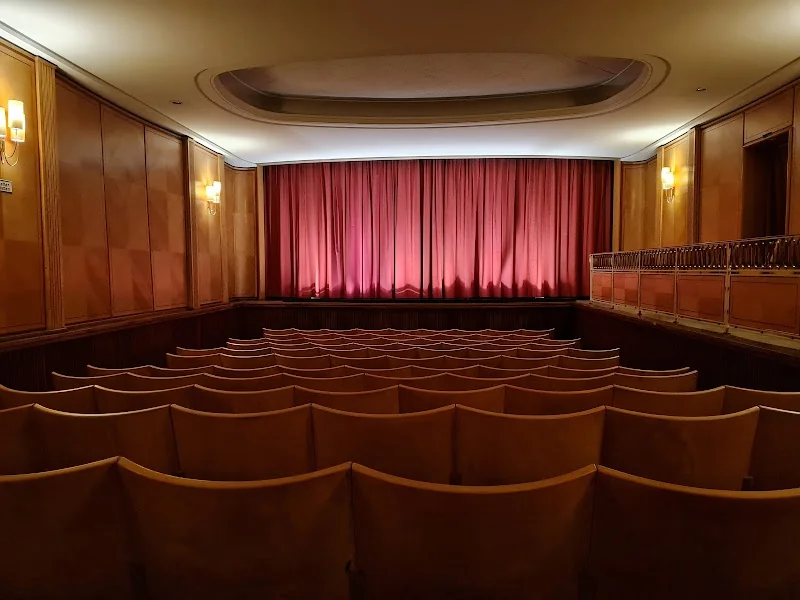
The search for seating plans, seats, and capacity is particularly understandable at Theatiner Film Theater because it is not a large multi-hall building but a compact single-screen cinema. The capacity of 164 seats clearly indicates that closeness rather than distance matters here. The price structure of the website divides the hall into rows 1 to 9 and 10 to 17, which provides visitors with a good indication of the seating arrangement: There are two clearly identifiable audience zones that differ in price and logically structure the space. This picture is complemented by the barrier-free description, which refers to elevated seating on one side of the hall, i.e., a box. This creates not an anonymous standard cinema, but a space with visible division and classic cinema gestures. The official history also emphasizes that the house has been preserved in its original condition to this day. This is a crucial part of the atmosphere, as the Theatiner does not rely on modern transformation but on preserved cinema culture. Those viewing photos of the house immediately recognize the historical impact of the place: the passage, the access, the hall character, and the feeling of descending into another decade. This perception is no coincidence but part of the concept that the cinema has carried for decades. Therefore, search queries for photos contain more than mere curiosity; they express the desire to see in advance how strongly the house makes its origins visible. This impression is often the background for reviews, even if evaluations remain subjective: The special hall size, the original design, and the focused program selection create a clear recognizability. Those looking for a cinema with great distance, many halls, and arbitrary comfort are in the wrong place here. However, for those who appreciate a consciously designed cinema environment, the Theatiner is a very precise answer to the questions of seating plan, best seats, and capacity. ([muenchenwiki.de](https://www.muenchenwiki.de/wiki/Theatiner_Filmtheater?utm_source=openai))
History of Theatiner Film Theater since 1957
The history of Theatiner Film Theater is an essential part of its current SEO relevance, as the cinema is not only used currently but is culturally charged. According to the official house page, Theatiner Film Art opened on August 13, 1957. Just a year later, Marlies Kirchner took over the theater management, and from 1976 to 2023, she led the house independently. In 2024, long-time employees Bastian Hauser and Claire Schleeger took over Theatiner Film Art. This continuity is remarkable because it shows that the cinema is understood not as an interchangeable business model but as a grown cultural project. Even further back is the work of Walter Kirchner, who founded the film distribution company Neue Filmkunst Walter Kirchner in 1953 and made significant contributions to international film art. The official description explicitly mentions his role in the dissemination of the French Nouvelle Vague as well as classic and at that time still relatively unknown works by Buster Keaton, Sergei Eisenstein, Dziga Vertov, Ernst Lubitsch, and Alfred Hitchcock. It also refers to the preservation of German cinema from the Weimar Republic and the path of European auteur filmmakers like Antonioni, Bergman, Buñuel, Fellini, or Straub and Huillet into cinemas. It becomes clear: The Theatiner is not simply a nostalgic house but part of a curatorial tradition that has actively made film history accessible. The location in the passage between Residenzstraße and Theatinerstraße also belongs to this narrative, as the cinema has always been connected to a very specific Munich urban space. So, when one searches for Theatiner Film Theater Munich or Theatiner Film Art today, one is unconsciously also searching for this history: for a place where film is not just played but categorized, accompanied, and taken seriously. This is precisely why the house has such a strong profile in Munich's cultural memory. ([theatiner-film.de](https://theatiner-film.de/theatiner))
Why Theatiner Film Theater is a Special Cinema in Munich
The Theatiner Film Theater remains so search-strong because it meets several needs simultaneously: program, location, atmosphere, and cultural identity. The house projects with 100 percent green electricity, offers a weekly program search via the website, and visibly sees itself as a curated place for arthouse films, original versions, and special formats. Additionally, it is located in Munich's old town, in an area that can be easily reached by subway or tram and is ideal for combining with a city stroll. This is particularly important for users searching for Theatiner Film Theater today, program, or photos: They do not just want to know if a film is playing, but whether the entire experience is coherent. At Theatiner, the answer is usually yes, because the cinema consistently maintains its identity. It is neither over-staged nor arbitrarily modernized but clearly readable as a historical arthouse venue. This is also relevant for online perception, as a strong visual and atmospheric profile automatically generates search interest in images, reviews, and location inquiries. Those planning an evening at Theatiner also receive not just a film but often context: film series, festival collaborations, discussions with guests, or thematic programs that place viewing in a larger framework. For visitors who prefer a focused, culture-oriented cinema situation, this is a real advantage. And for Munich as a whole, the house is an important part of the cinema landscape because it keeps the historical idea of arthouse cinema visibly alive. So, for those looking for a cinema with character, reliable program quality, and a strong address in the heart of the city, Theatiner Film Theater offers exactly the mix that many initially seek and that usually brings them back. ([theatiner-film.de](https://theatiner-film.de/))
Sources:
Show moreShow less
Theatiner Film Theater | Program & Today
The Theatiner Film Theater is not just any downtown cinema, but a consciously maintained arthouse venue with its own stance. Located at Theatinerstraße 32, in the heart of Munich's old town, visitors can expect a single hall with 164 seats, a historic 1950s atmosphere, and a program primarily aimed at people who want to watch films in their original language with subtitles. The venue opened on August 13, 1957, and has been preserved in its original condition to this day. The official presentation describes it as an arthouse cinema for Munich, with reservations available online or by phone, as well as opening hours from Monday to Saturday 4 PM to 10 PM and Sundays 11 AM to 10 PM. This blend of tradition, curation, and central location makes the Theatiner a venue that impresses not through size, but through character. This is also reflected in the clear digital structure of the website, which not only shows films but also provides orientation: Those looking to go to the cinema today can quickly find the current day's screenings, while those planning ahead can see the current week and upcoming titles. ([theatiner-film.de](https://theatiner-film.de/theatiner))
Theatiner Film Theater Program Today: What is currently playing?
Those searching for the Theatiner Film Theater program are usually looking for more than just a single title, but for orientation: Which films are playing today, what series are planned for the week, and what is coming soon? The homepage answers these questions quite clearly, as it is divided into the sections Today, Current Week, and Coming Soon. The cinema also demonstrates how effectively it functions as a curated address: It is not about mass release titles, but about carefully selected arthouse films, original versions, and special screenings. Currently, the website lists, among others, INGEBORG BACHMANN - SOMEONE WHO ONCE WAS ME, LE RENDEZ-VOUS DE L'ÉTÉ A Summer in Paris, MA VIE, MA GUEULE My Life, My Thing, and PRIMAVERA Vivaldi and Me. Additionally, there are film festival seasons and series and events such as Pour un cinéma parlant. The cinema of Éric Rohmer, MUNICH. READ AND LISTEN, Hair – Power – Lust: Film series for the exhibition at the Kunsthalle Munich, Ballet Extra, and FILM ART WEEKS. This mix is SEO-relevant because this is where the common search terms program, today, coming soon, and event converge. For visitors, this means: The Theatiner is often the right place when one is looking for a venue in Munich that is not a standard multiplex, but a house with character. The program logic is also flexible, as the homepage shows current screening times and reservation links directly next to the films, allowing for a quick transition from the search impulse to the specific screening. So, those searching for Theatiner Film Theater today do not land on a static cinema information page, but on a lively program that renews itself in short cycles while also making thematic series visible. ([theatiner-film.de](https://theatiner-film.de/))
Tickets, Prices, and Reservations at Theatiner Film Theater
A central search impulse regarding the Theatiner Film Theater concerns tickets, prices, and how to reserve seats. Here, the venue is very transparent: On the pricing page, the rates are neatly separated by cinema days and regular screenings. Monday and Tuesday are considered cinema days, during which all series cost 8.00 euros; further discounts are available for other eligible groups. From Wednesday to Sunday, the regular prices vary depending on the seating area, namely 11.00 euros for rows 1 to 9 and 12.00 euros for rows 10 to 17, each with discount options. For screenings with guests, an additional surcharge of 1 euro is mentioned. The cinema also recommends the Gildepass: It costs 6.00 euros, is valid for one year in all member cinemas, and provides at least a 1.00 euro discount per screening, even a price of 6.00 euros on cinema days. Important for practice is also the reservation logic: Ticket reservations are possible online or by phone during opening hours, and the website itself serves as information and ticket reservation; a classic online sale is not described there. This makes the booking process consciously personal and fitting to the character of the house. Those sitting in the Theatiner do not simply buy any ticket, but choose a specific screening in a house that curates its program and often works with guests, series, or festival references. For seekers, this is relevant because terms like tickets, prices, box office, and reservation actually have practical added value at this location: One can understand the pricing logic, categorize the seating rows, and clarify the reservation in advance, instead of being surprised at the door. ([theatiner-film.de](https://theatiner-film.de/preise))
Directions, Subway, and Parking at Theatinerstraße 32
When it comes to directions, the location of the Theatiner Film Theater plays a significant role, as the cinema is not on the outskirts but in the middle of Munich's center. The external barrier-free location description assigns the venue to the Theatiner passage, which is the area between Theatinerstraße and Residenzstraße. For public transport access, this is particularly pleasant: The subway station Odeonsplatz is, according to MVV, a hub for lines U3, U4, U5, and U6, and from there it is just a few steps to Theatinerstraße. Additionally, the cinema and city information mentions tram lines 19 and 21 as nearby lines, including at the Theatinerstraße stop. This is why many visitors search for terms like Theatiner Film Theater Theatinerstraße Munich or directions, as the route is uncomplicated for most when oriented towards Odeonsplatz. However, those arriving by car should realistically assess the central location: Parking options are available but scarce and often associated with typical old town situations. As nearby orientation, Mux mentions, among other things, the parking garage at the opera, as well as additional parking spaces in the vicinity. This is useful for spontaneous visits, but for a stress-free cinema experience, the subway is usually the better choice. An important practical note is accessibility: The barrier-free description explicitly points out that the cinema can only be reached via stairs, the hall is located in the basement, there is a staircase at the hall exit, and no wheelchair-accessible toilet is available. At the same time, it is mentioned that staff can accompany and assist if needed. Therefore, those coming for the first time should not only think about parking and stops but also about the architectural conditions of the historic building. The Theatiner remains authentic, but also requires a small amount of preparation. ([kultur-barrierefrei-muenchen.de](https://www.kultur-barrierefrei-muenchen.de/theatiner-filmtheater/))
Seating Plan, Seats, and Atmosphere at Theatiner Film Theater
The search for seating plans, seats, and capacity is particularly understandable at Theatiner Film Theater because it is not a large multi-hall building but a compact single-screen cinema. The capacity of 164 seats clearly indicates that closeness rather than distance matters here. The price structure of the website divides the hall into rows 1 to 9 and 10 to 17, which provides visitors with a good indication of the seating arrangement: There are two clearly identifiable audience zones that differ in price and logically structure the space. This picture is complemented by the barrier-free description, which refers to elevated seating on one side of the hall, i.e., a box. This creates not an anonymous standard cinema, but a space with visible division and classic cinema gestures. The official history also emphasizes that the house has been preserved in its original condition to this day. This is a crucial part of the atmosphere, as the Theatiner does not rely on modern transformation but on preserved cinema culture. Those viewing photos of the house immediately recognize the historical impact of the place: the passage, the access, the hall character, and the feeling of descending into another decade. This perception is no coincidence but part of the concept that the cinema has carried for decades. Therefore, search queries for photos contain more than mere curiosity; they express the desire to see in advance how strongly the house makes its origins visible. This impression is often the background for reviews, even if evaluations remain subjective: The special hall size, the original design, and the focused program selection create a clear recognizability. Those looking for a cinema with great distance, many halls, and arbitrary comfort are in the wrong place here. However, for those who appreciate a consciously designed cinema environment, the Theatiner is a very precise answer to the questions of seating plan, best seats, and capacity. ([muenchenwiki.de](https://www.muenchenwiki.de/wiki/Theatiner_Filmtheater?utm_source=openai))
History of Theatiner Film Theater since 1957
The history of Theatiner Film Theater is an essential part of its current SEO relevance, as the cinema is not only used currently but is culturally charged. According to the official house page, Theatiner Film Art opened on August 13, 1957. Just a year later, Marlies Kirchner took over the theater management, and from 1976 to 2023, she led the house independently. In 2024, long-time employees Bastian Hauser and Claire Schleeger took over Theatiner Film Art. This continuity is remarkable because it shows that the cinema is understood not as an interchangeable business model but as a grown cultural project. Even further back is the work of Walter Kirchner, who founded the film distribution company Neue Filmkunst Walter Kirchner in 1953 and made significant contributions to international film art. The official description explicitly mentions his role in the dissemination of the French Nouvelle Vague as well as classic and at that time still relatively unknown works by Buster Keaton, Sergei Eisenstein, Dziga Vertov, Ernst Lubitsch, and Alfred Hitchcock. It also refers to the preservation of German cinema from the Weimar Republic and the path of European auteur filmmakers like Antonioni, Bergman, Buñuel, Fellini, or Straub and Huillet into cinemas. It becomes clear: The Theatiner is not simply a nostalgic house but part of a curatorial tradition that has actively made film history accessible. The location in the passage between Residenzstraße and Theatinerstraße also belongs to this narrative, as the cinema has always been connected to a very specific Munich urban space. So, when one searches for Theatiner Film Theater Munich or Theatiner Film Art today, one is unconsciously also searching for this history: for a place where film is not just played but categorized, accompanied, and taken seriously. This is precisely why the house has such a strong profile in Munich's cultural memory. ([theatiner-film.de](https://theatiner-film.de/theatiner))
Why Theatiner Film Theater is a Special Cinema in Munich
The Theatiner Film Theater remains so search-strong because it meets several needs simultaneously: program, location, atmosphere, and cultural identity. The house projects with 100 percent green electricity, offers a weekly program search via the website, and visibly sees itself as a curated place for arthouse films, original versions, and special formats. Additionally, it is located in Munich's old town, in an area that can be easily reached by subway or tram and is ideal for combining with a city stroll. This is particularly important for users searching for Theatiner Film Theater today, program, or photos: They do not just want to know if a film is playing, but whether the entire experience is coherent. At Theatiner, the answer is usually yes, because the cinema consistently maintains its identity. It is neither over-staged nor arbitrarily modernized but clearly readable as a historical arthouse venue. This is also relevant for online perception, as a strong visual and atmospheric profile automatically generates search interest in images, reviews, and location inquiries. Those planning an evening at Theatiner also receive not just a film but often context: film series, festival collaborations, discussions with guests, or thematic programs that place viewing in a larger framework. For visitors who prefer a focused, culture-oriented cinema situation, this is a real advantage. And for Munich as a whole, the house is an important part of the cinema landscape because it keeps the historical idea of arthouse cinema visibly alive. So, for those looking for a cinema with character, reliable program quality, and a strong address in the heart of the city, Theatiner Film Theater offers exactly the mix that many initially seek and that usually brings them back. ([theatiner-film.de](https://theatiner-film.de/))
Sources:
Theatiner Film Theater | Program & Today
The Theatiner Film Theater is not just any downtown cinema, but a consciously maintained arthouse venue with its own stance. Located at Theatinerstraße 32, in the heart of Munich's old town, visitors can expect a single hall with 164 seats, a historic 1950s atmosphere, and a program primarily aimed at people who want to watch films in their original language with subtitles. The venue opened on August 13, 1957, and has been preserved in its original condition to this day. The official presentation describes it as an arthouse cinema for Munich, with reservations available online or by phone, as well as opening hours from Monday to Saturday 4 PM to 10 PM and Sundays 11 AM to 10 PM. This blend of tradition, curation, and central location makes the Theatiner a venue that impresses not through size, but through character. This is also reflected in the clear digital structure of the website, which not only shows films but also provides orientation: Those looking to go to the cinema today can quickly find the current day's screenings, while those planning ahead can see the current week and upcoming titles. ([theatiner-film.de](https://theatiner-film.de/theatiner))
Theatiner Film Theater Program Today: What is currently playing?
Those searching for the Theatiner Film Theater program are usually looking for more than just a single title, but for orientation: Which films are playing today, what series are planned for the week, and what is coming soon? The homepage answers these questions quite clearly, as it is divided into the sections Today, Current Week, and Coming Soon. The cinema also demonstrates how effectively it functions as a curated address: It is not about mass release titles, but about carefully selected arthouse films, original versions, and special screenings. Currently, the website lists, among others, INGEBORG BACHMANN - SOMEONE WHO ONCE WAS ME, LE RENDEZ-VOUS DE L'ÉTÉ A Summer in Paris, MA VIE, MA GUEULE My Life, My Thing, and PRIMAVERA Vivaldi and Me. Additionally, there are film festival seasons and series and events such as Pour un cinéma parlant. The cinema of Éric Rohmer, MUNICH. READ AND LISTEN, Hair – Power – Lust: Film series for the exhibition at the Kunsthalle Munich, Ballet Extra, and FILM ART WEEKS. This mix is SEO-relevant because this is where the common search terms program, today, coming soon, and event converge. For visitors, this means: The Theatiner is often the right place when one is looking for a venue in Munich that is not a standard multiplex, but a house with character. The program logic is also flexible, as the homepage shows current screening times and reservation links directly next to the films, allowing for a quick transition from the search impulse to the specific screening. So, those searching for Theatiner Film Theater today do not land on a static cinema information page, but on a lively program that renews itself in short cycles while also making thematic series visible. ([theatiner-film.de](https://theatiner-film.de/))
Tickets, Prices, and Reservations at Theatiner Film Theater
A central search impulse regarding the Theatiner Film Theater concerns tickets, prices, and how to reserve seats. Here, the venue is very transparent: On the pricing page, the rates are neatly separated by cinema days and regular screenings. Monday and Tuesday are considered cinema days, during which all series cost 8.00 euros; further discounts are available for other eligible groups. From Wednesday to Sunday, the regular prices vary depending on the seating area, namely 11.00 euros for rows 1 to 9 and 12.00 euros for rows 10 to 17, each with discount options. For screenings with guests, an additional surcharge of 1 euro is mentioned. The cinema also recommends the Gildepass: It costs 6.00 euros, is valid for one year in all member cinemas, and provides at least a 1.00 euro discount per screening, even a price of 6.00 euros on cinema days. Important for practice is also the reservation logic: Ticket reservations are possible online or by phone during opening hours, and the website itself serves as information and ticket reservation; a classic online sale is not described there. This makes the booking process consciously personal and fitting to the character of the house. Those sitting in the Theatiner do not simply buy any ticket, but choose a specific screening in a house that curates its program and often works with guests, series, or festival references. For seekers, this is relevant because terms like tickets, prices, box office, and reservation actually have practical added value at this location: One can understand the pricing logic, categorize the seating rows, and clarify the reservation in advance, instead of being surprised at the door. ([theatiner-film.de](https://theatiner-film.de/preise))
Directions, Subway, and Parking at Theatinerstraße 32
When it comes to directions, the location of the Theatiner Film Theater plays a significant role, as the cinema is not on the outskirts but in the middle of Munich's center. The external barrier-free location description assigns the venue to the Theatiner passage, which is the area between Theatinerstraße and Residenzstraße. For public transport access, this is particularly pleasant: The subway station Odeonsplatz is, according to MVV, a hub for lines U3, U4, U5, and U6, and from there it is just a few steps to Theatinerstraße. Additionally, the cinema and city information mentions tram lines 19 and 21 as nearby lines, including at the Theatinerstraße stop. This is why many visitors search for terms like Theatiner Film Theater Theatinerstraße Munich or directions, as the route is uncomplicated for most when oriented towards Odeonsplatz. However, those arriving by car should realistically assess the central location: Parking options are available but scarce and often associated with typical old town situations. As nearby orientation, Mux mentions, among other things, the parking garage at the opera, as well as additional parking spaces in the vicinity. This is useful for spontaneous visits, but for a stress-free cinema experience, the subway is usually the better choice. An important practical note is accessibility: The barrier-free description explicitly points out that the cinema can only be reached via stairs, the hall is located in the basement, there is a staircase at the hall exit, and no wheelchair-accessible toilet is available. At the same time, it is mentioned that staff can accompany and assist if needed. Therefore, those coming for the first time should not only think about parking and stops but also about the architectural conditions of the historic building. The Theatiner remains authentic, but also requires a small amount of preparation. ([kultur-barrierefrei-muenchen.de](https://www.kultur-barrierefrei-muenchen.de/theatiner-filmtheater/))
Seating Plan, Seats, and Atmosphere at Theatiner Film Theater
The search for seating plans, seats, and capacity is particularly understandable at Theatiner Film Theater because it is not a large multi-hall building but a compact single-screen cinema. The capacity of 164 seats clearly indicates that closeness rather than distance matters here. The price structure of the website divides the hall into rows 1 to 9 and 10 to 17, which provides visitors with a good indication of the seating arrangement: There are two clearly identifiable audience zones that differ in price and logically structure the space. This picture is complemented by the barrier-free description, which refers to elevated seating on one side of the hall, i.e., a box. This creates not an anonymous standard cinema, but a space with visible division and classic cinema gestures. The official history also emphasizes that the house has been preserved in its original condition to this day. This is a crucial part of the atmosphere, as the Theatiner does not rely on modern transformation but on preserved cinema culture. Those viewing photos of the house immediately recognize the historical impact of the place: the passage, the access, the hall character, and the feeling of descending into another decade. This perception is no coincidence but part of the concept that the cinema has carried for decades. Therefore, search queries for photos contain more than mere curiosity; they express the desire to see in advance how strongly the house makes its origins visible. This impression is often the background for reviews, even if evaluations remain subjective: The special hall size, the original design, and the focused program selection create a clear recognizability. Those looking for a cinema with great distance, many halls, and arbitrary comfort are in the wrong place here. However, for those who appreciate a consciously designed cinema environment, the Theatiner is a very precise answer to the questions of seating plan, best seats, and capacity. ([muenchenwiki.de](https://www.muenchenwiki.de/wiki/Theatiner_Filmtheater?utm_source=openai))
History of Theatiner Film Theater since 1957
The history of Theatiner Film Theater is an essential part of its current SEO relevance, as the cinema is not only used currently but is culturally charged. According to the official house page, Theatiner Film Art opened on August 13, 1957. Just a year later, Marlies Kirchner took over the theater management, and from 1976 to 2023, she led the house independently. In 2024, long-time employees Bastian Hauser and Claire Schleeger took over Theatiner Film Art. This continuity is remarkable because it shows that the cinema is understood not as an interchangeable business model but as a grown cultural project. Even further back is the work of Walter Kirchner, who founded the film distribution company Neue Filmkunst Walter Kirchner in 1953 and made significant contributions to international film art. The official description explicitly mentions his role in the dissemination of the French Nouvelle Vague as well as classic and at that time still relatively unknown works by Buster Keaton, Sergei Eisenstein, Dziga Vertov, Ernst Lubitsch, and Alfred Hitchcock. It also refers to the preservation of German cinema from the Weimar Republic and the path of European auteur filmmakers like Antonioni, Bergman, Buñuel, Fellini, or Straub and Huillet into cinemas. It becomes clear: The Theatiner is not simply a nostalgic house but part of a curatorial tradition that has actively made film history accessible. The location in the passage between Residenzstraße and Theatinerstraße also belongs to this narrative, as the cinema has always been connected to a very specific Munich urban space. So, when one searches for Theatiner Film Theater Munich or Theatiner Film Art today, one is unconsciously also searching for this history: for a place where film is not just played but categorized, accompanied, and taken seriously. This is precisely why the house has such a strong profile in Munich's cultural memory. ([theatiner-film.de](https://theatiner-film.de/theatiner))
Why Theatiner Film Theater is a Special Cinema in Munich
The Theatiner Film Theater remains so search-strong because it meets several needs simultaneously: program, location, atmosphere, and cultural identity. The house projects with 100 percent green electricity, offers a weekly program search via the website, and visibly sees itself as a curated place for arthouse films, original versions, and special formats. Additionally, it is located in Munich's old town, in an area that can be easily reached by subway or tram and is ideal for combining with a city stroll. This is particularly important for users searching for Theatiner Film Theater today, program, or photos: They do not just want to know if a film is playing, but whether the entire experience is coherent. At Theatiner, the answer is usually yes, because the cinema consistently maintains its identity. It is neither over-staged nor arbitrarily modernized but clearly readable as a historical arthouse venue. This is also relevant for online perception, as a strong visual and atmospheric profile automatically generates search interest in images, reviews, and location inquiries. Those planning an evening at Theatiner also receive not just a film but often context: film series, festival collaborations, discussions with guests, or thematic programs that place viewing in a larger framework. For visitors who prefer a focused, culture-oriented cinema situation, this is a real advantage. And for Munich as a whole, the house is an important part of the cinema landscape because it keeps the historical idea of arthouse cinema visibly alive. So, for those looking for a cinema with character, reliable program quality, and a strong address in the heart of the city, Theatiner Film Theater offers exactly the mix that many initially seek and that usually brings them back. ([theatiner-film.de](https://theatiner-film.de/))
Sources:

Frequently Asked Questions
Reviews
No reviews found