
München
Viktualienmarkt 3, 80331 München, Deutschland
Viktualienmarkt | Opening Hours & Beer Garden
The Viktualienmarkt is one of the places in Munich where everyday life, tradition, and enjoyment seamlessly blend together. Located in the heart of the old town, south of Marienplatz and at the edge of Isarvorstadt, it is a public square that is accessible around the clock and is considered one of the city's most famous food markets. Those who come here are not only looking for fresh goods but also for the special Munich lifestyle: a market with history, a meeting place for locals and visitors, a spot for breakfast, lunch breaks, beer garden visits, and inspiring walks among stalls, fountains, and the Maypole. The official market website describes the Viktualienmarkt as a popular place for connoisseurs and gourmets with goods ranging from regional to exotic; the city of Munich adds that the market has evolved from its original farmers' market to a shopping place with a unique flair. Depending on the source, around 110 vendors are mentioned on approximately 10,000 square meters or around 140 stalls and vendors, reflecting the vibrant character of the market well. ([stadt.muenchen.de](https://stadt.muenchen.de/service/info/viktualienmarkt/1075094/))
Opening Hours, Sunday Regulations, and Market Life
For many visitors, the first question is quite practical: When is a visit worthwhile? The Viktualienmarkt itself is accessible as a public square at any time, including late at night or early in the morning. However, the actual market stalls follow the opening hours of the respective operators. Officially, most stalls open from Monday to Saturday, usually around 8 a.m., and close by 8 p.m. Some stalls close earlier due to seasonal reasons, while others start their day much earlier. The official FAQ even mentions a first stall that opens as early as 5:30 a.m., while most others start between 7 and 10 a.m. On Sundays and public holidays, the market stalls are closed, but the area remains accessible. This is important for planning, as a Sunday stroll through the square is possible, but a classic shopping trip is not. In practice, the Viktualienmarkt is therefore a place that changes throughout the day: busy and almost quiet in the morning, densely visited at noon, and more relaxed in the late afternoon. Those looking for specific products should keep an eye on the individual vendors, as florists, bakers, and restaurateurs may have varying hours and can be open on Sundays. On special days like Carnival, Christmas Eve, or New Year's Eve, operations may also be limited. For visitors, however, this is more of an advantage than a disadvantage, as the market thus offers a slightly different atmosphere every day of the week. Free access, changing moods, and a clear rhythm of weekdays and quiet times make the Viktualienmarkt a true urban space and not just a shopping address. ([viktualienmarkt-muenchen.de](https://www.viktualienmarkt-muenchen.de/faq/))
Stalls, Assortment, and Specialties at the Viktualienmarkt
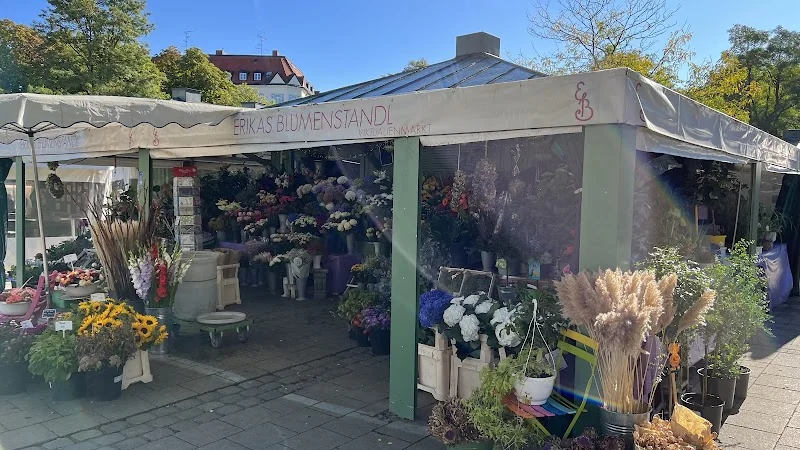
The greatest charm of the Viktualienmarkt lies in the variety of its offerings. According to official city information, the market area covers around 10,000 square meters; fruits, vegetables, tropical fruits, meat, game, poultry, cheese, fish, bread and baked goods, spices, flowers, and much more are sold. The market FAQ mentions around 140 stalls and vendors, including the butchers' row, while the city of Munich refers to about 110 vendors on approximately 10,000 square meters. Depending on the counting method, both figures are thus used. ([stadt.muenchen.de](https://stadt.muenchen.de/service/info/viktualienmarkt/1075094/))
Beer Garden, Breakfast, and Restaurants at the Viktualienmarkt
Few topics are as closely associated with the Viktualienmarkt as the beer garden. The official beer garden of the market is considered the most central beer garden in the state capital Munich and offers around 1,100 seats under chestnut trees. The special thing about it is not only the location in the midst of market activity but also the classic Munich beer garden rule: food can be brought in, drinks are purchased from the host. For this reason, the beer garden does not feel like a separate gastronomic area but rather like an extension of the public square. Additionally, it is a place with its own dynamics, as the beer selection changes approximately every six weeks among the major Munich breweries Hofbräu, Spaten, Augustiner, Hacker-Pschorr, Paulaner, and Löwenbräu. Therefore, those searching for the keyword beer garden will find here not just a side note, but one of the core elements of the entire market experience. Breakfast is also closely linked to the Viktualienmarkt. The official site recommends the Weißwurst breakfast as a classic Munich specialty, served with sweet mustard, pretzels, and wheat beer. At the same time, the tradition of eating Weißwürste in the morning, often before noon, and ordering them by the piece is highlighted. This fits well with the market character, as having breakfast at the Viktualienmarkt means not only getting full but also sitting in a place where activity, scent, and conversation come together in the morning. Those who prefer to sit indoors or at a table will find additional gastronomic addresses directly at the market and in the surrounding area, such as fish, soups, meat dishes, or smaller cafés. The adjacent Schrannenhalle with Eataly, cafés, and restaurants significantly expands the culinary offerings. Thus, the Viktualienmarkt becomes a destination for breakfast, lunch, beer garden breaks, and dinner all at once. ([viktualienmarkt-muenchen.de](https://www.viktualienmarkt-muenchen.de/biergarten/))
Directions, Parking, and Map in the Old Town
When it comes to directions, the Viktualienmarkt is particularly clearly positioned: it is located in the city center, just a few minutes' walk south of Marienplatz. The official directions page explicitly recommends arriving by public transport, as S-Bahn, U-Bahn, tram, and bus stop in the immediate vicinity. Almost all S-Bahn trains stop at Marienplatz, as well as the U3 and U6; from Marienplatz, it is only about 200 meters to the market. The stop is barrier-free, equipped with escalators and additionally with an elevator at Marienhof. Even closer is the tram stop at Reichenbachplatz, from there it is about 150 meters. The bus stops directly at the Viktualienmarkt at the corner of Rosental and Prälat-Zistl-Straße right by the Schrannenhalle. While driving is possible, it is not recommended on weekdays and Saturdays, as many old town streets are one-way and traffic is heavy. Finding a parking space directly at the market is extremely rare and difficult, according to the official parking page. Therefore, the page refers to nearby parking garages, especially the underground garage under the Schrannenhalle. This is accessible via Prälat-Zistl-Straße, with a maximum height of 2.0 meters. Additionally, short stopping options and other parking garages in the city center are mentioned, but the core recommendation remains clear: for a relaxed arrival, it is better to take public transport than to drive. The market map also helps with orientation, as the market is divided into seven sections. This is particularly useful for first-time visitors when they are looking for specific stalls, the beer garden, or market supervision. Therefore, the journey is uncomplicated if planned correctly, and the market remains a very urban place with a close connection to the old town area. ([viktualienmarkt-muenchen.de](https://www.viktualienmarkt-muenchen.de/anfahrt/))
History, Name, Fountains, and Maypole
The historical depth of the Viktualienmarkt is a significant part of its charm. The market was located until May 2, 1807, at the present Marienplatz. When the square became too small, King Maximilian I. Joseph ordered the relocation to the current site. This marked the beginning of the market's development at the location between Heiliggeistkirche and Frauenstraße, which over time became Munich's most famous food market. The name itself is derived from Viktualien, an old term for food, which goes back to the late Latin victualia or Latin victus. The market was originally a farmers' market and herb market; it only developed into the current place known for delicacies, freshness, and urban market diversity over the course of the 19th century. The official market site also emphasizes that the Viktualienmarkt reached its current size in 1890, among other things through additions such as fruit pavilions and a hall for North Sea fishing. To understand the history of the market, one should also pay attention to the fountains and the Maypole. Several fountains are located on the premises, named after Munich originals, including Karl Valentin, Liesl Karlstadt, Weiß Ferdl, Ida Schumacher, Elise Aulinger, and Roider Jackl. In August, a fountain festival takes place, where the fountains are decorated, and music and dance shape the market image. Particularly noteworthy is the potato fountain, which provides drinking water year-round. The Maypole, on the other hand, was erected in 1962 by Munich breweries and is now one of the most prominent landmarks of the market. Additionally, the Schrannenhalle at the edge of the area, which previously served as a grain market, is now again a culinary component of the district. All these elements make it clear that the Viktualienmarkt is not just a market but a historically grown urban space with symbolic power. ([muenchen.de](https://www.muenchen.de/sehenswuerdigkeiten/top-sehenswuerdigkeiten/viktualienmarkt?utm_source=openai))
Guided Tours, Market Supervision, and Practical Tips
If you want to not just stroll through the Viktualienmarkt but truly understand it, you should consider a guided tour. The official site offers guided tours and tasting tours that can be booked through a partner. The advantage is clear: instead of just walking past stalls, you learn background information about products, traditions, market stories, and culinary specialties. The market itself is freely accessible; booked tours are subject to a fee. The market supervision is also practical, serving as a central point of contact opposite the Liesl-Karlstadt fountain at Viktualienmarkt 3 and is available from Monday to Saturday from 6:30 a.m. to 6:30 p.m. The municipal market halls of Munich are responsible, which also operate other fixed markets and weekly markets in addition to the Viktualienmarkt. For visitors, free Wi-Fi via SWM and M-Net, the rule that dogs must be leashed, and the public toilet at the eastern end of the market, which is open daily from 9 a.m. to 6 p.m., are also relevant. All this may sound unremarkable, but it is particularly valuable for the search intent around Viktualienmarkt tours, tickets, food, and practical information. Because a market visit becomes significantly more pleasant when you know where to inquire, how to orient yourself, and what extras are available. Especially in a place that is so central and fulfills so many functions, such details are not trivial. Therefore, the Viktualienmarkt is a place that can be visited spontaneously but works even better with a little preparation: early hours for quieter shopping, public transport for less stress, a glance at the market map for targeted routes, and, if interested, a guided tour for added value. This way, a market visit becomes a true Munich experience. ([viktualienmarkt-muenchen.de](https://www.viktualienmarkt-muenchen.de/en/guided-tours-of-the-viktualienmarkt/?utm_source=openai))
Sources:
https://www.viktualienmarkt-muenchen.de/ - Viktualienmarkt, official website ([viktualienmarkt-muenchen.de](https://www.viktualienmarkt-muenchen.de/?utm_source=openai))https://www.viktualienmarkt-muenchen.de/oeffnungszeiten/ - Opening hours at Viktualienmarkt ([viktualienmarkt-muenchen.de](https://www.viktualienmarkt-muenchen.de/en/opening-hours/?utm_source=openai))https://www.viktualienmarkt-muenchen.de/anfahrt/ - Directions to Viktualienmarkt ([viktualienmarkt-muenchen.de](https://www.viktualienmarkt-muenchen.de/anfahrt/))https://www.viktualienmarkt-muenchen.de/parken/ - Parking near Viktualienmarkt ([viktualienmarkt-muenchen.de](https://www.viktualienmarkt-muenchen.de/parken/?utm_source=openai))https://www.viktualienmarkt-muenchen.de/biergarten/ - Beer garden at Viktualienmarkt ([viktualienmarkt-muenchen.de](https://www.viktualienmarkt-muenchen.de/biergarten/))https://www.viktualienmarkt-muenchen.de/fuehrungen-auf-dem-viktualienmarkt/ - Guided tours and tasting tours at Viktualienmarkt ([viktualienmarkt-muenchen.de](https://www.viktualienmarkt-muenchen.de/fuehrungen-auf-dem-viktualienmarkt/?utm_source=openai))
Show moreShow less
Viktualienmarkt | Opening Hours & Beer Garden
The Viktualienmarkt is one of the places in Munich where everyday life, tradition, and enjoyment seamlessly blend together. Located in the heart of the old town, south of Marienplatz and at the edge of Isarvorstadt, it is a public square that is accessible around the clock and is considered one of the city's most famous food markets. Those who come here are not only looking for fresh goods but also for the special Munich lifestyle: a market with history, a meeting place for locals and visitors, a spot for breakfast, lunch breaks, beer garden visits, and inspiring walks among stalls, fountains, and the Maypole. The official market website describes the Viktualienmarkt as a popular place for connoisseurs and gourmets with goods ranging from regional to exotic; the city of Munich adds that the market has evolved from its original farmers' market to a shopping place with a unique flair. Depending on the source, around 110 vendors are mentioned on approximately 10,000 square meters or around 140 stalls and vendors, reflecting the vibrant character of the market well. ([stadt.muenchen.de](https://stadt.muenchen.de/service/info/viktualienmarkt/1075094/))
Opening Hours, Sunday Regulations, and Market Life
For many visitors, the first question is quite practical: When is a visit worthwhile? The Viktualienmarkt itself is accessible as a public square at any time, including late at night or early in the morning. However, the actual market stalls follow the opening hours of the respective operators. Officially, most stalls open from Monday to Saturday, usually around 8 a.m., and close by 8 p.m. Some stalls close earlier due to seasonal reasons, while others start their day much earlier. The official FAQ even mentions a first stall that opens as early as 5:30 a.m., while most others start between 7 and 10 a.m. On Sundays and public holidays, the market stalls are closed, but the area remains accessible. This is important for planning, as a Sunday stroll through the square is possible, but a classic shopping trip is not. In practice, the Viktualienmarkt is therefore a place that changes throughout the day: busy and almost quiet in the morning, densely visited at noon, and more relaxed in the late afternoon. Those looking for specific products should keep an eye on the individual vendors, as florists, bakers, and restaurateurs may have varying hours and can be open on Sundays. On special days like Carnival, Christmas Eve, or New Year's Eve, operations may also be limited. For visitors, however, this is more of an advantage than a disadvantage, as the market thus offers a slightly different atmosphere every day of the week. Free access, changing moods, and a clear rhythm of weekdays and quiet times make the Viktualienmarkt a true urban space and not just a shopping address. ([viktualienmarkt-muenchen.de](https://www.viktualienmarkt-muenchen.de/faq/))
Stalls, Assortment, and Specialties at the Viktualienmarkt
The greatest charm of the Viktualienmarkt lies in the variety of its offerings. According to official city information, the market area covers around 10,000 square meters; fruits, vegetables, tropical fruits, meat, game, poultry, cheese, fish, bread and baked goods, spices, flowers, and much more are sold. The market FAQ mentions around 140 stalls and vendors, including the butchers' row, while the city of Munich refers to about 110 vendors on approximately 10,000 square meters. Depending on the counting method, both figures are thus used. ([stadt.muenchen.de](https://stadt.muenchen.de/service/info/viktualienmarkt/1075094/))
Beer Garden, Breakfast, and Restaurants at the Viktualienmarkt
Few topics are as closely associated with the Viktualienmarkt as the beer garden. The official beer garden of the market is considered the most central beer garden in the state capital Munich and offers around 1,100 seats under chestnut trees. The special thing about it is not only the location in the midst of market activity but also the classic Munich beer garden rule: food can be brought in, drinks are purchased from the host. For this reason, the beer garden does not feel like a separate gastronomic area but rather like an extension of the public square. Additionally, it is a place with its own dynamics, as the beer selection changes approximately every six weeks among the major Munich breweries Hofbräu, Spaten, Augustiner, Hacker-Pschorr, Paulaner, and Löwenbräu. Therefore, those searching for the keyword beer garden will find here not just a side note, but one of the core elements of the entire market experience. Breakfast is also closely linked to the Viktualienmarkt. The official site recommends the Weißwurst breakfast as a classic Munich specialty, served with sweet mustard, pretzels, and wheat beer. At the same time, the tradition of eating Weißwürste in the morning, often before noon, and ordering them by the piece is highlighted. This fits well with the market character, as having breakfast at the Viktualienmarkt means not only getting full but also sitting in a place where activity, scent, and conversation come together in the morning. Those who prefer to sit indoors or at a table will find additional gastronomic addresses directly at the market and in the surrounding area, such as fish, soups, meat dishes, or smaller cafés. The adjacent Schrannenhalle with Eataly, cafés, and restaurants significantly expands the culinary offerings. Thus, the Viktualienmarkt becomes a destination for breakfast, lunch, beer garden breaks, and dinner all at once. ([viktualienmarkt-muenchen.de](https://www.viktualienmarkt-muenchen.de/biergarten/))
Directions, Parking, and Map in the Old Town
When it comes to directions, the Viktualienmarkt is particularly clearly positioned: it is located in the city center, just a few minutes' walk south of Marienplatz. The official directions page explicitly recommends arriving by public transport, as S-Bahn, U-Bahn, tram, and bus stop in the immediate vicinity. Almost all S-Bahn trains stop at Marienplatz, as well as the U3 and U6; from Marienplatz, it is only about 200 meters to the market. The stop is barrier-free, equipped with escalators and additionally with an elevator at Marienhof. Even closer is the tram stop at Reichenbachplatz, from there it is about 150 meters. The bus stops directly at the Viktualienmarkt at the corner of Rosental and Prälat-Zistl-Straße right by the Schrannenhalle. While driving is possible, it is not recommended on weekdays and Saturdays, as many old town streets are one-way and traffic is heavy. Finding a parking space directly at the market is extremely rare and difficult, according to the official parking page. Therefore, the page refers to nearby parking garages, especially the underground garage under the Schrannenhalle. This is accessible via Prälat-Zistl-Straße, with a maximum height of 2.0 meters. Additionally, short stopping options and other parking garages in the city center are mentioned, but the core recommendation remains clear: for a relaxed arrival, it is better to take public transport than to drive. The market map also helps with orientation, as the market is divided into seven sections. This is particularly useful for first-time visitors when they are looking for specific stalls, the beer garden, or market supervision. Therefore, the journey is uncomplicated if planned correctly, and the market remains a very urban place with a close connection to the old town area. ([viktualienmarkt-muenchen.de](https://www.viktualienmarkt-muenchen.de/anfahrt/))
History, Name, Fountains, and Maypole
The historical depth of the Viktualienmarkt is a significant part of its charm. The market was located until May 2, 1807, at the present Marienplatz. When the square became too small, King Maximilian I. Joseph ordered the relocation to the current site. This marked the beginning of the market's development at the location between Heiliggeistkirche and Frauenstraße, which over time became Munich's most famous food market. The name itself is derived from Viktualien, an old term for food, which goes back to the late Latin victualia or Latin victus. The market was originally a farmers' market and herb market; it only developed into the current place known for delicacies, freshness, and urban market diversity over the course of the 19th century. The official market site also emphasizes that the Viktualienmarkt reached its current size in 1890, among other things through additions such as fruit pavilions and a hall for North Sea fishing. To understand the history of the market, one should also pay attention to the fountains and the Maypole. Several fountains are located on the premises, named after Munich originals, including Karl Valentin, Liesl Karlstadt, Weiß Ferdl, Ida Schumacher, Elise Aulinger, and Roider Jackl. In August, a fountain festival takes place, where the fountains are decorated, and music and dance shape the market image. Particularly noteworthy is the potato fountain, which provides drinking water year-round. The Maypole, on the other hand, was erected in 1962 by Munich breweries and is now one of the most prominent landmarks of the market. Additionally, the Schrannenhalle at the edge of the area, which previously served as a grain market, is now again a culinary component of the district. All these elements make it clear that the Viktualienmarkt is not just a market but a historically grown urban space with symbolic power. ([muenchen.de](https://www.muenchen.de/sehenswuerdigkeiten/top-sehenswuerdigkeiten/viktualienmarkt?utm_source=openai))
Guided Tours, Market Supervision, and Practical Tips
If you want to not just stroll through the Viktualienmarkt but truly understand it, you should consider a guided tour. The official site offers guided tours and tasting tours that can be booked through a partner. The advantage is clear: instead of just walking past stalls, you learn background information about products, traditions, market stories, and culinary specialties. The market itself is freely accessible; booked tours are subject to a fee. The market supervision is also practical, serving as a central point of contact opposite the Liesl-Karlstadt fountain at Viktualienmarkt 3 and is available from Monday to Saturday from 6:30 a.m. to 6:30 p.m. The municipal market halls of Munich are responsible, which also operate other fixed markets and weekly markets in addition to the Viktualienmarkt. For visitors, free Wi-Fi via SWM and M-Net, the rule that dogs must be leashed, and the public toilet at the eastern end of the market, which is open daily from 9 a.m. to 6 p.m., are also relevant. All this may sound unremarkable, but it is particularly valuable for the search intent around Viktualienmarkt tours, tickets, food, and practical information. Because a market visit becomes significantly more pleasant when you know where to inquire, how to orient yourself, and what extras are available. Especially in a place that is so central and fulfills so many functions, such details are not trivial. Therefore, the Viktualienmarkt is a place that can be visited spontaneously but works even better with a little preparation: early hours for quieter shopping, public transport for less stress, a glance at the market map for targeted routes, and, if interested, a guided tour for added value. This way, a market visit becomes a true Munich experience. ([viktualienmarkt-muenchen.de](https://www.viktualienmarkt-muenchen.de/en/guided-tours-of-the-viktualienmarkt/?utm_source=openai))
Sources:
https://www.viktualienmarkt-muenchen.de/- Viktualienmarkt, official website ([viktualienmarkt-muenchen.de](https://www.viktualienmarkt-muenchen.de/?utm_source=openai))https://www.viktualienmarkt-muenchen.de/oeffnungszeiten/- Opening hours at Viktualienmarkt ([viktualienmarkt-muenchen.de](https://www.viktualienmarkt-muenchen.de/en/opening-hours/?utm_source=openai))https://www.viktualienmarkt-muenchen.de/anfahrt/- Directions to Viktualienmarkt ([viktualienmarkt-muenchen.de](https://www.viktualienmarkt-muenchen.de/anfahrt/))https://www.viktualienmarkt-muenchen.de/parken/- Parking near Viktualienmarkt ([viktualienmarkt-muenchen.de](https://www.viktualienmarkt-muenchen.de/parken/?utm_source=openai))https://www.viktualienmarkt-muenchen.de/biergarten/- Beer garden at Viktualienmarkt ([viktualienmarkt-muenchen.de](https://www.viktualienmarkt-muenchen.de/biergarten/))https://www.viktualienmarkt-muenchen.de/fuehrungen-auf-dem-viktualienmarkt/- Guided tours and tasting tours at Viktualienmarkt ([viktualienmarkt-muenchen.de](https://www.viktualienmarkt-muenchen.de/fuehrungen-auf-dem-viktualienmarkt/?utm_source=openai))
Viktualienmarkt | Opening Hours & Beer Garden
The Viktualienmarkt is one of the places in Munich where everyday life, tradition, and enjoyment seamlessly blend together. Located in the heart of the old town, south of Marienplatz and at the edge of Isarvorstadt, it is a public square that is accessible around the clock and is considered one of the city's most famous food markets. Those who come here are not only looking for fresh goods but also for the special Munich lifestyle: a market with history, a meeting place for locals and visitors, a spot for breakfast, lunch breaks, beer garden visits, and inspiring walks among stalls, fountains, and the Maypole. The official market website describes the Viktualienmarkt as a popular place for connoisseurs and gourmets with goods ranging from regional to exotic; the city of Munich adds that the market has evolved from its original farmers' market to a shopping place with a unique flair. Depending on the source, around 110 vendors are mentioned on approximately 10,000 square meters or around 140 stalls and vendors, reflecting the vibrant character of the market well. ([stadt.muenchen.de](https://stadt.muenchen.de/service/info/viktualienmarkt/1075094/))
Opening Hours, Sunday Regulations, and Market Life
For many visitors, the first question is quite practical: When is a visit worthwhile? The Viktualienmarkt itself is accessible as a public square at any time, including late at night or early in the morning. However, the actual market stalls follow the opening hours of the respective operators. Officially, most stalls open from Monday to Saturday, usually around 8 a.m., and close by 8 p.m. Some stalls close earlier due to seasonal reasons, while others start their day much earlier. The official FAQ even mentions a first stall that opens as early as 5:30 a.m., while most others start between 7 and 10 a.m. On Sundays and public holidays, the market stalls are closed, but the area remains accessible. This is important for planning, as a Sunday stroll through the square is possible, but a classic shopping trip is not. In practice, the Viktualienmarkt is therefore a place that changes throughout the day: busy and almost quiet in the morning, densely visited at noon, and more relaxed in the late afternoon. Those looking for specific products should keep an eye on the individual vendors, as florists, bakers, and restaurateurs may have varying hours and can be open on Sundays. On special days like Carnival, Christmas Eve, or New Year's Eve, operations may also be limited. For visitors, however, this is more of an advantage than a disadvantage, as the market thus offers a slightly different atmosphere every day of the week. Free access, changing moods, and a clear rhythm of weekdays and quiet times make the Viktualienmarkt a true urban space and not just a shopping address. ([viktualienmarkt-muenchen.de](https://www.viktualienmarkt-muenchen.de/faq/))
Stalls, Assortment, and Specialties at the Viktualienmarkt
The greatest charm of the Viktualienmarkt lies in the variety of its offerings. According to official city information, the market area covers around 10,000 square meters; fruits, vegetables, tropical fruits, meat, game, poultry, cheese, fish, bread and baked goods, spices, flowers, and much more are sold. The market FAQ mentions around 140 stalls and vendors, including the butchers' row, while the city of Munich refers to about 110 vendors on approximately 10,000 square meters. Depending on the counting method, both figures are thus used. ([stadt.muenchen.de](https://stadt.muenchen.de/service/info/viktualienmarkt/1075094/))
Beer Garden, Breakfast, and Restaurants at the Viktualienmarkt
Few topics are as closely associated with the Viktualienmarkt as the beer garden. The official beer garden of the market is considered the most central beer garden in the state capital Munich and offers around 1,100 seats under chestnut trees. The special thing about it is not only the location in the midst of market activity but also the classic Munich beer garden rule: food can be brought in, drinks are purchased from the host. For this reason, the beer garden does not feel like a separate gastronomic area but rather like an extension of the public square. Additionally, it is a place with its own dynamics, as the beer selection changes approximately every six weeks among the major Munich breweries Hofbräu, Spaten, Augustiner, Hacker-Pschorr, Paulaner, and Löwenbräu. Therefore, those searching for the keyword beer garden will find here not just a side note, but one of the core elements of the entire market experience. Breakfast is also closely linked to the Viktualienmarkt. The official site recommends the Weißwurst breakfast as a classic Munich specialty, served with sweet mustard, pretzels, and wheat beer. At the same time, the tradition of eating Weißwürste in the morning, often before noon, and ordering them by the piece is highlighted. This fits well with the market character, as having breakfast at the Viktualienmarkt means not only getting full but also sitting in a place where activity, scent, and conversation come together in the morning. Those who prefer to sit indoors or at a table will find additional gastronomic addresses directly at the market and in the surrounding area, such as fish, soups, meat dishes, or smaller cafés. The adjacent Schrannenhalle with Eataly, cafés, and restaurants significantly expands the culinary offerings. Thus, the Viktualienmarkt becomes a destination for breakfast, lunch, beer garden breaks, and dinner all at once. ([viktualienmarkt-muenchen.de](https://www.viktualienmarkt-muenchen.de/biergarten/))
Directions, Parking, and Map in the Old Town
When it comes to directions, the Viktualienmarkt is particularly clearly positioned: it is located in the city center, just a few minutes' walk south of Marienplatz. The official directions page explicitly recommends arriving by public transport, as S-Bahn, U-Bahn, tram, and bus stop in the immediate vicinity. Almost all S-Bahn trains stop at Marienplatz, as well as the U3 and U6; from Marienplatz, it is only about 200 meters to the market. The stop is barrier-free, equipped with escalators and additionally with an elevator at Marienhof. Even closer is the tram stop at Reichenbachplatz, from there it is about 150 meters. The bus stops directly at the Viktualienmarkt at the corner of Rosental and Prälat-Zistl-Straße right by the Schrannenhalle. While driving is possible, it is not recommended on weekdays and Saturdays, as many old town streets are one-way and traffic is heavy. Finding a parking space directly at the market is extremely rare and difficult, according to the official parking page. Therefore, the page refers to nearby parking garages, especially the underground garage under the Schrannenhalle. This is accessible via Prälat-Zistl-Straße, with a maximum height of 2.0 meters. Additionally, short stopping options and other parking garages in the city center are mentioned, but the core recommendation remains clear: for a relaxed arrival, it is better to take public transport than to drive. The market map also helps with orientation, as the market is divided into seven sections. This is particularly useful for first-time visitors when they are looking for specific stalls, the beer garden, or market supervision. Therefore, the journey is uncomplicated if planned correctly, and the market remains a very urban place with a close connection to the old town area. ([viktualienmarkt-muenchen.de](https://www.viktualienmarkt-muenchen.de/anfahrt/))
History, Name, Fountains, and Maypole
The historical depth of the Viktualienmarkt is a significant part of its charm. The market was located until May 2, 1807, at the present Marienplatz. When the square became too small, King Maximilian I. Joseph ordered the relocation to the current site. This marked the beginning of the market's development at the location between Heiliggeistkirche and Frauenstraße, which over time became Munich's most famous food market. The name itself is derived from Viktualien, an old term for food, which goes back to the late Latin victualia or Latin victus. The market was originally a farmers' market and herb market; it only developed into the current place known for delicacies, freshness, and urban market diversity over the course of the 19th century. The official market site also emphasizes that the Viktualienmarkt reached its current size in 1890, among other things through additions such as fruit pavilions and a hall for North Sea fishing. To understand the history of the market, one should also pay attention to the fountains and the Maypole. Several fountains are located on the premises, named after Munich originals, including Karl Valentin, Liesl Karlstadt, Weiß Ferdl, Ida Schumacher, Elise Aulinger, and Roider Jackl. In August, a fountain festival takes place, where the fountains are decorated, and music and dance shape the market image. Particularly noteworthy is the potato fountain, which provides drinking water year-round. The Maypole, on the other hand, was erected in 1962 by Munich breweries and is now one of the most prominent landmarks of the market. Additionally, the Schrannenhalle at the edge of the area, which previously served as a grain market, is now again a culinary component of the district. All these elements make it clear that the Viktualienmarkt is not just a market but a historically grown urban space with symbolic power. ([muenchen.de](https://www.muenchen.de/sehenswuerdigkeiten/top-sehenswuerdigkeiten/viktualienmarkt?utm_source=openai))
Guided Tours, Market Supervision, and Practical Tips
If you want to not just stroll through the Viktualienmarkt but truly understand it, you should consider a guided tour. The official site offers guided tours and tasting tours that can be booked through a partner. The advantage is clear: instead of just walking past stalls, you learn background information about products, traditions, market stories, and culinary specialties. The market itself is freely accessible; booked tours are subject to a fee. The market supervision is also practical, serving as a central point of contact opposite the Liesl-Karlstadt fountain at Viktualienmarkt 3 and is available from Monday to Saturday from 6:30 a.m. to 6:30 p.m. The municipal market halls of Munich are responsible, which also operate other fixed markets and weekly markets in addition to the Viktualienmarkt. For visitors, free Wi-Fi via SWM and M-Net, the rule that dogs must be leashed, and the public toilet at the eastern end of the market, which is open daily from 9 a.m. to 6 p.m., are also relevant. All this may sound unremarkable, but it is particularly valuable for the search intent around Viktualienmarkt tours, tickets, food, and practical information. Because a market visit becomes significantly more pleasant when you know where to inquire, how to orient yourself, and what extras are available. Especially in a place that is so central and fulfills so many functions, such details are not trivial. Therefore, the Viktualienmarkt is a place that can be visited spontaneously but works even better with a little preparation: early hours for quieter shopping, public transport for less stress, a glance at the market map for targeted routes, and, if interested, a guided tour for added value. This way, a market visit becomes a true Munich experience. ([viktualienmarkt-muenchen.de](https://www.viktualienmarkt-muenchen.de/en/guided-tours-of-the-viktualienmarkt/?utm_source=openai))
Sources:
https://www.viktualienmarkt-muenchen.de/- Viktualienmarkt, official website ([viktualienmarkt-muenchen.de](https://www.viktualienmarkt-muenchen.de/?utm_source=openai))https://www.viktualienmarkt-muenchen.de/oeffnungszeiten/- Opening hours at Viktualienmarkt ([viktualienmarkt-muenchen.de](https://www.viktualienmarkt-muenchen.de/en/opening-hours/?utm_source=openai))https://www.viktualienmarkt-muenchen.de/anfahrt/- Directions to Viktualienmarkt ([viktualienmarkt-muenchen.de](https://www.viktualienmarkt-muenchen.de/anfahrt/))https://www.viktualienmarkt-muenchen.de/parken/- Parking near Viktualienmarkt ([viktualienmarkt-muenchen.de](https://www.viktualienmarkt-muenchen.de/parken/?utm_source=openai))https://www.viktualienmarkt-muenchen.de/biergarten/- Beer garden at Viktualienmarkt ([viktualienmarkt-muenchen.de](https://www.viktualienmarkt-muenchen.de/biergarten/))https://www.viktualienmarkt-muenchen.de/fuehrungen-auf-dem-viktualienmarkt/- Guided tours and tasting tours at Viktualienmarkt ([viktualienmarkt-muenchen.de](https://www.viktualienmarkt-muenchen.de/fuehrungen-auf-dem-viktualienmarkt/?utm_source=openai))
Upcoming Events
No events found
Frequently Asked Questions
Reviews
Jagoda Gajger
27. January 2026
It’s like a food market with many little stalls with cheese, fruits, sandwiches etc. so it’s perfect if you want to grab something for lunch or a snack. However, there are also regular shops (butchers, bakeries) just across the road so you can buy something for later and have it at home. It’s actually a great place with high quality products.
Anand
20. December 2025
Very nice market. There are a lot of options from cheese, ornaments, grocery and foods. This is in a great location central to the main parts of Munich. If you have the opportunity, I would recommend to visit.
Mujtaba A Khan
19. January 2026
The Viktualienmarkt is a food market and a square in the center of Munich, Germany. With the exception of Sundays and holidays, it has been held daily since 1807. The Viktualienmarkt developed from an original farmers' market to a popular market for gourmets, it’s a fantastic market, more than 200 stalls are available there, it’s really a very hygienic and clean place, you can find fresh veggies, fruits, fish and seafood, meat and poultry items at very reasonable prices, as well as you can chill out at the lots of open restaurants and bars, organic honey and many more things you can buy at one place, people are very caring and helpful.
Shadi Al Sarhan
4. October 2025
My wife and I found this amazing market by chance, we were just walking and exploring the city, then we found ourselves in the middle of this vivid place. Fruits, vegetables, poultry, flowers and many many more interesting things you can find here.
H. L.
26. September 2025
This place is basically a non-stop food parade – every variation you can imagine. Food, food, food everywhere! And beer, of course!!! Add in more churches than you can count, and you’ve got the full package. Personally, I’d say there were a few too many Americans around… especially considering it was supposed to be Italian weekend.