
München
Lenbachpl., 80333 München, Deutschland
Wittelsbacher Fountain | History & Access
The Wittelsbacher Fountain at Lenbachplatz is one of those places in Munich where art, city history, and everyday life come together in a very natural way. Anyone passing by not only sees a monumental fountain but also a distinctive piece of Munich's identity: a structure that stands at the transition between Lenbachplatz and Maximiliansplatz, is located in the immediate vicinity of important traffic routes, and yet is perceived as a calm, representative eye-catcher. The official city website assigns the fountain to Lenbachplatz, describes the square as a central location between the main train station, Stachus, and Odeonsplatz, and designates it as part of the public cityscape. This mix of prominent location and art-historical significance makes the Wittelsbacher Fountain particularly interesting for visitors who want to explore Munich on foot, take photos, or consciously start a city walk with a striking landmark. ([stadt.muenchen.de](https://stadt.muenchen.de/service/info/wittelsbacher-brunnen/1070668/))
The impact of the fountain arises not only from its size but also from its clear compositional idea. Adolf von Hildebrand created a structure between 1893 and 1895, which was donated by the city of Munich as a reminder of the completion of the water supply from the Mangfall Valley. Thus, the fountain represents not only ornamental beauty but also a municipal infrastructure project with high symbolic power. In official and museum sources, it is described as a monumental fountain, whose design organizes the square space while simultaneously setting an artistic center. Therefore, anyone viewing the fountain today does not simply see a historical decoration but rather an urban statement from the late 19th century, in which representation, technology, and public art were closely intertwined. ([municharttogo.zikg.eu](https://municharttogo.zikg.eu/items/show/135))
This is precisely why the Wittelsbacher Fountain also works excellently as a search term for people looking for a clear destination in Munich's city center: a beautiful photo motif, a conveniently accessible place for a walk, and a monument that can be experienced without admission and without special hurdles. The city explicitly mentions access to the fountain via MVV; given its central location at Lenbachplatz, this is also the most practical recommendation. Those familiar with Munich's city center know that the area around Stachus, Lenbachplatz, and Maximiliansplatz is heavily frequented. Therefore, the fountain is particularly suitable for a conscious stop: stay briefly, observe the figures and water basins, take in the surroundings, and then continue towards the old town, art area, or Odeonsplatz. ([stadt.muenchen.de](https://stadt.muenchen.de/service/info/wittelsbacher-brunnen/1070668/))
History of the Wittelsbacher Fountain at Lenbachplatz
The origin of the Wittelsbacher Fountain begins with a municipal modernization push. After the water supply of Munich was completed in 1883 through pipelines from the Mangfall Valley, the city decided to commemorate this event with a fountain. In 1888, a competition was announced; Adolf von Hildebrand was initially involved as a jury member before eventually winning the commission himself after further detours. Sources describe that he won the competition in late 1890, and the fountain was subsequently executed between 1893 and 1895. For the city, this was not only an art project but also a visible sign that technical infrastructure, civic pride, and artistic form belong together in public space. The inscription on the back of the structure still refers to this occasion and names the city of Munich as the donor. ([municharttogo.zikg.eu](https://municharttogo.zikg.eu/items/show/135))
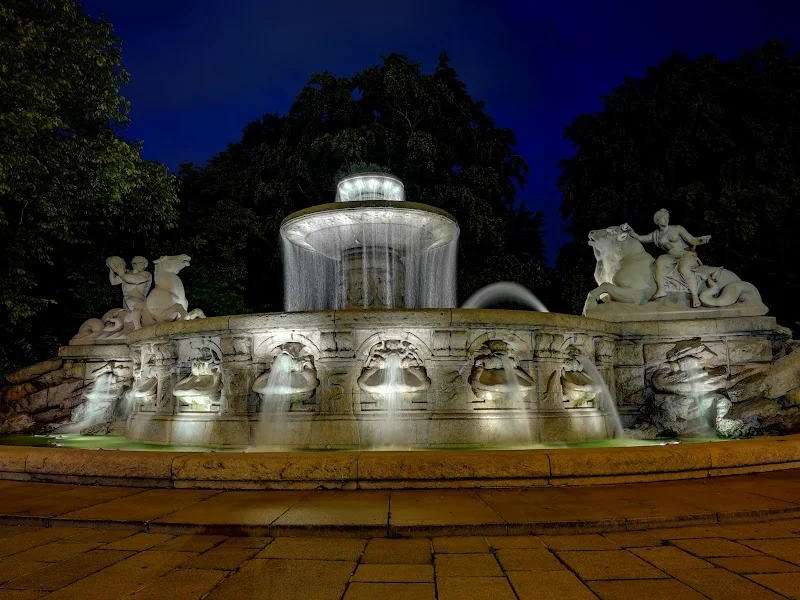
The spatial dimension is also remarkable. MunichArtToGo describes the structure as a 25-meter-wide water basin that bulges towards today's Lenbachplatz. Behind it rises a wall divided into seven fields, into which water spouts are integrated as reliefs. Two pedestals flank the composition, which seems to grow out of seemingly randomly arranged rock fragments. On these pedestals stand the two monumental groups of figures that still form the actual narrative core of the fountain today. Additionally, there is a two-bowl fountain with changing masks and coats of arms on the shaft, which gives the overall work a strong architectural order. This precise structuring explains why the fountain is considered one of Hildebrand's main works and why it is often highlighted in art-historical and urban-historical descriptions. ([municharttogo.zikg.eu](https://municharttogo.zikg.eu/items/show/135))
The imagery of the fountain is also clearly readable. On the left stands the so-called Stone-Thrower, a naked young man on a fish-tailed water horse, holding a rock above his head. On the right sits a young woman on a similarly fish-tailed bull, presenting a water bowl in her outstretched hand. According to sources, the two groups represent the destructive and the creative power of water: the man embodies the wildness of the mountain streams in the Mangfall Valley, while the woman represents the bountiful blessings of tamed water. The fact that this allegory is not only beautiful but also politically and technically readable is one of the special qualities of the fountain. It connects Munich as a city of art with Munich as a city of modern supply and makes the progress of that time visible in a lasting form. ([municharttogo.zikg.eu](https://municharttogo.zikg.eu/items/show/135))
However, the history of the fountain does not end in the 19th century. During the bombing raids on Munich in 1944, the structure was severely damaged; particularly, the Stone-Thrower was almost completely destroyed. In 1950, a working committee was established for the restoration of the Wittelsbacher Fountain, and in 1952, the group of figures was renewed by Theodor Georgii, the son-in-law and student of Adolf von Hildebrand. On October 3, 1952, the fountain resumed operation. The fact that it still appears so vibrant today is also due to this careful restoration. The fountain not only tells of the founding era but also of loss, reconstruction, and the strong desire of Munich to reclaim its distinctive works of art in public space. ([municharttogo.zikg.eu](https://municharttogo.zikg.eu/items/show/135))
Access, Location, and Orientation between Stachus and Odeonsplatz
For visitors, the location of the Wittelsbacher Fountain is one of its greatest advantages. Lenbachplatz is located in the heart of Munich, between the main train station, Stachus, and Odeonsplatz, and is, according to the official city website, an important traffic hub in the city center. Right there stands the fountain as a prominent urban element. The city locates the fountain at Lenbachplatz, while the square itself is characterized by striking buildings such as the New Maxburg, the Munich Artists' House, and the Justice Palace. Therefore, anyone looking for the fountain will not find it in a closed park or in a secluded courtyard but in a very open urban environment that thrives on movement, architecture, and sight lines. ([stadt.muenchen.de](https://stadt.muenchen.de/service/info/wittelsbacher-brunnen/1070668/))
The official fountain page mentions access to the Wittelsbacher Fountain via MVV. This fits well with the specific geography of the location, as Lenbachplatz is characterized by trams and several major traffic routes. For a relaxed visit, traveling by public transport is often the best choice: you get off nearby, walk a few minutes, and stand directly in front of the fountain. The location can also be easily incorporated into a walk, for example, from Karlsplatz, Stachus, or Odeonsplatz. The central position makes the fountain an ideal reference point for exploring the city, where you do not have to plan long routes but can dive directly into Munich's city center. ([stadt.muenchen.de](https://stadt.muenchen.de/service/info/wittelsbacher-brunnen/1070668/))
Regarding parking, restraint is the most honest answer. The official city pages do not mention a dedicated visitor parking area for the fountain but refer to access via MVV. This is plausible given the location at Lenbachplatz, as it is an inner-city junction where traffic space is heavily utilized. However, if you still arrive by car, you should anticipate the usual conditions of Munich's city center in advance and plan the visit more as a short stop rather than a comfortable arrival with guaranteed parking. Practically speaking, this means: tram, S-Bahn, or U-Bahn are usually the more relaxing solution for the Wittelsbacher Fountain, while the car is more sensible if the fountain is only a brief part of a larger city tour. ([stadt.muenchen.de](https://stadt.muenchen.de/service/info/wittelsbacher-brunnen/1070668/))
Orientation at Lenbachplatz is overall very simple because the fountain stands in the open urban space and is not shielded by fences or entrance areas. The official Munich page describes Lenbachplatz as a central square with spectacular buildings, and the municipal fountain overview classifies the Wittelsbacher Fountain as an integral part of this public space. Therefore, anyone visiting the site for the first time should not look for a classic museum entrance but rather for the interplay of square, traffic space, and fountain structure. This is precisely what makes it appealing: the fountain is visible at all times, accessible at all times, and simultaneously so embedded that it forms a harmonious counterpoint to the urban environment. ([muenchen.de](https://www.muenchen.de/sehenswuerdigkeiten/sehenswerte-plaetze/lenbachplatz?utm_source=openai))
Photos, Figures, and Architectural Details
For photos, the Wittelsbacher Fountain is a grateful motif because it combines strong figures, clear lines, and a striking square situation. The two allegorical main groups are particularly photogenic: on the left, the Stone-Thrower as a symbol of destructive water power, and on the right, the Water Bull Rider as an image of creative and bountiful power. This juxtaposition makes the fountain unusually narrative. Unlike many purely decorative fountains, it is not only decorative but can be read like a small sculpture reading. Anyone planning a shot should therefore not only seek the overall picture but also the details of the figure groups, the shaft of the two-bowl fountain, and the reliefs of the wall structure. The official art-historical source also emphasizes that the figures are made of Untersberg marble, which gives the ensemble a bright, noble effect. ([municharttogo.zikg.eu](https://municharttogo.zikg.eu/items/show/135))
The surroundings also contribute significantly to the photographic quality. MunichArtToGo describes back and front views in which the fountain connects with Maximiliansplatz, the New Maxburg, the Artists' House, the Old Stock Exchange, and the Bernheimer House. This creates not only frontal shots of a single monument but also cityscapes in which architecture and fountain engage in dialogue. For this reason, it is worthwhile to change locations while photographing: once from the front from Lenbachplatz, once slightly sideways, once focusing on the figures, and once with a wider view of the square edge. This transforms a monument into a small urban panorama that captures the cultural density of Munich's city center very well. ([municharttogo.zikg.eu](https://municharttogo.zikg.eu/items/show/135))
The construction principle itself is also worth seeing. The 25-meter-wide water structure with its bulging shape, the stepped wall, and the lateral pedestals resembles a stage set transferred outdoors. The inscriptions on the front and back anchor the work both art-historically and city-politically. Additionally, there are water spouts in the form of sea creatures, the masks and coats of arms on the shaft, and the varying readability of the structure depending on the viewing angle. Therefore, anyone looking for photos for social media, a travel blog, or a memory series will find a lot of material in one location: monumental overall view, calm detail shot, architectural context, and city life in the background. This is one of the reasons why search queries for photos of the Wittelsbacher Fountain are so frequent. ([municharttogo.zikg.eu](https://municharttogo.zikg.eu/items/show/135))
Particularly interesting is also the historical photo dimension. MunichArtToGo shows that early images of the fountain exist, including a full view from 1895, which was likely taken on the opening day. Such images make it clear that the fountain was intended from the beginning as a representative focal point. Those photographing today are thus part of a long tradition of viewers who perceive the fountain not only as an object but also as a visual axis, square figure, and urban statement. This continuity gives photos of the Wittelsbacher Fountain a special depth, as they do not merely document a pretty place but make a piece of Munich's cultural history visible. ([municharttogo.zikg.eu](https://municharttogo.zikg.eu/items/show/135))
Maximiliansstrand at the Wittelsbacher Fountain
The fact that search queries around the Wittelsbacher Fountain also include terms like beach or beach bar has a concrete background: The city of Munich announces the Maximiliansstrand at the Wittelsbacher Fountain for 2026. According to the official event page, the format opens from May 1 to September 15, 2026, and offers cool drinks, snacks, and a supporting program. This is interesting for the perception of the place because the fountain thus appears not only as a historical monument but also temporarily as a summer meeting point in the urban space. So, those looking for a lively, almost Mediterranean atmosphere in the city center will indeed find it here - but as a seasonal city event and not as a permanent beach bar. ([muenchen.de](https://www.muenchen.de/en/node/122960?utm_source=openai))
This summer reference also explains why the fountain sometimes gets mixed up with cultural beach or beach bar in search queries. However, the official designation is Maximiliansstrand, and the event is clearly tied to the location of the Wittelsbacher Fountain. This is important for editorial classification: the fountain itself remains a historical artwork, but its surroundings can gain an additional usage level in the warm season. For visitors, this means that the place can be experienced very differently - once as a calm monumental fountain in the urban space, another time as a summer meeting point with an audience, drinks, and events. This versatility makes the central location so attractive. ([muenchen.de](https://www.muenchen.de/en/node/122960?utm_source=openai))
Even without an event program, Lenbachplatz is a place for short breaks. The official Lenbachplatz page describes the square as suitable for a small break during a city stroll and highlights its cultural significance. Additionally, there is the Art Island at Lenbachplatz, where changing public art has been displayed since 2013. Together with the Wittelsbacher Fountain, this creates an environment that is more than just a traffic junction: it is a stage for public art, a place for spontaneous stays, and a very urban location that emphasizes quality of stay even more in summer. This is precisely where the search terms around beach and cultural beach come into play. ([muenchen.de](https://www.muenchen.de/sehenswuerdigkeiten/sehenswerte-plaetze/lenbachplatz?utm_source=openai))
For the visitor's everyday life, this is practical because the fountain can be easily combined with a city stroll. Those coming in summer can photograph the place, linger briefly, and then continue towards Stachus, Marienplatz, or Odeonsplatz depending on their mood. Those coming in winter or in the off-season will experience the same space much quieter and more focused on architecture and fountain art. The Wittelsbacher Fountain is thus a good example of how a historical monument can take on different roles throughout the year without losing its original significance. The official event page for Maximiliansstrand and the municipal square description together show that the place offers both historical substance and modern usage. ([muenchen.de](https://www.muenchen.de/en/node/122960?utm_source=openai))
Wittelsbacher Fountain or Wittelsbacher Fountain in the Residence?
A common reason for search confusion is the name itself. In Munich, there is not only the Wittelsbacher Fountain at Lenbachplatz but also a separately listed Wittelsbacher Fountain in the Residence. The state capital Munich has created its own service pages for both structures: one for the fountain at Lenbachplatz and a second for the Wittelsbacher Fountain (Residence) with the location reference Residenzstraße 1. Therefore, anyone searching for the fountain in the Residence does not mean the same place as the monumental fountain at Lenbachplatz described here. This distinction is important because both fountains are historically and spatially completely different. ([stadt.muenchen.de](https://stadt.muenchen.de/service/info/wittelsbacher-brunnen/1070668/))
The fountain at Lenbachplatz is a work by Adolf von Hildebrand from 1893 to 1895 and was conceived as a memorial to the municipal water supply. The fountain in the Residence, on the other hand, is an older and entirely differently constructed structure in the fountain courtyard of the Residence. The official city service page for the Residence explicitly names the location under Residenzstraße 1, right in the middle of the historic palace complex. Therefore, anyone looking for photos, access, or background information should always pay close attention to the location reference. Especially with search queries like Residence, Munich, or Wittelsbacher Fountain, the clear distinction is crucial to avoid accidentally visiting the wrong fountain or adopting the wrong historical classification. ([municharttogo.zikg.eu](https://municharttogo.zikg.eu/items/show/135))
For editorial texts and SEO, this clarity is particularly valuable because search engines and user intentions often overlap. People frequently enter only part of the name, remember a photo, or search for a general Wittelsbacher reference. This is where the addition at Lenbachplatz helps, as it clearly assigns the destination. The fountain described here stands openly in the urban space, while the Residence fountain is situated in a completely different architectural environment. By separating the two, misunderstandings are avoided, and visitors are provided with the correct path. This is not only semantically clean but also practically helpful. ([stadt.muenchen.de](https://stadt.muenchen.de/service/info/wittelsbacher-brunnen/1070668/))
Additionally, the search landscape around the name Wittelsbacher is very broad: people search for Munich but also for other places with similar names or for photos they have encountered somewhere. Therefore, the exact location reference is particularly important for the Wittelsbacher Fountain at Lenbachplatz. It protects against confusion and simultaneously strengthens the local identity of the monument. From an SEO perspective, this precision brings an advantage: those searching for the fountain at Lenbachplatz receive content that covers the right place, the right history, and the right access. ([stadt.muenchen.de](https://stadt.muenchen.de/service/info/wittelsbacher-brunnen/1070668/))
Around Lenbachplatz: Art, City Walks, and Breaks
The Wittelsbacher Fountain does not function in isolation but as part of a very dense urban fabric. Lenbachplatz is described by the city as a square with spectacular buildings, including the Wittelsbacher Fountain and the New Maxburg. Additionally, the Munich Artists' House and the Art Island at Lenbachplatz, where changing public art has been exhibited since 2013, are located here. This means that anyone visiting the fountain experiences not just a single sight but an entire small cultural zone in the heart of Munich. This neighborhood makes the location attractive for all those who want to combine art, architecture, and urban life in a single walk. ([muenchen.de](https://www.muenchen.de/sehenswuerdigkeiten/sehenswerte-plaetze/lenbachplatz?utm_source=openai))
The official Munich square page also describes Lenbachplatz as a great example of urban planning from the late 19th century. In front of an old group of trees stands one of the most beautiful fountains in Munich, and the square design consciously responds to the large amount of traffic in the vicinity. This explains why the place appears both open and generous on one hand, yet also very clearly and calmly staged on the other. For visitors, this means a pleasant mix of visibility and urban atmosphere: you stand in the middle of Munich and still feel that architecture and art give the square its own order. This contrast is a key reason why the Wittelsbacher Fountain is often described as particularly successful. ([stadt.muenchen.de](https://stadt.muenchen.de/infos/muenchner-plaetze.html?lang=en&utm_source=openai))
As a starting point for a city walk, the location is therefore ideal. From here, the paths towards Karlsplatz, the old town, the art area, or Odeonsplatz can be well planned without the fountain losing significance. The proximity to important axes such as the main train station, Stachus, and Odeonsplatz makes it a logical meeting point for anyone wanting to orient themselves in Munich. Those with little time can choose the fountain as a targeted photo stop; those with more time can combine it with a stroll around Lenbachplatz, a detour to the Art Island, or a break at the edge of the summer format Maximiliansstrand. Thus, a monument becomes a very practical and at the same time culturally highly interesting place. ([muenchen.de](https://www.muenchen.de/sehenswuerdigkeiten/sehenswerte-plaetze/lenbachplatz?utm_source=openai))
The relationship between public space and art is also remarkable here. Munich maintains nearly 700 fountains, 202 of which are under municipal care, and the Wittelsbacher Fountain stands in this tradition. It is not simply a standalone object but part of an entire urban fountain culture that enlivens squares, creates identity, and enhances the quality of stay. Therefore, anyone visiting the Wittelsbacher Fountain also discovers a piece of Munich as a fountain city - with historical depth, good accessibility, and many opportunities to embed the place in different urban experiences. ([stadt.muenchen.de](https://stadt.muenchen.de/infos/brunnen-muenchen.html?utm_source=openai))
Sources:
Show moreShow less
Wittelsbacher Fountain | History & Access
The Wittelsbacher Fountain at Lenbachplatz is one of those places in Munich where art, city history, and everyday life come together in a very natural way. Anyone passing by not only sees a monumental fountain but also a distinctive piece of Munich's identity: a structure that stands at the transition between Lenbachplatz and Maximiliansplatz, is located in the immediate vicinity of important traffic routes, and yet is perceived as a calm, representative eye-catcher. The official city website assigns the fountain to Lenbachplatz, describes the square as a central location between the main train station, Stachus, and Odeonsplatz, and designates it as part of the public cityscape. This mix of prominent location and art-historical significance makes the Wittelsbacher Fountain particularly interesting for visitors who want to explore Munich on foot, take photos, or consciously start a city walk with a striking landmark. ([stadt.muenchen.de](https://stadt.muenchen.de/service/info/wittelsbacher-brunnen/1070668/))
The impact of the fountain arises not only from its size but also from its clear compositional idea. Adolf von Hildebrand created a structure between 1893 and 1895, which was donated by the city of Munich as a reminder of the completion of the water supply from the Mangfall Valley. Thus, the fountain represents not only ornamental beauty but also a municipal infrastructure project with high symbolic power. In official and museum sources, it is described as a monumental fountain, whose design organizes the square space while simultaneously setting an artistic center. Therefore, anyone viewing the fountain today does not simply see a historical decoration but rather an urban statement from the late 19th century, in which representation, technology, and public art were closely intertwined. ([municharttogo.zikg.eu](https://municharttogo.zikg.eu/items/show/135))
This is precisely why the Wittelsbacher Fountain also works excellently as a search term for people looking for a clear destination in Munich's city center: a beautiful photo motif, a conveniently accessible place for a walk, and a monument that can be experienced without admission and without special hurdles. The city explicitly mentions access to the fountain via MVV; given its central location at Lenbachplatz, this is also the most practical recommendation. Those familiar with Munich's city center know that the area around Stachus, Lenbachplatz, and Maximiliansplatz is heavily frequented. Therefore, the fountain is particularly suitable for a conscious stop: stay briefly, observe the figures and water basins, take in the surroundings, and then continue towards the old town, art area, or Odeonsplatz. ([stadt.muenchen.de](https://stadt.muenchen.de/service/info/wittelsbacher-brunnen/1070668/))
History of the Wittelsbacher Fountain at Lenbachplatz
The origin of the Wittelsbacher Fountain begins with a municipal modernization push. After the water supply of Munich was completed in 1883 through pipelines from the Mangfall Valley, the city decided to commemorate this event with a fountain. In 1888, a competition was announced; Adolf von Hildebrand was initially involved as a jury member before eventually winning the commission himself after further detours. Sources describe that he won the competition in late 1890, and the fountain was subsequently executed between 1893 and 1895. For the city, this was not only an art project but also a visible sign that technical infrastructure, civic pride, and artistic form belong together in public space. The inscription on the back of the structure still refers to this occasion and names the city of Munich as the donor. ([municharttogo.zikg.eu](https://municharttogo.zikg.eu/items/show/135))
The spatial dimension is also remarkable. MunichArtToGo describes the structure as a 25-meter-wide water basin that bulges towards today's Lenbachplatz. Behind it rises a wall divided into seven fields, into which water spouts are integrated as reliefs. Two pedestals flank the composition, which seems to grow out of seemingly randomly arranged rock fragments. On these pedestals stand the two monumental groups of figures that still form the actual narrative core of the fountain today. Additionally, there is a two-bowl fountain with changing masks and coats of arms on the shaft, which gives the overall work a strong architectural order. This precise structuring explains why the fountain is considered one of Hildebrand's main works and why it is often highlighted in art-historical and urban-historical descriptions. ([municharttogo.zikg.eu](https://municharttogo.zikg.eu/items/show/135))
The imagery of the fountain is also clearly readable. On the left stands the so-called Stone-Thrower, a naked young man on a fish-tailed water horse, holding a rock above his head. On the right sits a young woman on a similarly fish-tailed bull, presenting a water bowl in her outstretched hand. According to sources, the two groups represent the destructive and the creative power of water: the man embodies the wildness of the mountain streams in the Mangfall Valley, while the woman represents the bountiful blessings of tamed water. The fact that this allegory is not only beautiful but also politically and technically readable is one of the special qualities of the fountain. It connects Munich as a city of art with Munich as a city of modern supply and makes the progress of that time visible in a lasting form. ([municharttogo.zikg.eu](https://municharttogo.zikg.eu/items/show/135))
However, the history of the fountain does not end in the 19th century. During the bombing raids on Munich in 1944, the structure was severely damaged; particularly, the Stone-Thrower was almost completely destroyed. In 1950, a working committee was established for the restoration of the Wittelsbacher Fountain, and in 1952, the group of figures was renewed by Theodor Georgii, the son-in-law and student of Adolf von Hildebrand. On October 3, 1952, the fountain resumed operation. The fact that it still appears so vibrant today is also due to this careful restoration. The fountain not only tells of the founding era but also of loss, reconstruction, and the strong desire of Munich to reclaim its distinctive works of art in public space. ([municharttogo.zikg.eu](https://municharttogo.zikg.eu/items/show/135))
Access, Location, and Orientation between Stachus and Odeonsplatz
For visitors, the location of the Wittelsbacher Fountain is one of its greatest advantages. Lenbachplatz is located in the heart of Munich, between the main train station, Stachus, and Odeonsplatz, and is, according to the official city website, an important traffic hub in the city center. Right there stands the fountain as a prominent urban element. The city locates the fountain at Lenbachplatz, while the square itself is characterized by striking buildings such as the New Maxburg, the Munich Artists' House, and the Justice Palace. Therefore, anyone looking for the fountain will not find it in a closed park or in a secluded courtyard but in a very open urban environment that thrives on movement, architecture, and sight lines. ([stadt.muenchen.de](https://stadt.muenchen.de/service/info/wittelsbacher-brunnen/1070668/))
The official fountain page mentions access to the Wittelsbacher Fountain via MVV. This fits well with the specific geography of the location, as Lenbachplatz is characterized by trams and several major traffic routes. For a relaxed visit, traveling by public transport is often the best choice: you get off nearby, walk a few minutes, and stand directly in front of the fountain. The location can also be easily incorporated into a walk, for example, from Karlsplatz, Stachus, or Odeonsplatz. The central position makes the fountain an ideal reference point for exploring the city, where you do not have to plan long routes but can dive directly into Munich's city center. ([stadt.muenchen.de](https://stadt.muenchen.de/service/info/wittelsbacher-brunnen/1070668/))
Regarding parking, restraint is the most honest answer. The official city pages do not mention a dedicated visitor parking area for the fountain but refer to access via MVV. This is plausible given the location at Lenbachplatz, as it is an inner-city junction where traffic space is heavily utilized. However, if you still arrive by car, you should anticipate the usual conditions of Munich's city center in advance and plan the visit more as a short stop rather than a comfortable arrival with guaranteed parking. Practically speaking, this means: tram, S-Bahn, or U-Bahn are usually the more relaxing solution for the Wittelsbacher Fountain, while the car is more sensible if the fountain is only a brief part of a larger city tour. ([stadt.muenchen.de](https://stadt.muenchen.de/service/info/wittelsbacher-brunnen/1070668/))
Orientation at Lenbachplatz is overall very simple because the fountain stands in the open urban space and is not shielded by fences or entrance areas. The official Munich page describes Lenbachplatz as a central square with spectacular buildings, and the municipal fountain overview classifies the Wittelsbacher Fountain as an integral part of this public space. Therefore, anyone visiting the site for the first time should not look for a classic museum entrance but rather for the interplay of square, traffic space, and fountain structure. This is precisely what makes it appealing: the fountain is visible at all times, accessible at all times, and simultaneously so embedded that it forms a harmonious counterpoint to the urban environment. ([muenchen.de](https://www.muenchen.de/sehenswuerdigkeiten/sehenswerte-plaetze/lenbachplatz?utm_source=openai))
Photos, Figures, and Architectural Details
For photos, the Wittelsbacher Fountain is a grateful motif because it combines strong figures, clear lines, and a striking square situation. The two allegorical main groups are particularly photogenic: on the left, the Stone-Thrower as a symbol of destructive water power, and on the right, the Water Bull Rider as an image of creative and bountiful power. This juxtaposition makes the fountain unusually narrative. Unlike many purely decorative fountains, it is not only decorative but can be read like a small sculpture reading. Anyone planning a shot should therefore not only seek the overall picture but also the details of the figure groups, the shaft of the two-bowl fountain, and the reliefs of the wall structure. The official art-historical source also emphasizes that the figures are made of Untersberg marble, which gives the ensemble a bright, noble effect. ([municharttogo.zikg.eu](https://municharttogo.zikg.eu/items/show/135))
The surroundings also contribute significantly to the photographic quality. MunichArtToGo describes back and front views in which the fountain connects with Maximiliansplatz, the New Maxburg, the Artists' House, the Old Stock Exchange, and the Bernheimer House. This creates not only frontal shots of a single monument but also cityscapes in which architecture and fountain engage in dialogue. For this reason, it is worthwhile to change locations while photographing: once from the front from Lenbachplatz, once slightly sideways, once focusing on the figures, and once with a wider view of the square edge. This transforms a monument into a small urban panorama that captures the cultural density of Munich's city center very well. ([municharttogo.zikg.eu](https://municharttogo.zikg.eu/items/show/135))
The construction principle itself is also worth seeing. The 25-meter-wide water structure with its bulging shape, the stepped wall, and the lateral pedestals resembles a stage set transferred outdoors. The inscriptions on the front and back anchor the work both art-historically and city-politically. Additionally, there are water spouts in the form of sea creatures, the masks and coats of arms on the shaft, and the varying readability of the structure depending on the viewing angle. Therefore, anyone looking for photos for social media, a travel blog, or a memory series will find a lot of material in one location: monumental overall view, calm detail shot, architectural context, and city life in the background. This is one of the reasons why search queries for photos of the Wittelsbacher Fountain are so frequent. ([municharttogo.zikg.eu](https://municharttogo.zikg.eu/items/show/135))
Particularly interesting is also the historical photo dimension. MunichArtToGo shows that early images of the fountain exist, including a full view from 1895, which was likely taken on the opening day. Such images make it clear that the fountain was intended from the beginning as a representative focal point. Those photographing today are thus part of a long tradition of viewers who perceive the fountain not only as an object but also as a visual axis, square figure, and urban statement. This continuity gives photos of the Wittelsbacher Fountain a special depth, as they do not merely document a pretty place but make a piece of Munich's cultural history visible. ([municharttogo.zikg.eu](https://municharttogo.zikg.eu/items/show/135))
Maximiliansstrand at the Wittelsbacher Fountain
The fact that search queries around the Wittelsbacher Fountain also include terms like beach or beach bar has a concrete background: The city of Munich announces the Maximiliansstrand at the Wittelsbacher Fountain for 2026. According to the official event page, the format opens from May 1 to September 15, 2026, and offers cool drinks, snacks, and a supporting program. This is interesting for the perception of the place because the fountain thus appears not only as a historical monument but also temporarily as a summer meeting point in the urban space. So, those looking for a lively, almost Mediterranean atmosphere in the city center will indeed find it here - but as a seasonal city event and not as a permanent beach bar. ([muenchen.de](https://www.muenchen.de/en/node/122960?utm_source=openai))
This summer reference also explains why the fountain sometimes gets mixed up with cultural beach or beach bar in search queries. However, the official designation is Maximiliansstrand, and the event is clearly tied to the location of the Wittelsbacher Fountain. This is important for editorial classification: the fountain itself remains a historical artwork, but its surroundings can gain an additional usage level in the warm season. For visitors, this means that the place can be experienced very differently - once as a calm monumental fountain in the urban space, another time as a summer meeting point with an audience, drinks, and events. This versatility makes the central location so attractive. ([muenchen.de](https://www.muenchen.de/en/node/122960?utm_source=openai))
Even without an event program, Lenbachplatz is a place for short breaks. The official Lenbachplatz page describes the square as suitable for a small break during a city stroll and highlights its cultural significance. Additionally, there is the Art Island at Lenbachplatz, where changing public art has been displayed since 2013. Together with the Wittelsbacher Fountain, this creates an environment that is more than just a traffic junction: it is a stage for public art, a place for spontaneous stays, and a very urban location that emphasizes quality of stay even more in summer. This is precisely where the search terms around beach and cultural beach come into play. ([muenchen.de](https://www.muenchen.de/sehenswuerdigkeiten/sehenswerte-plaetze/lenbachplatz?utm_source=openai))
For the visitor's everyday life, this is practical because the fountain can be easily combined with a city stroll. Those coming in summer can photograph the place, linger briefly, and then continue towards Stachus, Marienplatz, or Odeonsplatz depending on their mood. Those coming in winter or in the off-season will experience the same space much quieter and more focused on architecture and fountain art. The Wittelsbacher Fountain is thus a good example of how a historical monument can take on different roles throughout the year without losing its original significance. The official event page for Maximiliansstrand and the municipal square description together show that the place offers both historical substance and modern usage. ([muenchen.de](https://www.muenchen.de/en/node/122960?utm_source=openai))
Wittelsbacher Fountain or Wittelsbacher Fountain in the Residence?
A common reason for search confusion is the name itself. In Munich, there is not only the Wittelsbacher Fountain at Lenbachplatz but also a separately listed Wittelsbacher Fountain in the Residence. The state capital Munich has created its own service pages for both structures: one for the fountain at Lenbachplatz and a second for the Wittelsbacher Fountain (Residence) with the location reference Residenzstraße 1. Therefore, anyone searching for the fountain in the Residence does not mean the same place as the monumental fountain at Lenbachplatz described here. This distinction is important because both fountains are historically and spatially completely different. ([stadt.muenchen.de](https://stadt.muenchen.de/service/info/wittelsbacher-brunnen/1070668/))
The fountain at Lenbachplatz is a work by Adolf von Hildebrand from 1893 to 1895 and was conceived as a memorial to the municipal water supply. The fountain in the Residence, on the other hand, is an older and entirely differently constructed structure in the fountain courtyard of the Residence. The official city service page for the Residence explicitly names the location under Residenzstraße 1, right in the middle of the historic palace complex. Therefore, anyone looking for photos, access, or background information should always pay close attention to the location reference. Especially with search queries like Residence, Munich, or Wittelsbacher Fountain, the clear distinction is crucial to avoid accidentally visiting the wrong fountain or adopting the wrong historical classification. ([municharttogo.zikg.eu](https://municharttogo.zikg.eu/items/show/135))
For editorial texts and SEO, this clarity is particularly valuable because search engines and user intentions often overlap. People frequently enter only part of the name, remember a photo, or search for a general Wittelsbacher reference. This is where the addition at Lenbachplatz helps, as it clearly assigns the destination. The fountain described here stands openly in the urban space, while the Residence fountain is situated in a completely different architectural environment. By separating the two, misunderstandings are avoided, and visitors are provided with the correct path. This is not only semantically clean but also practically helpful. ([stadt.muenchen.de](https://stadt.muenchen.de/service/info/wittelsbacher-brunnen/1070668/))
Additionally, the search landscape around the name Wittelsbacher is very broad: people search for Munich but also for other places with similar names or for photos they have encountered somewhere. Therefore, the exact location reference is particularly important for the Wittelsbacher Fountain at Lenbachplatz. It protects against confusion and simultaneously strengthens the local identity of the monument. From an SEO perspective, this precision brings an advantage: those searching for the fountain at Lenbachplatz receive content that covers the right place, the right history, and the right access. ([stadt.muenchen.de](https://stadt.muenchen.de/service/info/wittelsbacher-brunnen/1070668/))
Around Lenbachplatz: Art, City Walks, and Breaks
The Wittelsbacher Fountain does not function in isolation but as part of a very dense urban fabric. Lenbachplatz is described by the city as a square with spectacular buildings, including the Wittelsbacher Fountain and the New Maxburg. Additionally, the Munich Artists' House and the Art Island at Lenbachplatz, where changing public art has been exhibited since 2013, are located here. This means that anyone visiting the fountain experiences not just a single sight but an entire small cultural zone in the heart of Munich. This neighborhood makes the location attractive for all those who want to combine art, architecture, and urban life in a single walk. ([muenchen.de](https://www.muenchen.de/sehenswuerdigkeiten/sehenswerte-plaetze/lenbachplatz?utm_source=openai))
The official Munich square page also describes Lenbachplatz as a great example of urban planning from the late 19th century. In front of an old group of trees stands one of the most beautiful fountains in Munich, and the square design consciously responds to the large amount of traffic in the vicinity. This explains why the place appears both open and generous on one hand, yet also very clearly and calmly staged on the other. For visitors, this means a pleasant mix of visibility and urban atmosphere: you stand in the middle of Munich and still feel that architecture and art give the square its own order. This contrast is a key reason why the Wittelsbacher Fountain is often described as particularly successful. ([stadt.muenchen.de](https://stadt.muenchen.de/infos/muenchner-plaetze.html?lang=en&utm_source=openai))
As a starting point for a city walk, the location is therefore ideal. From here, the paths towards Karlsplatz, the old town, the art area, or Odeonsplatz can be well planned without the fountain losing significance. The proximity to important axes such as the main train station, Stachus, and Odeonsplatz makes it a logical meeting point for anyone wanting to orient themselves in Munich. Those with little time can choose the fountain as a targeted photo stop; those with more time can combine it with a stroll around Lenbachplatz, a detour to the Art Island, or a break at the edge of the summer format Maximiliansstrand. Thus, a monument becomes a very practical and at the same time culturally highly interesting place. ([muenchen.de](https://www.muenchen.de/sehenswuerdigkeiten/sehenswerte-plaetze/lenbachplatz?utm_source=openai))
The relationship between public space and art is also remarkable here. Munich maintains nearly 700 fountains, 202 of which are under municipal care, and the Wittelsbacher Fountain stands in this tradition. It is not simply a standalone object but part of an entire urban fountain culture that enlivens squares, creates identity, and enhances the quality of stay. Therefore, anyone visiting the Wittelsbacher Fountain also discovers a piece of Munich as a fountain city - with historical depth, good accessibility, and many opportunities to embed the place in different urban experiences. ([stadt.muenchen.de](https://stadt.muenchen.de/infos/brunnen-muenchen.html?utm_source=openai))
Sources:
Wittelsbacher Fountain | History & Access
The Wittelsbacher Fountain at Lenbachplatz is one of those places in Munich where art, city history, and everyday life come together in a very natural way. Anyone passing by not only sees a monumental fountain but also a distinctive piece of Munich's identity: a structure that stands at the transition between Lenbachplatz and Maximiliansplatz, is located in the immediate vicinity of important traffic routes, and yet is perceived as a calm, representative eye-catcher. The official city website assigns the fountain to Lenbachplatz, describes the square as a central location between the main train station, Stachus, and Odeonsplatz, and designates it as part of the public cityscape. This mix of prominent location and art-historical significance makes the Wittelsbacher Fountain particularly interesting for visitors who want to explore Munich on foot, take photos, or consciously start a city walk with a striking landmark. ([stadt.muenchen.de](https://stadt.muenchen.de/service/info/wittelsbacher-brunnen/1070668/))
The impact of the fountain arises not only from its size but also from its clear compositional idea. Adolf von Hildebrand created a structure between 1893 and 1895, which was donated by the city of Munich as a reminder of the completion of the water supply from the Mangfall Valley. Thus, the fountain represents not only ornamental beauty but also a municipal infrastructure project with high symbolic power. In official and museum sources, it is described as a monumental fountain, whose design organizes the square space while simultaneously setting an artistic center. Therefore, anyone viewing the fountain today does not simply see a historical decoration but rather an urban statement from the late 19th century, in which representation, technology, and public art were closely intertwined. ([municharttogo.zikg.eu](https://municharttogo.zikg.eu/items/show/135))
This is precisely why the Wittelsbacher Fountain also works excellently as a search term for people looking for a clear destination in Munich's city center: a beautiful photo motif, a conveniently accessible place for a walk, and a monument that can be experienced without admission and without special hurdles. The city explicitly mentions access to the fountain via MVV; given its central location at Lenbachplatz, this is also the most practical recommendation. Those familiar with Munich's city center know that the area around Stachus, Lenbachplatz, and Maximiliansplatz is heavily frequented. Therefore, the fountain is particularly suitable for a conscious stop: stay briefly, observe the figures and water basins, take in the surroundings, and then continue towards the old town, art area, or Odeonsplatz. ([stadt.muenchen.de](https://stadt.muenchen.de/service/info/wittelsbacher-brunnen/1070668/))
History of the Wittelsbacher Fountain at Lenbachplatz
The origin of the Wittelsbacher Fountain begins with a municipal modernization push. After the water supply of Munich was completed in 1883 through pipelines from the Mangfall Valley, the city decided to commemorate this event with a fountain. In 1888, a competition was announced; Adolf von Hildebrand was initially involved as a jury member before eventually winning the commission himself after further detours. Sources describe that he won the competition in late 1890, and the fountain was subsequently executed between 1893 and 1895. For the city, this was not only an art project but also a visible sign that technical infrastructure, civic pride, and artistic form belong together in public space. The inscription on the back of the structure still refers to this occasion and names the city of Munich as the donor. ([municharttogo.zikg.eu](https://municharttogo.zikg.eu/items/show/135))
The spatial dimension is also remarkable. MunichArtToGo describes the structure as a 25-meter-wide water basin that bulges towards today's Lenbachplatz. Behind it rises a wall divided into seven fields, into which water spouts are integrated as reliefs. Two pedestals flank the composition, which seems to grow out of seemingly randomly arranged rock fragments. On these pedestals stand the two monumental groups of figures that still form the actual narrative core of the fountain today. Additionally, there is a two-bowl fountain with changing masks and coats of arms on the shaft, which gives the overall work a strong architectural order. This precise structuring explains why the fountain is considered one of Hildebrand's main works and why it is often highlighted in art-historical and urban-historical descriptions. ([municharttogo.zikg.eu](https://municharttogo.zikg.eu/items/show/135))
The imagery of the fountain is also clearly readable. On the left stands the so-called Stone-Thrower, a naked young man on a fish-tailed water horse, holding a rock above his head. On the right sits a young woman on a similarly fish-tailed bull, presenting a water bowl in her outstretched hand. According to sources, the two groups represent the destructive and the creative power of water: the man embodies the wildness of the mountain streams in the Mangfall Valley, while the woman represents the bountiful blessings of tamed water. The fact that this allegory is not only beautiful but also politically and technically readable is one of the special qualities of the fountain. It connects Munich as a city of art with Munich as a city of modern supply and makes the progress of that time visible in a lasting form. ([municharttogo.zikg.eu](https://municharttogo.zikg.eu/items/show/135))
However, the history of the fountain does not end in the 19th century. During the bombing raids on Munich in 1944, the structure was severely damaged; particularly, the Stone-Thrower was almost completely destroyed. In 1950, a working committee was established for the restoration of the Wittelsbacher Fountain, and in 1952, the group of figures was renewed by Theodor Georgii, the son-in-law and student of Adolf von Hildebrand. On October 3, 1952, the fountain resumed operation. The fact that it still appears so vibrant today is also due to this careful restoration. The fountain not only tells of the founding era but also of loss, reconstruction, and the strong desire of Munich to reclaim its distinctive works of art in public space. ([municharttogo.zikg.eu](https://municharttogo.zikg.eu/items/show/135))
Access, Location, and Orientation between Stachus and Odeonsplatz
For visitors, the location of the Wittelsbacher Fountain is one of its greatest advantages. Lenbachplatz is located in the heart of Munich, between the main train station, Stachus, and Odeonsplatz, and is, according to the official city website, an important traffic hub in the city center. Right there stands the fountain as a prominent urban element. The city locates the fountain at Lenbachplatz, while the square itself is characterized by striking buildings such as the New Maxburg, the Munich Artists' House, and the Justice Palace. Therefore, anyone looking for the fountain will not find it in a closed park or in a secluded courtyard but in a very open urban environment that thrives on movement, architecture, and sight lines. ([stadt.muenchen.de](https://stadt.muenchen.de/service/info/wittelsbacher-brunnen/1070668/))
The official fountain page mentions access to the Wittelsbacher Fountain via MVV. This fits well with the specific geography of the location, as Lenbachplatz is characterized by trams and several major traffic routes. For a relaxed visit, traveling by public transport is often the best choice: you get off nearby, walk a few minutes, and stand directly in front of the fountain. The location can also be easily incorporated into a walk, for example, from Karlsplatz, Stachus, or Odeonsplatz. The central position makes the fountain an ideal reference point for exploring the city, where you do not have to plan long routes but can dive directly into Munich's city center. ([stadt.muenchen.de](https://stadt.muenchen.de/service/info/wittelsbacher-brunnen/1070668/))
Regarding parking, restraint is the most honest answer. The official city pages do not mention a dedicated visitor parking area for the fountain but refer to access via MVV. This is plausible given the location at Lenbachplatz, as it is an inner-city junction where traffic space is heavily utilized. However, if you still arrive by car, you should anticipate the usual conditions of Munich's city center in advance and plan the visit more as a short stop rather than a comfortable arrival with guaranteed parking. Practically speaking, this means: tram, S-Bahn, or U-Bahn are usually the more relaxing solution for the Wittelsbacher Fountain, while the car is more sensible if the fountain is only a brief part of a larger city tour. ([stadt.muenchen.de](https://stadt.muenchen.de/service/info/wittelsbacher-brunnen/1070668/))
Orientation at Lenbachplatz is overall very simple because the fountain stands in the open urban space and is not shielded by fences or entrance areas. The official Munich page describes Lenbachplatz as a central square with spectacular buildings, and the municipal fountain overview classifies the Wittelsbacher Fountain as an integral part of this public space. Therefore, anyone visiting the site for the first time should not look for a classic museum entrance but rather for the interplay of square, traffic space, and fountain structure. This is precisely what makes it appealing: the fountain is visible at all times, accessible at all times, and simultaneously so embedded that it forms a harmonious counterpoint to the urban environment. ([muenchen.de](https://www.muenchen.de/sehenswuerdigkeiten/sehenswerte-plaetze/lenbachplatz?utm_source=openai))
Photos, Figures, and Architectural Details
For photos, the Wittelsbacher Fountain is a grateful motif because it combines strong figures, clear lines, and a striking square situation. The two allegorical main groups are particularly photogenic: on the left, the Stone-Thrower as a symbol of destructive water power, and on the right, the Water Bull Rider as an image of creative and bountiful power. This juxtaposition makes the fountain unusually narrative. Unlike many purely decorative fountains, it is not only decorative but can be read like a small sculpture reading. Anyone planning a shot should therefore not only seek the overall picture but also the details of the figure groups, the shaft of the two-bowl fountain, and the reliefs of the wall structure. The official art-historical source also emphasizes that the figures are made of Untersberg marble, which gives the ensemble a bright, noble effect. ([municharttogo.zikg.eu](https://municharttogo.zikg.eu/items/show/135))
The surroundings also contribute significantly to the photographic quality. MunichArtToGo describes back and front views in which the fountain connects with Maximiliansplatz, the New Maxburg, the Artists' House, the Old Stock Exchange, and the Bernheimer House. This creates not only frontal shots of a single monument but also cityscapes in which architecture and fountain engage in dialogue. For this reason, it is worthwhile to change locations while photographing: once from the front from Lenbachplatz, once slightly sideways, once focusing on the figures, and once with a wider view of the square edge. This transforms a monument into a small urban panorama that captures the cultural density of Munich's city center very well. ([municharttogo.zikg.eu](https://municharttogo.zikg.eu/items/show/135))
The construction principle itself is also worth seeing. The 25-meter-wide water structure with its bulging shape, the stepped wall, and the lateral pedestals resembles a stage set transferred outdoors. The inscriptions on the front and back anchor the work both art-historically and city-politically. Additionally, there are water spouts in the form of sea creatures, the masks and coats of arms on the shaft, and the varying readability of the structure depending on the viewing angle. Therefore, anyone looking for photos for social media, a travel blog, or a memory series will find a lot of material in one location: monumental overall view, calm detail shot, architectural context, and city life in the background. This is one of the reasons why search queries for photos of the Wittelsbacher Fountain are so frequent. ([municharttogo.zikg.eu](https://municharttogo.zikg.eu/items/show/135))
Particularly interesting is also the historical photo dimension. MunichArtToGo shows that early images of the fountain exist, including a full view from 1895, which was likely taken on the opening day. Such images make it clear that the fountain was intended from the beginning as a representative focal point. Those photographing today are thus part of a long tradition of viewers who perceive the fountain not only as an object but also as a visual axis, square figure, and urban statement. This continuity gives photos of the Wittelsbacher Fountain a special depth, as they do not merely document a pretty place but make a piece of Munich's cultural history visible. ([municharttogo.zikg.eu](https://municharttogo.zikg.eu/items/show/135))
Maximiliansstrand at the Wittelsbacher Fountain
The fact that search queries around the Wittelsbacher Fountain also include terms like beach or beach bar has a concrete background: The city of Munich announces the Maximiliansstrand at the Wittelsbacher Fountain for 2026. According to the official event page, the format opens from May 1 to September 15, 2026, and offers cool drinks, snacks, and a supporting program. This is interesting for the perception of the place because the fountain thus appears not only as a historical monument but also temporarily as a summer meeting point in the urban space. So, those looking for a lively, almost Mediterranean atmosphere in the city center will indeed find it here - but as a seasonal city event and not as a permanent beach bar. ([muenchen.de](https://www.muenchen.de/en/node/122960?utm_source=openai))
This summer reference also explains why the fountain sometimes gets mixed up with cultural beach or beach bar in search queries. However, the official designation is Maximiliansstrand, and the event is clearly tied to the location of the Wittelsbacher Fountain. This is important for editorial classification: the fountain itself remains a historical artwork, but its surroundings can gain an additional usage level in the warm season. For visitors, this means that the place can be experienced very differently - once as a calm monumental fountain in the urban space, another time as a summer meeting point with an audience, drinks, and events. This versatility makes the central location so attractive. ([muenchen.de](https://www.muenchen.de/en/node/122960?utm_source=openai))
Even without an event program, Lenbachplatz is a place for short breaks. The official Lenbachplatz page describes the square as suitable for a small break during a city stroll and highlights its cultural significance. Additionally, there is the Art Island at Lenbachplatz, where changing public art has been displayed since 2013. Together with the Wittelsbacher Fountain, this creates an environment that is more than just a traffic junction: it is a stage for public art, a place for spontaneous stays, and a very urban location that emphasizes quality of stay even more in summer. This is precisely where the search terms around beach and cultural beach come into play. ([muenchen.de](https://www.muenchen.de/sehenswuerdigkeiten/sehenswerte-plaetze/lenbachplatz?utm_source=openai))
For the visitor's everyday life, this is practical because the fountain can be easily combined with a city stroll. Those coming in summer can photograph the place, linger briefly, and then continue towards Stachus, Marienplatz, or Odeonsplatz depending on their mood. Those coming in winter or in the off-season will experience the same space much quieter and more focused on architecture and fountain art. The Wittelsbacher Fountain is thus a good example of how a historical monument can take on different roles throughout the year without losing its original significance. The official event page for Maximiliansstrand and the municipal square description together show that the place offers both historical substance and modern usage. ([muenchen.de](https://www.muenchen.de/en/node/122960?utm_source=openai))
Wittelsbacher Fountain or Wittelsbacher Fountain in the Residence?
A common reason for search confusion is the name itself. In Munich, there is not only the Wittelsbacher Fountain at Lenbachplatz but also a separately listed Wittelsbacher Fountain in the Residence. The state capital Munich has created its own service pages for both structures: one for the fountain at Lenbachplatz and a second for the Wittelsbacher Fountain (Residence) with the location reference Residenzstraße 1. Therefore, anyone searching for the fountain in the Residence does not mean the same place as the monumental fountain at Lenbachplatz described here. This distinction is important because both fountains are historically and spatially completely different. ([stadt.muenchen.de](https://stadt.muenchen.de/service/info/wittelsbacher-brunnen/1070668/))
The fountain at Lenbachplatz is a work by Adolf von Hildebrand from 1893 to 1895 and was conceived as a memorial to the municipal water supply. The fountain in the Residence, on the other hand, is an older and entirely differently constructed structure in the fountain courtyard of the Residence. The official city service page for the Residence explicitly names the location under Residenzstraße 1, right in the middle of the historic palace complex. Therefore, anyone looking for photos, access, or background information should always pay close attention to the location reference. Especially with search queries like Residence, Munich, or Wittelsbacher Fountain, the clear distinction is crucial to avoid accidentally visiting the wrong fountain or adopting the wrong historical classification. ([municharttogo.zikg.eu](https://municharttogo.zikg.eu/items/show/135))
For editorial texts and SEO, this clarity is particularly valuable because search engines and user intentions often overlap. People frequently enter only part of the name, remember a photo, or search for a general Wittelsbacher reference. This is where the addition at Lenbachplatz helps, as it clearly assigns the destination. The fountain described here stands openly in the urban space, while the Residence fountain is situated in a completely different architectural environment. By separating the two, misunderstandings are avoided, and visitors are provided with the correct path. This is not only semantically clean but also practically helpful. ([stadt.muenchen.de](https://stadt.muenchen.de/service/info/wittelsbacher-brunnen/1070668/))
Additionally, the search landscape around the name Wittelsbacher is very broad: people search for Munich but also for other places with similar names or for photos they have encountered somewhere. Therefore, the exact location reference is particularly important for the Wittelsbacher Fountain at Lenbachplatz. It protects against confusion and simultaneously strengthens the local identity of the monument. From an SEO perspective, this precision brings an advantage: those searching for the fountain at Lenbachplatz receive content that covers the right place, the right history, and the right access. ([stadt.muenchen.de](https://stadt.muenchen.de/service/info/wittelsbacher-brunnen/1070668/))
Around Lenbachplatz: Art, City Walks, and Breaks
The Wittelsbacher Fountain does not function in isolation but as part of a very dense urban fabric. Lenbachplatz is described by the city as a square with spectacular buildings, including the Wittelsbacher Fountain and the New Maxburg. Additionally, the Munich Artists' House and the Art Island at Lenbachplatz, where changing public art has been exhibited since 2013, are located here. This means that anyone visiting the fountain experiences not just a single sight but an entire small cultural zone in the heart of Munich. This neighborhood makes the location attractive for all those who want to combine art, architecture, and urban life in a single walk. ([muenchen.de](https://www.muenchen.de/sehenswuerdigkeiten/sehenswerte-plaetze/lenbachplatz?utm_source=openai))
The official Munich square page also describes Lenbachplatz as a great example of urban planning from the late 19th century. In front of an old group of trees stands one of the most beautiful fountains in Munich, and the square design consciously responds to the large amount of traffic in the vicinity. This explains why the place appears both open and generous on one hand, yet also very clearly and calmly staged on the other. For visitors, this means a pleasant mix of visibility and urban atmosphere: you stand in the middle of Munich and still feel that architecture and art give the square its own order. This contrast is a key reason why the Wittelsbacher Fountain is often described as particularly successful. ([stadt.muenchen.de](https://stadt.muenchen.de/infos/muenchner-plaetze.html?lang=en&utm_source=openai))
As a starting point for a city walk, the location is therefore ideal. From here, the paths towards Karlsplatz, the old town, the art area, or Odeonsplatz can be well planned without the fountain losing significance. The proximity to important axes such as the main train station, Stachus, and Odeonsplatz makes it a logical meeting point for anyone wanting to orient themselves in Munich. Those with little time can choose the fountain as a targeted photo stop; those with more time can combine it with a stroll around Lenbachplatz, a detour to the Art Island, or a break at the edge of the summer format Maximiliansstrand. Thus, a monument becomes a very practical and at the same time culturally highly interesting place. ([muenchen.de](https://www.muenchen.de/sehenswuerdigkeiten/sehenswerte-plaetze/lenbachplatz?utm_source=openai))
The relationship between public space and art is also remarkable here. Munich maintains nearly 700 fountains, 202 of which are under municipal care, and the Wittelsbacher Fountain stands in this tradition. It is not simply a standalone object but part of an entire urban fountain culture that enlivens squares, creates identity, and enhances the quality of stay. Therefore, anyone visiting the Wittelsbacher Fountain also discovers a piece of Munich as a fountain city - with historical depth, good accessibility, and many opportunities to embed the place in different urban experiences. ([stadt.muenchen.de](https://stadt.muenchen.de/infos/brunnen-muenchen.html?utm_source=openai))
Sources:
Upcoming Events
No events found
Frequently Asked Questions
Reviews
Praneeth Peiris
21. September 2019
Very calm place right next to a park. I've seen people sitting next to it and study and read. Even though I don't know much about the story/history behind it, these statues and the fountain are very attractive. It's worth paying a visit and spending some time there if you visit Munich.
Day Dreamer
27. May 2024
Maximiliansplatz boasts a charming and impressive fountain. Its beautiful architecture and sculptures showcase magnificent stonework. Two figures, one riding a bull and the other a horse, both offer water jars. It's definitely worth a visit and a great place to relax while exploring Munich.
Інна Петрук
22. August 2024
Nice place. We accidentally found ourselves at a Latin dancing party in the middle of Germany. It was unexpected and beautiful. It has a really beach vibe. The party is here every Tuesday if you ask.
david antoun
29. May 2023
Beautiful monument with magnificent stone architecture. Including two human beings giving water jars while riding a bull and horse.
macedonboy
2. June 2019
Located at the western end of Maximiliansplatz is this landmark fountain of the city. This beautiful, monumental fountain was built to commemorate the construction of Munich's water supply system and named for the House of Wittelsbach, who ruled over Bavaria for more than seven centuries. The centerpiece of the fountain is two central bowls, arranged with the smaller over the larger where the water cascades from a central bowl into a large bowl below. The central fountain is flanked by two marble statues, of a man and a woman, both riding seahorses. Allegorical figures representing the benefits and destructive natures of water.