
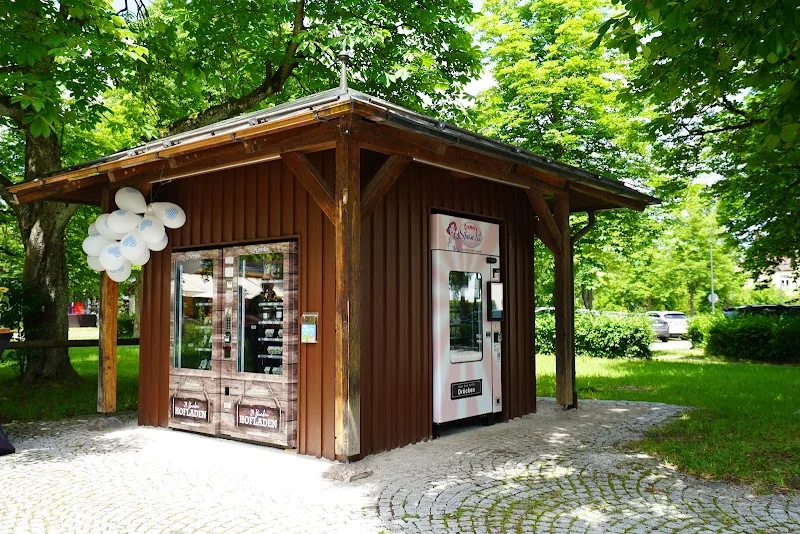
Kreuzeckstraße 22, Pullach im Isartal
Kreuzeckstraße 22, 82049 Pullach im Isartal, Germany
Wöllnerplatz Pullach | S-Bahn & Parking
The Wöllnerplatz is a conveniently located hub in the Pullach district of Großhesselohe: Just a few steps from the S-Bahn stop Großhesselohe Isartalbahnhof, it consolidates short routes for commuters, families, and neighbors. Right at the square, there is a public P+R parking lot for switching to the S-Bahn, as well as a community-managed playground for the youngest visitors. Within walking distance, a 24/7 harvest box with regional products and dining options in the train station area complement daily needs. The square is named after the Wöllner family, whose commitment to the development of Großhesselohe is historically documented. Visitors to the Wöllnerplatz will find a very practical, well-connected address between residential areas and mobility hubs – with reliable services on-site, clear orientation through municipal notice boards, and short distances for errands, daycare or school routes, as well as a relaxed start to excursions by train.
Access, S-Bahn and Parking at Wöllnerplatz in Pullach
Getting to Wöllnerplatz is straightforward, as the square is directly at the S-Bahn station Großhesselohe Isartalbahnhof. This station is served by the S-Bahn line S7, which connects Pullach with Munich Central Station on one side and Wolfratshausen on the other. The regular schedule of the S7 is particularly attractive for everyday trips, commuting, and leisure; the few minutes' walk from the platform to Wöllnerplatz allows for a comfortable, weather-independent transfer. For those arriving by car, there is a public P+R parking lot right at the square. These parking spaces are primarily intended for S-Bahn users who wish to park their vehicles during the day and complete the last stretch using public transport. Due to the location at the square, the distances are short; signage on-site provides information on usage. The municipality also points out the advantages of the P+R location at Wöllnerplatz in the context of newly planned facilities in the neighborhood, which enhances accessibility. The proximity of the parking lot to the S-Bahn and the residential area also helps to ease traffic during drop-off and pick-up situations that occur in the morning or afternoon. Those traveling without a car also benefit from the surroundings: The walking paths are short and run along the train station area, with signs aiding orientation. For a broader perspective, it is worthwhile to check the line network and any construction notices from S-Bahn Munich; construction-related schedule adjustments usually affect only specific periods and are announced in advance by the operator. For everyday practice: Wöllnerplatz is ideal for transferring to the S7, the P+R spaces facilitate parking on the outskirts of Munich, and the good integration into the residential environment makes the square a convenient meeting point for quick errands and appointments before the train ride.
Playground at Wöllnerplatz: Sand Area, Shade, and Family Comfort
For families, the playground at Wöllnerplatz is one of the reliable addresses in the neighborhood. It is primarily aimed at toddlers and preschool-aged children or early elementary school-aged children. Characteristic features include a large sand area and a shaded combination for small children, providing protection on warm days and enabling age-appropriate play. The municipality has organized the upgrading of its playgrounds throughout the area in stages and has specified concrete timelines; a revision for the playground at Wöllnerplatz was announced for November 2024. Such measures aim to modernize play equipment, improve fall protection and quality of stay, and continuously consider the needs of young families in the growing municipality. Because the playground is directly adjacent to the square and train station area, it is easily accessible: Those bringing children by S-Bahn or picking them up in the afternoon can easily combine their stay at the playground with everyday routes. Benches are available for accompanying persons, and the proximity to the residential area facilitates eye contact when siblings come to the square independently. The connection to the P+R area is also practical, as short stays can be well planned with the parking duration. Notices from the municipality regarding temporary closures during renovations are publicly announced; therefore, it is advisable to check current announcements before visiting. The location at Wöllnerplatz thus fulfills a dual function: it is a play area for the youngest – clear and convenient – and at the same time a meeting point for parents, grandparents, and caregivers, who can easily engage in conversation here. Due to its location in the train station area, the playground also serves as a small “green island” in everyday traffic, without the need for long distances. Those traveling with strollers benefit from the level paths around the square; one should be prepared for peak times – such as late afternoons – when many families are coming from school or daycare.
Shopping and Dining around Wöllnerplatz: Harvest Box and Neighborhood Dining
A special advantage in the immediate vicinity is the 24/7 harvest box in the train station area, accessible via Kreuzeckstraße. The farm shop vending machine offers regional products and is a practical complement to fixed store hours. Those who leave early in the morning or return late at night can conveniently purchase fresh produce – such as eggs from the region – here. The positioning “opposite the S-Bahn” makes the harvest box a classic stop on the go: The path from the platform to the parking lot or into the residential area leads right past it. In addition, the neighborhood offers dining options, including the Isartaler Brauhaus, located on Kreuzeckstraße, which provides Bavarian pub cuisine and generous opening hours, making it a reliable address for lunch, dinner, or a cozy stop after commuting. In the train station area itself, temporary gastronomic concepts are promoted, which enliven the historical train station area and provide additional quality of stay. Taken together, this means: At Wöllnerplatz and in its immediate surroundings, small shopping as well as spontaneous dining can be done – without detours and with short distances between platform, square, and parking. For people who consciously consume regionally, the harvest box is a significant added value: it connects the mobility offer of the S-Bahn with the direct marketing of local producers. In practice, this means: Those who park their car at the P+R in the morning can still take fresh products on the way back or meet family and friends at the pub – without additional travel effort. The combination of accessibility and offerings is also interesting for cyclists: The square is at the transition to the residential area, bicycles can be parked easily, and paths remain clear. It is also worth checking the notices and information on the notice boards, which can announce small markets or exchange actions, as small neighborhood formats regularly take place at the square.
History and Namesake: The Wöllner Family and Großhesselohe
The name of Wöllnerplatz refers to the Rhineland entrepreneurial family Wöllner, who acquired the estate of Großhesselohe in 1919. During the interwar period, the family sought agricultural revitalization, which, however, was not crowned with lasting success. Subsequently, Fritz Wöllner (1890–1964) continued the subdivision and sale of estate land from 1925, significantly contributing to the development of Großhesselohe into a villa colony. For his commitment, the municipality awarded him honorary citizenship on April 28, 1960. This historical context explains why the square is now present as an identity-forming place in the train station area: it stands for the urban transformation from estate to developed residential area and marks a functional focus where mobility, local supply, and neighborhood come together. The district of Großhesselohe itself is historically shaped by the Isartalbahn; the current S-Bahn line S7 follows the route of the former railway line between Großhesselohe Isartalbahnhof and Wolfratshausen. Those interested in railway history will find references to the long tradition of rail transport in Pullach in the train station area. The connection between historical naming and modern everyday use makes Wöllnerplatz special: it is not a representative square in the classical sense, but a place with concrete functions for daily routines – parking, transferring, picking up, small errands – while also keeping the history of the district visible. The editorially prepared street name portraits serve as a reliable source for orientation in the street name cosmos of the municipality; they document the backgrounds and contextualize the biographies of the namesakes. This makes it understandable how Wöllnerplatz got its name, what developmental steps Großhesselohe underwent, and why the train station area is the appropriate stage for this name.
Orientation, Notice Boards, and Small Events at the Square
Since many paths converge at Wöllnerplatz, clear information on-site is important. The municipality operates notice boards at the square on the front and back, where official announcements, club, and institutional information are posted. In the lead-up to elections, areas for posters are also designated; Wöllnerplatz serves as a location for this as well. The boards are a point of contact for anyone wanting to quickly inform themselves about local events, dates, and notices. In the past, small formats such as exchange and plant fairs have repeatedly taken place at Wöllnerplatz, promoting neighborly interaction and enlivening the square beyond its everyday function. Such micro-events are deliberately designed to be low-threshold: Those who have something to give bring it along; those who are looking for something will find it – without a large organizational framework. For visitors, it is important: Since the square is located close to the S-Bahn, such appointments can be combined with the commute. For people arriving by car, the parking spaces at the P+R are available; it is important to observe any short-term regulations. The notice boards provide early warnings of upcoming closures of sections, such as when the playground is being modernized or a section is being maintained. The flow of information through municipal channels ensures that users can plan whether to choose the square as a meeting point or alternatively prefer a different route or time. Familiar markings in the train station area also provide orientation: paths to the platforms, transitions towards Kreuzeckstraße, and connections to the residential area are clear, allowing even outsiders to find their way quickly. In summary, this creates a place that fulfills its practical role while also making a vibrant neighborhood visible through notices, information, and small formats.
Practical Tips for Visiting: Address, Timing, Best Times
For a smooth visit to Wöllnerplatz, a quick check in advance is worthwhile. Those coming by S-Bahn should check the departures of the S7 – construction-related deviations are regularly announced, but the basic schedule is reliable. The path from the platform to the square is short; therefore, it makes sense to meet accompanying persons directly at the square or at a prominent point in the train station area. Those using a car should head to the P+R area at Wöllnerplatz and follow the municipal signage. For short stops – such as picking up people – it is advisable to pay attention to designated short-term spaces and avoid peak times. Families with small children should ideally plan their playground visit outside of late afternoons when attendance is naturally high. Sun protection and drinks are essential on warm days despite the shaded elements in the playground. For small shopping in between, the harvest box on Kreuzeckstraße is practical: it is accessible around the clock and complements local needs with regional products. For those wishing to dine afterward, there are dining options in the neighborhood that are within walking distance. For guests unfamiliar with the area, it is advisable to save the address on their smartphone and set navigation to the S-Bahn stop Großhesselohe Isartalbahnhof; the path from the platform is self-explanatory. For people with strollers or luggage, the level, short paths between the platform, square, and parking area are advantageous. During events or short-term renovations, the municipality informs through its channels and notice boards, allowing visitors to divert in time or choose alternative meeting points. Those who commute regularly quickly develop a sense for quiet and busy time windows; Wöllnerplatz is experienced as a reliable, clear transfer point in everyday life. Thus, the place connects practical mobility with short distances, family-friendly offerings, and a touch of regional lifestyle.
Background on the S-Bahn and the Train Station Area
The train station area significantly shapes the character of Wöllnerplatz. Historically, the location goes back to the Isartalbahn; from this development, the current S-Bahn traffic on line S7, which serves the section to Wolfratshausen, emerged. The station Großhesselohe Isartalbahnhof is thus not only a transport hub but also an anchor point of local history. Expansion and modernization measures at platforms are announced and implemented by the responsible authorities; the goal is to increase capacity and comfort and to enable as barrier-free transfers as possible in the future. For everyday life, this means: The connection to Munich city center is directly available, and the transfer at Wöllnerplatz itself remains quick and uncomplicated due to its proximity to the platform. Additionally, various offers tailored to the neighborhood are growing around Kreuzeckstraße, which functionally round out the square – from dining to the harvest box. Municipal plans for additional social infrastructure in the vicinity regularly reference the advantage that the P+R parking lot at Wöllnerplatz improves accessibility. Thus, short distances remain the hallmark: on foot, by bike, from the car to the train and back. In summary, this embedding explains why Wöllnerplatz is just as sensible for commuters as it is for families using the playground and running errands on the go. Therefore, those visiting the place for the first time do not experience a classic “excursion spot,” but rather a modern, functional anchor point in the everyday mobility chain – clearly structured, well-signposted, and embedded in a developed residential environment. The combination of historical naming, infrastructural significance, and practical everyday offerings makes Wöllnerplatz a small but important focal point in the north of Pullach.
Sources:
- Municipality of Pullach – Street Name Portrait Wöllnerplatz
- Municipality of Pullach – Playgrounds, Announcement of Revision for Playground Wöllner Platz
- Harvest Box – The Farm Shop Vending Machine in Pullach (Kreuzeckstraße 23)
- Municipality of Pullach – Municipal Council: P+R Parking Lot at Wöllner Platz as a Location Advantage
- Wikipedia – Großhesselohe Isartalbahnhof (S7)
- Isartaler Brauhaus – Contact and Opening Hours (Kreuzeckstraße 23b)
- Municipality of Pullach – Notice Boards and Locations at Wöllner Platz
- Playground Treff – Playground Wöllnerplatz, Short Description
Show moreShow less
Wöllnerplatz Pullach | S-Bahn & Parking
The Wöllnerplatz is a conveniently located hub in the Pullach district of Großhesselohe: Just a few steps from the S-Bahn stop Großhesselohe Isartalbahnhof, it consolidates short routes for commuters, families, and neighbors. Right at the square, there is a public P+R parking lot for switching to the S-Bahn, as well as a community-managed playground for the youngest visitors. Within walking distance, a 24/7 harvest box with regional products and dining options in the train station area complement daily needs. The square is named after the Wöllner family, whose commitment to the development of Großhesselohe is historically documented. Visitors to the Wöllnerplatz will find a very practical, well-connected address between residential areas and mobility hubs – with reliable services on-site, clear orientation through municipal notice boards, and short distances for errands, daycare or school routes, as well as a relaxed start to excursions by train.
Access, S-Bahn and Parking at Wöllnerplatz in Pullach
Getting to Wöllnerplatz is straightforward, as the square is directly at the S-Bahn station Großhesselohe Isartalbahnhof. This station is served by the S-Bahn line S7, which connects Pullach with Munich Central Station on one side and Wolfratshausen on the other. The regular schedule of the S7 is particularly attractive for everyday trips, commuting, and leisure; the few minutes' walk from the platform to Wöllnerplatz allows for a comfortable, weather-independent transfer. For those arriving by car, there is a public P+R parking lot right at the square. These parking spaces are primarily intended for S-Bahn users who wish to park their vehicles during the day and complete the last stretch using public transport. Due to the location at the square, the distances are short; signage on-site provides information on usage. The municipality also points out the advantages of the P+R location at Wöllnerplatz in the context of newly planned facilities in the neighborhood, which enhances accessibility. The proximity of the parking lot to the S-Bahn and the residential area also helps to ease traffic during drop-off and pick-up situations that occur in the morning or afternoon. Those traveling without a car also benefit from the surroundings: The walking paths are short and run along the train station area, with signs aiding orientation. For a broader perspective, it is worthwhile to check the line network and any construction notices from S-Bahn Munich; construction-related schedule adjustments usually affect only specific periods and are announced in advance by the operator. For everyday practice: Wöllnerplatz is ideal for transferring to the S7, the P+R spaces facilitate parking on the outskirts of Munich, and the good integration into the residential environment makes the square a convenient meeting point for quick errands and appointments before the train ride.
Playground at Wöllnerplatz: Sand Area, Shade, and Family Comfort
For families, the playground at Wöllnerplatz is one of the reliable addresses in the neighborhood. It is primarily aimed at toddlers and preschool-aged children or early elementary school-aged children. Characteristic features include a large sand area and a shaded combination for small children, providing protection on warm days and enabling age-appropriate play. The municipality has organized the upgrading of its playgrounds throughout the area in stages and has specified concrete timelines; a revision for the playground at Wöllnerplatz was announced for November 2024. Such measures aim to modernize play equipment, improve fall protection and quality of stay, and continuously consider the needs of young families in the growing municipality. Because the playground is directly adjacent to the square and train station area, it is easily accessible: Those bringing children by S-Bahn or picking them up in the afternoon can easily combine their stay at the playground with everyday routes. Benches are available for accompanying persons, and the proximity to the residential area facilitates eye contact when siblings come to the square independently. The connection to the P+R area is also practical, as short stays can be well planned with the parking duration. Notices from the municipality regarding temporary closures during renovations are publicly announced; therefore, it is advisable to check current announcements before visiting. The location at Wöllnerplatz thus fulfills a dual function: it is a play area for the youngest – clear and convenient – and at the same time a meeting point for parents, grandparents, and caregivers, who can easily engage in conversation here. Due to its location in the train station area, the playground also serves as a small “green island” in everyday traffic, without the need for long distances. Those traveling with strollers benefit from the level paths around the square; one should be prepared for peak times – such as late afternoons – when many families are coming from school or daycare.
Shopping and Dining around Wöllnerplatz: Harvest Box and Neighborhood Dining
A special advantage in the immediate vicinity is the 24/7 harvest box in the train station area, accessible via Kreuzeckstraße. The farm shop vending machine offers regional products and is a practical complement to fixed store hours. Those who leave early in the morning or return late at night can conveniently purchase fresh produce – such as eggs from the region – here. The positioning “opposite the S-Bahn” makes the harvest box a classic stop on the go: The path from the platform to the parking lot or into the residential area leads right past it. In addition, the neighborhood offers dining options, including the Isartaler Brauhaus, located on Kreuzeckstraße, which provides Bavarian pub cuisine and generous opening hours, making it a reliable address for lunch, dinner, or a cozy stop after commuting. In the train station area itself, temporary gastronomic concepts are promoted, which enliven the historical train station area and provide additional quality of stay. Taken together, this means: At Wöllnerplatz and in its immediate surroundings, small shopping as well as spontaneous dining can be done – without detours and with short distances between platform, square, and parking. For people who consciously consume regionally, the harvest box is a significant added value: it connects the mobility offer of the S-Bahn with the direct marketing of local producers. In practice, this means: Those who park their car at the P+R in the morning can still take fresh products on the way back or meet family and friends at the pub – without additional travel effort. The combination of accessibility and offerings is also interesting for cyclists: The square is at the transition to the residential area, bicycles can be parked easily, and paths remain clear. It is also worth checking the notices and information on the notice boards, which can announce small markets or exchange actions, as small neighborhood formats regularly take place at the square.
History and Namesake: The Wöllner Family and Großhesselohe
The name of Wöllnerplatz refers to the Rhineland entrepreneurial family Wöllner, who acquired the estate of Großhesselohe in 1919. During the interwar period, the family sought agricultural revitalization, which, however, was not crowned with lasting success. Subsequently, Fritz Wöllner (1890–1964) continued the subdivision and sale of estate land from 1925, significantly contributing to the development of Großhesselohe into a villa colony. For his commitment, the municipality awarded him honorary citizenship on April 28, 1960. This historical context explains why the square is now present as an identity-forming place in the train station area: it stands for the urban transformation from estate to developed residential area and marks a functional focus where mobility, local supply, and neighborhood come together. The district of Großhesselohe itself is historically shaped by the Isartalbahn; the current S-Bahn line S7 follows the route of the former railway line between Großhesselohe Isartalbahnhof and Wolfratshausen. Those interested in railway history will find references to the long tradition of rail transport in Pullach in the train station area. The connection between historical naming and modern everyday use makes Wöllnerplatz special: it is not a representative square in the classical sense, but a place with concrete functions for daily routines – parking, transferring, picking up, small errands – while also keeping the history of the district visible. The editorially prepared street name portraits serve as a reliable source for orientation in the street name cosmos of the municipality; they document the backgrounds and contextualize the biographies of the namesakes. This makes it understandable how Wöllnerplatz got its name, what developmental steps Großhesselohe underwent, and why the train station area is the appropriate stage for this name.
Orientation, Notice Boards, and Small Events at the Square
Since many paths converge at Wöllnerplatz, clear information on-site is important. The municipality operates notice boards at the square on the front and back, where official announcements, club, and institutional information are posted. In the lead-up to elections, areas for posters are also designated; Wöllnerplatz serves as a location for this as well. The boards are a point of contact for anyone wanting to quickly inform themselves about local events, dates, and notices. In the past, small formats such as exchange and plant fairs have repeatedly taken place at Wöllnerplatz, promoting neighborly interaction and enlivening the square beyond its everyday function. Such micro-events are deliberately designed to be low-threshold: Those who have something to give bring it along; those who are looking for something will find it – without a large organizational framework. For visitors, it is important: Since the square is located close to the S-Bahn, such appointments can be combined with the commute. For people arriving by car, the parking spaces at the P+R are available; it is important to observe any short-term regulations. The notice boards provide early warnings of upcoming closures of sections, such as when the playground is being modernized or a section is being maintained. The flow of information through municipal channels ensures that users can plan whether to choose the square as a meeting point or alternatively prefer a different route or time. Familiar markings in the train station area also provide orientation: paths to the platforms, transitions towards Kreuzeckstraße, and connections to the residential area are clear, allowing even outsiders to find their way quickly. In summary, this creates a place that fulfills its practical role while also making a vibrant neighborhood visible through notices, information, and small formats.
Practical Tips for Visiting: Address, Timing, Best Times
For a smooth visit to Wöllnerplatz, a quick check in advance is worthwhile. Those coming by S-Bahn should check the departures of the S7 – construction-related deviations are regularly announced, but the basic schedule is reliable. The path from the platform to the square is short; therefore, it makes sense to meet accompanying persons directly at the square or at a prominent point in the train station area. Those using a car should head to the P+R area at Wöllnerplatz and follow the municipal signage. For short stops – such as picking up people – it is advisable to pay attention to designated short-term spaces and avoid peak times. Families with small children should ideally plan their playground visit outside of late afternoons when attendance is naturally high. Sun protection and drinks are essential on warm days despite the shaded elements in the playground. For small shopping in between, the harvest box on Kreuzeckstraße is practical: it is accessible around the clock and complements local needs with regional products. For those wishing to dine afterward, there are dining options in the neighborhood that are within walking distance. For guests unfamiliar with the area, it is advisable to save the address on their smartphone and set navigation to the S-Bahn stop Großhesselohe Isartalbahnhof; the path from the platform is self-explanatory. For people with strollers or luggage, the level, short paths between the platform, square, and parking area are advantageous. During events or short-term renovations, the municipality informs through its channels and notice boards, allowing visitors to divert in time or choose alternative meeting points. Those who commute regularly quickly develop a sense for quiet and busy time windows; Wöllnerplatz is experienced as a reliable, clear transfer point in everyday life. Thus, the place connects practical mobility with short distances, family-friendly offerings, and a touch of regional lifestyle.
Background on the S-Bahn and the Train Station Area
The train station area significantly shapes the character of Wöllnerplatz. Historically, the location goes back to the Isartalbahn; from this development, the current S-Bahn traffic on line S7, which serves the section to Wolfratshausen, emerged. The station Großhesselohe Isartalbahnhof is thus not only a transport hub but also an anchor point of local history. Expansion and modernization measures at platforms are announced and implemented by the responsible authorities; the goal is to increase capacity and comfort and to enable as barrier-free transfers as possible in the future. For everyday life, this means: The connection to Munich city center is directly available, and the transfer at Wöllnerplatz itself remains quick and uncomplicated due to its proximity to the platform. Additionally, various offers tailored to the neighborhood are growing around Kreuzeckstraße, which functionally round out the square – from dining to the harvest box. Municipal plans for additional social infrastructure in the vicinity regularly reference the advantage that the P+R parking lot at Wöllnerplatz improves accessibility. Thus, short distances remain the hallmark: on foot, by bike, from the car to the train and back. In summary, this embedding explains why Wöllnerplatz is just as sensible for commuters as it is for families using the playground and running errands on the go. Therefore, those visiting the place for the first time do not experience a classic “excursion spot,” but rather a modern, functional anchor point in the everyday mobility chain – clearly structured, well-signposted, and embedded in a developed residential environment. The combination of historical naming, infrastructural significance, and practical everyday offerings makes Wöllnerplatz a small but important focal point in the north of Pullach.
Sources:
- Municipality of Pullach – Street Name Portrait Wöllnerplatz
- Municipality of Pullach – Playgrounds, Announcement of Revision for Playground Wöllner Platz
- Harvest Box – The Farm Shop Vending Machine in Pullach (Kreuzeckstraße 23)
- Municipality of Pullach – Municipal Council: P+R Parking Lot at Wöllner Platz as a Location Advantage
- Wikipedia – Großhesselohe Isartalbahnhof (S7)
- Isartaler Brauhaus – Contact and Opening Hours (Kreuzeckstraße 23b)
- Municipality of Pullach – Notice Boards and Locations at Wöllner Platz
- Playground Treff – Playground Wöllnerplatz, Short Description
Wöllnerplatz Pullach | S-Bahn & Parking
The Wöllnerplatz is a conveniently located hub in the Pullach district of Großhesselohe: Just a few steps from the S-Bahn stop Großhesselohe Isartalbahnhof, it consolidates short routes for commuters, families, and neighbors. Right at the square, there is a public P+R parking lot for switching to the S-Bahn, as well as a community-managed playground for the youngest visitors. Within walking distance, a 24/7 harvest box with regional products and dining options in the train station area complement daily needs. The square is named after the Wöllner family, whose commitment to the development of Großhesselohe is historically documented. Visitors to the Wöllnerplatz will find a very practical, well-connected address between residential areas and mobility hubs – with reliable services on-site, clear orientation through municipal notice boards, and short distances for errands, daycare or school routes, as well as a relaxed start to excursions by train.
Access, S-Bahn and Parking at Wöllnerplatz in Pullach
Getting to Wöllnerplatz is straightforward, as the square is directly at the S-Bahn station Großhesselohe Isartalbahnhof. This station is served by the S-Bahn line S7, which connects Pullach with Munich Central Station on one side and Wolfratshausen on the other. The regular schedule of the S7 is particularly attractive for everyday trips, commuting, and leisure; the few minutes' walk from the platform to Wöllnerplatz allows for a comfortable, weather-independent transfer. For those arriving by car, there is a public P+R parking lot right at the square. These parking spaces are primarily intended for S-Bahn users who wish to park their vehicles during the day and complete the last stretch using public transport. Due to the location at the square, the distances are short; signage on-site provides information on usage. The municipality also points out the advantages of the P+R location at Wöllnerplatz in the context of newly planned facilities in the neighborhood, which enhances accessibility. The proximity of the parking lot to the S-Bahn and the residential area also helps to ease traffic during drop-off and pick-up situations that occur in the morning or afternoon. Those traveling without a car also benefit from the surroundings: The walking paths are short and run along the train station area, with signs aiding orientation. For a broader perspective, it is worthwhile to check the line network and any construction notices from S-Bahn Munich; construction-related schedule adjustments usually affect only specific periods and are announced in advance by the operator. For everyday practice: Wöllnerplatz is ideal for transferring to the S7, the P+R spaces facilitate parking on the outskirts of Munich, and the good integration into the residential environment makes the square a convenient meeting point for quick errands and appointments before the train ride.
Playground at Wöllnerplatz: Sand Area, Shade, and Family Comfort
For families, the playground at Wöllnerplatz is one of the reliable addresses in the neighborhood. It is primarily aimed at toddlers and preschool-aged children or early elementary school-aged children. Characteristic features include a large sand area and a shaded combination for small children, providing protection on warm days and enabling age-appropriate play. The municipality has organized the upgrading of its playgrounds throughout the area in stages and has specified concrete timelines; a revision for the playground at Wöllnerplatz was announced for November 2024. Such measures aim to modernize play equipment, improve fall protection and quality of stay, and continuously consider the needs of young families in the growing municipality. Because the playground is directly adjacent to the square and train station area, it is easily accessible: Those bringing children by S-Bahn or picking them up in the afternoon can easily combine their stay at the playground with everyday routes. Benches are available for accompanying persons, and the proximity to the residential area facilitates eye contact when siblings come to the square independently. The connection to the P+R area is also practical, as short stays can be well planned with the parking duration. Notices from the municipality regarding temporary closures during renovations are publicly announced; therefore, it is advisable to check current announcements before visiting. The location at Wöllnerplatz thus fulfills a dual function: it is a play area for the youngest – clear and convenient – and at the same time a meeting point for parents, grandparents, and caregivers, who can easily engage in conversation here. Due to its location in the train station area, the playground also serves as a small “green island” in everyday traffic, without the need for long distances. Those traveling with strollers benefit from the level paths around the square; one should be prepared for peak times – such as late afternoons – when many families are coming from school or daycare.
Shopping and Dining around Wöllnerplatz: Harvest Box and Neighborhood Dining
A special advantage in the immediate vicinity is the 24/7 harvest box in the train station area, accessible via Kreuzeckstraße. The farm shop vending machine offers regional products and is a practical complement to fixed store hours. Those who leave early in the morning or return late at night can conveniently purchase fresh produce – such as eggs from the region – here. The positioning “opposite the S-Bahn” makes the harvest box a classic stop on the go: The path from the platform to the parking lot or into the residential area leads right past it. In addition, the neighborhood offers dining options, including the Isartaler Brauhaus, located on Kreuzeckstraße, which provides Bavarian pub cuisine and generous opening hours, making it a reliable address for lunch, dinner, or a cozy stop after commuting. In the train station area itself, temporary gastronomic concepts are promoted, which enliven the historical train station area and provide additional quality of stay. Taken together, this means: At Wöllnerplatz and in its immediate surroundings, small shopping as well as spontaneous dining can be done – without detours and with short distances between platform, square, and parking. For people who consciously consume regionally, the harvest box is a significant added value: it connects the mobility offer of the S-Bahn with the direct marketing of local producers. In practice, this means: Those who park their car at the P+R in the morning can still take fresh products on the way back or meet family and friends at the pub – without additional travel effort. The combination of accessibility and offerings is also interesting for cyclists: The square is at the transition to the residential area, bicycles can be parked easily, and paths remain clear. It is also worth checking the notices and information on the notice boards, which can announce small markets or exchange actions, as small neighborhood formats regularly take place at the square.
History and Namesake: The Wöllner Family and Großhesselohe
The name of Wöllnerplatz refers to the Rhineland entrepreneurial family Wöllner, who acquired the estate of Großhesselohe in 1919. During the interwar period, the family sought agricultural revitalization, which, however, was not crowned with lasting success. Subsequently, Fritz Wöllner (1890–1964) continued the subdivision and sale of estate land from 1925, significantly contributing to the development of Großhesselohe into a villa colony. For his commitment, the municipality awarded him honorary citizenship on April 28, 1960. This historical context explains why the square is now present as an identity-forming place in the train station area: it stands for the urban transformation from estate to developed residential area and marks a functional focus where mobility, local supply, and neighborhood come together. The district of Großhesselohe itself is historically shaped by the Isartalbahn; the current S-Bahn line S7 follows the route of the former railway line between Großhesselohe Isartalbahnhof and Wolfratshausen. Those interested in railway history will find references to the long tradition of rail transport in Pullach in the train station area. The connection between historical naming and modern everyday use makes Wöllnerplatz special: it is not a representative square in the classical sense, but a place with concrete functions for daily routines – parking, transferring, picking up, small errands – while also keeping the history of the district visible. The editorially prepared street name portraits serve as a reliable source for orientation in the street name cosmos of the municipality; they document the backgrounds and contextualize the biographies of the namesakes. This makes it understandable how Wöllnerplatz got its name, what developmental steps Großhesselohe underwent, and why the train station area is the appropriate stage for this name.
Orientation, Notice Boards, and Small Events at the Square
Since many paths converge at Wöllnerplatz, clear information on-site is important. The municipality operates notice boards at the square on the front and back, where official announcements, club, and institutional information are posted. In the lead-up to elections, areas for posters are also designated; Wöllnerplatz serves as a location for this as well. The boards are a point of contact for anyone wanting to quickly inform themselves about local events, dates, and notices. In the past, small formats such as exchange and plant fairs have repeatedly taken place at Wöllnerplatz, promoting neighborly interaction and enlivening the square beyond its everyday function. Such micro-events are deliberately designed to be low-threshold: Those who have something to give bring it along; those who are looking for something will find it – without a large organizational framework. For visitors, it is important: Since the square is located close to the S-Bahn, such appointments can be combined with the commute. For people arriving by car, the parking spaces at the P+R are available; it is important to observe any short-term regulations. The notice boards provide early warnings of upcoming closures of sections, such as when the playground is being modernized or a section is being maintained. The flow of information through municipal channels ensures that users can plan whether to choose the square as a meeting point or alternatively prefer a different route or time. Familiar markings in the train station area also provide orientation: paths to the platforms, transitions towards Kreuzeckstraße, and connections to the residential area are clear, allowing even outsiders to find their way quickly. In summary, this creates a place that fulfills its practical role while also making a vibrant neighborhood visible through notices, information, and small formats.
Practical Tips for Visiting: Address, Timing, Best Times
For a smooth visit to Wöllnerplatz, a quick check in advance is worthwhile. Those coming by S-Bahn should check the departures of the S7 – construction-related deviations are regularly announced, but the basic schedule is reliable. The path from the platform to the square is short; therefore, it makes sense to meet accompanying persons directly at the square or at a prominent point in the train station area. Those using a car should head to the P+R area at Wöllnerplatz and follow the municipal signage. For short stops – such as picking up people – it is advisable to pay attention to designated short-term spaces and avoid peak times. Families with small children should ideally plan their playground visit outside of late afternoons when attendance is naturally high. Sun protection and drinks are essential on warm days despite the shaded elements in the playground. For small shopping in between, the harvest box on Kreuzeckstraße is practical: it is accessible around the clock and complements local needs with regional products. For those wishing to dine afterward, there are dining options in the neighborhood that are within walking distance. For guests unfamiliar with the area, it is advisable to save the address on their smartphone and set navigation to the S-Bahn stop Großhesselohe Isartalbahnhof; the path from the platform is self-explanatory. For people with strollers or luggage, the level, short paths between the platform, square, and parking area are advantageous. During events or short-term renovations, the municipality informs through its channels and notice boards, allowing visitors to divert in time or choose alternative meeting points. Those who commute regularly quickly develop a sense for quiet and busy time windows; Wöllnerplatz is experienced as a reliable, clear transfer point in everyday life. Thus, the place connects practical mobility with short distances, family-friendly offerings, and a touch of regional lifestyle.
Background on the S-Bahn and the Train Station Area
The train station area significantly shapes the character of Wöllnerplatz. Historically, the location goes back to the Isartalbahn; from this development, the current S-Bahn traffic on line S7, which serves the section to Wolfratshausen, emerged. The station Großhesselohe Isartalbahnhof is thus not only a transport hub but also an anchor point of local history. Expansion and modernization measures at platforms are announced and implemented by the responsible authorities; the goal is to increase capacity and comfort and to enable as barrier-free transfers as possible in the future. For everyday life, this means: The connection to Munich city center is directly available, and the transfer at Wöllnerplatz itself remains quick and uncomplicated due to its proximity to the platform. Additionally, various offers tailored to the neighborhood are growing around Kreuzeckstraße, which functionally round out the square – from dining to the harvest box. Municipal plans for additional social infrastructure in the vicinity regularly reference the advantage that the P+R parking lot at Wöllnerplatz improves accessibility. Thus, short distances remain the hallmark: on foot, by bike, from the car to the train and back. In summary, this embedding explains why Wöllnerplatz is just as sensible for commuters as it is for families using the playground and running errands on the go. Therefore, those visiting the place for the first time do not experience a classic “excursion spot,” but rather a modern, functional anchor point in the everyday mobility chain – clearly structured, well-signposted, and embedded in a developed residential environment. The combination of historical naming, infrastructural significance, and practical everyday offerings makes Wöllnerplatz a small but important focal point in the north of Pullach.
Sources:
- Municipality of Pullach – Street Name Portrait Wöllnerplatz
- Municipality of Pullach – Playgrounds, Announcement of Revision for Playground Wöllner Platz
- Harvest Box – The Farm Shop Vending Machine in Pullach (Kreuzeckstraße 23)
- Municipality of Pullach – Municipal Council: P+R Parking Lot at Wöllner Platz as a Location Advantage
- Wikipedia – Großhesselohe Isartalbahnhof (S7)
- Isartaler Brauhaus – Contact and Opening Hours (Kreuzeckstraße 23b)
- Municipality of Pullach – Notice Boards and Locations at Wöllner Platz
- Playground Treff – Playground Wöllnerplatz, Short Description
Upcoming Events
No events found
Frequently Asked Questions
Reviews
Alexandr Velechshuk
1. November 2024
Don't use it. It takes your money and gives you nothing.
Ilona Marten-McLean
27. June 2024
A very pretty place with regional food directly from the farmers. Open 24/7, well worth a visit.
Verena Hanny
30. July 2024
Lukas Hanny
30. July 2024