Arnulfstraße 21, München
Arnulfstraße 21, 80335 München, Germany
ZOB Munich | Directions & Parking
The ZOB Munich at Hackerbrücke is much more than just a place to get on and off. It is one of the most important long-distance bus hubs in southern Germany, connecting Munich daily with destinations in Germany and Europe, and is centrally located so that the main train station, S-Bahn, tram, and city center are within a short distance. With 29 fully covered bus terminals, a shopping arcade, service areas, and an underground garage, the site is designed for high travel frequency while also ensuring everyday comfort. For many travelers, this combination of mobility, orientation, and urban environment is the decisive advantage. Those looking for a clearly structured bus station with short distances will find a functional, modern, and urban travel center here. ([muenchen.de](https://www.muenchen.de/en/transportation/zob-central-bus-station?utm_source=openai))
At the same time, the ZOB Munich is a place where travel planning can be conveniently combined with practical errands. The official page describes it as a well-accessible bus station with shops, restaurants, a lounge area, lockers, and other services. This creates a mix of long-distance transport, everyday supplies, and waiting comfort that offers significantly more compared to traditional stops. Especially for people arriving with luggage, waiting for connecting buses, or picking up friends and family, the clear structure is helpful. The ZOB is located directly at Hackerbrücke and just a few minutes' walk from the main train station, making the arrival easy to integrate into the existing public transport system. ([muenchen-zob.de](https://www.muenchen-zob.de/de/service))
Directions and Parking at ZOB Munich
The journey to ZOB Munich is intentionally kept simple. Those traveling by train or public transport can reach the location via the S-Bahn station Hackerbrücke; according to the official directions page, lines S1 to S6 and S8 stop there. Additionally, tram lines 16 and 17 stop at Hackerbrücke. From the main train station, the ZOB is reachable in just a few minutes on foot or quickly connected with just one S-Bahn station. This proximity is one of the greatest practical advantages of the location, as long-distance buses, regional, and city transport come together without long transfers. For this reason, the ZOB is described on the official city page as an optimally connected transport hub. ([muenchen-zob.de](https://www.muenchen-zob.de/de/directions))
It is also easily accessible by car. The official directions mention the Mittleren Ring and Arnulfstraße as direct access routes. From the west, the entrance is via Bernhard-Wicki-Straße under the Hackerbrücke into the underground garage; from the east, one drives out of the city via Arnulfstraße and turns into the underground garage opposite Herbststraße. For short stops, there is a dedicated kiss-and-ride zone specifically designed for dropping off and picking up. This is particularly convenient for families, groups, or travelers with heavy luggage, as they do not have to search long in the vicinity. ([muenchen-zob.de](https://www.muenchen-zob.de/de/directions))
The underground garage of ZOB Munich offers 102 parking spaces and a height limit of 2.00 meters. Payment can be made at the East and South ticket machines with EC, Visa, or Mastercard; alternatively, payment via smartphone using the QR code on the parking ticket is also possible. For bicycles, there are numerous parking spaces around the ZOB, including covered bike racks under the Hackerbrücke. The combination of underground garage, short stop area, and bike parking makes the site flexible for different arrival scenarios. So, whether you are not starting with the bus but bringing someone, picking someone up, or using the ZOB as a transition point, you will find a very practical infrastructure here. ([muenchen-zob.de](https://www.muenchen-zob.de/de/faq))
Bus Terminals, Timetable, and Long-Distance Bus Connections
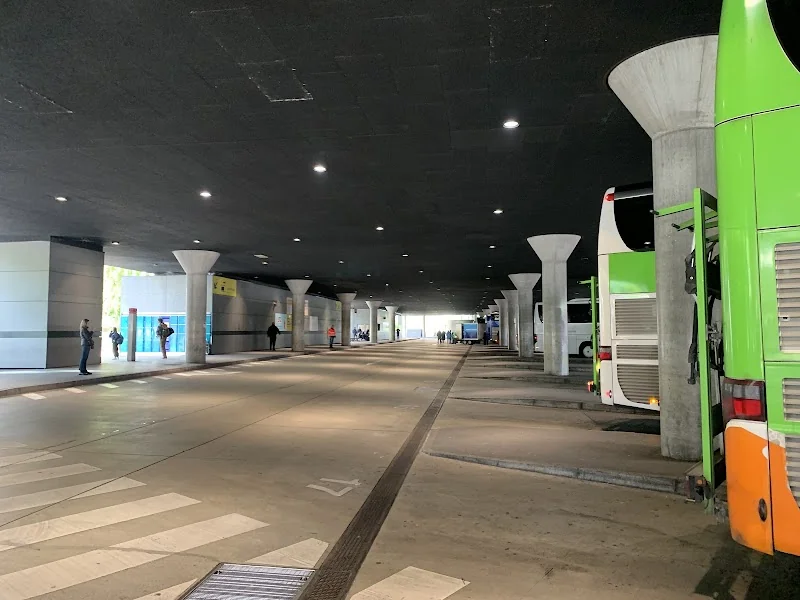
The most important core of ZOB Munich is its 29 bus terminals. The terminals are located directly below the shopping arcade and are thus fully covered, which is a real advantage in rain, cold, or summer heat. In long-distance bus transport, not only the actual departure time counts, but also the quality of transitions between arrival, orientation, and boarding. The ZOB is therefore designed so that travelers can quickly reach the platforms from the central level while also being able to use the shops or travel center above. This clear architectural separation between the transport level and waiting area ensures clarity and short distances. ([muenchen-zob.de](https://www.muenchen-zob.de/de/faq))
The timetable information of the ZOB shows that numerous destinations in Germany and Europe are served daily from Munich. The official page mentions, among others, Berlin, Hamburg, Stuttgart, Düsseldorf, Zurich, Amsterdam, Prague, and Budapest; other connections also lead to Innsbruck or Zagreb. The city of Munich also describes the location as a hub from which around 50,000 long-distance buses travel to destinations in Germany and Europe each year. For travelers, this means a dense network of direct connections and transfers that elevate the ZOB far beyond the role of a local stop. ([muenchen.de](https://www.muenchen.de/en/transportation/zob-central-bus-station?utm_source=openai))
Those using the ZOB for travel planning should check the timetable of the respective bus company in advance. The official page of the bus station emphasizes that the ZOB itself is not a travel agent, but that tickets and connections lie with the respective bus companies. On-site, travelers can purchase tickets directly from some providers such as FlixBus, Eurolines/Deutsche Touring, Sindbad, and Bemex Croatia. This is especially practical when traveling flexibly or looking for a connection at short notice. The ZOB thus remains a central transfer point, while the actual booking usually takes place with the long-distance bus provider. ([muenchen-zob.de](https://www.muenchen-zob.de/de/faq))
Tickets, Waiting Room, and Lockers
When it comes to tickets, a clear principle applies at ZOB Munich: The main booking usually takes place online directly with the bus companies. This makes sense because the ZOB is not a classic travel agency, and the trips are operated by various providers. Nevertheless, there is the possibility to obtain a ticket on-site at the ticket counters of selected companies. For many travelers, this mix of digital booking and stationary service is ideal, as it covers both planned advance reservations and spontaneous decisions. This is especially useful for long-distance bus trips when one wants to remain flexible or make last-minute changes. ([muenchen-zob.de](https://www.muenchen-zob.de/de/faq))
The waiting room at ZOB Munich is an important comfort factor. It is open daily from 6 AM to 10 PM and, according to the official description, is equipped with large window fronts and stylish designer benches by Konstantin Grcic. This not only creates a modern appearance but also a pleasant atmosphere when arriving early or waiting for a delayed bus. Especially in winter or during longer transfer times, this room is a real added value, as travelers do not have to wait outside. The service page also mentions information counters, toilets, an ATM, and a video-monitored environment, which further enhances the quality of the stay. ([muenchen-zob.de](https://www.muenchen-zob.de/de/faq))
For luggage that should not be carried around constantly, ZOB offers modern lockers. According to the official FAQ, these can be used for up to 72 hours and are available in small, medium, and large sizes. The fees are displayed for 12 hours and start at 3.00 euros for the smallest locker. This is particularly helpful if you want to spend some time in Munich before departure or check into the hotel later after arrival. Together with barrier-free toilets, information counters, taxi stands, currency exchange, and secure underground parking, a very functional travel environment is created that responds to different needs. ([muenchen-zob.de](https://www.muenchen-zob.de/de/faq))
Shops, Food, and Drinks in the Shopping Arcade
A special feature of ZOB Munich is the shopping arcade directly above the bus terminals. The official shops page mentions, among others, LIDL, US Nails, an O2 shop, Sparda-Bank as an ATM, and the U-Store. This is helpful for travelers as they can quickly buy groceries, snacks, cash, travel supplies, or small errands before departure. The ZOB is thus not just a transit point but an urban intermediate space where everyday life and travel intertwine. Those arriving with little time benefit from not having to walk long distances to organize the essentials. ([muenchen-zob.de](https://www.muenchen-zob.de/de/places?utm_source=openai))
The selection of food and drinks is also unusually broad for a bus station. The official page mentions Terrazza, Ihle Bakery, McDonald's, Oliva, Pommesfreunde, and KRATAE's Thai Food and Sushi. Additionally, there are different opening hours, so depending on the time of day, breakfast, lunch, snacks, or a quick bite are possible. The café-bar Terrazza focuses more on drinks, coffee, breakfast, and Italian dishes, while Ihle Bakery impresses with fresh baked goods, pretzels, cakes, and coffee. Oliva offers Mediterranean snacks with a focus on Turkish cuisine, and Pommesfreunde covers classic street food. Thus, one can not only start the journey but also enjoy a pleasant break. ([muenchen-zob.de](https://www.muenchen-zob.de/de/places/terrazza?utm_source=openai))
This variety is more than just a nice extra for the location. It supports the character of the ZOB as an urban mobility hub where one can still have breakfast, drink a coffee, grab a sandwich, or simply bridge some time before departure. Especially travelers with longer waiting times benefit from not having to shuttle between the platform, waiting room, and city center. The combination of shops, snacks, restaurants, and travel supplies makes the location attractive even for short stays. Those using ZOB Munich thus experience not just a stop but a compact infrastructure with supplies directly on the way. ([muenchen-zob.de](https://www.muenchen-zob.de/de/service))
History, Architecture, and Features of ZOB Munich
The current ZOB Munich was opened on September 11, 2009, making it a relatively young transport building in the center of Munich. The city of Munich describes it as a hub through which around 50,000 long-distance buses travel annually. At the same time, the city page points out its location at Hackerbrücke and that it is directly linked to urban and regional transport. For Munich, this was an important step because long-distance bus transport was thus brought for the first time into a modern, centrally located, and urbanistically ordered structure. The location is therefore not only functional but also a symbol of the development of long-distance bus transport in Germany. ([muenchen.de](https://www.muenchen.de/en/transportation/zob-central-bus-station?utm_source=openai))
Architecturally, the ZOB is also unusual. The building was realized as a seven-story mixed-use object with transport, service, and commercial use. An independent Munich architecture source describes the building as a transparent volume wrapped in aluminum tubes, stacking various levels and arranging the bus terminals below the arcade. The project was planned by Auer Weber and implemented by HOCHTIEF Project Development; completion took place in 2009. This resulted in not a classic, purely technical bus station, but a multipurpose building with urban presence and a clear functional hierarchy. ([entdecken.muenchen.de](https://entdecken.muenchen.de/en/station/26-9/?utm_source=openai))
Features include completely covered terminals, the shopping arcade on the central level, and the travel and office spaces arranged above. The urban description also points out that the outer façade resembles the front of an ICE train. Additionally, the Neuraum nightclub is located in the basement, which creates a very urban added value with regular parties and events. Together with the bright window fronts, barrier-free areas, and video-monitored infrastructure, a place is created that bundles transport, architecture, and everyday culture in a compact space. ([entdecken.muenchen.de](https://entdecken.muenchen.de/en/station/26-9/?utm_source=openai))
Why ZOB Munich is So Practical for Travelers
ZOB Munich is particularly practical due to its location. Those traveling by train, tram, or on foot can get there quickly, and those arriving by car find a clear solution for different situations with the underground garage and kiss-and-ride zone. Additionally, the immediate proximity to the main train station makes the location particularly efficient for transfers. Especially in long-distance bus transport, where time windows and connections are often tight, such a location is a real advantage. One does not have to drive long through the city but reaches a transport hub designed for short transfers. ([muenchen-zob.de](https://www.muenchen-zob.de/de/directions))
For travelers who still have time on-site, the ZOB is also attractive. The combination of waiting room, lockers, shops, restaurants, toilets, ATM, and information counters makes the stay manageable and comfortable. Those who want to use their city time in Munich sensibly can store luggage, buy a snack, and then continue to the city center or transfer at the station. The official page also emphasizes the good accessibility with all common means of transport and the variety of destinations in Germany and Europe. Thus, the ZOB is not only a departure point but also a convenient link between travel and city life. ([muenchen-zob.de](https://www.muenchen-zob.de/de/service))
Moreover, there is a clear service mindset. Through the combination of barrier-free development, security monitoring, taxi stand, currency exchange, covered terminals, and direct shopping arcade, ZOB Munich is prepared for different travelers. Families with luggage, business travelers with tight schedules, groups on weekend trips, or long-distance passengers each find suitable conditions here. This is exactly what makes the location so interesting from an SEO perspective and from the perspective of real users: The ZOB is not an interchangeable point on the map but a functional long-distance bus hub with urban quality and a surprisingly high level of comfort. ([muenchen-zob.de](https://www.muenchen-zob.de/de/service))
Sources:
Show moreShow less
ZOB Munich | Directions & Parking
The ZOB Munich at Hackerbrücke is much more than just a place to get on and off. It is one of the most important long-distance bus hubs in southern Germany, connecting Munich daily with destinations in Germany and Europe, and is centrally located so that the main train station, S-Bahn, tram, and city center are within a short distance. With 29 fully covered bus terminals, a shopping arcade, service areas, and an underground garage, the site is designed for high travel frequency while also ensuring everyday comfort. For many travelers, this combination of mobility, orientation, and urban environment is the decisive advantage. Those looking for a clearly structured bus station with short distances will find a functional, modern, and urban travel center here. ([muenchen.de](https://www.muenchen.de/en/transportation/zob-central-bus-station?utm_source=openai))
At the same time, the ZOB Munich is a place where travel planning can be conveniently combined with practical errands. The official page describes it as a well-accessible bus station with shops, restaurants, a lounge area, lockers, and other services. This creates a mix of long-distance transport, everyday supplies, and waiting comfort that offers significantly more compared to traditional stops. Especially for people arriving with luggage, waiting for connecting buses, or picking up friends and family, the clear structure is helpful. The ZOB is located directly at Hackerbrücke and just a few minutes' walk from the main train station, making the arrival easy to integrate into the existing public transport system. ([muenchen-zob.de](https://www.muenchen-zob.de/de/service))
Directions and Parking at ZOB Munich
The journey to ZOB Munich is intentionally kept simple. Those traveling by train or public transport can reach the location via the S-Bahn station Hackerbrücke; according to the official directions page, lines S1 to S6 and S8 stop there. Additionally, tram lines 16 and 17 stop at Hackerbrücke. From the main train station, the ZOB is reachable in just a few minutes on foot or quickly connected with just one S-Bahn station. This proximity is one of the greatest practical advantages of the location, as long-distance buses, regional, and city transport come together without long transfers. For this reason, the ZOB is described on the official city page as an optimally connected transport hub. ([muenchen-zob.de](https://www.muenchen-zob.de/de/directions))
It is also easily accessible by car. The official directions mention the Mittleren Ring and Arnulfstraße as direct access routes. From the west, the entrance is via Bernhard-Wicki-Straße under the Hackerbrücke into the underground garage; from the east, one drives out of the city via Arnulfstraße and turns into the underground garage opposite Herbststraße. For short stops, there is a dedicated kiss-and-ride zone specifically designed for dropping off and picking up. This is particularly convenient for families, groups, or travelers with heavy luggage, as they do not have to search long in the vicinity. ([muenchen-zob.de](https://www.muenchen-zob.de/de/directions))
The underground garage of ZOB Munich offers 102 parking spaces and a height limit of 2.00 meters. Payment can be made at the East and South ticket machines with EC, Visa, or Mastercard; alternatively, payment via smartphone using the QR code on the parking ticket is also possible. For bicycles, there are numerous parking spaces around the ZOB, including covered bike racks under the Hackerbrücke. The combination of underground garage, short stop area, and bike parking makes the site flexible for different arrival scenarios. So, whether you are not starting with the bus but bringing someone, picking someone up, or using the ZOB as a transition point, you will find a very practical infrastructure here. ([muenchen-zob.de](https://www.muenchen-zob.de/de/faq))
Bus Terminals, Timetable, and Long-Distance Bus Connections
The most important core of ZOB Munich is its 29 bus terminals. The terminals are located directly below the shopping arcade and are thus fully covered, which is a real advantage in rain, cold, or summer heat. In long-distance bus transport, not only the actual departure time counts, but also the quality of transitions between arrival, orientation, and boarding. The ZOB is therefore designed so that travelers can quickly reach the platforms from the central level while also being able to use the shops or travel center above. This clear architectural separation between the transport level and waiting area ensures clarity and short distances. ([muenchen-zob.de](https://www.muenchen-zob.de/de/faq))
The timetable information of the ZOB shows that numerous destinations in Germany and Europe are served daily from Munich. The official page mentions, among others, Berlin, Hamburg, Stuttgart, Düsseldorf, Zurich, Amsterdam, Prague, and Budapest; other connections also lead to Innsbruck or Zagreb. The city of Munich also describes the location as a hub from which around 50,000 long-distance buses travel to destinations in Germany and Europe each year. For travelers, this means a dense network of direct connections and transfers that elevate the ZOB far beyond the role of a local stop. ([muenchen.de](https://www.muenchen.de/en/transportation/zob-central-bus-station?utm_source=openai))
Those using the ZOB for travel planning should check the timetable of the respective bus company in advance. The official page of the bus station emphasizes that the ZOB itself is not a travel agent, but that tickets and connections lie with the respective bus companies. On-site, travelers can purchase tickets directly from some providers such as FlixBus, Eurolines/Deutsche Touring, Sindbad, and Bemex Croatia. This is especially practical when traveling flexibly or looking for a connection at short notice. The ZOB thus remains a central transfer point, while the actual booking usually takes place with the long-distance bus provider. ([muenchen-zob.de](https://www.muenchen-zob.de/de/faq))
Tickets, Waiting Room, and Lockers
When it comes to tickets, a clear principle applies at ZOB Munich: The main booking usually takes place online directly with the bus companies. This makes sense because the ZOB is not a classic travel agency, and the trips are operated by various providers. Nevertheless, there is the possibility to obtain a ticket on-site at the ticket counters of selected companies. For many travelers, this mix of digital booking and stationary service is ideal, as it covers both planned advance reservations and spontaneous decisions. This is especially useful for long-distance bus trips when one wants to remain flexible or make last-minute changes. ([muenchen-zob.de](https://www.muenchen-zob.de/de/faq))
The waiting room at ZOB Munich is an important comfort factor. It is open daily from 6 AM to 10 PM and, according to the official description, is equipped with large window fronts and stylish designer benches by Konstantin Grcic. This not only creates a modern appearance but also a pleasant atmosphere when arriving early or waiting for a delayed bus. Especially in winter or during longer transfer times, this room is a real added value, as travelers do not have to wait outside. The service page also mentions information counters, toilets, an ATM, and a video-monitored environment, which further enhances the quality of the stay. ([muenchen-zob.de](https://www.muenchen-zob.de/de/faq))
For luggage that should not be carried around constantly, ZOB offers modern lockers. According to the official FAQ, these can be used for up to 72 hours and are available in small, medium, and large sizes. The fees are displayed for 12 hours and start at 3.00 euros for the smallest locker. This is particularly helpful if you want to spend some time in Munich before departure or check into the hotel later after arrival. Together with barrier-free toilets, information counters, taxi stands, currency exchange, and secure underground parking, a very functional travel environment is created that responds to different needs. ([muenchen-zob.de](https://www.muenchen-zob.de/de/faq))
Shops, Food, and Drinks in the Shopping Arcade
A special feature of ZOB Munich is the shopping arcade directly above the bus terminals. The official shops page mentions, among others, LIDL, US Nails, an O2 shop, Sparda-Bank as an ATM, and the U-Store. This is helpful for travelers as they can quickly buy groceries, snacks, cash, travel supplies, or small errands before departure. The ZOB is thus not just a transit point but an urban intermediate space where everyday life and travel intertwine. Those arriving with little time benefit from not having to walk long distances to organize the essentials. ([muenchen-zob.de](https://www.muenchen-zob.de/de/places?utm_source=openai))
The selection of food and drinks is also unusually broad for a bus station. The official page mentions Terrazza, Ihle Bakery, McDonald's, Oliva, Pommesfreunde, and KRATAE's Thai Food and Sushi. Additionally, there are different opening hours, so depending on the time of day, breakfast, lunch, snacks, or a quick bite are possible. The café-bar Terrazza focuses more on drinks, coffee, breakfast, and Italian dishes, while Ihle Bakery impresses with fresh baked goods, pretzels, cakes, and coffee. Oliva offers Mediterranean snacks with a focus on Turkish cuisine, and Pommesfreunde covers classic street food. Thus, one can not only start the journey but also enjoy a pleasant break. ([muenchen-zob.de](https://www.muenchen-zob.de/de/places/terrazza?utm_source=openai))
This variety is more than just a nice extra for the location. It supports the character of the ZOB as an urban mobility hub where one can still have breakfast, drink a coffee, grab a sandwich, or simply bridge some time before departure. Especially travelers with longer waiting times benefit from not having to shuttle between the platform, waiting room, and city center. The combination of shops, snacks, restaurants, and travel supplies makes the location attractive even for short stays. Those using ZOB Munich thus experience not just a stop but a compact infrastructure with supplies directly on the way. ([muenchen-zob.de](https://www.muenchen-zob.de/de/service))
History, Architecture, and Features of ZOB Munich
The current ZOB Munich was opened on September 11, 2009, making it a relatively young transport building in the center of Munich. The city of Munich describes it as a hub through which around 50,000 long-distance buses travel annually. At the same time, the city page points out its location at Hackerbrücke and that it is directly linked to urban and regional transport. For Munich, this was an important step because long-distance bus transport was thus brought for the first time into a modern, centrally located, and urbanistically ordered structure. The location is therefore not only functional but also a symbol of the development of long-distance bus transport in Germany. ([muenchen.de](https://www.muenchen.de/en/transportation/zob-central-bus-station?utm_source=openai))
Architecturally, the ZOB is also unusual. The building was realized as a seven-story mixed-use object with transport, service, and commercial use. An independent Munich architecture source describes the building as a transparent volume wrapped in aluminum tubes, stacking various levels and arranging the bus terminals below the arcade. The project was planned by Auer Weber and implemented by HOCHTIEF Project Development; completion took place in 2009. This resulted in not a classic, purely technical bus station, but a multipurpose building with urban presence and a clear functional hierarchy. ([entdecken.muenchen.de](https://entdecken.muenchen.de/en/station/26-9/?utm_source=openai))
Features include completely covered terminals, the shopping arcade on the central level, and the travel and office spaces arranged above. The urban description also points out that the outer façade resembles the front of an ICE train. Additionally, the Neuraum nightclub is located in the basement, which creates a very urban added value with regular parties and events. Together with the bright window fronts, barrier-free areas, and video-monitored infrastructure, a place is created that bundles transport, architecture, and everyday culture in a compact space. ([entdecken.muenchen.de](https://entdecken.muenchen.de/en/station/26-9/?utm_source=openai))
Why ZOB Munich is So Practical for Travelers
ZOB Munich is particularly practical due to its location. Those traveling by train, tram, or on foot can get there quickly, and those arriving by car find a clear solution for different situations with the underground garage and kiss-and-ride zone. Additionally, the immediate proximity to the main train station makes the location particularly efficient for transfers. Especially in long-distance bus transport, where time windows and connections are often tight, such a location is a real advantage. One does not have to drive long through the city but reaches a transport hub designed for short transfers. ([muenchen-zob.de](https://www.muenchen-zob.de/de/directions))
For travelers who still have time on-site, the ZOB is also attractive. The combination of waiting room, lockers, shops, restaurants, toilets, ATM, and information counters makes the stay manageable and comfortable. Those who want to use their city time in Munich sensibly can store luggage, buy a snack, and then continue to the city center or transfer at the station. The official page also emphasizes the good accessibility with all common means of transport and the variety of destinations in Germany and Europe. Thus, the ZOB is not only a departure point but also a convenient link between travel and city life. ([muenchen-zob.de](https://www.muenchen-zob.de/de/service))
Moreover, there is a clear service mindset. Through the combination of barrier-free development, security monitoring, taxi stand, currency exchange, covered terminals, and direct shopping arcade, ZOB Munich is prepared for different travelers. Families with luggage, business travelers with tight schedules, groups on weekend trips, or long-distance passengers each find suitable conditions here. This is exactly what makes the location so interesting from an SEO perspective and from the perspective of real users: The ZOB is not an interchangeable point on the map but a functional long-distance bus hub with urban quality and a surprisingly high level of comfort. ([muenchen-zob.de](https://www.muenchen-zob.de/de/service))
Sources:
ZOB Munich | Directions & Parking
The ZOB Munich at Hackerbrücke is much more than just a place to get on and off. It is one of the most important long-distance bus hubs in southern Germany, connecting Munich daily with destinations in Germany and Europe, and is centrally located so that the main train station, S-Bahn, tram, and city center are within a short distance. With 29 fully covered bus terminals, a shopping arcade, service areas, and an underground garage, the site is designed for high travel frequency while also ensuring everyday comfort. For many travelers, this combination of mobility, orientation, and urban environment is the decisive advantage. Those looking for a clearly structured bus station with short distances will find a functional, modern, and urban travel center here. ([muenchen.de](https://www.muenchen.de/en/transportation/zob-central-bus-station?utm_source=openai))
At the same time, the ZOB Munich is a place where travel planning can be conveniently combined with practical errands. The official page describes it as a well-accessible bus station with shops, restaurants, a lounge area, lockers, and other services. This creates a mix of long-distance transport, everyday supplies, and waiting comfort that offers significantly more compared to traditional stops. Especially for people arriving with luggage, waiting for connecting buses, or picking up friends and family, the clear structure is helpful. The ZOB is located directly at Hackerbrücke and just a few minutes' walk from the main train station, making the arrival easy to integrate into the existing public transport system. ([muenchen-zob.de](https://www.muenchen-zob.de/de/service))
Directions and Parking at ZOB Munich
The journey to ZOB Munich is intentionally kept simple. Those traveling by train or public transport can reach the location via the S-Bahn station Hackerbrücke; according to the official directions page, lines S1 to S6 and S8 stop there. Additionally, tram lines 16 and 17 stop at Hackerbrücke. From the main train station, the ZOB is reachable in just a few minutes on foot or quickly connected with just one S-Bahn station. This proximity is one of the greatest practical advantages of the location, as long-distance buses, regional, and city transport come together without long transfers. For this reason, the ZOB is described on the official city page as an optimally connected transport hub. ([muenchen-zob.de](https://www.muenchen-zob.de/de/directions))
It is also easily accessible by car. The official directions mention the Mittleren Ring and Arnulfstraße as direct access routes. From the west, the entrance is via Bernhard-Wicki-Straße under the Hackerbrücke into the underground garage; from the east, one drives out of the city via Arnulfstraße and turns into the underground garage opposite Herbststraße. For short stops, there is a dedicated kiss-and-ride zone specifically designed for dropping off and picking up. This is particularly convenient for families, groups, or travelers with heavy luggage, as they do not have to search long in the vicinity. ([muenchen-zob.de](https://www.muenchen-zob.de/de/directions))
The underground garage of ZOB Munich offers 102 parking spaces and a height limit of 2.00 meters. Payment can be made at the East and South ticket machines with EC, Visa, or Mastercard; alternatively, payment via smartphone using the QR code on the parking ticket is also possible. For bicycles, there are numerous parking spaces around the ZOB, including covered bike racks under the Hackerbrücke. The combination of underground garage, short stop area, and bike parking makes the site flexible for different arrival scenarios. So, whether you are not starting with the bus but bringing someone, picking someone up, or using the ZOB as a transition point, you will find a very practical infrastructure here. ([muenchen-zob.de](https://www.muenchen-zob.de/de/faq))
Bus Terminals, Timetable, and Long-Distance Bus Connections
The most important core of ZOB Munich is its 29 bus terminals. The terminals are located directly below the shopping arcade and are thus fully covered, which is a real advantage in rain, cold, or summer heat. In long-distance bus transport, not only the actual departure time counts, but also the quality of transitions between arrival, orientation, and boarding. The ZOB is therefore designed so that travelers can quickly reach the platforms from the central level while also being able to use the shops or travel center above. This clear architectural separation between the transport level and waiting area ensures clarity and short distances. ([muenchen-zob.de](https://www.muenchen-zob.de/de/faq))
The timetable information of the ZOB shows that numerous destinations in Germany and Europe are served daily from Munich. The official page mentions, among others, Berlin, Hamburg, Stuttgart, Düsseldorf, Zurich, Amsterdam, Prague, and Budapest; other connections also lead to Innsbruck or Zagreb. The city of Munich also describes the location as a hub from which around 50,000 long-distance buses travel to destinations in Germany and Europe each year. For travelers, this means a dense network of direct connections and transfers that elevate the ZOB far beyond the role of a local stop. ([muenchen.de](https://www.muenchen.de/en/transportation/zob-central-bus-station?utm_source=openai))
Those using the ZOB for travel planning should check the timetable of the respective bus company in advance. The official page of the bus station emphasizes that the ZOB itself is not a travel agent, but that tickets and connections lie with the respective bus companies. On-site, travelers can purchase tickets directly from some providers such as FlixBus, Eurolines/Deutsche Touring, Sindbad, and Bemex Croatia. This is especially practical when traveling flexibly or looking for a connection at short notice. The ZOB thus remains a central transfer point, while the actual booking usually takes place with the long-distance bus provider. ([muenchen-zob.de](https://www.muenchen-zob.de/de/faq))
Tickets, Waiting Room, and Lockers
When it comes to tickets, a clear principle applies at ZOB Munich: The main booking usually takes place online directly with the bus companies. This makes sense because the ZOB is not a classic travel agency, and the trips are operated by various providers. Nevertheless, there is the possibility to obtain a ticket on-site at the ticket counters of selected companies. For many travelers, this mix of digital booking and stationary service is ideal, as it covers both planned advance reservations and spontaneous decisions. This is especially useful for long-distance bus trips when one wants to remain flexible or make last-minute changes. ([muenchen-zob.de](https://www.muenchen-zob.de/de/faq))
The waiting room at ZOB Munich is an important comfort factor. It is open daily from 6 AM to 10 PM and, according to the official description, is equipped with large window fronts and stylish designer benches by Konstantin Grcic. This not only creates a modern appearance but also a pleasant atmosphere when arriving early or waiting for a delayed bus. Especially in winter or during longer transfer times, this room is a real added value, as travelers do not have to wait outside. The service page also mentions information counters, toilets, an ATM, and a video-monitored environment, which further enhances the quality of the stay. ([muenchen-zob.de](https://www.muenchen-zob.de/de/faq))
For luggage that should not be carried around constantly, ZOB offers modern lockers. According to the official FAQ, these can be used for up to 72 hours and are available in small, medium, and large sizes. The fees are displayed for 12 hours and start at 3.00 euros for the smallest locker. This is particularly helpful if you want to spend some time in Munich before departure or check into the hotel later after arrival. Together with barrier-free toilets, information counters, taxi stands, currency exchange, and secure underground parking, a very functional travel environment is created that responds to different needs. ([muenchen-zob.de](https://www.muenchen-zob.de/de/faq))
Shops, Food, and Drinks in the Shopping Arcade
A special feature of ZOB Munich is the shopping arcade directly above the bus terminals. The official shops page mentions, among others, LIDL, US Nails, an O2 shop, Sparda-Bank as an ATM, and the U-Store. This is helpful for travelers as they can quickly buy groceries, snacks, cash, travel supplies, or small errands before departure. The ZOB is thus not just a transit point but an urban intermediate space where everyday life and travel intertwine. Those arriving with little time benefit from not having to walk long distances to organize the essentials. ([muenchen-zob.de](https://www.muenchen-zob.de/de/places?utm_source=openai))
The selection of food and drinks is also unusually broad for a bus station. The official page mentions Terrazza, Ihle Bakery, McDonald's, Oliva, Pommesfreunde, and KRATAE's Thai Food and Sushi. Additionally, there are different opening hours, so depending on the time of day, breakfast, lunch, snacks, or a quick bite are possible. The café-bar Terrazza focuses more on drinks, coffee, breakfast, and Italian dishes, while Ihle Bakery impresses with fresh baked goods, pretzels, cakes, and coffee. Oliva offers Mediterranean snacks with a focus on Turkish cuisine, and Pommesfreunde covers classic street food. Thus, one can not only start the journey but also enjoy a pleasant break. ([muenchen-zob.de](https://www.muenchen-zob.de/de/places/terrazza?utm_source=openai))
This variety is more than just a nice extra for the location. It supports the character of the ZOB as an urban mobility hub where one can still have breakfast, drink a coffee, grab a sandwich, or simply bridge some time before departure. Especially travelers with longer waiting times benefit from not having to shuttle between the platform, waiting room, and city center. The combination of shops, snacks, restaurants, and travel supplies makes the location attractive even for short stays. Those using ZOB Munich thus experience not just a stop but a compact infrastructure with supplies directly on the way. ([muenchen-zob.de](https://www.muenchen-zob.de/de/service))
History, Architecture, and Features of ZOB Munich
The current ZOB Munich was opened on September 11, 2009, making it a relatively young transport building in the center of Munich. The city of Munich describes it as a hub through which around 50,000 long-distance buses travel annually. At the same time, the city page points out its location at Hackerbrücke and that it is directly linked to urban and regional transport. For Munich, this was an important step because long-distance bus transport was thus brought for the first time into a modern, centrally located, and urbanistically ordered structure. The location is therefore not only functional but also a symbol of the development of long-distance bus transport in Germany. ([muenchen.de](https://www.muenchen.de/en/transportation/zob-central-bus-station?utm_source=openai))
Architecturally, the ZOB is also unusual. The building was realized as a seven-story mixed-use object with transport, service, and commercial use. An independent Munich architecture source describes the building as a transparent volume wrapped in aluminum tubes, stacking various levels and arranging the bus terminals below the arcade. The project was planned by Auer Weber and implemented by HOCHTIEF Project Development; completion took place in 2009. This resulted in not a classic, purely technical bus station, but a multipurpose building with urban presence and a clear functional hierarchy. ([entdecken.muenchen.de](https://entdecken.muenchen.de/en/station/26-9/?utm_source=openai))
Features include completely covered terminals, the shopping arcade on the central level, and the travel and office spaces arranged above. The urban description also points out that the outer façade resembles the front of an ICE train. Additionally, the Neuraum nightclub is located in the basement, which creates a very urban added value with regular parties and events. Together with the bright window fronts, barrier-free areas, and video-monitored infrastructure, a place is created that bundles transport, architecture, and everyday culture in a compact space. ([entdecken.muenchen.de](https://entdecken.muenchen.de/en/station/26-9/?utm_source=openai))
Why ZOB Munich is So Practical for Travelers
ZOB Munich is particularly practical due to its location. Those traveling by train, tram, or on foot can get there quickly, and those arriving by car find a clear solution for different situations with the underground garage and kiss-and-ride zone. Additionally, the immediate proximity to the main train station makes the location particularly efficient for transfers. Especially in long-distance bus transport, where time windows and connections are often tight, such a location is a real advantage. One does not have to drive long through the city but reaches a transport hub designed for short transfers. ([muenchen-zob.de](https://www.muenchen-zob.de/de/directions))
For travelers who still have time on-site, the ZOB is also attractive. The combination of waiting room, lockers, shops, restaurants, toilets, ATM, and information counters makes the stay manageable and comfortable. Those who want to use their city time in Munich sensibly can store luggage, buy a snack, and then continue to the city center or transfer at the station. The official page also emphasizes the good accessibility with all common means of transport and the variety of destinations in Germany and Europe. Thus, the ZOB is not only a departure point but also a convenient link between travel and city life. ([muenchen-zob.de](https://www.muenchen-zob.de/de/service))
Moreover, there is a clear service mindset. Through the combination of barrier-free development, security monitoring, taxi stand, currency exchange, covered terminals, and direct shopping arcade, ZOB Munich is prepared for different travelers. Families with luggage, business travelers with tight schedules, groups on weekend trips, or long-distance passengers each find suitable conditions here. This is exactly what makes the location so interesting from an SEO perspective and from the perspective of real users: The ZOB is not an interchangeable point on the map but a functional long-distance bus hub with urban quality and a surprisingly high level of comfort. ([muenchen-zob.de](https://www.muenchen-zob.de/de/service))
Sources:
Upcoming Events
No events found
Frequently Asked Questions
Reviews
niba karan
19. November 2025
I have been traveling a lot via ZOB München. They just closed the waiting area after 10pm. Please think about the passengers’ convenience, especially during winter season.
L Rox
27. September 2025
I tried to use the toilet at the bus station, but the man working there was extremely rude. He was smoking inside the stall, which is unacceptable, especially since I’m pregnant. Very unprofessional and unsafe.
Prakash Singh
24. June 2018
I have travelled from Munich to Prague and return... For Prague from Munich - It's better to use the bus than trains. As buses are cheaper in cost and take less time. So it's saving your time and money as well. Flixbus provides great service and English-speaking staff as well... ticket booking counter staff are very helpful and gentle in nature... the bus pilot was also very very helpful. The best part is it's a safe and secure service, they never speed, you feel very comfortable and relaxed during the whole trip. Only one issue you will face is that free Wi-Fi is very limited... it will give you access to the net up to 150MB only and Wi-Fi is not working in some of the buses. One more good thing is that they keep playing English songs at low volume, it makes your trip more pleasant. The best place to sit is on the top roof to get a beautiful view, and it's better if you get the front one at the top driver seat. The roads between Munich and Prague are very good and the natural views are amazing... that gives you a great experience of European farming fields on both sides of the roads. So in the end, I can say that Flixbus service is very good at a convenient price. In the future, it's going to play a very big role in Euro trips..! As trains are getting costly day by day.
Jane Scherer
17. December 2021
Flixbus experience Munich-Florence. The 13-hour bus ride was smooth and safe. The bus arrived on time at the Munich terminal and reached Florence in an acceptable time even though there was quite a bit of traffic in some tunnels in Italy. I can repeat this kind of journey again.
Niesjen Ipema
8. August 2023
Very nice bus operating system, I always use the app. Prices differ a lot between seasons but when your bus isn't completely full it's quite comfortable. Toilets are usually a mess so try to do your things before your trip or while on a break at a gas station, but this doesn't happen every time. Sleeping in the chairs is 9/10 times uncomfortable and usually people are very noisy at night. But for me, it's still worth the money as it's mostly cheaper than any other transport. I've used Flixbus over 50 times now.